
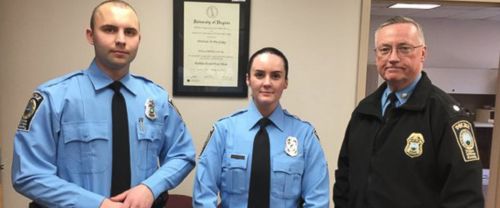
Officer Guindon (center), Prince William County Police, died on her first shift during a domestic disturbance. She was shot and killed on February 27, 2016. Two other officer were injured.
Ten years ago on the early morning of Sunday, February 28, 2016, I learned about the shooting of three Prince William County Police Officers as I prepared to head to my church (at the time in Mechanicsville, Virginia). One of the officers, Officer Guindon, had died from her wounds – just a day after becoming an officer.
Now, I had friends who worked with that department, and at times when an officer in Alexandria, I had served alongside Prince William police in training or some other task. Yet, I did not know her or those wounded. Still, the shootings angered me, and her death impacted me with surprising emotion and connection; bringing a sense of loss and memories of past, similar trauma.
There are reasons thousands of officers travel far, sometimes at their own expense, to honor fallen officers. Certainly, it displays solidarity and respect for the fallen. It’s meant to be a concrete sign of support to the family and department members in deep grief. A large crowd can help proclaim the message that the deceased’s life mattered and continues to matter. Much as the National Police Memorial indicates through its inscriptions, they will be honored, not for the way they died, but for how they lived.
As one police ministry in Texas notes on its webpage, “The job is referred to as having ‘a mystique veiled by a sacred canopy.’ The symbolism, pageantry and tradition make our calling noble.” And certainly, the “final radio call” and the playing of bagpipes serve to honor the officer’s dedication to service, but they also serve as a profound expression of grief fostering an emotional connection between those presents and speaking memories of other people and places gone but still carried in one’s heart. Vincent E. Henry correctly notes in his book, Death Work: Police, Trauma, and the Psychology of Survival (2004), that these events force officers to confront their own mortality. Funerals act as a necessary, though painful, part of the process for the survivors. There always exists the psychological reality that it could have been you or someone you know and love.
At the time of Officer Guindon’s death, I suspect that many people sensed the added “wrong” of her just starting her job with hope and celebration only to die the next day. As with infant or child deaths, such unexpected, sudden officer deaths can become personalized. Thus, they can become more intense if not traumatic. As suggested in literature about grief such as The Burden of Loss: Unexpected loss of a loved one and psychiatric disorder across the life course in a national study (2015), unexpected losses can make processing grief more difficult. The proximity of death emotionally or identity can cause very real complications for some. At the same time, I would remind the reader that we never fully “deal” with the grief of those we feel connected too. Anniversaries or other reminders can make us grieve anew. Indeed, it’s important to say that no one person grieves the same way.
So, I suppose that’s the fuller context of Prince William County’s Facebook post this morning. Departments promise to “never forget.” There are certainly members of the department still working who knew her personally and remember the trauma and loss of that day as if yesterday. Based on comments, you can see how people in and outside the department are touched by personal grief. Such deaths tend to stick with you.
The below essay was written in haste before heading out my door that morning. It wasn’t masterful. It won’t win a prize for literature. Yet it was my real time response echoing what I wrote about above. I’m reposting it in her honor but also for other colleagues of mine who have been murdered or died by suicide. May they all rest in peace, and may our love for one another, sacred memories shared, and God’s grace bring ongoing healing and hope until Jesus returns to wipe away all tears (Rev. 21:4).
God bless Officer Guindon’s mother, and all those who continue to grieve. Please join me in praying for our officers, deputies and their families each day.
My original post follows:
I’m thinking a lot this morning about my first shift, my first arrest, and the many men and women who helped me have a great (if relatively short) law enforcement career. They actually helped me become who I am today, and so I always give God thanks for them and my experiences. It is why I volunteer as a police chaplain today – to try to give back.
And yet, I’m also recalling the joy my family felt having just seen me graduate from the police academy, and then on that same weekend, seeing their fear as I headed out to my first midnight shift. I also remember with love coworkers injured and killed as a result of their desire to serve others. Thus, Officer Guindon’s death is somehow personal to me, as with every law enforcement death. I can’t help it. I feel like a piece of me has died, although I know it doesn’t make much sense to many.
How many Officer Guindon’s are out there? How many such families sacrifice, live in fear, or are now grieving across our country? How must her Field Training Officer and fellow officers feel as this recruit died and as they try to make sense of it? They all need our active support and prayer.
And yet, I don’t know how to pray for this. She was on her first shift, and the hope of last Friday has turned into community shock and grief spreading across the Thin Blue Line. I remain at a loss for words, especially as law enforcement officers in our country continue to be so quickly and openly hated, condemned and needlessly die. And so, I find comfort in these words. “But if we hope for what we do not see, we wait for it with patience. Likewise the Spirit helps us in our weakness; for we do not know how to pray as we ought, but that very Spirit intercedes with sighs too deep for words.” (Romans 8:25-26).
To my brothers and sisters still fighting the fight, you are not alone. God has not forgotten you. God will make good come from this evil, although we do not yet know how. No life dedicated to the service and love of neighbor is a wasted one, no matter how short. I remain in communion with you, and you will all be with me at worship this morning in my heavy but hopeful heart.
The Rev. Louis Florio is a former member of the City of Alexandria Police Department and current volunteer law enforcement chaplain with Hanover County Sheriff’s Office and the City of Fredericksburg’s Police Department. This post may be shared freely with proper attribution.
(C) 2026 The Rev. Louis Florio. All content not held under another’s copyright may not be used without permission of the author. Scripture passages when used are from the NRSVue translation unless otherwise indicated.


 2pennyblog
Pingback: Early mourning thoughts and prayers…revisited. – Midnights LEO