Category Archives: Pastoral Letter

The Way of Wisdom

Image: “Divine Wisdom,” (2010), by Shiloh Sophia McCloud, acrylic on canvas, available for purchase at https://fineartamerica.com/featured/divine-wisdom-shiloh-sophia-mccloud.html. The artist retains all rights.

What our Jewish siblings call the Writings (or Ketuvim) are examples of “wisdom literature.” They are the third and final section of the Tanakh (the Jewish scriptures, or what many Christians call the Old Testament). These selections are found after the Torah (“instruction”; the five Books of Moses, also called the Pentateuch) and Nevi’im (the “prophets”). How does this journey to wisdom start? Proverbs tells us, “The fear of the Lord is the beginning of knowledge.”

No, we aren’t supposed to run away from God like Adam and Eve after sinning in the Garden of Eden. We are supposed to seek after God. We experience a holy fear as we encounter the one true God, and we come to understand our vulnerability and reliance in something greater than ourselves. We tremble before God’s greatness, because we discover we are not God, nor even masters of our destiny. In fact, on our own, we are worthy of condemnation. To think otherwise is vanity. Yet, we turn to God humbly, because we discover that God is only love, and we know we need God’s grace and salvation. We also know through Jesus and the tug of the Holy Spirit, God desires to save us, not destroy.

A favorite Christian musician and Bible scholar of mine back in the 1990s was a man named Michael Card. He used his love of scripture to ponder God’s greatness through music. He created a three CD work contemplating the Torah, The Prophets, and the Writings. In his reflection song on Proverbs, he reframes this fear with these words, “The Way of Wisdom beckons us; To find the end of fear that perfect love pursues; Wisdom did not come to simply speak the words of truth; He’s the Word that makes us true.” In other words, our holy fear leads us eventually to our grace-filled salvation found only in Jesus. Jesus’ love has the power to transform us.

The path of wisdom leads us from fear toward a perfect love, one that wishes to help and embrace us. Indeed, Wisdom in the Writings is often personified as a welcoming woman. It is much as the Jewish faith has often contemplated and represented God’s Spirit in female imagery in art and other poetry. As Jesus describes God’s love as a Mother Hen, Proverbs tells us that Wisdom beckons us home in our weakness and need. It invites us to knock at the door and seek as Jesus did saying, “I love those who love me, and those who seek me diligently find me.”

So how do we seek? The way of Wisdom calls us to live a life in community where forgiveness is offered, where support is shared, where we meet Christ in one another as well as the Word and Sacraments. The original wisdom works were based on observations and experiences rather than visons and dreams – people found God at work in real life and reflected upon it.

Through their lives, poetry, and sayings preserved in scripture, we learn that our seeking is not just a Sunday adventure or a diversion to our week. It cannot be fully explored alone. We seek to listen for Wisdom daily as we interact with the world. For, God is there. We uncover our true place is among God’s chosen people, and we see that God is at work around us. Even in small acts of love or kindness to our neighbor, we might spot Wisdom.

It is only through such Wisdom that we find our true significance. As we are promised, whoever finds Lady Wisdom, finds true life. I think it comforting that the source of such Wisdom, the Holy Spirit (by the way, spirit is a feminine word in ancient Hebrew), is already seeking and reaching out to us. Perhaps, we should stop, look, and listen for her during our busy days or on days when we feel overwhelmed or afraid. She’ll be there waiting to not just teach us, but embrace us, as our Triune God’s children.

Unless otherwise indicated, all scripture quotations for this post are from the New Revised Standard Version (NRSV) translation.

Originally published in the July 18, 2023 weekly newsletter, the Hub, of Christ Lutheran Church, Fredericksburg, VA, this post was edited and expanded upon for my blog.

© 2025 The Rev. Louis Florio. All content not held under another’s copyright may not be used without permission of the author.

Leave a comment

Filed under Pastoral Letter, Uncategorized

Deliver us from evil…including our own

“You, my brothers and sisters, were called to be free. But do not use your freedom to indulge the flesh; rather, serve one another humbly in love.” Galatians 5:13

Left or right or in between in the US, we all are a sinful, stiff necked people in need of grace; called to become more through Christ. As a culture and fallen people, we historically swing dysfunctionally between political poles of excess and denouncing the “other,” hurting ourselves and those entrusted to our care all the while. Platforms tend to become more important than people, for we rest in the assurance that we are “right,” and we want to defeat the “other.” We self righteously think, “They are the evil ones after all.” In doing so, we often forget that true justice requires mercy and the least of these are indeed our responsibility. At the same time, or perhaps because of this plank in our eye, we tend not to like to reflect deeply on our own sins – what we have done and failed to do – with the gift of holy wisdom at our disposal. We prefer passion and group-think over the Holy Spirit’s guidance and light.

It ultimately doesn’t matter what wrong was done in the past. We must let it go instead of letting anger metastasize. We are called to love one another in the present, not ignoring or enabling wrongs, but striving with God’s help to see the Christ in others and treating them with gentleness, patience, and the love we ourselves have received first. As I’ve said before, it is a habit of life which takes practice. We are to forgive and forgive again when wronged. “Seventy times seven” times according to Jesus, we should forgive. This means we should forgive others without limit even when they don’t deserve it. For Jesus died for our sin – that which we have been born into or done, those we struggle with today, and the sins we’ve yet to do – when we still don’t and never will deserve it.

And what about us? Our recalcitrance in regard to all the teachings of Jesus including doing good to those whom hate us? What evil is at work in and through us and our choices as we face the fears and pressures of our day? How might we be making a bad situation worse? Who are we to condemn people to hell in our hearts or cause others to suffer through our actions? Each day in a similar way to our siblings in Twelve Step programs, we who are addicted to sin and selfishness can take a searching and fearless moral inventory of ourselves. Then, we ask for God’s forgiveness, seek to repent of our wrongs (turning back to God), make amends as we can (as we are empowered by God). We do so because Jesus said he wants us to have his abundant life and peace, and this is the Way.

We might feel caught in an impossible situation, but all things remain possible with God. We can make choices to help change our behaviors and attitudes for the better today; repenting of our wrongs and positively influencing others. God’s Spirit has already been sent to help us, residing in our hearts through the gifts of our faith and baptism. Most importantly, Jesus promises that we are never alone. He will carry our cross when we cannot. He already has!

Jesus once said, “People do not light a lamp and put it under the bushel basket; rather, they put it on the lampstand, and it gives light to all in the house. In the same way, let your light shine before others, so that they may see your good works and give glory to your Father in heaven.” In times of trouble and discord, this is even more true. We need our yes to mean yes and to seek to love God and others as ourselves no matter the cost. It is Jesus who has called us to this time and place to be his body. Don’t be afraid.

Whatever happens around us or to us, our first allegiance as a Christian is always to Jesus. As we American Christians look upon fireworks tonight celebrating Independence Day, never forget that Jesus always wants us to reflect his light…always. Sinning in our anger is never his way. Political waffling is not his style. We can be better as a person and a nation. We can be healed. We live in hope thanks be to God.

I wish you a happy and safe Independence Day, while remembering and seeking to serve the only One who truly makes us free.

Peace+, Pastor Lou

Leave a comment

Filed under Pastoral Letter

Lies don’t lead to justice

Image from “Social Media: The biggest lie.”

The post began simply, “Meet Jennifer Thurston – the latest activist on the bench.” Those responsible went on from there saying this judge was stopping Border Patrol from arresting “illegal aliens without a warrant.” They continue with self righteous indignation, “You read that right: The people tasked with protecting our borders are now being told to stand down unless they have paperwork—while illegal entry is happening in real time. This isn’t about justice. It’s about tying the hands of law enforcement and opening the gates even wider. Border security should be law. Not optional.”

The post was unsolicited; promoted on Facebook and likely coming to me through my feed thanks to AI and my interest in law enforcement. It spoke of a desire for justice. Yet, I think it reflects the deep darkness impacting our public discourse; infecting us through social media’s memes and posts as well as uninformed podcasts and sites pretending to be news. Fake news and incendiary commentary is sadly a problem among all political persuasions. It just happened to be leaning conservative this time.

I’m not naming the page because I don’t want them to be promoted. I also don’t need anyone hunting me down on line or in real life. Yet as a pastor, former law enforcement officer, and current chaplain, I want to warn anyone who will listen to be careful trusting nondescript Facebook groups, other social media posts, and podcasts claiming a law enforcement connection. Just because someone claims to love and support law enforcement, it doesn’t mean the poster knows what they are talking about. Indeed, watch out for the veracity of posts from such sources and in general. Verify claims. This one just popped up in my Facebook feed, and I immediately found it distressing. I saw major red flags in its tone but also broad brush of accusations.

In this case, they insinuated Judge Jennifer Thurston was an activist judge, thus an enemy to justice. I don’t claim to know all her cases, yet with a quick Google search, one finds her statement at the ruling was actually, “You just can’t walk up to people with brown skin and say, ‘Give me your papers.” Is that so evil? Do we really want our Native, Hispanic and other neighbors to have papers checked because they look foreign in some official’s eyes or because they have an accent? We aren’t supposed to be judged by the color of our skin, accent, etc.

In the 1990s when the Clinton administration floated national identification cards, I clearly remember conservatives were concerned about illegal stops and tracking of citizens especially (the Cato Institute, for one, argued) during times of emergency. They feared abuse of our civil liberties. What’s changed? At some level, law enforcement agents always needed to have a warrant or reasonable suspicion for a stop – much like police are expected to do. If we have an immigration emergency as is claimed, this doesn’t mean all judicial precaution is to be thrown in the trash.

Yes, border security should be and is the law. Laws should be enforced, including immigration enforcement, but we also have laws on the books about when a legal stop can be made to help prevent abuse of our civil liberties. Case law has also historically shaped law enforcement policy. This is all for our protection. Imagine repeatedly being stopped because of your appearance or accent. How might you feel? It would likely anger or annoy most people. Imagine being falsely detained for days (as has happened) because you look Hispanic and was found to be walking without identification. Then, your rights have been abridged. You don’t need a law degree to understand that.

During this time of discord, journalists, judges, and others are having threats made against them and their families. The post invites condemnation which can indirectly call people, especially unhealthy people, to action. They claim the judge is not doing her job, abusing our rights. They point an accusatory finger with words; words not supported by fact.

It was wrong when extremists threatened police families during the last decade’s protests over alleged law enforcement wrongs, and this kind of propaganda which can incite violence is wrong too. Unhealthy people could follow through on the misrepresentations and seriously injure or kill somebody. The page in question, at least through this post, appears to be about inciting people to anger rather than making legal claims. Yet, it ultimately doesn’t rely on “just the facts” as Detective Friday might want on Dragnet. It omits them. In the end, lies of omission can be as harmful as lies of commission, and this kind of post is ultimately sinful.

Martin Luther writes in detail about the Eighth Commandment (as Lutheran’s count them), “Thou shalt not bear false witness against thy neighbor.” He addresses the social and spiritual and practical values of this commandment in courts, in the family, and amidst the greater community. “In the third place, what concerns us all, this commandment forbids all sins of the tongue whereby we may injure or approach too closely to our neighbor. For to bear false witness is nothing else than a work of the tongue.” He suggests this sin includes speaking behind a person’s back and slandering. We often love to hear people speak of us like we are gold, “yet we cannot bear that the best is spoken about others.”

Indeed, he goes on, we too often behave like base beasts when we “know a slight offense of another, carry it into every corner, and are delighted and tickled that they can stir up another’s displeasure [baseness], as swine roll themselves in the dirt and root in it with the snout.” We pass sentence, taking God’s place as judge. In doing so, we might not wield a sword like worldly powers, but we use or “poisonous tongue to the shame and hurt of your neighbor.” In a sense, we murder them – killing their honor and the respect due to another.

Martin Luther makes many other great points about how our lies and assumptions hurt others and our unity. It can tear communities apart and lead to injustice rather than justice. This easily applies to our social media posts in a way that would horrify Luther. (I suspect it certainly saddens Christ.) Luther argues we should assume the best of people rather than the worst. Although he doesn’t use this specific word, he suggests that we be empathetic. How would we like to be treated?

Luther concludes, “Thus we have now the sum and general understanding of this commandment, to wit, that no one do any injury with the tongue to his neighbor, whether friend or foe, nor speak evil of him, no matter whether it be true or false, unless it be done by commandment or for his reformation, but that every one employ his tongue and make it serve for the best of every one else, to cover up his neighbor’s sins and infirmities, excuse them, palliate and garnish them with his own reputation. The chief reason for this should be the one which Christ alleges in the Gospel, in which He comprehends all commandments respecting our neighbor, Matt. 7, 12: Whatsoever ye would that men should do to you, do ye even so to them.”

Today, we have arguments over many laws and court cases. These spill from the courtroom into online discussions. Yet to irresponsibly mischaracterize a legal argument may not just end a person’s career. It could conceivably end a life. The post in question makes no threat, but it doesn’t need to. Someone reading it could act on the anger stirred by its inferences.

Yet, this just isn’t just a problem for others. James writes, “If any think they are religious and do not bridle their tongues but deceive their hearts, their religion is worthless” (James 1:26). Along with our mouths, we need to bridle our fingers today. If we share such posts, take them at face value, or act on them, we are likely guilty of sin too.

© 2025 The Rev. Louis Florio. All content not held under another’s copyright may not be used without permission of the author. Scripture passages are from the NRSVue translation.

Leave a comment

Filed under Pastoral Letter

Do you not perceive it? God’s in the small stuff.

Photo by the author (May 20, 2025)

There were abundant signs of hope and new life this morning as Boomer and I took our walk – a beautiful sunrise, the repetitive knock of a woodpecker feeding in the nearby woods, blue birds galore swirling all around us, a mockingbird performing its twirling mating dance and song from a roof top, and cherry tree blooms bursting forth. As you go through your day, I hope you keep your eyes open for beauty and small signs of hope. They are sustaining because God is there – in the small stuff.

As bad or challenging as one’s life can seem at times, God’s always at work creating and blessing, among the too often overlooked, weak, forgotten or small. Thus, you are never alone or unloved, no matter how small and powerless you feel, for God’s at work in and through you and your circumstances, too.

Happy Spring, friends! Trust in the loving promises of God.

Isaiah 43:19 – “Behold, I am doing a new thing; now it springs forth, do you not perceive it?”

© 2025 The Rev. Louis Florio. All content not held under another’s copyright may not be used without permission of the author.

Leave a comment

Filed under Pastoral Letter

Of Lions, Lambs & Love

Image Used with Permission (c) Clipart.email

Although written in 2020, Lent once again begins the first week of March. This has been popular of late, so I am reposting it. Blessings this Lent and always. PL

Although we have had a mild winter (as I write this), we likely enter March with the old adage, “March comes in like a lion, but goes out like a lamb,” entering our minds. Although not a phrase related to faith, it recently struck me that it very well could serve as one. For this year with March, we have also just entered Lent.

Some people are intimidated by Lent. They don’t want to think about sin and death. Yet as Christians, we should. Jesus came to defeat these dark powers over our lives. Recognizing our need is not only being honest and humble but an opportunity to increase our gratitude.

Lent isn’t just about more sacrifice and activity. It is a chance for us to reflect upon the story of salvation at work in the past and in each day of our lives. We are sinners yet simultaneously saints. Struggling yet free. Dying yet growing in our experience of a new life that will last eternally. Through the grace-filled moments and disciplines of Lent, God helps us grow in our love for God, our neighbor and of ourselves.

The lion which is sin proves a ravenous foe. Its roar is ignored at our peril, but it need not be a roar lasting in our ears or misshaping our lives. For the Lamb of God has come and speaks love to us. A name given Jesus by John the Baptizer, the Lamb of God reflects the sacrificial lamb, an atonement for sin, during the Temple period. The image is so powerful, the meaning so important, the symbol of a lamb carrying a Roman banner of victory became synonymous with Jesus. The Risen Christ has conquered death for us and for all who trust in him. It is the certainty of this truth that inspired Paul to write the church in Rome, “Yet in all these things [all the suffering and struggles of our worldly experience] we are more than conquerors through Him who loved us.” We already share his victory, and we can thus walk on in his peace.

The lion and lamb (as I am using them today) remain part of the story of our salvation and always go together. They cannot be separated for they prove both our history and inheritance. No surprise, the lion has thus commonly come to symbolize Christ, both in his suffering and his triumph. Echoing prophecy, the lamb and lion laying together have become a rightful symbol of paradise. It’s both resurrected life and a promised paradise that we will celebrate on Easter. I wish you all the blessings of a fruitful Lent, an experience graciously magnified by our shared Easter joy. Come, Lord Jesus, come!

Originally version published in the March 2020 newsletter of Christ Lutheran Church, Fredericksburg, VA.

© 2020 The Rev. Louis Florio. All content not held under another’s copyright may not be used without permission of the author.

Leave a comment

Filed under Pastoral Letter

It Can Always Be Springtime

These Ukrainian eggs were gifted to my in 1995 while volunteering in France.

The below is a reposting of an earlier blog (May 17, 2022) – an item originally for my congregation as the war against Ukraine’s independence and sovereignty escalated. As I recently posted on Facebook, no, Ukraine didn’t start the war no matter what the President or anyone else says. Way back as Russia hosted the Olympics in 2014, I wrote Russia would attack Ukraine, and they did. I wasn’t a prophet. It was clear, and I wasn’t alone in my prognosticating. Russia wanted to reestablish its empire, secure Black sea access, and acquire more economic benefits. Things escalated in 2022 with a total invasion marked by many war crimes and actions that international law calls genocide. Personally, I believe based on my experience and past training in the military, an unjust peace will only encourage Russia to push further for their advantage down the road. They have already been sabotaging industry and communications in the West. Ukraine’s wanting to be part of the EU or NATO isn’t an excuse for Russia’s invasion, kidnapping children, raping women, bombing noncombatants and hospitals, starving/torturing/killing prisoners, taking or destroying cultural heritage or using human shields. War crimes and crimes against humanity are never virtuous no matter the result or perceived benefits. Christians must denounce them. And if you think we can trust old Vlad as an ally, I would ask you to think again. “Woe to those who call evil good and good evil, who put darkness for light and light for darkness, who put bitter for sweet and sweet for bitter” (Isa . 5:20). And yet, with all I have said, the below reflection still proves true. With all the dark clouds of war, I remain hopeful – not in humanity, but in Christ’s promises. It haunts me that the man in my story might have become a casualty of the war, but I trust nothing separates us from the Love of God, not even death. The man was right to live out his faith as he did. Lord have mercy. +

When I served as a volunteer with the Ecumenical Community of Taizé in the mid-1990s, it was an exciting time. The Berlin Wall had just come down, and the Eastern Bloc nations had recently transitioned from tyranny toward freedom. With this change, Christianity in the east of Europe and into Russia experienced what one might call a little springtime – a true rebirth of faith.

So, almost naturally, many Eastern Europeans decided to visit the community on pilgrimage. Since the end of World War 2, it had become a yearly event for the hillside that was home to the monks of Taizé living in the province of Burgundy to flower with multicolored tents helping to welcome young Christians from across the denominations and continents. The village could swell from 200-plus people in the winter to several thousand each week from Easter through summer. Now, the brothers welcomed Eastern Europeans among their many guests.

Indeed, the ecumenically minded Pope John XXIII loved the community and what the Spirit was doing there so much, he once greeted Brother Roger, the Prior, shouting, “Ah, Taizé, that little springtime!” Spending a week with the monks (fifty percent Protestant and fifty percent Roman Catholic), helping with their daily work welcoming and supporting visitors and local ministries, participating in small group discussions over scripture guided by the brothers, and praying their beautiful chants in community three times a day was more than just busy work or a distraction. Over time, people often heard God’s call in their lives better, including the call to love one another in community.

Yet, how difficult it might prove to have Estonians, Ukrainians, and Russians arrive at the same time for a week’s visit among other guests. Bitterness still existed over mistreatment of the recently deceased Soviet imperial power. As much as the Estonians and Ukrainians were overjoyed and boisterous, the Russians appeared as a defeated people: quiet, suspicious, and tending to stay among themselves. (Certainly, religious, economic, and cultural differences with the Western Christians present didn’t help.)

Surprisingly, during the week, I witnessed firsthand what can happen when people get to know one another as individuals. In reflecting upon scripture and sharing one’s understanding, hopes and struggles, the Word went to work. Friendships formed. Attitudes changed. Forgiveness and grace were shared. It is no wonder the brothers had become known for their work – really Christ’s work – of reconciliation and trust. They had even worked secretly in support of Christian young people behind the Iron Curtain at times.

I remember one Ukrainian teacher who stood out from the crowd of pilgrims that week. He told me he made about $25 USD per month (about $50 today). He recalled the horrors and worry over Chernobyl. He remembered the fear that came with Soviet domination and its prescription against almost any signs of faith. And yet each day, I would see him rejoicing among new people, including Russian people. He gave away gifts – small flags of the now independent Ukraine as well as small sets of Ukrainian Easter Eggs. An ancient folk art, the eggs had moved in meaning as his country became Christian in the Middle Ages from representing the rebirth of the Earth each spring to the rebirth of humanity through Christ’s resurrection.

I still treasure that man’s joy, openness, and generosity. As the war in Ukraine continues, as political divisions and violence challenge us in the USA, as even within our church families we might encounter people tending to judge and withdraw rather than offer grace, I stare at his eggs gifted to me and many others that week now long ago. Through his past witness, hope comes back to me today. Without a doubt, I believe springtime will come again. Jesus will come again. Signs of spring can be found everywhere if we dare look through the eyes of faith and seek to love one another – even our enemies.

Originally published in The Hub, a weekly email of Christ Lutheran Church, May 17, 2022 edition. Christ Lutheran Church is located in Fredericksburg, Virginia.

© 2025 The Rev. Louis Florio. All content not held under another’s copyright may not be used without permission of the author.
1 Comment

Filed under hope, Pastoral Letter

Christmas always

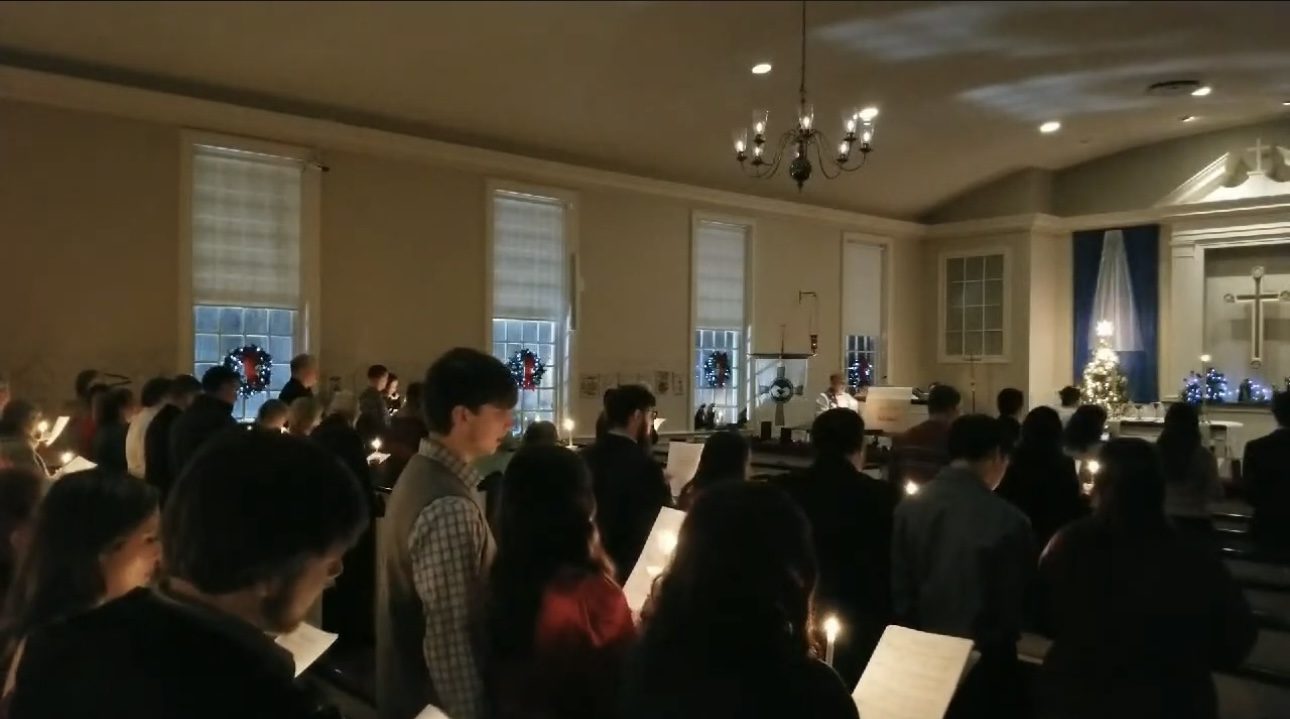
A Christmas service at Christ Lutheran (Fredericksburg, VA) in 2024

When I was a child, my father always bought a live Christmas tree. He was an old school Italian. So, our tree came down only after Epiphany. He wanted everyone to enjoy the full season of Christmas – all twelve days. (To this day, I actually say to people because of my father’s commitment to and love of Christmas, “Merry Christmas, all twelve days.”)

Just thinking about that time, I can smell the scent of post-Christmas fir tree wafting in the air after our tree’s removal. The occasional needle might be discovered lingering in the rug or my clothing for a few weeks following. Christmas seems to have wanted to stay. Yet, even as the signs of our times might change, Christmas does not have to leave. I take comfort in old Scrooge’s conversion in Dickens’ A Christmas Carol as he says, “I will honor Christmas in my heart, and try to keep it all the year. I will live in the Past, the Present, and the Future. The Spirits of all Three shall strive within me. I will not shut out the lessons that they teach.”

I suspect Scrooge’s policy is a pretty good one to follow. In life, it can too often seem like darkness is on the verge of surrounding us, if not consuming us. Yet as others have written, “The Light we’ve celebrated is still with us,” thus we can choose to stand up to the darkness with its help. Indeed, this Light beckons us forward in confidence, because the world also needs the Light. Through the power of our faith and baptism, we can choose to be merry all year long as in the original Anglo-Saxon sense of being “brave and spirited.” We can strive to reflect the light rather than fear any darkness. For the Light which is Jesus wills to become born into our world – in a sense, incarnate in and through us – whenever we chose to love as we have been loved first (1 John 4:19).

The poem, “The Work of Christmas,” by Howard Thurman comes to my mind:

When the song of the angels is stilled,
When the star in the sky is gone,
When the kings and princes are home,
When the shepherds are back with their flock,
The work of Christmas begins:
To find the lost,
To heal the broken,
To feed the hungry,
To release the prisoner,
To rebuild the nations,
To bring peace among brothers,
To make music in the heart.

So, take heart, dear Church. Christmas and Epiphany has passed by us once again, but our time of celebration is only beginning. Christ’s gifts of hope, peace, joy, and love remain within reach. Just hold on in faith, wait, and see.

This reflection was originally published in the January 7, 2025 weekly newsletter, the Hub, of Christ Lutheran Church, Fredericksburg, VA.

© 2025 The Rev. Louis Florio. All content not held under another’s copyright may not be used without permission of the author.
1 Comment

Filed under Pastoral Letter

Serenity Now

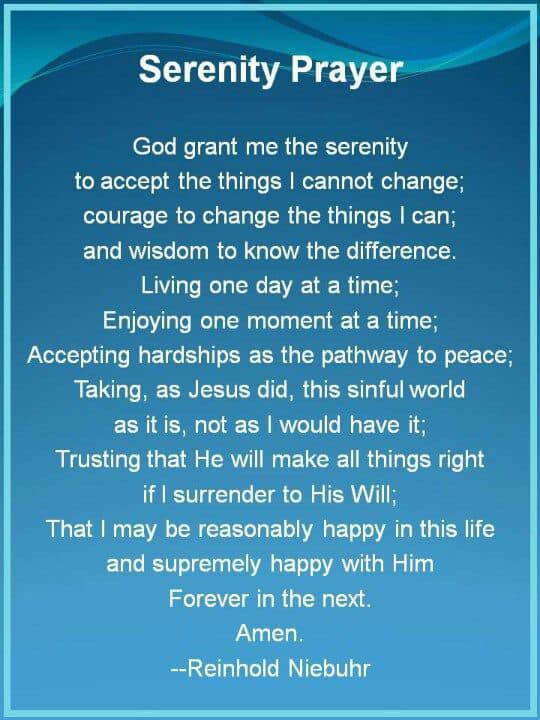
Who knew the well-known and respected Serenity Prayer could cause something other than peace – doubts, anxiousness, and many more questions? After sharing it on our Facebook page post-election, I have had many great and fruitful discussions about the theology behind it. On its face it sounds crazy to accept the world as it is. Yet, that is not really all that it says.

As I wrote someone recently, the Serenity Prayer was written as the US was battered by the Great Depression and the Nazis took over in Germany. Things looked grim. It began as an observation by Reinhold Niebuhr in 1932 as Roosevelt was elected: “The victorious man in the day of crisis is the man who has the serenity to accept what he cannot help and the courage to change what he must.”

The prayer challenges us to discern our unique individual call, as well as a call in community. We are to take stock of what we really can influence in the world, act accordingly in faith, and with any things that prove out of our hands, we are asked to trust that they remain in God’s. Many studies have shown that “letting go” can help us physically, emotionally, and mentally function better. Based on the teachings of Jesus, I always say that it benefits us spiritually too. Consider John 14:1 for one example: “Do not let your hearts be troubled. You believe in God; believe also in me.”

Lutherans also believe in a Theology of the Cross – the cross is seen as the best source of knowledge concerning who God is and how God saves. It also encourages us to take up our cross and follow Jesus. As the Lutheran theologian, pastor, and martyr, Dietrich Bonhoeffer wrote, “When Christ calls a man, he bids him come and die.” None of our recent posts are about “just getting along” or stopping our work for a more just world. We know the world is a mess. Loving others is difficult. In the face of reality, these prayers and teachings challenge us to trust and love God at all times, and love one another, even our enemies.

How we respond to perceived injustices might change when we trust God is always at work for our welfare. This theological lens invites us to find Christ’s peace and hold on to it, even if facing the worst evil. Our suffering and sacrifice can become sacred, not by our own power, but because of God’s promise that all things work for the good of those who love God (Romans 8).  God will be with us in our suffering, but God also somehow will use it to bless us and the world. We are asked by Jesus not to lose hope when it seems like the world is ending. He taught that these things must happen (Matthew 24:6) before his Kingdom, a new heaven and earth, fully comes.

We can look toward our theological forbearers. They sometimes died for their faith. Some still do. In the US, there has been worst times of trouble – the Civil War being arguably the worst and most costly. (It took Spotsylvania County one hundred years to return to its pre-war census.) Working within the ebb and flow of history, we are called to pray and act, but always trust. God wills more for us. As Lutheran theologian Ernst Troeltsch writes, “God, therefore is always living, always creating. He is truly manifested not in being but in becoming; not in nature, but in history” [Troeltsh, E. (1991) The Christian Faith, p.120. Minneapolis: Fortress Press]. God is at work in and through us as we live in a Fallen World. God may seem like a hidden God, as Luther often called God, but God is awake and at work. It is not all up to us. God’s will will be done.

These beliefs, this kind of trust, often helps us extend our focus to see more possibilities of what we can do in hard or conflicted times – acting in love rather than just fear or anger. Acting in love does not mean there are never any consequences. For the sake of the weak, the vulnerable, really all our neighbors, sometimes some are called to respond more directly and forcefully than others. Yet as a former soldier and police officer, now a police chaplain, I see that violence is never a good thing – never without cost – even when violence becomes necessary. (Luther in discussing his Two Kingdoms theology or in his essay “Whether Soldiers Too, Can Be Saved?” speaks of these kinds of things.) We each have parts to play in making a more just world, but we each must discern how Christ is calling us with the gifts we have been given.

Still in Christ’s teachings, the call to be open to reconciliation, to even nurture it, is ever present. For me, my understanding of this broadened when I came to know and eventually live with Brother Roger of Taizé in France. Under the Vichy government, he helped Jews escape. He ultimately narrowly escaped the Gestapo’s arrest; going to Switzerland until the war was over. After the war, he came back. He cared for German soldiers (former POWs) as they made their way home. In the region, he was among some of the most anti-church people in France. Some Communists slaughtered a pig on the church steps in the nearby village each Good Friday to show their disdain for Jesus and his Church. Yet, he with other friends helped form a coop for the community anyway, and they cared for the sick and hungry. His authenticity, patience and love changed hearts and minds over time with God’s help. And I believe his witness eventually changed my way of seeing and being as well.

When we as Christians say, “all is well,” or “love your enemy,” we are ultimately affirming that Jesus is Lord. He lives, and that matters. In fact, it changes everything, so it must change how we respond to the world. Jesus promises that his Kingdom will come, but he is here with us now. It has broken into our world, but it is not in its fullness yet. We are already victorious even when we might suffer (1 Corinthians 15:57). This truth can free and empower us to respond to our Fallen world and our neighbors in surprising ways.

For, God is not done with us or the world yet. Yes, the poor will always be with us (Mark 14:7, John 12:8, Matthew 26:11), but we seek to feed and house them as Jesus also taught us. As we face those in opposition to us, we seek to bless those who curse us and pray for those who mistrust us (Luke 6:27-36). In the face of worldly reality, we seek to live in abundant, generous, and merciful faith, hope, and love. All is well, but all is not perfect…yet. As the body of Christ, we have work to do, but we trust most importantly that God is at work, too. We need not be afraid.

Parts of this reflection originally were published in the November 18, 2024 weekly newsletter, the Hub, of Christ Lutheran Church, Fredericksburg, VA as well as sections in a Facebook post that I shared. 

© 2024 The Rev. Louis Florio. All content not held under another’s copyright may not be used without permission of the author.
Leave a comment

Filed under Pastoral Letter, Uncategorized

All is well…Yes, really.

So many people – both “blue” and “red” (plus other political colors as well) – have been anxious this election cycle. Unfortunately, anxiety can turn into anger rather quickly. Now, hear me clearly, anger is not a sin according to scripture, but we as humans can too swiftly ride the tide of our emotions into the vortex of sin when we feel insecure, unmoored from what usually grounds us. As animals, fight or flight responses can take over. Biologically, we focus on what we think a threat. This is meant to be a safety skill built into us, but it can become our downfall. We can miss the bigger picture. We might abuse others who don’t deserve such treatment. We can begin to wear blinders so that we miss out on facts or observations that might help us avoid loss of relationships or our sanity. We can hurt ourselves and others in ways we never imagined possible. Anticipatory stress can prove a real trap hurting our overall health.

When I was a child growing up in a family with many challenges, I learned to be vigilant for signs of potential trouble whenever I entered my home. As a soldier in the National Guard, I was trained to watch for ambushes and danger. When a finally became a police officer, I found that I sometimes had a hard time “turning off” after my shift. It was a violent time in the Metro-DC area. I eventually learned how to keep this hypervigilance in check after some help from others. Yet, I discovered my greatest gift to combat such issues proved to be faith. Faith is more than just an intellectual trust in the Lord. It is at its best a deep and growing trust that our gracious God loves us and will never abandon us – even as we face death. This gift of faith certainly helped me lower any anxiety or anger which might pop up. I became calmer and less reactive. Instead, I saw more options and possibilities in a fallen world. I grew in empathy, compassion, and patience. I learned better how to love myself and others in stressful situations, and people began to notice.

Why this dramatic change? I started to see beyond the problems facing me in the world. I think it was because the Holy Spirit longs to help us learn that (as others taught me) the God behind us is bigger than any problems facing us. Indeed as Brother Roger of Taizé used to teach, God is already in our future waiting for us – no matter how dark it might appear – ready to embrace us. We need not be afraid (as scripture so often reminds us). Everything – even our own sin – can be used by God to bless us (Romans 8:28). We can act instead of react. We can choose love. This is because God promises to love us…always.

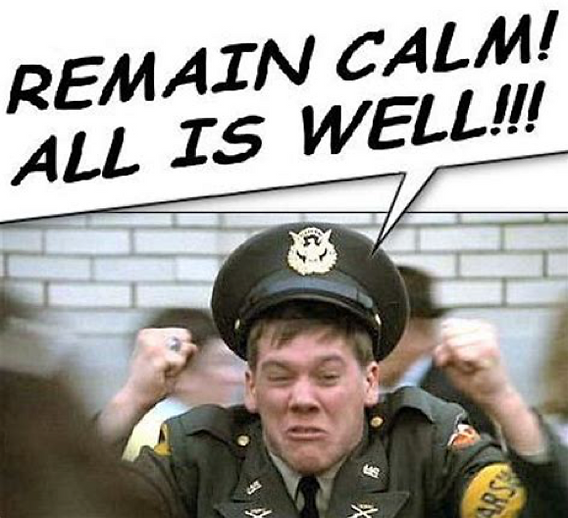
Yet sometimes we can feel like one of the characters in Animal House, a movie I saw as a teen. For years, if anyone were to say, “Remain calm. All is well,” I thought of the ROTC cadet, played by Kevin Bacon, standing in the midst of a parade crowd running amok. Things did not seem well at all. It is not easy when the world seems in chaos to hold on to this “hope as an anchor for the soul” (Hebrews 6:19). others might even think that we are foolish. Ultimately, we need the Spirit’s help to know and trust that all is well. This assurance can be found through prayer, our study of scripture, as well as beloved community. We need to risk believing as Luther taught, “Jesus does not lie.” Then, the Spirit will do its work. As Paul points out, when we feel tempted to sin or give up, when all seems lost, it is ultimately God who will give us a way out (1 Corinthians 10:13).

At this time of cultural shift and uncertainty, when the United States population seems so at odds, it is important that we not play by the world’s rules. I shared this with my congregation on social media:

For those celebrating the election, remember not to gloat (Prov. 24:17) and to seek to love those you think in opposition to you (Matthew 5:44). For those grieving, remember we are never alone on good days or bad, or when the world seems confusing or disappoints (Matthew 28:20). As believers, all of us have work to do together (Micah 6:8). More importantly, God is at work through us and all that happens in the world (Jeremiah 29:11). We can choose to live in hope because of God’s love for us (1 Peter 1:3). As Church, we are called to be ambassadors for Christ and agents of reconciliation in our conversations and social media posts (2 Corinthians 5:16-21). We are called to love one another as Jesus loved us first (1John 4:19). “Be kind to one another, tenderhearted, forgiving one another, as God in Christ forgave you” (Ephesians 4:32). Especially as Lutherans, we know that “though the earth give way and the mountains fall into the heart of the sea, though its waters roar and foam and the mountains quake with their surging…The Lord Almighty is with us; the God of Jacob is our fortress” (Psalm 46). Jesus lives and reigns forever (Hebrews 7:24-25), and together, we are called to be his witnesses to the ends of the Earth (Acts 1:7-8). Life together in any community can prove difficult, but with God, all things are possible (Matthew 19:26). All is well.

I might still remember the humor of Kevin Bacon being overrun, but I trust in the observation of Julian of Norwich that all is well. As she reflected long ago:

All shall be well, and all shall be well, and all manner of things shall be well…For there is a Force of love moving through the universe that holds us fast and will never let us go.

In our fallen world, there might be negative consequences at any time. We will suffer at times or potentially face abuse or persecution. It might prove time to take up our cross or fight the good fight for justice. Real life is never easy. We are not asked to fake our happiness, just not get stuck in or sin in our feelings. For, we have a real God who is with us and loves us.

All is well…Yes, really.

© 2024 The Rev. Louis Florio. All content not held under another’s copyright may not be used without permission of the author.

Leave a comment

Filed under Pastoral Letter

Think about these things (S3, E1)

Image: the Bible App Verse of the Day, November 4, 2024

This reflection is also available as a podcast on Spotify.

It’s easy to get stuck thinking about all the negativity during a bitter election cycle. Or, perhaps our brains get busy anticipating all that might go wrong if one thing happens or another. Yet if you take some time to meditate and give thanks for what is going well in your life or the many blessings around you no matter how small, you might just find some peace along with better clarity.

When so many people tell you that the world’s about to end, civil war is imminent, the (fill in the blank) party will destroy our nation, or “it’s us versus them,” that’s the thinking of the world. Try to remember that Jesus said you will always belong to him when you believe (trust) in him. No earthly events can ever change that promise. You can act (and vote!) in loving faith rather than in response to any fear.

We are called as Christians to love our neighbors, even enemies. Try to show others grace, patience, forgiveness, and kindness on social media and in real life, even if you disagree with them or they turn on you. All things will somehow work for the good of those who love God (see Romans 8 ) including whatever happens in the US during this election cycle – even if times grow hard. Kingdoms will rise and fall in this world, but we are called to always reflect Christ, because we belong to him forever.

So, even our vote should reflect our love of God and neighbor. Our Lutheran faith particularly places emphasis on this. Recall that on 4 November 1520, Martin Luther published “On the Freedom of a Christian” to describe how God’s love is both a radical gift and a call to service. (The treatise is sometimes called “A Treatise on Christian Liberty.”) Specifically, the treatise introduces the concept that as fully forgiven children of God, Christians are no longer compelled to keep God’s law to obtain salvation. However, Christians freely and willingly are to serve God and their neighbors. We are subject to none, but called to be servants to all.

Where as God calls us to care for our neighbors and actively shape a just and compassionate society, as the Evangelical Lutheran Church in America points out, civic engagement, including voting and public service, is a meaningful way to live out our faith in the public sphere. Therefore, voting responsibly and faithfully becomes part of our Christian call. Representing Christ’s Church, we are to engage in the political process with integrity, advocating for justice, peace, and the common good. Consider the issues soberly and pray for the Spirit’s guidance before you vote. Approach opponents with respect for their humanity. In losing or winning, we are meant to be gracious, trusting in the Lord, reflecting our faith in Jesus – especially in how we engage those in opposition. Rather than giving into the power of anxiety or anger, we can remember Jesus who always helps and cares for us.

Please join in this prayer for the election shared by Bishop Phyllis Milton, Bishop of the Virginia Synod:

Lord of all, you have declared what is right: to seek justice, to love kindness, and to walk humbly with you. Help us to participate in wise decisions for our common life that we may serve our neighbors. We pray for the volunteers who share their time and experience to assist us in the election process. Give us grace to live in unity and peace. We pray in the name of Jesus Christ, our sovereign and our Savior. Amen.

Another prayer I mentioned on social media that many indicated they thought helpful is the tried and true Serenity Prayer in its long version. This prayer composed in the 1930s is helpful on all days, including Election Day. The person who composed the prayer, Reinhold Niebuhr, was one of America’s leading theologians and ethicists for several decades of the 20th century. He received the Presidential Medal of Freedom in 1964. Thought of as a “public theologian,” he wrote and spoke frequently about the intersection of religion, politics, and public policy. A short version of the prayer (the first sentence with three sections) has become popular among 12 step communities as well. You can pray along with me and others using these words:

God grant me the Serenity
To accept the things I cannot change,
Courage to change the things I can,
And the Wisdom to know the difference.

Living one day at a time,
Enjoying one moment at a time.
Accepting hardship as a pathway to peace,
Taking, as Jesus did, this sinful world as it is,
Not as I would like it.

Trusting that he will make all things right,
If I surrender to his will.
That I may be reasonably happy in this world
And supremely happy in the next.

Although many other prayers suitable for this election cycle and presidential transition exist, last for this essay is a prayer an Episcopal priest friend shared on his Facebook page. The prayer was written in 1882, and he reports that it was actually suggested to become the Thanksgiving Day prayer of the day for Episcopalians in 1892. It has been part of the Book of Common Prayer of the Episcopal Church since the 1928 edition. I think it encompasses many of the shared concerns of reasonable people on the left or the right politically. It seems to reflect well the sentiments I have shared recently in preaching, teaching, as well as this essay:

Almighty God, who hast given us this good land for our heritage: We humbly beseech thee that we may always prove ourselves a people mindful of thy favor and glad to do thy will. Bless our land with honorable industry, sound learning, and pure manners. Save us from violence, discord, and confusion; from pride and arrogance, and from every evil way. Defend our liberties, and fashion into one united people the multitudes brought hither out of many kindreds and tongues. Endue with the spirit of wisdom those to whom in thy Name we entrust the authority of government, that there may be justice and peace at home, and that, through obedience to thy law, we may show forth thy praise among the nations of the earth. In the time of prosperity, fill our hearts with thankfulness, and in the day of trouble, suffer not our trust in thee to fail; all which we ask through Jesus Christ our Lord. Amen.

In closing, I share a quote from Abraham Lincoln. As the tumult of the Civil War approached, Lincoln shared these words which still hold true today: “Let us at all times remember that all American citizens are brothers of a common country, and should dwell together in the bonds of fraternal feeling.” This is difficult. Historically, we have failed as a nation many times before. Yet, for those with faith, it remains always possible. We can serve as a catalyst for unity, rather than division.

As Saint Paul writes in 2 Corinthians 5, “All this is from God, who reconciled us to himself through Christ and gave us the ministry of reconciliation: that God was reconciling the world to himself in Christ, not counting people’s sins against them. And he has committed to us the message of reconciliation.”

Think about these things. Pray these things. Hope in these things. You might not see any noticeable change in others, but it matters. If nothing else, this attitude of faithful positivity in the face of so much evil and angst has the power to change us. In that way, it certainly changes our world for the better.

Parts of this reflection originally were published in the November 5, 2024 weekly newsletter, the Hub, of Christ Lutheran Church, Fredericksburg, VA as well as Facebook posts that I shared. The Book of Common prayer paragraph is thanks to a friend who wished to remain anonymous.

© 2024 The Rev. Louis Florio. All content not held under another’s copyright may not be used without permission of the author.

1 Comment

Filed under Pastoral Letter