Mosaic in El Moallaqah Coptic Orthodox Church: The Flight to Egypt, Cairo, Egypt by Unknown. c. 9th Century AD.
Whoever said the Middle Ages weren’t fun? I bring you glad tidings and happy greetings on this Feast of the Ass.
Yes, according to a blog post by Fr. John Zuhlsdorf: “The feast which became popular in France, could have stemmed from the so-called ‘feast of fools.’ It may tendrils into biblical donkeys, or the integration of the ass into the nativity narrative. It could have been in part inspired by a sermon of pseudo-Augustine. The day included the tradition of a parading a couple of kids (not goats) on an ass (not a Jesuit) right into the church, next to the pulpit during the sermon. The congregation would respond with loud ‘hee haws.’”[i]
This sounds a bit like an early version of Vacation Bible School or maybe fiction, but nope, this liturgical feast was the real deal. It was meant to commemorate the Holy Family’s flight into Egypt. So, on and near the day appointed, congregations would hear donkey-related stories in the Bible including the escape into Egypt (Matthew 2:13–23). Problematically, scripture never explicitly mentions a donkey in the narrative of Christ’s birth or the flight, but that’s firmly in the cultural memory. Why?
Well, donkeys were a symbol of humility and peace while horses were symbols of earthly power and war. Also, through many prophetic texts speaking to ancient Israel, we learn that God did not desire the Holy People of Israel to trust in horses and chariots, as Egypt did, but in the Lord (i.e. Psalm 20:7). Instead, they commonly utilized donkeys also known as asses. Donkeys are also one of the earliest and most frequently mentioned animals in the Bible through multiple texts. In the book of Job, the donkey is one of the fourteen animals that the Lord uses to illustrate God’s own power and creativity to Job (Job 39). Then, Balaam’s donkey actually speaks (Numbers 22:23). The only other animal ever to speak is the serpent of Genesis. Indeed, many verses urge people to be good to their beasts including their donkeys (i.e. Exodus 20:10, Deuteronomy 5:14, Proverbs 12:10).
Yet perhaps most importantly, the donkey was connected to the Messiah as a sign: “Rejoice greatly, O daughter of Zion; shout, O daughter of Jerusalem: behold, thy King cometh unto thee: he is just, and having salvation; lowly, and riding upon an ass, and upon a colt the foal of an ass” (Zechariah 9:9). Jesus embodies this as he rode into Jerusalem for his final Passover. If Jesus ends his life with a ride on a donkey, it does not take a great deal of creativity to imagine Jesus (through his expectant mother, Mary) rode one as he entered into our world incarnate. (It is likely one was not only available but used.)
So, if anyone ever says you are acting like an ass, or you feel like one, don’t be too quick to take offense or lose heart. Think of the humble donkey and give God thanks. For all their drawbacks, the ass remains a valuable animal, born with a purpose, and dearly loved by God. If God can use an ass, God can surely use you or me. The Bible tells us so.
Yes, this feast might no longer be on the liturgical calendar, but blessed Festum Asinorum, Feast of the Ass Day, to one and all!
Epilogue:
Hear is a song from Italian history with the feast to help brighten your celebration.[ii] As the feast was seemingly associated with the Feast of Fools, it is quite jolly unlike other liturgical music of the day. An Italian troubadour version of ‘Orientis Partibus’ with braying chorus.[iii]
Translation:
From the country of the East, Came this strong and handsome beast: This able ass, beyond compare, Heavy loads and packs to bear.
Chorus: Now, seignor ass, a noble bray, Thy beauteous mouth at large display; Abundant food our hay-lofts yield, And oats abundant load the field. Hee-haw! He-haw! He-haw!
True it is, his pace is slow, Till he feels the quickening blow; Till he feel the urging goad, On his hinder part bestowed.
Chorus: Now, seignor ass, &c.
He was born on Shechem’s hill; In Reuben’s vales he fed his fill; He drank of Jordan’s sacred stream, And gambolled in Bethlehem.
Chorus: Now, seignor ass, &c.
See that broad majestic ear! Born he is the yoke to wear: All his fellows he surpasses! He’s the very lord of asses!
Chorus: Now, seignor ass, &c.
In leaping he excels the fawn, The deer, the colts upon the lawn; Less swift the dromedaries ran, Boasted of in Midian.
Chorus: Now, seignor ass, &c.
Gold from Araby the blest, Seba myrrh, of myrrh the best, To the church this ass did bring; We his sturdy labours sing.
Chorus: Now, seignor ass, &c.
While he draws the loaded wain, Or many a pack, he don’t complain. With his jaws, a noble pair, He doth craunch his homely fare.
Chorus: Now, seignor ass, &c.
The bearded barley and its stem, And thistles, yield his fill of them: He assists to separate, When it ‘s threshed, the chaff from wheat.
Chorus: Now, seignor ass, &c.
With your belly full of grain, Bray, most honoured ass, Amen! Bray out loudly, bray again, Never mind the old Amen; Without ceasing, bray again, Amen! Amen! Amen! Amen! Hee-haw! He-haw! He-haw!’[iv]
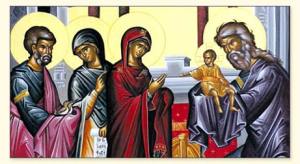
There’s definitely some confusion when it comes to Candlemas each February 2. Not only is it overshadowed by Groundhog Day, but it also remains rather obscure to many modern Christians and most certainly non-Christians. Candlemas is perhaps most properly or commonly called the Feast of the Presentation of Jesus. The Church remembers Mary and Joseph taking Jesus to the Temple forty days after his birth to complete Mary’s ritual purification after childbirth and to perform the redemption of the firstborn son as reported in Luke 2:22-40.
Candlemas is an old feast of the Church, a kind of holiday or holy day one might say. Normally, a feast day commemorates a person or event. Unfortunately, with Candlemas, it appears multiple, closely related meanings have been attached to it over the centuries and events perhaps merged. In a web search, you will quickly learn that Candlemas can not only be called Feast of the Presentation of Jesus, but it can also be known as the Feast of the Purification of the Blessed Virgin Mary, or the Feast of the Holy Encounter.
In Leviticus 12:2-8, we learn “A woman who becomes pregnant and gives birth to a son will be ceremonially unclean for seven days, just as she is unclean during her monthly period. On the eighth day the boy is to be circumcised. Then the woman must wait thirty-three days to be purified from her bleeding. She must not touch anything sacred or go to the sanctuary until the days of her purification are over.” (There are separate requirements for the birth of a girl child.) For the male, a year-old lamb was to be offered for a burnt offering and a young pigeon or a dove for a sin offering. If the mother and her family could not afford a lamb, she was to bring two doves or two young pigeons, one for a burnt offering and the other for a sin offering. God was thought to be a God of life. Things that smacked of death and illness such as blood were deemed unclean. In sacrificing the offering as part of the ritual in faith with prayer, the priest was thought to be atoning for any of her sins. A person was being made fit to be in the presence of God and among God’s Holy People.
The first male child held special significance to the early Hebrews. With their cultic life and practice centered around priestly activities and offerings relating to the Ark of the Covenant and Ten Commandments, members of the twelve tribes were expected to support the work of the Tent of Meeting and later the Temple in Jerusalem. As the people became more numerous and the cultic practices more established, it was recognized that not every first male child need to serve with the priests. Indeed, sometimes families making a subsistence living might need him more just to survive.
Exodus 13:2-15 describes another ordinance. Through Moses, God was believed to have commanded, “Consecrate to me every firstborn male. The first offspring of every womb among the Israelites belongs to me, whether human or animal.” All the firstborn males of their livestock were also to belong to the Lord. When people asked why, they were to explain, “Pharaoh stubbornly refused to let us go, the Lord killed the firstborn of both people and animals in Egypt. This is why I sacrifice to the Lord the first male offspring of every womb and redeem each of my firstborn sons.”
In Numbers 18:15-16, it says, “The redemption price for firstborn non-Levites was set at 5 shekels.” Today, this practice is known as the pidyon haben, the redemption of the first-born son, and silver coins are used. It is only conducted for male babies but not if the baby was delivered by cesarian section. In effect, the father “buys” or “redeems” his son from the priest and the expected, traditional service. (The Temple no longer exists, so it is more symbolic than in the past.) At least under rabbinical practice today (if not earlier), this obligation only exists if the parents are not Levites or part of the priestly class. In a quick review of scripture, I see no date for this to be held in scripture, but today the obligation begins when the baby is 30 days old, and so the ceremony often occurs on the thirty-first day after birth. If included parents do not redeem the child for whatever the child becomes responsible for his own redemption at thirteen years of age. (See the article Redeeming firstborn sons for more details.)
Certainly, Luke seems to confuse these two practices – the redemption of the first male child and the purification of the mother forty days after birth. In fact, Luke has the fee for the purification of the mother become the redemption price for the son. Remember, Luke did not observe these events. He was a Greek doctor who had come to believe in Jesus and served with Paul for a time. To me, it certainly seems reasonable that he didn’t fully understand Levitical codes. I’ve read some articles suggesting that there was no such custom of presenting a Jewish male child in the Temple back in the first Century, but with the redemption needing to be made to a priest, perhaps a child need not be there, but I would certainly not be surprised if a family did. I see no reason to doubt the ultimate truth of the passage. Jesus was presented in the Temple. Simeon and the prophet Anna could have certainly encountered Jesus and through the Spirit’s revelation understood his import. (Hence, Candlemas can also be known as the Feast of the Holy Encounter.)
Whether we focus on some kind of presentation of Jesus including most likely the story of his redemption, the purification right of Mary, or Jesus being revealed as the Messiah to Simeon and Anna, I hope we remember all these early stories and practices amidst their variations. They help make Jesus and his family come alive in context of their time. February 2 being forty days Christmas remains the perfect day to do so. Indeed, as I have written elsewhere, the date was once was considered the end of what was called the Season of Epiphany, and any remaining Christmas greens were taken down. (Today, most denominations don’t have a season of Epiphany but have January 6 as the Feast of Epiphany and what is now called the start of the Season after Epiphany.)
So that all said, with all those names and remembrances possibly now making more sense, why is the day also called Candlemas? Well, in past days, Christian families would commonly bring candles to the church as we remembered Jesus as “a light for revelation to the Gentiles, and the glory of [God’s] people Israel.” Much as we bless food to our use or dedicate worship items through prayer, families would ask that the candles used in the home for light be blessed.
Happy Candlemas everyone! As Jesus urged, “let your light shine before others, so that they may see your good works and give glory to your Father in heaven.”
Unless otherwise indicated, all scripture quotations for this post are from the New Revised Standard Version (NRSV) translation.
Reviewing several television and government weather forecasts as well as other public safety resources, it seems our region is expecting an inch or less of snow accumulation. Unfortunately, a number of these same resources suggest that it could come fast and with heavy “bursts” causing a quarter mile or less visibility in some areas. Wind gusts could reach 30 mph with temperatures dramatically falling into the single digits this evening. Wind chill is expected to be in the below zero range (-5). Melting prior to nightfall is expected to refreeze causing hazardous road conditions into tomorrow.
The snow is supposed to arrive in our region right as we would have gathered for worship (5:00 pm – 8:00 pm). As our membership comes from such a wide expanse of territory in our region, we are cancelling tonight’s service for safety reasons. Yet for those interested, we will offer the imposition of Ashes on the First Sunday of Lent, February 22 at both services.
In addition, it is important to understand that the imposition of ashes need not be done only in a church or by a pastor or priest. As our upcoming Wednesday night Lenten program, “The Priesthood of All Believers,” will help remind us, we are all called to ministry and every home is a little church. For those interested, there is a home liturgy available through the article, “Ashes on Ice: Celebrating Ash Wednesday at Home.”
The imposition of ashes on the forehead as a sign of repentance recalls the Jewish practice of wearing sackcloth (a coarse, black cloth made from goat’s hair), fasting, and sitting in ashes as a sign of mourning or repentance. Christians began to practice this ritual by the 10th Century AD. It became an official rite of the church by the 13th century. Roman Catholics, Lutherans, Anglicans/Episcopalians, Methodists, and other liturgical Protestants continue this tradition. The practice serves as a symbol of our mortality as well as the regret we share over our individual and collective sin. Imposing ashes in the sign of the cross, it serves to witness to others and remind ourselves that we are sinner-saints, people who struggle with sin but who also rely on God’s grace. It echoes the marking of a cross on our foreheads with anointing oil during our baptism.
In all the above traditions, a pastor, deacon or lay person can impose the ashes. Although ashes can be distributed “on the go” at any location, we prefer to gather corporately during public worship as a reminder of our interconnectedness in a fallen world. We suffer from and contribute to individual and systemic sin. We live in hope with all the heavenly host and communion of saints.
Thus in the spirit of the prophet Joel’s admonition, we seek to live in a manner that reflects the short time we have to live out our baptismal call and share Christ’s love. We gather together in a spirit of repentance but also in hopeful expectation of Christ’s imminent return: Blow the trumpet in Zion; sound the alarm on my holy hill. Let all who live in the land tremble, for the day of the Lord is coming. (Joel 2:1)
Life is too short, and Judgment Day will surely come for all. Yet as part of the communion of saints, trusting in Jesus, we are never alone. Even on that terrible day, forgiveness is ours. With confidence, we may await the day of Christ’s return.
While we wait, let us cooperate with the grace offered us to reform our lives. Let us struggle to love God and others all the more.
Unless otherwise indicated, all scripture quotations for this article are from the New Revised Standard Version (NRSV) translation.
What a wonderful opportunity to rejoice in the light of Christ once again – Candlemas!
Candlemas is actually the Christian “Feast of the Presentation of Jesus at the Temple.” The Holy family had come to the Temple to fulfill the Law of Moses. Forty days after the birth of the male child, Mary’s ritual purification and the redemption of the firstborn son were due to be performed. Being a poor family, only a pair of turtledoves or two young pigeons needed to be offered to God.
Yet while they prepared to do so, two elderly, faithful people, Simeon and Anna, saw something else going on beyond the sacrifice. God was doing something much greater and offering something much dearer. God was doing something new. The Spirit revealed to them that God’s light had broken through the darkness. The infant, Jesus, was the long awaited Messiah and nothing would be the same ever again. Jesus, our joy and salvation, had come into the world!
This feast day comes forty days after Christmas and historically closed out the season. The remaining Christmas greens would be taken down. The days were still short and nights long. Spring was, well, yet to be sprung. And so this day came to serve as reminder that, “The light shines in the darkness, and the darkness did not overcome it” (John 1:5).
In time, it became a practice to bless the candles to be used in church during the coming year. Later, families would bring their own candles to church for a blessing. Hence, we now have the alternative name for the feast day, Candlemas.
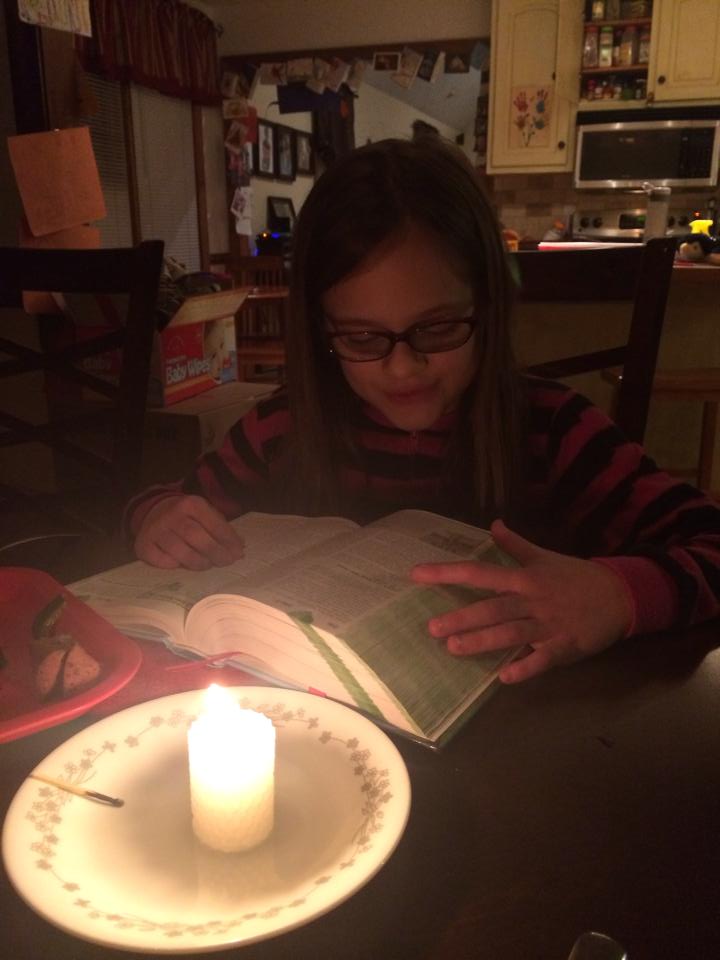
Using resources from Evangelical Lutheran Worship and the Revised Common Lectionary, your family can easily mark this day and your own baptismal call. The following is a short ritual I offered my congregation for home use:
As the family gathers for a meal, before bed or at another convenient time, light your candle.
All: Alleluia. My eyes have seen your salvation, which you have prepared in the presence of all peoples. Alleluia.
Leader reads: Luke 2:22-40
A short reflection may be shared, or discussion time, or even a brief moment of silence to reflect in the light of the candle. When finished…
Leader: Let us pray together…
All: Almighty and ever-living God, your only-begotten Son was presented this day in the temple. May we be presented to you with clean and pure hearts by the same Jesus Christ, our great high priest, who lives and reigns with you and the Holy Spirit, one God, now and forever. Amen.
Leader: “Let your light shine before others, that they may see your good deeds and glorify your Father in heaven.” Go in peace to love and serve the Lord.
All: Thanks be to God.
Optional –
Close the gathering with a hymn or song dealing with light, perhaps “This little light of mine.”
This might also be a wonderful time to take out any saved baptismal candles and reflect upon the meaning of our individual baptism and talk about events of that day.
As better candles are made of beeswax, perhaps make a beehive cake to help your family celebrate.
A quote from John Chrysostom comes to my mind, “The bee is more honored than other animals, not because it labors, but because it labors for others.”
As we look upon our candles this Candlemas, let us urge our children (and all the children of God) to not waste time just being “busy bees” chasing things of this world. Let us instead love God and neighbor. Then, our lives will be used to build the Kingdom of God with Jesus. His light will come to shine through us.
Happy Candlemas, everyone!
Unless otherwise indicated, all scripture quotations for this article are from the New Revised Standard Version (NRSV) translation.
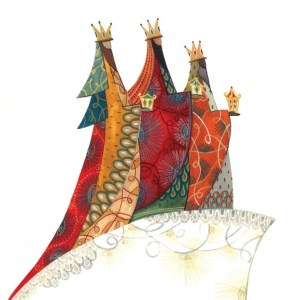
Epiphany, also historically known as “Little Christmas,” marks the end of Christmas celebrations in Western Christendom on January 6th. The arrival of the Magi is often remembered as part of these celebrations. Although scripture never numbers the gentile Magi who came to worship Jesus, a tradition developed that there were three; each one baring a special gift of gold, frankincense, and myrrh. They became popularly known as Melchior, Caspar and Balthazar and are often artistically represented as being of different peoples and races, for Jesus came to offer salvation to all.
Over time, a popular custom began to bless one’s home on Epiphany with the words in Latin, Christus Mansionem Benedicat (May Christ bless this house). I surmise this was because of the biblical scene from Matthew 2: 1-12. (Jesus was no longer in the stable but described to be in a house with his own family when the Magi visit.) Yet, I have not confirmed the origin of this practice. The first letter from each word of this blessing corresponds to the traditional names given the Magi. Which came first – the blessing or the names – remains a mystery, but their development within popular culture is likely related.
As we move forward into a new year, I suggest use of a simple blessing ceremony I have adapted from the internet. You can further adapt it to meet your family’s needs:
Leader: Peace be to this house and to all who dwell here, in the name of the Lord.
All: Blessed be God forever.
Reading: Matthew 2:1-12
Using chalk, write on the outside of your house’s door or frame (alternatively, on a path or driveway, or above or next to an entrance):
+ 20 C M B 14 +
This stands for the first half of the current year written out, Christus Mansionem Benedicat (Christ bless this house), then the other half of the current year written out. Start and end with a cross.
Optionally, the entire phrase may be written out. Each marking or word could be written by a varied member of the household if desired. The leader can share a prayer of their own or simply ask God to bless your home as the markings are made.
When finished, all can join in a closing prayer – “Lord God of heaven and earth, you revealed your only begotten Son to every nation by the guidance of a star. Bless this house and all who inhabit it. May we be blessed with health, goodness of heart, gentleness and the keeping of your law. Fill us with the light of Christ, that our love for each other may go out to all. We ask this through Christ our Lord. Amen.”
May a joyful and blessed Epiphany be yours!
Pastor Lou
Unless otherwise indicated, all scripture quotations for this article are from the New Revised Standard Version (NRSV) translation.
For those that have looked at my Heroes and Sheroes page, you might recognize that today is a special day for me. March 25th is the traditional commemoration date of Saint Dismas on a number of Christian liturgical calendars, and I bear his name.
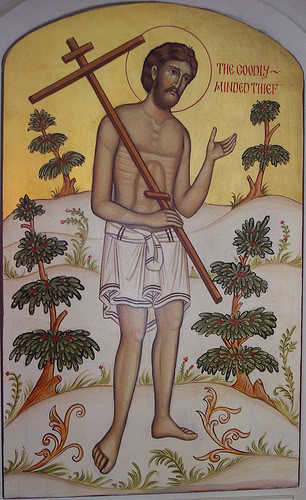
Widely known as the “Good Thief” or the “Penitent Thief”, Dismas was crucified beside Jesus. The name Dismas was later adapted from a Greek word meaning “sunset” or “death.” His real name is unknown. Most likely, he was not a thief, but instead, some kind of rebel or raider deserving the death penalty under Roman law.
Dismas’ lesser feast day or commemoration derived from a tradition believing that March 25th was the actual calendar date of Christ’s crucifixion, although the Passover and Easter celebrations move due to their following a lunar calendar. The Feast of the Annunciation is the primary, modern celebration on our Lutheran calendars today (except when March 25th falls during Holy Week), but I still stop to remember St. Dismas annually on this day.
Although Dismas was never officially canonized by the Roman Catholic Church, he is declared so in scripture by Jesus himself. We hear in Luke that Dismas defended Jesus from the abuse of the other condemned man, commonly named Gestas (but also unknown). Hearing Jesus preach, teach and pray from the cross, Dismas began to look to Jesus with trust. He asked, “Jesus remember me when you come into your kingdom.” Jesus declared, “Truly I tell you, today you will be with me in Paradise.” (See Luke 23:39-43)
Years ago in a home with many challenges, I came to see the world in black and white terms. I secretly believed myself unlovable and defective even at a young age. As I write elsewhere, I am sure I heard the story of Dismas often in church growing up, but it first really impacted me while watching The Greatest Story Ever Told on television with my father in about eighth grade. At that time, I had been going through confirmation classes at St. Pius X Roman Catholic Church. Prior to confirmation (viewd as a sacrament in the Roman Catholic faith tradition), we were asked to think of a confirmation name, one to symbolize our coming to adulthood in faith and hopefully be a saint who inspired us.
In the Roman Catholic tradition, St. Dismas is the patron saint of condemned prisoners, reformed thieves, undertakers, funeral directors, penitent sinners, and prisoners. Indeed, some Lutheran and other prison ministries are named after him. When confirmed in the Catholic tradition, I decided to take his name. This seems ironic perhaps for one who would become a police officer, yet I always remembered how my heart was deeply touched by his story. In the depths of my being, I hoped I could be so loved.
Later as a young adult, I left active life in the church. I believed in God at some level, but I made bad choices at times, experienced losses that often come with life, and experienced much too much evil as a police officer. In short, I gave up on God. I became empty and cynical. I came to feel that not even Christ’s cross was enough to save me. I had much to repent over, for I was very wrong.
Yet when my life seemed darkest after another profound loss, two dear Christian friends from my past redirected my gaze toward the cross and its certain grace. On March 7, 1992, I had what I call my “re-conversion experience” – for I understand now that since my baptism and before, God has always been active in my life. My faith was small and deformed, but it made a difference in my life. God loved me before I ever realized it, even on Christ’s cross long ago. I truly experienced amazing grace, and my life changed.
Through this renewed experience with grace, I came to understand and more importantly finally trust that I was indeed loved and forgiven. I began to dig into scripture as never before. I hungered for the Word of life, and I found it alive in and through Christ’s church. With the church, I sought to share the grace I knew to be true with others in both word and deed. My police work became a sacred vocation. Later, God would invite me to take his love on the road through mission. Overtime, I discovered a home in the Lutheran family of faith. Still a sinner, I trust that I am also a saint. Christ declares this through his death and resurrection for our sake, and I do trust him for he never lies. His sacrifice atoned for our sin – past, present and future. His death remains enough to save us all.
Each year since my “re-conversion” and return to the church, I think of Dismas and rejoice. I celebrate the opportunities found in Lent and Christ’s forgiveness. I trust that with others who believe (and even those who don’t yet) I was, am and will be remembered. Dismas’ story is our own.
Yes, Jesus remembered us all as he died on that cross. He died, so that we could truly live…starting today.
Psalm 32 – The Joy of Forgiveness 1 Happy are those whose transgression is forgiven,
whose sin is covered. 2 Happy are those to whom the Lord imputes no iniquity,
and in whose spirit there is no deceit. 3 While I kept silence, my body wasted away
through my groaning all day long. 4 For day and night your hand was heavy upon me;
my strength was dried up as by the heat of summer. Selah
5 Then I acknowledged my sin to you,
and I did not hide my iniquity;
I said, ‘I will confess my transgressions to the Lord’,
and you forgave the guilt of my sin. Selah
6 Therefore let all who are faithful
offer prayer to you;
at a time of distress, the rush of mighty waters
shall not reach them. 7 You are a hiding-place for me;
you preserve me from trouble;
you surround me with glad cries of deliverance. Selah
8 I will instruct you and teach you the way you should go;
I will counsel you with my eye upon you. 9 Do not be like a horse or a mule, without understanding,
whose temper must be curbed with bit and bridle,
else it will not stay near you. 10 Many are the torments of the wicked,
but steadfast love surrounds those who trust in the Lord. 11 Be glad in the Lord and rejoice, O righteous,
and shout for joy, all you upright in heart.
Prayer:
Gracious Lord, even as you died on your cross, you looked upon Dismas and saw our human need, shared suffering, and sin. You looked upon him with love before his repentence. His simple trust in you opened a way of communion with your heart’s mercy and forgiveness even as the centurion’s spear sought to tear your heart asunder. Your death and resurrection saves me. His trust in you inspires me. Bless your entire church; that together we remember your cross with confidence, persevere in faith through times of trial, and experience the resurrection of our lives today. Empower us to remember and serve the outcast, sinner, and all who suffer; sharing your grace, mercy and love, as you have so abundantly shared it with us. Amen.[i]
[i] This prayer is inspired by a Roman Catholic prayer.
Unless otherwise indicated, all scripture quotations for this article are from the New Revised Standard Version (NRSV) translation.
“From silly devotions and fromsour-faced saints, good Lord, deliver us.” – St. Teresa of Ávila
Much too often, I come across people dreading Lent. Perhaps these folks might not like to remember that we are all sinners. Perhaps they feel threatened by the scriptural reminders of condemnation and death found in the texts so often used at our worship. They might be filled with dread as they overly focus on sacrifices and rituals. In doing so, we risk minimizing the power of Christ’s cross and resurrection; forgetting God’s grace reaching out to each of us. We tend to forget to live out and share our faith in daily life, and thus fail to fully experience the joy that it can bring to us and others today (not just in heaven). Lent in its Old English root means “spring,” and today, I have trouble viewing Lent as anything but a beautiful experience of growth and new life.
As I have shared with others, I become remarkably joyful during Lent. Even as I might confess my sins anew with ashes on my head, I can’t keep from smiling. You see, Lent was coincidentally the time of my rapproachement to the Church after many years away. Much like the prodigal son, I had spent my early adult years squandering the grace offered to me in my baptism. A difficult family life and things I saw as a police officer had hardened my heart against God and others. Eventually, I had come up empty. (No surprise there, I suppose.)
It was at this time of crisis – as Lent began in 1992 – faith-filled friends reminded me of the reality of God’s grace. With their loving witness, invitation and guidance, I discovered the compassion that God had for me all along. Much like Zaccheus in his tree, I became excited to hear Christ’s invitation to join with him in celebration within his Church. God was love indeed, and God could even love me! (This was indeed a great surprise to me at the time, for I had suspected wrongfully that my sins were too great even for Christ’s cross.)
Lent that year became a gift for me to be excitedly opened and treasured; a period of renewal and celebration. It was a joyful time of being embraced by Christ and by his Church. It proved to be my “re-conversion” experience, where I discovered the beauty of our baptismal promises and shared faith. It wasn’t a perfect time, and I still struggle with sin, but Jesus used this time of shared disciplines, fellowship, and service to restore me to wholeness. By Easter, I understood more about the Resurrection than I ever dreamed possible. I had begun to experience its reality in my own life. Thus affirmed, I trust I have much more to learn and experience in the years ahead.
Despite our sin and unworthiness, I don’t believe sour-faces or dread are necessarily very appropriate as we go about our Lent. Instead, I echo Paul proclaiming, “Rejoice in the Lord always; again I will say, Rejoice!” For with Jesus, all things are possible – even our new life in him. I pray this Lent prove a time of “re-conversion” for us all and a very real celebration. I am sure God’s grace will surprise us once again. [1]
For even more Joy this Lent…
As I reentered the Church, I found listening to other people’s stories helped me on my own walk with Jesus. Both historic persons – biblical personas such as the Prodigal Son, or real people such as Zaccheus and later saints – as well as people around me became a testimony about the grace God offers us through a beautifully diverse “great cloud of witnesses.”[2] These people of faith speak to me, not of perfection, but of God’s grace at work in our everyday lives. They remain concrete signs of God’s love active in the world as we ourselves strive to love God and neighbor.
Even as Lent is meant to be a time of self-examination and repentance, it is also certainly a time of joy. Fun need not be outlawed. Therefore, I am very grateful to the two Episcopal priests who created the interactive fun known as Lent Madness, and I happily recommend it to you as part of your own Lenten devotions.
Lent Madness is basically 32 saints (those primarily included in liturgical commemorations by the Church) matched up in a tournament-like single elimination bracket. By participating in Lent Madness, you will likely learn and laugh, because the bloggers responsible also seek to reveal the sometime laughable nature of Christ’s saints – a nature we all share.
So, I strongly urge you join other saints of our time at the website daily. We’ll read about some very special, faithful people and have the chance to vote for our favorites. Jesus offers salvation to us all, but your vote helps determine who “wins” the Golden Halo.
[1] The above portion of this post was written for use in the Lenten reflections to be shared by FaithInRichmond.org during Lent 2013. It was published under the title, Surprised by God’s Love.
The following are the three meditations I shared during our Family Christmas Eve Service at Messiah Lutheran Church and School in 2012. Our theme was “Sent into the World.” We remembered both how Jesus was sent into our world to save us as a newborn babe and how we are sent as his church out into the world. Thus, the service included many hymns and carols from all over the world. The three below were part of the meditation portion of the program, but it was a night filled with music and fun.
The Gift of Jesus
Reading: Isaiah 9:2-7
Prop: small Christmas tree ornament of the globe
“The people who walked in darkness have seen a great light; those who lived in a land of deep darkness—on them light has shined” (Isaiah 9:2).
Consider the world [holding up ornament]….Ok, it’s a bit larger than this ornament, but it’s a relatively small place in the vast, extensive darkness of space. Proportionally, this ornament in comparison to your own size is much, much larger – infinitesimally so – than what we would find with a God’s eye view of our planet. Our world is only a small rock in a vast galaxy that itself is only one of millions of galaxies. Our universe was created from a black void – both the Bible and science think so – and this poor little sphere spends much of its time suspended amidst that darkness; hidden by larger heavenly bodies, and threatened by them as well. Yes, our fallen world is filled with threats and horrors and many terrible unknowns, and it always has been. Yet, light breaks in to give warmth, nurture life, and bring joy. Amidst a cosmic battle, God doesn’t leave us unloved or alone in the dark. Instead, he chose to dwell among us…even became one of us on this tiny, out of the way planet we call home.
Long ago, the great prophet Isaiah lived in the 8th Century BC. It was a time of much darkness. Certainly, they didn’t have our modern conveniences or scientific knowledge, but they shared in our troubled humanity. Throughout Isaiah’s life, the nation of Israel faced wars and rumors of war. At least three times, the existence of Israel was at risk of obliteration and exile. It was a time of early death due to violence, famine and disease. There was seemingly too little joy and never enough peace. Yet, a son was born to a young maiden, wife of the king, and the prophet saw in this somewhat ordinary experience the promise that lay within. God would be faithful no matter how dark the days got. God’s plan to rescue his Holy people would never go unfulfilled. Later Christians would understand this same passage to testify to the coming of Jesus Christ.
Over the last few weeks, we have seen too much darkness. Many are still homeless in the northeast after Hurricane Sandy. Diplomats in Benghazi were horrifically killed. In Connecticut, we hear the cries of modern “Rachels” weeping as foretold by the prophet Jeremiah. (See Jeremiah 31:15-17 and Matthew 2) They cry over too many innocents and our own innocence lost in the safety of their small town school. Closer to home and only in these past few weeks, members of our community have suffered new joblessness, accidents and serious illness, and our beloved Assistant to the Bishop, Pastor Chip Gunsten, died unexpectedly. More tears. More death. Darkness. We might be tempted to echo the writer of Lamentations wondering, “Why God would allow such things? Why would he punish us so?” as we groan anew:
5 [God] has besieged and enveloped me
with bitterness and tribulation; 6 he has made me sit in darkness
like the dead of long ago. (See Lamentations 3)
Yet in these times of trouble, hear the promises that come to us through Isaiah. Much like that time long ago, there is a sign to remember and hope to be found amidst our darkness. When the time was right, a virgin did conceive, and a very different child was born…one like no one before or since…perhaps beyond Isaiah’s own understanding. He would be a miracle of light, giving hope, joy and love to all the nations. This king would not be a king in our political sense. Instead, he would suffer under the political forces of our world as we might. He would live amongst the ill and dying. His life would be continually threatened from the slaughter of the innocents in Bethlehem until his own death on a cross. God had come, not to punish us, but to share our lot and change it; to end suffering and bring everlasting peace. All authority rested on Jesus’ shoulders, and yet out of love, he took upon those same shoulders the weight of sin, death and the Devil to defeat them all and save us.
Like that original Christmas night long ago, Jesus comes to our tiny planet to touch our tiny lives and hearts today. He wishes to be God with Us, Emmanuel, and so none of the political chaos, evil or darkness is powerful enough to stop him. Although it might be hard for us to recognize him with our human senses at times, our faith hears his voice and trusts he is near. Together as church, we gather as one, holding on in the darkness and never alone. God does not will such suffering. God is only love. Jesus remains our proof, and the fullness of God’s Kingdom will banish our darkness forever when the time is right.
Until then, we testify to the light and hold on to one another – teaching, serving, worshipping, loving God and neighbor. For, “What has come into being in [that baby] was life, and the life was the light of all people. The light shines in the darkness, and the darkness did not overcome it (See John 1).”
Although we remain in this land of darkness, the light shines on us and through us still, and our Lord Jesus promises that it always will. No matter what worries us or threatens us…no matter the darkness we sense around us or in us, rejoice! Rejoice with the choirs of angels and all God’s saints for the promise of Christmas has come to us, and we will never again be separated from his love. Amen.
Carol, “Angels We have Heard on High,” Red, 289
The Gift of Grace
Reading: Titus 2:11-14
Prop: Wrapped package or gift bag – empty inside
One of my favorite traditions each Christmas Eve is to gather with my extended family and friends, share a special meal and open gifts. It is such a great joy to see the look of expectation through the eyes of my young nieces and nephews gathered together. Unfortunately sometimes…and I’m afraid it was the same when I was young too…the package comes all wrapped and beautifully bowed…it gets opened frantically, quickly…only to have the child move on just as rapidly to the next gift. The gift delights for a moment, but then the child moves on perhaps as if that beautiful gift box or bag was filled with nothing. [Emptying and examining package]
We, the children of God, spend much of our lives in a similar fashion. We chase after the next bobble or possession, seek positions of power that don’t last, and spend too much time in activities that can’t love us – costly time away from our family and friends. I often hear when someone has a near death experience or approaches the end of their life, “I wish things were different. I have wasted my life.” Yes, as children, we can easily lose our way.
Yet through Christ, a different gift lies before us; one that is eternal and can fill all our life’s empty places. We sense that something is missing, and that perhaps, we could do better. We somehow in our hearts expect more from this life. And so, Jesus calls us buy name, offering us the ultimate gift of his love and friendship.
The theologian Dietrich Bonhoeffer compared us to miners trapped underground. We might feel that we are without hope – waiting for death – until suddenly a voice is heard, calling from seemingly nowhere, yet calling in our darkness. “Where are you? Help is coming!” The helpless miner stands up, mustering strength to cry out in return, “Here I am! Come through to me and rescue me!” Faced with the inability to save himself, the miner admits his neediness, “I cannot come through. I cannot help myself. But I wait. I wait and will hold on until you come. Only come quickly.” The miner sees nothing, nothing at all to give him hope. He only hears the promise of the savior, “I am coming for you!” Blow after blow, the sound comes nearer. There is a last crashing, seemingly thunderous blow of the hammer…light breaks in…at first just a hope or glimmer of light…but yes, more…certainly more! One strike and he will be free. New life will be his.[i]
This story is a metaphor for the giftedness of our present life. Jesus has come to save us, he is with us, and he will come again. That saving work began in a small stable. It continued on a cross. It proceeded from a tomb. Yet this is only the first breaking in of his light and love. His saving work continues to dawn in our daily lives today. He calls us to wait…listen for his voice, hold on for his help, and live in his hope. Look up, raise your heads, and expect salvation…a salvation that not even the power of death can keep from us.
In return, we are only asked in the present age to seek lives that are self-controlled, upright, and godly, 13while we wait for the blessed hope and the manifestation of the glory of our great God and Savior,* Jesus Christ (see Titus 2:11-14). He will do all the heavy work, so that through faith, we receive a gift beyond price – a saving grace, a living grace…a grace that must be shared with others, so that we may one day taste our freedom fully together. With such a life reborn of faith, we’ll sense the light of Christ is near us even amidst our darkness. Amen.
Carol, “I Am So Glad Each Christmas Eve,” Red, 271
The Gift of Church
Reading: Luke 2:1-20
“Props”: the people of God!
In these modern times, skeptics demand proof. “Prove that the reason for the season is Jesus! Prove to me that God is love!” What signs can we give them?
Long ago, some less modern skeptics gathered in a field. They were of lowly status, shepherds of sheep. They were known for dirty bodies and dirty lives filled with drinking, lies, and even theft. They were a hard people shaped by the hardness of life, and they expected little.
“Then an angel of the Lord stood before them, and the glory of the Lord shone around them, and they were terrified. But the angel said to them, “Do not be afraid; for see—I am bringing you good news of great joy for all the people: to you is born this day in the city of David a Savior, who is the Messiah, the Lord. This will be a sign for you: you will find a child wrapped in bands of cloth and lying in a manger.” (see Luke 2)
The long expected sign for the King of Kings, the Messiah, our Savior…the one who would change all the world…was a baby! It was a poor infant from a poor family in poor circumstances. A child swaddled in simple, torn strips of cloth. That was the great sign of God’s love. God had come to share in the hardness of life and free us from it.
That child would grow to be a boy wise beyond his years. Then, he would become a man who preached and taught not as the scribes and priests did but as one with the authority of God. This great rabbi would travel the land by foot. He would walk far and wide reaching out not only to the expected Chosen Ones of God, but all people: the lepers, the wounded, and the greatest of sinners. Even on his cross, that man would share comforting words of God from scripture, pray for his persecutors, offer forgiveness to someone crucified beside him, care for his mother, and give up his own life so that others might live. Jesus’ life and being was and remains that greatest of signs of God’s love for us.
And so here we are, gathered as millions and millions of Christians have done over the millennia and do so tonight. We would not be here if Jesus hadn’t been born as one of us and risen from the dead…if people like us hadn’t been touched by the light of his life and past that light on to us through the ages (as we will symbolically do with candlelight later this evening). The incarnate Christ is who we worship…the ever so real and yet divine Jesus…and he is present in our world through the incarnate church, the embodiment of his teachings, life and love.
We can be a hard people with a hard life, and yet the angels speak to us…call us to become Christ’s messengers. “Do not be afraid! To you is born a Savior”…for you a Savior. He is a gift come to you, so that you with others might share one communal, eternal, joyful life with him. Through faith, we are to be his body, a sign of good news and great joy for all people.
As his body, we are asked to share in his life, suffering, death, and resurrection out of love. It is his Spirit that washes over us in our baptism, and his flesh and blood that touches our own in our sacred meal. Just as Jesus’ life is the final answer to sin, death and the Devil, he has spoken us into being for this time and this place with all its unique challenges. Look to your right and left…see yourself in a mirror. We are the church! We are to be Christ in the world!
We are called to be Christ’s church together, a gift to the world as Jesus was God’s loving gift to us. As the Spirit was a gift to the first disciples that same Holy Spirit seeks to empower us now. Therefore go and make disciples of all nations (see Matthew 28:16-20)…be zealous in good deeds (Titus 2:14)…walk in his light (Isaiah 9:2)…For God so loved the world that he sent his only Son into our world to rescue us and dwell in our hearts (John 3:16-17). Out of that same love, God sends us back out into that hard, dark world – strengthened and never alone – to share his light not just on this holy night, but always.
May we like those shepherds, praise God and share with one and all what we have seen and heard. Amen.
Carol, “Infant Holy, Infant Lowly,” Red, 276
[i] Paraphrase of a portion of a sermon by Dietrich Bonhoeffer as translated in Robertson, E. (trans. And ed.) (2005) Dietrich Bonhoeffer’s Christmas Sermons. “How a prisoner awaits for his release.” December 3, 1933. pp. 88-90.
Unless otherwise indicated, all scripture quotations for this article are from the New Revised Standard Version (NRSV) translation.
The following is a short sermon I preached to my congregation at Messiah Lutheran Church and School, on the Third Sunday of Advent, often called Gaudete (Rejoice) Sunday. Although our preschool students and elementary-agers were present to perform a joyous Christmas musical, the death and sadness of the last week, especially in Newtown, CT, could not be ignored.
As our last hymn [O come, O come, Emmanuel] reminds us[i], the Advent season is a time of waiting and expectation. The song is much like many others among our Advent hymns and even some of our more traditional Christmas carols. Many project a sense of sadness and longing. They can prove almost melancholy. Our hymn writers and liturgists – just like us – know the imperfections and pain of this world, and so we look toward Christ to deliver us. Our music, images, and prayers can reflect that sense of loss, waiting and hope. Being a Christian, I heard someone once say, is like being a person separated from their greatest love; something is missing, and not quite right. We hunger and thirst for that love to be one with us again, so that our lives can feel whole.
This week, we have been unhappily reminded of that truth. We lost our assistant to the bishop, Pastor “Chip” Gunsten, a dear friend of mine and many here at Messiah as well as throughout our synod, who died suddenly while undergoing treatment for cancer. We are not the only ones mourning, for our Catholic brothers and sisters lost their former beloved bishop, Walter Sullivan on the same day. He was someone I knew well, and he proved influential to my own discernment of service within the church. Our Presbyterian friends in Virginia lost one of their own leaders as well, Cynthia Bolboch, Moderator of the 219th General Assembly of the Presbyterian Church (U.S.A.) on December 12th. Having many Presbyterian friends after attending a Presbyterian seminary, I shared in their own grief and sadness. As the week closed, I was tired and worn down from dealing with death and the many emotions that always accompany it. Then, we received the horrific, numbing news of Newtown, CT. People thousands of miles away shared in that community’s dread and grief and fearfully held their own loved ones closer.
How can we make sense of such things? I’m not sure that we can. Oh, as a Christian, I trust that God can use them – turn them on their head and make all things work for our good. I know blessings and signs of love can be found even amidst tragedy – perhaps especially at times of tragedy – through the heroes and servants shining in those times of darkness, or through the love that is shared with us to help us make it through. Yet, maybe we are never supposed to make sense of these things at all. It isn’t within our capabilities to make sense of the nonsensicle. The issues can be too involved for us to handle or beyond us. Maybe they just can’t ever make sense, because they are counter to what God wants for us. God’s will is to save us for a future full of hope, not to condemn us to an eternity of woe[ii]. God’s plan from the time of Adam and Eve was to redeem and save us out of love.[iii]
These sufferings are symptoms of that earlier wound. They are parts of our life as a fallen, imperfect people in a fallen, imperfect world. People sin. People suffer. People die. Uncontrollable evil and sadness do exist. Perhaps instead of looking back for answers as to why things happened, we should look forward. Our time is better spent in the face of such evil asking, “What would you have us do, Lord?”
Certainly, God never abandons us to this sorrow. God has a purpose and a plan which includes us. Jesus was sent into our world as a little child to share our life and lot; even our suffering unto death. God doesn’t rejoice at our destruction, but rather wants us to live abundantly through his only son.[iv] Jesus would become God’s final word on evil, sin and death. They have been defeated through his cross and resurrection, and we are saved here and now. Yet, sin and death are enjoying their final death throws at our expense. Jesus declares we are free from their power; saved even as we and creation might groan at times.[v]
In this present age, Jesus promises to come again to complete the work which he started and banish sin and death forever. There will be a new heaven and earth where suffering will be no more.[vi] In the meantime amidst our lingering troubles, he asks us to look up and be ready, not as a sullen or defeated people, but as his beloved people. Be ready, he says, so that our hearts are not weighed down with dissipation and drunkenness and the worries of this life, so that the day doesn’t catch us unexpectedly, like a trap.[vii]
No, we who are saved have a purposeful, divine work to do. We are left here – called to this time and this place – as his messengers speaking his words of love, healing and forgiveness; words so sorely needed in this wounded, combative world. Like the law and the prophets before him including John the Baptizer[viii], Jesus taught us what we need to do – love God with all we are and our neighbors as ourselves.[ix]
Today both despite our suffering and because of it, we are to speak these words and embody them. God uses us with all our weakness and imperfection to give them form and substance, flesh and bone, to make them real. We are echoes of Jesus crossing all the earth shouting, “Do not be afraid! Jesus has come! He is risen and will come again!” We are called to lovingly and boldly put these words into actions together as church…Christ’s church…his body…his hands reaching out and touching broken lives through our own.[x]
Today, we have also heard words that Paul spoke to Christians in Philippi when they were persecuted, broken and felt alone. These same words were shared with us yesterday at Pastor Gunsten’s funeral. Perhaps it is providential that the lectionary had them as one of our assigned texts considering recent events:
Rejoice in the Lord always. I will say it again: Rejoice! Let your gentleness be evident to all. The Lord is near. Do not be anxious about anything, but in every situation, by prayer and petition, with thanksgiving, present your requests to God.And the peace of God, which transcends all understanding, will guard your hearts and your minds in Christ Jesus. (Philippians 4: 4-7)
Rightly, Jesus is called Emmanuel, God with Us. We need not get stuck in our fear, hurt or anger. Look up! Raise your head! Do not be afraid! These are the words Jesus speaks to us in the face of our most unimaginable threats or losses. When the world and its realities rage, when struck by great sorrow, or when we cannot find reconciliation with others we so deeply long for, Jesus speaks to us as he did similarly to that storm long ago, “Peace I leave with you; my peace I give you. I do not give to you as the world gives. Do not let your hearts be troubled and do not be afraid.”[xi]
This world can be a frightful, sad and lonely place, but we need not grieve as people without faith.[xii] We need not live as a people without love.[xiii] Despite any of our doubts, Christ’s peace and love are with us always[xiv], and we have a shared ministry to do in his holy name.[xv] His light is in our midst and shining through our hearts, and the darkness shall not overcome it.[xvi] Remember always that we are baptized – claimed and called, to be Christ and to serve Christ in the world.[xvii] We must never try to hide ourselves from the pain of this life and thus not truly live.[xviii]
We are Christ’s church, together with Jesus and thus never alone. He has come for us and will come again. Our longing will be vindicated. This truth is rightly celebrated at every moment and forever, but especially during Advent. We celebrate it this morning through our young people attending Messiah Lutheran School who have come to proclaim the story of Christ’s birth with us anew today.[xix] Amen.
Readings for the Third Sunday of Advent – December 16, 2012
Zephaniah 3:14-20
Isaiah 12:2-6
Philippians 4:4-7
Luke 3:7-18
[i] “O come, O come, Emmanuel, and ransom captive Israel, that mourns in lonely exile here until the Son of God appear. Rejoice! Rejoice! Emmanuel shall come to you, O Israel. (Evangelical Lutheran Worship, Hymn 257, verse 1)
[xiv] In Mother Teresa and Brother Roger’s book called Seeking the Heart of God (1993), Brother Roger writes: “Four hundred years after Christ, a believer names Augustine lived in North Africa. He had experienced misfortunes, the death of his loved one. One day he was able to say to Christ: ‘Light of my heart, do not let me darkness speak to me.’ In his trials, St. Augustine realized that the presence of the Risen Christ had never left him; it was the light in the midst of his darkness.”
[xvii] At times of fear or doubt, Martin Luther is said to have reminded himself, “I am baptized”; a reminder that he was Christ’s called, claimed and sent child. His writings also indicate that we act as Jesus in the world, but also encounter Jesus in the least of these, those suffering and alone. Through their lives Jesus cries out to us for compassion.
I am the pastor at Messiah Lutheran Church in Mechanicsville, VA. We are continually blessed by a creative and active relationship with the local Lutheran Family Services of Virginia staff. We have cooperated on many projects like the Change Who Waits Rally in Richmond (see my entry below).
This past spring, we hosted our second annual LFS Family Celebration Picnic at Messiah. Our special guests included LFS staff and their families, along with children, family and volunteers of their adoption/foster care programs and autism programs. Fun is always had by all – both Messiah members and our guests – as evidenced by this wonderful video shared with us on our recent Rally Day. (Many of the pictures are from this year’s picnic.)
Our theme for Rally Day 2012 was “We are family!” And thanks be to God, we can always strive to live like one. We are already looking forward to our next LFS picnic! You should come…
To learn more about Lutheran Family Services of Virginia, visit: http://www.lfsva.org
Husband, Pastor, Law Enforcement Chaplain, and member of the Clerical Errors (aka "The Three Priests"), I'm sharing my two cents with anyone who cares...
You can also find me on social media as Loudluthrn (Lou-d-Luthrn or Lou the Lutheran). It is a moniker given me while attending a Presbyterian Seminary, but I'm a loud and proud Lutheran too (just not too loud and proud, mind you).







 2pennyblog