Finding Christmas in 2020

Photo by Alexas_Fotos on Pixaby. Used by permission.

During the pandemic of 2020, it seems many people are being tempted to put our 2020 goggles on (rather than see the world with 20/20 vision) as we look toward the holiday season, especially Christmas. “There won’t be much to Christmas this year.” “Christmas won’t be like we remember it.” Some have wondered out loud if there will be any Christmas at all!

This is very human, but it is not seeing things very clearly. Among the greatest biblical truths regarding Christmas, we do not find feasts, bright colored lights, and gifts wrapped in bows. We find Jesus who came to us as a vulnerable babe to share our lot. In this incarnate form, he would grow up to face emotional wounds, isolation, sickness, physical suffering, and death. Members of his own family would reject him, at least for a time. In other words, he became fully human in a fallen world – just like us.

Yes, suffering was part of Christ’s experience, so it remains an important part of the Christmas story. A baby is born in abject poverty in unsanitary conditions. His parents are so poor, all he can be dressed in are bands of cloth. He is surrounded by threats: war and revolution, plagues, and early death accepted as a norm. His mother and father flee with their child to avoid assassination. A tyrant king sends his troops to kill innocent babes and toddlers in the insane hope of stopping God’s will. This is Christmas too.

And yet thanks to scripture, carols, family and community traditions over the years, we know that this is not the full story. To only focus on the negative would be like telling ourselves a lie. We hear angels come to announce good news of great joy for us amidst any suffering. We see poor and marginalized shepherds find hope in the Christ child. It is a hope so bursting with possibility, they cannot help but share it despite (or perhaps because of) the exceedingly difficult lives they share with their families and neighbors. We also learn how God protects those God loves. Yes, Jesus and his parents are protected, but we are told our God desires to offer that same protection and peace to all the earth. Amidst all the frightening and sad things, God’s loving will remains. Jesus has come for our good – to ultimately crush suffering, sin and death – and nothing will stop God’s will…not even our own doubts and fears.

A Spanish priest poetically answered the question of “Will there be a Christmas?” in this way:

Will there be Christmas? Of course! More silent and with more depth. More like unto the first one, when Jesus was born in solitude. Without many lights on earth, but with the star of Bethlehem shining on paths of life in its immensity. Without colossal royal processions, but with the humility of feeling as if we are shepherds, young and old, seeking the Truth. Without big tables and with bitter absences, but with the presence of a God who will fill everything.

Merry Christmas, dear Church. Let nothing trouble us, for Christ is here.

For the full text of Javier Leoz’s poem, read this article: https://aleteia.org/2020/11/13/pope-calls-spanish-priest-to-congratulate-him-for-will-there-be-christmas-reflection/

 This pastoral letter was originally published in Christ Lutheran Church’s December 2020 newsletter.

© 2020 The Rev. Louis Florio. All content not held under another’s copyright may not be used without permission of the author.
Leave a comment

Filed under Pastoral Letter, Uncategorized

Masses for the dead, or no? Purging common ideas related to purgatory

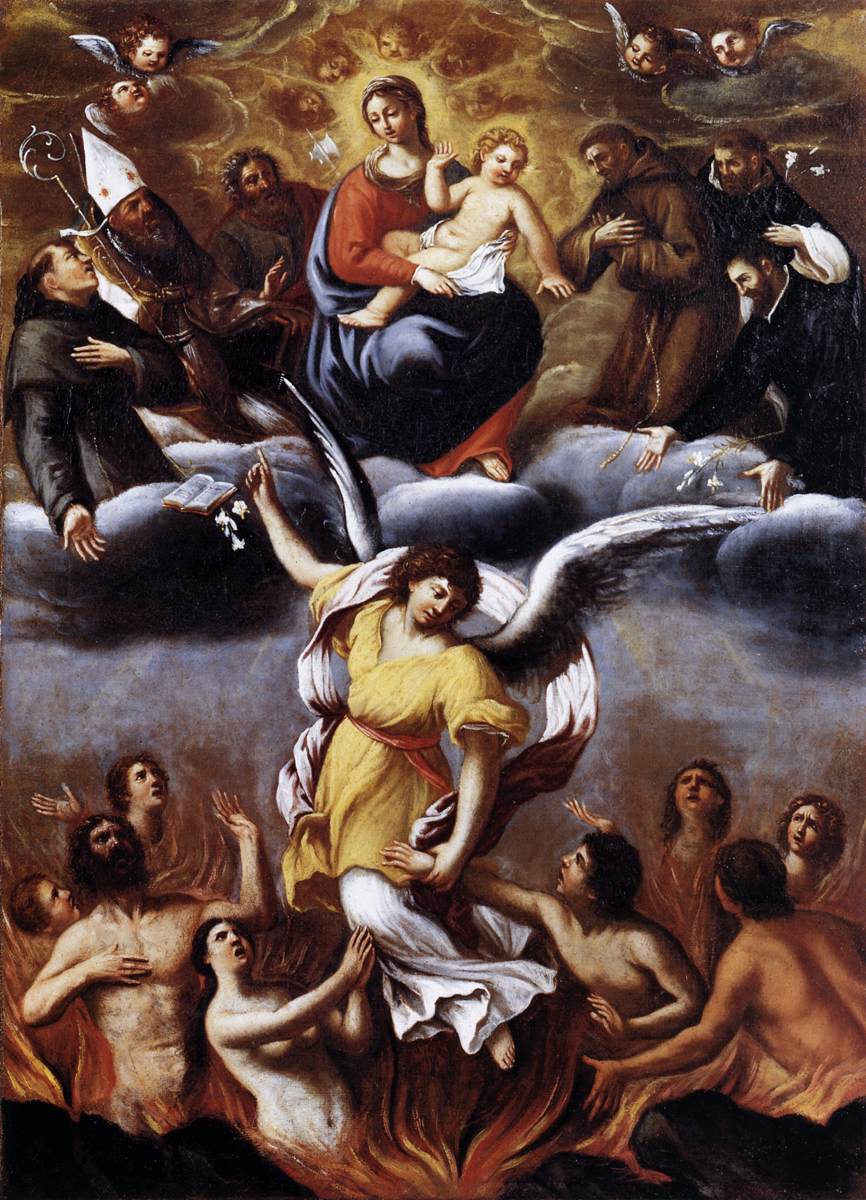
A fiery image of purgatory by Ludovico Carracci

Recently, a congregant received a mass card from Roman Catholic friends after her mother died. A certain number of masses are going to be said at a church community or through a religious community on behalf of the beloved departed. I often get the question in such circumstances, “What is this all about?”

That’s a great and common question. It is all related to the idea of purgatory. From several verses in the Bible and the Apocrypha (Old Testament books not recognized at the level of scripture by Lutherans, but respected), Roman Catholics had developed the idea of purgatory – a place where our sins would be purged after death in order to make us worthy of living with God. More sin meant a longer time in purgatory perhaps hundreds or thousands of human years.

Thought to be a painful process or place, Roman Catholics discerned those languishing in purgatory might be helped with prayers offered for their sake. (Again, they did so using some scripture and Apocryphal sources, but also some questionable human mythic ideas that popped up over time.) In short, they began to think people could make sacrifices, pilgrimages, etc. to help the dearly departed or themselves. This eventually came to include paying money to satisfy any debt for sin. That’s where paid indulgences came into popularity and eventually Luther’s 95 Theses in opposition.

Although paid indulgences don’t exist as they did in the 16th Century, the Roman Catholic Church still holds onto the idea of purgatory and the need for additional satisfaction for sin. Although some modern Roman Catholic theologians now focus on purgatory being more of a process than a place, you still find literature and devotions allowing for a certain number of years off any time in purgatory based on prayers (rosaries said or novenas for example), masses said where the souls of those in purgatory are prayed for (usually for a donation), or specified approved service or pilgrimages (for example, some pilgrimage completed and 0 or 500 years off). At other times no such benefit is promised. The benefit is discerned by the Church leadership under the Pope, not locally. Despite some changes in or diversity amidst explanations offered, old ways die hard.

Although Lutheran’s often pray at the time of death, funerals, and committals that Christ accept the soul of the departed into his care and keeping, we don’t agree with the idea of purgatory per se. We don’t feel there is firm scriptural proof for it. Luther did for a time seem to hold onto the idea that some kind of purging would happen, but this did not necessarily mean a place existed nor was it anything faith in the death and resurrection of Jesus couldn’t cover. If there is any “purging” (or in effect “purifying”) this isn’t something we worry about or seek to describe. We are saved by grace through faith in Jesus. That’s all we know clearly from scripture. That’s what we trust in. Luther used to argue, “Remember you are baptized,” and “Jesus doesn’t lie.” If you are Jesus’ through faith and baptism, you are saved. Yet, Lutherans and other Protestants (particularly the Reformed) sometimes still talk in terms of “glorification” after death which might echo the Roman Catholic view somewhat. Yet again, we all basically reject the Roman Catholic construct of purgatory.

That said, when someone Roman Catholic has paid for masses to be said for the soul of someone who has died, a “mass card” is often sent to let the bereaved family members know. The mass is said as an offering for the person to be acceptable before God. (There might be other names prayed for at the same time.) It is meant to honor and help the departed and comfort the grieving, so I just say thank you instead of entering any theological debate. It was a gift offered in love and their faith. If they ask about our faith in regards to this practice, I’m honest. In my heart, I trust my loved one is already covered by grace through faith. On the negative side, some Roman Catholic agencies and parishes (not all) can use paid for masses as a form of fundraising – not so unlike Luther’s hated indulgences. Its problematic on many levels even among the Roman Catholic faithful, but sadly, it does happen.

Leave a comment

Filed under Church History, Grace, Theology

Trust begins our Thanksgiving journey

Image from Pixaby. Used by permission.

Whenever someone is baptized, we gather in community (or at least a subset of our local community and the universal Church) to remember. We recall promises our Triune God makes to each of us every day, not only to the newly baptized, and we give thanks for the spiritual gifts we are all given for free. During the ritual, we proclaim a list of sorts for all to hear enumerating when God has used ordinary people and ordinary things like water to do miracles.

As ordinary people baptized and set free, we are then sent out in hope – an expectant, miraculous, mysterious body connected through the Holy Spirit – to separate places and spaces where God needs us to be. Wherever this road takes us, alone or with others, we are invited to reflect God’s light in what can prove a dark land. We find ourselves on a sacred journey, not necessarily and easy one.

Under persecution like the early Church or during times of pandemic, famine, economic crisis, or war as with any of the saints before us, our loving God remains the same, and we remain God’s beloved. As uncertain or hard as it might be to answer God’s call today, it is our time and place to be and remember that we are the Church. No one and nothing can ultimately stand against us with God on our side.

Much as God swore to Joshua after the death of Moses, God speaks to us. “I will be with you; I will not fail you or forsake you. Be strong and courageous…” (Joshua 1). It is our time to remember and trust. It is we who are now asked to help lead others to hope and light in the Lord. With God’s boundless love and help, we can give thanks in all circumstances (1 Thessalonians 5:16-18) in both word and deed. And what if we struggle to see the light ourselves? Jesus promises to somehow come to us. With all the Church throughout time, we can watch and wait, for deliverance – our joy is at hand and will be made complete. I know that such trust can be hard, but trust is the start of any thanksgiving journey.

This week, I challenge all of us to remember who God is. Scripture proclaims God is only love and that God loves and delights in us. We are never defined by our circumstances or our failures. We are defined by God who spoke us into being and calls us to this time and place. All is well with us. As hard or lonely or unusual as this year’s Thanksgiving holiday might prove, we remain God’s people. We can choose to give thanks. Wherever we are, however we find ourselves, God will never cast us aside. Indeed, Jesus and the Spirit have reached out to us to gather us in and lead us home. In that alone, we can begin to discover joy and peace.

Originally published in The Hub, a weekly email of Christ Lutheran Church, Fredericksburg, VA.

Unless otherwise indicated, all scripture quotations for this article are from the New Revised Standard Version (NRSV) translation.

© 2020 The Rev. Louis Florio. All content not held under another’s copyright may not be used without permission of the author.

Leave a comment

Filed under Pastoral Letter

Turn the other cheek and scroll away

For those that might still be wondering what all the recent Facebook hubbub about Parler is about, here’s a pretty reasonable article. I’ve seen plenty of old friends announcing their migration to this newer social media platform. As for me? I don’t often use Facebook for political stuff. I prefer to talk in person about weighty issues. On Twitter, I share more news articles but from multiple sources and usually little or no commentary.

I know there’s a lot of junk on these sites. (To be honest, let’s admit it’s from both the left and right.) I recognize attempts at curtailing bad or untrue comments by the social media powers that be has been sloppy at best and often seemingly lopsided. And yes, these platforms seek to manipulate us and limit competition. So, I try to ignore the junk and educate myself from multiple news sources with varied perspectives off of Facebook. I actually talk to live people which includes a lot of listening.

If on social media, I much prefer looking at funny memes, or pictures from my friends garden in Africa, seeing a morning walk of a congregant, and sharing joyful events like births or even sad or troubling events like surgeries or deaths. These can help us feel connected and cared for. Heck, I even enjoy my friend’s post who shares his photos of small, rural post offices. Simple joys can matter. Through social media, I’ve found weightier things such as positive resources for prayer and meditation and even some resources to consider future travel when the pandemic ends (or at least dream about it).

That’s the better side of social media, and to make that my focus helps improve my attitude for the day as well as shape what I say or post. I don’t need to personalize or catastrophize everything. I can choose to be happy. I can try to be patient, kind and understanding. I don’t have to be compelled to comment on everything. Those are powers we all have with some intentionality and God’s help.

And in reality, I doubt Facebook will last forever. Younger folks have already tended to move on. It will likely go the way of Six Degrees or MySpace unless it changes drastically. Whatever the platform we choose, I’ve seen too many relationships broken needlessly, and I don’t need that in my life. The world can be hard enough on its own. We don’t have to let that happen or play along with those less healthy than we might be. At the same time, that doesn’t mean we should cut off from everyone who thinks different than us.

Instead, we can turn the other cheek and scroll or click away without total cut-off, or cancelling, or condemning anyone to the fires of hell. We are free not to feel obliged to answer in haste or perhaps at all. We can wish others well even as we disagree or are offended, pray for them, and perhaps model a better way forward if we are right. If we discover we are wrong, we might learn something from them as well.

As I’ve said elsewhere, a new “thing” will certainly come along, but I’m just not sure I need another or new social media platform of any type in my life right now. In fact, I’ve been using social media less. That’s certainly helped make this election cycle and my life better. There’s plenty of research indicating that too much social media has led to social isolation, depression and other concerns.

Paul wrote (Phil. 4:8): “Finally, beloved, whatever is true, whatever is honorable, whatever is just, whatever is pure, whatever is pleasing, whatever is commendable, if there is any excellence and if there is anything worthy of praise, think about these things.” If that doesn’t sound like our Facebook or other social media feeds, maybe it’s we who are doing it wrong and not just the platform. Changes can be made for good based on our desires, resilience and love for others. For all those migrating, or staying, or totally turning things off, go with God wherever you digitally find yourself. You can always contact me in the real world to share your news. I’d be happy to hear it.

© 2020 The Rev. Louis Florio. All content not held under another’s copyright may not be used without permission of the author. 

1 Comment

Filed under Community Life

Be still this season

Photo by Valiphotos on Pixaby. Used by Permission.

With the excitement of our seven CLC youth confirmed on Reformation Sunday and our return to worship in the sanctuary on All Saints Day, we have many reasons to thank and honor God. But, as Martin Luther reminds us, works cannot on their own do this – “only faith of the heart can.”

As the year gets darker around us, let us look to the light which is Christ and welcome him by the warm hearth of our heart with joy. How? Perhaps we can better cooperate with the grace reaching out to us. Take some time to meditate on the scripture of the day. Participate in book studies and group discussions about faith. Integrate a discipline of prayer into your daily life. Seek to learn more about Jesus, not just as an historical oddity or mythic figure, but as he is. All that he has done, he has done in love for you.

If we don’t know the one who loves us, how can we welcome him well? How can we be sure that we aren’t worshipping an image of Jesus (one of our own making) rather than the resurrected Son of the Living God? Jesus wants to be known in our lives in an intimate way. He wants to reveal himself as much as he did for the disciples over a meal on the road to Emmaus. As with Paul, only Jesus can remove the scales from our eyes.

Like any relationship, spending time with the one we love and who loves us matters. Getting to know them and our taking the risk to become vulnerable opens us up to one another. There is so much more to learn about God’s great love for us, but it isn’t possible just through doing or thinking. We are asked to abide in Jesus. Take some time to be still this season – intentionally waiting for Jesus to speak – so that you will know all the more that he is truly your God.

This pastoral letter was originally published in Christ Lutheran Church’s October 2020 newsletter.

© 2020 The Rev. Louis Florio. All content not held under another’s copyright may not be used without permission of the author. 

Leave a comment

Filed under Pastoral Letter

We are now fighting over social media formats. Where’s my dislike button?

It was another innocent post run amok. A friend was considering migrating to Parler over concerns for alleged Facebook errors regarding policing of its site and allegations of outright censorship. A mutual acquaintance, a pastor, decried the use of Facebook in general for anything political. They found it best used for family connections and photos, not for “spouting off about politics.” He might not have meant to offend anyone, but it took only moments for someone to insult him. By not using Facebook for more important issues, someone implied, he must find Facebook’s practices expedient (politically?) or he is just a coward. I think there’s a wide variety of reasons to use or not use Facebook, not solely expediency or cowardice. And in this very exchange, I found a perfect example of how quickly the blessings of social media can go wrong.

I’ve never found Facebook or social media in general a great place to talk about politics. People seem prone to get angry and personalize things too quickly. People are easily misunderstood and talk at people rather than with people. Anonymous attacks are often the truly expedient and cowardly thing here, and attacking someone you barely know (if at all) from miles away, proves too easy. I suspect social media has a lot to do with our growing cultural and political divide these days, as well as the easy spread of half truths if not total falsehoods.

Yet, how can we influence anyone with what we understand as truth if we never interact due to our preferred social media bubbles? How can we humbly be sure that what we think is correct if fully so? Life isn’t as dualistic as social media can make things seem. I find there are other, better ways to talk about and address important issues. Face to face has a lot of benefits. If over a beer or other beverage, that certainly doesn’t hurt. People tend to listen better and be more respectful when together in person. We also communicate a great deal through our facial expressions and body language which gets missed in social media.

In person, I find I have a greater chance to have some form of lasting impact on someone, and I often feel I’ve come to a better understanding of things as well (either in affirming what I’ve come to believe or stretching my understanding in new directions). Preaching, teaching and (this day and age) blog posts or videos might prove more helpful and a more intentional way to share ideas – especially if a pastor/priest. Truth can get quickly muddled during social media’s pithy commentary, memes and jibes.

Facebook has a boatload of issues, perceptions of or very real censorship being one, but as for me, I don’t care what platform one uses. I just encourage people to remember their chosen platform’s limits and strive to use social media and interact in a way worthy of the name Christian. If it isn’t what one hopes, use it less or leave for hopefully greener passages.

With such limitations, I, like my fellow pastor-friend, find Facebook is perhaps best left to pictures/memes, family connections, and hearing about community events – not weighty discussions. It is demonstrably ineffective for that time and again. If one wants to migrate other places to discuss politics electronically (as many of my friends are), that’s fine with me too. Hopefully, it will prove better, but one never knows. I think it likely there will be limitations in any of these mediums at this point.

Will I migrate to another platform? Will I do several? I’m not sure yet or that Parler is a good fit for me or anyone. There are concerns over hate groups using it and other issues. I’ve not really looked into it. Again, I’m not a big fan of any social media even as I recognize it has some benefits. Plus, statistically, something new is always coming down the electronic pike. I anticipate Facebook will eventually go the way of Six Degrees, Myspace and others. I don’t feel a rush to change, but I won’t make fun of someone who does. I also won’t make fun of someone who wants to use Facebook or other social media for the weightiest of matters of all – to nurture loving connections with family and friends.

© 2020 The Rev. Louis Florio. All content not held under another’s copyright may not be used without permission of the author. 
Leave a comment

Filed under peace

Root of Bitterness or Blessing?

Image source: ykaiavu on pixaby.com

“Pursue peace with everyone, and the holiness without which no one will see the Lord. See to it that no one fails to obtain the grace of God; that no root of bitterness springs up and causes trouble, and through it many become defiled.” Hebrews 12:14-15

As I write this, it seems a bitter time. Some suggest the fall will see a spike in pandemic cases. Others fear or argue over the nomination process for the Supreme Court. There’s concern about the vitality of the economy, protests, violence, corruption and crime. The list could go on, but will listing out all that is wrong with our fallen world help us? In my experience no, and I think scripture agrees.

If we look at the world, ourselves, or others and only see the bad, we are making a mistake. I have done that in my past, and it led me into a dark and lonely place. It fractured my relationships. It might be human, but sin is very human too. Even in Martin Luther’s time, it was a “common evil plague that every one prefers hearing evil to hearing good of his neighbor; and although we ourselves are so bad that we cannot suffer that any one should say anything bad about us, but everyone would much rather that all the world should speak of him in terms of gold, yet we cannot bear that the best is spoken about others.” He challenged believers to: think the best of people (show them compassion and grace); to consider why in their woundedness they might be acting or speaking as they are (practice empathy); to not rush in judging (where we might fall into sin that is greater, acting as if we are God). Simply put, if we see the world in simple terms of clear good and evil, our vision is impaired. We are the one’s who choose to wound ourselves. Then like a sickness, anger, cynicism and sin can and will most certainly spread to others.

Sometimes, I find it hard not to get angry at others. Yet, when I struggle, I try to remember the warnings and encouragement of scripture and our Lutheran confessions. “We love because God loved us first.” If Jesus had not risen from the dead, if he did not promise to return, if he hadn’t said that there would be times of trial, fear and even persecution, but we would be and are ok, perhaps then scorn might be justified. Instead, we are asked to remember that Jesus is the vine and we are the branches. He’s the anchor we can trust in during any storm. Jesus has already made us victors over sin, death and the devil, and we can choose to love – love even those that don’t deserve it or love us back – no matter what happens because he loves us.

Now, I’m not saying consequences or tough actions are never needed. I’m asking, as I ask myself, “Why are we doing what we are doing? How does it reflect Christ’s own love for us?” We need not act like “everyone else.” We are to be in this world but not of it, and that’s a tough spot to be in. Yet it remains true, that we are baptized. We are forgiven and loved. We are empowered by the Spirit to be ambassadors for Christ’s kingdom no matter what political winds blow. Just as evil can spread person to person, so can the justice, peace and love of God. What will we choose to be part of in this world – a root of bitterness or blessing?

Yes, people can prove difficult, ignorant, or worse. I can’t deny it. Yet, they are only human after all. And the world can be unfair, but so is God’s grace. Despite all the storms raging around us, we have been chosen to be like the first bow God put down in the sky declaring a beautiful and everlasting peace.

Unless otherwise indicated, all scripture quotations for this article are from the New Revised Standard Version (NRSV) translation.

This pastoral letter was originally published in Christ Lutheran Church’s October 2020 newsletter.

© 2020 The Rev. Louis Florio. All content not held under another’s copyright may not be used without permission of the author. 

Leave a comment

Filed under Pastoral Letter

The Door’s Open

“To preach Christ is to feed the soul, to justify it, to set it free, and to save it, if it believes the preaching.” – Martin Luther

This fall, the ELCA marks the 500th anniversary of Martin Luther’s early important work, The Freedom of a Christian (also known as On Christian Liberty and other similar names), and we will remember it as well at Christ Lutheran. Why? Well, through this early work, Martin Luther decisively influenced the entire Protestant movement in all its forms. As the theologian Dietrich Oppen noted, “As such, it is one of the great documents of world history, a work which opened doors to the future, first in Luther’s time and still in our own.”

Starting on Thursday, September 10, at 10:00 am, join me as we journey through this important work anew or for the first time. Our sessions will help us better understand the mystery of Christ, especially Christ’s work in and through our daily lives. Participants will be provided a pdf copy of the text (which can be printed out or read electronically), but the text is also widely available for purchase if you prefer. A special anniversary study guide will also be provided. Recognizing both the importance of this work and busy schedules, sessions will be recorded and posted on our private Facebook group, but the sessions’ quality and impact will improve if you make an effort to attend together live – willing to share both your faith and questions about faith with others. Don’t worry if you can’t make every session, as always, just come as you can.

In these challenging times amidst much fear for the future, I cannot emphasize enough how important it is to trust in Christ’s saving, active love for each of us and our world. Like the earliest disciples, we are called to certainly watch and pray, but we are also asked to be Christ in the world. God has a purpose for you and I to fulfill in this time and this place as unlikely as that might seem to us. Doubts may grow strong, but they are never stronger than Christ’s love for us or his purpose.

My hope remains that – whether you find yourself out in the world or find yourself restricted to serving Christ’s Church from home – these sessions bless you to be a blessing. I also pray that they nurture a joyful, certain hope to be found in our shared future as children of God. You and I have been set free for a purpose, and so as my friend and spiritual mentor Br. Roger of Taizé once wrote, “Set out, forward, one step at a time, from doubt toward faith, not worrying about the impossible ahead.” The door has been opened by Christ alone. Let us walk through it together.

I remain in communion with you and love you,

Pastor Lou

For the ELCA’s curriculum and/or a free copy of Martin Luther’s “The Freedom of a Christian” visit elca500.org.

If you have interest in our congregation’s class, please contact me.

© 2020 The Rev. Louis Florio. All content not held under another’s copyright may not be used without permission of the author. This letter was first published in Christ Lutheran Church’s September 2020 newsletter.
Leave a comment

Filed under Pastoral Letter

God remembers

O give thanks to the Lord, call on his name, make known his deeds among the peoples. Sing to him, sing praises to him, tell of all his wonderful works. Glory in his holy name; let the hearts of those who seek the Lord rejoice. Seek the Lord and his strength, seek his presence continually. Remember the wonderful works he has done, his miracles, and the judgments he uttered, O offspring of his servant Israel, children of Jacob, his chosen ones. – 1 Chronicles 16:8-13 (NRSV)

After the followers of David defeated their enemies and settled in Jerusalem, David wanted a place for the Lord to live among God’s chosen people. At first, the Ark of the Covenant was brought to a specially prepared tent pitched centrally among them. David’s instructions echoed the formation the Israelites had used under Moses as directed by God to travel through the wilderness. The central placement of the Tent of Meeting was to symbolically remind them that God’s ways must remain central in their individual, familial and communal life.

The Israelites had been through a precarious time, but God had led them this far. More difficulties certainly lay ahead, but they trusted God would continue to lead them. Their vision remained clouded and eclipsed by challenges of many kinds including their own sinfulness. Yet as has always been true for those who trust in God, “for you who fear my name, the sun of righteousness shall rise with healing in its wings” (Malachai 4:2a). No matter the time or place, we are to seek God, give thanks, and try our best to share the light of God’s grace and love as called and able, because God continues to know, claim and love us.

As our own way forward seems currently clouded by pandemic fears, social injustice or unrest, and perhaps other doubts galore, remembering the past faithfulness of God’s love at work in our lives, our family, and within the history of our family of faith can prove helpful. As we have talked about before, among the many words God offers us through scripture, we find the word “remember” to be among those most often used. The same God who loved us and our forebearers of the past, loves us now, and God promises to love us for eternity. The proof? We can find it in God’s steadfast love for us throughout the ages.

Life will be hard, and our way forward remain uncertain at times, but God is with us and at work. We are chosen and claimed, placed in this time and context, to reflect God’s own light while being used to help fulfill God’s plans for all people. Through our faith and baptism, God has forgone a tent or building located in the heart of a community and desires to reside in and work through our hearts instead. God has prepared a place in us because God always remembers us and longs to be with us. More wonderful works, miracles and judgments are surely yet to come. 

Originally published in the July/August 2020 newsletter of Christ Lutheran Church, Fredericksburg, VA.

© 2020 The Rev. Louis Florio. All content not held under another’s copyright may not be used without permission of the author.

Leave a comment

Filed under Pastoral Letter

Invite the weak. Don’t sacrifice them.

Photo credit: WKRN screenshot

I wouldn’t post this if it weren’t for the fact I see too many friends on Facebook expressing the same opinion in not so many words. “Sacrifice the weak. Reopen the economy.” A simple, utilitarian approach is antithetical to Christian faith.

No, we need not unnecessarily “martyr” the economy nor “sacrifice the weak.” Yes, I understand that sacrifices will need to be made, among all, and these sacrifices won’t always be perceived as fair. Life isn’t fair. Yet, we do need to remember the “least of these” and the most vulnerable of our society as we seek a way forward. They must remain an important part of our “equation.”

Out of love for our neighbors, some freedoms and prosperity might need to be given up freely; not out of obligation but in love, at least for a time. There is no other way forward if we want to walk with Christ. Loving your neighbor cannot be based solely on death counts or the perceived liabilities of “others.” Who rightly judges who is “weak” and without worth? That’s the way of that past in Nazi Germany and the Soviet Union.

Tough economic decisions can’t be based solely on fear of the virus nor fear about where our daily bread will come from. We can and must do better. Jesus said, “…But when you give a banquet, invite the poor, the crippled, the lame, the blind, and you will be blessed. Although they cannot repay you, you will be repaid at the resurrection of the righteous” (Luke 14:13-14). If you hope to someday celebrate an economic recovery, you might just want to invite these folks as well.

© 2020 The Rev. Louis Florio. All content not held under another’s copyright may not be used without permission of the author.

Leave a comment

Filed under Uncategorized