
The following is a short sermon I preached to my congregation at Messiah Lutheran Church and School, on the Third Sunday of Advent, often called Gaudete (Rejoice) Sunday. Although our preschool students and elementary-agers were present to perform a joyous Christmas musical, the death and sadness of the last week, especially in Newtown, CT, could not be ignored.
As our last hymn [O come, O come, Emmanuel] reminds us[i], the Advent season is a time of waiting and expectation. The song is much like many others among our Advent hymns and even some of our more traditional Christmas carols. Many project a sense of sadness and longing. They can prove almost melancholy. Our hymn writers and liturgists – just like us – know the imperfections and pain of this world, and so we look toward Christ to deliver us. Our music, images, and prayers can reflect that sense of loss, waiting and hope. Being a Christian, I heard someone once say, is like being a person separated from their greatest love; something is missing, and not quite right. We hunger and thirst for that love to be one with us again, so that our lives can feel whole.
This week, we have been unhappily reminded of that truth. We lost our assistant to the bishop, Pastor “Chip” Gunsten, a dear friend of mine and many here at Messiah as well as throughout our synod, who died suddenly while undergoing treatment for cancer. We are not the only ones mourning, for our Catholic brothers and sisters lost their former beloved bishop, Walter Sullivan on the same day. He was someone I knew well, and he proved influential to my own discernment of service within the church. Our Presbyterian friends in Virginia lost one of their own leaders as well, Cynthia Bolboch, Moderator of the 219th General Assembly of the Presbyterian Church (U.S.A.) on December 12th. Having many Presbyterian friends after attending a Presbyterian seminary, I shared in their own grief and sadness. As the week closed, I was tired and worn down from dealing with death and the many emotions that always accompany it. Then, we received the horrific, numbing news of Newtown, CT. People thousands of miles away shared in that community’s dread and grief and fearfully held their own loved ones closer.
How can we make sense of such things? I’m not sure that we can. Oh, as a Christian, I trust that God can use them – turn them on their head and make all things work for our good. I know blessings and signs of love can be found even amidst tragedy – perhaps especially at times of tragedy – through the heroes and servants shining in those times of darkness, or through the love that is shared with us to help us make it through. Yet, maybe we are never supposed to make sense of these things at all. It isn’t within our capabilities to make sense of the nonsensicle. The issues can be too involved for us to handle or beyond us. Maybe they just can’t ever make sense, because they are counter to what God wants for us. God’s will is to save us for a future full of hope, not to condemn us to an eternity of woe[ii]. God’s plan from the time of Adam and Eve was to redeem and save us out of love.[iii]
These sufferings are symptoms of that earlier wound. They are parts of our life as a fallen, imperfect people in a fallen, imperfect world. People sin. People suffer. People die. Uncontrollable evil and sadness do exist. Perhaps instead of looking back for answers as to why things happened, we should look forward. Our time is better spent in the face of such evil asking, “What would you have us do, Lord?”
Certainly, God never abandons us to this sorrow. God has a purpose and a plan which includes us. Jesus was sent into our world as a little child to share our life and lot; even our suffering unto death. God doesn’t rejoice at our destruction, but rather wants us to live abundantly through his only son.[iv] Jesus would become God’s final word on evil, sin and death. They have been defeated through his cross and resurrection, and we are saved here and now. Yet, sin and death are enjoying their final death throws at our expense. Jesus declares we are free from their power; saved even as we and creation might groan at times.[v]
In this present age, Jesus promises to come again to complete the work which he started and banish sin and death forever. There will be a new heaven and earth where suffering will be no more.[vi] In the meantime amidst our lingering troubles, he asks us to look up and be ready, not as a sullen or defeated people, but as his beloved people. Be ready, he says, so that our hearts are not weighed down with dissipation and drunkenness and the worries of this life, so that the day doesn’t catch us unexpectedly, like a trap.[vii]
No, we who are saved have a purposeful, divine work to do. We are left here – called to this time and this place – as his messengers speaking his words of love, healing and forgiveness; words so sorely needed in this wounded, combative world. Like the law and the prophets before him including John the Baptizer [viii], Jesus taught us what we need to do – love God with all we are and our neighbors as ourselves.[ix]
Today both despite our suffering and because of it, we are to speak these words and embody them. God uses us with all our weakness and imperfection to give them form and substance, flesh and bone, to make them real. We are echoes of Jesus crossing all the earth shouting, “Do not be afraid! Jesus has come! He is risen and will come again!” We are called to lovingly and boldly put these words into actions together as church…Christ’s church…his body…his hands reaching out and touching broken lives through our own.[x]
Today, we have also heard words that Paul spoke to Christians in Philippi when they were persecuted, broken and felt alone. These same words were shared with us yesterday at Pastor Gunsten’s funeral. Perhaps it is providential that the lectionary had them as one of our assigned texts considering recent events:
Rejoice in the Lord always. I will say it again: Rejoice! Let your gentleness be evident to all. The Lord is near. Do not be anxious about anything, but in every situation, by prayer and petition, with thanksgiving, present your requests to God.And the peace of God, which transcends all understanding, will guard your hearts and your minds in Christ Jesus. (Philippians 4: 4-7)
Rightly, Jesus is called Emmanuel, God with Us. We need not get stuck in our fear, hurt or anger. Look up! Raise your head! Do not be afraid! These are the words Jesus speaks to us in the face of our most unimaginable threats or losses. When the world and its realities rage, when struck by great sorrow, or when we cannot find reconciliation with others we so deeply long for, Jesus speaks to us as he did similarly to that storm long ago, “Peace I leave with you; my peace I give you. I do not give to you as the world gives. Do not let your hearts be troubled and do not be afraid.”[xi]
This world can be a frightful, sad and lonely place, but we need not grieve as people without faith.[xii] We need not live as a people without love.[xiii] Despite any of our doubts, Christ’s peace and love are with us always[xiv], and we have a shared ministry to do in his holy name.[xv] His light is in our midst and shining through our hearts, and the darkness shall not overcome it.[xvi] Remember always that we are baptized – claimed and called, to be Christ and to serve Christ in the world.[xvii] We must never try to hide ourselves from the pain of this life and thus not truly live.[xviii]
We are Christ’s church, together with Jesus and thus never alone. He has come for us and will come again. Our longing will be vindicated. This truth is rightly celebrated at every moment and forever, but especially during Advent. We celebrate it this morning through our young people attending Messiah Lutheran School who have come to proclaim the story of Christ’s birth with us anew today.[xix] Amen.
Readings for the Third Sunday of Advent – December 16, 2012
Zephaniah 3:14-20
Isaiah 12:2-6
Philippians 4:4-7
Luke 3:7-18
[i] “O come, O come, Emmanuel, and ransom captive Israel, that mourns in lonely exile here until the Son of God appear. Rejoice! Rejoice! Emmanuel shall come to you, O Israel. (Evangelical Lutheran Worship, Hymn 257, verse 1)
[xiv] In Mother Teresa and Brother Roger’s book called Seeking the Heart of God (1993), Brother Roger writes: “Four hundred years after Christ, a believer names Augustine lived in North Africa. He had experienced misfortunes, the death of his loved one. One day he was able to say to Christ: ‘Light of my heart, do not let me darkness speak to me.’ In his trials, St. Augustine realized that the presence of the Risen Christ had never left him; it was the light in the midst of his darkness.”
[xvii] At times of fear or doubt, Martin Luther is said to have reminded himself, “I am baptized”; a reminder that he was Christ’s called, claimed and sent child. His writings also indicate that we act as Jesus in the world, but also encounter Jesus in the least of these, those suffering and alone. Through their lives Jesus cries out to us for compassion.
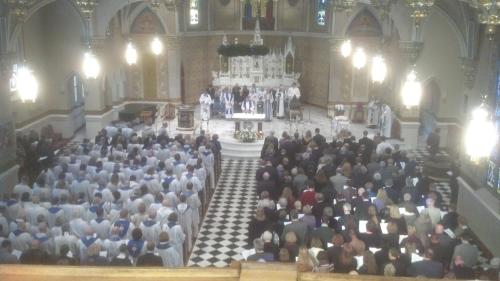
The Funeral of the Rev. Paul “Chip” Gunsten by The Rev. David Delaney, Ph.D
Unless otherwise indicated, all scripture quotations for this article are from the New Revised Standard Version (NRSV) translation.
© 2012 The Rev. Louis Florio. All content not held under another’s copyright may not be used without permission of the author.




 2pennyblog