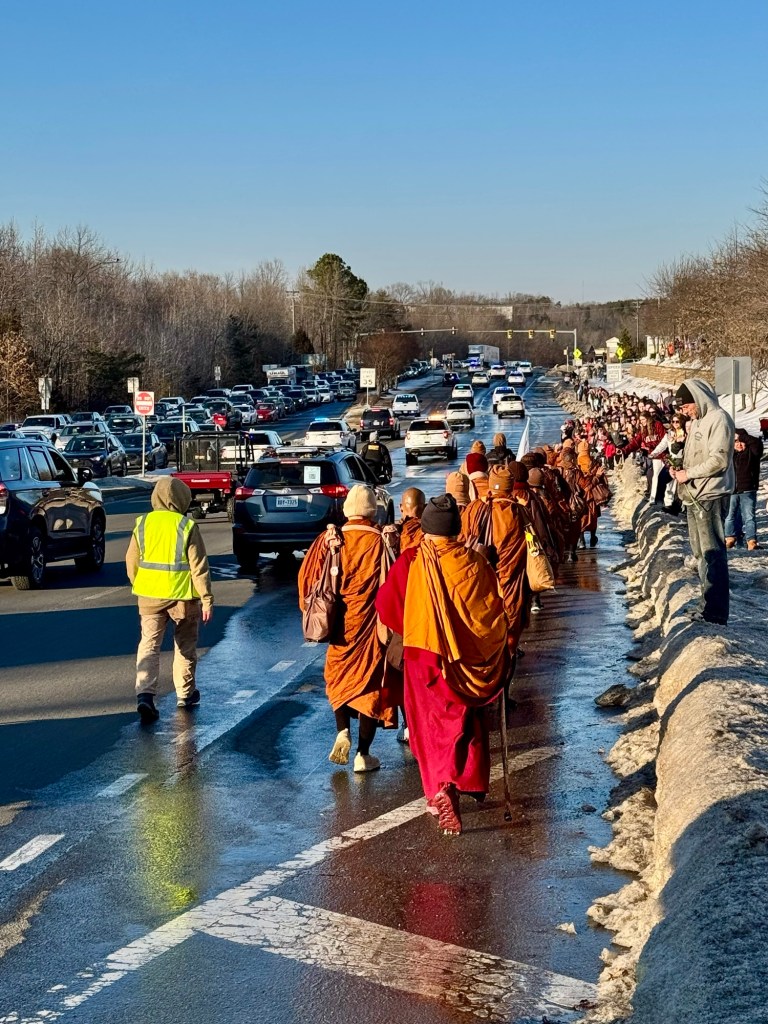
“I’ll see you in the funny papers” is a phrase reportedly dating back to the 1920s. It was a lighthearted way to say goodbye. Yet true goodbyes are never easy, especially when forced upon you by unfortunate events. Due to a reported financial crisis at my most recent congregation, I was advised in October by leadership that there would be a recommendation made to transition to a single pastor model. So, long story short, I’ve resigned in exchange for a severance package.
Today (December 1, 2025 as I write) was my first day without a full time call since ordination in 2007. My office is empty, some tears have been shed over these last weeks, but my heart remains full and hopeful. I will be working with the bishop’s office to discern my next call in a congregation or in some other role. Prayers are appreciated as I seek whats next, although I firmly believe God’s in the mix and always working for my (really our) welfare. You can learn something from bad experiences as well as good even if only to hold on to God more tightly than one did before. (God will ultimately never disappoint.)
Indeed, wherever we go, whatever our vocation or situation, we can always love and serve God and neighbor, and that’s been a source of great joy throughout my life – working, laid off; in higher income positions, lower income positions, or with no income at times. (I’ve been through all such periods before having worked in both secular and faith based positions.) I firmly believe that money is really only a tool. It’s the giving and receiving that comes through love based relationships and service that makes one truly rich.
Farewell gathering (November 16, 2025)
Looking back, I will certainly miss most deeply the youth at my recent congregation as I walk on, and I will always love them. I witnessed unique gifts in each one of them, and I found blessing through our time together. (I hope they did too.) As with others who I have come to love before through my police work, volunteering with the Community of Taize,’ as a houseparent and teacher at St. Joseph’s Indian School, as a researcher and writer at First Nations Development Institute, or while serving as a hospice and hospital chaplain as well as many other places and spaces, I know they have become part of who I am and how I will love and serve the Lord and others forever. The communion of saints is real, and nothing can truly separate us when God has connected us through love.
My favorite comic strip as a young adult was always Bloom County, and it still can make me smile reading the old strips that are now digitized or in collections on my bookshelf. As a fan, I developed a special affinity for Opus the Penguin. I admired his innocence and how that could lead him to make keen if ironic observations about life. I came to think of him this week in relationship to my current situation. In the “final” strip, you see the familiar scenes empty of life. The colorful artwork fades to white within the panel, and Opus waddles on into the unknown to the distress and sadness of fans. (He looked sad, too.)
Bloom County, August 6, 1989
Yet ultimately this departure led to new books, totally new comic strips with reimagined characters and plots, and adventures on television including a Christmasspecial. Bloom County even came back after a prolonged absenceas the original comic strip in recent years thanks to social media. So maybe there’s something we can learn from the funny papers after all. Life is not always easy. It won’t always be funny or fun. Yet who one shares life with brings joy to our journey. And a somewhat innocent, hopeful attitude can help us on our way no matter how many times life knocks us down.
Best of all, our own story never really ends…God’s making all things new (Isa. 43:19). Thus, I guess it’s time for me to waddle my way toward what God has in store for me next. I can do so boldly and with confidence (with the Spirit’s help and support of family and friends anyway). Whatever condition I might find myself in, it can serve God’s will and prove to my benefit. For as Paul writes, “And we know that in all things God works for the good of those who love him, who have been called according to his purpose” (Romans 8:28); including within any unexpected end to one’s position or perceived security.
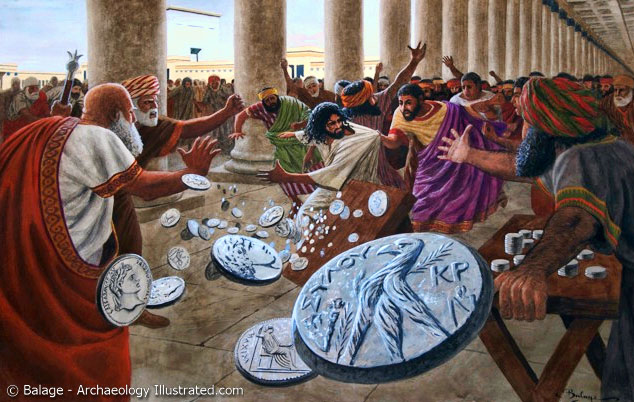
Image: Charles O’Donnell, Detail from “Ancient city of Jerusalem with Solomon’s Temple,” ca. 1871.Public domain, via Wikimedia commons.
The below sermon was preached on Reformation Sunday, September 28, 2025, following the Narrative Lectionary (Year 4). The preaching text was 1 Kings 5:1-5; 8:1-13.
For those who might not know, the Books of First and Second Kings were originally one book. The stories within cover an expansive narrative of Israel’s kings from the end of David’s reign through the Babylonian Captivity. (That’s about 400 years.) In them, you can discover ancient history with moral and ethical high points, and often people who fall short in their love for God and neighbor.
Today, we join King Solomon, David’s son, blessed with great wisdom by God, as the nation dedicates its long-awaited Temple for their God on Mount Moriah in Jerusalem. With that gift of wisdom, Solomon had led his people well. Israel was experiencing both peace and prosperity. His God given gift has led to this great blessing for the people of Isreal. They are a people whom God has declared Qodesh Olam, “the Holy People of God.” Yet, they aren’t Holy because of anything they do. They are holy because God has chosen them, loves them, and wishes to live among them.
Yet hold on to your hammers and nails, you good Lutherans out there (it is Reformation Sunday after all), because there’s much more to this story. The Temple Mount and the Temple itself have long been a part of salvation history before we ever come to this day of Temple dedication – the Temple being what becomes the center of all priestly activities and place of cultic sacrifice. You might recall the story of Abraham binding Isaac so that Isaac might be sacrificed on a mountaintop in the Land of Moriah. In lieu of this, God provides a ram to be sacrificed. This is believed by many Jewish, Christian, and Muslim persons to be the site of what is now called the Temple Mount. You can find a large bolder there located under the present-day mosque which people suggest is where it all happened.
As the story of the Jewish people unfolds through a time of slavery in Egypt and beyond, we eventually get to King Saul. The people have been tribal and nomadic once in the Holy Land. The were anxious to move from governance by tribal leaders, known as Judges, toward governance by kings. God indicated that the Israelites did not really need a king. God was their ultimate king. Still, God said, “OK.”
Then, when David replaces Saul, he conquers a city, named Jebus, owned by a foreign people. Now firmly Isreal’s, David renames the city, Jerusalem. It will become their capital. He joyfully dances before the Ark of the Covenant as it is carried to be placed within the Tent of Meeting. As the Tent of Meeting and the Ark moved through the desert with Moses’ people, wherever they people camped, it was always placed in the center of the Tribes. Symbolically, this reminded them that God and their Holy Covenant was to remain central to their lives within community. The city itself was also chosen to be the capital because it was in a relatively central, neutral location between the twelve tribes, had strong defenses, and was where the story of Abraham and Isaac occurred. Jerusalem would become where the Tent and Ark would now dwell.
As the nation grew and David and his people looked around at other growing nations or city states, David began to think, “Hmmm, maybe we need a great Temple to honor God as well as our nation.” That’s what all his neighbors had after all, so why not Israel? Well, through the Prophet Nathan, God basically says, “I was perfectly happy traveling with you in the wilderness within the Tent of Meeting. I don’t need a Temple…but if you do, ok.” God relents once again. Yet because of David’s sin and other faith issues, always still beloved by God, God decrees that the Temple will not be built until David’s son becomes the king. This is not too unlike Moses when he was not allowed to see the Promised Land. David never gets to see the Temple.
Finally, we arrive back to the glorious dedication of the Temple with Solomon. Seven years have passed since work began with a great financial cost, the investment of lots of sweat and toil, and like modern construction sites today, perhaps at the cost of some lives as well. That would be likely. Great excitement and joy must have been generated in the city as the Israelites prepared to move the Ark from Mount Zion to the neighboring Mount Moriah.
Again, today this location is known as the Temple Mount. All the religious and political leaders are there (the “insiders”), but all the commoners and less than common people are there too (the average people and the “outsiders”). All the people, no matter how rich or poor, weak or strong, perfect or imperfect, have been decaled the Holy People of God, so they are there. The covenant and promises made with Abraham, Moses, and other patriarchs include each and every one.
God will reside in the inner sanctum of the Temple, an area available only to Priests and hidden behind a large curtain. (This curtain will tear as Jesus dies. Some suggest this symbolizes the Kingdom breaking into our world through Jesus’ death and resurrection.) Golden cherubim located opposite one another over the Ark will sit with wings spread toward one another. This will continue to serve as God’s throne, his “mercy seat,” where God’s presence was said to dwell, and the ultimate God would mercifully deign to speak to and bless his Holy People. They must have thought that the Temple might last forever just like their God…but it didn’t. Babylon will invade Israel and destroy it. Cyrus the Persian will defeat the Babylonians and rebuild it. It will be defiled later by the Greeks and even later conquered by the Romans.
Then, Herod the Great, will be installed as a vassal king serving Rome, and he will look at the Temple and think in his pride, “We need better to reflect my glorious reign.” And as we know from scripture and historians of the time, he was not a great believer, but Herod the Great understood politics. His expansion of the Temple would beautify a place for faithful people to gather, but it was also a place to reflect his own glory as it becomes through its size and splendor a Wonder of the Ancient World.
Yes, Herod the Great’s work will become the Temple that Jesus and his Apostles would know and love. It will be the Temple the Apostles will marvel at before Jesus’ death because of the large and ornate stones. Yet Jesus would respond, “As for these things that you see, the days will come when not one stone will be left upon another; all will be thrown down” (Luke 21:5). Later, Jesus will declare that he will become our cornerstone (Luke 20:16-18). The Apostles and world will soon learn that life has never been about just nations or kings, tents or temples, sacrifice or worship. Jesus wanted to build a Church out of you and me and millions of others like us. Over the centuries as had happened with the Jewish People, what will matter most is that God comes again and again, despite our pride or mistakes, success or failures, to form us into one Holy People of God. We will stand together forever through God’s power, promises, and help.
And when the Temple is finally destroyed in 70 AD, and all that fine furnishings, holy vessels, and wealth were carried away by the Roman Legion to Rome, we see that Ecclesiastes was right. “All is vanity.” The earliest Christians finally came to understand promises of old in a new way. From Ezekiel we hear, “I will give you a new heart and put a new spirit in you; I will remove from you your heart of stone and give you a heart of flesh. And I will put my Spirit in you and move you to follow my decrees and be careful to keep my laws” (Ezekiel 36:26-27).
No temple, church building, or anything else is needed other than faith in Jesus. For through faith, we become a “living temple” where God has longed to reside. Yes, it was God’s plan all along. Just as a cloud filled the Temple, the Glory of the Lord hungers to fill us and overflow. It desires because of love for us to dwell in our hearts and make us one through God’s own Spirit.
As Professor Amy Oden suggests,[i] I think people do like to try to put God in one place…to restrain God and define God for their own advantage or comfort…or to limit or doubt the capacity for God to save (perhaps not always wittingly)…or maybe it is because they don’t yet fully trust God’s love or love God fully with their hearts. Despite human doubts and darkness, or any evil of this world, likely because of it, we are told the Spirit is on the move (Genesis 1:2, Acts 2:1-4). God is doing new things (Isaiah 43:19). And God guides and blesses us on our way as we move through valleys of darkness and the heights of joy (Psalm 23).
Certainly, temples can be destroyed. People and their congregations will die before Jesus returns. Yet, we are to always trust God’s great and steadfast love for us. For even as we stand between hope and despair, God becomes our bulwark defending the weak and helpless (Psalm 9:9, 12:5). “Nations are in uproar, kingdoms fall; [God] lifts his voice, the earth melts,” and yet, the God of Jacob proves our mighty fortress (Psalm 46:6-7, NIV translation).
Friends, we might not always feel like it, nor live up to it, but God has declared that we are the Holy People of God. We have become Christ’s body by our faith and baptism through grace alone. Whatever comes our way, through fire or pouring rain,[ii] as the Evil One devises any plans,[iii] we need not be shaken. Although our own strength might fail us, God never will.[iv] God’s love and mercy will see to it that the Holy People of God will stand eternally. Amen.
[i] Ogden, A.G. Commentary on 1 Kings 5:1-5; 8:1-13. Working Preacher.
[ii] Bethel Music. “We Will Not Be Shaken (Live).” We Will Not Be Shaken, Bethel Music, 2015.
[iii] The Imperials. “Let the Wind Blow.” Let the Wind Blow, Myrrh/Word Records, 1985
[iv] Martin Luther, “Ein feste Burg ist unser Gott.” 1529.
The Apocrypha including texts like the Book of Sirach is not considered part of the Protestant cannon of scripture, but Martin Luther did suggest the Apocrypha was “profitable and good to read.” The Apocrypha is a collection of works primarily in Greek, and they can help provide historical context for the period between what is identified as Jewish scriptures and the Christian scriptures. They also can help us better understand God and our world.
As they contain teachings that some traditions find unbiblical, they can be challenged. Jewish people of Luther’s time and today have consistently found that they are not the level of scripture. That said, the Roman Catholic and Orthodox world both consider the Apocryphal texts scripture, but they do recognize some different texts as part of those works. So, there’s no fully ecumenical or interfaith consensus. Our Lutheran bibles often include them with explanation (and we do study them in seminary), but I’ve read some Protestant editions began to drop them over time after the Reformation to help make the Bible more affordable. So, they aren’t always well known.
And still, some Evangelicals and others – like Pat Robertson who I saw once denounce them as dangerous – have had no use for them. It’s a minority voice among worldwide Christianity, and I have suggested that if such people don’t want you to risk reading the Apocryphal texts, then perhaps they should offer the same counsel about their own writings available for purchase. For, those aren’t scripture either.
I stand with Luther. There’s no consensus among Jewish traditions nor Christian ones regarding them. That gives me pause to consider them scripture. Yet, they are profitable and good to read, for historical insights or wisdom including this saying by Sirach about friends (Sirach 6:14-17):
14 A faithful friend is a sturdy shelter: he that has found one has found a treasure. 15 There is nothing so precious as a faithful friend, and no scales can measure his excellence. 16 A faithful friend is an elixir of life; and those who fear the Lord will find him. 17 Whoever fears the Lord directs his friendship aright, for as he is, so is his neighbor also.
Through chapter 6, he argues, “True friends are discerned not by prosperity (v. 11), but through the trials of adversity: distress, quarrels (v. 9), sorrow (v. 10) and misfortune (v. 12) (USCCB Daily Readings, 2025).
The Book of Sirach which was written in Hebrew remains the oldest example of such wisdom literature. It is absolutely applicable to modern times as it addresses friendship. Similar to Proverbs or Ecclesiastes, it offers helpful sayings about ethics written by Yeshua ben Eleazar ben Sira (Ben Sira), a Hellenistic Jewish scribe of the Second Temple period, yet it also can inspire or encourage.
Friends prove a treasure as other scriptural texts and my own life suggest. Friends helped me reconnect to the Church and lift me up after traumas in my past. Friends helped identify my call as a pastor, and they have concretely and through prayer supported my work. Friends helped me as I grieved the death of loved ones, faced cancer, or experienced past jobless periods in my life. In many ways, I discover Gospel truth and holy wisdom through them, not of the level of scripture but true nonetheless.
Friends, new and old, I covet your prayers always, and give thanks for you as I pray. Peace+ and love be with you this day and always. Yet if you ever find yourself doubting or afraid, if you ever feel like giving up, remember your trusted friends. For Christ is waiting in their hearts ready to help and embrace you.
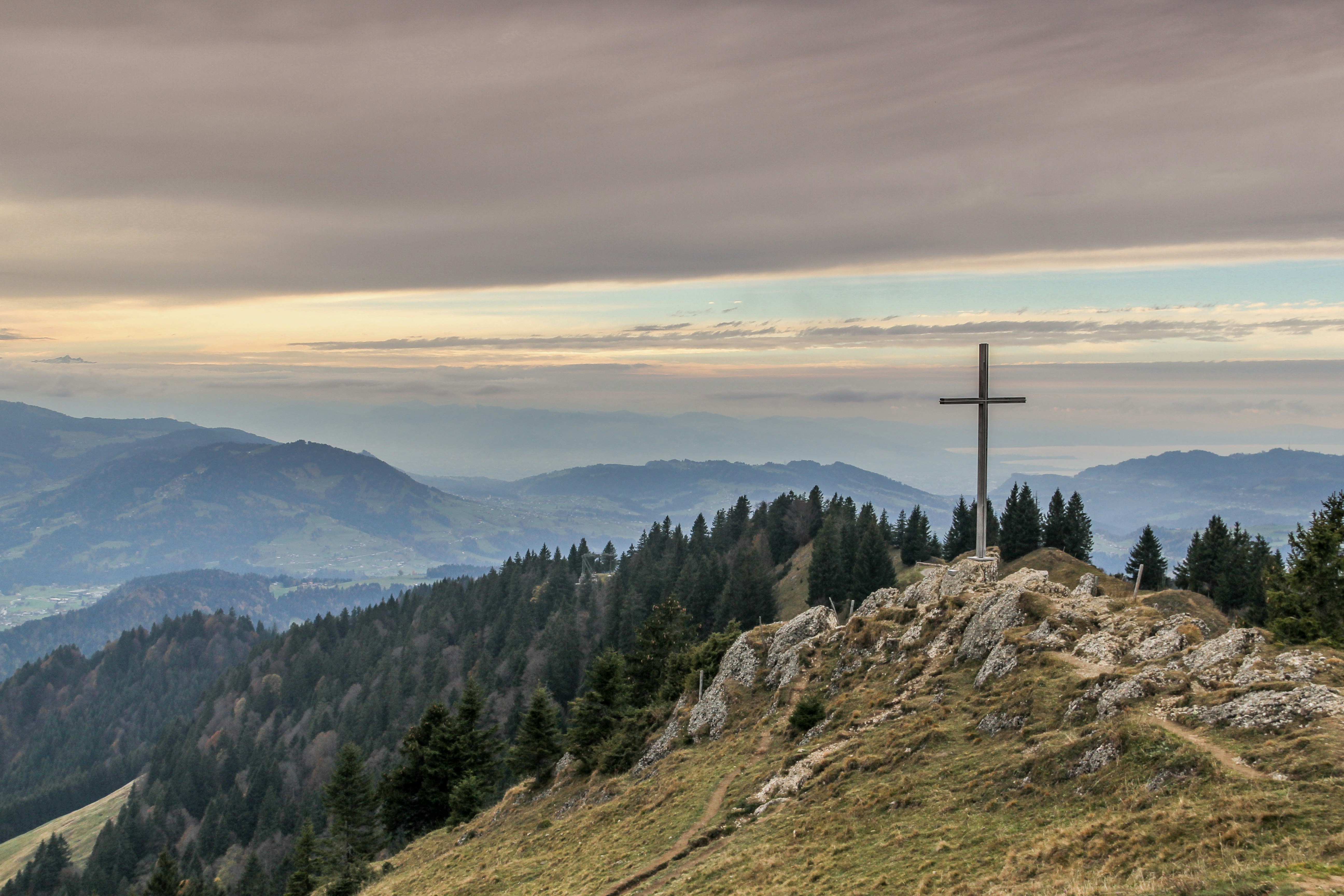
Image: VMI Cadets on House Mountain, from House Mountain Reserve and the Virginia Military Institute. They retain all rights.The words below are my own, and do not reflect the views of these or any other entities or persons.
The below sermon was preached on the Sixteenth Sunday After Pentecost, September 28, 2025, following the Narrative Lectionary (Year 4). The preaching text isExodus 2:23-25; 3:1-15; 4:10-17:
Thirty-nine years ago, among a crucible of challenges faced as I began to attend the Virginia Military Institute, New Cadets (nicknamed “Rats” for their lowly position at the school) were “invited” to hike up House Mountain. This mountain is a beautiful mountain indeed shaped a bit like a house, and it reaches about 3600 feet in elevation. It stands uniquely alone in the skyline, a bit separate from the other mountains of the Shenandoah Valley, and it is clearly visible from the Institute.
This annual event made the mountain a bit like holy ground for us. The forced march, a very fast one, up a very steep and fatiguing incline, was a tool used to bind us closer together. On the way, New Cadets were not only expected to challenge themselves individually, but they were also to help and encourage one another on the way – carrying their “Brother Rats” if necessary. And once the arduous climb to the top is done, you look around at the beautiful expanse of the valley below you, and you feel pride for your accomplishment, but also a deeper connection to those around you and to those who came before. Dare I say that you get the sense that you find yourself in a kind of sacred space and time. To this day, whenever I drive up and down route 81 and see that mountain, I remember the importance of that cherished experience.
There’s something empowering about mountaintop experiences. Sure, the climb can be challenging and the view spectacular, but I find that I often get the sense that amidst my smallness, I am part of something greater than myself. Throughout history, mountaintops have been used for signal fires, monuments, and just a place to see the scenery, but they also have been used for religious rituals and prayer. They have often proved the site of important spiritual awakenings or experiences for people throughout time and across cultures. This is much as the Lakota and Cheyanne look at Bear Butte in South Dakota as a sacred site…praying on and around the mountain, performing rituals or leaving sacred offerings at the top. We might come to understand why the “high places” so often referred to in the Bible were outdoor religious sites on mountaintops. Where was Abraham to sacrifice Isaac?[i] It was to be on a mountaintop, much as the pagan religions around him sacrificed their children. When we lift our eyes to the hills (to the mountains or high places), from whence does our help come from?[ii] God is the answer, for God has dominion over the high places. El Shaddai is one of the names for God used in Jerusalem meaning “God Almighty.” In the most ancient times, it appears that among what would become the Jewish people (as with other peoples around them), the gods were often associated with peoples and places, especially mountains. And in the Akkadian language, the earliest known Semitic language, the root of Shaddi – shadû – means “mountain.” Some suggest that El Shaddai conceives of our God as holding dominion over their regional high places.
Therefore, I don’t think it should surprise us that Moses’ own call story takes place on such heights. Indeed, it was already thought to be sacred ground, “the Mountain of God.” It was a place said to be where God rested at times, but it was to become a place where Moses’ life and the life of his people would be changed forever. Though, it really isn’t the ground or the elevation that’s key to this story. It is the relationship forged between Moses and his God that truly matters. Within our text, we can see a number of ancient hints for this. For example, Moses takes off his shoes to approach the burning bush. That’s an ancient sign of respect. Through the outward sign of humbling oneself, one is reflecting an inward sign of reverence and worship. For God’s part, God calls Moses forward while reminding Moses of past powerful relationships, “I am the God of your father, the God of Abraham, the God of Isaac, and the God of Jacob.” The three covenants or promises made by God to Abraham, Isaac, and Jacob – three being itself a symbol of perfection and fullness in Judaism – still hold. God broke into these lives with the intention of changing the course of history, and that remains God’s will. With this mountaintop experience, God intends to break into and claim Moses’ life so that he can be used for a sacred purpose. We are witnessing what is known as a call story.
And in the face of such power (as displayed by a burning bush which really didn’t burn), Moses turned away. Ancient peoples believed that if a mortal was to look upon such immortal power, one would die. Instead of destroying Moses, God chooses to be humble and approachable. God offers Moses a sign of friendship…a name, “I am who I am.” In ancient cultures through the indigenous cultures of today, a person’s name is deemed sacred. It is thought to have a kind of force. Yes, it might identify one’s heritage or family, or represent what they have experienced or hope to accomplish in life, but it commonly was believed (and in some cultures is still believed) to give one person power over another. That is why one usually blesses or curses using a name in most traditional cultures, and the ancient Jews refrained from using the Lord’s specific name for a fearful respect of the power it represents and could unleash. This Jewish traditions is captured in our modern bibles when you see LORD (in all capital letters) in lieu of speaking God’s name. We even baptize in the name of Father, Son, and Holy Spirit, but also officially give infants a name. We are said to Christen them.
Through this account, we are witnessing something extraordinary. Our perfect Almighty God from on high comes down to meet Moses (and us) as imperfect as humans are. Unlike other gods, our God is not distant and uncaring. God hears the groaning of God’s people and acts when the time was right. This is just as we are told later – Jesus came when the time was right (Galatians 4:4-5). It is still that way as Paul writes, “Likewise the Spirit helps us in our weakness, for we do not know how to pray as we ought, but that very Spirit intercedes with groanings too deep for words” (Romans 8:26).
Yes, this powerful yet merciful god was calling a very ordinary, imperfect human to do great things. Still as many humans do…all humans at times…Moses resisted. He doubts instead of trusts. No wonder God gets angry? I think of Jesus, too, who was so often frustrated by his disciples’ unwillingness to trust him no matter how many miracles were performed. Yet to be fair, Moses by many human standards was a very unlikely prophet. Remember, Moses descended from a lowly people, slaves. He was a murderer, killing an Egyptian slave master. Moses was only a poor shepherd with an adopted family and home. He had no great family name or social status. Significantly, Moses apparently had a speech impediment. As Professor Fretheim of Luther Seminary in St. Paul wrote, “Moses raises sharp objections to God regarding this calling. One could name a total of eight objections on Moses’ part, ranging from issues of competence to knowledge to the nature of the situation and the kind of people (and God!) involved.”[iii]
In this very dynamic back and forth of confrontation met by assurance, God basically reminds Moses by word and deed…as God will do throughout the entire cycle of the Exodus story over and over again…“I am with you…I am your God…I am yours, and you are mine.” Where Moses is so hesitant to give of himself, God offers the divine-self to Moses. As Moses seeks to trust and move forward, than trust and move forward a bit more…trust grows…a heart of faith based on a personal relationship with God begins to flourish. Our God is willing to be present in Moses’ life and work through it…that’s what gave his life and our lives true meaning…that’s what makes an ordinary human extraordinary.
Eventually, Moses will prove to be one of the greatest of God’s prophets. No, he will never be perfect. Just like us, Moses will struggle to trust at times, and with his people, grumble or drag his feet. Yet in the end, Moses will walk on in trust…step by step into the unknown but seeking to trust the god revealed to him. This revealed and now known god, our God, is with him. It is God that gives Moses his vision…a vision that directs Moses’ life through many adversities in order to help his faith grow and bless others.
Yet again, it isn’t the high ground, or Moses, or his staff who has the power and glory…it is God alone. Despite any of Moses’ flaws or hesitation, even his sin, God wants to work through Moses and with Moses to change the world. Much as with Moses, God wishes to interact with us…to enter a powerful, personal relationship with us. Yes, we can confess our weaknesses to God. We can speak of our faults or fears…even our doubts. Yet, we can’t let them shape our lives. It’s God’s presence and promise that matters.
Through our faith and baptism, God is always with us…truly with us. And by Christ’s death and resurrection…through the Holy Spirit (reflecting the power of Pentecost)…we have an ongoing, intimate, most powerful and lifechanging access to God in ways that Moses did not. True, we might never prove to be an Abraham, Isaac, or Jacob, but we are their descendants through our shared faith. We may never be a great prophet like Moses. As recent days remind us, we can surely be a lowly, sinful people. Yet, God still claims us and is with us. At any time, where we walk might become like holy ground for us as we sense God’s presence more clearly, feel the holy communion with Christ’s Church more dearly, or sense the Spirit’s call to love, forgive, and serve others and our world. [This is much as St. Richard of Chichester, (c. 1197–1253), prayed: O most merciful redeemer, friend and brother, may I know thee more clearly, love thee more dearly, and follow thee more nearly, day by day. Amen.]
In response to such an invitation, we should seek to answer our unique call from God. This might in the end be just to do small but hard and necessary things within the sphere of influence where we have been planted – helping as we can, loving and forgiving with God’s help, being patient and gracious toward others, maybe not saving the world but just saving or positively shaping or redirecting even just one life that we come in contact with. God can use us in that way to change the world, too.[iv]
Indeed, we are used by God daily…aware of it or not…when we just try to love as we have been loved by God. For through this messy, stressful, frightening life, God is leading us together toward the highest ground…an eternal life to be shared with the one revealed to Moses as “I am who I am,” and comes to us as Jesus and the Holy Spirit. Amen.
[iv] There is an ancient Jewish precept, “Whoever saves one life is considered as if he saved an entire world.” This highlights the infinite value of each life and our interconnectedness.
If you would like to listen to the above sermon or watch our service, the video can be found below. The sermon begins at about the 11:14 minute mark.
What our Jewish siblings call the Writings (or Ketuvim) are examples of “wisdom literature.” They are the third and final section of the Tanakh (the Jewish scriptures, or what many Christians call the Old Testament). These selections are found after the Torah (“instruction”; the five Books of Moses, also called the Pentateuch) and Nevi’im (the “prophets”). How does this journey to wisdom start? Proverbs tells us, “The fear of the Lord is the beginning of knowledge.”
No, we aren’t supposed to run away from God like Adam and Eve after sinning in the Garden of Eden. We are supposed to seek after God. We experience a holy fear as we encounter the one true God, and we come to understand our vulnerability and reliance in something greater than ourselves. We tremble before God’s greatness, because we discover we are not God, nor even masters of our destiny. In fact, on our own, we are worthy of condemnation. To think otherwise is vanity. Yet, we turn to God humbly, because we discover that God is only love, and we know we need God’s grace and salvation. We also know through Jesus and the tug of the Holy Spirit, God desires to save us, not destroy.
A favorite Christian musician and Bible scholar of mine back in the 1990s was a man named Michael Card. He used his love of scripture to ponder God’s greatness through music. He created a three CD work contemplating the Torah, The Prophets, and the Writings. In his reflection song on Proverbs, he reframes this fear with these words, “The Way of Wisdom beckons us; To find the end of fear that perfect love pursues; Wisdom did not come to simply speak the words of truth; He’s the Word that makes us true.” In other words, our holy fear leads us eventually to our grace-filled salvation found only in Jesus. Jesus’ love has the power to transform us.
The path of wisdom leads us from fear toward a perfect love, one that wishes to help and embrace us. Indeed, Wisdom in the Writings is often personified as a welcoming woman. It is much as the Jewish faith has often contemplated and represented God’s Spirit in female imagery in art and other poetry. As Jesus describes God’s love as a Mother Hen, Proverbs tells us that Wisdom beckons us home in our weakness and need. It invites us to knock at the door and seek as Jesus did saying, “I love those who love me, and those who seek me diligently find me.”
So how do we seek? The way of Wisdom calls us to live a life in community where forgiveness is offered, where support is shared, where we meet Christ in one another as well as the Word and Sacraments. The original wisdom works were based on observations and experiences rather than visons and dreams – people found God at work in real life and reflected upon it.
Through their lives, poetry, and sayings preserved in scripture, we learn that our seeking is not just a Sunday adventure or a diversion to our week. It cannot be fully explored alone. We seek to listen for Wisdom daily as we interact with the world. For, God is there. We uncover our true place is among God’s chosen people, and we see that God is at work around us. Even in small acts of love or kindness to our neighbor, we might spot Wisdom.
It is only through such Wisdom that we find our true significance. As we are promised, whoever finds Lady Wisdom, finds true life. I think it comforting that the source of such Wisdom, the Holy Spirit (by the way, spirit is a feminine word in ancient Hebrew), is already seeking and reaching out to us. Perhaps, we should stop, look, and listen for her during our busy days or on days when we feel overwhelmed or afraid. She’ll be there waiting to not just teach us, but embrace us, as our Triune God’s children.
Unless otherwise indicated, all scripture quotations for this post are from the New Revised Standard Version (NRSV) translation.
Originally published in the July 18, 2023 weekly newsletter, the Hub, of Christ Lutheran Church, Fredericksburg, VA, this post was edited and expanded upon for my blog.
The post began simply, “Meet Jennifer Thurston – the latest activist on the bench.” Those responsible went on from there saying this judge was stopping Border Patrol from arresting “illegal aliens without a warrant.” They continue with self righteous indignation, “You read that right: The people tasked with protecting our borders are now being told to stand down unless they have paperwork—while illegal entry is happening in real time. This isn’t about justice. It’s about tying the hands of law enforcement and opening the gates even wider. Border security should be law. Not optional.”
The post was unsolicited; promoted on Facebook and likely coming to me through my feed thanks to AI and my interest in law enforcement. It spoke of a desire for justice. Yet, I think it reflects the deep darkness impacting our public discourse; infecting us through social media’s memes and posts as well as uninformed podcasts and sites pretending to be news. Fake news and incendiary commentary is sadly a problem among all political persuasions. It just happened to be leaning conservative this time.
I’m not naming the page because I don’t want them to be promoted. I also don’t need anyone hunting me down on line or in real life. Yet as a pastor, former law enforcement officer, and current chaplain, I want to warn anyone who will listen to be careful trusting nondescript Facebook groups, other social media posts, and podcasts claiming a law enforcement connection. Just because someone claims to love and support law enforcement, it doesn’t mean the poster knows what they are talking about. Indeed, watch out for the veracity of posts from such sources and in general. Verify claims. This one just popped up in my Facebook feed, and I immediately found it distressing. I saw major red flags in its tone but also broad brush of accusations.
In this case, they insinuated Judge Jennifer Thurston was an activist judge, thus an enemy to justice. I don’t claim to know all her cases, yet with a quick Google search, one finds her statement at the ruling was actually, “You just can’t walk up to people with brown skin and say, ‘Give me your papers.” Is that so evil? Do we really want our Native, Hispanic and other neighbors to have papers checked because they look foreign in some official’s eyes or because they have an accent? We aren’t supposed to be judged by the color of our skin, accent, etc.
In the 1990s when the Clinton administration floated national identification cards, I clearly remember conservatives were concerned about illegal stops and tracking of citizens especially (the Cato Institute, for one, argued) during times of emergency. They feared abuse of our civil liberties. What’s changed? At some level, law enforcement agents always needed to have a warrant or reasonable suspicion for a stop – much like police are expected to do. If we have an immigration emergency as is claimed, this doesn’t mean all judicial precaution is to be thrown in the trash.
Yes, border security should be and is the law. Laws should be enforced, including immigration enforcement, but we also have laws on the books about when a legal stop can be made to help prevent abuse of our civil liberties. Case law has also historically shaped law enforcement policy. This is all for our protection. Imagine repeatedly being stopped because of your appearance or accent. How might you feel? It would likely anger or annoy most people. Imagine being falsely detained for days (as has happened) because you look Hispanic and was found to be walking without identification. Then, your rights have been abridged. You don’t need a law degree to understand that.
During this time of discord, journalists, judges, and others are having threats made against them and their families. The post invites condemnation which can indirectly call people, especially unhealthy people, to action. They claim the judge is not doing her job, abusing our rights. They point an accusatory finger with words; words not supported by fact.
It was wrong when extremists threatened police families during the last decade’s protests over alleged law enforcement wrongs, and this kind of propaganda which can incite violence is wrong too. Unhealthy people could follow through on the misrepresentations and seriously injure or kill somebody. The page in question, at least through this post, appears to be about inciting people to anger rather than making legal claims. Yet, it ultimately doesn’t rely on “just the facts” as Detective Friday might want on Dragnet. It omits them. In the end, lies of omission can be as harmful as lies of commission, and this kind of post is ultimately sinful.
Martin Luther writes in detail about the Eighth Commandment (as Lutheran’s count them), “Thou shalt not bear false witness against thy neighbor.” He addresses the social and spiritual and practical values of this commandment in courts, in the family, and amidst the greater community. “In the third place, what concerns us all, this commandment forbids all sins of the tongue whereby we may injure or approach too closely to our neighbor. For to bear false witness is nothing else than a work of the tongue.” He suggests this sin includes speaking behind a person’s back and slandering. We often love to hear people speak of us like we are gold, “yet we cannot bear that the best is spoken about others.”
Indeed, he goes on, we too often behave like base beasts when we “know a slight offense of another, carry it into every corner, and are delighted and tickled that they can stir up another’s displeasure [baseness], as swine roll themselves in the dirt and root in it with the snout.” We pass sentence, taking God’s place as judge. In doing so, we might not wield a sword like worldly powers, but we use or “poisonous tongue to the shame and hurt of your neighbor.” In a sense, we murder them – killing their honor and the respect due to another.
Martin Luther makes many other great points about how our lies and assumptions hurt others and our unity. It can tear communities apart and lead to injustice rather than justice. This easily applies to our social media posts in a way that would horrify Luther. (I suspect it certainly saddens Christ.) Luther argues we should assume the best of people rather than the worst. Although he doesn’t use this specific word, he suggests that we be empathetic. How would we like to be treated?
Luther concludes, “Thus we have now the sum and general understanding of this commandment, to wit, that no one do any injury with the tongue to his neighbor, whether friend or foe, nor speak evil of him, no matter whether it be true or false, unless it be done by commandment or for his reformation, but that every one employ his tongue and make it serve for the best of every one else, to cover up his neighbor’s sins and infirmities, excuse them, palliate and garnish them with his own reputation. The chief reason for this should be the one which Christ alleges in the Gospel, in which He comprehends all commandments respecting our neighbor, Matt. 7, 12: Whatsoever ye would that men should do to you, do ye even so to them.”
Today, we have arguments over many laws and court cases. These spill from the courtroom into online discussions. Yet to irresponsibly mischaracterize a legal argument may not just end a person’s career. It could conceivably end a life. The post in question makes no threat, but it doesn’t need to. Someone reading it could act on the anger stirred by its inferences.
Yet, this just isn’t just a problem for others. James writes, “If any think they are religious and do not bridle their tongues but deceive their hearts, their religion is worthless” (James 1:26). Along with our mouths, we need to bridle our fingers today. If we share such posts, take them at face value, or act on them, we are likely guilty of sin too.
While serving at Christ Lutheran, I have not had many opportunities to participate in any concrete, personal ministry serving those with intellectual disabilities or those on the autism spectrum. Yet, such experiences remain a deep part of who I am. They have shaped my vocation, my relationships and theology, even my personal relationship with God. People experiencing these issues have always been part of my life, and they have taught me a lot…even helped me experience Jesus…if not see him.
Long before I was born, my grandmother chose to keep my Aunt Therese at home after she was born with intellectual disabilities in the 1930s. Many relatives pressured my Nana to give her daughter up…to institutionalize her and move on with her own life. That was the way things were back then. Instead, my grandmother (with my grandfather’s support) ensured that my aunt learned how to read and write, manage household tasks, and was educated about Jesus and the importance of loving others. As a result, Aunt Therese was eventually able to find a job in a factory, serve on her congregation’s altar guild, and even drive. Later in life, she could live alone with the proper support in place. When I came along and still a child, I only saw my aunt as my aunt. There were no labels yet in my mind. She was just another person to love and care for me. And I loved her. I still love her although she died many years ago.
In high school, I was one of several students chosen to assist physical education teachers during the school day. One day, a coach came over to ask me if I would be willing to help a teen new to the school with intellectual disabilities. He was having a hard time adjusting, had loads of energy, and was prone to act out as a result. My job, if I accepted it, was to help accompany him…to model and teach sportsmanship and relationship…and try to get some of his energy out in a healthier way. I was maybe 15 years old, and I must confess I was intimidated. This was not my aunt. It was a new experience.
Yet, I said yes, and my relationship with that young man led me to a new kind of joy. I was eventually asked to help the Special Education Teacher at our high school on a regular basis, and I made more friends who just happened to have disabilities as a result. I also discovered that these students who were sometimes made fun of by others, discounted, ignored, or cast aside, could teach me more things than I ever taught them – especially about kindness and the acceptance of others. Those who were often called the least of these proved to have an inestimable value.
Once in college, I was on a vocational retreat exploring service in the Church. We were in the Appalachian region of Kentucky, and as part of the ten days, we stopped by to visit and help residents at an underserved nursing care facility. Brother Cal, the group leader, invited me to help feed a young woman who was restricted to a life reclining in a special wheelchair. She was physically, and intellectually, severely disabled. She was also almost blind, only able to see shadowy figures. I believe I’ve shared with some of you this experience, for my fear and reluctance turned to a profound joy with new understandings as she responded to my male voice, felt the contours of my face and stubble of my unshaven chin (in order to “see” me in some way), and giggled like a small child as she felt words and noises come from my mouth. I came to sense a kind of holy relationship form between us. Although brief, I still sense our connection as I speak of her or when I think of her. It created a kind of mystical and life-changing communion like that which we speak of in our prayers.
Later remembering these experiences and many others, I would come to support Special Olympics as a police officer after college. You likely know that police officers love to support Special Olympics. (It’s a thing.) Still later as a pastor, I therefore quickly volunteered to Go Over the Edge for Special Olympics Virginia, rappelling down the 26-story Sun Trust building in Richmond for donations. “Push your pastor over the edge” was my tagline, and apparently many people wanted to do just that! I raised over $6,000 that first year. And in following years, other pastors and Lutheran lay people (including Pastor Anne) were crazy enough to join me on that rooftop. In three outings, Lutherans in Virginia raised nearly $20,000 for Special Olympics. This went not only to high quality training and sporting events for those with intellectual disabilities but also to school programs, health and dental programs, along with family support. These are all the activities of Special Olympics.
This became one factor leading to my being invited to serve on the Board with Lutheran Family Services of Virginia, now called enCircle. The nonprofit began with adoption related care in the 1800s, but it now helps with foster children and adoption, geriatric issues, schools for at-risk youth, counseling services for individuals or family, some migrant and refugee assistance, and many other things. Their efforts, of course, include services helping those with intellectual disabilities and autism. They offer day centers, in home care and support, and options to live in community.
I served for nine years on that board, and eventually came to also serve with a L’Arche community in Richmond. L’Arche is an international Christian program that supports and promotes people with different levels of ability living together in community. At one worship service at Messiah Lutheran, my former congregation, a severely autistic young woman, a member of L’Arche, could not wait for the Lord’s Supper and ran up to the altar with great abandon and joy to stand next to me. In her hunger and excitement for Jesus, she taught me something holy that day. And as with everything else I mentioned, I learned a lot about myself, life, and Jesus.
In reflection, I recognize that I could feel my heart burning inside me. There was something…is something…sacred about all these relationships and experiences. In summary, I agree with the words of Father Henri Nouwen, famous for what he learned through his involvement with L’Arche communities:
Giving yourself to others is only possible when you have been fully received…only when you know yourself as unconditionally loved – that is fully received by God – can you give gratuitously. Giving without wanting anything in return is trusting that all of your needs will be provided by the one who loves you unconditionally. It is trusting that you do not need to protect your own security but can give yourself completely to the service of others…When you know yourself as fully loved, you will be grateful for what is given to you without clinging to it, and joyful for what you can give without bragging about it. You will be a free person….Free to love! (As quoted at Apprenticeship to Jesus.)
I do not share these experiences to brag, but hopefully to help point you a way down your own road…a way available to all of us…to help us encounter the Risen Christ. In life, too often, the stressors of our day, the fears over our tomorrows or potential want, and the sin that is at work in us and around us can blind us. We forget God’s promises, and we fail to see Christ’s presence…even though he is right before us!
Today, we heard of Cleopas and another unnamed disciple (possibly his wife, Mary, according to some early authorities) traveling to Emmaus after stories of Jesus’ resurrection had begun to spread. Think about what they had just experienced… profound grief and fear. They were likely still in shock over the death of their beloved Jesus…Now, they were to believe in his physical resurrection? It would be unthinkable for many of us. We would likely be overcome with perplexity and confusion just as they were. Again, fear remained like a specter before them as well.
Then unexpectedly, Jesus appears. He’s in a form where they do not recognize him at first. He’s just another traveler on the road as far as they are concerned…an uninformed one at that. So, they begin to share their dilemma. They speak of Jesus and all that was seen and heard. Jesus finally has had enough. How foolish they are! They seem not to remember all that Jesus and the scriptures before them have taught. “Then,” scripture says, “beginning with Moses and all the prophets, [Jesus] interpreted to them the things about himself in all the scriptures.” He unpacked the scriptures for them…held them up…so they might see how the scriptures touched their lives.
As they near the day’s end, they must have found some comfort or inspiration from their time with this supposed stranger. “Please do not go. Stay.” They perhaps hoped to help him, as he had helped them. This is the context in which their food is shared…a mutual, caring relationship. As Jesus blessed and broke the bread, only then do they see Jesus for whom he is. They ask in wonder, “Were not our hearts burning inside us?”
It is highly unlikely that Jesus will appear to us in a dream or a vision. (It is not impossible, but it is unlikely.) It is even more unlikely that we will see him in the flesh until our own resurrection. Yet, we are promised Jesus is here. Sure, scripture can help us catch a glimpse of Jesus. The sacraments rightly practiced and received in faith might give us a glimpse of Jesus sparking a fire in our hearts. These are both true, but they are not the totality of where we might see Jesus.
Let us recall Jesus’ parable about the judgement of the nations at the end of time for help. To those at the King’s right hand, he will say: “‘Come, you who are blessed by my Father, inherit the kingdom prepared for you from the foundation of the world, for I was hungry and you gave me food, I was thirsty and you gave me something to drink, I was a stranger and you welcomed me, I was naked and you gave me clothing, I was sick and you took care of me, I was in prison and you visited me.’ Then the righteous will answer him, ‘Lord, when was it that we saw you hungry and gave you food or thirsty and gave you something to drink? And when was it that we saw you a stranger and welcomed you or naked and gave you clothing? And when was it that we saw you sick or in prison and visited you?’ And the king will answer them, ‘Truly I tell you, just as you did it to one of the least of these brothers and sisters of mine, you did it to me.’” (See the complete parable at Matthew 25:31-46).
Indeed, in our faith and baptism, we become the vary body of Jesus as we serve. Yet, Jesus is reminding us that he is all around us in the world. He’s in all those who are suffering need. Jesus is even in the hearts of our enemies and those who don’t know him yet…trying to set a spark of recognition…wanting to warm their hearts. He can be spotted at the oddest times…when ordinary kindnesses are seen as the sacred things that they are meant to be…binding us together as one…helping us learn more about Jesus and the life he himself exemplified.
Today’s story tells us of a great miracle, but, oh, how foolish we remain and how slow of heart to believe all that the prophets have declared!…We are slow to believe what Jesus himself has taught us. Our life is meant to be sacred…a life where Jesus is not only made known but fully made present. We might only catch a glimpse, but he says he is there. Can you not perceive him? Have you ever slowed down enough to try. We can so often be like those travelers – seeing people for what they do or don’t do, or maybe as the world labels them, blinded by our own shortsightedness or our concerns for self. It is too easy to prove blind to Jesus who is always with us!
Yet, Jesus wills to not leave us in our blindness. He comes to us again and again in the need we find around us. In our ordinary life, we are called to a holy purpose that we might not ever fully recognize…or maybe we might never know and understand in this world…Still, there is something Jesus would have us do. If we want to glimpse…just glimpse…even a shadow of the Risen Christ in our lives, we have to look up and around us. We must walk the roads and byways aware and alert for those in need but also those marginalized and easily overlooked. For Jesus will be there.
Yet, we live in a world that often sees things otherwise. The autistic and intellectually disabled are sometimes said to not provide value. For too many, they are not seen as fully human. The homeless deserve what they get, some say, and those suffering mental weakness might be labeled as weak. The old are an inconvenience, a drag on finances. To have empathy and compassion is said to be against Christian values. (Some Christians say that!) These are all things I have seen, heard and read over the years…not just these last months. The day is over, and things are getting dark.
Who might Jesus be calling us to break bread with, so that he might be seen? It might be through serving others or in the sacraments. We might catch a glimpse of him in the forgiveness and kindness we offer others. It could be just non-anxiously accompanying someone through a life’s challenge, not having answers but being willing to listen and care as we walk with them.
These kinds of opportunities to see Jesus can happen when we least expect it…when we are so tired or stressed that we think that we cannot take anything else on…or present themselves at the most inconvenient of times. Yet Christ’s love is a fire, and his love burns in our hearts. When we feel it, we must pay attention to it…no matter how small a spark or even if it might lead toward our own sacrifices or death. For it is at just those times, we and others can be profoundly gripped by the wonder of Christ’s love. We will come to know that we are loved, and we will be better able to find a road forward loving others; leading us to a deeper communion with God; taking us to places where we will come to see Jesus face to face…together. Amen.
If you would like to listen to the above sermon or watch our service, the video can be found below. The Gospel text and sermon begins at about the 18:45 minute mark.The preaching text isLuke 24:13-35.
Can’t understand why some are upset over any potential autism registry? Culling data from medical records, pharmacies, genetic tests, even smartwatches reminds many of similar lists Nazis used to kill hundreds if not thousands of autistic and intellectually disabled kids. (It is estimated that close to 250,000 disabled people were murdered under the Nazi regime.) Whether one thinks it fair or not, likely to happen in the US or not, people are concerned, if not afraid.
It’s all being done because Secretary Kennedy is convinced autism is an epidemic. The term “epidemic” is typically used to describe a rapid increase in the incidence of a disease, and most reasearchers and medical professionals understand autism as a neurodevelopmental brain condition. It ignores that better tools and awareness has increased detection.
Many on the spectrum work, marry, and live full lives despite Kennedy’s suggesting otherwise this past week. His comments were not generous nor true. (I wonder what Kennedy’s friend, Elon Musk, thinks. He’s on the spectrum too.) And ultimately as a Christian, does one’s ability to produce make one more valuable in the Kingdom of God? The answer is no. Every life has value to God. They should to us as well.
This is ultimately the government accessing private medical histories for its own use – theoretically for research, but without any historically required consent. It’s instigated by a person with no true medcal knowledge, just theories too often echoing the evils of eugenics. He’s suggesting an answer to the causes of autism will be found by September because he has a preferred cause in sight based on his assumptions and half baked ideas, not scientific research. Nothing says that this proposed list won’t result in black lists of some kind, restrictions on rights or care, insurance loss, or who knows what.
We are a fallen humanity and capable of great evil, even when we think we are doing good. Now all of a sudden, it seems we are to trust the government (or anyone) implicitly? That’s ignoring biblical and real world realities. In fact, the US government doesn’t have such a great track record. (Nor does humanity in general.) Consider as just one example the moral depravity of the Tuskegee Experiment. And so, we must not be too quick to look away from your neighbors’ loss of privacy if not eventually many other rights. It can become a downward spiral. It could be any of us next.
Love of neighbor, in this case protecting and caring for those with special needs, is a call of all Christians and a civilized society. Meanwhile as debate rages over any registry, services to our autistic neighbors or loved ones (and others) are being cut. These cuts can lead to reduced access to therapy, longer wait times, increased financial burdens, and limitations in school-based services, potentially affecting low-income and rural families the most.
I understand cuts or changes in policies, but the ways this is being done is not loving our neighbors well. It has been utilitarian. This leads me to share why I am posting about this when just a pastor, not a medical professional. It’s because I love people on the spectrum and with intellectual disabilities – in and outside of my family over many years. I invite you to get to know such people better and love them too; supporting their families as you can and they allow. It can be hard in some cases, but no human is ever a curse. You will likely learn more about love, joy and Jesus on your way.
An icon of Mary Magdalene, Apostle to the Apostles. She holds an egg, a symbol of resurrection, and myrrh, as she has been associated with the sinful woman who anoints Jesus’ feet. (This identification is contested.) She also intended to care for his body after burial, likely with ointments containing myrrh.
As Easter approached, a very problematic, allegedly Evangelical pastor was waxing eloquent on social media. Joel Webbon wrote, “The young men are waking up. Women will learn to have a quiet and gentle spirit. Deus vult [God wills it]” (Joel Webbon on X, April 7, 2025). He was likely referencing 1 Timothy 2:11-15 – out of its original context, of course – where women (likely in the Greek most particularly wives) were supposed to publicly follow the lead of the husband during instruction and worship within a Greco-Roman patriarchy of the day. The post is being accepted as sound advise by some, including some I know. That concerns me greatly, and I’d like to publicly challenge that.
Yes, the Bible speaks of submission, but what is that and how does it apply? Paul and his contemporaries were trying to fit in, being all things to all people (1 Corinthians 9:19-23), including those influenced or under the dominion of Roman culture and laws. In that culture, respectable faiths should not be too loud and crazy at worship. So, Paul asked that all things be done in an orderly way (1 Corinthians 14:40). Women should have head coverings and men should have short, uncovered hair while at worship like other contemporaries. It was improper and shameful in that world to do otherwise…but he never explicitly calls it a sin. Thus, later Christians have allowed all kinds of practices regarding length of hair and head coverings. Cultural expectations plays a part in what Paul writes, as he never wants such things to discredit Christianity or become a stumbling block to faith. They play a part in our lives now. Would a church allow men in shorts at worship in the 1950s? A women’s bare shoulder? What is “right” is often impacted by what culture sees as acceptable.
Paul also continually connected the Christian faith to the ancient Jewish faith. Why? The Romans expected a “real” religion to be orderly, reflecting Roman social structures as above, but also connected to an ancient faith. “Real religions” were ancient ones to the Romans. New faiths were looked upon with suspicion if not derision as cults. So, the Romans respected and allowed Judaism, and Paul regularly tried to ensure the Roman world knew that Christianity was not new. It was a the fulfillment of ancient promises. Jesus was the New Adam (see Romans 5). And Christians, whether originally Gentile or Jew, were all the Children of Abraham (see Romans 9).
Yes, the early Church lived in a Greco-Roman world under suspicion and threat from many sides. The execution of Jesus was just the start. That context matters. Ironically, Webbon made his comment about women just before Easter, when the entire Church worships Jesus, Son of the Living God, risen from the dead. Among the Gospel stories read at worship, one most often hears of a woman who would not be quiet, Mary Magdalene. (She is also known as Mary of Magdala, a small town on the Sea of Galilee where she was likely from.) Out of the norm of her day, she followed Jesus. She seems to not have been under the authority of any household male. Yet, she helped sustain his mission with money, and she seems to have been looked upon with respect within the Christian community.
The day after the sabbath had ended, three days after Christ’s resurrection, women went to the tomb carrying myrrh and other spices to anoint and clean the body of Jesus. They hoped to finish the burial possess cut short by the start of Passover. These women are called with respect, the Myrrhbearers. (The list includes Nicodemus and nine named women including Mary Magdalene. (Some suspect there were more than those named.) As a result, Mary Magdalene is often pictured with an urn of myrrh ointment, a spice used for healing, blessing, and burials, and an egg, meant to remind Christians of the Resurrected Christ coming out of the tomb.) In Matthew 28, as they came to the tomb, Mary and another Mary, the mother of James the Less and Joses, are told of the resurrection by an angel. Jesus soon appears to them both, instructing them to share the Good News with his other disciples. In the oldest Gospel account, Mark 16, Mary Magdalene and Mary the mother of James and Salome go to the tomb. An angel appears, and they are told to tell others, but fear keeps them quiet…at least for a time. For Luke 24 reports, “Now it was Mary Magdalene, Joanna, Mary the mother of James, and the other women with them who told this [of Jesus’ resurrection] to the apostles. But these words seemed to them an idle tale, and they [the Apostles] did not believe them.” Despite disbelief, and likely being told to be quiet, they spoke until Peter ran to confirm it. And in John 20, Jesus appears to Mary first of all, asking her to tell the others. In all the Gospels, Mary Magdalene plays a significant role particularly after the resurrection.
As a witness to the Resurrected Christ, she brings the Good News to others. She eventually becomes called the Apostle to the Apostles, most likely first called this by Thomas Aquinas, a Doctor of the Church. Yet who was she to deserve this? All the Bible says is that she was a woman of means who supported and traveled with Jesus. She had seven demons exercised out of her according to Luke, but it is only later in the Middle Ages that people start to assume she is a prostitute or adulteress. (One of the common excuses for besmirching her reputation is that she had money to share, when Greco-Roman women could actually have money under certain circumstances. They could even run businesses and farms.) Ultimately, it was grace. She was chosen by Jesus to be the first to see him. He thought her important apparently. She’s called an Apostle as a first hand witness to Christ’s Resurrection and commissioned by him to tell others.
Contrary to this story, Webbon doesn’t apparently trust or keep women in such high esteem. Along with following the husband’s lead and staying in the home, women should not vote. He claims the 19th Amendment has stolen half of his vote from him. He only “allows” his wife to vote as a form of restitution. She votes his way. (Listen here.) Sure, 1 Timothy 2 was particularly in the context of worship, but I see that scripture is usually fitted into his preconceived political and social notions. He appears to want women not just submissive but subjugated. (This effort to make scripture fit one’s argument is called prooftexting.) He’s not a fan of using scholarship of any kind to help us understand what the original voices were really saying in their time and place and why.
And so, he has also suggested women who falsely accuse men of sexual assault could be publicly executed to stop the #metoo movement. That might have been good for some leaders of ancient Israel – if a lie. Death could indeed be the sentence if someone lied under oath. Yet Webbon’s way is not the way of Jesus. He seems to call for death in light of his politics, bias, and desire for control. I have not yet seen him call for justice for men who do sexually assault women as in Deuteronomy. Nor can I find where he ever considers the many accusations and findings against the current President’s sexual improprieties, if not crimes, seriously. Webbon appears to start with doubting any woman’s claims. In fact, if one wants to be “biblical,” the ancient Israelites were meant to consider a women’s accusation, but the repercussions were like many other tribal people’s of the time. If a man committed sexual violence against an unmarried woman, he might have to marry her. If she was engaged or married, this might lead to his death. Still in that patriarchal society, the woman’s well being was not always of prime concern. Keeping some kind of peace within the family, tribe, and people would be.
In contrast to Jewish scriptural laws and Webbon’s corruption of them, Jesus lifts up repentance and forgiveness as his way. Justice is offered to all people, and justice includes mercy. In John 8:1-11, Jesus famously stops a woman caught in adultery from being stoned according to Deuteronomy 22:21. Paul writes in Galatians 3:23-28, the Children of God are no longer male or female, even though he recognizes social structures and their realities. So, you can find Christian societies allowing women to exercise varied levels of female emancipation throughout time. For example, women likely had more freedom and power under the Roman Empire than in Europe under the Middle Ages. And over time, women in modernizing, democratic countries have allowed women self agency and the ability to protect themselves or seek justice.
In the original statement sparking this post, Webbon was responding to Fox News’ Megyn Kelly’s concern that educated, working, conservative women were running into trouble. On the right, more young men do not want to marry a woman who works. This might be true. There are some polls and studies that suggest young men are looking toward the ancient Orthodox faith more with its claimed clear certainty, religious rigor, and high church spiritual practices including long-term, prayerful fasting. While other Christian churches are shrinking (both liberal and conservative congregations and denominations), Orthodoxy has grown in the United States by as much as 78% – or so it is claimed. Articles and Orthodox friends I know gleefully suggest it is due to the feminization of the Church. (Indeed, women make up the majority of most religious bodies in the United States.) Yet, multiple studies indicate a number of factors leading to attendance changes including the growth of what is called the “nones.“
One conservative, Reformed person that I know from my past simply suggested that Webbon was right. “The Bible opposes feminism and egalitarianism. And has high callings for husbands and wives,” the person said. (I doubt he knew Webbon’s reputation, he just heard a statement he agreed with.) Unfortunately, too often, that high calling becomes staying at home and losing oneself. It can lead to abusive relationship. Webbon’s (and my Reformed friend’s) is not a clear reading of scripture but a simplistic one. Yes, being a spouse and mother can be a wonderful calling. Yet, God can call women to other pursuits alongside or in place of marriage. Even the earliest Reformers understood that. Each person has their unique call from God. Indeed, people might have multiple calls in their lifetime – one after another, or more than one at once. We need to allow people to answer their call. If called to marriage, men, too, are to be helpmates, not task overseers. God created Eve as Adam’s helper before the Fall. There is no biblical implication that she was to be subject to his whims. “So God created humans in his image, in the image of God he created them; male and female he created them” (Genesis 1:26-28).
Further, there is evidence in and out of scripture that women took some leadership rolls in the early Church. Lydia’s home church, started by Paul with her willingness and generosity as a business owner, was critical to Paul’s success in Philippi (Acts 16:11-15). We hear accounts of widows ministering to others, but we also learn on the office of deaconess. Deaconesses likely existed as an office into the 4th Century, then the office began to decline as culture changed and faced worldly pressures. (The Roman Empire split in 395 AD into East and West. It ended in 476 AD.) Some archeological evidence might exist that they served as pastors/priests at communion, such as a famous fresco (see below) in the Santa Priscilla Catacombs, although it is hotly debated. There is no indication it was common practice as of yet, even if exceptions might have existed for female pastors/priests. (The figure referenced could have been a deaconess as some suggest, but hand gestures shown make them think of the Eucharistic prayers.) Then in the closing of Paul’s Letter to the Romans, he gives thanks for many people to include women for their faithful leadership within the Church and for helping him. One who is named Junia (in most translations) might have really been named Julia according to five thus far discovered early versions of the letter. It remains an unsettled mystery. Still, there were much later women under oppression from communists behind the Iron Curtain who took on the role of Roman Catholic priests. Ludmila Javorova was one such known person, along with others. (The religious validity of this ordination was suspect according to the Vatican who never recognized it. Yet, she and others seem to have served as priests in the underground church to help the Church survive oppression.) Perhaps a similar thing happened in the early times of the earliest Church?
I would have loved to ask Martin Luther his thoughts. In a desert island scenario, he suggested the stranded group might consider anyone from the group to serve as pastor in order to preside at communion, as Lutherans believe in the priesthood of all believers. Would he have included women as candidates? Even within his own cultural context, I suspect that he likely would have said ok if no men were present. His wife, Katie, might have been much more in favor of this. After all, there is much evidence that she was a major part of Martin Luther’s ministry behind the scenes. She was a theologically educated nun in her own right, one who had found freedom through the Reformation and escaped her convent. Based on letters and outside sources, she seems to have deeply influenced his life and theology.
By the 9th Century, only nuns could be deaconesses in the West. By the Middle Ages, the role had pretty much disappeared for woman. Lutherans of the 19th Century led the way to restore this office for women. “In 1836, in Germany Pastor Theodor Fliedner and his wife Friedericke Műnster, using the story of New Testament Phoebe (Romans 16:1), the example of Mennonite deaconesses in Holland, the work of the Daughters of Charity of Saint Vincent de Paul and the work of Wichern and his brotherhoods of deacons, called women to serve as deaconesses in a small pastoral charge in Kaiserswerth.” (Read more at the ELCA Deaconess website.) The first female pastor recognized in modern times seems to be Antoinette Brown Blackwell. She was given a license to preach by the Congregational Church in 1851 and then offered a position as Minister of a Congregationalist church in South Butler, New York in 1852. She ultimately became Unitarian though.
Yet, this blog post isn’t about women’s ordination. It is not ultimately just about the treatment of women in society or families. This problematic pastor’s writings, sermons, and public statements ripple into other spheres. He has influenced (along with others) national discourse and attitudes in an unhealthy way. This is also about who is a Christian or not. It is about Christian nationalism, too. It’s about dangerous teaching, a threat to life and liberty to include the expression of one’s faith. I’m sharing this post because members of my congregation had concerns and questions about his post, so maybe others do too. They are right to be concerned!
Unfortunately, some others on social media thought his quote seemed like a welcome vision of the family without looking at the darkness behind the words. The first thing to remember is that a Christian is not a Christian is not a Christian. Even Jesus says some who cry out, “Lord! Lord!” won’t be recognized by him (Matthew 7:21-23). Being a Christian isn’t just being one in name. It is a life that is meant to reflect Christ’s own. Yet in practice, Christianity is a huge umbrella of beliefs. Some are closer to Jesus’ teaching while others miss the mark, still others manipulate, offend, or violate laws under the name Christian for prophet, sexual gain, or other worldly power. Yet no group of individual reflects Christ perfectly (including my own understanding and practices) because we are human.
In fact, not all Christians or denominations are humble enough to recognize they could be wrong on some things if not many things. Christians can echo worldly politics more than the Holy Sprit. This happens among both those labeled liberal or conservative politically. Meanwhile we as Christians are supposed reflect and hope in Christ first – to embody him in the world. We are in the world, but not supposed to be of it (see John 17). Or as Paul writes in Romans 12:2, “Do not be conformed to this age, but be transformed by the renewing of the mind, so that you may discern what is the will of God—what is good and acceptable and perfect.” Then theologically, some might be incredibly rigid and unhealthy, while others become so open, it’s hard to see Christ amidst the syncretism. So when we see such posts, I suggest we consider the source – the spiritual leader’s judicatory if any, as well as the person speaking. It might sound like a reasoned statement but prove anything but. It can be helpful to dig deeper to better understand the argument being made.
Take for example this particular pastor who is listed publicly as simply “Evangelical.” Again, no one size fits under this label. In his case, his congregation is part of The Evangelical Covenant Church (ECC). It was founded by immigrants who broke away from Swedish Lutheranism in favor of a radical pietism, emphasizing certain teachings regarding holy living over grace. As it’s base, pietism has some merit. Faith should have a heart centered component. Yet with radical pietism, if faith is not in your heart (at an emotional and personal level), and you don’t overtly, rigidly witness to your faith in your actions, you might be told that you are not a “real Christian.” Those who believe but struggle with sin are out. You might say you are a Christian and go to church and serve others, but that might not be good enough for radical pietists despite whatever might be said about heart and grace. His denomination focuses a great deal on perfectionism and legalism in practice. They tend to be politically very conservative and quickly judge others. Radical Pietists in general tend to distinguish between “true” and “false” Christianity based on their assessment of works and a rigid theology and biblical fundamentalism.
This pastor who wants women to “submit” is in a very small denomination, yet it teams up politically with likeminded people. In our modern age, he can have a big influence. In this season of Easter, it’s good to remember that Mary Magdalene and other women refused to be quiet. Again, she’s the “Apostle to the Apostles,” first sharing news of Jesus. She traveled with him before his death and watched as he died. She was going to care for his body when men were still hiding out of fear. There have always been women leaders. Moses’ sister, Miriam, was a prophet for example. Deborah was a Judge of Israel, a tribal leader, and prophesied as well. Many women helped the Apostles and first disciples succeed and even start churches. Paul was helped in his ministry by a married couple. “Greet Prisca and Aquila, my coworkers in Christ,” he writes in Romans 16:3. On the other hand, Webbon seems to deny women a place not just in the pulpit or voting booth, but perhaps even at the feet or Jesus or at his table. He seems to not truly like and respect women. He has said he would prefer his wife never votes.
Perhaps most dangerously, Webbon is also a Christian Nationalist who aggressively supports the current administration. His Christian beliefs are bound as one to national ones. His wants to control more than women. He has wrongly and explicitly claimed that the United States belongs exclusively to Christians, and that means non-Christians shouldn’t hold public office. He’s overtly anti-semetic. He has wrongly said that God is done with Jews. He has suggested illegal immigrants be shot crossing the border. This rigid thinking all loops us back to his extreme pietistic roots. Who’s going to be considered a real Christian and who a false Christian? It’s not going to be Roman Catholics, the Orthodox, Methodists, Lutherans, Presbyterians, and members from other established denominations out of sink with his rigid worldview who have power, a vote, or even a say. It will be a small group of unhealthy Christians lording their ways over others – including Christians and non-Christians alike. It’s dangerous and unlike Christ. It most certainly does not reflect the Constitution.
Certainly, his desire to subjugate goes well beyond women. His teachings are far from Jesus who says, “Take my yoke upon you, and learn from me, for I am gentle and humble in heart, and you will find rest for your souls. For my yoke is easy, and my burden is light.” When you have executive orders that might inadvertently (or perhaps intentionally) disenfranchise women by creating more hoops to jump through, it is people like Webbon who is applauding if not urging this on. We discover it becomes a bigger issue that potentially impact all of us in many varied ways, crossing from family, into religious freedom, and Constitutional values. Formally of the New Apostolic Reformation, now denouncing them, Webbon still shares their goal – a Christian nation in the worst and most un-Christian sense.
The ripples of injustice can have a long reach. So, I encourage everyone to stay informed, and please don’t take memes or social media quotes at face value. Sharing them might connect you to some very bad theology, politics, and people. When considering hot button social and political issues of the day, especially when someone uses scripture (including when you read anything from me), test what you read. Look deeper. Listen to other voices of the past and the present. We don’t want freedom to be drowned by ignorance, nor our true faith and baptism, amidst its many differences being worked out peacefully, to be denied by a wolf in sheep’s clothing (Matthew 7:15). Just because someone claims the title of pastor, it does not mean they should be one.
Jesus wants streams of justice and a baptismal people who live and love others like he does. He calls all people to follow him together as one. For he alone is the Living Water, the Good Shepherd of his sheep. Don’t settle for the political poison, the gall of the world. Gall, which contained myrrh in it, was not for healing, honor, or blessing. Gall was offered to Jesus to numb his pain. Worldly control and domination might seem to numb our fear and pain for awhile, make one think they are in control, but it leads to death. Jesus refused it. Out of love, he was willing to fully willing to experience the pain of death.
We, too, are asked to risk feeling the pain that can come when following Jesus in love. He invites us to accept our crosses and bear them with his help. It is hard to live in relationship with others. Yet, we are told to die to oneself for the good of others. Yes, even marriage is a form of martyrdom to the Orthodox. We are meant to give of ourselves fully and freely in love of our spouse, answering Jesus’ call.
The Christian life exemplified by Jesus is hard, but it leads to life for you and others. It is meant to be walked in communion together, no longer slaves but children of God, siblings, family. Thank heavens Mary Magdalen and other women of the early Church did not shut up because culture told them too. In a time such as this, they have more to teach us.
Image source: the Evangelical Lutheran Church in America (ELCA)
Hearing the story of Jesus’ Passion hits differently when you hear it all at one time, doesn’t it? The pace of the story and the details woven into it wash over us in a more discernable way. You might sense a theme in the author’s focus…get a better feeling of what Jesus went through in his human form. Our beloved Jesus faced extreme exhaustion and grief as these stressful events went on overnight and into the next day; a body slowly giving in to torture, bleeding, and pain; a heart hurting as people he loved abandoned him and still others mocked him ceaselessly. Then, ultimately a final gasp, most likely amidst the sounds of what is commonly called a death rattle…“It is finished.”
We have moved away from the Narrative Lectionary during this Tenebrae service, a service of growing shadow echoing the growing darkness of that day long ago. Instead of Luke, we chose to solemnly reflect upon John’s witness. And among the most ancient practices of the service, sights and sounds might be added to reflect the words of the story. Thanks to Mike Moffit, we heard the occasional clang of a bell, tolling us toward Jesus’ death on the cross. In the earliest traditions, a loud bang was often created to simulate the closing of the tomb. Or, shrill lamenting might be heard as the chanting of Psalms continued. The final lit candle might be taken out of the sanctuary as if it was Jesus’ body being transported to the grave…only to have it come back again after a time of meditation. For just as John began his Gospel witness, “The light shines in the darkness, and the darkness has not overcome it” (John 1:5).
In some traditions for Good Friday, you might hear from more than one Gospel witness, and perhaps like in a courtroom, this can help us move closer to the horrible, full truth of the events. Imagine if we had heard Matthew, Mark, or Luke, along with John this evening. We would have heard differences, nuances, and varied details, because that’s what happens when people speak truly. They don’t get their story straight. They report on what they know as best they can. As humans, we focus on and remember various things. We tell our stories differently. I argue that this attests to the truth of scripture. These words are considered so sacred that despite knowing these differences, the Church has decided to rest in their mystery. And so, amidst some glaring discrepancies and questions…not only on the our Bible’s pages but in our lives…we wait for God’s Spirit to speak to us…to help us understand…perhaps more importantly to trust.
At my former congregation, we used to have a three-hour service from noon to three where we listened to Matthew, Mark and Luke, one per hour, interspersed with silence, song, and reflections. People came and went, or they stayed for three hours, likely as people did during the crucifixion of Jesus itself. Jerusalem was a busy city after all, and it was packed with holiday excitement and people going to and fro. Then, we shared in a John-centered service that night. Still other congregations have shared in a three-hour service with multiple pastors preaching on the seven last sayings of Jesus as recorded in the Gospels. There are many more Good Friday traditions than there are Christian congregations – no one tradition perfect. For, we never can fully express or understand Jesus’ suffering. Words can never capture it. Only Jesus knows the full truth.
Certainly, there are countless creative ways to help us try to encounter the suffering and death of Jesus. I’ve used art to reflect upon the Stations of the Cross. It is not unusual, and has always been a tradition of the Church, to have Jesus reflect varied ethnicities and races. For Jesus came to draw all people to himself, and sometimes seeing ourselves reflected in Jesus’ person can make us more likely to approach him.
In movies, plays, even musicals such as Jesus Christ Superstar (now at the Riverside Center by the way), the stories are melded together to elicit an emotional response (perhaps more so than any objective accuracy). Even a number of our children recently went to the King of Kings, an animated version of Jesus’ life and Passion. As a result of the film, we overheard their young voices asking awe inspired questions, and a few tears were seen shed as Jesus died. Such artistic renderings have their place in conveying the realities of the story, for art can mirror life. It can help focus our attention on what we might have otherwise missed. It can facilitate the connection of our emotions to life…even as such efforts remain imperfect… glossing over facts, or taking artistic license at times to help the story flow.
Among my favorite Holy Week spiritual practices, I look forward to listening to Bach’s “St. John’s Passion.” It stands out for its dramatic portrayal of Jesus’ suffering, trial, and crucifixion. Its musical settings are meant to evoke emotion, not just images in your mind, because Jesus’ suffering was not just some mechanical, step by step history. It is not “just a story.” It really happened and the suffering was real with a human toll. As we contemplate how Jesus suffered and died for us…his loneliness, his own emotional desolation as people abandoned him, sadness as he gasped his last words…his life might just touch our own heart.
And if we slow down to listen closely, we find that scripture itself very well captures the truth of Roman executions. The Gospels are validated by outside histories of the day and archeology. There are three main parts to any Roman crucifixion: scourging, carrying the cross, and being hung to a cross publicly to warn others not to offend. In Jesus’ case, he was nailed. The scourging Roman soldier used a flagellum (a whip with multiple ends to tear your flesh more efficiently). You see, that would start bleeding and potentially send your body into shock.
Many have tried to guess how many times Jesus was struck. Some suggest thirty-nine times as that’s the limit under Jewish law, but it could have been more. The Gospels don’t say, and Jesus died under a Roman sentence. Many more strikes with the whip remain a possibility.
The carrying of the cross subjected one to more abuse – people hurling more than just curses at you. The fatigue helps facilitate one’s death. Then, hung on the cross, a means of execution usually reserved for the worst offenders against Rome, your death could last for days. Your body could remain on the cross to rot much longer. Again, the cross served as a warning to those who would defy the power of Rome.
Perhaps you have never considered this, but why would Jesus be offered poison instead of water to drink? For gall was usually a mixture of myrrh and vinegary, foul wine. Yes, it could serve as a painkiller or anesthetic for your suffering, slight relief though it would prove, but it wasn’t what your body longed for. And yet, even then, Jesus refuses this bitter consolation…this mockery of kindness. He chose to bear the full pain of his death…a death he would die thinking of us.
And then, why would the authorities want to break Jesus’ legs? You die on the cross from fatigue, exposure, blood loss and your system shuts down, but ultimately you can no longer support yourself in a way that you can freely breathe. Your legs give out. Your lungs cannot expand enough to welcome life-giving air. Breaking Jesus’ legs would suffocate Jesus prior to the start of the sabbath holiday…not for mercy’s sake, but out of political convenience, efficient calculation, and a nod to cultural and religious propriety. To ensure that Jesus was truly dead, that the breaking of his legs was not necessary, the Romans speared his side.
Now, I know this is graphic, horrific, seemingly inappropriate perhaps to speak about in detail at a church service, but this is indeed what Good Friday asks us to remember. Our Easter joy and our redemption come at a great cost…amidst great sadness. This should not be a surprise or a shock. For we have already heard all this from our faithful readers this evening.
It’s true! John attests to this very thing, as does our other Gospel writers. The early Christians would have known this horror well. Today, it seems far removed…almost unreal. Still…and I know this is true for me…I don’t want to understand it. I resist it. I want to gloss over it. I don’t want to believe it. It is too horrible to contemplate. Each wound, every insult, his horrid death…was for me…was for you. It is hard enough for me to accept the violence that I have seen and experienced in my life…but this? To contemplate this story makes my heart cry, and I want to push its realities away and move quickly past it toward Easter joy.
Yet, John won’t let us. He wants us to hear and contemplate the details. For even amidst the horrors of Jesus’ death…the horrors of our own life and losses…there remain signs of hope that we must recognize. Jesus said these things must happen. He died when the time was right. And through his death, prophesies and ancient promises are fulfilled.
From the prophet Zechariah 12:10, we hear that the nation would look upon the one they have pierced. Psalm 22 hinted that the Chosen One would have his garments shared among his oppressors. Pieces of clothing would be won through the casting of lots. Further, his strength would become dried up; and his tongue would cleave to his jaws…He would thirst. Then according to Psalm 34:20, none of the Messiah’s bones were to be broken…just has happened with Jesus. There are many other passages that prophetically point to Jesus’ death, but they also shout of who he is and his purpose. He came to gift us with true, abundant, and eternal life. He is our Messiah.
“It…is…finished.” Jesus’ mission…God’s plan for our salvation…was fulfilled on the cross, and Resurrection joy with a new and final age would soon begin as a direct result. Yes, Jesus wanted to fully share in our life, so he had to suffer our death, too. Even before we were ever born…Jesus was remembering us as he suffered each indignity, with every stroke of the hammer, in every tear he shed, with every faltering breath…as he died…remembering us as much as he did when forgiving the criminal at his side (recorded in Luke).
It is ultimately Jesus that asks us to remember what he went through so long ago. He wants us to have our hearts to be ripped open like his tomb would soon be, to watch and learn…to find assurance. For if anyone wants to follow after him, Jesus says that we must deny ourselves, take up our cross, and follow. Peter later wrote (1 Peter 2:21), “To this you were called, because Christ suffered for you, leaving you an example, that you should follow in his steps.”
Yes, Jesus really suffered and died, but it was because he really loves us. His death can never be understood rightly unless we also understand that suffering and death never has the final word under the sovereignty of our loving God. Jesus hopes our lives and love will be just as passionate, sacrificial, and real…that we won’t reject suffering if that cup most be drunk in order to fulfill God’s will and share God’s love concretely with others.
For through faith, we have become Christ’s body to be broken in love for the world. Fears of our own want, sin and death need not control us. They don’t have to dominate our decision-making process, worldview, or actions. We are to live in hope even as we suffer and die, for the powers of this world will never defeat us because of Jesus and his cross. Never! The dark powers of this world might still rage, but they are done for…It is they that are finished.
“So maybe today,” a non-ordained friend of mine (Robert Keith Cartwright, Facebook post, 4/18/25) so wisely urged in a reflection shared with his friends, “the invitation is this: Don’t rush through Friday. Don’t numb it. Don’t theologize it away. Don’t skip to Sunday. Let Friday do its work. Let it remind you that some of the best things come not by conquering the darkness, but by trusting God enough to walk through it.” Amen.
If you would like to hear my sermon or watch our service, the video can be found below. The Gospel text and sermon begins at about the 42:16 minute mark.The preaching text isJohn 18:1—19:42.
Husband, Pastor, Law Enforcement Chaplain, and member of the Clerical Errors (aka "The Three Priests"), I'm sharing my two cents with anyone who cares...
You can also find me on social media as Loudluthrn (Lou-d-Luthrn or Lou the Lutheran). It is a moniker given me while attending a Presbyterian Seminary, but I'm a loud and proud Lutheran too (just not too loud and proud, mind you).