Tag Archives: bible

Maybe we should be an ass

Mosaic in El Moallaqah Coptic Orthodox Church: The Flight to Egypt, Cairo, Egypt by Unknown. c. 9th Century AD.

Whoever said the Middle Ages weren’t fun? I bring you glad tidings and happy greetings on this Feast of the Ass.

Yes, according to a blog post by Fr. John Zuhlsdorf: “The feast which became popular in France, could have stemmed from the so-called ‘feast of fools.’ It may tendrils into biblical donkeys, or the integration of the ass into the nativity narrative. It could have been in part inspired by a sermon of pseudo-Augustine. The day included the tradition of a parading a couple of kids (not goats) on an ass (not a Jesuit) right into the church, next to the pulpit during the sermon. The congregation would respond with loud ‘hee haws.’”[i]

This sounds a bit like an early version of Vacation Bible School or maybe fiction, but nope, this liturgical feast was the real deal. It was meant to commemorate the Holy Family’s flight into Egypt. So, on and near the day appointed, congregations would hear donkey-related stories in the Bible including the escape into Egypt (Matthew 2:13–23). Problematically, scripture never explicitly mentions a donkey in the narrative of Christ’s birth or the flight, but that’s firmly in the cultural memory. Why?

Well, donkeys were a symbol of humility and peace while horses were symbols of earthly power and war. Also, through many prophetic texts speaking to ancient Israel, we learn that God did not desire the Holy People of Israel to trust in horses and chariots, as Egypt did, but in the Lord (i.e. Psalm 20:7). Instead, they commonly utilized donkeys also known as asses. Donkeys are also one of the earliest and most frequently mentioned animals in the Bible through multiple texts. In the book of Job, the donkey is one of the fourteen animals that the Lord uses to illustrate God’s own power and creativity to Job (Job 39). Then, Balaam’s donkey actually speaks (Numbers 22:23). The only other animal ever to speak is the serpent of Genesis. Indeed, many verses urge people to be good to their beasts including their donkeys (i.e. Exodus 20:10, Deuteronomy 5:14, Proverbs 12:10).

Yet perhaps most importantly, the donkey was connected to the Messiah as a sign: “Rejoice greatly, O daughter of Zion; shout, O daughter of Jerusalem: behold, thy King cometh unto thee: he is just, and having salvation; lowly, and riding upon an ass, and upon a colt the foal of an ass” (Zechariah 9:9). Jesus embodies this as he rode into Jerusalem for his final Passover. If Jesus ends his life with a ride on a donkey, it does not take a great deal of creativity to imagine Jesus (through his expectant mother, Mary) rode one as he entered into our world incarnate. (It is likely one was not only available but used.)

So, if anyone ever says you are acting like an ass, or you feel like one, don’t be too quick to take offense or lose heart. Think of the humble donkey and give God thanks. For all their drawbacks, the ass remains a valuable animal, born with a purpose, and dearly loved by God. If God can use an ass, God can surely use you or me. The Bible tells us so.

Yes, this feast might no longer be on the liturgical calendar, but blessed Festum Asinorum, Feast of the Ass Day, to one and all!

Epilogue:

Hear is a song from Italian history with the feast to help brighten your celebration.[ii] As the feast was seemingly associated with the Feast of Fools, it is quite jolly unlike other liturgical music of the day. An Italian troubadour version of ‘Orientis Partibus’ with braying chorus.[iii]

Translation:

From the country of the East,
Came this strong and handsome beast:
This able ass, beyond compare,
Heavy loads and packs to bear.

Chorus:
Now, seignor ass, a noble bray,
Thy beauteous mouth at large display;
Abundant food our hay-lofts yield,
And oats abundant load the field.
Hee-haw! He-haw! He-haw!

True it is, his pace is slow,
Till he feels the quickening blow;
Till he feel the urging goad,
On his hinder part bestowed.

Chorus: Now, seignor ass, &c.

He was born on Shechem’s hill;
In Reuben’s vales he fed his fill;
He drank of Jordan’s sacred stream,
And gambolled in Bethlehem.

Chorus: Now, seignor ass, &c.

See that broad majestic ear!
Born he is the yoke to wear:
All his fellows he surpasses!
He’s the very lord of asses!

Chorus: Now, seignor ass, &c.

In leaping he excels the fawn,
The deer, the colts upon the lawn;
Less swift the dromedaries ran,
Boasted of in Midian.

Chorus: Now, seignor ass, &c.

Gold from Araby the blest,
Seba myrrh, of myrrh the best,
To the church this ass did bring;
We his sturdy labours sing.

Chorus: Now, seignor ass, &c.

While he draws the loaded wain,
Or many a pack, he don’t complain.
With his jaws, a noble pair,
He doth craunch his homely fare.

Chorus: Now, seignor ass, &c.

The bearded barley and its stem,
And thistles, yield his fill of them:
He assists to separate,
When it ‘s threshed, the chaff from wheat.

Chorus: Now, seignor ass, &c.

With your belly full of grain,
Bray, most honoured ass, Amen!
Bray out loudly, bray again,
Never mind the old Amen;
Without ceasing, bray again,
Amen! Amen! Amen! Amen!
Hee-haw! He-haw! He-haw!’[iv]

© 2025 The Rev. Louis Florio. All content not held under another’s copyright may not be used without permission of the author.


[i] Zuhlsorf, J. (January 14, 2020). “14 January – Festum Asinorum #FeastoftheAss Day! (No, it’s not a special Jesuit holiday.)” The American Catholic. Downloaded January 14, 2025 from https://the-american-catholic.com/2020/01/14/feast-of-the-ass/.

[ii] Faber Teatro. Orientis Partibus (con asino), a Bracciano, 12 Luglio 2009 at cristinadelmastro.

[iii] Thanks to the Equus Asinus blog for sharing this song among its several great blog posts on the Feast of the Ass. Thomas, G. (January 14, 2023). “Feast of the Ass, 14 January.” As downloaded at https://equusasinus.net/2023/01/14/feast-of-the-ass-14-january/.

[iv] Ibid.

Leave a comment

Filed under Church History, Liturgical Year, worship

Serenity Now

Who knew the well-known and respected Serenity Prayer could cause something other than peace – doubts, anxiousness, and many more questions? After sharing it on our Facebook page post-election, I have had many great and fruitful discussions about the theology behind it. On its face it sounds crazy to accept the world as it is. Yet, that is not really all that it says.

As I wrote someone recently, the Serenity Prayer was written as the US was battered by the Great Depression and the Nazis took over in Germany. Things looked grim. It began as an observation by Reinhold Niebuhr in 1932 as Roosevelt was elected: “The victorious man in the day of crisis is the man who has the serenity to accept what he cannot help and the courage to change what he must.”

The prayer challenges us to discern our unique individual call, as well as a call in community. We are to take stock of what we really can influence in the world, act accordingly in faith, and with any things that prove out of our hands, we are asked to trust that they remain in God’s. Many studies have shown that “letting go” can help us physically, emotionally, and mentally function better. Based on the teachings of Jesus, I always say that it benefits us spiritually too. Consider John 14:1 for one example: “Do not let your hearts be troubled. You believe in God; believe also in me.”

Lutherans also believe in a Theology of the Cross – the cross is seen as the best source of knowledge concerning who God is and how God saves. It also encourages us to take up our cross and follow Jesus. As the Lutheran theologian, pastor, and martyr, Dietrich Bonhoeffer wrote, “When Christ calls a man, he bids him come and die.” None of our recent posts are about “just getting along” or stopping our work for a more just world. We know the world is a mess. Loving others is difficult. In the face of reality, these prayers and teachings challenge us to trust and love God at all times, and love one another, even our enemies.

How we respond to perceived injustices might change when we trust God is always at work for our welfare. This theological lens invites us to find Christ’s peace and hold on to it, even if facing the worst evil. Our suffering and sacrifice can become sacred, not by our own power, but because of God’s promise that all things work for the good of those who love God (Romans 8).  God will be with us in our suffering, but God also somehow will use it to bless us and the world. We are asked by Jesus not to lose hope when it seems like the world is ending. He taught that these things must happen (Matthew 24:6) before his Kingdom, a new heaven and earth, fully comes.

We can look toward our theological forbearers. They sometimes died for their faith. Some still do. In the US, there has been worst times of trouble – the Civil War being arguably the worst and most costly. (It took Spotsylvania County one hundred years to return to its pre-war census.) Working within the ebb and flow of history, we are called to pray and act, but always trust. God wills more for us. As Lutheran theologian Ernst Troeltsch writes, “God, therefore is always living, always creating. He is truly manifested not in being but in becoming; not in nature, but in history” [Troeltsh, E. (1991) The Christian Faith, p.120. Minneapolis: Fortress Press]. God is at work in and through us as we live in a Fallen World. God may seem like a hidden God, as Luther often called God, but God is awake and at work. It is not all up to us. God’s will will be done.

These beliefs, this kind of trust, often helps us extend our focus to see more possibilities of what we can do in hard or conflicted times – acting in love rather than just fear or anger. Acting in love does not mean there are never any consequences. For the sake of the weak, the vulnerable, really all our neighbors, sometimes some are called to respond more directly and forcefully than others. Yet as a former soldier and police officer, now a police chaplain, I see that violence is never a good thing – never without cost – even when violence becomes necessary. (Luther in discussing his Two Kingdoms theology or in his essay “Whether Soldiers Too, Can Be Saved?” speaks of these kinds of things.) We each have parts to play in making a more just world, but we each must discern how Christ is calling us with the gifts we have been given.

Still in Christ’s teachings, the call to be open to reconciliation, to even nurture it, is ever present. For me, my understanding of this broadened when I came to know and eventually live with Brother Roger of Taizé in France. Under the Vichy government, he helped Jews escape. He ultimately narrowly escaped the Gestapo’s arrest; going to Switzerland until the war was over. After the war, he came back. He cared for German soldiers (former POWs) as they made their way home. In the region, he was among some of the most anti-church people in France. Some Communists slaughtered a pig on the church steps in the nearby village each Good Friday to show their disdain for Jesus and his Church. Yet, he with other friends helped form a coop for the community anyway, and they cared for the sick and hungry. His authenticity, patience and love changed hearts and minds over time with God’s help. And I believe his witness eventually changed my way of seeing and being as well.

When we as Christians say, “all is well,” or “love your enemy,” we are ultimately affirming that Jesus is Lord. He lives, and that matters. In fact, it changes everything, so it must change how we respond to the world. Jesus promises that his Kingdom will come, but he is here with us now. It has broken into our world, but it is not in its fullness yet. We are already victorious even when we might suffer (1 Corinthians 15:57). This truth can free and empower us to respond to our Fallen world and our neighbors in surprising ways.

For, God is not done with us or the world yet. Yes, the poor will always be with us (Mark 14:7, John 12:8, Matthew 26:11), but we seek to feed and house them as Jesus also taught us. As we face those in opposition to us, we seek to bless those who curse us and pray for those who mistrust us (Luke 6:27-36). In the face of worldly reality, we seek to live in abundant, generous, and merciful faith, hope, and love. All is well, but all is not perfect…yet. As the body of Christ, we have work to do, but we trust most importantly that God is at work, too. We need not be afraid.

Parts of this reflection originally were published in the November 18, 2024 weekly newsletter, the Hub, of Christ Lutheran Church, Fredericksburg, VA as well as sections in a Facebook post that I shared. 

© 2024 The Rev. Louis Florio. All content not held under another’s copyright may not be used without permission of the author.

Leave a comment

Filed under Pastoral Letter, Uncategorized

All is well…Yes, really.

So many people – both “blue” and “red” (plus other political colors as well) – have been anxious this election cycle. Unfortunately, anxiety can turn into anger rather quickly. Now, hear me clearly, anger is not a sin according to scripture, but we as humans can too swiftly ride the tide of our emotions into the vortex of sin when we feel insecure, unmoored from what usually grounds us. As animals, fight or flight responses can take over. Biologically, we focus on what we think a threat. This is meant to be a safety skill built into us, but it can become our downfall. We can miss the bigger picture. We might abuse others who don’t deserve such treatment. We can begin to wear blinders so that we miss out on facts or observations that might help us avoid loss of relationships or our sanity. We can hurt ourselves and others in ways we never imagined possible. Anticipatory stress can prove a real trap hurting our overall health.

When I was a child growing up in a family with many challenges, I learned to be vigilant for signs of potential trouble whenever I entered my home. As a soldier in the National Guard, I was trained to watch for ambushes and danger. When a finally became a police officer, I found that I sometimes had a hard time “turning off” after my shift. It was a violent time in the Metro-DC area. I eventually learned how to keep this hypervigilance in check after some help from others. Yet, I discovered my greatest gift to combat such issues proved to be faith. Faith is more than just an intellectual trust in the Lord. It is at its best a deep and growing trust that our gracious God loves us and will never abandon us – even as we face death. This gift of faith certainly helped me lower any anxiety or anger which might pop up. I became calmer and less reactive. Instead, I saw more options and possibilities in a fallen world. I grew in empathy, compassion, and patience. I learned better how to love myself and others in stressful situations, and people began to notice.

Why this dramatic change? I started to see beyond the problems facing me in the world. I think it was because the Holy Spirit longs to help us learn that (as others taught me) the God behind us is bigger than any problems facing us. Indeed as Brother Roger of Taizé used to teach, God is already in our future waiting for us – no matter how dark it might appear – ready to embrace us. We need not be afraid (as scripture so often reminds us). Everything – even our own sin – can be used by God to bless us (Romans 8:28). We can act instead of react. We can choose love. This is because God promises to love us…always.

Yet sometimes we can feel like one of the characters in Animal House, a movie I saw as a teen. For years, if anyone were to say, “Remain calm. All is well,” I thought of the ROTC cadet, played by Kevin Bacon, standing in the midst of a parade crowd running amok. Things did not seem well at all. It is not easy when the world seems in chaos to hold on to this “hope as an anchor for the soul” (Hebrews 6:19). others might even think that we are foolish. Ultimately, we need the Spirit’s help to know and trust that all is well. This assurance can be found through prayer, our study of scripture, as well as beloved community. We need to risk believing as Luther taught, “Jesus does not lie.” Then, the Spirit will do its work. As Paul points out, when we feel tempted to sin or give up, when all seems lost, it is ultimately God who will give us a way out (1 Corinthians 10:13).

At this time of cultural shift and uncertainty, when the United States population seems so at odds, it is important that we not play by the world’s rules. I shared this with my congregation on social media:

For those celebrating the election, remember not to gloat (Prov. 24:17) and to seek to love those you think in opposition to you (Matthew 5:44). For those grieving, remember we are never alone on good days or bad, or when the world seems confusing or disappoints (Matthew 28:20). As believers, all of us have work to do together (Micah 6:8). More importantly, God is at work through us and all that happens in the world (Jeremiah 29:11). We can choose to live in hope because of God’s love for us (1 Peter 1:3). As Church, we are called to be ambassadors for Christ and agents of reconciliation in our conversations and social media posts (2 Corinthians 5:16-21). We are called to love one another as Jesus loved us first (1John 4:19). “Be kind to one another, tenderhearted, forgiving one another, as God in Christ forgave you” (Ephesians 4:32). Especially as Lutherans, we know that “though the earth give way and the mountains fall into the heart of the sea, though its waters roar and foam and the mountains quake with their surging…The Lord Almighty is with us; the God of Jacob is our fortress” (Psalm 46). Jesus lives and reigns forever (Hebrews 7:24-25), and together, we are called to be his witnesses to the ends of the Earth (Acts 1:7-8). Life together in any community can prove difficult, but with God, all things are possible (Matthew 19:26). All is well.

I might still remember the humor of Kevin Bacon being overrun, but I trust in the observation of Julian of Norwich that all is well. As she reflected long ago:

All shall be well, and all shall be well, and all manner of things shall be well…For there is a Force of love moving through the universe that holds us fast and will never let us go.

In our fallen world, there might be negative consequences at any time. We will suffer at times or potentially face abuse or persecution. It might prove time to take up our cross or fight the good fight for justice. Real life is never easy. We are not asked to fake our happiness, just not get stuck in or sin in our feelings. For, we have a real God who is with us and loves us.

All is well…Yes, really.

© 2024 The Rev. Louis Florio. All content not held under another’s copyright may not be used without permission of the author.

Leave a comment

Filed under Pastoral Letter

Think about these things (S3, E1)

Image: the Bible App Verse of the Day, November 4, 2024

This reflection is also available as a podcast on Spotify.

It’s easy to get stuck thinking about all the negativity during a bitter election cycle. Or, perhaps our brains get busy anticipating all that might go wrong if one thing happens or another. Yet if you take some time to meditate and give thanks for what is going well in your life or the many blessings around you no matter how small, you might just find some peace along with better clarity.

When so many people tell you that the world’s about to end, civil war is imminent, the (fill in the blank) party will destroy our nation, or “it’s us versus them,” that’s the thinking of the world. Try to remember that Jesus said you will always belong to him when you believe (trust) in him. No earthly events can ever change that promise. You can act (and vote!) in loving faith rather than in response to any fear.

We are called as Christians to love our neighbors, even enemies. Try to show others grace, patience, forgiveness, and kindness on social media and in real life, even if you disagree with them or they turn on you. All things will somehow work for the good of those who love God (see Romans 8 ) including whatever happens in the US during this election cycle – even if times grow hard. Kingdoms will rise and fall in this world, but we are called to always reflect Christ, because we belong to him forever.

So, even our vote should reflect our love of God and neighbor. Our Lutheran faith particularly places emphasis on this. Recall that on 4 November 1520, Martin Luther published “On the Freedom of a Christian” to describe how God’s love is both a radical gift and a call to service. (The treatise is sometimes called “A Treatise on Christian Liberty.”) Specifically, the treatise introduces the concept that as fully forgiven children of God, Christians are no longer compelled to keep God’s law to obtain salvation. However, Christians freely and willingly are to serve God and their neighbors. We are subject to none, but called to be servants to all.

Where as God calls us to care for our neighbors and actively shape a just and compassionate society, as the Evangelical Lutheran Church in America points out, civic engagement, including voting and public service, is a meaningful way to live out our faith in the public sphere. Therefore, voting responsibly and faithfully becomes part of our Christian call. Representing Christ’s Church, we are to engage in the political process with integrity, advocating for justice, peace, and the common good. Consider the issues soberly and pray for the Spirit’s guidance before you vote. Approach opponents with respect for their humanity. In losing or winning, we are meant to be gracious, trusting in the Lord, reflecting our faith in Jesus – especially in how we engage those in opposition. Rather than giving into the power of anxiety or anger, we can remember Jesus who always helps and cares for us.

Please join in this prayer for the election shared by Bishop Phyllis Milton, Bishop of the Virginia Synod:

Lord of all, you have declared what is right: to seek justice, to love kindness, and to walk humbly with you. Help us to participate in wise decisions for our common life that we may serve our neighbors. We pray for the volunteers who share their time and experience to assist us in the election process. Give us grace to live in unity and peace. We pray in the name of Jesus Christ, our sovereign and our Savior. Amen.

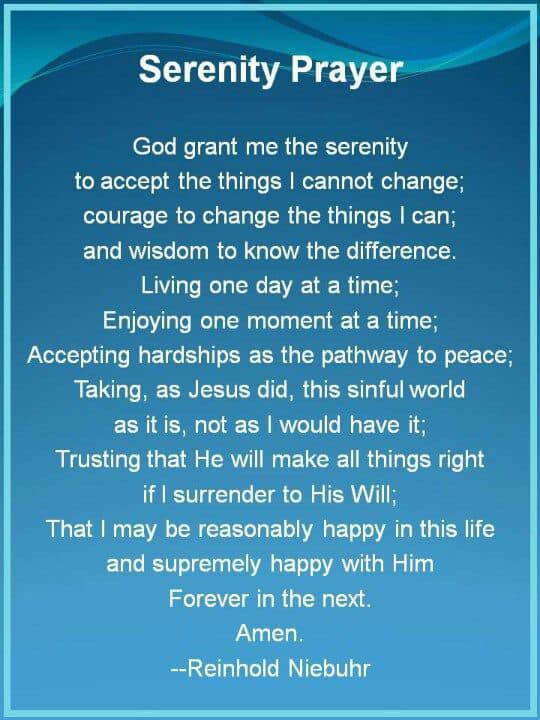
Another prayer I mentioned on social media that many indicated they thought helpful is the tried and true Serenity Prayer in its long version. This prayer composed in the 1930s is helpful on all days, including Election Day. The person who composed the prayer, Reinhold Niebuhr, was one of America’s leading theologians and ethicists for several decades of the 20th century. He received the Presidential Medal of Freedom in 1964. Thought of as a “public theologian,” he wrote and spoke frequently about the intersection of religion, politics, and public policy. A short version of the prayer (the first sentence with three sections) has become popular among 12 step communities as well. You can pray along with me and others using these words:

God grant me the Serenity
To accept the things I cannot change,
Courage to change the things I can,
And the Wisdom to know the difference.

Living one day at a time,
Enjoying one moment at a time.
Accepting hardship as a pathway to peace,
Taking, as Jesus did, this sinful world as it is,
Not as I would like it.

Trusting that he will make all things right,
If I surrender to his will.
That I may be reasonably happy in this world
And supremely happy in the next.

Although many other prayers suitable for this election cycle and presidential transition exist, last for this essay is a prayer an Episcopal priest friend shared on his Facebook page. The prayer was written in 1882, and he reports that it was actually suggested to become the Thanksgiving Day prayer of the day for Episcopalians in 1892. It has been part of the Book of Common Prayer of the Episcopal Church since the 1928 edition. I think it encompasses many of the shared concerns of reasonable people on the left or the right politically. It seems to reflect well the sentiments I have shared recently in preaching, teaching, as well as this essay:

Almighty God, who hast given us this good land for our heritage: We humbly beseech thee that we may always prove ourselves a people mindful of thy favor and glad to do thy will. Bless our land with honorable industry, sound learning, and pure manners. Save us from violence, discord, and confusion; from pride and arrogance, and from every evil way. Defend our liberties, and fashion into one united people the multitudes brought hither out of many kindreds and tongues. Endue with the spirit of wisdom those to whom in thy Name we entrust the authority of government, that there may be justice and peace at home, and that, through obedience to thy law, we may show forth thy praise among the nations of the earth. In the time of prosperity, fill our hearts with thankfulness, and in the day of trouble, suffer not our trust in thee to fail; all which we ask through Jesus Christ our Lord. Amen.

In closing, I share a quote from Abraham Lincoln. As the tumult of the Civil War approached, Lincoln shared these words which still hold true today: “Let us at all times remember that all American citizens are brothers of a common country, and should dwell together in the bonds of fraternal feeling.” This is difficult. Historically, we have failed as a nation many times before. Yet, for those with faith, it remains always possible. We can serve as a catalyst for unity, rather than division.

As Saint Paul writes in 2 Corinthians 5, “All this is from God, who reconciled us to himself through Christ and gave us the ministry of reconciliation: that God was reconciling the world to himself in Christ, not counting people’s sins against them. And he has committed to us the message of reconciliation.”

Think about these things. Pray these things. Hope in these things. You might not see any noticeable change in others, but it matters. If nothing else, this attitude of faithful positivity in the face of so much evil and angst has the power to change us. In that way, it certainly changes our world for the better.

Parts of this reflection originally were published in the November 5, 2024 weekly newsletter, the Hub, of Christ Lutheran Church, Fredericksburg, VA as well as Facebook posts that I shared. The Book of Common prayer paragraph is thanks to a friend who wished to remain anonymous.

© 2024 The Rev. Louis Florio. All content not held under another’s copyright may not be used without permission of the author.

1 Comment

Filed under Pastoral Letter

Anticipation

Photo credit: https://x.com/HeinzTweets.

During the late 1970s and into the early 1980s, a popular television commercial jingle for Heinz remained highly ranked among all the “ear worms” of the world. The ad showed a bottle of Heinz being poured, and all so slowly, a closeup showed the red, luscious ketchup mouthwateringly meandering out of the bottle. All the while, you heard Carly Simon sing her hit, Anticipation: “Anticipation; Anticipation; Is making me late; Is keeping me waiting.”

Anticipation is part of life. As children, we could likely not wait for summer. Then, in a short time, we began to start to miss our friends and want to return to school. The world is never perfect. Our hungers (literal or figurative) are never fully satisfied. We watch and wait for the next best thing. Paul plays off this experience as he writes about waiting for Christ’s return, “Rejoice in hope; be patient in affliction; persevere in prayer” (Romans 12:12). As Christians waited expectantly, he asks that they do so in hope – fully trusting and relying in their loving God’s provision and support. Yes, Christ has been victorious. We are also conquerors through our faith in him. And yet…and yet…we wait.

Anticipation can be either a positive experience, a negative one, or a mix of emotions. Indeed, many of us struggle at times with what psychology calls “anticipatory stress.” We worry about the “what ifs” of life and all that can potentially go wrong. Professionals of that discipline will encourage us to use compassionate and positive self-talk (“I have survived many things. I will get through this too.” “This is going to be hard, but I know how to face a challenge.”) They encourage people to take care of themselves (with sleep, diet, socially, etc.) as people will tend to fair better. Surrounding yourself with positive people is proven to help too. Being a downer is contagious, but so is positivity! Then, we can learn mindfulness exercises, helping us to stay in the present.

Paul’s own advice to his churches echoes many other parts of scripture and predate these helpful, valid tools. In fact, religious disciplines incorporate the above (for example, Christian music or chants, memorizing encouraging scripture verses to recite when anxious, coming to participate in the life of Christ’s body, meditation, fellowship of the Church, etc.). Further, Jesus encourages us to not worry about tomorrow just like the Psalmist’s teachings shared before his earthly ministry – “Be still, and know that I am God” (Psalm 46:10).

The Christian faith is meant for the real world, not just eternity. It is a true gift in a hard world. With Paul, we know life is hard, but God is always good. We can seek to remind ourselves with Luther (as when he was afraid or doubted), “remember that we are baptized.” We are Christ’s. So, all is well, no matter what our anxieties or doubts might say. Through prayer, community, and trusting in the promises of scripture, we are reminded that we are loved. We need not let our fears rule us anymore. We can anticipate a better tomorrow through our life found in Christ Jesus.

Unless otherwise indicated, all scripture quotations for this post are from the New Revised Standard Version (NRSV) translation.

Adapted from an article originally published in the Aug/Sept/Oct 2024 newsletter of Christ Lutheran Church, Fredericksburg, VA.

© 2024 The Rev. Louis Florio. All content not held under another’s copyright may not be used without permission of the author.

1 Comment

Filed under Pastoral Letter

Found yourself in a pickle? Return to the manger (Sermon)

Weinachts gurke, Christbaumschmuck der Firma Inge-Glas, Neustadt bei Coburg, Deutschland, CC BY-SA 3.0 via Wikimedia Commons.

This Christmas sermon inspired by the popular pickle ornament was preached on  Luke 2:1-20 at Christ Lutheran Church (Fredericksburg, VA) on Christmas Eve, December 24, 2023. You can also find a recording of this post at my 2 Penny Blog Podcast.

Sadly, there is no children’s message tonight, but we are all Children of God, and this is Christmas Eve, so I have something to show you. [Displaying pickle Christmas ornament.] Can anyone tell me what this is?  —- That’s right, it is a pickle ornament, but in this case, it has a pickle flavored gummy candy inside. (Yum, right?) As I shopped for gifts this year, both in Walmart and Target, I discovered versions of this tasty “gift” inspired by the popular Christmas ornament – the pickle.

Now, there are several different origin stories attributed to the tradition of hanging a pickle on one’s tree, including one claiming an origination in Germany. This has been largely discounted by those who study such things, and it is now thought to be a German-American tradition created in the late 19th century – perhaps during the Civil War – right here in the US. Yet however it started, the idea remains that on Christmas morning, the first person to find the pickle on the tree will receive an extra present from Santa Claus or (they say) you will have a year of good fortune ahead.

In any case, seeing this pickle candy ornament got me thinking. It has a sour and sweet taste. Some will like it. For others, it might be hard to swallow. And in that tension – stick with me now – we might just have a perfect allegory for Christmas. You see, the story of Christmas is not really one of just lights, triumphant song, and gifts. We celebrate something much more complex. The story of Jesus is both sweet and sour, joyous and sad, easy for some to hold on to and hard for others to dare hope in.

When we look closely at the story itself, when we ponder it perhaps as Mary and Joseph truly experienced it, we witness a couple who had to accept the impossible – a virgin birth. They did so at the risk of accusations of sins such as adultery. This could make Joseph appear the cuckolded fiancé to his peers or one who took advantage of poor, young Mary, thus he would dishonored, a pariah, in an honor-based society. Worse, it perhaps could have resulted in Mary’s stoning for adultery – for a relationship outside of marriage was deemed a reason for death. Who among their family, friends and neighbors would believe such a crazy story as a virgin birth? Despite the risks, they accepted their fate. They trusted God, and therefore, both Mary and Joseph said yes to God.

Then, they faced another challenge – that of the census and its associated taxes. They had to travel to Joseph’s ancestral, tribal home of Bethlehem. They embarked on what was likely a four to seven day journey over about 90-miles. Remember, there were no paved roads, cars, trains, planes, nor were there rest-stops along the way.[i] Lyft and Uber were not options. They traveled on rocky, dirty, dusty paths. They traveled through a land under military occupation by the Romans, who could sometimes randomly be bullies to the native peoples. Not only that, Mary and Joseph also faced the very common risk of rebels and robbers harassing them as they traveled as well.

And let us not forget that Mary traveled even as Jesus’ birth was imminent. She was in her third trimester. If Joseph cared about Mary and the baby, the pace would have likely been slower with many stops for the bathroom, rest, and food. So, some specuilate that the trip might have taken a week traveling at the less than the rocket pace of about 2-mph.[ii] Despite facing many challenges in trusting in the great promise of Jesus, if not experiencing very real fear at the political and religious threats around them, both Mary and Joseph continued to say yes to God. They stepped out bravely in faith, for God had promised to be with them on their journey.

And once they arrived, more challenges appeared. There was no room at the inn. This small, backwater village of Bethlehem did not seem to have the capacity for all those who returned to be counted. They found themselves instead in a stable. Archeology and historical studies in the area indicate these stables were often more like caves. They offered the smallest amount of protection and comfort. Yes, the newborn king was not yet widely celebrated. He was laid somewhat quietly in a manger…a trough for animals, surrounded by noisy animals and filth. No, there were no robes or crowns for Jesus. Luke reports he was wrapped in bands or strips of cloth – essentially “wrapping” Jesus tightly…swaddling him…in what meager things they had.

There’s a common and ancient Christian belief that being born in this cave and wearing his swaddling clothes foreshadow Jesus’ future burial in a stone tomb. As cute as Jesus must have been, as warm as the loved shared between parents and child could ever be, we should not forget why our Messiah came. This innocent baby, born without sin, would be hated by many, find no roof to call his home for the last years of his life, and he would ultimately suffer and die for our sake. (Thus, you will often see Eastern Orthodox icons and ancient European art shockingly portraying Jesus as an infant wrapped tightly within his burial cloth.)

Even as Jesus started his life among us, scripture suggests he and his family were poor. They had no finery. And yet, again, Mary and Joseph made do with what they had. They trusted God to supply their every need, and they shared what they had including all their love with Jesus. Yes, they trusted God with their lives, and despite the many threats and challenges, they sought to live in expectation and hope. (Of course, this doesn’t mean they never cried, or suffered, or felt fear. They were human after all, but the power of such times did not control them. They knew they were in God’s loving hands, and that truth helped them to act free of fear to do the right thing – as that same truth might do for us.)

So, we see that the story of the nativity is in a great part one of threat, struggle, poverty, and suffering…There’s a sourness to it. Our modern sensibilities might not like it, but that is the way it was. That’s the way our lives can be today in part. We might not want to think about the hard things that come with life. We probably prefer the happy, but Jesus came to share our lives fully – even the bad parts, including death – even as he remained our God. And Mary and Joseph? This was a couple who likely experienced much joy, but they also knew what it meant to be a human in a very fallen and unfair world. They, my friends, as great as they were, were much like us.

However, before we lose hope, remember that there is much sweetness in this story too. There proves much reason for joy. For Jesus came as Immanuel, God with us. Jesus has come to ultimately save us from harm and every evil – even our own struggle with sin. And we can also see that Mary and Joseph’s own love and faith sustained them – much as such faithful, loving relationships with others can help empower and sustain us. Mary and Joseph proved stronger due to these social bonds, and so can we.

And we learn as the Gospel unfolds that many others who are oppressed, forgotten, alone, sick or suffering – perhaps again people like us – came to see Jesus as he truly is over time…see him as Mary and Joseph did as the Holy Spirit opens eyes, minds, and hearts. Jesus is not you average baby. He is the Messiah, our Savior, our Redeemer, our way to forgiveness, joy, and everlasting life…He’s meant to be our everything. And because of Jesus’ call for us to be one, these newly enlightened ones sought to be one no matter what they have done or failed to do, and they invited others to be in relationship with Jesus – as we should strive to do.

If that wasn’t enough, the angels remind us of the eternal import of this baby’s birth as they sing, “Glory to God in the highest heaven, and on earth peace to those on whom his favor rests.” We can’t trust our feelings. We cannot look to our situation or the world for a final clue. No, God loves us so much, God comes to us…as one of the most vulnerable among us…a baby…and angels (God’s messengers) point the way. Our Father in Heaven declares that it is upon us that his favor rests…us! Can you believe it? God in Jesus has come to us and for us. Wow!

The world can seem so daunting at times, perhaps even against us, but it is at Martin Luther observed so long ago now, “The incarnation is proof that God is not against us.” No, as bad as life can get, God always loves us and promises a future filled with hope ahead of us. God comes to us in our need over and over again. Is it any wonder that the shepherds left amazed, and Mary treasured these mysteries and pondered them? There is so much sour in our world. It can be hard to believe that good exists, never mind believe that the baby laying at her breast was God.

Faith is hard. Trusting is a risk. And so sometimes as a human as I face difficulties, I just want to spit all the sour out; throw up my hands and walk away. Even as Advent started, as many of you know, I was reminded of the sting of death as someone incredibly important to me died. And many here have faced their own losses, disappointments, negative diagnoses, financial problems, perhaps even worse this past year. Each of us has a unique story, but I know we are all human in a broken world. Even with faith, life is hard. The imperfections of our world and our life are always present. They remain almost easier to identify than our blessings. They can capture our attention and hold us hostage. Much as our sin can do, our problems might also bind and blind us.

In response, God’s messengers again shout for our attention, “in the town of David a Savior has been born to you,”…for you. In some ways, Christmas seems most especially for the sad ones among us…Those of us walking through a “Bleak Midwinter” can see a light beckoning us on, warming our hearts, and calling us toward trust.[iii] Like Mary and Joseph, understanding that God is Love, a Love that has and will continue to reach out to us, we can seek to trust the promises of God to be with us, and for us, even if we must do so through tears at times.

Thus, no matter who we are or our situations, we, too, can step out in faith as Mary and Joseph once did. Like the shepherds, we might not fully understand, we might struggle to trust, but we can seek this hope we have heard testified to us. We can try to share our experience, strength, and hope with others. For in seeking Jesus with the eyes of faith, we will find that Jesus is already and always will be reaching out to us before we even recognize him – much as he came unnoticed by most of the world on that first Christmas Eve.

I, for one, think we need to both notice his birth and look for Jesus in our lives each day. As a young adult from the Slovak Republic reminded me through a meditation she shared while I faced my own grief, “When we are feeling hopeless, we are not facing the God that is giving us hope, [instead] we are facing the world that is giving us these hopeless feelings.”[iv] In effect, we are believing in the power of the world more than God’s power. We are in a way worshipping the world instead of God, giving it power over our lives. Instead, we have the choice to turn to our God and live.

And so, in both good times and bad, God calls us back to the manger – to take another look. Amidst the sour of this world, the sweet cries of Jesus lying in the manger were calling us by name before we were even born; imploring us to trust in him today and always. Times might be hard, we might feel like we are in a pickle (you knew I had to go there), but through that baby in a manger, we always have access to a hope we can concretely hold onto. Jesus is here. God became human in the flesh. Heaven has broken into our world. In this, we can rejoice. We might only get a foretaste of this glory for now, but life – thanks to Jesus and his promises – remains very sweet indeed. Amen.  


[i] https://aleteia.org/2018/12/18/a-feast-no-longer-celebrated-invites-us-deeper-into-the-bethlehem-journey/

[ii] Gordon College. (December 18, 2020) “Five things you didn’t know about the Christmas story.” https://stories.gordon.edu/5-things-you-didnt-know-about-the-christmas-story

[iii] See Condon, S. (December 17, 2023). Put the sad back in Christmas: Enough with the forced holly jolly. https://mbird.com/holidays/christmas/put-the-sad-back-in-christmas/

[iv] Eva Chalupkova. Lutheran World Federation, Facebook Reel dated December 19, 2023.

Unless otherwise indicated, all scripture quotations for this post are from the New Revised Standard Version Updated Edition (NRSVue) translation.

© 2023 The Rev. Louis Florio. All content not held under another’s copyright may not be used without permission of the author.

Leave a comment

Filed under Christmas, Sermon

Lutherans fast? Sometimes…

Christ in the Desert,
by Ivan Kramskoi
, oil on canvas, 1872.
Public domain, via Wikimedia Commons

Many people ask pastors about fasting as Lent begins. For Lutherans, it is commended, but it is in no way a mandate. Why do some choose to fast during Lent? We do so because of Christ’s own example during his forty days in the wilderness, but it is also recommended to us in both the Hebrew and Christian scriptures as a helpful spiritual discipline – not just during Lent but at any time of the year. It can also serve as a sort of penance.[i] The Augsburg Confession states, “Fasting in itself is not rejected, but what is rejected is making a necessary service of fasts on prescribed days and with specified foods, for this confuses consciences. . . . Such outward forms of service do not make us righteous before God . . . therefore it is not a sin to omit them.”[ii]

Primarily, fasting often involves a restriction on when, how much, or what type of food (for example, choosing fish or vegetarian dishes over meat) one might eat. We should not fast from food if it puts our health at risk. You might like to speak with your doctor as to what might work for your circumstances, and please stop fasting if you begin to feel unwell. Yet in modern times, many people fast from activities or things such as social media, enjoyable hobbies, or drinking alcohol. If choosing to fast, you might like to choose something meaningful to you, so that when you feel the pangs of any absence or sacrifice, you might draw your thoughts to God and Christ’s own sacrifice for our sake. Prayer, meditation, and Bible study are helpful during a fast, as they can make the experience all the more meaningful as God’s Spirit seeks to speak to us. Through fasting, we wish to open and refocus our hearts toward God with the Spirit’s help.

Certainly, some kinds of fasting might help us curb unhelpful behaviors or improve our health. Yet, never think we earn more of God’s love in the process. We cannot earn such a gift already freely offered us by Jesus. In speaking about fasting, Martin Luther argued:

“The Scriptures present to us two kinds of true fasting: one, by which we try to bring the flesh into subjection to the spirit, of which St. Paul speaks in 2 Cor 6:5: ‘In labors, in watchings, in fastings.’ The other is that which we must bear patiently, and yet receive willingly because of our need and poverty, of which St. Paul speaks in 1 Cor 4:11: ‘Even unto this present hour we both hunger, and thirst,’ and Christ in Mt 9:15: ‘When the bridegroom shall be taken away from them, then will they fast.’ This kind of fasting Christ teaches us here while in the wilderness alone without anything to eat, and while he suffers his penury without murmuring. The first kind of fasting, one can end whenever he wills, and can satisfy it by food; but the other kind we must observe and bear until God himself changes it and satisfies us. Hence it is much more precious than the first, because it moves in greater faith.”[iii]

Can’t fast for forty days? Well, try it for a week or on the occasional day during Lent. Whatever you choose to do or don’t do, offer it up in love to the glory of God. Prayerfully and expectantly watch and wait for the Spirit to help and guide you.

Want to read Martin Luther’s sermon? Visit this link: Sermon for the First Sunday in Lent; Matthew 4:1-11


[i] Penance is an outward expression of one’s desire to repent, to turn our hearts back to God and make amends for our wrongs toward our neighbors.

[ii] See https://bookofconcord.org/augsburg-confession/#article26.33

[iii] Excerpted from Volume II:133-147 of The Sermons of Martin Luther, published by Baker Book House (Grand Rapids, MI). It was originally published in 1906 in English by Lutherans in All Lands Press (Minneapolis, MN), as The Precious and Sacred Writings of Martin Luther, vol. 11. Original sermon title: “The fast and temptation of Christ.” Downloaded at liturgies.net/Lent/Sermons/lutherlent1.htm on February 23, 2023.

Unless otherwise indicated, all scripture quotations for this post are from the New Revised Standard Version Updated Edition (NRSVue) translation.

© 2023 The Rev. Louis Florio. All content not held under another’s copyright may not be used without permission of the author.

Leave a comment

Filed under Lent

Through the Tumult

Art: Crossing the Red Sea, by Gitty Fuchs. Learn more or purchase at https://www.gittyfuchs.com/

This sermon was preached on the Seventeenth Sunday after Pentecost (October 2, 2022) at Christ Lutheran Church in Fredericksburg, VA. You can listen to this sermon at my podcast, 2 Penny Blog.

For unknown reasons, God chose Egypt to be a land intimately connected to our salvation history. For a few examples, consider that Egypt was the land that saved the family of Joseph from starvation. Years passed, and the extended family later grew into a numerous people who became viewed by a later Pharoah as a threat. As a result, they were enslaved. Out of Egypt, God would call what had become twelve disparate, squabbling tribes (descendants of Joseph and his eleven brothers) to become one people serving God but also intended to bless the world.

“Out of Egypt I called my son,” spoke Hosea for God. The people of Israel were the inheritors of God’s grace, God’s children. That’s how Hosea understood the story of the Exodus when he originally spoke the words that we heard quoted in Matthew’s Gospel. Yet, Egypt also becomes the place Jesus as a child would find safety with his family from Herod’s power. Jesus, God’s only true son, would be called later from Egypt to fulfill his purpose in a way Hosea likely could not have imagined.

You might also know that Mark the Evangelist would seek to build the Church in Egypt. He would become the first Bishop of Alexandria (Egypt). For a time, it was the most Christian nation in the world until Islam oppressed the church in that region and supplanted it. Yet no human, natural or supernatural powers can fully extinguish faith. Believers remain.

And perhaps most curious of all, one sees in today’s reading from the Book of Exodus how God used Egypt’s folly and sin to firmly establish God’s sovereignty before the people of Israel and all the earth. More than a mere rescue or miracle story, the story of the Red Sea’s parting is ultimately revealing God’s self and purpose.

This is an extremely ancient story. Although there is only one historic column found thus far in Egypt with hieroglyphics believed to be identifying the people of Israel, scant other physical or extrabiblical, written testimony of the escape from Egypt remains. This should be no surprise, as Egyptian pharaohs tended only to preserve the history that lifted them up as gods and declared their power as supreme. Defeats and struggles were to be forgotten, as these didn’t fit their agenda.

The location of Yam Suph, or technically “the Reed Sea,” might lead us to consider the crossing in the north. This is where marshy waters of the Red Sea basin historically existed. Yet, tradition only indicates the crossing was through what we know today as the Red Sea. It does not indicate exactly where the Israelites traveled. Some scientists have tried to explain the waters parting through the impacts of wind. Perhaps it was a miracle not so unlike the reverse storm surge seen with Hurricane Ian. In this historic case, what is called a wind setdown is suspected. With a wind setdown, strong winds — a little over 60 miles per hour — create a ‘push’ on coastal water which, in one location, creates a storm surge. But in the location from which the wind pushes — in this case, the east — the water moves away.”[i] Other ideas have been suggested.  

Yet when all is said and done, we have this inherited story lasting thousands of generations, a story that shapes the identity of the Jewish people and our own. For the events did not just happen for the sake of those present on that shore long ago. As noted elsewhere, “The story of the stunning triumph of Yahweh over the great power of Egypt is told in order to summon Israel to faith.”[ii] It is a faith we have inherited and share. Trapped before the waters, the people cry to God in fear. They also attack Moses three times. “Was it because there were no graves in Egypt that you have taken us away to die in the wilderness? What have you done to us, bringing us out of Egypt? Is this not the very thing we told you in Egypt…” (Exodus 14:11-12). And Moses replies three times, explicitly calling them to faith, “Do not be afraid, stand firm, and see the deliverance that the Lord will accomplish for you today…” (Exodus 14:13-14). Much as Joseph had a defender in God, Moses says the people who God chose to love will be defended. Moses shouts, “The Lord will fight for you, and you have only to keep still.” This understanding is echoed later in the Psalms and elsewhere when God says, “Be still and know (trust) that I am God.”

With the greatest army of the earth at the time descending upon them…facing the most developed armaments of war, the chariot, with basically no weapons…the people of Israel are asked only to be still…to trust in God. Even in the face of defeat, they are conquerors. Some scholars suggest that it is unlikely Saint Paul would have understood Jesus in the same way if not for this incredible scene.[iii] In Romans 8 (verse 37), he would declare, “No, in all these things [all the sufferings and tribulations of our lives] we are more than victorious through him who loved us.” (Or many translations say, we are more than conquerors.) Even facing our greatest losses, challenges, or defeats, when pushed up against raging seas of despair, we are conquerors because of God’s great love for us. God will do what we cannot…always. God will save. We will survive the tumult because our ultimate destination is assured. This has been decreed by God since before the time of Israel…promised us…and as I often quote and Luther often said, “God does not lie.”

Psalm 46 teaches us, “God is our refuge and strength, an ever-present help in trouble. Therefore, we will not fear, though the earth give way and the mountains fall into the heart of the sea, though its waters roar and foam and the mountains quake with their surging” (verses 1-3). The theological understanding behind these later words is the same reality of the Israelites cornered at the sea. It remains true for us as we are cornered by whatever threatens or demoralizes us. God is with us. God loves us. Watch, wait, and see for our deliverance – even when the face of death is near.

This is an amazing promise. It is perhaps even hard for us humans to believe, and yet stories like today’s challenge us to cling to God in faith like a life preserver.[iv] Be still before this awesome God who loves you…before this remarkable God who wills to save you. Trust, believe, and worship. Stop what you are doing, still your mind, “and acknowledge that God alone is the sovereign ruler of the universe and commit to following him”[v]…wherever God leads us.

Through our support and rescue, through the many Hurricane Ians, the wars like the one in Ukraine, the economic hardships of recent times…the daily loss and death before us…nothing will separate us from the love of God. Indeed, I don’t think my faith would be as strong if I had not come from a family with so many troubles, seen so much violence, or faced cancer. God will be glorified and his sovereignty be made known as he helps us through and saves us. Then as we praise and give God thanks (even when we can only do so with tears in our eyes), others will come to believe.

“Be still and remember who God is, be still and stop fearing, be still and see what God is doing, be still and acknowledge his greatness, be still and know God is with you…now spread the knowledge of who he is!”[vi] So counsels Christian blogger, Liz Auld. Be still doesn’t mean we no longer need to try. The Israelites still had to walk through those two imposing walls of water, didn’t they? It doesn’t mean things will be easy. It doesn’t release us from toil or tears. Again, the history of the Israelites exemplifies this. Yet, God’s faithfulness teaches us that we will be ok no matter what we face.

Do not fear. Stand firm. Trust and see. Everything that has already been done by God, has been done for you. Indeed, God gave his only Son to die for you. After so much effort, God won’t give up on you now, so don’t you give up. Keep walking in God’s love, for no empire, no principality, not even our own doubts or darkness will stop our God’s will to save us. Amen.


[i] Moony, C. (December 8, 2014). “No, really: There is a scientific explanation for the parting of the Red Sea in Exodus.” Washington Post. Washington, DC: Nash Holdings.

[ii] Keck, L.E. (2004). “Exodus 14:1-31.” The New Interpreter’s® Bible Commentary Volume I: Introduction to the Pentateuch, Genesis, Exodus, Leviticus, Numbers, Deuteronomy, p. 796.

[iii] Ibid, p. 796

[iv] Image from Alcoholics Anonymous literature.

[v] Auld, L. (2 march 2021). “What does “Be still and know that I am God’ really mean?” Downloaded from https://www.crosswalk.com/faith/bible-study/what-is-the-meaning-of-the-verse-be-still-and-know-that-i-am-god.html on September 30, 2022.

[vi] Ibid

Unless otherwise indicated, all scripture quotations for this post are from the New Revised Standard Version (NRSV) translation.

© 2022 The Rev. Louis Florio. All content not held under another’s copyright may not be used without permission of the author.

1 Comment

Filed under Uncategorized

The Spirit is on the Move

Photo by Oliver Hihn on Unsplash

This sermon was preached on the Sixth Sunday in Easter (May 22, 2022) at Christ Lutheran Church in Fredericksburg, VA. You can listen to the sermon on my companion podcast: S1, Ep17, or watch it on our congregational YouTube channel.

         Grace and peace to you from God our Father and from the Lord Jesus Christ. Amen.

        Through our Gospel lesson this morning, we have just heard part of Jesus’ farewell discourse from the night before his death. As he speaks of his departure, his death, resurrection, and ascension as well, the Apostles suspect that there are many dangers which lie in wait for them. There’s both anxiety and questions in their life. There’s also misunderstanding. As Prof. Elisabeth Johnson points out, “First Peter (John 13:36), then Thomas (14:5), then Phillip (14:8), and then Judas (not Iscariot)[i] (14:22) ask for clarification about what Jesus is telling them,”[ii] as they gather for the last time.

        Not included in today’s assigned reading, the Apostle Judas (not Iscariot), sometimes identified as Jude, has just asked, “Lord, how is it that you will reveal yourself to us and not to the world?” The answer is not found in some secret spiritual knowledge. It is not a matter of extensive study or any kind of perfection. Jesus seeks to make clear that the Advocate, the Holy Spirit, will come in a new, intimate way as a gift. Those of the world will not recognize the Spirit any more than the world has recognized Jesus. Yet that won’t stop the Spirit’s purposeful movement or power. Jesus’ children will hear that voice, and as a result, those children will share the love of God with the world.

        Yes, Jesus reveals himself through the Holy Spirit, just one part of our one Triune (Trinitarian) God…a Spirit which was, is, and always will be one with Jesus. Through that Holy Spirit on the move through circumstances and individual hearts, Jesus continues to work in the world. As noted in many Bible commentaries, Jesus’ promise stands out “that the Father will send the Holy Spirit to be alongside his disciples, to teach them and remind them of all that Jesus has said to them (John 14:26).”[iii] As Advocate, the Spirit acts like our ambassador or attorney, conveying our needs to God and guiding us -advising us, counseling us. It empowers us through grace and forgiveness and thus makes us holy. The Spirit is also called the Paraclete, meaning “called along beside.” For as predicted through the prophets, the Spirit will finally come to reside in our hearts through the experience of Pentecost. The Spirit goes with us into the world, binding us with God and in communion with one another as one holy catholic (or universal) Church.

        Just as the earth was first shaped with the God’s breathing of commands (“Let their be light!”), life came into the first human beings through God’s breath, “the breath of life.” And as the Church comes into being, the risen Jesus will breathe upon his disciples to gift them peace and guide them. Finally with the event called Pentecost, the Spirit will come to the disciples in a locked room amidst a sound like the rush of a violent wind and appearing as if tongues of fire. The Spirit, often portrayed as wind or breath, comes to breathe life into our lives, comes to protect us in our life, and call us into deeper trust of God. It is through the Spirit that the disciples finally, truly became Church, and we ourselves have come to believe. For no one can come to acknowledge Jesus as Lord without the Spirit’s help (see 1 Cor. 12:3). No one can truly live or experience an abundant life without that “breath of life”…the gift of the ever active, always present, Holy Spirit.

          Now, we don’t have time to do this right now, but if we were to break into small groups and consider how God brought us to this place, as we are on this day, we would likely identify miraculous and expansive connections – an intermingling of events and people – that have guided us, shaped us, and perhaps even thrust us into this time and place as the people we have become. Without even knowing the details of your history, I know that nothing that you’ve experienced (good or bad), none of your weaknesses or strengths, nor even any of your relationships (no matter how deep, hurtful, or blessed) has been wasted by God. God has the will and the knack for using everything for our good (see Romans 8:28) because God loves us.

        However, this love means that God is not done with us. We certainly aren’t keeping Jesus’ word perfectly even as we try to do so…that’s impossible for any human, imperfect sinner-saints that we are…so God through the Holy Spirit acts for us, and in us, and upon us. In a fallen world…a fallen life…God has not given up on you. God never gives up on us. The Spirit blows where it will, and in being part of our lives…in bringing us faith and peace…we are shaped and sanctified (made holy) over time through the Sacraments, the Word of God that we hear and read, and even through our experiences encountered through faith. We are blown forward toward God’s goal despite what choices we might make. God’s will will be done.

        Yes, with complete confidence, I can proclaim that all of us have been led here for a singular, shared – yet at the same time unique to each one of us – purpose. God is doing something in our lives whether we see it or not, feel it or not, or understand it or not. Indeed, not one of us came up with the idea of God or understanding of Jesus on our own. The Good News of Jesus was heard and received through others. It is exactly as Luther identified long ago, “[One] would find Christ must first find the Church.”[iv] You have to hear the Good News of Jesus Christ from somebody. When all is said and done, the Spirit spreads faith and increases the Church through imperfect, unfinished people like you and me.

        And is not that what we see today in Lydia’s life back in Philippi? Throughout all the Book of Acts? God’s love spreads (as an old French proverb suggests) similar to a disease…from person to person…but in a good way. Paul had a vision of someone calling for his aid, “Come over to Macedonia and help us.” As Lydia happened to hear Paul, Silas, and Timothy preach and teach, “The Lord opened her heart to respond to Paul’s message.” She already believed in God, but something changed. She grew in faith and understanding. She came to know Jesus. And that experience led her to welcome Paul into her home…welcome Jesus into her heart. That small home Church would eventually become the famous church of Philippi, and in her hospitality, we discover that relationship and community matter. Human relationship, community, is used by Spirit to make the Church and individual believers grow.   

        Throughout time, we see this repeatedly. For example, Martin Luther’s faith and understanding did not grow in isolation. He treasured the transcendent, heart-centered faith of the mystics before him (in the period of the 1000s to 1200s) – voices shared with him through both books and teaching. He learned from them of a loving God offering grace. He benefitted from the grace-filled, loving faith and guidance of his confessor, Johann von Staupitz. He learned from the witness of reformers like Jan Huss who came before him, even as he grew in the present from what became known as his Table Talks. These gatherings were simply where questions, doubts and faith were shared over food and beer among friends…perhaps as you might share about life and faith at your own table. Martin Luther and others grew in faith and found strength through such communal meals.  

        Later, Moravians, formally the United Brethren (followers of Huss’ teachings), came to better understand Martin Luther’s theology through a Lutheran named Zinzendorf who offered the Moravians protection from persecution in the early 18th century. Luther’s Catechism is still studied by the Moravians today. And as some Moravians read Luther’s Preface to the Epistle to Romans, sang and prayed, John Wesley overheard them and felt his heart “strangely warmed.” Wesley came to a deeper, more personal, enlivened faith;a witness that lives on in the faith tradition we know as Methodism. What we see here is an example of how the Holy Spirit works. Zigging and zagging through time and individuals, the Spirit draws us together, moves us apart, and drives us forward as much as Jesus was driven into the wilderness.

        So, how did you come to know Jesus? What parent, grandparent or friend spoke in such a way that opened your heart to Jesus? Was it an instantaneous change or did their faith plants seeds to grow yours over time? Perhaps you aren’t that far on your journey, and you come with deep questions…more questions than answers perhaps. Those are gift of the Spirit too. The Spirit was at work in all such moments. That’s worth thinking about, giving thanks for, and talking about perhaps as you go home today. Your story is connected directly from person to person all the way back to Paul and Lydia’s story and the story of all in the early Church. And you might not feel like it right now or recognize it, but listen closely….Your story is as sacred as what we find in any piece of scripture…your story, your experience, your struggles, your hopes are as sacred as what is recorded in the scriptures for God’s Spirit is there alongside you…in you.  

        For those here who already believe, your faith is not an accident. For those here who struggle to believe, don’t think for a moment that God is not reaching out to you. We are told that the Holy Spirit is always active, reaching out to one and all through the imperfect lives of those around us as well as through direct whispers, dreams and visions received through our hearts. We aren’t alone. The Holy Spirit is always with us even when we are not aware of it.[v] Just wait and watch. Seek and eventually, thanks to the Spirit, we will discover our sacred purpose within God’s own story and plan. Amen.


[i] “Judas (not Iscariot)” is used by the evangelist to differentiate this Apostle from Judas who betrayed Jesus. Outside of scripture, there arose a tradition to call him Saint Jude to help avoid this confusion.

[ii] Johnson, E. (May 1, 2016). Commentary on John 14:23-29. Downloaded from workingpreacher.org on May 14, 2022.

[iii] Ibid.

[iv] Martin Luther, “Sermon for the Early Christmas Service; Luke 2:15-20” (1521-1522). Luther’s Works, Sermons II. Ed. Hans J. Hillerbrand, Helmut T. Lehmann (Philadelphia: Fortress Press, 1974),  vol. 52: 39-40.

[v] “God of love, by the Holy Spirit you are always present. Your presence is invisible, but you live at the center of our soul, even when we are unaware of it.” – Br. Roger of Taizé

Unless otherwise indicated, all scripture quotations for this post are from the New Revised Standard Version (NRSV) translation.

© 2022 The Rev. Louis Florio. All content not held under another’s copyright may not be used without permission of the author.

1 Comment

Filed under Sermon

Finding Christmas in 2020

Photo by Alexas_Fotos on Pixaby. Used by permission.

During the pandemic of 2020, it seems many people are being tempted to put our 2020 goggles on (rather than see the world with 20/20 vision) as we look toward the holiday season, especially Christmas. “There won’t be much to Christmas this year.” “Christmas won’t be like we remember it.” Some have wondered out loud if there will be any Christmas at all!

This is very human, but it is not seeing things very clearly. Among the greatest biblical truths regarding Christmas, we do not find feasts, bright colored lights, and gifts wrapped in bows. We find Jesus who came to us as a vulnerable babe to share our lot. In this incarnate form, he would grow up to face emotional wounds, isolation, sickness, physical suffering, and death. Members of his own family would reject him, at least for a time. In other words, he became fully human in a fallen world – just like us.

Yes, suffering was part of Christ’s experience, so it remains an important part of the Christmas story. A baby is born in abject poverty in unsanitary conditions. His parents are so poor, all he can be dressed in are bands of cloth. He is surrounded by threats: war and revolution, plagues, and early death accepted as a norm. His mother and father flee with their child to avoid assassination. A tyrant king sends his troops to kill innocent babes and toddlers in the insane hope of stopping God’s will. This is Christmas too.

And yet thanks to scripture, carols, family and community traditions over the years, we know that this is not the full story. To only focus on the negative would be like telling ourselves a lie. We hear angels come to announce good news of great joy for us amidst any suffering. We see poor and marginalized shepherds find hope in the Christ child. It is a hope so bursting with possibility, they cannot help but share it despite (or perhaps because of) the exceedingly difficult lives they share with their families and neighbors. We also learn how God protects those God loves. Yes, Jesus and his parents are protected, but we are told our God desires to offer that same protection and peace to all the earth. Amidst all the frightening and sad things, God’s loving will remains. Jesus has come for our good – to ultimately crush suffering, sin and death – and nothing will stop God’s will…not even our own doubts and fears.

A Spanish priest poetically answered the question of “Will there be a Christmas?” in this way:

Will there be Christmas? Of course! More silent and with more depth. More like unto the first one, when Jesus was born in solitude. Without many lights on earth, but with the star of Bethlehem shining on paths of life in its immensity. Without colossal royal processions, but with the humility of feeling as if we are shepherds, young and old, seeking the Truth. Without big tables and with bitter absences, but with the presence of a God who will fill everything.

Merry Christmas, dear Church. Let nothing trouble us, for Christ is here.

For the full text of Javier Leoz’s poem, read this article: https://aleteia.org/2020/11/13/pope-calls-spanish-priest-to-congratulate-him-for-will-there-be-christmas-reflection/

 This pastoral letter was originally published in Christ Lutheran Church’s December 2020 newsletter.

© 2020 The Rev. Louis Florio. All content not held under another’s copyright may not be used without permission of the author.

Leave a comment

Filed under Pastoral Letter, Uncategorized