
An audio version of this post can be found here.
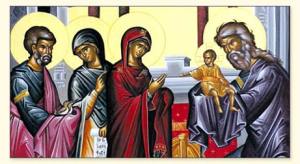
There’s definitely some confusion when it comes to Candlemas each February 2. Not only is it overshadowed by Groundhog Day, but it also remains rather obscure to many modern Christians and most certainly non-Christians. Candlemas is perhaps most properly or commonly called the Feast of the Presentation of Jesus. The Church remembers Mary and Joseph taking Jesus to the Temple forty days after his birth to complete Mary’s ritual purification after childbirth and to perform the redemption of the firstborn son as reported in Luke 2:22-40.

Candlemas is an old feast of the Church, a kind of holiday or holy day one might say. Normally, a feast day commemorates a person or event. Unfortunately, with Candlemas, it appears multiple, closely related meanings have been attached to it over the centuries and events perhaps merged. In a web search, you will quickly learn that Candlemas can not only be called Feast of the Presentation of Jesus, but it can also be known as the Feast of the Purification of the Blessed Virgin Mary, or the Feast of the Holy Encounter.
In Leviticus 12:2-8, we learn “A woman who becomes pregnant and gives birth to a son will be ceremonially unclean for seven days, just as she is unclean during her monthly period. On the eighth day the boy is to be circumcised. Then the woman must wait thirty-three days to be purified from her bleeding. She must not touch anything sacred or go to the sanctuary until the days of her purification are over.” (There are separate requirements for the birth of a girl child.) For the male, a year-old lamb was to be offered for a burnt offering and a young pigeon or a dove for a sin offering. If the mother and her family could not afford a lamb, she was to bring two doves or two young pigeons, one for a burnt offering and the other for a sin offering. God was thought to be a God of life. Things that smacked of death and illness such as blood were deemed unclean. In sacrificing the offering as part of the ritual in faith with prayer, the priest was thought to be atoning for any of her sins. A person was being made fit to be in the presence of God and among God’s Holy People.
The first male child held special significance to the early Hebrews. With their cultic life and practice centered around priestly activities and offerings relating to the Ark of the Covenant and Ten Commandments, members of the twelve tribes were expected to support the work of the Tent of Meeting and later the Temple in Jerusalem. As the people became more numerous and the cultic practices more established, it was recognized that not every first male child need to serve with the priests. Indeed, sometimes families making a subsistence living might need him more just to survive.
Exodus 13:2-15 describes another ordinance. Through Moses, God was believed to have commanded, “Consecrate to me every firstborn male. The first offspring of every womb among the Israelites belongs to me, whether human or animal.” All the firstborn males of their livestock were also to belong to the Lord. When people asked why, they were to explain, “Pharaoh stubbornly refused to let us go, the Lord killed the firstborn of both people and animals in Egypt. This is why I sacrifice to the Lord the first male offspring of every womb and redeem each of my firstborn sons.”
In Numbers 18:15-16, it says, “The redemption price for firstborn non-Levites was set at 5 shekels.” Today, this practice is known as the pidyon haben, the redemption of the first-born son, and silver coins are used. It is only conducted for male babies but not if the baby was delivered by cesarian section. In effect, the father “buys” or “redeems” his son from the priest and the expected, traditional service. (The Temple no longer exists, so it is more symbolic than in the past.) At least under rabbinical practice today (if not earlier), this obligation only exists if the parents are not Levites or part of the priestly class. In a quick review of scripture, I see no date for this to be held in scripture, but today the obligation begins when the baby is 30 days old, and so the ceremony often occurs on the thirty-first day after birth. If included parents do not redeem the child for whatever the child becomes responsible for his own redemption at thirteen years of age. (See the article Redeeming firstborn sons for more details.)
Certainly, Luke seems to confuse these two practices – the redemption of the first male child and the purification of the mother forty days after birth. In fact, Luke has the fee for the purification of the mother become the redemption price for the son. Remember, Luke did not observe these events. He was a Greek doctor who had come to believe in Jesus and served with Paul for a time. To me, it certainly seems reasonable that he didn’t fully understand Levitical codes. I’ve read some articles suggesting that there was no such custom of presenting a Jewish male child in the Temple back in the first Century, but with the redemption needing to be made to a priest, perhaps a child need not be there, but I would certainly not be surprised if a family did. I see no reason to doubt the ultimate truth of the passage. Jesus was presented in the Temple. Simeon and the prophet Anna could have certainly encountered Jesus and through the Spirit’s revelation understood his import. (Hence, Candlemas can also be known as the Feast of the Holy Encounter.)
Whether we focus on some kind of presentation of Jesus including most likely the story of his redemption, the purification right of Mary, or Jesus being revealed as the Messiah to Simeon and Anna, I hope we remember all these early stories and practices amidst their variations. They help make Jesus and his family come alive in context of their time. February 2 being forty days Christmas remains the perfect day to do so. Indeed, as I have written elsewhere, the date was once was considered the end of what was called the Season of Epiphany, and any remaining Christmas greens were taken down. (Today, most denominations don’t have a season of Epiphany but have January 6 as the Feast of Epiphany and what is now called the start of the Season after Epiphany.)
So that all said, with all those names and remembrances possibly now making more sense, why is the day also called Candlemas? Well, in past days, Christian families would commonly bring candles to the church as we remembered Jesus as “a light for revelation to the Gentiles, and the glory of [God’s] people Israel.” Much as we bless food to our use or dedicate worship items through prayer, families would ask that the candles used in the home for light be blessed.
Happy Candlemas everyone! As Jesus urged, “let your light shine before others, so that they may see your good works and give glory to your Father in heaven.”
Unless otherwise indicated, all scripture quotations for this post are from the New Revised Standard Version (NRSV) translation.
© 2022 The Rev. Louis Florio. All content not held under another’s copyright may not be used without permission of the author.


 2pennyblog