Tag Archives: christianity

Called to decency, not consequentialism

As an ethicist from Grove City College, a conservative, evangelical institution, opined recently, a consequentialist “holds that good ends, however they might be defined, can justify the use of unethical means.” As he reflects on recent administration’s behaviors, he suggests that sort of thinking is a utilitarian approach, but not truly Christian. I agree, and I’ve been suggesting the same over the last few weeks. “I don’t agree with what’s happening (or all that’s being done or said), but…” isn’t a great approach to Christian ethics.

I’ve spoken or written to a number of Christians including pastors in favor of the administration’s ultimate goals about current events. I, too, want safety, prosperity, and justice. I am sensitive to how people long for a government that reflects their values, American traditional values included. I love and have served my country, making an oath to defend the Constitution. I have been injured doing so at times (as a police officer), and I have had several near death experiences. I say this as evidence that I love our nation, and I admit that I am supportive of some (not all) of the stated goals. Yet, I also know there is no justice without mercy (Micah 6:8). I remember that Jesus came to call all people to himself, not just Americans (John 12:32). We live in a political world where good people might not agree, but we don’t have to hate one another or demonize. Jesus calls us to be better than that.

I have come to understand from scripture that there is no “me first” sentiment overruling love of neighbor or enemy, but we are told to follow Jesus which means we must instead cary a cross (Matthew 16:24). Sacrifice is often necessary. I’ve sought to apply Christ’s Beatitudes to whatever I should do or not do, especially in difficult situations. I have of course failed at times, sometimes abysmally so, but I try to repent and make amends for my sin, turning to God so that I might live (Isaiah 45:22) – to live abundantly now as well as eternally as Jesus promises.

As Christians, we need to have our yes mean yes, and no mean no (Matthew 5:37). We should not explain away sin, rude behaviors or hurting people – intentionally or not – because we think the goals are “good.” We are to defeat evil with good (Romans 12:21) whether a liberal, a conservative, or an “anywhere in between” Christian. Humbly, we should listen and consider where we might be wrong, because no human is always right. We should repent and show others grace if they are willing to change. For as Jesus says in Mark 8:36, “For what does it profit a man to gain the whole world and forfeit his soul?”

This doesn’t mean we must go to war, culture war or otherwise, but we are called to decency – to be human in the best sense of the word, loved and changed by God. St. Peter himself argued, “but as he who called you is holy, you also be holy in all your conduct” (1 Peter 1:25). We are to love, not objectify, demean or abuse. Meekness was a word used to describe both Moses and Jesus, so I expect it does not mean what much of the world thinks. It takes courage, and it’s hard.

So perhaps like Sophie Scholl, Christian martyr of WW2, we must grow to understand that, “Just because so many things are in conflict does not mean that we ourselves should be divided” (as quoted in Seeking Peace: Notes and Conversations Along the Way, 1998, by Johann Christoph Arnold, p. 155). Or as with Dietrich Bonhoeffer, we can try to just be decent in the face of evil, as Victoria Barnett, a Bonhoeffer scholar, points out so well. Or even as Mother Teresa, Br. Roger of Taizé, and so many others who sought to live simply and at peace demonstrated through the simplicity of their lives, we can seek to do all things with great love. That’s often how the world experiences change; ultimately experiences Jesus.

A hero of mine, Jonathan Daniels, closed his valedictory address at VMI with this sentiment, one which I share, “I wish you the decency and nobility of which you are capable.” By God’s help, we are all capable of such a life no matter how impossible it might seem.

© 2025 The Rev. Louis Florio. All content not held under another’s copyright may not be used without permission of the author.
Leave a comment

Filed under Theology

My little springtime

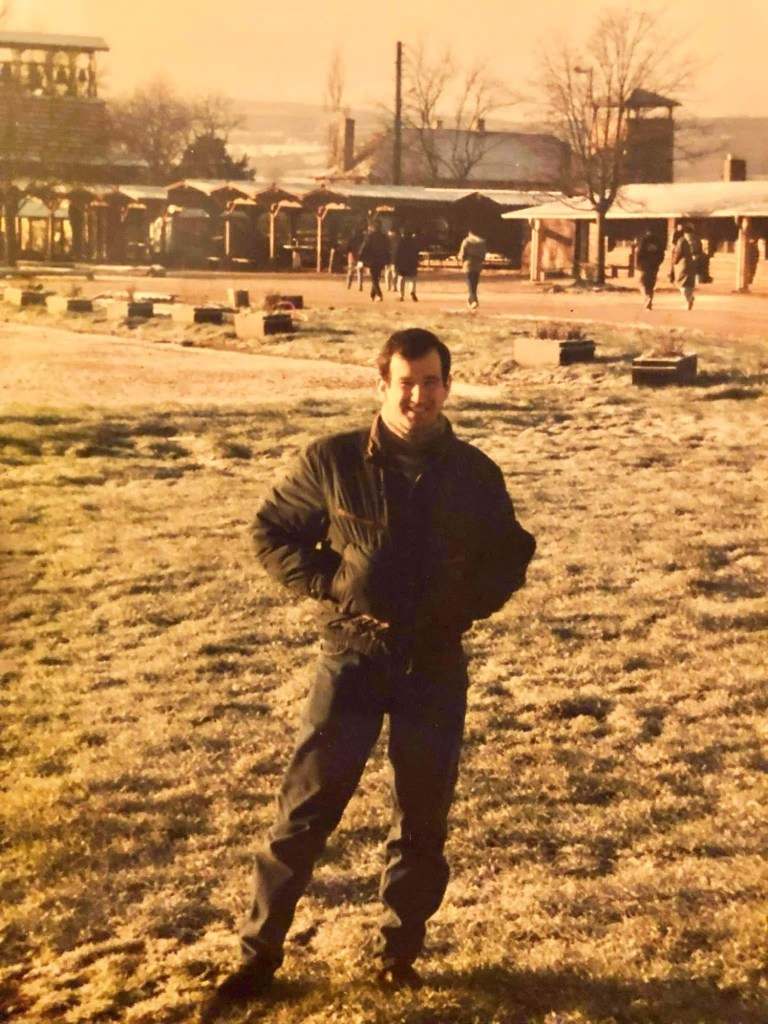
This is me in Taizé shortly after my arrival, perhaps January 1995. A new Lithuanian friend who was a former draftee in the Soviet Army took the photo for me. I finished my own US Army commitment in 1994. Enemies can become friends.

“Ah, Taizé, that little springtime,” remarked Pope John XXIII about the ecumenical monastic community nestled on a hill in Burgundy, France. Being there definitely was a springtime experience for me. I have recently been thinking about my time there a lot. For, I moved to Taize’ in France on December 5, 1994 – 30 years ago! 

I first met the brothers escorting Mary Washington College students to their first large meeting ever held in the US at Dayton University. Several thousand young adults from across the US gathered across denominational lines. As part of “the Pilgrimage of Trust,” we stayed with local families where conversations would continue. 

I had no idea how my heart would open when I first volunteered to go as a chaperone and participant. My experience changed the way I looked at life and the Church – how I understood myself as well. People sharing their faith, positive interactions with people who were previously “other” to me, and a more intimate prayer life energized me. 

I read much about the Ecumenical Community of Taizé and from Br. Roger, the founder, after that. I continued to pray with chants at home and with friends. I went to a few smaller regional meetings. It slowly became a part of me. I’d even catch myself singing their chants (ultimately prayers) as I drove to emergency calls or in quiet moments of my day. Like the prophet, Nehemiah, my prayer life and work life merged. I found myself praying all the time. As I found more peace, I became more patient and discerning when working with others or arresting people. I discovered peace even when amidst the thick of things. Even my sergeant noticed the change. He said during my review, “I don’t know what you are doing, but keep it up.” I think it was more what God was doing in my life, but his observations affirmed for me that I was in a better place and heading in the right direction. Whatever my future, God was with me.

All the while, I began to wonder if I was being called to become a brother. When younger, I had investigated becoming a priest while Roman Catholic. Yet like many young adults, with unaddressed trauma, grief and sin from the past, I had wondered far. I finally became open to radically trusting God after a crisis. Thanks to seeds planted in my past, faith-filled friends, and intentional spiritual, mental, and emotional work, I found my way back home. The Dayton meeting came when the time was right and catapulted me forward toward a new, radical trust in God. Now, I also understood the Church was more than my denomination. I came to believe my past errors need not hold me back. I was and remain forgiven and free. I became determined to address the issue of serving in the Church once and for all wherever God might lead me. For God had been faithful to me, and again, I trusted the Spirit would set me on the right path. 

During this time of growth, I had come to know Br. John. Br. John is one of the community’s American brothers, and he is often asked to go abroad. He had introduced me to a Croatian immigrant in Alexandria who hoped to have a meeting in the DC region where I then lived. Certainly, I would help! It proved such a special event. Only about 100 attended, but the impact was similar to my time in Dayton. As I spoke with Br. John during a break, I tentatively told him of my vocational search over the years – on and off. My friend Tony and I would be visiting Taizé in France for the first time, and I wondered – although I can’t sing well or speak French – maybe there was still an answer for me there? 

Brother John did not laugh at me as I feared. I was not rejected, but instead taken seriously in my search. Although I had not been before to the community, Br. John said that as I was in a different place than many in my search (I had done a lot of work regarding my repentance, healing, and discernment) perhaps I should spend a week in silence. I still would go to the three daily prayers. I would have moments of conversation. Yet mostly, I would spend time in silence or speaking with my future contact brother, Br. Francois, who would serve as a kind of spiritual director. (He was an early brother, and much later, I learned he was also a Lutheran pastor.) 

My contact brother, Brother Francois

Of course, most of my time was indeed spent meditating on scripture, praying, or going for walks. Yet, I was invited to eat with Br. Roger and the brothers once during this first visit as well. A brother who did not know me introduced himself and said, “You are in a week of silence aren’t you?” I said yes, but asked how he knew. He said that people experiencing a week of silence often had a glow about them. (Although I did not understand it at the time, I would later see that glow on other faces.) My growing trust and peace showed.

As my week closed, I told Br. Francois that I thought perhaps I should come for a longer time for more discernment. This would necessitate my resigning from the police department. My eyes and heart had opened wider, so I understood it was time to take a leap of faith. I felt pulled there. He said after a short time of discussion, “We cannot know yet what the answer will be, but we have similar hearts. You must come.” And so, long story very short, I resigned from the police department and came. I began my service as a long term volunteer, “a permanent” in Taize’ parlance, primarily working among the campsites and with meeting preparations. 

Upon arrival, I continued to meet with Br. Francois, and there were many, many more important friendships and memories made during my time there including at the Paris European Meeting with over 100,000 young adults! 

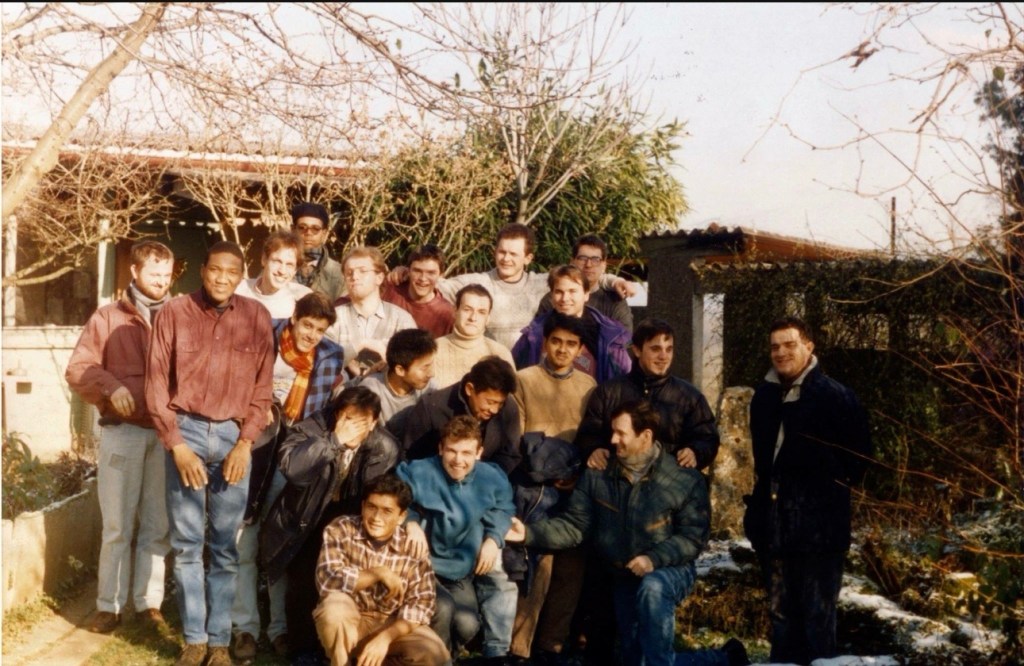
A group photo of the male Permanents at the time from all over the globe. Br. Mathew, a “young brother” in charge of caring for us, is now the Prior of the community (far right). Great memories!

Yet after about seven months, it became clear that I was not to stay, but I never doubted that I had been called there. I came to that little hill, and I saw Christ more clearly than ever before. I just now knew he was calling me to something else. Back to the valley for me! This led me to other people, and thus more new understandings of God’s love, but that’s for another time to share. 

I have not been back to what I still consider my spiritual home, but my wife, Kristine, and I did make it to a European Meeting in Barcelona. (It was the last time I saw Br. Francois. He died a few years ago.) I also was able to welcome Br. John and Br. Emile for a meeting at my church in the Richmond area in 2019. I hope our paths will cross again, but as I have written to my many dear fellow volunteers now across the globe, it’s ok if I don’t meet them again. I still sense the deep, living communion which we share any time I hear Taize’ chants, see a photo, or think of them. The Spirit works this way among the Church, a communion of saints. That communion spoken about in the creeds of the Church is tangible.

Yes, we are together still. It’s hard to explain, but it is true. I trust – thanks be to God – that it will be so forever.

“The Hill,” the village of Taizé in Burgundy, France.

Reflection expanded upon from a Facebook post shared on the 30th anniversary of my arrival to the Ecumenical Community of Taize’.

© 2025 The Rev. Louis Florio. All content not held under another’s copyright may not be used without permission of the author.

2 Comments

Filed under Memories

Be at peace.

Image from Global Orthodox

St. Isaac the Syrian knew what he was talking about. For the Orthodox and many other Christians (sadly not all) humility isn’t docileness. It’s an understanding and deep trust that all we have comes from God. We are sinners in need of God’s mercy and direction. Yet because God is love and loves us, we can find peace. We can be nonanxious as others rage. We can rest in Jesus even as we work hard for justice, mercy and truth. We can be patient with those who don’t see the world as we do. We know who we are but also whose we are. This doesn’t mean we don’t struggle with fear at times or never fail or fall, but we find the strength in God’s Spirit to keep trying; to seek to love as God loves us; to keep moving forward knowing we don’t walk alone. Some people will see Christ in us and want the peace we have. Many more might reject us as they do Jesus and his message through word or deed, even as they might call themselves “Christians.” That matters not. Embraced by Christ, we can do no other than cling to Christ and our call nonetheless, even as we fight the interior whisper of demons telling us we aren’t good enough, don’t have the strength, must give up. Yet how can we give up when we have everything in Jesus who has already made us victorious? In that shared victory, we ought not judge or puff ourselves up. We must love the other. We should forgive. We should nurture peace. We do this from a God-given humility, not out of our willfulness. “What is hell as compared with the grace of resurrection?” St. Isaac once asked. Nothing. We can always choose to live in hope by God’s help. And through the power of his Spirit, God will.

© 2025 The Rev. Louis Florio. All content not held under another’s copyright may not be used without permission of the author.

Leave a comment

Filed under saints

Loving and learning as we go (Sermon)

The below sermon was offered at Christ Lutheran Church in Fredericksburg on February 2, 2025. It is definitely much longer than my normal sermon, because the topic was immediate, adjusted last minute to a high profile current event on the fly, and about an issue prone to nurture strong disagreement. Although our denomination, the Evangelical Lutheran Church in America leans politically liberal, multiple surveys suggest that the membership leans toward the center. Indeed at this congregation, we have strong supporters for President Trump and those adamantly against him. This sermon was intentionally crafted so that all people could hear and reflect about these things without shutting down. Maybe it would spark conversation? I cannot change Elon Musk’s mind with my sermon, but I might be able to help my congregation see things in a new way.

In my time with Brother Roger and his community in France, the Ecumenical Community of Taizé, we often had people come who lived in severe conflict with one another in their home country or region. How can we speak to one another with open hearts if we call one another names or shut down? So in small groups, people were asked to share their experiences of faith, but not in a way of debate or even to convince. Listen for the Spirit in what others say. I also learned and came to believe that the Spirit is calling all people and within them even before they might realize it. We should treat them with respect, even if we struggle to like them or do not approve of what they do or say.

This was modeled in Brother Roger’s own history. Before the community formed, he risked his life to help Jews escape persecution in France. As a result, he was narrowly escaped arrest by the Gestapo. After the war, he offered care and hospitality to German prisoners returning home. This was not popular with some of his French neighbors who had suffered so much and were rightfully angry. And living in one of the most Communist areas of post-war France, amidst people who sometimes overtly hated Christ and his Church, he and his brothers helped their neighbors no matter their political leanings. They even were able to start food cooperatives which benefitted all. In time, authentic love at work in his life and the lives of other brothers earned trust and effected change. This witness has impacted the way I try to address conflicts of our day and in my life. It shows in this sermon.

Some pastors and others will likely say I did not go far enough to condemn or fight what they perceive as evil. (They might be right. At the very least, it is a mistake to have stripped the funding in the way it was done – too carelessly and with false accusations – likely a sin, certainly a shame despite any intentions.) Yet, like the brothers, I feel a profound call to try to live as an agent of reconciliation. (See 2 Corinthians 5:17-20.) If we wait for people to be perfect before we seek to reconcile, reconciliation will never happen. In reconciling, sometimes people change or see their wrongs more clearly. It proves a give and take process, requiring ongoing forgiveness and patience along with self-awareness.

Further, this sermon was shared with people whom I know well and deeply love. Sometimes a pastor can do more good using the gentle nudging of a staff rather than the full force of a rod. And I take Jesus’ mandate for us to love one another very seriously. I want my congregation to as well. I think this approach might prove the same for you in your relationships even if not a pastor.

The text of my sermon follows, but I will also include the YouTube link at the bottom of this post if you prefer to watch all or part of the service. I have tried to adjust the original manuscript to better reflect what was said balanced with clarity. Is a sermon ever truly done? I am confident I will write or speak more about what appears to be bad policy if not illegal as it impacts a nonprofit I know to be honorable. This is only a start of a conversation.

To listen to the mp3, click here.

Peace+
Pastor Lou


It has been a stressful 2025 for many of us. There’s a lot going on in the world – wars and pestilence – but there’s been a lot of change, too. Whether you like change or not, whether good or bad, our recent political changes are still change. And as any health practitioner will tell you, “Even good changes can leave you feeling drained, out of control, and depressed.”[i] And as our national administration does change things, we have seen many fast and furious changes making some neighbors of ours worried about the security of their jobs, what might happen to their medical aid, or even the legality of their marriage. And much as it was when I lived along the Arizona border while in the Army, a lot of people are rightly afraid of some of the violence or other negative issues that can come with unbridled, unsecured immigration, and perhaps at the same time, we might be concerned about our friend, or neighbor, or fellow employee, or fellow student who has a questionable immigration status – someone that might have been here for many years, who is a good worker and kind neighbor, but at risk because of past choices they made. (Or maybe, adult relatives made a choice for them.) And I know of friends that have already had their adult child lose their government job suddenly as a result of different government priorities. It happens. My uncle used to be an executive with Lincoln-Mercury, and he had to lay people off at times… regrettable, difficult, but it happens.

Yet coming in this morning (I’m going off text now, so hang in there), I saw a tweet from Elon Musk, and it talked about “the Lutherans.” Oooo, that tweaked my attention. Basically, he was complaining about all the money going to Lutheran parachurch organizations for their social services. Yet, he never explained what this money went for. His main concern was probably immigration, because there are elements that do help with refugees and other immigrants including our allies from Afghanistan. (Some of these live right here in Fredericksburg.) Yet, he lumped all the services together. The thing that I would like you to know…that I know because I used to be on the board of Lutheran Family Services of Virginia (now enCircle)…is that Lutheran Services of America, the overarching organization (which is kind of like the United Way) helps one in fifty Americans with all different kind of things. (This is a correction from the recording. I said, “one in five,” in error. Still, this is a staggering, impressive number.)

And so, when you look at a group like Lutheran Family Services of Virginia (now enCircle), they have some programs that help refugees and immigrants, but they also facilitate adoption and foster care. They help with counseling services which some people in our community have taken advantage of. They help with schools for at-risk youth. They have helped with kids who are on the spectrum. They helped with elder care. They have houses for folks with intellectual disabilities and help them live independently or in community. So, there are a lot of things that go into these nonprofits…these parachurch organizations (started by the Church, but not the Church). And they receive grants from the government, yes, but also from industry and other nonprofit funds, and then, they get funding from good people like you who donate in support of what they do. Yet as funding streams change, so does their ministry or outreach. Even in the nine years that I was a board member, Lutheran Family Services did that.

And so, funding streams are changing because political priorities are changing. And that really is “fair,” right? That’s the way our government works. That’s the way the world works. Yet, I do hope that we are concerned that with doing things quickly…lumping all things together…that maybe, some people will be left behind or hurt unintentionally. And that, I think, is something that we can certainly speak about as Christians. We want to do things “smart.” We want to do things in a way that doesn’t hurt others and make things worse.

So, with all these political changes, right or wrong (as you see them), good or bad (as time will tell), I hope we can recognize that this is a stressful time for many people. During this period of change, mistakes might be made, and there are things people will have to adjust to, but some people might even be afraid. (Whether you understand why or not, they might be afraid.) And that is no secret. You can just look at social media posts and see that. Yet, whenever we strive for justice and peace, to do the right thing, whether left or right in our political leanings, we as Christians are supposed to approach others empathetically…care for them…offering mercy and help as we can (as all the prophets say)…forgiving when they make mistakes…and try to love and help them as they are…even as we see them as totally wrong, or sinful, or whatever the problem may be. Even when I was a police officer, long ago in the 80s and 90s, and I would arrest people…one of the things I learned as I came back into the Church again…started to really believe this Jesus stuff was true…one of the big challenges I had as I arrested people for violations that were serious remained: How do I treat this arrestee as a human? Do justice, but how do I show mercy in the way I relate to them. That’s a kind of love and a kind of Christian witness, too. So, I know it is hard…but with God’s help, we can do it. We can do it and change becomes possible.

These are all huge issues that we are talking about nationally and locally…important issues! You should care! And I am not going to tell you today how to vote or think. I am not going to dissect policies or waste your time during this sermon pointing fingers at those “bad people.” You can fill in the blank for who those bad people are. Yet, I do believe today’s sacred stories perhaps ask us not to point at others, but instead, maybe point at ourselves. Where am I in all of this? What am I doing or failing to do? These stories lend themselves to discernment. Are we responding from our faith, hope, and love as we should, or are maybe some other influences…even sin…are affecting our decisions? This comes up with issues of religiosity (how we behave in church, how we live our faith), politics, or any other areas of our lives. Are we responding in faith, or is something else guiding us? So, we can always do better whoever we are, because none of us are perfect in our ability to love…ever.

In fact, our friend Martin Luther always sought to remind us that we can be sure that we are absolutely, positively not perfect. You and I are a mess. Selfishness, shortsightedness, and other sin can always creep in to blind us, to trick us, so that we start to call bad something good. In fact, he argued that really, we don’t truly have free will. We think that we do, but we don’t, because sin is so powerful that even when we do our best, what we do is always tainted…always. We remain fallen creatures even if are saved; sinner-saints all.

And so much like the days of old, theological and political debates can happen, and they can merge into hot button issues of our day. Thus, we must ask ourselves, how should we act? What are the right standards to maintain? How do we uphold justice while trying to be merciful at the same time? And faithful people, “good people,” end up all over the political spectrum. And why is that? Because they are applying their experiences, their knowledge, the wisdom God has given them, but in the end, it is all coming through and from a human being. So, we come to different conclusions. (Sometimes these are very wrong conclusions.) And so, that begs us to try to treat each other with a great amount of compassion or patience. We are only human. And only God perhaps knows the best and perfect answer for any situation you can come up with. We are like beggars that can only reach out for grace-filled guidance and commit to try to do our best in striving to be like Jesus…yet also always ready to repent…and always ready to forgive.

Certainly, one side of any human argument might be closer to God’s truth than the other, but in humility…recognizing our own human fallibility…perhaps we should not be so quick to think that we are totally, infallibly correct and the other side totally, unbelievably wrong. Again and again, it must be said, we are all human with limited intellects and an imperfect capacity for unselfish love. We need God’s help. We need to listen to God, as well as listen and learn from one another. Spiritual and moral truths exist to be sure, but our ethical and our concrete situations change. How we apply our beliefs and laws need to change sometimes. We must keep our minds open to new possibilities when a God claiming to always be doing something new comes around.

Today’s passage proves an example of situations just like that. Jesus doesn’t cancel out the law, but we see him reapply and interpret it under specific, challenging circumstances. He kind of expands our understanding of the law. So, here we are…in a field with Jesus on the Sabbath. His disciples are hungry, and so they plucked some heads of grain. They took what they needed to satiate their hunger and no more. That was an allowable practice on other days…except on the Sabbath. So, what should Jesus have done? Let them starve? Does God’s care for the hungry end on the Sabbath? Jesus thinks not. Jesus understands that he is Lord of the Sabbath, but also, the Sabbath is a gift to us. It serves us. It blesses us. We don’t serve it.

In fact, there is the precedent with David as he fled from King Saul, and he ate the bread of the Temple meant to be offered to God. Technically by the law, this was explicitly wrong, but in that situation, he is not condemned by scripture. Jesus declares, “The Son of Man is the Lord of the Sabbath,” and it is not the other way around. Now, Jesus isn’t throwing the law away or ignoring it. He’s reapplying it in a way that allows for a greater capacity to love in a certain circumstance…a way that honors God’s original intentions. His teaching is consistent with the love of God and neighbor accentuated in Deuteronomy 11. When it comes to the laws of God, they are always meant to prove a blessing and not a curse.

And similarly, on another Sabbath Day, Jesus is faced with a man who has a withered hand. He could have waited until the Sabbath was over to heal him, but is our God a God of love or indifference…a God of life or death? Jesus has come to proclaim the Good News that the Kingdom of God is at hand, and so healing such illnesses were an important sign of the things to come. Could there be any better place than the sanctuary in the context of praise and worship among God’s beloved people to make God’s love known through healing? The time was right and the place appropriate, so Jesus opted for life and love (the intended fulfillment of the law) over a rigorous observance of the law.

As one commentator points out, Pharisees were like the mainline Protestants of first century Judaism.[ii] They were trying to bring faith into the community and into the home. They created local houses of worship, the synagogue. And they also suggested religious disciplines, practices, that people could do to embody the faith…deepen their faith. They studied the Word of God arduously and tried to apply it to the everyday life rigorously. And so, we have extra-biblical writings – the teachings of the rabbis, not always agreeing – describing how faithful Jews should live out their faith as best as they can. They believed all the actions of our lives, even those of less consequence, should seek to reflect our faith in the one true, living God concretely. I hope all of us agree with that, for faith should inform our lives.

Yet at that time, keeping the Sabbath holy was a critical, central faith conviction of the Pharisees as well as other Jews. Yet what constituted rest and what constituted work…ah, that’s the question. It appears that at least some Pharisees tended to opt for the strictest construction of the Law – no work at all, even to feed people who are hungry or heal someone in need. Over time, very fine points of Jewish ritual law have been defined by Rabbis – both in and outside of scripture – in admittedly a copious and complex way. On one Jewish site that I visited, the consensus suggested that we really can never learn enough about keeping the Sabbath holy.[iii] Yet even today, the more orthodox believers of Judaism avoid writing, erasing and tearing paper on the Sabbath for that is work…a kind of physical exertion. They aren’t allowed to make business transactions or prepare food either. (That can be done ahead of time with proper planning.) As kindling or sparking fires were prohibited in the Levitical law, turning on lights or a stove (allowing for a sparking of electricity) remain forbidden today. And the list goes on and on, but this is not out of some obsessive love for the Law, but it is an explicit, intentional attempt to encourage people to honor and love our one true God with their lives…through those actions, to bring God to the forefront of our minds and hearts. It stops us during our day to think about God in our life.

These two Sabbath controversies are about observing the Sabbath day rightly, but it is also ultimately about how we should honor and love God and neighbor. That dual command of loving God and neighbor that Jesus lifted up over and over again is critical to interpreting the scene put before us today. Loving God and neighbor as ourselves, reflecting the biblical teachings and mandates, proves the highest form of worship and holy living according to Jesus. Our actions should embody this faith. Yet, this wasn’t new with Jesus…just sometimes not properly applied or understood. Many of the earliest Jewish interpretations (through many today) always emphasize that saving a life always overrides Sabbath law.[iv] They agree with Jesus’ interpretation.

Name whatever hot button political issue you like…consider any ethical dilemma you are facing (or our nation might face for that matter)…we are to consult scripture and discern our response the best we can. (Hopefully, we do so in community.) According to Luther, the prophets, and Jesus, loving God and neighbor as ourselves is to remain our ultimate maxim and measure. When justice and mercy are at odds, there is to be a bias toward mercy.

Yet when we are asked to love others, this doesn’t mean we aren’t to love our community, family, or ourselves and automatically ignore any of our risks or needs. No, no, no, the context matters, and that’s what makes Christian ethics so difficult. The context matters. Our options and gifts that we have been given matter. Our willingness to be open to God’s love and sharing that love with others matters. We should wrestle with our problems intentionally, not fall back into some kind of autopilot, for if we have not love, we gain nothing. (So, St. Paul argued.)

As we face the many controversies of our own time, I am not called here as pastor to provide you specific, political answers for your life. I’m human, and I can be just as wrong or more wrong than you. (I’m wrong all the time…ask my wife.) Instead, what I wish to do is encourage us all to engage the issues of our days in a faith-centered, faith-filled, intentional way as Jesus did. In doing so, seek to be gracious and humble. Seek to listen more than we talk…to love more than we judge or condemn…to try to understand and be empathetic toward the opposition rather than for us to worry about being understood…because when we do that, then we might just learn something. All these hot button issues are important. In some cases, they are life or death matters. So, I don’t think we should expect easy, pat answers…We should more likely expect a cross.

Therefore, our Savior is rightly consulted and trusted: through prayer and bible study…through following Christ’s own example of humility, gentleness and peace…and yes, through listening to the concerns and cares of our neighbors…even those opposed to us…even those we might think have lost their way or lost their minds…for God has often used “the least of these” to help redirect others whom God loves. It might even be helpful to take a moment to rest, to step away from all that troubles us, or to find others to share our time with. So, don’t feel obligated to post that meme that might insult another or stir the pot. If you see something offensive to you, it is ok to turn the other cheek and scroll right by it. After all, among all the controversies Jesus faced and busyness of starting his ministry with others, there’s one little verse today that we might have missed (v. 12)…this is about Jesus: “Now during those days he went out to the mountain to pray; and he spent the night in prayer to God.” Facing all these controversies and dangers, he stopped to pray, to rest.

I don’t have all the answers to the troubles of our time any more than you, and that’s ok, because we are not God. Yet, we can turn to God in trust. We can seek to love one another as best as we are able, even our enemy. As God’s chosen people, holy and dearly loved, clothe ourselves with compassion, kindness, humility, gentleness and patience (Colossians 3:12). Fast and pray, repenting of our own sins first, before trying to fix others…because we really cannot fix anybody. That’s the way of true wisdom; leading us to where we need to be…walking with Jesus as his disciples…loving and learning as we go. Amen.


[i] “How to Cope with Stress and Change,” Newport Healthcare (November 5, 2024) at https://www.newporthealthcare.com/resources/industry-articles/10-ways-to-cope-with-change/.

[ii] Allen, O. Wesley Jr. (2017) Commentary on Luke 6:1-16 at https://www.workingpreacher.org/commentaries/narrative-lectionary/healing-on-the-sabbath/commentary-on-luke-61-16-4.

[iii] https://www.chabad.org/library/article_cdo/aid/5724/jewish/Questions-Answers.htm

[iv] The Jewish Annotated New Testament, Editors: Amy-Jill Levine, Marc Zvi Brettler (2017). Oxford University Press. Footnotes on Luke 6.

My sermon starts at 21:40 on this video of our service from February 2, 2025.

© 2025 The Rev. Louis Florio. All content not held under another’s copyright may not be used without permission of the author.

1 Comment

Filed under Sermon

Love transcends boundaries

JD VANCE: There is a Christian concept that you love your family and then you love your neighbor, and then you love your community, and then you love your fellow citizens, and then after that, prioritize the rest of the world. A lot of the far left has completely inverted that… (January 29,, 2025 in a Fox News interview)

There has been a lot of angry posts created since the Vice President shared the above during an interview on Fox News. If only loving was so organized and clear cut! Sadly, love in a fallen world never is. Loving others is most often difficult, confusing, and often messy. It is easy to love too much as well as not love enough. We find that God is love, but we are not God. All of us fail at loving all the time – sometimes out of selfishness; sometimes out of ignorance.

Yes, things are not as clear and linear as the Vice President suggests. True, I’ve seen some Evangelicals and Roman Catholics write about circles of love reflecting varied intimacy or immediacy – spouse, family, community, nation, world. And certainly, the original Protestant Reformers tried to reaffirm marriage and family as not just a necessary passion but a sacred calling equal to others (particularly celibate vocations) glorifying God. Indeed, Jesus called his disciples a family. It was a fictive family, but with more import eternally. When Jesus spoke about loving one another (John 13:34), it was a command specifically for and amidst disciples. They were to love one another as his body. Yet, this was not selfish. He also called them to go throughout all the earth making disciples of all peoples (Matthew 28:19) – to invite them to be part of the body. Our Christian ethic of love might allow for intimacy, but it is never meant to be exclusive. Instead, it is expansive and generous.

A walk through scripture helps us see that our Christian ethics are as complicated as our lives. Take for example, Matthew 10:37. In it, we hear Jesus tell us to not put father or mother (really anyone) before him. For his mission, people are sometimes called to leave family behind. “And everyone who has left houses or brothers or sisters or father or mother or wife or children or fields for my sake will receive a hundred times as much and will inherit eternal life,” says Jesus (Matt 19:29). His first Apostles and disciples did this. But we also learn in 1 Timothy 5:8, that we might have another slightly different call as the Church develops. We are told that we are to provide and care for family. “And whoever does not provide for relatives, and especially for family members, has denied the faith and is worse than an unbeliever.”

Then, you have Matthew 22:36-40 where we are told to love God but also love our neighbor as ourselves. In Deuteronomy, this twin command was the heart of all the laws that followed, and Jesus agreed. This command pushes us outside the tribal or genetic bonds of family. So when asked who is our neighbor, Jesus uses the Parable of the Good Samaritan found in Luke 10:25-37 to teach us that love and compassion is for anyone in need, even our enemies.

Here’s another tension. When Jesus came into the world, the Kingdom of God was at hand. He was racing to his cross and resurrection. Time was short. So, in Matthew 8:21-22, Jesus tells someone who wants to follow him in mission that his call is more important and immediate than burying the dead – in this case, the man’s father. Yet then in Mark 5:19, Jesus rejects someone’s hope to go with him.  “Go home to your own people and tell them how much the Lord has done for you, and how he has had mercy on you.” The person is sent home to do the will of God amidst family and folk! For him at that time, that was the better way to love.

My friends, I think it is a mistake to force things into an either/or dichotomy. Perhaps like St. Paul at his conversion, it is better to ask, “Jesus what would you have me do?” (Acts 9:6). Sometimes we are called to sacrifice all. Sometimes not. Sometimes we need to care for family, community, or nation as part of our primary vocation. Others might have vocations that are outward facing such as missionaries. Such people might be called to go beyond generosity to family or kinship groups to love the stranger. Dependent upon our call from God, we might need to leave family and property behind, or offer our lives as martyrs, or yes, even as a Protestant, live a single life to fulfill God’s call for us. Or, we might need to be a sign of God’s love in a family or community. Still, those at home might be asked to support missions and outreach to others. Vocations vary as much as situations, but we share all one mission to the world.

Yes, the Vice President’s interpretation is too limited and rigid, but so can be the interpretation of those who argue for more generous giving. We have to watch out for enabling behaviors. At times, we must discern who needs our help most like a medical professional in a triage unit. Our context, abilities, resources, and most importantly our call from God can impact what we should do.

Take for a recent popular example, Dietrich Bonhoeffer. He believed after World War I that Christians were called to pacifism. Still, in the face of Nazi evil, he decided a greater evil than committing violence was to do nothing to save Jews from genocide. Nation did not come first. Ideology or theology was not preeminent. Love – even if imperfect human love – did. He erred on the side of mercy.

Yet again, no matter who we are or what our vocation is, there is no denying that Jesus calls us toward one another in the Church, love of family, and even love of “other” to include our enemy. We are not called to tribalism, selfishness, or fear. Sometimes this means sacrifice. “When Christ calls a man, he bids him come to die.” Dietrich Bonhoeffer wrote in The Cost of Discipleship. This can mean a person/family/nation might need to sacrifice if not suffer in order to love others as God calls. For is not that the way Jesus loved us – dying on a cross?

Maybe this is partly why St. Augustine defined virtue as “rightly ordered love” in his work City of God. Augustine believed that a just and holy life requires loving things in the right order. God is first. Then others. Some suggest loving family before others (as you are called as parent or child) might mean caring for “self” first. For example, a pastor might take a leave of call to care for a dying parent or child. Or maybe leave must be taken to fight cancer. There can be valid reasons to prioritize your love for the one’s entrusted to your care by God; not out of selfishness but need.

Similarly, Thomas Aquinas argued for an order of love. Aquinas argues, “One’s obligation to love a person is proportionate to the gravity of the sin one commits in acting against this love.” In his argument, we’re to love with greater devotion those who have been entrusted to our care. Fulfilling our vocation was a key understanding for him.

Yet, I am arguing that the Christian ethic of love is not one size fits all. Your call and the circumstances matter. Therefore, Augustine prays, “Love ever burning, never quenched! O Charity, my God, set me on fire with your love! You command me to be continent. Give me the grace to do as you command, and command me to do what you will!” (Confessions, X.29). Augustine wrote that the earnest student “exercises himself” to find in Scripture that: 1) God is to be loved for his own sake, 2) our neighbor is to be loved for God’s sake, and 3) that God is to be loved above all.

The kicker (very difficult and somewhat surprising) which must be reiterated comes from Matthew 5:43-48, “You have heard that it was said, ‘Love your neighbor and hate your enemy.’ But I tell you, love your enemies and pray for those who persecute you, that you may be children of your Father in heaven. He causes his sun to rise on the evil and the good and sends rain on the righteous and the unrighteous. If you love those who love you, what reward will you get? Are not even the tax collectors doing that? And if you greet only your own people, what are you doing more than others? Do not even pagans do that? Be perfect, therefore, as your heavenly Father is perfect.” We are called to love others who don’t necessarily deserve our love from a human, utilitarian perspective. Certainly, again, this does not mean we become enablers of addiction or other bad behaviors. Sometimes the consequences can be loving as we protect someone from harming themselves or others more. Yet, the command to love our enemy challenges us to consider how we respond to all those whom prove difficult to love.

Then, of course, Christian counselors often remind us that self-care is not always selfish. Even Jesus took care of his needs for solitude, prayer, or fellowship at times. Yet, when the time was right, he offered himself completely up for our sake. Similarly, self-care is sometimes necessary, not a sin, for us. Remember, the maxim is to love others AS yourself, not better than yourself. This reminds me of Carl Jung: “But what if I should discover that the least among them all, the poorest of all beggars, the most impudent of all offenders, yea the very fiend himself – that these are within me, and that I myself stand in need of my own kindness, that I myself am the enemy who must be loved – what then?” If we are caring for ourselves so that we can fulfill our call from God better and value the gift we have been given (our body for example), that is not selfish. As humans, especially as caregivers, self-care is critical.

Sometimes to love others better, you need to love yourself – loving oneself in an unselfish way, recognizing your human needs or limitations – so that you can glorify the Lord all the more in how you love others. At other times, love calls us to die to self. There can be a lot of in between, shadowy times. (God often is found speaking from a cloud, right?) It is hard to see what to do. In welcoming the refugee, facing criminal justice issues, caring for the sick and elderly, we can’t just say “me first” or “America first.” It is not that easy. We are going to have to wrestle over our actions and intentionally discern. The utilitarian answer will not always be the best. We have to open our hearts to God and others, then ask the Spirit to guide us. For without God’s help, without continually questioning and testing our motives and actions, we will surely love less than we ought or are able. Common sense can lead us into sin.  

Love is complicated. Let’s strive to love generously and well by God’s help. And if we aren’t sure? Perhaps it is best to err on the side of mercy, for God is merciful toward us. Our God who is love is the God of all people, calling all people, and those outside the Church and our kinship groups are entrusted to our care. As God’s love reaches out, we are invited to be the divine’s hands, feet, and voice. For Christ followers, God’s love is meant to transcend the social and political boundaries of this world.

One day when Jesus returns, we will be one. That’s been God’s will all along.

© 2025 The Rev. Louis Florio. All content not held under another’s copyright may not be used without permission of the author.

Leave a comment

Filed under Uncategorized

Christmas always

A Christmas service at Christ Lutheran (Fredericksburg, VA) in 2024

When I was a child, my father always bought a live Christmas tree. He was an old school Italian. So, our tree came down only after Epiphany. He wanted everyone to enjoy the full season of Christmas – all twelve days. (To this day, I actually say to people because of my father’s commitment to and love of Christmas, “Merry Christmas, all twelve days.”)

Just thinking about that time, I can smell the scent of post-Christmas fir tree wafting in the air after our tree’s removal. The occasional needle might be discovered lingering in the rug or my clothing for a few weeks following. Christmas seems to have wanted to stay. Yet, even as the signs of our times might change, Christmas does not have to leave. I take comfort in old Scrooge’s conversion in Dickens’ A Christmas Carol as he says, “I will honor Christmas in my heart, and try to keep it all the year. I will live in the Past, the Present, and the Future. The Spirits of all Three shall strive within me. I will not shut out the lessons that they teach.”

I suspect Scrooge’s policy is a pretty good one to follow. In life, it can too often seem like darkness is on the verge of surrounding us, if not consuming us. Yet as others have written, “The Light we’ve celebrated is still with us,” thus we can choose to stand up to the darkness with its help. Indeed, this Light beckons us forward in confidence, because the world also needs the Light. Through the power of our faith and baptism, we can choose to be merry all year long as in the original Anglo-Saxon sense of being “brave and spirited.” We can strive to reflect the light rather than fear any darkness. For the Light which is Jesus wills to become born into our world – in a sense, incarnate in and through us – whenever we chose to love as we have been loved first (1 John 4:19).

The poem, “The Work of Christmas,” by Howard Thurman comes to my mind:

When the song of the angels is stilled,
When the star in the sky is gone,
When the kings and princes are home,
When the shepherds are back with their flock,
The work of Christmas begins:
To find the lost,
To heal the broken,
To feed the hungry,
To release the prisoner,
To rebuild the nations,
To bring peace among brothers,
To make music in the heart.

So, take heart, dear Church. Christmas and Epiphany has passed by us once again, but our time of celebration is only beginning. Christ’s gifts of hope, peace, joy, and love remain within reach. Just hold on in faith, wait, and see.

This reflection was originally published in the January 7, 2025 weekly newsletter, the Hub, of Christ Lutheran Church, Fredericksburg, VA.

© 2025 The Rev. Louis Florio. All content not held under another’s copyright may not be used without permission of the author.

1 Comment

Filed under Pastoral Letter

Serenity Now

Who knew the well-known and respected Serenity Prayer could cause something other than peace – doubts, anxiousness, and many more questions? After sharing it on our Facebook page post-election, I have had many great and fruitful discussions about the theology behind it. On its face it sounds crazy to accept the world as it is. Yet, that is not really all that it says.

As I wrote someone recently, the Serenity Prayer was written as the US was battered by the Great Depression and the Nazis took over in Germany. Things looked grim. It began as an observation by Reinhold Niebuhr in 1932 as Roosevelt was elected: “The victorious man in the day of crisis is the man who has the serenity to accept what he cannot help and the courage to change what he must.”

The prayer challenges us to discern our unique individual call, as well as a call in community. We are to take stock of what we really can influence in the world, act accordingly in faith, and with any things that prove out of our hands, we are asked to trust that they remain in God’s. Many studies have shown that “letting go” can help us physically, emotionally, and mentally function better. Based on the teachings of Jesus, I always say that it benefits us spiritually too. Consider John 14:1 for one example: “Do not let your hearts be troubled. You believe in God; believe also in me.”

Lutherans also believe in a Theology of the Cross – the cross is seen as the best source of knowledge concerning who God is and how God saves. It also encourages us to take up our cross and follow Jesus. As the Lutheran theologian, pastor, and martyr, Dietrich Bonhoeffer wrote, “When Christ calls a man, he bids him come and die.” None of our recent posts are about “just getting along” or stopping our work for a more just world. We know the world is a mess. Loving others is difficult. In the face of reality, these prayers and teachings challenge us to trust and love God at all times, and love one another, even our enemies.

How we respond to perceived injustices might change when we trust God is always at work for our welfare. This theological lens invites us to find Christ’s peace and hold on to it, even if facing the worst evil. Our suffering and sacrifice can become sacred, not by our own power, but because of God’s promise that all things work for the good of those who love God (Romans 8).  God will be with us in our suffering, but God also somehow will use it to bless us and the world. We are asked by Jesus not to lose hope when it seems like the world is ending. He taught that these things must happen (Matthew 24:6) before his Kingdom, a new heaven and earth, fully comes.

We can look toward our theological forbearers. They sometimes died for their faith. Some still do. In the US, there has been worst times of trouble – the Civil War being arguably the worst and most costly. (It took Spotsylvania County one hundred years to return to its pre-war census.) Working within the ebb and flow of history, we are called to pray and act, but always trust. God wills more for us. As Lutheran theologian Ernst Troeltsch writes, “God, therefore is always living, always creating. He is truly manifested not in being but in becoming; not in nature, but in history” [Troeltsh, E. (1991) The Christian Faith, p.120. Minneapolis: Fortress Press]. God is at work in and through us as we live in a Fallen World. God may seem like a hidden God, as Luther often called God, but God is awake and at work. It is not all up to us. God’s will will be done.

These beliefs, this kind of trust, often helps us extend our focus to see more possibilities of what we can do in hard or conflicted times – acting in love rather than just fear or anger. Acting in love does not mean there are never any consequences. For the sake of the weak, the vulnerable, really all our neighbors, sometimes some are called to respond more directly and forcefully than others. Yet as a former soldier and police officer, now a police chaplain, I see that violence is never a good thing – never without cost – even when violence becomes necessary. (Luther in discussing his Two Kingdoms theology or in his essay “Whether Soldiers Too, Can Be Saved?” speaks of these kinds of things.) We each have parts to play in making a more just world, but we each must discern how Christ is calling us with the gifts we have been given.

Still in Christ’s teachings, the call to be open to reconciliation, to even nurture it, is ever present. For me, my understanding of this broadened when I came to know and eventually live with Brother Roger of Taizé in France. Under the Vichy government, he helped Jews escape. He ultimately narrowly escaped the Gestapo’s arrest; going to Switzerland until the war was over. After the war, he came back. He cared for German soldiers (former POWs) as they made their way home. In the region, he was among some of the most anti-church people in France. Some Communists slaughtered a pig on the church steps in the nearby village each Good Friday to show their disdain for Jesus and his Church. Yet, he with other friends helped form a coop for the community anyway, and they cared for the sick and hungry. His authenticity, patience and love changed hearts and minds over time with God’s help. And I believe his witness eventually changed my way of seeing and being as well.

When we as Christians say, “all is well,” or “love your enemy,” we are ultimately affirming that Jesus is Lord. He lives, and that matters. In fact, it changes everything, so it must change how we respond to the world. Jesus promises that his Kingdom will come, but he is here with us now. It has broken into our world, but it is not in its fullness yet. We are already victorious even when we might suffer (1 Corinthians 15:57). This truth can free and empower us to respond to our Fallen world and our neighbors in surprising ways.

For, God is not done with us or the world yet. Yes, the poor will always be with us (Mark 14:7, John 12:8, Matthew 26:11), but we seek to feed and house them as Jesus also taught us. As we face those in opposition to us, we seek to bless those who curse us and pray for those who mistrust us (Luke 6:27-36). In the face of worldly reality, we seek to live in abundant, generous, and merciful faith, hope, and love. All is well, but all is not perfect…yet. As the body of Christ, we have work to do, but we trust most importantly that God is at work, too. We need not be afraid.

Parts of this reflection originally were published in the November 18, 2024 weekly newsletter, the Hub, of Christ Lutheran Church, Fredericksburg, VA as well as sections in a Facebook post that I shared. 

© 2024 The Rev. Louis Florio. All content not held under another’s copyright may not be used without permission of the author.

Leave a comment

Filed under Pastoral Letter, Uncategorized

All is well…Yes, really.

So many people – both “blue” and “red” (plus other political colors as well) – have been anxious this election cycle. Unfortunately, anxiety can turn into anger rather quickly. Now, hear me clearly, anger is not a sin according to scripture, but we as humans can too swiftly ride the tide of our emotions into the vortex of sin when we feel insecure, unmoored from what usually grounds us. As animals, fight or flight responses can take over. Biologically, we focus on what we think a threat. This is meant to be a safety skill built into us, but it can become our downfall. We can miss the bigger picture. We might abuse others who don’t deserve such treatment. We can begin to wear blinders so that we miss out on facts or observations that might help us avoid loss of relationships or our sanity. We can hurt ourselves and others in ways we never imagined possible. Anticipatory stress can prove a real trap hurting our overall health.

When I was a child growing up in a family with many challenges, I learned to be vigilant for signs of potential trouble whenever I entered my home. As a soldier in the National Guard, I was trained to watch for ambushes and danger. When a finally became a police officer, I found that I sometimes had a hard time “turning off” after my shift. It was a violent time in the Metro-DC area. I eventually learned how to keep this hypervigilance in check after some help from others. Yet, I discovered my greatest gift to combat such issues proved to be faith. Faith is more than just an intellectual trust in the Lord. It is at its best a deep and growing trust that our gracious God loves us and will never abandon us – even as we face death. This gift of faith certainly helped me lower any anxiety or anger which might pop up. I became calmer and less reactive. Instead, I saw more options and possibilities in a fallen world. I grew in empathy, compassion, and patience. I learned better how to love myself and others in stressful situations, and people began to notice.

Why this dramatic change? I started to see beyond the problems facing me in the world. I think it was because the Holy Spirit longs to help us learn that (as others taught me) the God behind us is bigger than any problems facing us. Indeed as Brother Roger of Taizé used to teach, God is already in our future waiting for us – no matter how dark it might appear – ready to embrace us. We need not be afraid (as scripture so often reminds us). Everything – even our own sin – can be used by God to bless us (Romans 8:28). We can act instead of react. We can choose love. This is because God promises to love us…always.

Yet sometimes we can feel like one of the characters in Animal House, a movie I saw as a teen. For years, if anyone were to say, “Remain calm. All is well,” I thought of the ROTC cadet, played by Kevin Bacon, standing in the midst of a parade crowd running amok. Things did not seem well at all. It is not easy when the world seems in chaos to hold on to this “hope as an anchor for the soul” (Hebrews 6:19). others might even think that we are foolish. Ultimately, we need the Spirit’s help to know and trust that all is well. This assurance can be found through prayer, our study of scripture, as well as beloved community. We need to risk believing as Luther taught, “Jesus does not lie.” Then, the Spirit will do its work. As Paul points out, when we feel tempted to sin or give up, when all seems lost, it is ultimately God who will give us a way out (1 Corinthians 10:13).

At this time of cultural shift and uncertainty, when the United States population seems so at odds, it is important that we not play by the world’s rules. I shared this with my congregation on social media:

For those celebrating the election, remember not to gloat (Prov. 24:17) and to seek to love those you think in opposition to you (Matthew 5:44). For those grieving, remember we are never alone on good days or bad, or when the world seems confusing or disappoints (Matthew 28:20). As believers, all of us have work to do together (Micah 6:8). More importantly, God is at work through us and all that happens in the world (Jeremiah 29:11). We can choose to live in hope because of God’s love for us (1 Peter 1:3). As Church, we are called to be ambassadors for Christ and agents of reconciliation in our conversations and social media posts (2 Corinthians 5:16-21). We are called to love one another as Jesus loved us first (1John 4:19). “Be kind to one another, tenderhearted, forgiving one another, as God in Christ forgave you” (Ephesians 4:32). Especially as Lutherans, we know that “though the earth give way and the mountains fall into the heart of the sea, though its waters roar and foam and the mountains quake with their surging…The Lord Almighty is with us; the God of Jacob is our fortress” (Psalm 46). Jesus lives and reigns forever (Hebrews 7:24-25), and together, we are called to be his witnesses to the ends of the Earth (Acts 1:7-8). Life together in any community can prove difficult, but with God, all things are possible (Matthew 19:26). All is well.

I might still remember the humor of Kevin Bacon being overrun, but I trust in the observation of Julian of Norwich that all is well. As she reflected long ago:

All shall be well, and all shall be well, and all manner of things shall be well…For there is a Force of love moving through the universe that holds us fast and will never let us go.

In our fallen world, there might be negative consequences at any time. We will suffer at times or potentially face abuse or persecution. It might prove time to take up our cross or fight the good fight for justice. Real life is never easy. We are not asked to fake our happiness, just not get stuck in or sin in our feelings. For, we have a real God who is with us and loves us.

All is well…Yes, really.

© 2024 The Rev. Louis Florio. All content not held under another’s copyright may not be used without permission of the author.

Leave a comment

Filed under Pastoral Letter

Think about these things (S3, E1)

Image: the Bible App Verse of the Day, November 4, 2024

This reflection is also available as a podcast on Spotify.

It’s easy to get stuck thinking about all the negativity during a bitter election cycle. Or, perhaps our brains get busy anticipating all that might go wrong if one thing happens or another. Yet if you take some time to meditate and give thanks for what is going well in your life or the many blessings around you no matter how small, you might just find some peace along with better clarity.

When so many people tell you that the world’s about to end, civil war is imminent, the (fill in the blank) party will destroy our nation, or “it’s us versus them,” that’s the thinking of the world. Try to remember that Jesus said you will always belong to him when you believe (trust) in him. No earthly events can ever change that promise. You can act (and vote!) in loving faith rather than in response to any fear.

We are called as Christians to love our neighbors, even enemies. Try to show others grace, patience, forgiveness, and kindness on social media and in real life, even if you disagree with them or they turn on you. All things will somehow work for the good of those who love God (see Romans 8 ) including whatever happens in the US during this election cycle – even if times grow hard. Kingdoms will rise and fall in this world, but we are called to always reflect Christ, because we belong to him forever.

So, even our vote should reflect our love of God and neighbor. Our Lutheran faith particularly places emphasis on this. Recall that on 4 November 1520, Martin Luther published “On the Freedom of a Christian” to describe how God’s love is both a radical gift and a call to service. (The treatise is sometimes called “A Treatise on Christian Liberty.”) Specifically, the treatise introduces the concept that as fully forgiven children of God, Christians are no longer compelled to keep God’s law to obtain salvation. However, Christians freely and willingly are to serve God and their neighbors. We are subject to none, but called to be servants to all.

Where as God calls us to care for our neighbors and actively shape a just and compassionate society, as the Evangelical Lutheran Church in America points out, civic engagement, including voting and public service, is a meaningful way to live out our faith in the public sphere. Therefore, voting responsibly and faithfully becomes part of our Christian call. Representing Christ’s Church, we are to engage in the political process with integrity, advocating for justice, peace, and the common good. Consider the issues soberly and pray for the Spirit’s guidance before you vote. Approach opponents with respect for their humanity. In losing or winning, we are meant to be gracious, trusting in the Lord, reflecting our faith in Jesus – especially in how we engage those in opposition. Rather than giving into the power of anxiety or anger, we can remember Jesus who always helps and cares for us.

Please join in this prayer for the election shared by Bishop Phyllis Milton, Bishop of the Virginia Synod:

Lord of all, you have declared what is right: to seek justice, to love kindness, and to walk humbly with you. Help us to participate in wise decisions for our common life that we may serve our neighbors. We pray for the volunteers who share their time and experience to assist us in the election process. Give us grace to live in unity and peace. We pray in the name of Jesus Christ, our sovereign and our Savior. Amen.

Another prayer I mentioned on social media that many indicated they thought helpful is the tried and true Serenity Prayer in its long version. This prayer composed in the 1930s is helpful on all days, including Election Day. The person who composed the prayer, Reinhold Niebuhr, was one of America’s leading theologians and ethicists for several decades of the 20th century. He received the Presidential Medal of Freedom in 1964. Thought of as a “public theologian,” he wrote and spoke frequently about the intersection of religion, politics, and public policy. A short version of the prayer (the first sentence with three sections) has become popular among 12 step communities as well. You can pray along with me and others using these words:

God grant me the Serenity
To accept the things I cannot change,
Courage to change the things I can,
And the Wisdom to know the difference.

Living one day at a time,
Enjoying one moment at a time.
Accepting hardship as a pathway to peace,
Taking, as Jesus did, this sinful world as it is,
Not as I would like it.

Trusting that he will make all things right,
If I surrender to his will.
That I may be reasonably happy in this world
And supremely happy in the next.

Although many other prayers suitable for this election cycle and presidential transition exist, last for this essay is a prayer an Episcopal priest friend shared on his Facebook page. The prayer was written in 1882, and he reports that it was actually suggested to become the Thanksgiving Day prayer of the day for Episcopalians in 1892. It has been part of the Book of Common Prayer of the Episcopal Church since the 1928 edition. I think it encompasses many of the shared concerns of reasonable people on the left or the right politically. It seems to reflect well the sentiments I have shared recently in preaching, teaching, as well as this essay:

Almighty God, who hast given us this good land for our heritage: We humbly beseech thee that we may always prove ourselves a people mindful of thy favor and glad to do thy will. Bless our land with honorable industry, sound learning, and pure manners. Save us from violence, discord, and confusion; from pride and arrogance, and from every evil way. Defend our liberties, and fashion into one united people the multitudes brought hither out of many kindreds and tongues. Endue with the spirit of wisdom those to whom in thy Name we entrust the authority of government, that there may be justice and peace at home, and that, through obedience to thy law, we may show forth thy praise among the nations of the earth. In the time of prosperity, fill our hearts with thankfulness, and in the day of trouble, suffer not our trust in thee to fail; all which we ask through Jesus Christ our Lord. Amen.

In closing, I share a quote from Abraham Lincoln. As the tumult of the Civil War approached, Lincoln shared these words which still hold true today: “Let us at all times remember that all American citizens are brothers of a common country, and should dwell together in the bonds of fraternal feeling.” This is difficult. Historically, we have failed as a nation many times before. Yet, for those with faith, it remains always possible. We can serve as a catalyst for unity, rather than division.

As Saint Paul writes in 2 Corinthians 5, “All this is from God, who reconciled us to himself through Christ and gave us the ministry of reconciliation: that God was reconciling the world to himself in Christ, not counting people’s sins against them. And he has committed to us the message of reconciliation.”

Think about these things. Pray these things. Hope in these things. You might not see any noticeable change in others, but it matters. If nothing else, this attitude of faithful positivity in the face of so much evil and angst has the power to change us. In that way, it certainly changes our world for the better.

Parts of this reflection originally were published in the November 5, 2024 weekly newsletter, the Hub, of Christ Lutheran Church, Fredericksburg, VA as well as Facebook posts that I shared. The Book of Common prayer paragraph is thanks to a friend who wished to remain anonymous.

© 2024 The Rev. Louis Florio. All content not held under another’s copyright may not be used without permission of the author.
1 Comment

Filed under Pastoral Letter

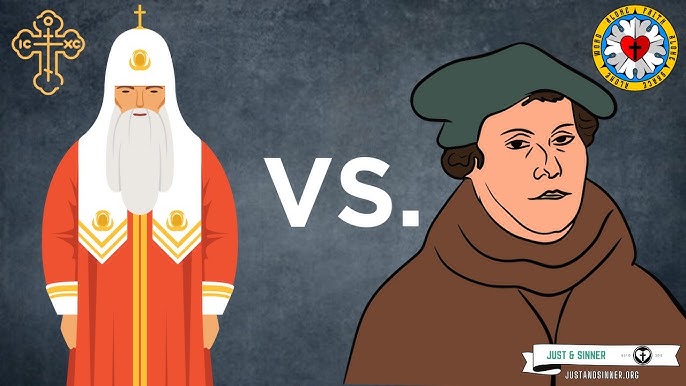
Why Reformation Day?

Image: picture-alliance/dpa/P. Ending from the article Luther in the City of Worms on DW.com.

Another Reformation Day is upon us, and so one might wish to ask in the spirit of Martin Luther’s Small Catechism, “What does this mean?”

Reformation Day is a church festival that recalls how the Holy Spirit moved through Martin Luther and other Reformers to spur a religious, political, and cultural reform movement that reshaped modern history and had many lasting effects.

Many mark the feast through worship on the Sunday prior to October 31st calling it Reformation Sunday. Because we believe it was Spirit led, the liturgical color of the day is red recalling the fires of Pentecost. In 1517 on All Hallows Eve (All Saints Eve today), professor and monk, Martin Luther, posted his 95 Theses in Wittenberg, Germany, listing points of debate and inquiry regarding the practice of indulgences by the Medieval Roman Catholic Church and its associated abuses. It sparked a fire leading to a reexamination of all Medieval church practices in the West, and as a result, some unintended fractures came to pass. Yet, it also bore the fruit of a purified theology in a Church seeking to resist superstition, ignorance, and abuse. Biblical scholarship of today originates with the Reformation witnesses, especially Martin Luther.

Although others before Luther had suggested sharing the scriptures and worship in the common, local tongue, it stuck as a widely accepted norm after Martin Luther’s efforts to translate the Bible into German. Where the Medieval church had stopped allowing laity to share the blood of Christ (the reason is lost to us), the Reformation emphasized a return to Christ’s teaching that the body and blood be shared among all baptized believers. The spiritual equality of laity and ordained person as one within a “priesthood of all believers” became a force in the daily life of the Church, and with that, laws, schools, and governments saw reforms helping to lead Western Europe out of the dark ages. Everything was on the table for review, such as what books should be considered scripture or what of the seven major ministry practices of the Church should be considered sacrament. (Martin Luther came to argue that only baptism and the Eucharist were sacraments, although confession was held up as a sacrament in his earlier catechisms.) Perhaps the biggest change was understanding that we are saved by grace through faith in Jesus Christ, not by any works on our part.

Certainly, this is a broad brushstroke, as there remained many voices arguing over theological nuances and details right up through today. Even among those Christians coming to be known as Lutherans, there were arguments. Philip Melanchthon, a coworker with Luther who is largely responsible for the famous Augsburg Confession defending the Reformers’ faith, was even blacklisted by some for his attempts to reconcile with followers of John Calvin. Later, Lutherans would divide over local or national practices, how strictly one should adhere to the Lutheran confessions (the central writings of the Lutheran faith), as well as how “orthodox” (traditional, usually more high Church) worship should be or Pietistic (heart centered, often low Church). Luther himself has rightly come under some criticism for his support of government suppression of the German Peasant Wars, his approval of the persecution of Anabaptists, and later in life, his hardening heart against his Jewish neighbors. (These issues merit a separate essay of their own.) Luther like all of us is a sinner-saint at best.

Yet, Lutheran witnesses would positively influence the larger Church and world too. The Lutheran pastor, Martin Bucer, influenced Anglican worship and the formation of the Book of Common Prayer. William Tyndale who is credited with creating the first English biblical translation that was mass-produced studied in Wittenberg. The Thirty-Nine Articles, the historically defining statements of doctrines and practices of the Church of England, largely reflect the arguments of the Augsburg Confession. The oppressed Moravian Church was saved by a Lutheran, and they now adhere to Martin Luther’s Catechism. (They are one of six denominations with which the ELCA shares full communion.) They, in turn, introduced John Wesley to Luther’s Commentary on Romans which “strangely warmed his heart” resulting in what we now know as Methodism. A Lutheran helped influence the foundation of Alcoholics Anonymous, while another Lutheran helped form the Gideons. The Lutheran understanding of justification by faith has now led to The Joint Declaration on the Doctrine of Justification (JDDJ) signed by the Lutheran World Federation and the Roman Catholic Church on October 31, 1999. Twenty-five years later, the World Methodist Council, the Anglican Communion, and the World Communion of Reformed Churches have also signed. (There are still some issues with details and practice, but we formally agree that only God’s grace can save us.) Even our Roman Catholic siblings have adopted many of our 16th Century Reforms after their council gathering now known as Vatican Council II (in the 1950s). Lutherans have also been center stage when it comes to relief efforts and work with Refugees. In fact, one in five Americans receive assistance through Lutheran ministries/nonprofits under the banner of Lutheran Services in America, one of the nation’s largest and most respected health and human services networks.

The impact of the Reformation is still being worked out in our lifetimes. It has faced many bumps in the road, we can fall short, but God is still at work. On Reformation Day, it is ultimately God who we celebrate. You might like to explore some of these resources to learn more:

By Heart: A conversation with Martin Luther’s Small Catechism was written by one of my former professors, Dr. Kirsi Stjerna, and several others. It is an excellent, accessible, highly readable unpacking of Lutheran core beliefs.

The ELCA publisher Augsburg Fortress points out, “Martin Luther posted his Ninety-five Theses on the church door at Wittenberg in 1517. In the three years that followed, Luther clarified and defended his position in numerous writings. Chief among these are the three treatises written in 1520.” They still apply today, and you can find them in one text at the Augsburg Fortress website, Amazon, or through other vendors. His Three Treatises (“To the Christian Nobility of the German Nation” asking leaders to play a part in the Reformation; “On the Babylonian Captivity of the Church” particularly focusing on the Sacraments; and “On the Freedom of the Christian” about living the Christian life) are fundamental to understanding the Reformation. As a former Roman Catholic, I can testify that they still have application in our times.

You might also like Heiko Oberman’s Luther: Man Between God and the Devil, a deep, psychological and spiritual treatment of Luther.

The Annotated Luther Series illuminates the essential writings of Martin Luther. You can find it here: Annotated Luther Series.

If you want to go all in, Logos.com offers the collection of Luther’s writings (55 volumes) for online access at $259. Since this collection was created, several more volumes have been added as his works were translated from German. Those are available at an extra charge.

Lutherans solidified their faith by agreeing on core documents collected now in our book of confessions called The Book of Concord, meaning book of unity. You can see it for free online at several sites, or buy it at Augsburg Fortress or another vendor of your choice.

If you prefer podcasts, try the Doth Protest Podcast. It focuses on church history and how the theology of the 16th-century Reformers can inform us today. Many Lutheran scholars are interviewed among others from varied traditions. A friend of mine, a local Episcopal priest, is one of the hosts.

For heavier theology, you might enjoy the Queen of the Sciences Podcast: Conversations between a Theologian and Her Dad. Rev. Dr. Sarah Hinlicky Wilson is Associate Pastor at Tokyo Lutheran Church and the Founder of Thornbush Press. Her father is Paul Hinlicky who after 22 years of service has retired from Roanoke College as the Tise Professor of Lutheran Theology. He is currently Distinguished Fellow and Research Professor of the Institute of Lutheran Theology.

Then, of course, there are many movies about the Reformation. Luther (2003) is among the most recent starring Joseph Fiennes, Bruno Ganze, and Peter Ustinov. You can find many past documentaries streaming as well.

Have you ever seen the rose image on the floor in our Christ Lutheran entryway? The Luther rose or Luther seal is a widely recognized symbol for Lutheranism. It is the seal that was designed by Martin Luther while Luther was staying at the Coburg Fortress during the Diet of Augsburg. Martin Luther thought it a summary of our Lutheran faith. See the image below for an explanation. (Source: OldLutheran.com)

Originally published in the October 22, 2024 weekly newsletter, the Hub, of Christ Lutheran Church, Fredericksburg, VA.

© 2024 The Rev. Louis Florio. All content not held under another’s copyright may not be used without permission of the author.

Leave a comment

Filed under Pastoral Letter