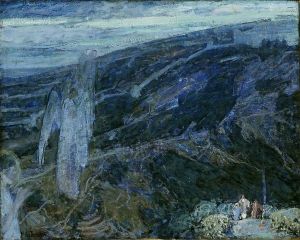
Angels appearing before the shepherds, by Henry Ossawa Tanner
And suddenly there was with the angel a multitude of the heavenly host, praising God and saying, “Glory to God in the highest heaven, and on earth peace among those whom he favors!”(Luke 2:13-14)
What a powerful, enduring image – an angelic multitude proclaiming the birth of Jesus to poor shepherds in a field! In great works of art or on more humble Christmas cards or creches, even in our favorite carols, we imagine them in song with the shepherds below basking in the glory and love of our God. How much more should we let our lives sing a song of gladness? For Jesus came not to remain in that stable, but instead plans to come to us where we are. He desires to reside in our hearts.
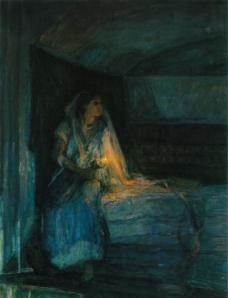
Mary (1914), by Henry Ossawa Tanner
Yes, through our faith and baptism, we share a more similar experience to Mary’s own. She was a poor, relatively uneducated young lady; likely 13 to 15 years old. She had lots of questions, doubts and fears to wrestle with, yet when the angel announced she would become the mother of the one true God, she submitted. Her magnificat (a song of praise captured in Luke 1) declares with certainty, “My soul magnifies the Lord, and my spirit rejoices in God my Savior.”
Mary was God’s favored one, and we share in that favor. Truly, Jesus waits to be born in each of us and reborn each day. No matter how we perceive ourselves with our varied gifts and struggles, God has come to us declaring each of us beloved child. Prophets in the Jewish scriptures predicted a time when the Temple would be no more, for our bodies would become the place where the yet unknown Christ resides. The Angels in the field proclaimed that Jesus came for all of us who are poor, imperfect and in need of love.
In Jewish theology, our heart represents more than an organ or emotional passion, it reflects our utmost being – the depths and totality of who we are. That’s where Jesus wishes to reside. So, Jesus prayed that we be one as he and the Trinity are one. It is Jesus who chose and called each of us to follow him. It is he who wants to live inside us and through us so intimately in every moment that he names us as his body. This good fortune is offered as a certain gift to all who dare trust in his promises.
Surely, Christ’s presence will upset our lives. It might even make us the objects of scorn or worse. Yet, “Do not be afraid!” God’s favor will never disappoint. Walk on so that your life becomes his song. Walk on trusting that Christ walks with you and that many more miracles shall surely come. His presence will bless us beyond our expectations.
The Christian singer Francessca Battistelli in a recent song imagines these words coming from the heart of Mary and her own, “I am not brave. I’ll never be. The only thing my heart can offer is a vacancy. I’m just a girl. Nothing more. But I am willing, I am Yours. Be born in me.”
Do not doubt any longer, but believe. Open your heart and welcome Christ at each new sunrise or whenever darkness falls. The promises of God are fulfilled in your hearing. Blessed are you! Holy are you! Sing to the glory of God, so that all might believe!
Be born in me (Mary), Francesca Battistelli
This post was originally published in Messiah Lutheran Church and School’s newsletter, The Messenger (December 2014/January 2015).
Unless otherwise indicated, all scripture quotations for this article are from the New Revised Standard Version (NRSV) translation.
Epiphany, also historically known as “Little Christmas,” marks the end of Christmas celebrations in Western Christendom on January 6th. The arrival of the Magi is often remembered as part of these celebrations. Although scripture never numbers the gentile Magi who came to worship Jesus, a tradition developed that there were three; each one baring a special gift of gold, frankincense, and myrrh. They became popularly known as Melchior, Caspar and Balthazar and are often artistically represented as being of different peoples and races, for Jesus came to offer salvation to all.
Over time, a popular custom began to bless one’s home on Epiphany with the words in Latin, Christus Mansionem Benedicat (May Christ bless this house). I surmise this was because of the biblical scene from Matthew 2: 1-12. (Jesus was no longer in the stable but described to be in a house with his own family when the Magi visit.) Yet, I have not confirmed the origin of this practice. The first letter from each word of this blessing corresponds to the traditional names given the Magi. Which came first – the blessing or the names – remains a mystery, but their development within popular culture is likely related.
As we move forward into a new year, I suggest use of a simple blessing ceremony I have adapted from the internet. You can further adapt it to meet your family’s needs:
Leader: Peace be to this house and to all who dwell here, in the name of the Lord.
All: Blessed be God forever.
Reading: Matthew 2:1-12
Using chalk, write on the outside of your house’s door or frame (alternatively, on a path or driveway, or above or next to an entrance):
+ 20 C M B 14 +
This stands for the first half of the current year written out, Christus Mansionem Benedicat (Christ bless this house), then the other half of the current year written out. Start and end with a cross.
Optionally, the entire phrase may be written out. Each marking or word could be written by a varied member of the household if desired. The leader can share a prayer of their own or simply ask God to bless your home as the markings are made.
When finished, all can join in a closing prayer – “Lord God of heaven and earth, you revealed your only begotten Son to every nation by the guidance of a star. Bless this house and all who inhabit it. May we be blessed with health, goodness of heart, gentleness and the keeping of your law. Fill us with the light of Christ, that our love for each other may go out to all. We ask this through Christ our Lord. Amen.”
May a joyful and blessed Epiphany be yours!
Pastor Lou
Unless otherwise indicated, all scripture quotations for this article are from the New Revised Standard Version (NRSV) translation.
On coming to the house, they saw the child with his mother Mary, and they bowed down and worshiped him. Then they opened their treasures and presented him with gifts of gold, frankincense and myrrh.” (Matthew 2:11)
Have you ever taken a good look around our sanctuary? Our stained glass windows are beautiful and educational. Long before the average person could read, people attempted to capture and share the wonder of God’s love for us through the art of stained glass.
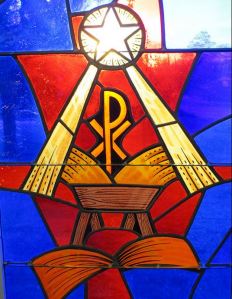
At this time of year, my thoughts are always drawn to meditate upon the meaning behind our nativity window. It shows the star of Bethlehem shining above a manger. In the manger is the ancient “Chi Rho” symbol. This symbol is the first two letters of “Christ” in Greek joined together. Early Christians used this mark to represent Jesus. The window reminds us that Jesus, the Christ, came to us in human form at Christmas. Such news becomes even more wondrous when one considers that he comes to us throughout time. He is the Alpha and Omega, the beginning and the end – present before history began and will be after it ends – because Jesus always was, is and will be our God who is with us and for us.
Luther once wrote that the Bible is like the manger where we can meet, know and worship Jesus the Christ over and over again. This, too, is true, but it also doesn’t quite capture this special relationship – the intimacy spoken of goes well beyond “knowing” Jesus with only our intellect. Our holy texts assure us that Jesus has come to live with us in our hearts. Jesus wants to abide in us. He longs to be an intimate part of every aspect of our lives. This joyful mystery cannot be captured fully in written word or by any other human art, yet my thoughts came back to an old 18th Century Danish hymn which focuses upon the joining of our human hearts with the divine heart though the incarnation and gift of faith. It is one of my favorite pieces of Christmas music.
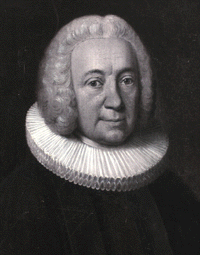
Written by a Danish Lutheran pastor and later bishop, Hans Adolph Brorson, Mitt Hjerte Alltid Vanker (in English, sometimes entitled “My Heart Always Wanders” or “My Heart Remains in Wonder”) movingly grasps at the surprise and mystery of the incarnation. Soundly pietist, the reflection remains more oriented toward his feelings and heart rather than any intellectual exploration. The lyrics reflect relationship and intimacy, as well as grace and gratitude. Contemplating this miracle, God coming to us as a vulnerable newborn in a stable, Brorson’s own mind and heart wanders and enters a blissful wonderment as he thinks about his current saving, relationship with Christ.
O come, my Lord, I pray Thee!
And be my honour’d guest,
I will in love array Thee
A home within my breast.
That home can be no stranger
You bought it all yourself.
Thou will surely stay here
Swaddled in my heart.
We will never be able to fully appreciate, capture, or understand the miracle of love offered to us through Jesus Christ. Yet because it is not just an historical event, each and every day we may strive to cooperate with grace and make room for the Christ child in our hearts above all other things. His birth should move us to reflect upon the ultimate, ongoing Christmas miracle which comes to us through Christian faith, worship, fellowship and service. Christ’s Spirit continues to shape us and sanctify us into the gift God first intended with our own creation. We become part of God’s greatest gift to the world, where in Jesus’ name, we will love others. Through grace, we concretely become the Christ’s body, here and now.
Throughout your holiday wanderings and celebrations, I pray that you, your family and friends stop and ponder the nativity. Continue to wonder about and experience this joyful mystery and invitation in your life. Rejoice, for a child has been born for us! His name is Jesus, and we will never be alone or unloved. In response, let us seek to rightly worship him, opening our hearts and offering all that we are to him in thanksgiving.
—————————–
Many variants of the song exist in English due to the difficulty of translation. Along with the above video, here are English lyrics for this wonderful Christmas song:
My Heart Remains in Wonder/My Heart Always Wanders
My heart remains in wonder (or better translation: My heart always wanders)
Before that lowly bed
Within the stable yonder
Where Christ, my Lord, was laid. (or: was born)
My faith finds there its treasure,
My soul its pure delight,
Its joy beyond all measure,
The Lord of Christmas night.
But Oh! my heart is riven
With grief and sore dismay
To see the Lord of heaven
Must rest on straw and hay,
That He whom angels offer
Their worship and acclaim
From sinful man must suffer
Such scorn, neglect and shame.
Why should not castles royal
Before Him open stand,
And kings, as servants loyal,
Obey His least command?
Why came He not in splendor
Arrayed in robes of light
And called the world to render
Its homage to His might?
The sparrow finds a gable
Where it may build its nest,
The oxen know a stable
For shelter, food and rest;
Must then my Lord and Savior
A homeless stranger be,
Denied the simplest favor
His lowly creatures see.
O come, my Lord, I pray Thee,
And be my honored guest.
I will in love array Thee
A home within my breast.
It cannot be a stranger
To Thee, who made it free.
Thou shalt find there a manger (or: Thou will surely stay there)
Warmed by my love to Thee.[i](or: swaddled in my heart)
In English, it is difficult to find a flowing, direct translation of the traditional final stanza in Danish or Norwegian, but it means roughly:
I’ll willingly spread branches Of palms around your bed. For you and you alone I will live and I will die. Come, let my soul find bliss In this moment of delight: To see you born right here, Deep inside my heart’s abyss. (or: loving heart)[ii]
[ii] Translation merging multiple sources, primarily the above video and pust.org
The above piece was adapted from one shared in Messiah’s newsletter, The Messenger, in November 2009. Unless otherwise indicated, all scripture quotations for this article are from the New Revised Standard Version (NRSV) translation.
An image of a ‘light echo’ produced by the glare from a star that was, for one brief shining moment, the brightest star in the night sky – V838 Monocerotis (Source: Daily Mail)
“And I, when I am lifted up from the earth, will draw all people to myself.” (John 12:32)
Through the fall, the world suffered what seemed to be irreparable separation from God. Instead, the rest of scripture reveals God’s ultimate plan, the reconciliation and unity that occur through Jesus Christ.
In the Jewish scriptures, God promises time and again to use the Jewish people as a means to bless all nations. In the Gospels, we see Jesus preach, teach and do miracles in ways that heal the world and draw people together in his love. As the church begins, we learn from the Spirit that there is no longer gentile or Jew, male or female. Economic and political differences, ethnicity and language are moot points when it comes to the reach of God’s love.
In the end of time, all promises will be fulfilled. Jesus will come again as “the bright morning star” announcing:
“The Spirit and the bride say, ‘Come.’
And let everyone who hears say, ‘Come.’
And let everyone who is thirsty come.
Let anyone who wishes take the water of life as a gift.” (Rev. 22:17)
Until that day, we have been called together to be his one body, the church. On his behalf and with his authority, we have the honor and duty to share the water of life and invite all we meet, “Come, follow Jesus. Be one with us in his love.”
Discussion questions:
What gets in your way of a deeper relationship with Jesus? How do you live as one with his church? How can you invite others into such a relationship?
The above reflection was originally published in Messiah Lutheran Church and School’s worship bulletin for the Second Sunday of Advent, 2013. It is meant to complement Creative Communications’ Bright Star of Bethlehem series for Advent and Christmas.
Unless otherwise indicated, all scripture quotations for this article are from the New Revised Standard Version (NRSV) translation.
The following are the three meditations I shared during our Family Christmas Eve Service at Messiah Lutheran Church and School in 2012. Our theme was “Sent into the World.” We remembered both how Jesus was sent into our world to save us as a newborn babe and how we are sent as his church out into the world. Thus, the service included many hymns and carols from all over the world. The three below were part of the meditation portion of the program, but it was a night filled with music and fun.
The Gift of Jesus
Reading: Isaiah 9:2-7
Prop: small Christmas tree ornament of the globe
“The people who walked in darkness have seen a great light; those who lived in a land of deep darkness—on them light has shined” (Isaiah 9:2).
Consider the world [holding up ornament]….Ok, it’s a bit larger than this ornament, but it’s a relatively small place in the vast, extensive darkness of space. Proportionally, this ornament in comparison to your own size is much, much larger – infinitesimally so – than what we would find with a God’s eye view of our planet. Our world is only a small rock in a vast galaxy that itself is only one of millions of galaxies. Our universe was created from a black void – both the Bible and science think so – and this poor little sphere spends much of its time suspended amidst that darkness; hidden by larger heavenly bodies, and threatened by them as well. Yes, our fallen world is filled with threats and horrors and many terrible unknowns, and it always has been. Yet, light breaks in to give warmth, nurture life, and bring joy. Amidst a cosmic battle, God doesn’t leave us unloved or alone in the dark. Instead, he chose to dwell among us…even became one of us on this tiny, out of the way planet we call home.
Long ago, the great prophet Isaiah lived in the 8th Century BC. It was a time of much darkness. Certainly, they didn’t have our modern conveniences or scientific knowledge, but they shared in our troubled humanity. Throughout Isaiah’s life, the nation of Israel faced wars and rumors of war. At least three times, the existence of Israel was at risk of obliteration and exile. It was a time of early death due to violence, famine and disease. There was seemingly too little joy and never enough peace. Yet, a son was born to a young maiden, wife of the king, and the prophet saw in this somewhat ordinary experience the promise that lay within. God would be faithful no matter how dark the days got. God’s plan to rescue his Holy people would never go unfulfilled. Later Christians would understand this same passage to testify to the coming of Jesus Christ.
Over the last few weeks, we have seen too much darkness. Many are still homeless in the northeast after Hurricane Sandy. Diplomats in Benghazi were horrifically killed. In Connecticut, we hear the cries of modern “Rachels” weeping as foretold by the prophet Jeremiah. (See Jeremiah 31:15-17 and Matthew 2) They cry over too many innocents and our own innocence lost in the safety of their small town school. Closer to home and only in these past few weeks, members of our community have suffered new joblessness, accidents and serious illness, and our beloved Assistant to the Bishop, Pastor Chip Gunsten, died unexpectedly. More tears. More death. Darkness. We might be tempted to echo the writer of Lamentations wondering, “Why God would allow such things? Why would he punish us so?” as we groan anew:
5 [God] has besieged and enveloped me
with bitterness and tribulation; 6 he has made me sit in darkness
like the dead of long ago. (See Lamentations 3)
Yet in these times of trouble, hear the promises that come to us through Isaiah. Much like that time long ago, there is a sign to remember and hope to be found amidst our darkness. When the time was right, a virgin did conceive, and a very different child was born…one like no one before or since…perhaps beyond Isaiah’s own understanding. He would be a miracle of light, giving hope, joy and love to all the nations. This king would not be a king in our political sense. Instead, he would suffer under the political forces of our world as we might. He would live amongst the ill and dying. His life would be continually threatened from the slaughter of the innocents in Bethlehem until his own death on a cross. God had come, not to punish us, but to share our lot and change it; to end suffering and bring everlasting peace. All authority rested on Jesus’ shoulders, and yet out of love, he took upon those same shoulders the weight of sin, death and the Devil to defeat them all and save us.
Like that original Christmas night long ago, Jesus comes to our tiny planet to touch our tiny lives and hearts today. He wishes to be God with Us, Emmanuel, and so none of the political chaos, evil or darkness is powerful enough to stop him. Although it might be hard for us to recognize him with our human senses at times, our faith hears his voice and trusts he is near. Together as church, we gather as one, holding on in the darkness and never alone. God does not will such suffering. God is only love. Jesus remains our proof, and the fullness of God’s Kingdom will banish our darkness forever when the time is right.
Until then, we testify to the light and hold on to one another – teaching, serving, worshipping, loving God and neighbor. For, “What has come into being in [that baby] was life, and the life was the light of all people. The light shines in the darkness, and the darkness did not overcome it (See John 1).”
Although we remain in this land of darkness, the light shines on us and through us still, and our Lord Jesus promises that it always will. No matter what worries us or threatens us…no matter the darkness we sense around us or in us, rejoice! Rejoice with the choirs of angels and all God’s saints for the promise of Christmas has come to us, and we will never again be separated from his love. Amen.
Carol, “Angels We have Heard on High,” Red, 289
The Gift of Grace
Reading: Titus 2:11-14
Prop: Wrapped package or gift bag – empty inside
One of my favorite traditions each Christmas Eve is to gather with my extended family and friends, share a special meal and open gifts. It is such a great joy to see the look of expectation through the eyes of my young nieces and nephews gathered together. Unfortunately sometimes…and I’m afraid it was the same when I was young too…the package comes all wrapped and beautifully bowed…it gets opened frantically, quickly…only to have the child move on just as rapidly to the next gift. The gift delights for a moment, but then the child moves on perhaps as if that beautiful gift box or bag was filled with nothing. [Emptying and examining package]
We, the children of God, spend much of our lives in a similar fashion. We chase after the next bobble or possession, seek positions of power that don’t last, and spend too much time in activities that can’t love us – costly time away from our family and friends. I often hear when someone has a near death experience or approaches the end of their life, “I wish things were different. I have wasted my life.” Yes, as children, we can easily lose our way.
Yet through Christ, a different gift lies before us; one that is eternal and can fill all our life’s empty places. We sense that something is missing, and that perhaps, we could do better. We somehow in our hearts expect more from this life. And so, Jesus calls us buy name, offering us the ultimate gift of his love and friendship.
The theologian Dietrich Bonhoeffer compared us to miners trapped underground. We might feel that we are without hope – waiting for death – until suddenly a voice is heard, calling from seemingly nowhere, yet calling in our darkness. “Where are you? Help is coming!” The helpless miner stands up, mustering strength to cry out in return, “Here I am! Come through to me and rescue me!” Faced with the inability to save himself, the miner admits his neediness, “I cannot come through. I cannot help myself. But I wait. I wait and will hold on until you come. Only come quickly.” The miner sees nothing, nothing at all to give him hope. He only hears the promise of the savior, “I am coming for you!” Blow after blow, the sound comes nearer. There is a last crashing, seemingly thunderous blow of the hammer…light breaks in…at first just a hope or glimmer of light…but yes, more…certainly more! One strike and he will be free. New life will be his.[i]
This story is a metaphor for the giftedness of our present life. Jesus has come to save us, he is with us, and he will come again. That saving work began in a small stable. It continued on a cross. It proceeded from a tomb. Yet this is only the first breaking in of his light and love. His saving work continues to dawn in our daily lives today. He calls us to wait…listen for his voice, hold on for his help, and live in his hope. Look up, raise your heads, and expect salvation…a salvation that not even the power of death can keep from us.
In return, we are only asked in the present age to seek lives that are self-controlled, upright, and godly, 13while we wait for the blessed hope and the manifestation of the glory of our great God and Savior,* Jesus Christ (see Titus 2:11-14). He will do all the heavy work, so that through faith, we receive a gift beyond price – a saving grace, a living grace…a grace that must be shared with others, so that we may one day taste our freedom fully together. With such a life reborn of faith, we’ll sense the light of Christ is near us even amidst our darkness. Amen.
Carol, “I Am So Glad Each Christmas Eve,” Red, 271
The Gift of Church
Reading: Luke 2:1-20
“Props”: the people of God!
In these modern times, skeptics demand proof. “Prove that the reason for the season is Jesus! Prove to me that God is love!” What signs can we give them?
Long ago, some less modern skeptics gathered in a field. They were of lowly status, shepherds of sheep. They were known for dirty bodies and dirty lives filled with drinking, lies, and even theft. They were a hard people shaped by the hardness of life, and they expected little.
“Then an angel of the Lord stood before them, and the glory of the Lord shone around them, and they were terrified. But the angel said to them, “Do not be afraid; for see—I am bringing you good news of great joy for all the people: to you is born this day in the city of David a Savior, who is the Messiah, the Lord. This will be a sign for you: you will find a child wrapped in bands of cloth and lying in a manger.” (see Luke 2)
The long expected sign for the King of Kings, the Messiah, our Savior…the one who would change all the world…was a baby! It was a poor infant from a poor family in poor circumstances. A child swaddled in simple, torn strips of cloth. That was the great sign of God’s love. God had come to share in the hardness of life and free us from it.
That child would grow to be a boy wise beyond his years. Then, he would become a man who preached and taught not as the scribes and priests did but as one with the authority of God. This great rabbi would travel the land by foot. He would walk far and wide reaching out not only to the expected Chosen Ones of God, but all people: the lepers, the wounded, and the greatest of sinners. Even on his cross, that man would share comforting words of God from scripture, pray for his persecutors, offer forgiveness to someone crucified beside him, care for his mother, and give up his own life so that others might live. Jesus’ life and being was and remains that greatest of signs of God’s love for us.
And so here we are, gathered as millions and millions of Christians have done over the millennia and do so tonight. We would not be here if Jesus hadn’t been born as one of us and risen from the dead…if people like us hadn’t been touched by the light of his life and past that light on to us through the ages (as we will symbolically do with candlelight later this evening). The incarnate Christ is who we worship…the ever so real and yet divine Jesus…and he is present in our world through the incarnate church, the embodiment of his teachings, life and love.
We can be a hard people with a hard life, and yet the angels speak to us…call us to become Christ’s messengers. “Do not be afraid! To you is born a Savior”…for you a Savior. He is a gift come to you, so that you with others might share one communal, eternal, joyful life with him. Through faith, we are to be his body, a sign of good news and great joy for all people.
As his body, we are asked to share in his life, suffering, death, and resurrection out of love. It is his Spirit that washes over us in our baptism, and his flesh and blood that touches our own in our sacred meal. Just as Jesus’ life is the final answer to sin, death and the Devil, he has spoken us into being for this time and this place with all its unique challenges. Look to your right and left…see yourself in a mirror. We are the church! We are to be Christ in the world!
We are called to be Christ’s church together, a gift to the world as Jesus was God’s loving gift to us. As the Spirit was a gift to the first disciples that same Holy Spirit seeks to empower us now. Therefore go and make disciples of all nations (see Matthew 28:16-20)…be zealous in good deeds (Titus 2:14)…walk in his light (Isaiah 9:2)…For God so loved the world that he sent his only Son into our world to rescue us and dwell in our hearts (John 3:16-17). Out of that same love, God sends us back out into that hard, dark world – strengthened and never alone – to share his light not just on this holy night, but always.
May we like those shepherds, praise God and share with one and all what we have seen and heard. Amen.
Carol, “Infant Holy, Infant Lowly,” Red, 276
[i] Paraphrase of a portion of a sermon by Dietrich Bonhoeffer as translated in Robertson, E. (trans. And ed.) (2005) Dietrich Bonhoeffer’s Christmas Sermons. “How a prisoner awaits for his release.” December 3, 1933. pp. 88-90.
Unless otherwise indicated, all scripture quotations for this article are from the New Revised Standard Version (NRSV) translation.
The following is a short sermon I preached to my congregation at Messiah Lutheran Church and School, on the Third Sunday of Advent, often called Gaudete (Rejoice) Sunday. Although our preschool students and elementary-agers were present to perform a joyous Christmas musical, the death and sadness of the last week, especially in Newtown, CT, could not be ignored.
As our last hymn [O come, O come, Emmanuel] reminds us[i], the Advent season is a time of waiting and expectation. The song is much like many others among our Advent hymns and even some of our more traditional Christmas carols. Many project a sense of sadness and longing. They can prove almost melancholy. Our hymn writers and liturgists – just like us – know the imperfections and pain of this world, and so we look toward Christ to deliver us. Our music, images, and prayers can reflect that sense of loss, waiting and hope. Being a Christian, I heard someone once say, is like being a person separated from their greatest love; something is missing, and not quite right. We hunger and thirst for that love to be one with us again, so that our lives can feel whole.
This week, we have been unhappily reminded of that truth. We lost our assistant to the bishop, Pastor “Chip” Gunsten, a dear friend of mine and many here at Messiah as well as throughout our synod, who died suddenly while undergoing treatment for cancer. We are not the only ones mourning, for our Catholic brothers and sisters lost their former beloved bishop, Walter Sullivan on the same day. He was someone I knew well, and he proved influential to my own discernment of service within the church. Our Presbyterian friends in Virginia lost one of their own leaders as well, Cynthia Bolboch, Moderator of the 219th General Assembly of the Presbyterian Church (U.S.A.) on December 12th. Having many Presbyterian friends after attending a Presbyterian seminary, I shared in their own grief and sadness. As the week closed, I was tired and worn down from dealing with death and the many emotions that always accompany it. Then, we received the horrific, numbing news of Newtown, CT. People thousands of miles away shared in that community’s dread and grief and fearfully held their own loved ones closer.
How can we make sense of such things? I’m not sure that we can. Oh, as a Christian, I trust that God can use them – turn them on their head and make all things work for our good. I know blessings and signs of love can be found even amidst tragedy – perhaps especially at times of tragedy – through the heroes and servants shining in those times of darkness, or through the love that is shared with us to help us make it through. Yet, maybe we are never supposed to make sense of these things at all. It isn’t within our capabilities to make sense of the nonsensicle. The issues can be too involved for us to handle or beyond us. Maybe they just can’t ever make sense, because they are counter to what God wants for us. God’s will is to save us for a future full of hope, not to condemn us to an eternity of woe[ii]. God’s plan from the time of Adam and Eve was to redeem and save us out of love.[iii]
These sufferings are symptoms of that earlier wound. They are parts of our life as a fallen, imperfect people in a fallen, imperfect world. People sin. People suffer. People die. Uncontrollable evil and sadness do exist. Perhaps instead of looking back for answers as to why things happened, we should look forward. Our time is better spent in the face of such evil asking, “What would you have us do, Lord?”
Certainly, God never abandons us to this sorrow. God has a purpose and a plan which includes us. Jesus was sent into our world as a little child to share our life and lot; even our suffering unto death. God doesn’t rejoice at our destruction, but rather wants us to live abundantly through his only son.[iv] Jesus would become God’s final word on evil, sin and death. They have been defeated through his cross and resurrection, and we are saved here and now. Yet, sin and death are enjoying their final death throws at our expense. Jesus declares we are free from their power; saved even as we and creation might groan at times.[v]
In this present age, Jesus promises to come again to complete the work which he started and banish sin and death forever. There will be a new heaven and earth where suffering will be no more.[vi] In the meantime amidst our lingering troubles, he asks us to look up and be ready, not as a sullen or defeated people, but as his beloved people. Be ready, he says, so that our hearts are not weighed down with dissipation and drunkenness and the worries of this life, so that the day doesn’t catch us unexpectedly, like a trap.[vii]
No, we who are saved have a purposeful, divine work to do. We are left here – called to this time and this place – as his messengers speaking his words of love, healing and forgiveness; words so sorely needed in this wounded, combative world. Like the law and the prophets before him including John the Baptizer[viii], Jesus taught us what we need to do – love God with all we are and our neighbors as ourselves.[ix]
Today both despite our suffering and because of it, we are to speak these words and embody them. God uses us with all our weakness and imperfection to give them form and substance, flesh and bone, to make them real. We are echoes of Jesus crossing all the earth shouting, “Do not be afraid! Jesus has come! He is risen and will come again!” We are called to lovingly and boldly put these words into actions together as church…Christ’s church…his body…his hands reaching out and touching broken lives through our own.[x]
Today, we have also heard words that Paul spoke to Christians in Philippi when they were persecuted, broken and felt alone. These same words were shared with us yesterday at Pastor Gunsten’s funeral. Perhaps it is providential that the lectionary had them as one of our assigned texts considering recent events:
Rejoice in the Lord always. I will say it again: Rejoice! Let your gentleness be evident to all. The Lord is near. Do not be anxious about anything, but in every situation, by prayer and petition, with thanksgiving, present your requests to God.And the peace of God, which transcends all understanding, will guard your hearts and your minds in Christ Jesus. (Philippians 4: 4-7)
Rightly, Jesus is called Emmanuel, God with Us. We need not get stuck in our fear, hurt or anger. Look up! Raise your head! Do not be afraid! These are the words Jesus speaks to us in the face of our most unimaginable threats or losses. When the world and its realities rage, when struck by great sorrow, or when we cannot find reconciliation with others we so deeply long for, Jesus speaks to us as he did similarly to that storm long ago, “Peace I leave with you; my peace I give you. I do not give to you as the world gives. Do not let your hearts be troubled and do not be afraid.”[xi]
This world can be a frightful, sad and lonely place, but we need not grieve as people without faith.[xii] We need not live as a people without love.[xiii] Despite any of our doubts, Christ’s peace and love are with us always[xiv], and we have a shared ministry to do in his holy name.[xv] His light is in our midst and shining through our hearts, and the darkness shall not overcome it.[xvi] Remember always that we are baptized – claimed and called, to be Christ and to serve Christ in the world.[xvii] We must never try to hide ourselves from the pain of this life and thus not truly live.[xviii]
We are Christ’s church, together with Jesus and thus never alone. He has come for us and will come again. Our longing will be vindicated. This truth is rightly celebrated at every moment and forever, but especially during Advent. We celebrate it this morning through our young people attending Messiah Lutheran School who have come to proclaim the story of Christ’s birth with us anew today.[xix] Amen.
Readings for the Third Sunday of Advent – December 16, 2012
Zephaniah 3:14-20
Isaiah 12:2-6
Philippians 4:4-7
Luke 3:7-18
[i] “O come, O come, Emmanuel, and ransom captive Israel, that mourns in lonely exile here until the Son of God appear. Rejoice! Rejoice! Emmanuel shall come to you, O Israel. (Evangelical Lutheran Worship, Hymn 257, verse 1)
[xiv] In Mother Teresa and Brother Roger’s book called Seeking the Heart of God (1993), Brother Roger writes: “Four hundred years after Christ, a believer names Augustine lived in North Africa. He had experienced misfortunes, the death of his loved one. One day he was able to say to Christ: ‘Light of my heart, do not let me darkness speak to me.’ In his trials, St. Augustine realized that the presence of the Risen Christ had never left him; it was the light in the midst of his darkness.”
[xvii] At times of fear or doubt, Martin Luther is said to have reminded himself, “I am baptized”; a reminder that he was Christ’s called, claimed and sent child. His writings also indicate that we act as Jesus in the world, but also encounter Jesus in the least of these, those suffering and alone. Through their lives Jesus cries out to us for compassion.
Throughout Scandinavia and especially Sweden, the feast of St. Lucy on December 13th holds a special place on the liturgical calendar. Associated today with the lights and laughter of Christmas, the roots of this holy day are much darker.
Before science proved otherwise, December 13th was commonly considered the darkest point of the year. In nations where darkness reigns at wintertime due to their extreme northern location, a celebration developed to mark the transition from darkness to light. The pre-Christian season of Yule honored the winter solstice and the return of the sun through feasting, gift giving, and other gatherings. Such activities would hopefully keep one safe from the evil forces that lurked as an ever present danger.
One such danger was Lussi, a female demon who was thought to actively roam on December 13th. She would ride through the air with her followers, the Lussiferda. It would be dangerous to walk alone in the darkness. People feared falling asleep and becoming her victim. In some traditions, she might even come down the chimney to snatch away misbehaving children. Throwing all night parties seemed to remedy her threat.
Much later and far away in Italy, Lucy (sharing the Latin root for light, lux) was born in 283 CE. In Italian, she is known as Santa Lucia. Details of her life are sketchy and often tinged with myth, but she seems to have been a devoted Christian woman known for her generosity and faithfulness. The core of the story indicates she was pledged to a pagan for marriage. Lucy’s heart was elsewhere. She wanted to devote her life to Jesus Christ. Instead of using her dowry for marriage, she gave it to the poor. One story accounts that she wore a wreath with candles atop it to keep her hands free in order to deliver more assistance to her fellow Christians in the catacombs. Word came to her betrothed that she had found a more suitable bridegroom. In anger, he turned Lucy over to the local Roman authority, the magistrate Paschasius.
Here the stories vary, but what seems certain is that Lucy refused to marry her intended husband or reject Christ even under torture. She was perhaps blinded, thus hagiographic images of Lucy often show her eyes on a plate of some kind. Yet, this part of the story didn’t appear until the 15th Century in any known writings. However she met her end, it is uniformly reported she did so with faith in Christ even unto death in 304 CE. She is remembered as a martyr, thus her feast day’s liturgical color is red.
Lucy’s legacy is not that of Lussi, yet in the northern European lands, there stories somewhat merged. The light of Christ which shined so brightly through this young virgin’s life now became associated with the winter solstice. She doesn’t break into the home through the chimney. No one hides in fear. Instead a young girl is often selected to represent her and bear gifts (usually foods such as Lussekatt – a “St. Lucia Bun” – made with saffron) to her family, singing songs and wearing a wreath with lit candles around it. The song lyrics vary, but they have the Italian tune Santa Lucia. Today, many cities in Northern Europe have public processions to remember Lucy.
This is the English translation to one version called “Night Walks with a Heavy Step”[i]:
Night walks with a heavy step
Round yard and hearth,
As the sun departs from earth,
Shadows are brooding.
There in our dark house,
Walking with lit candles,
Santa Lucia, Santa Lucia!
Night walks grand, yet silent,
Now hear its gentle wings,
In every room so hushed,
Whispering like wings.
Look, at our threshold stands,
White-clad with light in her hair,
Santa Lucia, Santa Lucia!
Darkness shall take flight soon,
From earth’s valleys.
So she speaks a Wonderful Word to us:
A new day will rise again From the rosy sky…
Santa Lucia, Santa Lucia!
So whether in Italian (Santa Lucia), Swedish (Sankta Lucia), or English (Saint Lucy), this woman shouldn’t be confused with the burglarizing evil spirit or witch of old legends. Lucy is her own woman, not just a remake from paganism. She deserves to be remembered for her Christian witness through her ordinary life. She can serve as an inspiration for us to let the light of Christ shine through us. She is just one of a great cloud of witnesses God has used to break into the darkness of our world.
Like Lucy, we are children of that same light. We are innocent of all charges against us, real or imagined, through faith in the Son of God who came as a child in Bethlehem long ago. All powers of evil, sin and death raged against him then, but “The light shines in the darkness, and the darkness did not overcome it” (John 1:5). We are asked to serve as his living symbols, an assurance that he once came that Christmas long ago, but also proof that he is risen. We remain signs pointing to the truth that he will come again. We do this through boldly loving in his name, even unto death, for we know we shall share in his final victory. “Whoever loves a brother or sister lives in the light, and in such a person there is no cause for stumbling” (1 John 2:10). In Christ, we shall find forgiveness, new life, and a love we never dared hope for.
When Jesus finally does come at the end of the age, a new everlasting day shall rise. Darkness will forever take flight. “And there will be no more night; [those who trusted in him] need no light of lamp or sun, for the Lord God will be their light, and they will reign for ever and ever” (Revelation 22:5). With Lucy and all the communion of saints, we await and announce his coming.
Let us pray: Lord God, Saint Lucy did not hide her light under a bushel, but let your light shine for the whole world, for all the centuries, to see. We may not suffer torture the way she did, but we are still called to let the light of our faith illumine our daily lives and the lives of others. Help us to have the courage to bring our faith into our work, our recreation, our relationships, our conversations, and every corner of this day. Amen[i]
Merry Christmas! Buon Natele! God Jul!
Pastor Lou
[i] Variation of a Roman Catholic prayer and one seen in a devotion by Bishop Kanouse of the Northern Texas-Northern Louisiana Synod, ELCA)
Mugshot of Suspect: Bishop Nicholas of Myra. Used under fair use guidlines – (c) Anand Kapoor, 2004 (Click the photo for more images from stnicholascenter.org)
Ladies and gentlemen, the report you are about to read is true. Only some names have been changed to protect the innocent…
Nicea Police Department – Crime Report
Date: On or about May 20, 325 AD
Offense: Assualt & Battery Case Number: 1225
1. Victim: Arius, Presbyter of Alexandria, Egypt
DOB: UD, 250 AD or 256 AD National Origin: Central-North African
S: Male Ht.: UK Wt.: UK Skin: Dark to Olive color
Other: Facial Hair – full beard; described as “tall and lean, of distinguished appearance and polished address.”
Previous Arrests & Torture: N/A
2. Suspect: Nicholas, Bishop of Myrna, Region of Lycia
DOB: UD, 270 AD National Origin: Greece
S: Male Ht.: 5′ 6″ Wt: 160 – 200 lbs. Skin: Olive
Other: Facial hair – full beard; previously broken nose
Previous Arrests & Torture: During the persecution of Christians under Roman Emperor Diocletian
3. Disposition: Arrest
4. Incident Summary:
Presbyter Arius of Alexandria, Egypt reported that Bishop Nicholas of Myra (aka Nikolaos of Myra) did intentionally assault and batter him in the presence of multiple witnesses on or about the start of the Emperor’s church council in 325 AD. Witnesses included his royal highness, Flavius Valerius Aurelius Constantinus Augustus (aka Constantine I), Emperor of Rome, along with over 300 bishops, other clergy, scribes, servants, and attendees.
Presbyter Arius stated to officers that he was attending the First Ecumenical Council of Nicea to defend his position on the Trinitarian controversy over the nature of The Son, Jesus Christ, and his relationship to God the Father. Arius contended that Jesus as the Son of God was not the eternal God, but rather was created by God the Father – a denial of the more widely accepted concept of the Trinity.
Bishop Nicholas took issue with Arius’ position. He rejected the view of Arius and his followers that “there was once that when he was not” and was of the attendees arguing for the co-eternity of the Son with the Father. Also rejected was the position that Jesus was “mutable or subject to change” in his essence. Bishop Nicholas agreed with those who maintained that the Son just like the Father was beyond any form of weakness or corruptibility, and most importantly that he could not fall away from absolute moral perfection.
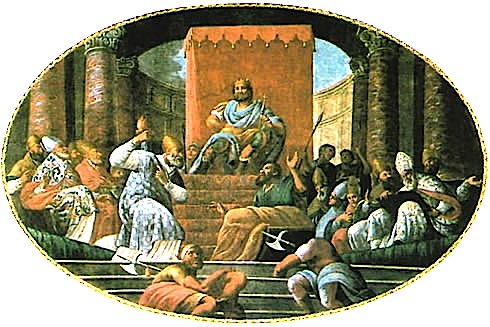
At some unspecified point, the scholarly debate turned into an argument, and the victim along with mutiple witnesses from the assembled council (see supplement to this report to be filed later) stated that Bishop Nicholas did use his right hand or fist to punch or slap Arius, causing the victim to fall to the floor. Seeing the alleged offence, the Emperor and assembled bishops had Bishop Nicholas taken into custody, stripped of his bishop’s garments, and thrown in prison to cool off.
Upon interview of the prisoner by this reporting officer, Bishop Nicholas admitted the offense done “out of love for Jesus Christ.” He stated he had grown tired of Arius’ insults to Christ’s full divinity. Further legal action is pending, but Bishop Myra is expected to return to his duties upon the request of Emperor Constantine in his role as Pontifex Maximus, the high priest of the College of Pontiffs of Rome.
It should be noted that the suspect has reportedly been involved in previous altercations and incidents of public controversy, including but not limited to: saving young women from slavery, protecting sailors, sparing innocents from excecution, providing grain in a famine, and the rescue of a kidnaped boy.
Artist rendition of the alleged offense.
Form NPD-CR1 Reporting Officer: Centurion A. Brutus
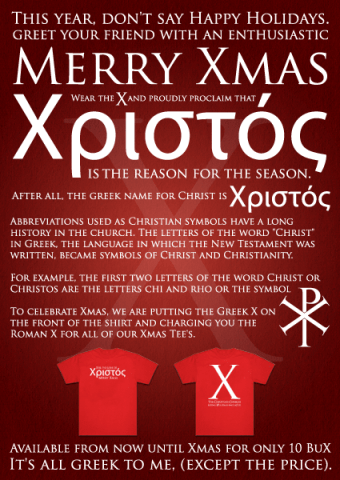
For all the hubbub about using “Xmas” instead of “Christmas” as shorthand (and in some cases where people intentionally desire to erase any reference of Christ from Christmas by using Xmas), the ironic, historic truth remains that ancient Christians utilized the Greek letter Chi and letter symbol Chi-Rho as a means to represent Jesus Christ. Such symbols are called christograms.
You see, the name Jesus Christ in Greek, the language of the New Testament texts, is Ἰησοῦς Χριστός. The first letter of the title Christ (signifying Jesus as the anointed one, the Messiah) looks like our English X and became a convenient, somewhat obscure way for early Christians in the catacombs and elsewhere to identify artistic representations of Jesus and Christian markings, signs, or art – similar to use of the Christian fish symbol.
Later, the Emperor Constantine I had a dream that he should put the “heavenly divine” symbol of Chi-Rho on his army’s shield before the Battle of the Milvian Bridge to guarantee victory. He did just that, won the battle, and turned the formerly pagan empire into a Christian one. The Chi-Rho symbol became and remains one of the most common christograms used in sacred and liturgical settings. In fact, it is often used as part of the modern Christmas tradition of the Chrismon Tree. Invented by a Lutheran in Danville, Virginia in 1957, this practice is now popular in many congregations throughout the United States and across denominational lines.
As I find the debate over the use of Xmas somewhat distracting if not tedious and dislike the rush toward Christmas only to hide it away from the public eye as soon as December 25th passes, I try to experience Advent as a true time of expectant waiting and preparation. I also make an effort to enjoy the traditional Christmas period lasting twelve days through Epiphany on January 6th. So last year as Christmas approached, I posted an image I had found by Orthodox iconographer Raymond J. Mastroberte on Facebook saying, “Keep Chi in Christmas…Because early Christians used Greek abbreviations!” The illustrator’s image struck my sometimes questionable funny bone, and I playfully proclaimed that I would be putting the Chi in Christmas all twelve days.
Image and copyright by Orthodox iconographer Raymond J. Mastroberte. Image used here for teaching and not for profit under the terms of fair use.
In the context of our modern conundrum over Xmas, it wasn’t long until someone missed my attempt at humor. They argued that surely since Jesus Christ had done so much, suffered and died for our sake, we could most certainly take the time to spell out his name in full. It was as if the ancient Christian signs and symbols were suddenly disrespecting our Lord. And so, my attempt at lighthearted banter fell as another victim of this modern culture war.
As the past few years attest, an annual argument has indeed arisen about the secularization and explicit anti-Christian elements of our Christmas celebration. It should be expected, for in school gatherings and shopping malls, on public plazas and in our homes, religious symbols for Christ and his birth have come to be often replaced by winter scenes, Santa and his reindeer, snowmen, cute penguins or polar bears…the list goes on and on. In fact, some suggest that many Americans can’t specify what the Christmas holiday commemorates.
In opposition to Christmas, one atheist author argues that there is historically no proof that “Christ is the reason for the season.”[i] They suggest that winter celebrations have always existed, and such a modern mantra is only a Christian attempt to assert their cultural superiority over everyone else. Sadly in the name of multiculturalism, echoing choruses of Merry Christmas can be explicitly prohibited in some environs. Yes, just as there was no room at the inn on the original Christmas Eve, there seems to be no room in our public lives for Jesus today.
Yet, let’s not be too quick about things, as there are other signs to look for. Gallop found, “Ninety-five percent of Americans celebrate Christmas, and of these, 51% describe the holiday as ‘strongly religious’ for them, continuing an upward trend seen since 1989.” This 2010 poll also found a majority of Americans self-reported “incorporating specific religious activities or symbols into their holiday celebrations. This includes 62% who attend religious services on Christmas Eve or Christmas Day, 65% who display decorations with a religious meaning, and 78% who take time to reflect on the birth of Christ.”[ii] Self-reporting surveys can prove inflated, but we can see signs of hope for our beloved holiday.
Nevertheless, further confusing this debate, this same Gallop study found many more Americans were likely to practice secular traditions (in the ninetieth percentile range, depending upon the activity) than religious. Sadly, a recent poll by Think Finance claimed that 45% would rather skip Christmas due to the debt accumulated from gift giving.[iii] Others seasonally face bouts of depression or other mental illnesses magnified by their isolation or sense of loss during the holiday season, and thus they dread Christmas’ arrival.[iv]
Amidst debates and arguments, blinded by bobbles, decorations, and good deals, we can forget that our redemption is drawing near. Our time on earth is short, and we should live with hopeful and loving expectation as if Christ will indeed come soon. Signs of trouble and even outright persecution are nothing new. Jesus promised us such as these in his prophesies, comparing them to birth pangs.[v]
Should we then be so surprised that people are confused, lost, and hurting when it comes to Christmas and more importantly Jesus Christ? Should we let this distract us from our call as a holy people living together in Jesus’ holy name? Intentionally seeking the newborn Christ in our own hearts, we can repent of our own errors and grow in faith. Living as part of his body through our shared ministry of preaching, teaching and baptizing, or accepting and loving others (even our enemies) as they are, we can be used by God to bear Jesus into the world.
The devil’s in the details, and so it appears with our modern Christmas. Let’s not get anxious about the holiday – lost in empty debates or the holiday wrapping of materialism. As Christians, we are called to celebrate!
Look to the true heart of Christmas toward Jesus Christ himself, the final Word on this argument, come to save us. Whatever we choose to do and however we choose to say it, let’s seek to make Christ known every day. Look past the veneer of our time and see those suffering and alone around us. Enter relationship with them, help them, or guide them toward people who can. Celebrate the truth of Christ’s coming within every aspect of our lives – for the love of Χριστός, ourselves, and our neighbors.
There are more than enough signs of trouble and discord. Let’s not waste time dwelling upon them or pointing them out. Instead, let’s seek to be living, joyful signs that Jesus is near. That’s probably the best way for any of us to wish the world a meaningful Merry Christmas and eternity.
My wife, Kristine, and I wish you a holiday filled with blessings. May those same blessings flow through you to help transform the lives of others.
Pastor Lou
For those interested, visit OldLuteran.com for their comical take on this debate. Access their site through the image below:
The above pastoral letter was originally published in Messiah Lutheran Church and School’s newsletter, The Messenger (December/January 2012 edition) in an abridged version. To view the entire issue of The Messenger or to see the full calendar of events, visit: http://www.mlcas.org
Unless otherwise indicated, all scripture quotations for this article are from the New Revised Standard Version (NRSV) translation.
Husband, Pastor, Law Enforcement Chaplain, and member of the Clerical Errors (aka "The Three Priests"), I'm sharing my two cents with anyone who cares...
You can also find me on social media as Loudluthrn (Lou-d-Luthrn or Lou the Lutheran). It is a moniker given me while attending a Presbyterian Seminary, but I'm a loud and proud Lutheran too (just not too loud and proud, mind you).







 2pennyblog