

Happy National Peacock Day! Oh, you did not know that National Peacock Day was a thing? Well, it is. While a quick Google search indicates that there is no official, widely recognized “National Peacock Day” designated by any government or organization, Upper Iowa University (UIU) uses March 25th as a day to celebrate its mascot, the Peacock, as part of their UIU Giving Days. You will find that zoos and arboretums have also signed onto the practice. So, it seems that this national day is just coincidentally placed on a day when Christians might want to celebrate the symbolism of this beautiful bird too. You see, today is when the Church marks both the Annunciation of Mary and the unnamed thief of Luke’s Gospel forgiven on the cross beside Jesus (Luke 23:39-43). The celebrations are set on the liturgical calendar as the day that Jesus came into the world within Mary’s womb and also the day that he died.
How and why is this? Jesus came into the world to suffer, die, and rise for our sins. He called for people to repent and hear the Good News throughout his ministry. So theologically, it appears quite beautiful to keep this connection – Jesus came into Mary’s womb to save sinners and bring abundant, eternal life through the cross. Yet really, it likely has much more to do with how the early Church understood salvation history and the world itself.
Looking at existing Jewish beliefs about the date for creation being on March 25, perhaps that itself being influenced by the timing of the spring equinox, Christians of the Middle Ages for unclear reasons came to agree that March 25 was the date on which creation began. It was also to become the date on which Christ was crucified. Among those earlier movers and shakers influencing this discernment process, you will find Tertullian, a 2nd-century theologian who suggested that Jesus’ death on the 24th of the Hebrew month Nisan (the day of the crucifixion in the Gospel of John) corresponded to March 25th in the Roman calendar, and Augustine of Hippo in his treatise “On the Trinity.” It seems a popular day, for ancient martyrologies also assigned the fall of Lucifer, the passing of Israel through the Red Sea, and the binding of Isaac to March 25.
If Jesus entered Mary’s womb on March 25, it made sense that Christmas be set on the liturgical calendar nine months later, December 25. (This is the real reason Christmas is remembered on that date, not simply to usurp pagan holidays.) Thus, the doctrines of creation, incarnation, and redemption were brought together as one through this liturgical remembrance, although the Bible never gives us a firm date for any of these events. In fact, scholars even debate over the year of Christ’s birth. The Bible is quiet on specifics. Yet with this important connection being made by the Church, March 25 was subsequently observed as New Year’s Day in much of Christian Europe. The Gregorian calendar, introduced by Pope Gregory XIII only made January 1 the universally recognized New Year’s Day in 1582. The United Kingdom, along with its colonies, was the last hold out to switch from the Julian calendar to the Gregorian calendar In 1752. (They likely resisted looking like Papists, but economics and other influences convinced them to finally change.)
So why peacocks? Where do they come into our tale? They were commonly used in the Greco-Roman world for decoration. Peacocks symbolized royalty, beauty, and immortality. People of that time associated “the eyes” on a tail of the peacock with the goddess Hera (Juno). She had a hundred-eyed giant for a guardian, Argus or Argos Panoptes. Eventually slayed by Hermes on Zeus’s orders, his eyes were said to have then been incorporated into the peacock’s tail by Hera in his honor.
Now, flash forward to early Christendom. Augustine of Hippo referred to a meal shared in his famous work, The City of God, where peacock, a delicacy of the time, was served. He reports that after taking a large slice of its breast, he “ordered it to be kept, and when it had been kept as many days as make any other flesh stinking, it was produced and set before me, and emitted no offensive smell. And after it had been laid by for thirty days and more, it was still in the same state; and a year after, the same still, except that it was a little more shriveled, and drier. (Book XXI, ch. 4).[i] This further supported the already existent cultural belief that the peacock was incorruptible and a sign of eternity.
Over time, peacocks became a common symbol for Christians. Peacocks with a floral motif alluded to the bounty of God’s creation in icons about creation. It also could signify immortality and Christian resurrection. The peacock portrayed drinking from a vase came to symbolize drinking the waters of eternal life – a baptismal motif. With those symbolic connections, you find peacocks in many icons about paradise and eternal life, as well as on ancient baptismal fonts, liturgical furnishings and architecture, and even tombs.
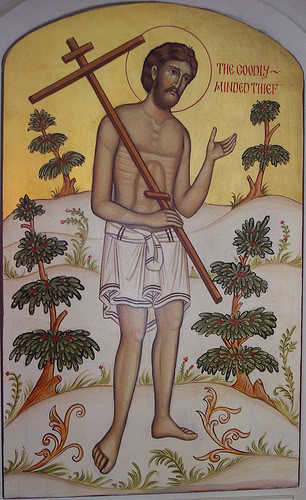
As the Penitent Thief is recorded in Luke pleading, “Jesus, remember me when You come into Your kingdom!” Jesus answers, “Truly I say to you, today you will be with me in Paradise.” This theologically and symbolically forges links between creation’s Paradise, the promise of eternal life in Paradise through the gift of our faith and baptism (available only because of Jesus’ death and resurrection), and the restoration of our fallen world with Jesus’s Second Coming.
The man who died beside Jesus found Paradise through trusting in Jesus, fully human and fully divine, dying unjustly for us all. Thus, he is often depicted with a peacock in his iconography. The guilty one who turns toward Jesus in hope is not named in scripture, and people from the Greek and context interpret him as a rebel, thief, and ultimately repentant sinner – none of these roles being mutually exclusive. Yet if you see a man with a peacock in icons, it’s likely there to help identify Adam or the one who was forgiven from the cross.
Over time, the man was given names by the Church. He’s called Dismas (this may have been adapted from a Greek word meaning “dying”) in the West. He’s called Demas (meaning “popular” or “the people,” stemming from the Greek word “demos”) in Coptic Orthodoxy. In an apocryphal gospel from Syria, he is called Titus (meaning “title of honor” or “honorable”). In Russian Orthodoxy, he became known as Rakh. The name origin is unclear, but one scholar theorizes that the Russian title may have come from a garbled reading of an inscription possibly due to damage of the title of a particular icon type of the Penitent Thief that is called “The Wise/Prudent Thief in Paradise,” written in Cyrillic.[ii]
Perhaps it is best we do not know his name. Much as the peacock symbolizes our eternal destiny through Christ, he can become a symbol for us all. For we, too, can prove to be malefactors, thieves, and rebels in our own way through our sin, yet Jesus will always remember us when we turn to him in trust. The signs, portents, and his own promises points us toward celebrating eternally in Paradise with Jesus – saved sinners, repenting on our way, looking with our own eyes only toward Jesus for our salvation.

Peacock Sarcophagus, Basilica of San Vitale, Ravenna.
Peacocks look toward a Chi Rho, a symbol for Jesus.
c. 7th Century (Source in references.)
References:
Orthodox Monastery of St. Macarius the Great of Egypt (Saint Macarius OCA). (2024). Wadi El Natrun, Beheira Governorate, Egypt. “Icon of St. Dismas.” Downloaded at https://www.etsy.com/listing/1594726259/handmade-mounted-icon-the-right-hand
Sharon Mollerus, CC BY 2.0, via Wikimedia Commons. “Peacock Sarcophagus, Basilica of San Vitale, Ravenna (6094775009).jpg as downloaded at https://commons.wikimedia.org/wiki/File:Peacock_Sarcophagus,_Basilica_of_San_Vitale,_Ravenna_%286094775009%29.jpg.
Robel, S., Peyton, R., Kramer, M., and Jackson, B. Christian Symbols in Art Blog, as downloaded at https://christiansymbolsinart.wordpress.com/2014/11/13/peacock/.
Smith, R. (July 2018). “The Peacock as an Early Christian Symbol of Eternal Life.” Russel’s Inspiration Daybook Blog as downloaded at https://inspirationdaybook.wordpress.com/2018/07/23/the-peacock-as-an-early-christian-symbol-of-eternal-life.
Tribe, S. “The Use of the Peacock in Christian Art.” Liturgical Arts Journal. Downloaded at https://www.liturgicalartsjournal.com/2023/11/the-use-of-peacock-in-christian-art.html.
Wikipedia. “Argus Panoptes.” As downloaded at https://en.wikipedia.org/wiki/Argus_Panoptes.
Wikipedia. “Penitent Thief.” As downloaded at https://en.wikipedia.org/wiki/Penitent_thief#cite_note-13.
[i] Augustine of Hippo, The City of God, as quoted in Tribe, S. “The Use of the Peacock in Christian Art.” Liturgical Arts Journal. Downloaded at https://www.liturgicalartsjournal.com/2023/11/the-use-of-peacock-in-christian-art.html
[ii] David. (January 14, 2021). “A Seldom Seen Scroll.” Icons and Their Interpretation Blog. Downloaded at https://russianicons.wordpress.com/tag/rakh/
© 2025 The Rev. Louis Florio. All content not held under another’s copyright may not be used without permission of the author.


 2pennyblog
