Tag Archives: ecumenical

My little springtime

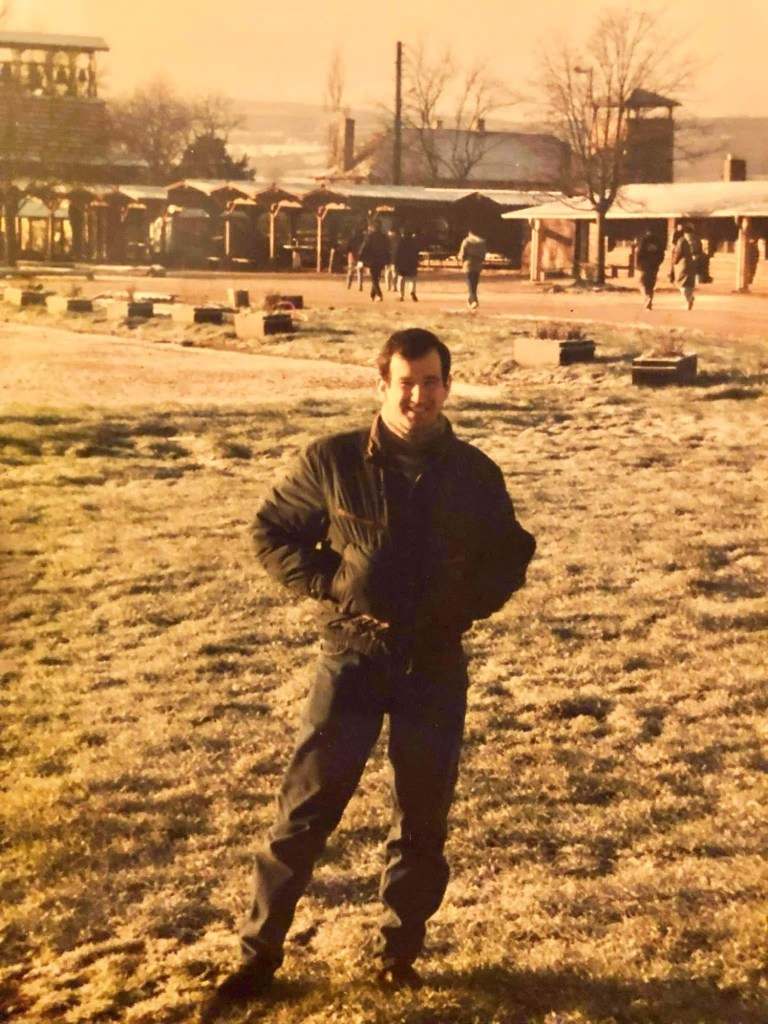
This is me in Taizé shortly after my arrival, perhaps January 1995. A new Lithuanian friend who was a former draftee in the Soviet Army took the photo for me. I finished my own US Army commitment in 1994. Enemies can become friends.

“Ah, Taizé, that little springtime,” remarked Pope John XXIII about the ecumenical monastic community nestled on a hill in Burgundy, France. Being there definitely was a springtime experience for me. I have recently been thinking about my time there a lot. For, I moved to Taize’ in France on December 5, 1994 – 30 years ago! 

I first met the brothers escorting Mary Washington College students to their first large meeting ever held in the US at Dayton University. Several thousand young adults from across the US gathered across denominational lines. As part of “the Pilgrimage of Trust,” we stayed with local families where conversations would continue. 

I had no idea how my heart would open when I first volunteered to go as a chaperone and participant. My experience changed the way I looked at life and the Church – how I understood myself as well. People sharing their faith, positive interactions with people who were previously “other” to me, and a more intimate prayer life energized me. 

I read much about the Ecumenical Community of Taizé and from Br. Roger, the founder, after that. I continued to pray with chants at home and with friends. I went to a few smaller regional meetings. It slowly became a part of me. I’d even catch myself singing their chants (ultimately prayers) as I drove to emergency calls or in quiet moments of my day. Like the prophet, Nehemiah, my prayer life and work life merged. I found myself praying all the time. As I found more peace, I became more patient and discerning when working with others or arresting people. I discovered peace even when amidst the thick of things. Even my sergeant noticed the change. He said during my review, “I don’t know what you are doing, but keep it up.” I think it was more what God was doing in my life, but his observations affirmed for me that I was in a better place and heading in the right direction. Whatever my future, God was with me.

All the while, I began to wonder if I was being called to become a brother. When younger, I had investigated becoming a priest while Roman Catholic. Yet like many young adults, with unaddressed trauma, grief and sin from the past, I had wondered far. I finally became open to radically trusting God after a crisis. Thanks to seeds planted in my past, faith-filled friends, and intentional spiritual, mental, and emotional work, I found my way back home. The Dayton meeting came when the time was right and catapulted me forward toward a new, radical trust in God. Now, I also understood the Church was more than my denomination. I came to believe my past errors need not hold me back. I was and remain forgiven and free. I became determined to address the issue of serving in the Church once and for all wherever God might lead me. For God had been faithful to me, and again, I trusted the Spirit would set me on the right path. 

During this time of growth, I had come to know Br. John. Br. John is one of the community’s American brothers, and he is often asked to go abroad. He had introduced me to a Croatian immigrant in Alexandria who hoped to have a meeting in the DC region where I then lived. Certainly, I would help! It proved such a special event. Only about 100 attended, but the impact was similar to my time in Dayton. As I spoke with Br. John during a break, I tentatively told him of my vocational search over the years – on and off. My friend Tony and I would be visiting Taizé in France for the first time, and I wondered – although I can’t sing well or speak French – maybe there was still an answer for me there? 

Brother John did not laugh at me as I feared. I was not rejected, but instead taken seriously in my search. Although I had not been before to the community, Br. John said that as I was in a different place than many in my search (I had done a lot of work regarding my repentance, healing, and discernment) perhaps I should spend a week in silence. I still would go to the three daily prayers. I would have moments of conversation. Yet mostly, I would spend time in silence or speaking with my future contact brother, Br. Francois, who would serve as a kind of spiritual director. (He was an early brother, and much later, I learned he was also a Lutheran pastor.) 

My contact brother, Brother Francois

Of course, most of my time was indeed spent meditating on scripture, praying, or going for walks. Yet, I was invited to eat with Br. Roger and the brothers once during this first visit as well. A brother who did not know me introduced himself and said, “You are in a week of silence aren’t you?” I said yes, but asked how he knew. He said that people experiencing a week of silence often had a glow about them. (Although I did not understand it at the time, I would later see that glow on other faces.) My growing trust and peace showed.

As my week closed, I told Br. Francois that I thought perhaps I should come for a longer time for more discernment. This would necessitate my resigning from the police department. My eyes and heart had opened wider, so I understood it was time to take a leap of faith. I felt pulled there. He said after a short time of discussion, “We cannot know yet what the answer will be, but we have similar hearts. You must come.” And so, long story very short, I resigned from the police department and came. I began my service as a long term volunteer, “a permanent” in Taize’ parlance, primarily working among the campsites and with meeting preparations. 

Upon arrival, I continued to meet with Br. Francois, and there were many, many more important friendships and memories made during my time there including at the Paris European Meeting with over 100,000 young adults! 
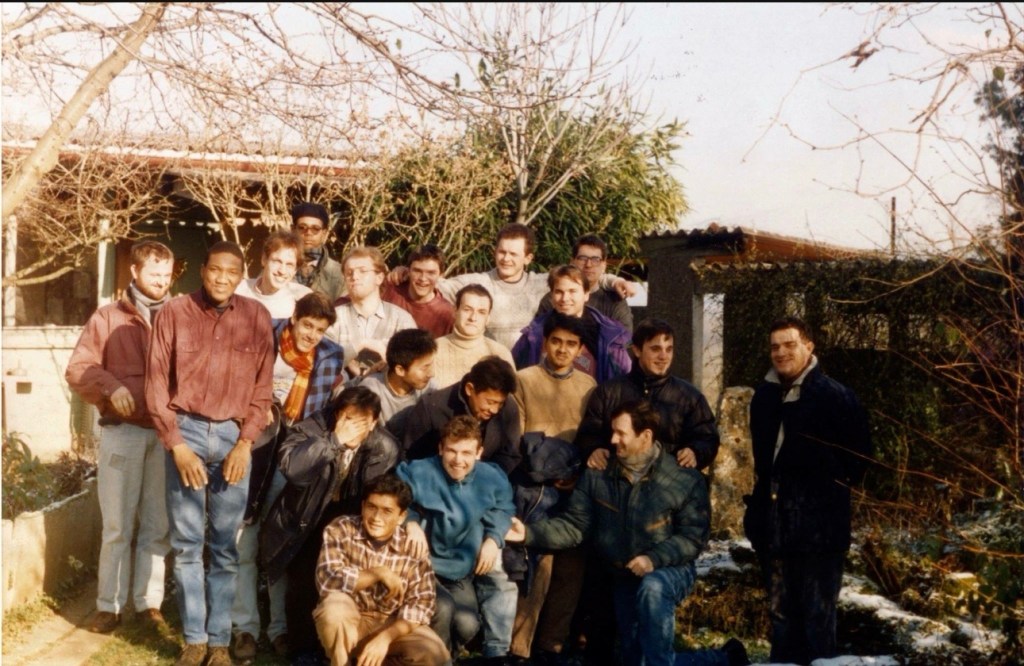
A group photo of the male Permanents at the time from all over the globe. Br. Mathew, a “young brother” in charge of caring for us, is now the Prior of the community (far right). Great memories!

Yet after about seven months, it became clear that I was not to stay, but I never doubted that I had been called there. I came to that little hill, and I saw Christ more clearly than ever before. I just now knew he was calling me to something else. Back to the valley for me! This led me to other people, and thus more new understandings of God’s love, but that’s for another time to share. 

I have not been back to what I still consider my spiritual home, but my wife, Kristine, and I did make it to a European Meeting in Barcelona. (It was the last time I saw Br. Francois. He died a few years ago.) I also was able to welcome Br. John and Br. Emile for a meeting at my church in the Richmond area in 2019. I hope our paths will cross again, but as I have written to my many dear fellow volunteers now across the globe, it’s ok if I don’t meet them again. I still sense the deep, living communion which we share any time I hear Taize’ chants, see a photo, or think of them. The Spirit works this way among the Church, a communion of saints. That communion spoken about in the creeds of the Church is tangible.

Yes, we are together still. It’s hard to explain, but it is true. I trust – thanks be to God – that it will be so forever.

“The Hill,” the village of Taizé in Burgundy, France.

Reflection expanded upon from a Facebook post shared on the 30th anniversary of my arrival to the Ecumenical Community of Taize’.

© 2025 The Rev. Louis Florio. All content not held under another’s copyright may not be used without permission of the author.

2 Comments

Filed under Memories

One Church? Yes, but not quite yet…

Knock, knock, knock…Below is my response to “Protestantism is Not United, Not Catholic, and Not a Church,” by Fr. Andrew Stephen Damick (2017).

The argument that Protestants are not united, not Catholic, and not a Church doesn’t upset me much as a Lutheran. The Great Schism (1054) and the start of the Protestant Reformation (1517) left the Christian world divided with the Orthodox, Roman Catholics (or Papists), Evangelicals (the first called Protestants and eventually Lutherans), and what were often at first named Radicals (Anabaptists and others pushing the traditional theological envelope). The Augsburg Confession was written with the hope for unity even amidst some practical, concrete theological differences.

As regional and theological breaks continued to occur, “Protestant” became an umbrella term for many disparate groups, and Evangelicalism more recently became connected to believer-baptism, “Bible based” traditions. The term, Protestant, is now sometimes used to indicate mainline denominations, but in general, the term covers a disparate group in common usage – often Mainline Protestant, Evangelical, Pentecostal and others. Although, it is important to note that some high church Episcopalians/Anglicans don’t like to be thought of as Protestant at all. Still, most everyone else considers them so (whether fair or not).

I would argue that some Protestants are more attached to the “Catholic” (universal) heart of the church than others. Determining what that heart is remains the rub. For my part, I put my trust in Jesus, Son of the Living God, risen from the dead. Beyond that, I’m open to arguments and even ultimately being proved wrong. Despite our hardheartedness, I find continually that the Holy Spirit makes us one Church out of many denominations (or “church bodies” if you prefer) whether we like it or not. There are many commonalities. There is an ecumenical movement affirming catholicity over division. Yes, we find these are muddied, sinful waters, but I expect the Baptismal waters will win out yet.

So, I believe the author fails to adequately or even fairly differentiate between varied beliefs of Protestantism. Echoing his own argument, must of us confess that we are not one! We understand that the Church is fractured, but we don’t have to look far to identify fractures in the Orthodox edifice as well. Just look at what’s going on in orthodoxy over in the Ukraine. Closer to home, in my own county, I know of Orthodox Christians that mutually condemn one another. Certainly, we know Orthodox folks in the Richmond area who are viewed with suspicion if not distaste by other Orthodox folks. The catholicity of the Church is broken, and so, many Christians are working toward repairing the breach when and where they can. There’s a hunger for unity with God and one another.

In my view, the author makes a mistake by conflating Protestant traditions. He focuses on the “Reforming Catholic Confession” as if it is a seminal Protestant document. It is actually a document initiated (as I understand it) by Kevin Vanhoozer, a seminary instructor at Trinity Evangelical Divinity School (Deerfield, IL). Interestingly, the seminary is affiliated with the Evangelical Free Church of America. This denomination is Evangelical in the modern sense (believer-baptism, “bible based,” etc.) not the Lutheran sense (“of or according to the teaching of scripture”). The Evangelical Free Church of America’s deepest roots are indeed found among Swedish, Danish, and Norwegian Lutheranism, but they are ultimately a break-off sect in the United States – former Lutherans influenced by Baptist and Evangelical neighbors. Ironically, they were originally considered “liberal” by some, as the predecessor bodies were trying to cast off the cloak of the “Old World” religion and hungered to be a “free” (not state supported) church. Today, Evangelicalism is in fact often closely connected to conservative politics and traditions, but not always.  

I would argue we all fall short of the “Catholic” standard. Orthodox, Roman Catholics, Mainline Protestants, Evangelicals, Pentecostals, and all others have plenty of repenting to do rather than casting stones. I’m thankful to be part of a Protestant denomination that is trying to live out the Augsburg Confession’s hope of our being one, and most importantly, Jesus’ own prayer for us to be one (John 17:20-23).

I don’t fault the authors of “The Reforming Catholic Confession” for arguing for the catholicity of their faith (as they see it), even though, I do often disagree with their theological claims. Thanks to the Holy Spirit, I trust we are one even as we disagree. Thus, perhaps we as Church would find it more productive (and in line with God’s will) to focus on what unites us rather than divides us as Pope John XXIII suggested; even if we need good beer and conversation as the starting course.

Amidst our Christian brokenness and sin, I trust the fullness of the promised feast is yet to come. Someday, Jesus’ prayer will be completely fulfilled. Yes, we are one Church, just not quite yet.

Pastor Lou is a member of “the Three Priests.” Join him (an ELCA pastor), Fr. Adam (an Orthodox Church in America priest), and Fr. Nic for a Three Priests Walk in a Bar event in Ashland, Virginia, or through their (hopefully) upcoming podcast series.

This post was created in response to an article shared by an Orthodox friend, Fr. Adam, on Facebook, “Protestantism is Not United, Not Catholic, and Not a Church – Orthodoxy and Heterodoxy,” by Fr. Andrew Stephen Damick, on Reformation Day 2019. Find it here: https://bit.ly/36o4XtI

You can learn about “The Reforming Catholic Confession” at https://reformingcatholicconfession.com/

You can learn about the Orthodox-Lutheran dialogue here:

Via my denomination, Evangelical Lutheran Church in America, an LWF member body at https://www.elca.org/Faith/Ecumenical-and-Inter-Religious-Relations/Bilateral

Via the Lutheran World Federation (“a communion of churches” in the Lutheran tradition) https://www.lutheranworld.org/content/lutheran-orthodox-dialogue

© 2019 The Rev. Louis Florio. All content not held under another’s copyright may not be used without permission of the author.

Leave a comment

Filed under Uncategorized

A response to “The invention of Ego in Martin Luther’s Defiance”

Martin Luther posting his 95 Theses

In case you come across this article by Thomas Cahill as I have being reposted and misused by some Roman Catholic brothers and sisters (along with some rather un-Christian remarks), be assured the author misses the mark somewhat when it comes to Luther’s psychology and theology. His take is too simplistic.

Luther’s efforts to reform the church (especially at the start) weren’t about ego alone, but about the Word of God being adhered to without mental gymnastics to make them fit corrupt and superstitious practices of the day. He was a pastor caring for his people, and a teacher seeking truth. His intent was not to be independent, revolutionary, or famous.

Unlike the short quote within the article, Luther’s words at Worms were more nuanced [please note the points I emphasize]:

“Unless I am refuted and convicted by testimonies of the Scriptures or by clear arguments (since I believe neither the Pope nor the Councils alone; it being evident that they have often erred and contradicted themselves), I am conquered by the Holy Scriptures quoted by me, and my conscience is bound in the word of God: I can not and will not recant any thing, since it is unsafe and dangerous to do any thing against the conscience.” (History of the Christian Church, vol. VII, ch. 3, sec. 55).

Martin Luther was posting an academic disputation – a common practice of his day – and wrote later writings to be discussed in community. He wasn’t looking for a fight nor a break with the church catholic, and his efforts were shaped by much more than just a matter of an individual’s ego.

True, self-interpretation of scripture has its weaknesses and excesses, but Luther wasn’t guilty there either. His focus remained on the assembly (the church) in relationship with one another and Christ. (This is made quit clear in his Large Catechism and other theological writings.) The church guided by the Spirit and tested by the divine revelation of scripture is the corrective for us all when it comes to interpretation, for Luther knew we all can err as much as popes and councils. We need to open scripture, listening for the Spirit and to one another.

As the debates rolled on and intensified, Luther failed to do that at times himself. Much like those posting anti-Lutheran insults and commentary, he let his anger and disappointment (and perhaps later his mental illness) govern some of his responses. After all, many people wanted to see him dead and weren’t exactly charitable either.

Martin Luther was human, and he realized it. In reviewing much of his writings, you will see him hesitate to state things definitively rather than to risk error. He critiques himself and his lack of ability. You will see calls for discernment rather than name calling over theological issues. He turns toward grace to light his way forward and not some internal power of his own.

I think such an attitude represents a very human, Christian humility and maturity rather than egocentricity. Adapted beyond theology discussions to a way of life, such an attitude will likely prove the best answer to what gridlocks us in our politics and divides our culture today.

As St. Paul reminded Luther and reminds us all, “And do not grieve the Holy Spirit of God, with which you were marked with a seal for the day of redemption. Put away from you all bitterness and wrath and anger and wrangling and slander, together with all malice, and be kind to one another, tenderhearted, forgiving one another, as God in Christ has forgiven you.” (Eph. 4:30-32). Even amidst important theological or other disputes, we are to remain one family of faith, the holy people of God.

Unless otherwise indicated, all scripture quotations for this article are from the New Revised Standard Version.

© 2013 The Rev. Louis Florio. All content not held under another’s copyright may not be used without permission of the author.

Leave a comment

Filed under Books, Church History, Community Life, Uncategorized

Surprise! It’s time to celebrate Lent.

“From silly devotions and from sour-faced saints, good Lord, deliver us.”
– St. Teresa of Ávila

Much too often, I come across people dreading Lent. Perhaps these folks might not like to remember that we are all sinners. Perhaps they feel threatened by the scriptural reminders of condemnation and death found in the texts so often used at our worship. They might be filled with dread as they overly focus on sacrifices and rituals. In doing so, we risk minimizing the power of Christ’s cross and resurrection; forgetting God’s grace reaching out to each of us. We tend to forget to live out and share our faith in daily life, and thus fail to fully experience the joy that it can bring to us and others today (not just in heaven). Lent in its Old English root means “spring,” and today, I have trouble viewing Lent as anything but a beautiful experience of growth and new life.

As I have shared with others, I become remarkably joyful during Lent. Even as I might confess my sins anew with ashes on my head, I can’t keep from smiling. You see, Lent was coincidentally the time of my rapproachement to the Church after many years away. Much like the prodigal son, I had spent my early adult years squandering the grace offered to me in my baptism. A difficult family life and things I saw as a police officer had hardened my heart against God and others. Eventually, I had come up empty. (No surprise there, I suppose.)

It was at this time of crisis – as Lent began in 1992 – faith-filled friends reminded me of the reality of God’s grace. With their loving witness, invitation and guidance, I discovered the compassion that God had for me all along. Much like Zaccheus in his tree, I became excited to hear Christ’s invitation to join with him in celebration within his Church. God was love indeed, and God could even love me! (This was indeed a great surprise to me at the time, for I had suspected wrongfully that my sins were too great even for Christ’s cross.)

Lent that year became a gift for me to be excitedly opened and treasured; a period of renewal and celebration. It was a joyful time of being embraced by Christ and by his Church. It proved to be my “re-conversion” experience, where I discovered the beauty of our baptismal promises and shared faith. It wasn’t a perfect time, and I still struggle with sin, but Jesus used this time of shared disciplines, fellowship, and service to restore me to wholeness. By Easter, I understood more about the Resurrection than I ever dreamed possible. I had begun to experience its reality in my own life. Thus affirmed, I trust I have much more to learn and experience in the years ahead.

Despite our sin and unworthiness, I don’t believe sour-faces or dread are necessarily very appropriate as we go about our Lent. Instead, I echo Paul proclaiming, “Rejoice in the Lord always; again I will say, Rejoice!” For with Jesus, all things are possible – even our new life in him. I pray this Lent prove a time of “re-conversion” for us all and a very real celebration. I am sure God’s grace will surprise us once again. [1]

For even more Joy this Lent…
Lent Madness 2012

As I reentered the Church, I found listening to other people’s stories helped me on my own walk with Jesus. Both historic persons – biblical personas such as the Prodigal Son, or real people such as Zaccheus and later saints – as well as people around me became a testimony about the grace God offers us through a beautifully diverse “great cloud of witnesses.”[2] These people of faith speak to me, not of perfection, but of God’s grace at work in our everyday lives. They remain concrete signs of God’s love active in the world as we ourselves strive to love God and neighbor.

Even as Lent is meant to be a time of self-examination and repentance, it is also certainly a time of joy. Fun need not be outlawed. Therefore, I am very grateful to the two Episcopal priests who created the interactive fun known as Lent Madness, and I happily recommend it to you as part of your own Lenten devotions.

Lent Madness is basically 32 saints (those primarily included in liturgical commemorations by the Church) matched up in a tournament-like single elimination bracket. By participating in Lent Madness, you will likely learn and laugh, because the bloggers responsible also seek to reveal the sometime laughable nature of Christ’s saints – a nature we all share.

So, I strongly urge you join other saints of our time at the website daily. We’ll read about some very special, faithful people and have the chance to vote for our favorites. Jesus offers salvation to us all, but your vote helps determine who “wins” the Golden Halo.

Watch this helpful video to learn more:

Voting 101 : A How-to Guide for the Lent Madness Voter from Forward Movement on Vimeo.

Unless otherwise indicated, all scripture quotations for this article are from the Today’s New International Version translation.

© 2011 The Rev. Louis Florio. All content not held under another’s copyright may not be used without permission of the author.



[1] The above portion of this post was written for use in the Lenten reflections to be shared by FaithInRichmond.org during Lent 2013. It was published under the title, Surprised by God’s Love.

Leave a comment

Filed under Church History, Community Life, Lectionary, Liturgical Year, saints, worship

New Worship Times for Messiah Lutheran!

As a prisoner for the Lord, then, I urge you to live a life worthy of the calling you have received. Be completely humble and gentle; be patient, bearing with one another in love. Make every effort to keep the unity of the Spirit through the bond of peace. There is one body and one Spirit, just as you were called to one hope when you were called; one Lord, one faith, one baptism; one God and Father of all, who is over all and through all and in all. (Ephesians 4:1-6)

[Jesus said,] I will remain in the world no longer, but they are still in the world, and I am coming to you. Holy Father, protect them by the power ofyour name, the name you gave me, so that they may be one as we are one. (John 17:11)

Dear members and friends of Messiah Lutheran:

As announced in our newsletter and at worship, we have the great opportunity to concretely live out Paul’s hope for unity among believers and Christ’s prayer that we live as one. Our brothers and sisters of All Souls Episcopal (a mission congregation) will begin worshiping at 9:30 AM on most Sundays as our regular guest while they work toward establishing their own facility. This required we set new worship times of 8:00 AM and 11:00 AM starting this Sunday, August 12th.

Please join me in welcoming them, as I am confident they will welcome you, as one family in Christ. Along with our worship space, we will be sharing in some ministries to build up the body of Christ and share Christ’s love within our community. We hope this sets a firm foundation for when they have their own building; that this cooperative relationship continues to the glory of God.

The early Lutheran Reformers did not see themselves as fracturing the church, but rather hoped to repair divisions while living consistent with their individual understandings of scripture. Thus, the vast majority of Lutheran bodies throughout the world have been open to ecumenical efforts from the beginning. To learn more about the special cooperative relationship of the ELCA and Episcopal Church as well as with five other denominations in the United States, follow this link:

http://www.elca.org/Who-We-Are/Our-Three-Expressions/Churchwide-Organization/Office-of-the-Presiding-Bishop/Ecumenical-and-Inter-Religious-Relations/Full-Communion-Partners.aspx

A “full communion” relationship does not indicate a merging of these denominations with the ELCA, but it instead declares our intention to live as one as much as possible (repairing historic wounds while helping one another through the sharing of pastors, ministries and assets whenever deemed appropriate).

Thank you for your willingness to try to live out this unity in Christ. If you note any problems or concerns, or you have ideas of how to do something better while the All Souls community remains our guest, please be sure to speak with me or a council representative. See you Sunday!

Peace,

Pastor Lou

3 Comments

Filed under Church History, Pastoral Letter, Uncategorized, worship