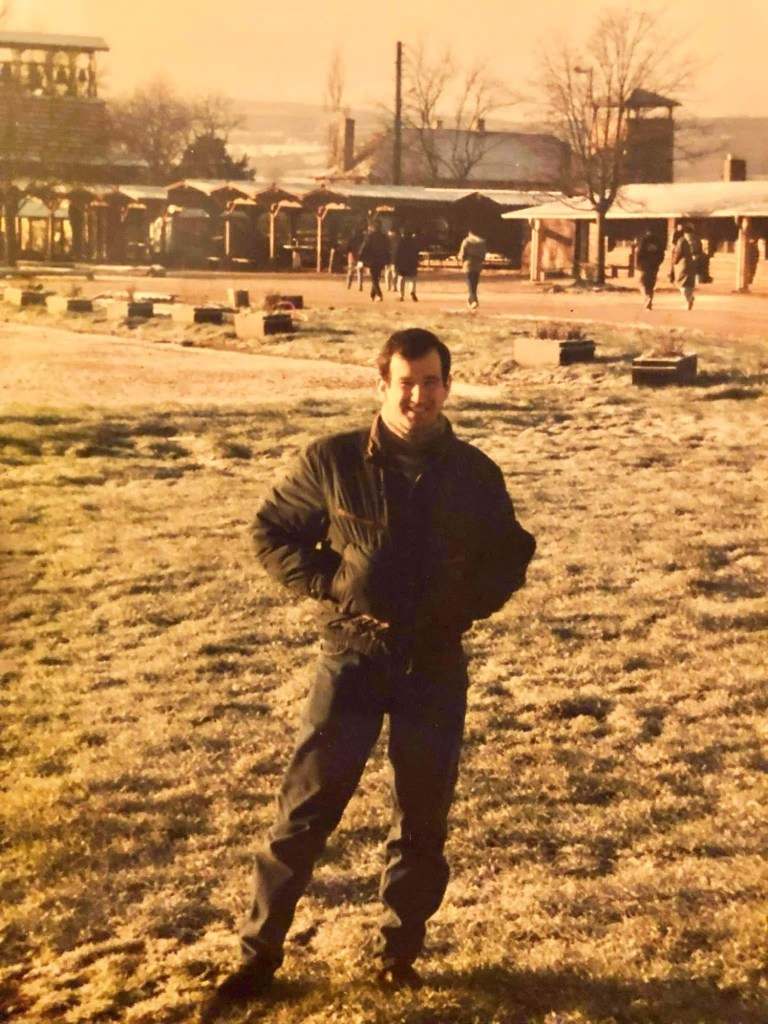
This is me in Taizé shortly after my arrival, perhaps January 1995. A new Lithuanian friend who was a former draftee in the Soviet Army took the photo for me. I finished my own US Army commitment in 1994. Enemies can become friends.
“Ah, Taizé, that little springtime,” remarked Pope John XXIII about the ecumenical monastic community nestled on a hill in Burgundy, France. Being there definitely was a springtime experience for me. I have recently been thinking about my time there a lot. For, I moved to Taize’ in France on December 5, 1994 – 30 years ago!
I first met the brothers escorting Mary Washington College students to their first large meeting ever held in the US at Dayton University. Several thousand young adults from across the US gathered across denominational lines. As part of “the Pilgrimage of Trust,” we stayed with local families where conversations would continue.
I had no idea how my heart would open when I first volunteered to go as a chaperone and participant. My experience changed the way I looked at life and the Church – how I understood myself as well. People sharing their faith, positive interactions with people who were previously “other” to me, and a more intimate prayer life energized me.
I read much about the Ecumenical Community of Taizé and from Br. Roger, the founder, after that. I continued to pray with chants at home and with friends. I went to a few smaller regional meetings. It slowly became a part of me. I’d even catch myself singing their chants (ultimately prayers) as I drove to emergency calls or in quiet moments of my day. Like the prophet, Nehemiah, my prayer life and work life merged. I found myself praying all the time. As I found more peace, I became more patient and discerning when working with others or arresting people. I discovered peace even when amidst the thick of things. Even my sergeant noticed the change. He said during my review, “I don’t know what you are doing, but keep it up.” I think it was more what God was doing in my life, but his observations affirmed for me that I was in a better place and heading in the right direction. Whatever my future, God was with me.
All the while, I began to wonder if I was being called to become a brother. When younger, I had investigated becoming a priest while Roman Catholic. Yet like many young adults, with unaddressed trauma, grief and sin from the past, I had wondered far. I finally became open to radically trusting God after a crisis. Thanks to seeds planted in my past, faith-filled friends, and intentional spiritual, mental, and emotional work, I found my way back home. The Dayton meeting came when the time was right and catapulted me forward toward a new, radical trust in God. Now, I also understood the Church was more than my denomination. I came to believe my past errors need not hold me back. I was and remain forgiven and free. I became determined to address the issue of serving in the Church once and for all wherever God might lead me. For God had been faithful to me, and again, I trusted the Spirit would set me on the right path.
During this time of growth, I had come to know Br. John. Br. John is one of the community’s American brothers, and he is often asked to go abroad. He had introduced me to a Croatian immigrant in Alexandria who hoped to have a meeting in the DC region where I then lived. Certainly, I would help! It proved such a special event. Only about 100 attended, but the impact was similar to my time in Dayton. As I spoke with Br. John during a break, I tentatively told him of my vocational search over the years – on and off. My friend Tony and I would be visiting Taizé in France for the first time, and I wondered – although I can’t sing well or speak French – maybe there was still an answer for me there?
Brother John did not laugh at me as I feared. I was not rejected, but instead taken seriously in my search. Although I had not been before to the community, Br. John said that as I was in a different place than many in my search (I had done a lot of work regarding my repentance, healing, and discernment) perhaps I should spend a week in silence. I still would go to the three daily prayers. I would have moments of conversation. Yet mostly, I would spend time in silence or speaking with my future contact brother, Br. Francois, who would serve as a kind of spiritual director. (He was an early brother, and much later, I learned he was also a Lutheran pastor.)
My contact brother, Brother Francois
Of course, most of my time was indeed spent meditating on scripture, praying, or going for walks. Yet, I was invited to eat with Br. Roger and the brothers once during this first visit as well. A brother who did not know me introduced himself and said, “You are in a week of silence aren’t you?” I said yes, but asked how he knew. He said that people experiencing a week of silence often had a glow about them. (Although I did not understand it at the time, I would later see that glow on other faces.) My growing trust and peace showed.
As my week closed, I told Br. Francois that I thought perhaps I should come for a longer time for more discernment. This would necessitate my resigning from the police department. My eyes and heart had opened wider, so I understood it was time to take a leap of faith. I felt pulled there. He said after a short time of discussion, “We cannot know yet what the answer will be, but we have similar hearts. You must come.” And so, long story very short, I resigned from the police department and came. I began my service as a long term volunteer, “a permanent” in Taize’ parlance, primarily working among the campsites and with meeting preparations.
Upon arrival, I continued to meet with Br. Francois, and there were many, many more important friendships and memories made during my time there including at the Paris European Meeting with over 100,000 young adults!
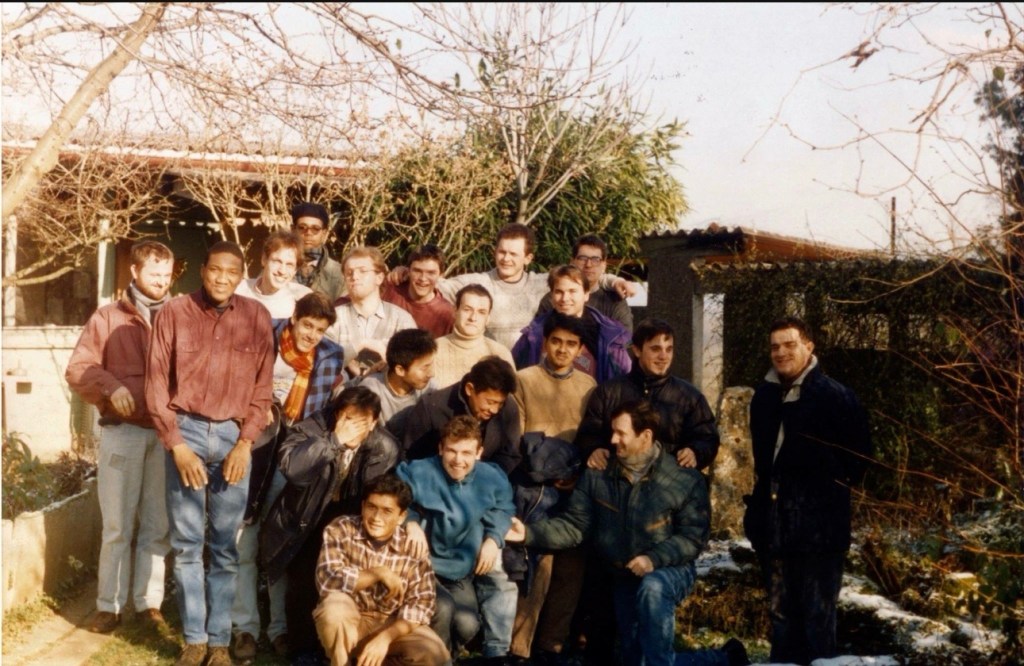
A group photo of the male Permanents at the time from all over the globe. Br. Mathew, a “young brother” in charge of caring for us, is now the Prior of the community (far right). Great memories!
Yet after about seven months, it became clear that I was not to stay, but I never doubted that I had been called there. I came to that little hill, and I saw Christ more clearly than ever before. I just now knew he was calling me to something else. Back to the valley for me! This led me to other people, and thus more new understandings of God’s love, but that’s for another time to share.
I have not been back to what I still consider my spiritual home, but my wife, Kristine, and I did make it to a European Meeting in Barcelona. (It was the last time I saw Br. Francois. He died a few years ago.) I also was able to welcome Br. John and Br. Emile for a meeting at my church in the Richmond area in 2019. I hope our paths will cross again, but as I have written to my many dear fellow volunteers now across the globe, it’s ok if I don’t meet them again. I still sense the deep, living communion which we share any time I hear Taize’ chants, see a photo, or think of them. The Spirit works this way among the Church, a communion of saints. That communion spoken about in the creeds of the Church is tangible.
Yes, we are together still. It’s hard to explain, but it is true. I trust – thanks be to God – that it will be so forever.
For those who attend our theology on tap meetings, Three Priests Walk in a Bar, you might recall that we originally created a special Facebook group so conversations could continue. Our producer and facilitator, Nick2, similarly invited folks to “pick apart” our gatherings conversation at a later date. Here’s a few more items I wish to share after listening to the recent podcast of the live event held on “Can Christians Worship Together or Not?,” Episode 3.
Source: Pixaby. Used by Permission
During our recent discussions, I told a story of a young man in high school who came forward to the altar in order to commune. As I provided him the body of Christ, he said, “Amen,” consumed it, and added excitedly, “This was my first time!” I did not know this young man or his mother kneeling beside him at the time, but she appeared visibly dismayed. Traditionally, Lutherans prepare young people and new adult members for sharing in the Lord’s Supper. Her body language and facial expression indicated she and her son had done something wrong. In response, I simply said, “Welcome to the Lord’s Table.” Then, I continued to commune others and preside over the closing of our worship together.
Normally, I try to be in the narthex (the entrance area of the church building) to greet both visitors and returning church members to our Sunday service. This mother and son were visitors, but they came in as the service began. In our bulletin, we had an invitation to commune which outlined not only how to commune but also who can commune. (It specifically invited all baptized, communing members of any Christian church to do so.) I approached the mother and son after the service, not only to greet them formally, but to invite the mother and son into deeper relationship with our congregation. I didn’t overtly accuse or correct. I didn’t lecture. I just met them where they were in order that we could walk forward together with Jesus Christ.
It turned out that the family had fallen away from church attendance after moving to our area, but they desired to be one with the church again. How wonderful! Why would I put additional stumbling blocks before them to hinder them from coming to Jesus? Instead, I conversed with them, properly instructed them (especially the son regarding the Lord’s Supper), and we welcomed them into our congregation. The previously baptized young man went on to not only commune regularly but also to become a young adult leader in the congregation – one who continued in relationship with the Church through the rite of confirmation and beyond.
If he had not been baptized, it might have been a mistake or a shame, certainly improper by our polity, but I argue it would not necessarily be a sin for him to commune. A sin and a human mistake are not always the same thing. No evil or affront was intended. In 1 Corinthians 11, Paul does indeed argue against receiving the sacrament unworthily (as Fr. Nik noted), but it seems Paul is primarily addressing disunity in the community and not baptism or knowledge of the Sacrament. He never indicates how often the community should commune, but he expresses concern that some have privatized a communal act. Paul appears most concerned with how our lives relate to Jesus’ own and how love ties us in one body together.
As a result, he encourages self-reflection and examination more than present some theological argument over the form and substance of the elements or whom should be admitted to the supper. (Although some of that might have been assumed by Paul, it isn’t his main point nor preserved in writing.) The good news is that we can repent and be renewed even when facing judgement for our lack of discernment regarding love and unity. “Paul’s counsels are driven not by a veneration of the supper properly observed, but by the Corinthians’ failure to have the supper function among them as it should, namely as a beacon by which to keep their lives on the proper path of faith” (The New Interpreter’s Bible Commentary, Abingdon Press, 2002, p. 938). In Paul’s mind the illness and death in the community is a sign of eschatological judgement for disunity, not some sudden, wrath of God, superstitious punishment for lack of understanding while consuming the Eucharist. He seems to believe it is better not to participate in the meal than to dishonor it with disunity. To receive it improperly (in disunity) profanes the life and death of our Lord (Harper Collins Bible Commentary, Harper San Francisco, 2000, p. 1088).
Perhaps this is why “the kiss of peace” and confession were deemed critical to the Lord’s Supper and reserved only for the baptized in some early communities according to some Roman Catholic sources I’ve read in the past. Yet, this particular passage might not prove a great argument against who should commune or changes in practice. It isn’t really about that. Indeed, Christian communities including the Orthodox have changed some practices regarding the Lord’s Supper over time. For example, even when catechumens are dismissed in certain Orthodox liturgies, they actually don’t leave any more. (Listen to our podcast for more on this.) Reserving reception of the Lord’s Supper to those whom are baptized is primarily based upon the earliest known church practices as observed in and interpreted from scripture. It is a tradition handed down to us. Yet just as the “kiss of peace” (now “the sign of peace”) is now open to all, and catechumens are not actually dismissed any longer, perhaps other changes might be discerned by the Church in who should receive the Eucharist. (I’m not saying we should change, as I value the voices of the past, but people aren’t necessarily evil for raising the question.)
In rebuttal to my personal example above, our Orthodox friend, Fr. Adam, spoke about the necessity of knowing whom you commune and protecting the sanctity of the eucharist by overseeing (if not controlling) who participates. In ordination, the Orthodox priest promises “unto death” to protect the Sacrament. They are thought stewards of this mighty, miraculous gift. Those outside of the Orthodox Church, the only true expression of Church in their understanding, cannot and must not commune. He argued this is not exclusionary but a sign of hope that in the future we may all commune. To have someone unprepared or unworthy to commune is anathema, a grave sin in his tradition. Therefore, he must seek to welcome unfamiliar persons, and it is the responsibility of visiting Orthodox to present themselves to him. The expectation remains that only those properly baptized, confirmed and confessed, free of grave sin, participate. Thus, he inferred that the error in this case was not ultimately the young man’s but the priest’s (mine). In the Orthodox view, I should have stopped him from communing. In fact, he never should have even had the opportunity.
Meanwhile the Evangelical Church in America (ELCA), our pastors when ordained or installed promise to love, serve, and pray for God’s people, nourishing them with the word and sacraments. While respecting the sanctity of the Sacrament and the need to preside in a meet and right way, there is no explicitly, strong guardian language as with the Orthodox, although we understand that we are stewards. We recognize that the Sacraments are a means of grace, not an end in themselves. We understand that we share this responsibility with the congregational council and the people of the congregation as well. The sacrament belongs ultimately to Jesus and is our gift and honor to share.
Among those who commune, Martin Luther and our confessions condemn any requirement for preparatory acts such as confessing or fasting in order to do so. We can perform such practices as a personal spiritual discipline, but they aren’t required, and we receive no merit for salvation with any of our efforts. No one is worthy on their own or by their own efforts of receiving the Lord’s Supper – ever. No one can properly prepare to receive what is this pure gift of grace. At some level the sacrament as a means of grace always remains a mystery. It doesn’t truly belong to any bishop’s office or any pastor, but it remains a gift from Christ left in the care of the priesthood of all believers, administered in accordance with scripture, our confessions and polity. In that sense, we all are stewards of it.
Again, following Apostolic tradition, only those baptized commune. (Although, this is now being debated by some.) We instruct those baptized about to commune for the first time in scripture, our confessional beliefs, and our practices, so that they might better participate and value what they are receiving. The methodology and scope of this training varies widely by community. Hopefully, faith will increase through the training and education (by cooperating with the grace being offered), but no specific training is explicitly mandated or outlined by scripture. Though, it appears to have been a practice to educate new members of the community. Our modern model for it based on early Christian communities, early writings and traditions, but again, they vary widely within our denomination and the wider Church.
Traditionally, many if not most Lutherans appear to have communed upon confirmation. Yet with changes in the Roman Catholic Church under Pope Pius X in the 1920s regarding the age for communing and growing ecumenism, it appears discernment over these issues continued. A pan-Lutheran meeting in the 1960s settled on fifth grade as an appropriate age to commune, or nearly settled, for this wasn’t a mandate. Lutherans began to commune youth members at earlier ages as time passed, fifth grade, and still at confirmation. Today, you still find a wide variety of practices with children communing even younger than second grade at times. Even in some Confessional Lutheran bodies, it is left up to pastoral discretion. As for my practice, I enter conversations with parents to discern what might be best for the Church and the individual child. We remember that the age requirement isn’t scriptural but a practice discerned, developed even changed over time. Through our baptism, we are “qualified” in a sense or made worthy by the Holy Spirit’s presence and claim upon us (received through baptism) to be welcomed at the table. We are saved in Baptism and receiving the Eucharist through grace by faith alone. These Sacraments are deemed special means of grace.
Although requiring preparation and sacrifice for communing is condemned, I have actually heard of some American Lutheran pastors (especially in the 1940/50s) requiring confession before communing. This appears contrary to our common understanding of our confessions, the Book of Concord. We do have a rite to offer private confession, and we most often include confession as part of our Sunday liturgy or other times we share in the Lord’s Supper, but it isn’t required. Like the Orthodox, some Lutherans do require visitors present themselves before communing, and I have even been told of congregations expecting some form or written confirmation of denominational participation before one can commune. Still other Lutheran bodies will not let anyone outside of their denomination participate and refuse altar fellowship between Christian bodies if they don’t accept our Confessions fully. These more restrictive measures prove often to be taken by Confessional Lutheran congregations in my experience and the testimonies I have heard, not members of the Lutheran World Federation and ELCA (90+% of all Lutherans globally.)
In contrast, most congregations seem to just include requirements for communing in the Sunday bulletin or make announcements, and we hope and trust visitors will comply. Some of the common wording will invite any baptized communing Christians to participate. Others add that participants must also affirm the real presence of Christ in the Sacrament. We often explicitly explain our understanding of the Sacrament and mention our expectations for communing before weddings, funerals and community worship services where we sometimes celebrate the Eucharist and know many from other traditions might be present. Like the Orthodox, offering the Lord’s Supper at weddings and funerals remains rare, but it is allowed.
Whatever our policy, the majority of Lutherans do not usually challenge people at the altar rail from what I have seen and heard, although perhaps some Confessional Lutherans might. In practical terms, we do not always have the capacity (especially in a 200+ person church) to engage everyone before the service. So, again, trust might be required that people will accept our training, requests and guidance. Ushers, greeters and people in the pews are also asked to help with the welcome and orientation to the service. If people come to the rail, we usually commune them. If they did so in error and we come to know this, pastors tend to meet them later to offer future guidance and instruction. It might be deemed sloppy if not wrong by Fr. Adam and our Orthodox brothers and sisters, but I suspect God has a way of “protecting” the Eucharist better than we do. Here, my supposed “error” providentially led the young man and his family into deeper faith and rootedness in the Church likely because I responded pastorally; taking our theological and scriptural stances seriously while seeking to meet people where they are.
As much as I hear our Orthodox, Roman Catholic and Confessional Lutheran friends framing the need for theological, denominational compliance prior to communing as a hopeful thing, I struggle to accept that. It focuses on division more than welcome. It puts into question the power of our shared baptism. I accept the historic teaching and guidance that only baptized, believing Christians should commune, but if we worship the same Lord and share in baptism, why not commune together? No one properly and fully understands this mystery. I agree with John XXIII that there is more that unites us than divides us. I have witnessed grace in the way pastors and communities welcomed outsiders to the table – sometimes making pastoral exceptions to the common rules. Some communities such as Taizé seem particularly creative in their welcome. Therefore, I accept the benefit of communal standards while arguing for sensitivity and grace.
It brings to mind a story shared by Jean Vanier, founder of L’Arche:
“A young girl with a mental disability made her First Communion during a beautiful celebration of the Eucharist. After the ceremony her uncle said to her mother: ‘What a beautiful liturgy! The sad thing is that she did not understand anything.’ The young girl overheard this remark and said to her mother: ‘Don’t worry, Mommy, Jesus loves me as I am.’”
Perhaps, just perhaps, we self-assured bishops, pastors and lay leaders could learn something about the Eucharist from her?
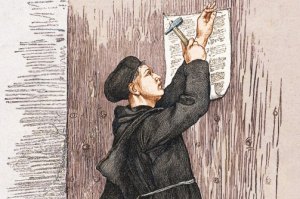
Knock, knock, knock…Below is my response to “Protestantism is Not United, Not Catholic, and Not a Church,” by Fr. Andrew Stephen Damick (2017).
The argument that Protestants are not united, not Catholic, and not a Church doesn’t upset me much as a Lutheran. The Great Schism (1054) and the start of the Protestant Reformation (1517) left the Christian world divided with the Orthodox, Roman Catholics (or Papists), Evangelicals (the first called Protestants and eventually Lutherans), and what were often at first named Radicals (Anabaptists and others pushing the traditional theological envelope). The Augsburg Confession was written with the hope for unity even amidst some practical, concrete theological differences.
As regional and theological breaks continued to occur, “Protestant” became an umbrella term for many disparate groups, and Evangelicalism more recently became connected to believer-baptism, “Bible based” traditions. The term, Protestant, is now sometimes used to indicate mainline denominations, but in general, the term covers a disparate group in common usage – often Mainline Protestant, Evangelical, Pentecostal and others. Although, it is important to note that some high church Episcopalians/Anglicans don’t like to be thought of as Protestant at all. Still, most everyone else considers them so (whether fair or not).
I would argue that some Protestants are more attached to the “Catholic” (universal) heart of the church than others. Determining what that heart is remains the rub. For my part, I put my trust in Jesus, Son of the Living God, risen from the dead. Beyond that, I’m open to arguments and even ultimately being proved wrong. Despite our hardheartedness, I find continually that the Holy Spirit makes us one Church out of many denominations (or “church bodies” if you prefer) whether we like it or not. There are many commonalities. There is an ecumenical movement affirming catholicity over division. Yes, we find these are muddied, sinful waters, but I expect the Baptismal waters will win out yet.
So, I believe the author fails to adequately or even fairly differentiate between varied beliefs of Protestantism. Echoing his own argument, must of us confess that we are not one! We understand that the Church is fractured, but we don’t have to look far to identify fractures in the Orthodox edifice as well. Just look at what’s going on in orthodoxy over in the Ukraine. Closer to home, in my own county, I know of Orthodox Christians that mutually condemn one another. Certainly, we know Orthodox folks in the Richmond area who are viewed with suspicion if not distaste by other Orthodox folks. The catholicity of the Church is broken, and so, many Christians are working toward repairing the breach when and where they can. There’s a hunger for unity with God and one another.
In my view, the author makes a mistake by conflating Protestant
traditions. He focuses on the “Reforming Catholic Confession” as if it is a
seminal Protestant document. It is actually a document initiated (as I
understand it) by Kevin Vanhoozer, a seminary instructor at Trinity Evangelical
Divinity School (Deerfield, IL). Interestingly, the seminary is affiliated with
the Evangelical Free Church of America. This denomination is Evangelical in the
modern sense (believer-baptism, “bible based,” etc.) not the Lutheran sense (“of
or according to the teaching of scripture”). The Evangelical Free Church of
America’s deepest roots are indeed found among Swedish, Danish, and Norwegian
Lutheranism, but they are ultimately a break-off sect in the United States – former
Lutherans influenced by Baptist and Evangelical neighbors. Ironically, they
were originally considered “liberal” by some, as the predecessor bodies were
trying to cast off the cloak of the “Old World” religion and hungered to be a “free”
(not state supported) church. Today, Evangelicalism is in fact often closely
connected to conservative politics and traditions, but not always.
I would argue we all fall short of the “Catholic” standard. Orthodox, Roman Catholics, Mainline Protestants, Evangelicals, Pentecostals, and all others have plenty of repenting to do rather than casting stones. I’m thankful to be part of a Protestant denomination that is trying to live out the Augsburg Confession’s hope of our being one, and most importantly, Jesus’ own prayer for us to be one (John 17:20-23).
I don’t fault the authors of “The Reforming Catholic Confession” for arguing for the catholicity of their faith (as they see it), even though, I do often disagree with their theological claims. Thanks to the Holy Spirit, I trust we are one even as we disagree. Thus, perhaps we as Church would find it more productive (and in line with God’s will) to focus on what unites us rather than divides us as Pope John XXIII suggested; even if we need good beer and conversation as the starting course.
Amidst our Christian brokenness and sin, I trust the fullness of the promised feast is yet to come. Someday, Jesus’ prayer will be completely fulfilled. Yes, we are one Church, just not quite yet.
Pastor Lou is a member of “the Three Priests.” Join him (an ELCA pastor), Fr. Adam (an Orthodox Church in Americapriest), and Fr. Nic for a Three Priests Walk in a Bar event in Ashland, Virginia, or through their (hopefully) upcoming podcast series.
This post was created in response to an article shared by an Orthodox friend, Fr. Adam, on Facebook, “Protestantism is Not United, Not Catholic, and Not a Church – Orthodoxy and Heterodoxy,” by Fr. Andrew Stephen Damick, on Reformation Day 2019. Find it here: https://bit.ly/36o4XtI
Picture credit: Gerard Seghers (attr) – The Four Doctors of the Western Church, Saint Augustine of Hippo (354–430); or as I would call it, “Let me think, think, think…”
At a recent “Three Priests” theology discussion, one sticking point remained as we closed our talk on the Word of God: Is the biblical canon closed? Well, I argue that depends on how you look at it.
Due to some modern fictional books and movies, the Emperor Constantine is sometimes wrongly given credit for the canon inherited in Western Christendom. Constantine did call the Council of Nicea (325), which was the first general conference or “ecumenical Council” of the Christian church, but this first gathering is not reported to have addressed the canon. In 330 CE, Constantine did finance the copying of fifty Christian “bibles,” comprised of commonly accepted books, but he, too, does not seem to have officially influenced the cannon.
So, did any council approve what we know as the cannon? That in itself is a tricky question. There *was* a “council” (small “c”) to help establish the Roman Catholic/Western cannon and later councils affirmed it, but these were not any of the seven great “Ecumenical Councils” which occurred before the split of Eastern and Western Christendom.
The Synod of Hippo of 393 is one of several gatherings of bishops sharing this name. (Synods of Hippo were also held in 394, 397, 401 and 426.) This specific gathering is commonly held by Roman Catholics as the first time any council of bishops (again, not to be confused with one of the seven “Ecumenical Councils”) listed and approved a Christian biblical canon. This list corresponds closely to the modern canon in the West. This canon included the six later books classed as deuterocanonical/apocryphal as well as First Ezra/Esdras and Second Ezra/Esdra. Also included among these apocryphal texts: Tobit, Judith, 1 and 2 Maccabees, Wisdom, Sirach, Baruch, parts of Esther and parts of Daniel. It left out some apocryphal books recognized by the Orthodox.
This canon list was later approved at
the Council of Carthage (again a series of synods and not listed as one of the seven
ecumenical councils) pending ratification by the “Church across the
sea”, that is, the See of Rome. This Council of Carthage (the third of
several synods in the 3rd, 4th and 5th
Centuries sharing this name) affirmed the canon established in Hippo on 28
August 397 (and again in 419).
The councils held at Hippo were held under the authority of Augustine, and I’ve read he considered the cannon closed. In reality, others (both saints and heretics) continued to propose varied lists. Indeed, First Ezra/Esdras was excluded in the Vulgate Bible (late fourth century) and ceased to be considered canonical in the West. The modern Book of Ezra formerly included the Book of Nehemiah in a single book, but it is now commonly split since the 9th century onwards. It was not until 1516/17, in the first printed Rabbinic Bible of Daniel Bomberg that the separation was introduced generally in Hebrew Bibles.
The cannon solidified over time in the West, but Luther stirred the pot again with his Reformation review when he asked, “What is truly scripture?” He evaluated opinions and judgments of the past, but he wasn’t afraid to challenge them. He ultimately rejected the Apocrypha. Jewish religious leaders of Germany tended to reject them, so why shouldn’t Christians? He also attempted to remove the books of Hebrews, James, Jude and Revelation from the canon. To him, they were out of whack with “grace alone” and “faith alone” doctrine. Other Reformers disagreed. In the end, he kept these New Testament books, but these books are still to be found toward the end of the German Language “Luther Bible.”
The Council of Trent (1545-1563), the 19th “ecumenical council” of the Roman Catholic Church, was called in response to the Reformation. Indeed, my old priest and Sunday school teacher (from pre-Lutheran days), Father Foley, considered this council the start of the “Catholic Reformation” in response to the “Protestant Revolt.” (These terms were common among Catholics, and remains so among some hard-corps, conservative Roman Catholics.) This council was not truly ecumenical, as it did not include anyone from the Orthodox Church. In response to the Reformation, it approved the Catholic Cannon we know today. This includes apocryphal books.
The Lutheran/Protestant cannon continued
to exclude the Apocrypha as scripture. Although not viewed as being the
standard of scripture, these works remained valued even by Martin Luther. They
are often included in modern editions of scripture, but you will find them
clearly designated as apocryphal or deuterocanonical texts.
So, is the cannon closed? Theoretically, it closed in the 300s, but one can see there have been and remain variations. The Church (East and West; Catholic, Protestant and Orthodox) could work toward more unity someday, as unlikely as that sounds. Or, maybe the West might accept just as my Orthodox friend, Father Adam Sexton, proposes, “The Orthodox Church is right. We have received what we were meant to receive.” Then, in that sense, the West could accept the East’s ruling and “go back” to that. Yet many of those Christians who are orthodox (small “o” meaning more traditional) would say, the canon is absolutely closed as is. Some suggest the canon was closed with the death of the last Apostle. Others say that scripture points to the revelation in the Christ which has fully come in Jesus.
Yet some scholars and others do indeed argue about the closing of scripture. Usually, they suggest better, more complete surviving texts might someday be found calling for an amendment to the canon. Or, they suggest texts formally rejected for theological or political reasons might need to be reevaluated. Or, they argue that there is nothing in scripture that defines the canon, only councils of men did. Yet again, most of the catholic (small c meaning universal), orthodox (small o, meaning more traditional) Church deems the canon closed by the Spirit. To do otherwise can be viewed heretical and certainly false prophets and revelation could mislead us.
In practice, some argue that the canon was closed with early gatherings of bishops (in the 300s), as well as with the East-West break, or even with the Reformation and/or Council of Trent (1500s). Yet even after choosing any of these historic markers, disputes remain between Christians over exactly which books belong. Is it really closed if the entire church can’t reach a consensus? Some past and present Protestants believe that the Church recognizes the canon, but it does not have the authority to close it.
Looking at history, Karl Barth, a Reformed theologian of the 20th Century, put it this way, “The insight that the concrete form of the Canon is not closed absolutely, but only very relatively, cannot be denied even with a view to the future” (Karl Barth, Church Dogmatics: The Doctrine of the Word of God, Vol. I/2, trans. Bromiley, G. W., & Torrance, T. F. London; New York: T&T Clark. 2004. Print. p. 476). Another major shaking of the Church could yet cause the books to be reevaluated, shuffled, or who knows what. Well, as I said last night, only God knows, and we will find out. Until then, we seem to be left with a general, human consensus – we trust guided by the Holy Spirit – and thus could be in error or not done discerning, “What is scripture?”
*As this was just for fun and general edification, I’m not listing all my resources, but they included the Catholic Encyclopedia, US Catholic Bishops Conference website, multiple Wikipedia articles (yeah, I know, not always authoritative), multiple blogs (some kind of out there), and classes by Father James Foley, SJ (may he rest in peace).
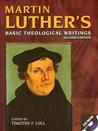
In case you come across this article by Thomas Cahill as I have being reposted and misused by some Roman Catholic brothers and sisters (along with some rather un-Christian remarks), be assured the author misses the mark somewhat when it comes to Luther’s psychology and theology. His take is too simplistic.
Luther’s efforts to reform the church (especially at the start) weren’t about ego alone, but about the Word of God being adhered to without mental gymnastics to make them fit corrupt and superstitious practices of the day. He was a pastor caring for his people, and a teacher seeking truth. His intent was not to be independent, revolutionary, or famous.
Unlike the short quote within the article, Luther’s words at Worms were more nuanced [please note the points I emphasize]:
“Unless I am refuted and convicted by testimonies of the Scriptures or by clear arguments (since I believe neither the Pope nor the Councils alone; it being evident that they have often erred and contradicted themselves), I am conquered by the Holy Scriptures quoted by me, and my conscience is bound in the word of God: I can not and will not recant any thing, since it is unsafe and dangerous to do any thing against the conscience.” (History of the Christian Church, vol. VII, ch. 3, sec. 55).
Martin Luther was posting an academic disputation – a common practice of his day – and wrote later writings to be discussed in community. He wasn’t looking for a fight nor a break with the church catholic, and his efforts were shaped by much more than just a matter of an individual’s ego.
True, self-interpretation of scripture has its weaknesses and excesses, but Luther wasn’t guilty there either. His focus remained on the assembly (the church) in relationship with one another and Christ. (This is made quit clear in his Large Catechism and other theological writings.) The church guided by the Spirit and tested by the divine revelation of scripture is the corrective for us all when it comes to interpretation, for Luther knew we all can err as much as popes and councils. We need to open scripture, listening for the Spirit and to one another.
As the debates rolled on and intensified, Luther failed to do that at times himself. Much like those posting anti-Lutheran insults and commentary, he let his anger and disappointment (and perhaps later his mental illness) govern some of his responses. After all, many people wanted to see him dead and weren’t exactly charitable either.
Martin Luther was human, and he realized it. In reviewing much of his writings, you will see him hesitate to state things definitively rather than to risk error. He critiques himself and his lack of ability. You will see calls for discernment rather than name calling over theological issues. He turns toward grace to light his way forward and not some internal power of his own.
I think such an attitude represents a very human, Christian humility and maturity rather than egocentricity. Adapted beyond theology discussions to a way of life, such an attitude will likely prove the best answer to what gridlocks us in our politics and divides our culture today.
As St. Paul reminded Luther and reminds us all, “And do not grieve the Holy Spirit of God, with which you were marked with a seal for the day of redemption. Put away from you all bitterness and wrath and anger and wrangling and slander, together with all malice, and be kind to one another, tenderhearted, forgiving one another, as God in Christ has forgiven you.” (Eph. 4:30-32). Even amidst important theological or other disputes, we are to remain one family of faith, the holy people of God.
Unless otherwise indicated, all scripture quotations for this article are from the New Revised Standard Version.
For all the hubbub about using “Xmas” instead of “Christmas” as shorthand (and in some cases where people intentionally desire to erase any reference of Christ from Christmas by using Xmas), the ironic, historic truth remains that ancient Christians utilized the Greek letter Chi and letter symbol Chi-Rho as a means to represent Jesus Christ. Such symbols are called christograms.
You see, the name Jesus Christ in Greek, the language of the New Testament texts, is Ἰησοῦς Χριστός. The first letter of the title Christ (signifying Jesus as the anointed one, the Messiah) looks like our English X and became a convenient, somewhat obscure way for early Christians in the catacombs and elsewhere to identify artistic representations of Jesus and Christian markings, signs, or art – similar to use of the Christian fish symbol.
Later, the Emperor Constantine I had a dream that he should put the “heavenly divine” symbol of Chi-Rho on his army’s shield before the Battle of the Milvian Bridge to guarantee victory. He did just that, won the battle, and turned the formerly pagan empire into a Christian one. The Chi-Rho symbol became and remains one of the most common christograms used in sacred and liturgical settings. In fact, it is often used as part of the modern Christmas tradition of the Chrismon Tree. Invented by a Lutheran in Danville, Virginia in 1957, this practice is now popular in many congregations throughout the United States and across denominational lines.
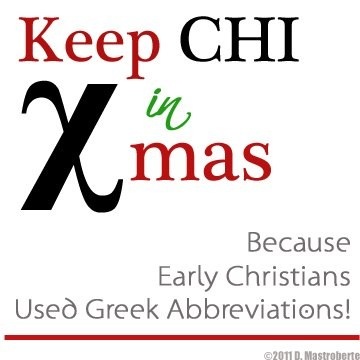
As I find the debate over the use of Xmas somewhat distracting if not tedious and dislike the rush toward Christmas only to hide it away from the public eye as soon as December 25th passes, I try to experience Advent as a true time of expectant waiting and preparation. I also make an effort to enjoy the traditional Christmas period lasting twelve days through Epiphany on January 6th. So last year as Christmas approached, I posted an image I had found by Orthodox iconographer Raymond J. Mastroberte on Facebook saying, “Keep Chi in Christmas…Because early Christians used Greek abbreviations!” The illustrator’s image struck my sometimes questionable funny bone, and I playfully proclaimed that I would be putting the Chi in Christmas all twelve days.
Image and copyright by Orthodox iconographer Raymond J. Mastroberte. Image used here for teaching and not for profit under the terms of fair use.
In the context of our modern conundrum over Xmas, it wasn’t long until someone missed my attempt at humor. They argued that surely since Jesus Christ had done so much, suffered and died for our sake, we could most certainly take the time to spell out his name in full. It was as if the ancient Christian signs and symbols were suddenly disrespecting our Lord. And so, my attempt at lighthearted banter fell as another victim of this modern culture war.
As the past few years attest, an annual argument has indeed arisen about the secularization and explicit anti-Christian elements of our Christmas celebration. It should be expected, for in school gatherings and shopping malls, on public plazas and in our homes, religious symbols for Christ and his birth have come to be often replaced by winter scenes, Santa and his reindeer, snowmen, cute penguins or polar bears…the list goes on and on. In fact, some suggest that many Americans can’t specify what the Christmas holiday commemorates.
In opposition to Christmas, one atheist author argues that there is historically no proof that “Christ is the reason for the season.”[i] They suggest that winter celebrations have always existed, and such a modern mantra is only a Christian attempt to assert their cultural superiority over everyone else. Sadly in the name of multiculturalism, echoing choruses of Merry Christmas can be explicitly prohibited in some environs. Yes, just as there was no room at the inn on the original Christmas Eve, there seems to be no room in our public lives for Jesus today.
Yet, let’s not be too quick about things, as there are other signs to look for. Gallop found, “Ninety-five percent of Americans celebrate Christmas, and of these, 51% describe the holiday as ‘strongly religious’ for them, continuing an upward trend seen since 1989.” This 2010 poll also found a majority of Americans self-reported “incorporating specific religious activities or symbols into their holiday celebrations. This includes 62% who attend religious services on Christmas Eve or Christmas Day, 65% who display decorations with a religious meaning, and 78% who take time to reflect on the birth of Christ.”[ii] Self-reporting surveys can prove inflated, but we can see signs of hope for our beloved holiday.
Nevertheless, further confusing this debate, this same Gallop study found many more Americans were likely to practice secular traditions (in the ninetieth percentile range, depending upon the activity) than religious. Sadly, a recent poll by Think Finance claimed that 45% would rather skip Christmas due to the debt accumulated from gift giving.[iii] Others seasonally face bouts of depression or other mental illnesses magnified by their isolation or sense of loss during the holiday season, and thus they dread Christmas’ arrival.[iv]
Amidst debates and arguments, blinded by bobbles, decorations, and good deals, we can forget that our redemption is drawing near. Our time on earth is short, and we should live with hopeful and loving expectation as if Christ will indeed come soon. Signs of trouble and even outright persecution are nothing new. Jesus promised us such as these in his prophesies, comparing them to birth pangs.[v]
Should we then be so surprised that people are confused, lost, and hurting when it comes to Christmas and more importantly Jesus Christ? Should we let this distract us from our call as a holy people living together in Jesus’ holy name? Intentionally seeking the newborn Christ in our own hearts, we can repent of our own errors and grow in faith. Living as part of his body through our shared ministry of preaching, teaching and baptizing, or accepting and loving others (even our enemies) as they are, we can be used by God to bear Jesus into the world.
The devil’s in the details, and so it appears with our modern Christmas. Let’s not get anxious about the holiday – lost in empty debates or the holiday wrapping of materialism. As Christians, we are called to celebrate!
Look to the true heart of Christmas toward Jesus Christ himself, the final Word on this argument, come to save us. Whatever we choose to do and however we choose to say it, let’s seek to make Christ known every day. Look past the veneer of our time and see those suffering and alone around us. Enter relationship with them, help them, or guide them toward people who can. Celebrate the truth of Christ’s coming within every aspect of our lives – for the love of Χριστός, ourselves, and our neighbors.
There are more than enough signs of trouble and discord. Let’s not waste time dwelling upon them or pointing them out. Instead, let’s seek to be living, joyful signs that Jesus is near. That’s probably the best way for any of us to wish the world a meaningful Merry Christmas and eternity.
My wife, Kristine, and I wish you a holiday filled with blessings. May those same blessings flow through you to help transform the lives of others.
Pastor Lou
For those interested, visit OldLuteran.com for their comical take on this debate. Access their site through the image below:
The above pastoral letter was originally published in Messiah Lutheran Church and School’s newsletter, The Messenger (December/January 2012 edition) in an abridged version. To view the entire issue of The Messenger or to see the full calendar of events, visit: http://www.mlcas.org
Unless otherwise indicated, all scripture quotations for this article are from the New Revised Standard Version (NRSV) translation.
As a prisoner for the Lord, then, I urge you to live a life worthy of the calling you have received. Be completely humble and gentle; be patient, bearing with one another in love. Make every effort to keep the unity of the Spirit through the bond of peace. There is one body and one Spirit, just as you were called to one hope when you were called; one Lord, one faith, one baptism; one God and Father of all, who is over all and through all and in all. (Ephesians 4:1-6)
[Jesus said,] I will remain in the world no longer, but they are still in the world, and I am coming to you. Holy Father, protect them by the power ofyour name, the name you gave me, so that they may be one as we are one. (John 17:11)
Dear members and friends of Messiah Lutheran:
As announced in our newsletter and at worship, we have the great opportunity to concretely live out Paul’s hope for unity among believers and Christ’s prayer that we live as one. Our brothers and sisters of All Souls Episcopal (a mission congregation) will begin worshiping at 9:30 AM on most Sundays as our regular guest while they work toward establishing their own facility. This required we set new worship times of 8:00 AM and 11:00 AM starting this Sunday, August 12th.
Please join me in welcoming them, as I am confident they will welcome you, as one family in Christ. Along with our worship space, we will be sharing in some ministries to build up the body of Christ and share Christ’s love within our community. We hope this sets a firm foundation for when they have their own building; that this cooperative relationship continues to the glory of God.
The early Lutheran Reformers did not see themselves as fracturing the church, but rather hoped to repair divisions while living consistent with their individual understandings of scripture. Thus, the vast majority of Lutheran bodies throughout the world have been open to ecumenical efforts from the beginning. To learn more about the special cooperative relationship of the ELCA and Episcopal Church as well as with five other denominations in the United States, follow this link:
A “full communion” relationship does not indicate a merging of these denominations with the ELCA, but it instead declares our intention to live as one as much as possible (repairing historic wounds while helping one another through the sharing of pastors, ministries and assets whenever deemed appropriate).
Thank you for your willingness to try to live out this unity in Christ. If you note any problems or concerns, or you have ideas of how to do something better while the All Souls community remains our guest, please be sure to speak with me or a council representative. See you Sunday!
Husband, Pastor, Law Enforcement Chaplain, and member of the Clerical Errors (aka "The Three Priests"), I'm sharing my two cents with anyone who cares...
You can also find me on social media as Loudluthrn (Lou-d-Luthrn or Lou the Lutheran). It is a moniker given me while attending a Presbyterian Seminary, but I'm a loud and proud Lutheran too (just not too loud and proud, mind you).






 2pennyblog