Tag Archives: epiphany

Shedding a Light on Candlemas

An audio version of this post can be found here.

There’s definitely some confusion when it comes to Candlemas each February 2. Not only is it overshadowed by Groundhog Day, but it also remains rather obscure to many modern Christians and most certainly non-Christians. Candlemas is perhaps most properly or commonly called the Feast of the Presentation of Jesus. The Church remembers Mary and Joseph taking Jesus to the Temple forty days after his birth to complete Mary’s ritual purification after childbirth and to perform the redemption of the firstborn son as reported in Luke 2:22-40.

Photo by Sixteen Miles Out on Unsplash; licensed under CC0.

Candlemas is an old feast of the Church, a kind of holiday or holy day one might say. Normally, a feast day commemorates a person or event. Unfortunately, with Candlemas, it appears multiple, closely related meanings have been attached to it over the centuries and events perhaps merged. In a web search, you will quickly learn that Candlemas can not only be called Feast of the Presentation of Jesus, but it can also be known as the Feast of the Purification of the Blessed Virgin Mary, or the Feast of the Holy Encounter.

In Leviticus 12:2-8, we learn “A woman who becomes pregnant and gives birth to a son will be ceremonially unclean for seven days, just as she is unclean during her monthly period. On the eighth day the boy is to be circumcised. Then the woman must wait thirty-three days to be purified from her bleeding. She must not touch anything sacred or go to the sanctuary until the days of her purification are over.” (There are separate requirements for the birth of a girl child.) For the male, a year-old lamb was to be offered for a burnt offering and a young pigeon or a dove for a sin offering. If the mother and her family could not afford a lamb, she was to bring two doves or two young pigeons, one for a burnt offering and the other for a sin offering. God was thought to be a God of life. Things that smacked of death and illness such as blood were deemed unclean. In sacrificing the offering as part of the ritual in faith with prayer, the priest was thought to be atoning for any of her sins. A person was being made fit to be in the presence of God and among God’s Holy People.

The first male child held special significance to the early Hebrews. With their cultic life and practice centered around priestly activities and offerings relating to the Ark of the Covenant and Ten Commandments, members of the twelve tribes were expected to support the work of the Tent of Meeting and later the Temple in Jerusalem. As the people became more numerous and the cultic practices more established, it was recognized that not every first male child need to serve with the priests. Indeed, sometimes families making a subsistence living might need him more just to survive.

Exodus 13:2-15 describes another ordinance. Through Moses, God was believed to have commanded, “Consecrate to me every firstborn male. The first offspring of every womb among the Israelites belongs to me, whether human or animal.” All the firstborn males of their livestock were also to belong to the Lord. When people asked why, they were to explain, “Pharaoh stubbornly refused to let us go, the Lord killed the firstborn of both people and animals in Egypt. This is why I sacrifice to the Lord the first male offspring of every womb and redeem each of my firstborn sons.”

In Numbers 18:15-16, it says, “The redemption price for firstborn non-Levites was set at 5 shekels.” Today, this practice is known as the pidyon haben, the redemption of the first-born son, and silver coins are used. It is only conducted for male babies but not if the baby was delivered by cesarian section. In effect, the father “buys” or “redeems” his son from the priest and the expected, traditional service. (The Temple no longer exists, so it is more symbolic than in the past.) At least under rabbinical practice today (if not earlier), this obligation only exists if the parents are not Levites or part of the priestly class.  In a quick review of scripture, I see no date for this to be held in scripture, but today the obligation begins when the baby is 30 days old, and so the ceremony often occurs on the thirty-first day after birth. If included parents do not redeem the child for whatever the child becomes responsible for his own redemption at thirteen years of age. (See the article Redeeming firstborn sons for more details.)

Certainly, Luke seems to confuse these two practices – the redemption of the first male child and the purification of the mother forty days after birth. In fact, Luke has the fee for the purification of the mother become the redemption price for the son. Remember, Luke did not observe these events. He was a Greek doctor who had come to believe in Jesus and served with Paul for a time. To me, it certainly seems reasonable that he didn’t fully understand Levitical codes. I’ve read some articles suggesting that there was no such custom of presenting a Jewish male child in the Temple back in the first Century, but with the redemption needing to be made to a priest, perhaps a child need not be there, but I would certainly not be surprised if a family did. I see no reason to doubt the ultimate truth of the passage. Jesus was presented in the Temple. Simeon and the prophet Anna could have certainly encountered Jesus and through the Spirit’s revelation understood his import. (Hence, Candlemas can also be known as the Feast of the Holy Encounter.)

Whether we focus on some kind of presentation of Jesus including most likely the story of his redemption, the purification right of Mary, or Jesus being revealed as the Messiah to Simeon and Anna, I hope we remember all these early stories and practices amidst their variations. They help make Jesus and his family come alive in context of their time. February 2 being forty days Christmas remains the perfect day to do so. Indeed, as I have written elsewhere, the date was once was considered the end of what was called the Season of Epiphany, and any remaining Christmas greens were taken down. (Today, most denominations don’t have a season of Epiphany but have January 6 as the Feast of Epiphany and what is now called the start of the Season after Epiphany.)

So that all said, with all those names and remembrances possibly now making more sense, why is the day also called Candlemas? Well, in past days, Christian families would commonly bring candles to the church as we remembered Jesus as “a light for revelation to the Gentiles, and the glory of [God’s] people Israel.” Much as we bless food to our use or dedicate worship items through prayer, families would ask that the candles used in the home for light be blessed.

Happy Candlemas everyone! As Jesus urged, “let your light shine before others, so that they may see your good works and give glory to your Father in heaven.”

Unless otherwise indicated, all scripture quotations for this post are from the New Revised Standard Version (NRSV) translation.

© 2022 The Rev. Louis Florio. All content not held under another’s copyright may not be used without permission of the author.
Leave a comment

Filed under Church History, Lectionary, scripture, worship

Epiphany Blessing


3kings blessing


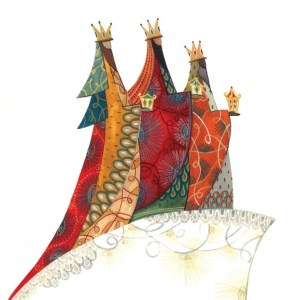
Epiphany, also historically known as “Little Christmas,” marks the end of Christmas celebrations in Western Christendom on January 6th. The arrival of the Magi is often remembered as part of these celebrations. Although scripture never numbers the gentile Magi who came to worship Jesus, a tradition developed that there were three; each one baring a special gift of gold, frankincense, and myrrh.  They became popularly known as Melchior, Caspar and Balthazar and are often artistically represented as being of different peoples and races, for Jesus came to offer salvation to all.

Over time, a popular custom began to bless one’s home on Epiphany with the words in Latin, Christus Mansionem Benedicat (May Christ bless this house). I surmise this was because of the biblical scene from Matthew 2: 1-12. (Jesus was no longer in the stable but described to be in a house with his own family when the Magi visit.) Yet, I have not confirmed the origin of this practice. The first letter from each word of this blessing corresponds to the traditional names given the Magi. Which came first – the blessing or the names – remains a mystery, but their development within popular culture is likely related.

As we move forward into a new year, I suggest use of a simple blessing ceremony I have adapted from the internet. You can further adapt it to meet your family’s needs:

Once gathered, all may make the Sign of the Cross.

Leader: Peace be to this house and to all who dwell here, in the name of the Lord.

All: Blessed be God forever.

Reading: Matthew 2:1-12

Using chalk, write on the outside of your house’s door or frame (alternatively, on a path or driveway, or above or next to an entrance):

+ 20 C M B 14 +

This stands for the first half of the current year written out, Christus Mansionem Benedicat (Christ bless this house), then the other half of the current year written out. Start and end with a cross.

Optionally, the entire phrase may be written out. Each marking or word could be written by a varied member of the household if desired. The leader can share a prayer of their own or simply ask God to bless your home as the markings are made.

When finished, all can join in a closing prayer – “Lord God of heaven and earth, you revealed your only begotten Son to every nation by the guidance of a star. Bless this house and all who inhabit it. May we be blessed with health, goodness of heart, gentleness and the keeping of your law. Fill us with the light of Christ, that our love for each other may go out to all. We ask this through Christ our Lord. Amen.”

May a joyful and blessed Epiphany be yours!

Pastor Lou

Unless otherwise indicated, all scripture quotations for this article are from the New Revised Standard Version (NRSV) translation.

© 2013 The Rev. Louis Florio. All content not held under another’s copyright may not be used without permission of the author.
Leave a comment

Filed under Christmas, Community Life, Epiphany, Liturgical Year, Uncategorized, worship

My Heart Remains in Wonder

stained glass nativity with sunOn coming to the house, they saw the child with his mother Mary, and they bowed down and worshiped him. Then they opened their treasures and presented him with gifts of gold, frankincense and myrrh.” (Matthew 2:11)

Have you ever taken a good look around our sanctuary? Our stained glass windows are beautiful and educational. Long before the average person could read, people attempted to capture and share the wonder of God’s love for us through the art of stained glass.

At this time of year, my thoughts are always drawn to meditate upon the meaning behind our nativity window. It shows the star of Bethlehem shining above a manger. In the manger is the ancient “Chi Rho” symbol. This symbol is the first two letters of “Christ” in Greek joined together. Early Christians used this mark to represent Jesus. The window reminds us that Jesus, the Christ, came to us in human form at Christmas. Such news becomes even more wondrous when one considers that he comes to us throughout time. He is the Alpha and Omega, the beginning and the end – present before history began and will be after it ends – because Jesus always was, is and will be our God who is with us and for us.

Luther once wrote that the Bible is like the manger where we can meet, know and worship Jesus the Christ over and over again. This, too, is true, but it also doesn’t quite capture this special relationship – the intimacy spoken of goes well beyond “knowing” Jesus with only our intellect. Our holy texts assure us that Jesus has come to live with us in our hearts. Jesus wants to abide in us. He longs to be an intimate part of every aspect of our lives. This joyful mystery cannot be captured fully in written word or by any other human art, yet my thoughts came back to an old 18th Century Danish hymn which focuses upon the joining of our human hearts with the divine heart though the incarnation and gift of faith. It is one of my favorite pieces of Christmas music.

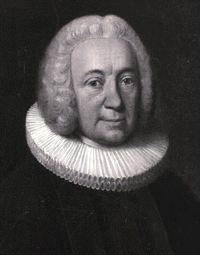
BrorsonWritten by a Danish Lutheran pastor and later bishop, Hans Adolph Brorson, Mitt Hjerte Alltid Vanker (in English, sometimes entitled “My Heart Always Wanders” or “My Heart Remains in Wonder”) movingly grasps at the surprise and mystery of the incarnation. Soundly pietist,  the reflection remains more oriented toward his feelings and heart rather than any intellectual exploration. The lyrics reflect relationship and intimacy, as well as grace and gratitude. Contemplating this miracle, God coming to us as a vulnerable newborn in a stable, Brorson’s own mind and heart wanders and enters a blissful wonderment as he thinks about his current saving, relationship with Christ.

O come, my Lord, I pray Thee!
And be my honour’d guest,
I will in love array Thee
A home within my breast.
That home can be no stranger
You bought it all yourself.
Thou will surely stay here
Swaddled in my heart.

We will never be able to fully appreciate, capture, or understand the miracle of love offered to us through Jesus Christ. Yet because it is not just an historical event, each and every day we may strive to cooperate with grace and make room for the Christ child in our hearts above all other things. His birth should move us to reflect upon the ultimate, ongoing Christmas miracle which comes to us through Christian faith, worship, fellowship and service. Christ’s Spirit continues to shape us and sanctify us into the gift God first intended with our own creation. We become part of God’s greatest gift to the world, where in Jesus’ name, we will love others. Through grace, we concretely become the Christ’s body, here and now.

Throughout your holiday wanderings and celebrations, I pray that you, your family and friends stop and ponder the nativity. Continue to wonder about and experience this joyful mystery and invitation in your life. Rejoice, for a child has been born for us! His name is Jesus, and we will never be alone or unloved. In response, let us seek to rightly worship him, opening our hearts and offering all that we are to him in thanksgiving.

—————————–

Many variants of the song exist in English due to the difficulty of translation. Along with the above video, here are English lyrics for this wonderful Christmas song:

My Heart Remains in Wonder/My Heart Always Wanders

My heart remains in wonder (or better translation: My heart always wanders)
Before that lowly bed
Within the stable yonder
Where Christ, my Lord, was laid. (or: was born)
My faith finds there its treasure,
My soul its pure delight,
Its joy beyond all measure,
The Lord of Christmas night.

But Oh! my heart is riven
With grief and sore dismay
To see the Lord of heaven
Must rest on straw and hay,
That He whom angels offer
Their worship and acclaim
From sinful man must suffer
Such scorn, neglect and shame.

Why should not castles royal
Before Him open stand,
And kings, as servants loyal,
Obey His least command?
Why came He not in splendor
Arrayed in robes of light
And called the world to render
Its homage to His might?

The sparrow finds a gable
Where it may build its nest,
The oxen know a stable
For shelter, food and rest;
Must then my Lord and Savior
A homeless stranger be,
Denied the simplest favor
His lowly creatures see.

O come, my Lord, I pray Thee,
And be my honored guest.
I will in love array Thee
A home within my breast.
It cannot be a stranger
To Thee, who made it free.
Thou shalt find there a manger (or: Thou will surely stay there)
Warmed by my love to Thee.[i] (or: swaddled in my heart)

In English, it is difficult to find a flowing, direct translation of the traditional final stanza in Danish or Norwegian, but it means roughly:

I’ll willingly spread branches
Of palms around your bed.
For you and you alone
I will live and I will die.
Come, let my soul find bliss
In this moment of delight:
To see you born right here,
Deep inside my heart’s abyss. (or: loving heart)[ii]


[i] English version on Hymnary.org

[ii] Translation merging multiple sources, primarily the above video and pust.org

The above piece was adapted from one shared in Messiah’s newsletter, The Messenger, in November 2009. Unless otherwise indicated, all scripture quotations for this article are from the New Revised Standard Version (NRSV) translation.

© 2013 The Rev. Louis Florio. All content not held under another’s copyright may not be used without permission of the author.
Leave a comment

Filed under Christmas, Liturgical Year, Uncategorized

Put the Chi back in Christmas

For all the hubbub about using “Xmas” instead of “Christmas” as shorthand (and in some cases where people intentionally desire to erase any reference of Christ from Christmas by using Xmas), the ironic, historic truth remains that ancient Christians utilized the Greek letter Chi and letter symbol Chi-Rho as a means to represent Jesus Christ. Such symbols are called christograms.

You see, the name Jesus Christ in Greek, the language of the New Testament texts, is Ἰησοῦς Χριστός. The first letter of the title Christ (signifying Jesus as the anointed one, the Messiah) looks like our English X and became a convenient, somewhat obscure way for early Christians in the catacombs and elsewhere to identify artistic representations of Jesus and Christian markings, signs, or art – similar to use of the Christian fish symbol.

Later, the Emperor Constantine I had a dream that he should put the “heavenly divine” symbol of Chi-Rho on his army’s shield before the Battle of the Milvian Bridge to guarantee victory. He did just that, won the battle, and turned the formerly pagan empire into a Christian one. The Chi-Rho symbol became and remains one of the most common christograms used in sacred and liturgical settings. In fact, it is often used as part of the modern Christmas tradition of the Chrismon Tree. Invented by a Lutheran in Danville,  Virginia in 1957, this practice is now popular in many congregations throughout the United States and across denominational lines.

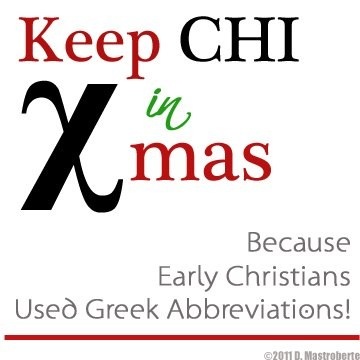
As I find the debate over the use of Xmas somewhat distracting if not tedious and dislike the rush toward Christmas only to hide it away from the public eye as soon as December 25th passes, I try to experience Advent as a true time of expectant waiting and preparation. I also make an effort to enjoy the traditional Christmas period lasting twelve days through Epiphany on January 6th. So last year as Christmas approached, I posted an image I had found by Orthodox iconographer Raymond J. Mastroberte on Facebook saying, “Keep Chi in Christmas…Because early Christians used Greek abbreviations!” The illustrator’s image struck my sometimes questionable funny bone, and I playfully proclaimed that I would be putting the Chi in Christmas all twelve days.

Image and copyright by Orthodox iconographer Raymond J. Mastroberte. Image used here for teaching and not for profit under the terms of fair use.

Image and copyright by Orthodox iconographer Raymond J. Mastroberte. Image used here for teaching and not for profit under the terms of fair use.

In the context of our modern conundrum over Xmas, it wasn’t long until someone missed my attempt at humor. They argued that surely since Jesus Christ had done so much, suffered and died for our sake, we could most certainly take the time to spell out his name in full. It was as if the ancient Christian signs and symbols were suddenly disrespecting our Lord. And so, my attempt at lighthearted banter fell as another victim of this modern culture war.

As the past few years attest, an annual argument has indeed arisen about the secularization and explicit anti-Christian elements of our Christmas celebration. It should be expected, for in school gatherings and shopping malls, on public plazas and in our homes, religious symbols for Christ and his birth have come to be often replaced by winter scenes, Santa and his reindeer, snowmen, cute penguins or polar bears…the list goes on and on. In fact, some suggest that many Americans can’t specify what the Christmas holiday commemorates.

In opposition to Christmas, one atheist author argues that there is historically no proof that “Christ is the reason for the season.”[i] They suggest that winter celebrations have always existed, and such a modern mantra is only a Christian attempt to assert their cultural superiority over everyone else. Sadly in the name of multiculturalism, echoing choruses of Merry Christmas can be explicitly prohibited in some environs. Yes, just as there was no room at the inn on the original Christmas Eve, there seems to be no room in our public lives for Jesus today.

Yet, let’s not be too quick about things, as there are other signs to look for. Gallop found, “Ninety-five percent of Americans celebrate Christmas, and of these, 51% describe the holiday as ‘strongly religious’ for them, continuing an upward trend seen since 1989.” This 2010 poll also found a majority of Americans self-reported “incorporating specific religious activities or symbols into their holiday celebrations. This includes 62% who attend religious services on Christmas Eve or Christmas Day, 65% who display decorations with a religious meaning, and 78% who take time to reflect on the birth of Christ.”[ii] Self-reporting surveys can prove inflated, but we can see signs of hope for our beloved holiday.

Nevertheless, further confusing this debate, this same Gallop study found many more Americans were likely to practice secular traditions (in the ninetieth percentile range, depending upon the activity) than religious. Sadly, a recent poll by Think Finance claimed that 45% would rather skip Christmas due to the debt accumulated from gift giving.[iii] Others seasonally face bouts of depression or other mental illnesses magnified by their isolation or sense of loss during the holiday season, and thus they dread Christmas’ arrival.[iv]

Amidst debates and arguments, blinded by bobbles, decorations, and good deals, we can forget that our redemption is drawing near. Our time on earth is short, and we should live with hopeful and loving expectation as if Christ will indeed come soon. Signs of trouble and even outright persecution are nothing new. Jesus promised us such as these in his prophesies, comparing them to birth pangs.[v]

Should we then be so surprised that people are confused, lost, and hurting when it comes to Christmas and more importantly Jesus Christ? Should we let this distract us from our call as a holy people living together in Jesus’ holy name? Intentionally seeking the newborn Christ in our own hearts, we can repent of our own errors and grow in faith. Living as part of his body through our shared ministry of preaching, teaching and baptizing, or accepting and loving others (even our enemies) as they are, we can be used by God to bear Jesus into the world.

The devil’s in the details, and so it appears with our modern Christmas. Let’s not get anxious about the holiday – lost in empty debates or the holiday wrapping of materialism. As Christians, we are called to celebrate!

Look to the true heart of Christmas toward Jesus Christ himself, the final Word on this argument, come to save us. Whatever we choose to do and however we choose to say it, let’s seek to make Christ known every day. Look past the veneer of our time and see those suffering and alone around us. Enter relationship with them, help them, or guide them toward people who can. Celebrate the truth of Christ’s coming within every aspect of our lives – for the love of Χριστός, ourselves, and our neighbors.

There are more than enough signs of trouble and discord. Let’s not waste time dwelling upon them or pointing them out. Instead, let’s seek to be living, joyful signs that Jesus is near. That’s probably the best way for any of us to wish the world a meaningful Merry Christmas and eternity.

My wife, Kristine, and I wish you a holiday filled with blessings. May those same blessings flow through you to help transform the lives of others.

Pastor Lou

For those interested, visit OldLuteran.com for their comical take on this debate. Access their site through the image below:


[i] Cline, C. Putting Christ Back in Christmas: Is Jesus the Reason for the Season? as downloaded from http://atheism.about.com/od/christmasholidayseason/p/JesusReason.htm on November 30, 2012.

[ii] Jones, J.M. Christmas Strongly Religious for Half in U.S. Who Celebrate It: Secular traditions more common among Americans than religious traditions.  December 24, 2010 as downloaded from http://www.gallup.com/poll/145367/Christmas-Strongly-Religious-Half-Celebrate.aspx on November 30, 2012.

[iii] Berk, C.C. Why One Poll Says 45% Would Rather Skip Christmas. November 19, 2012 as downloaded from http://www.cnbc.com/id/49880517/Why_One_Poll_Says_45_Would_Rather_Skip_Christmas on November 30, 2012.

[iv] See for example Mayo Clinic’s Stress, depression and the holidays: Tips for coping at http://www.mayoclinic.com/health/stress/MH00030

[v] See for example Luke 21: 25-36 or Mark 13:8.

The above pastoral letter was originally published in Messiah Lutheran Church and School’s newsletter, The Messenger (December/January 2012 edition) in an abridged version. To view the entire issue of The Messenger or to see the full calendar of events, visit: http://www.mlcas.org

Unless otherwise indicated, all scripture quotations for this article are from the New Revised Standard Version (NRSV) translation.

© 2012 The Rev. Louis Florio. All content not held under another’s copyright may not be used without permission of the author.

Leave a comment

Filed under Church History, Community Life, Lectionary, Liturgical Year, Pastoral Letter, Uncategorized