
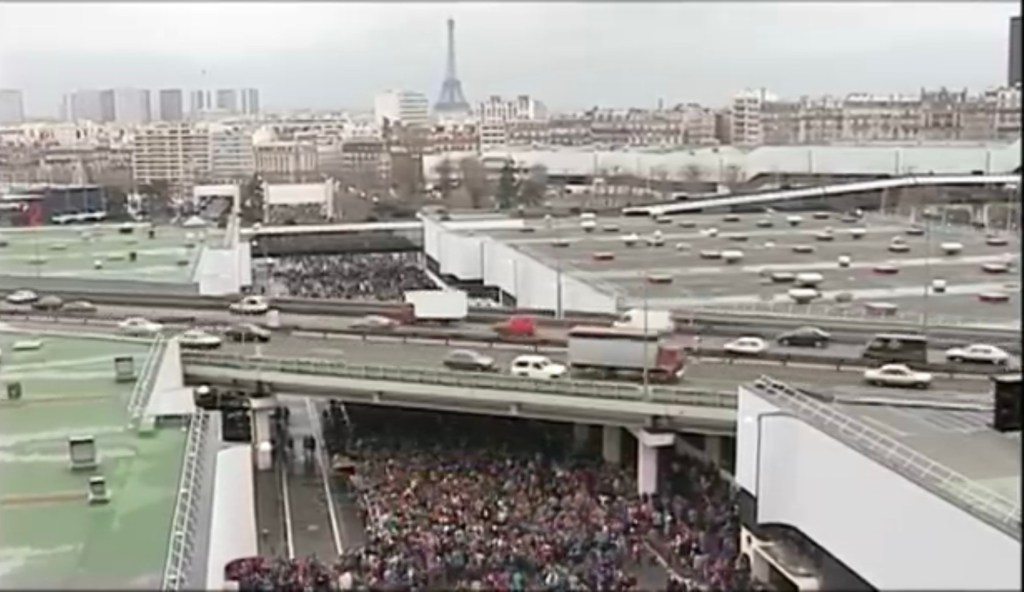
Thirty years ago (as of December 26, 2024 through January 1, 2025), I served at and attended my first European Meeting in Paris as “a permanent” (long-term volunteer) with the Brothers of Taizé. “100,000 Youths Invade Paris for Prayer” was the New York Times headline. “Spurred by an ideal that helped undermine communism in Eastern Europe, more than 100,000 young people have poured into Paris for a five-day prayer marathon.”
A number of volunteers had been working all year long helping to prepare the site (Porte de Versailles) and coordinating with local congregations and families to help receive the many young adult pilgrims. At these meetings, visitors live with local families or congregations to help deepen the relationships built and foster greater reconciliation and unity among the people of varied nations and denominations represented. The opening of the Iron Curtain after communism facilitated many coming from the East for the first time.
Just a couple of weeks before the meeting, a few thousand people still needed housing. I was invited to be with Brother Roger and the younger brothers for a song practice in their home when he spoke of the news. He shrugged his shoulders at this challenge and said in French, “God will provide.” It was among many of the lessons learned while I lived with them; challenging me to radically trust God. And of course, God did provide. As some friends from that time reminded when previously reminiscing, the provision was through the willing hearts and sweat of many – people risking the opening of their homes, and many volunteers and locals churches working long and hard to identify and prepare a welcome of young adults from across Europe primarily, but also the world. Hospitality remains a too often overlooked but important, ancient mark of the Church, but it can prove more difficult when at such a large scale.
At the event, I was assigned to work under Br. Ulrich (originally from Germany) distributing food. I helped oversee three of the large feeding stations which served lunch and dinner to these multitudes – more than 25k people at each area for each meal. (I was told that approximately 110,000 in total attended the event.) It was up early before dawn and in bed after midnight each day. My teams and I were outside in the elements for most of the day. I felt a bit like I was back in the Army, especially as among the food items many NATO surplus meals were served. Each food item had its place in multiple serving lines – bread, fruit, cheese, main course. As stockpiles grew smaller, they were replaced quickly. I became expert at driving a forklift. It wasn’t the Feeding of the 5,000, but it was miraculous in its own way. People cooperated well despite the use of varied languages. Volunteers and those served were for the most part patient and joyful.
The positive spirit of the event spread throughout our work, but it proved fatiguing nonetheless. With multiple languages and abilities, it could indeed be challenging. So, I along with other volunteers there from Taize’ tried to keep the pilgrims assigned to help us in brighter spirits. I taught many the poem Fuzzy Wuzzy was a Bear. Or as it rained, I shared the song, “It’s raining, it’s pouring, the old man is snoring,” along with other silly things – new to them, often as I said, people who knew little or no English. As young adults, many were keen to have fun but also learn or improve their English. Humor helped pass the time, and just as I survived many an Army field exercise with laughter, humor played well at the European Meeting too. I learned about 26 ways to say the word “cheese” as we served meals that week. Taizé is famous for its musical chants, and this ode to cheese almost became a chant on its own repeating the list in a sing-song voice: “cheese, fromage, formagio, queijo, queso, ost, ser, syr…”
True, I did get to see Paris a bit during the wonderful season of Christmas to include walking up the Eiffel Tower or visiting Notre Dame and the Champs de Lycee, but this trip was primarily about service. Yet, there was much joy and many new friendships made too. I became friends with a young woman from Germany who hated her “old fashioned” name, Cordelia. She liked American names, she said. So, I dubbed her Joe. I recall my friend, Petr, who spoke long and lovingly on a metro ride about the superior virtues of Czech chocolate, “the best chocolate in the world,” after tasting some French chocolate. Walking down the street one night with new friends from Lithuania and Poland, the Lithuanian man had to translate my English to the Polish woman in English because she could not understand my accent. She said it sounded like “waw waw waw.” I sounded a bit like Charlie Brown’s teacher if I comprehended correctly, but I understood them both! And what a splendid Feierabend, a phrase a German volunteer taught me for “quitting time,” as we watched New Year’s Eve fireworks explode over the Eiffel Tower from our warehouse rooftop as we closed up services. There are so many memories of wonderful people and conversations.
Unfortunately, the realities of the world were seen too. I noted a greatly increased police presence as the program neared completion. I learned later that a terrorist threat had come in, but – praise the Lord – nothing occurred and everyone had a safe time. If you know the more recent history of France, you know there have been significant, successful attacks since then. I’ve been told that since my time there, there’s a constant police presence on the hill of Taizé now because of increased threats. That saddens me even as I understand the need.
My week in Paris fell only a few weeks after my arrival in France, and it helped shape all that came after. It was a transformative experience for many including me. The managers of Porte de Versailles remarked with great amazement at how little trouble there had been, how friendly people were, and that the facilities and property were left cleaner than before we came. (Pilgrims had helped throughout including the cleanup.) Before the age of email, people left for home with new friends’ addresses and hope for the future. I learned more of what the Church could be, even amidst disagreements, and how peace could be made manifest most simply and beautifully between individuals.
Like most, I definitely left with deeper faith than I had come with, and I still ponder the miracles that are the European Meetings hosted by Taizé. This Paris encounter was the 17th annual meeting for young people organized by the community and was also at that time the biggest. As reported in the earlier cited article, “Organizers turned four austere halls at a Paris exhibition center into copies of the main church at Taizé, with saffron- colored drapes and icons glittering in the light of hundreds of candles.” Yet what makes the meeting is the people and the Holy Spirit, not the spaces.
Each year, the formal meeting is held in a different European city from December 28 through January 1. It’s not usually as big, but I suspect each one is profound in its own way. I’ve only been to one other meeting (Barcelona, 2000), but amidst the divisions of today’s world, I recognize the meetings’ sacredness. It’s import and the import of any efforts like it should not be underestimated. These meetings have the power to change your view of the world and your place in it.
As reported by the BBC, Brother Roger, the community’s founder, shared in Lisbon (2004) with the young people present, “If we are at present undertaking a pilgrimage of trust on earth with young people from every continent, it is because we are aware of how urgent peace is. We can contribute to peace to the extent that we try to respond to the following question by the life we live: Can I become a bearer of trust where I live? Am I ready to understand others better and better?”
As some governments expect war in the Pacific or a more expansive war in Europe within five years, such efforts nurturing trust in God and others, reconciliation, and peace remain beyond urgent. Perhaps beyond the importance of any treaty, I learned that peace must start with each one of us, today. We must seek to be reconciled with God and one another. For, Christ becomes more visibly present when we do. His joy and hope are experienced as real.
Yes, the importance of such a pilgrimage never ends. It continues through one’s life.
© 2025 The Rev. Louis Florio. All content not held under another’s copyright may not be used without permission of the author.


 2pennyblog