There were abundant signs of hope and new life this morning as Boomer and I took our walk – a beautiful sunrise, the repetitive knock of a woodpecker feeding in the nearby woods, blue birds galore swirling all around us, a mockingbird performing its twirling mating dance and song from a roof top, and cherry tree blooms bursting forth. As you go through your day, I hope you keep your eyes open for beauty and small signs of hope. They are sustaining because God is there – in the small stuff.
As bad or challenging as one’s life can seem at times, God’s always at work creating and blessing, among the too often overlooked, weak, forgotten or small. Thus, you are never alone or unloved, no matter how small and powerless you feel, for God’s at work in and through you and your circumstances, too.
Happy Spring, friends! Trust in the loving promises of God.
Isaiah 43:19 – “Behold, I am doing a new thing; now it springs forth, do you not perceive it?”
On March 7, 1992, I cried out to God through the simplest of heartfelt prayers. “God help me! I cannot take this anymore! Just show me the way out of this!” This lament wrapped in tears was uttered during a time of extreme desperation and loss while I walked my dog, Falstaff, late on a quiet, lonely night. It would be answered almost immediately in the most profound, miraculous way. I discovered an unexpected, long ignored door open wider than it ever had before.
As I shouted to heaven, I came to think of past joys that I had experienced through youth groups, college ministry, and faith-filled friendships. These relationships had planted seeds of faith, hope and love, when sometimes as a youth from a troubled home, I could feel unloved and unforgiveable. That’s pretty common thinking when you grow up in an alcoholic family, but for me, it was a realization still hidden amidst family secrets and a lack of understanding. It was all I knew, and I could not see more.
As a young adult facing new wounds as a police officer and after unhealthy relationships and choices, I had become cut off from the Church, and I had lost touch with many who loved me. Yet, as these former faces and spaces came to mind, I felt a strong urge to call someone from that past time. It was a risk. Would the reject me? Laugh at me? Think I was stupid? Yet, it seemed also something I could not resist any longer.
The first person I spoke to diagnosed my problems quickly and gently. I had meant to call a dear, old friend, but his wife answered. As I told her my story, she spoke of things hidden in my heart that I had not yet shared with anyone. Yet, she knew! Unbeknownst to me, she had experience working with people from alcoholic and codependent families, and through that conversation, she lovingly pointed me back to Jesus, his promises for me, and the Church. I got off the phone with a sense of hope I don’t think I ever experienced before.
No, it was not that I didn’t know God before that moment. I can see how my earlier baptism and faith (if immature faith) made a difference. I recognize in hindsight how God often saved me from myself and the snares of this world while planting seeds all along the way. I remain thankful for the many people who tried to love me on my way. Yet, for me, I chalk this up to a similar experience to that described by Jonathan Daniels in his own life. My faith was synthesized. I encountered and understood everything in a new way.
It was most certainly a conversion of sorts, or a radical deepening of relationship, as my heart tore open and God’s Spirit filled my emptiness. The Spirit’s light scattered my darkness, and a deep joy began. I had much still to learn, but I was on my way again – really Christ’s way. Despite the suffering and grief that I would still have to work through, and their were things that I would need to let go of, although it was only a beginning, I knew everything had changed. I had changed. I sensed that I was free.
As I dug into scripture, Gospel truths invited me to trust Christ in a new way and see promises fulfilled springing forth like the lilies of the field all around me. I began to understand that all things – my losses and sin included – would be used for my good (Romans 8). Although I had guilt, I no longer needed to be ashamed. I was forgiven, and I could do better in the future by God’s help. As Christ’s peace grew within me, people even began to see my life and daily attitude change. I became committed to never turning back. More importantly, I came to understand that Jesus would never let me go.
This experience – starting particularly that night in March – has taught me to trust God as I never had before, a trust that I am still learning about today. As humans, we can never know enough or trust enough. Doubts and struggles can remain…do remain to tempt us. Taking advantage of the disciplines of Lent (happening at the time), I was helped into this new start and ongoing sanctification of my life. The gifts of being Church with others has helped me stay on the path since then. So as I think of that time throughout the year, but especially on this date and during Lent, I give great thanks.
Perhaps someday, I will share more details about the experience. I have with some, but for now, I most often use the Psalmist’s words from Psalm 30, my annual “scripture of the day.” I had been ill, lost and blinded in the darkness of my own sin and the powers of this world – dead in a sense. I just had not recognized it. Once I more clearly saw the light, even as I might falter or stumble at times, I have not wanted to go back. I won’t go back. I trust the Lord will help me on my way, and the gift of his joy still growing in me will never die.
Psalm 30 follows (NRSVue translation):
1 I will extol you, O Lord, for you have drawn me up and did not let my foes rejoice over me. 2 O Lord my God, I cried to you for help, and you have healed me. 3 O Lord, you brought up my soul from Sheol, restored me to life from among those gone down to the Pit. 4 Sing praises to the Lord, O you his faithful ones, and give thanks to his holy name. 5 For his anger is but for a moment; his favor is for a lifetime. Weeping may linger for the night, but joy comes with the morning. 6 As for me, I said in my prosperity, “I shall never be moved.” 7 By your favor, O Lord, you had established me as a strong mountain; you hid your face; I was dismayed. 8 To you, O Lord, I cried, and to the Lord I made supplication: 9 “What profit is there in my death, if I go down to the Pit? Will the dust praise you? Will it tell of your faithfulness? 10 Hear, O Lord, and be gracious to me! O Lord, be my helper!” 11 You have turned my mourning into dancing; you have taken off my sackcloth and clothed me with joy, 12 so that my soul may praise you and not be silent. O Lord my God, I will give thanks to you forever.
Amen.
Taizé chant, English translation: Lord Jesus Christ, your light shines within us. Let not my doubts nor my darkness speak to me. Lord Jesus Christ, your light shines within us. Let my heart always welcome your love. (Inspired by the writings of St. Augustine of Hippo.)
The below sermon was offered at Christ Lutheran Church in Fredericksburg on February 23, 2025. It proved a difficult sermon for me to preach on several levels, but it was received extraordinarily well by people I know as left, right, and in between. I don’t post all my sermons, but based on that response and the many people that I have already spoken with because of my sermon at our two services, I suspect it might resonate with many others as well. So, here I post. I hope it somehow blesses you. If you prefer to listen to the sermon, a recording of our worship service follows the below text.
The woman that we meet today in Luke’s account proves a bit of a mystery, and everything about this meeting seems a bit unorthodox for that day. Here, we have an unescorted, unnamed woman of low rank and reputation barging into a high-ranking citizen’s home, a rabbi’s home, to approach a great religious teacher, Jesus. Then, she unceremoniously baths his feet in perfumed oils and her tears…drying them with her hair…kissing the feet that Peter would later say he was unfit to wash. How dare she presume such a scandalous interaction?
Well, she does so because she is thankful beyond words. Jesus commends her and identifies her actions as a sign of her gratitude for being forgiven of many sins…many sins…potentially very grave and serious sins…yet sins which are never explicitly named in Luke…any more than the woman herself.[i]
As I have shared before, when I was a teen and young adult, I often felt unlovable and unworthy. I imagined my sins were too great even for the power of the cross. So, as I came back into the Church, finally trusting in the forgiveness of all my sins, it proved easy for me to imagine myself in the place of that woman. Thinking of it, I can still experience a joy that can bring me to tears at times.
This realization of forgiveness changed the direction of my life, but I had much still to learn. You see, I could still play the part of the Pharisee. Sure, I finally trusted Jesus’ promises, and it had changed my life in remarkable ways…ways that others even began to notice. Yet, notwithstanding Paul’s encouragement to forgive one another, as God in Christ forgave us (Ephesians 4:32), it proved terribly hard to put forgiveness into practice.
I had been through a lot of traumatic experiences in my family of origin. I have experienced much trauma later through my police service. Such wounds of the world can last. The sin and unfairness we face can warp the way we look at ourselves and others. Despite my best intentions, I could judge people harshly. I could objectify them. I still could return hatred for the hate that I encountered on patrol, because I was prone to only see the sin and not the struggling, wounded person underneath…a person who through grace could be forgiven by Jesus too.
This past week on social media, I expressed to a friend that I was really concerned with the immediate cessation of all aid overseas. I suggested that perhaps some people who urgently needed help might suffer and die. A person unknown to me chimed in, “I chalk that up to [stuff] happens.” (Now, he used a different word than stuff, but we are in church.) Stuff happens? Well, my first response was, yes, stuff does happen to the just and the unjust alike just as Jesus taught (Matthew 5:45). That’s partly why God calls us to care for one another, because stuff happens.
I came across others who called government workers vermin and parasites. And yet although some government workers might fail in their duties, I look around here in this sanctuary, seeing current and past government workers that I know well, and I see people who are nothing of the kind. They are people who work hard and honorably. I don’t see vermin… I don’t see parasites, no matter any failings that might have…No matter any failings, I see Children of God, imperfect but loved siblings in Christ whom I must love…who I do love.
Then, I encountered others who thought anyone who supported the President at any level must be white trash and racist, ignorant or cruel…perhaps even a Nazi. And yet I see people here that I know have voted for president Trump…who are supportive of some of his policies…and I know them differently. They are nothing of the kind. These people are prone to generosity and love, who just want what they think is best for their country, and so they voted that way. No matter any failings, I see Children of God, imperfect but loved siblings in Christ whom I must love…who I do love.
You know…y’all are messed up! …We are all messed up in our own way. And yet I love you…and I hope that comes across…I love you. And I hope you can love the mess that is me. For, we are only human even at our best. We fail often. We can be selfish or shortsighted, and we always need one another’s love and forgiveness. We can also just be plain and blindly wrong at times.
Yet as tribal, sinful humans, we can be awful to one another…truly, abysmally awful. We can close off our hearts…And those we should love, we push away…We judge…We coldly condemn…We see evil, but we fail to see evil at work within our own hearts. And those who hate us, we might tend to hate all the more. This might surprise many in the world, but we can actually say we think someone or something is wrong without hating or objectifying. In fact, the Bible says for us to defeat evil with good (Romans 12:21), not with name calling or insulting memes.
Not doing good with our words and actions can have unintended, deadly consequences. For with such sin, as Luther teaches, we can become murderers killing peace, relationships, and in some cases, killing the spirit of others. This sin is like a disease that can spread from person to person. Perhaps this is partly why an eleven-year-old girl died by suicide in Texas after being taunted over her immigration status by other children. We can become murderers, Luther argues, through the simmering anger, hatred, and contempt hidden in our hearts, and others like our children might just pick up on that and go further than we ever intended.
So, Luther states passionately in his Large Catechism, that “Thou shall not murder” goes way beyond actually stabbing someone. “God wishes,” he writes, “to remove the root and source by which the heart is embittered against our neighbor…[urging us] to commit to [God] the wrong which we suffer. Thus, we shall [put up with] our enemies to rage and be angry, doing what they can, and we learn to calm our [own] wrath, and to have a patient, gentle heart, especially toward those who give us cause to be angry, that is, our enemies.”
Thus, this week, I thought of my own hard and terrible lesson about this sin that works within me. As a police officer in the 1980s and 1990s, I told you before that my heart had grown hard. I was on bicycle patrol one night with my partner and close friend, Willie, when a burglary of an athletic store occurred. The thieves had gone through the roof, stole a lot, and they had successfully gotten away. Hours later in the early morning…hours before any commuters had awoken…Willie and I saw a young male walking with an athletic bag. His clothes were covered in black pitch and tar, and the bag was stuffed to the brim with items. In the context of the recent theft, this seemed like reasonable suspicion for a stop.
Yet soon after we began to speak to him, the suspect got nervous and began to fight us with all his might. He was big. He was strong…very strong…and it took all we had to try to contain and restrain him. And during the fight, the suspect reached for my weapon and tried to wrench my weapon multiple times out of its holster violently. I was fighting with all my might to keep control of it. It came to my mind that if I lost this fight I might die. (I can remember this moment so unbelievably clearly.)
He broke away almost as quickly as he had begun to attack us, and a pursuit by foot and bicycle began. We had already called a Signal 13 which in Alexandra meant an officer was in dire trouble, and units were screaming their way toward us from all over the city. As we sought to cut off and corner the man, Willie and I were separated during the chase, and in the midst of the pursuit my radio went dead just as a large bang could be heard echoing through the darkness. (I remember that clearly too.) A friend told me later that with no one able to reach me, he feared that I had been shot and killed.
So, it was chaos. There was adrenaline pumping, and there was fear. And there was righteous anger, too. After all, he was a thief. He had fought the police. He had even fought for my gun likely to use it against us. This man was caught hiding in a dumpster. (That was the loud bang that people heard.) Yet to arrest him, a police K9 had to be deployed. And as the man fought more and more, the dog bit him more and more…He was damaged pretty badly…until he submitted.
So when I came up to the group, there he was, my enemy, on the pavement in cuffs, profusely bleeding and waiting for an ambulance. He was in pain…that’s for sure…but what I remember very clearly was looking at his eyes and seeing a lot of anger and hatred. (A look that I will not forget…a lot of hatred.) And as I surveyed him in all his suffering, I thought in the depths of my heart, “Good. I am glad he is hurt. He deserves to suffer. He deserves to die. He is trash.” I am ashamed to say it. It is ugly, but it is true. I would have been happy in that time of my anger if he had died.
Yet it was at that very moment, like a voice in my head, I heard the words, “How can you condemn him, after all that I have forgiven you? He could be with you in heaven someday.” Whether that voice was the Spirit of God, or my mind’s synapses had finally made a new but powerful connection between scripture and my life[ii]…I knew I was a murderer…a sinner…a person who must repent. And although I know that the use of force was necessary, and the arrest was ultimately for the community and even the man’s safety (stopping him from harming himself and others more), my heart immediately softened. I saw myself in him, and I began to have compassion for him…to love him…wanting him to have the love and forgiveness that I had myself received. Now, this did not mean that I regretted any consequences for him that he faced. (Consequences can be necessary or unavoidable.) Yet, I recognized that more was going on in that situation…something eternal.
Years later, I have no idea what became of this man, but I still pray for him when he comes to mind. And he often does whenever I struggle to forgive someone, or whenever I start to objectify someone, or whenever I call someone a jerk. I catch myself thinking of that moment and of him. This was a life-changing event for me. It is one still difficult to share, especially in the context of what happened in Virginia Beach this past week.[iii] But it is also difficult to share because I am ashamed of my sin. And yet at this time, where people are failing in love so often and to such a great extent, painting groups of people with a broad brushstrokes with little or no discernment of their unique differences or situations, I see so many strong parallels.
You likely have seen it or experienced it yourselves. We tend cut off from one another in judgement and hate…where an adult child might not wish to speak to a parent due to disagreements over hot button political issues of our day. And after arguments, longtime friendships have died. I thought it important to confess my sin once again…this time to you. To acknowledge that I struggle at times to resist becoming the Pharisee of this tale, the one saying, “Doesn’t Jesus know who these people are, these sinners?”
Why, yes…yes, he does. They are the people he has come to love and save. Jesus taught us in his Beatitudes, as children of the Kingdom of God, saved-sinners, that we must love our neighbor as ourselves, even our enemies. In fact, Jesus had just shared the Beatitudes in Luke’s account immediately before this dinner. As with the women in Luke, it might seem sometimes a mystery how others have found themselves struggling in sin or on another political side opposed to us. Yet the mystery of Jesus’ suffering, death, and resurrection for our sake, for all of us, points us only toward love for those whom we might otherwise judge without mercy or objectify.
My brothers and sisters, we live in a time of trouble. There are wars and rumors of wars – but not just overseas. These wars are happening in our communities, congregations, and within our families. People are turning against the ones they should love, forgive, and be gentle toward, and in their hearts, they start to think of others as trash…disposable. Our hearts have divided allegiances between Jesus’ way and the world’s way.
Yet, we who have been forgiven so much need not give in to the malevolent spirit of these times. By God’s help, whatever others say or do, we can be moved by the Holy Spirit toward patience, compassion, and forgiveness for those who might not deserve it in the eyes of the world. We can seek to protect and speak up for those who are maligned, objectified, or threatened even when those people are wrong. For we have been forgiven all our sin, because of what Christ suffered on the cross and nothing else…proving that no one is trash to Jesus, including you or me. Amen.
[i] Jane Schaberg, “Luke,” The Women’s Bible Commentary, ed. Carol A. Newsome and Sharon H. Ringe (SPCK, 1992), p. 285-286.
[ii] I know what I believe, that it was a theophany of sorts, but I will leave it up to you to decide for yourselves.
[iii] Two Virginia Beach Police officers died after being shot during a traffic stop the Friday night (February 21, 2025) before this sermon was delivered. The sermon was already written, but many police friends and I had been reflecting how such a loss impacted us. Losses from our own departments came back to haunt us. I lost four colleagues during my six years as an officer – two from being shot, one from suicide, and one from a unknown, preexisting heart condition after a foot pursuit. The death of any officer resonates through the police community plus their families in a way hard to describe. The grief sticks with us for the rest of our lives.
I am not sure of the original source of the above artwork. I found it at the Holy Smack blog. If you know the artist, please let me know. I’d like to give proper attribution.
If you would like to hear my sermon or watch our service, the video can be found below. The Gospel text and sermon begins at about the 17 minute mark.
These Ukrainian eggs were gifted to my in 1995 while volunteering in France.
The below is a reposting of an earlier blog (May 17, 2022) – an item originally for my congregation as the war against Ukraine’s independence and sovereignty escalated. As I recently posted on Facebook, no, Ukraine didn’t start the war no matter what the President or anyone else says. Way back as Russia hosted the Olympics in 2014, I wrote Russia would attack Ukraine, and they did. I wasn’t a prophet. It was clear, and I wasn’t alone in my prognosticating. Russia wanted to reestablish its empire, secure Black sea access, and acquire more economic benefits. Things escalated in 2022 with a total invasion marked by many war crimes and actions that international law calls genocide. Personally, I believe based on my experience and past training in the military, an unjust peace will only encourage Russia to push further for their advantage down the road. They have already been sabotaging industry and communications in the West. Ukraine’s wanting to be part of the EU or NATO isn’t an excuse for Russia’s invasion, kidnapping children, raping women, bombing noncombatants and hospitals, starving/torturing/killing prisoners, taking or destroying cultural heritage or using human shields. War crimes and crimes against humanity are never virtuous no matter the result or perceived benefits. Christians must denounce them. And if you think we can trust old Vlad as an ally, I would ask you to think again. “Woe to those who call evil good and good evil, who put darkness for light and light for darkness, who put bitter for sweet and sweet for bitter” (Isa . 5:20). And yet, with all I have said, the below reflection still proves true. With all the dark clouds of war, I remain hopeful – not in humanity, but in Christ’s promises. It haunts me that the man in my story might have become a casualty of the war, but I trust nothing separates us from the Love of God, not even death. The man was right to live out his faith as he did. Lord have mercy. +
When I served as a volunteer with the Ecumenical Community of Taizé in the mid-1990s, it was an exciting time. The Berlin Wall had just come down, and the Eastern Bloc nations had recently transitioned from tyranny toward freedom. With this change, Christianity in the east of Europe and into Russia experienced what one might call a little springtime – a true rebirth of faith.
So, almost naturally, many Eastern Europeans decided to visit the community on pilgrimage. Since the end of World War 2, it had become a yearly event for the hillside that was home to the monks of Taizé living in the province of Burgundy to flower with multicolored tents helping to welcome young Christians from across the denominations and continents. The village could swell from 200-plus people in the winter to several thousand each week from Easter through summer. Now, the brothers welcomed Eastern Europeans among their many guests.
Indeed, the ecumenically minded Pope John XXIII loved the community and what the Spirit was doing there so much, he once greeted Brother Roger, the Prior, shouting, “Ah, Taizé, that little springtime!” Spending a week with the monks (fifty percent Protestant and fifty percent Roman Catholic), helping with their daily work welcoming and supporting visitors and local ministries, participating in small group discussions over scripture guided by the brothers, and praying their beautiful chants in community three times a day was more than just busy work or a distraction. Over time, people often heard God’s call in their lives better, including the call to love one another in community.
Yet, how difficult it might prove to have Estonians, Ukrainians, and Russians arrive at the same time for a week’s visit among other guests. Bitterness still existed over mistreatment of the recently deceased Soviet imperial power. As much as the Estonians and Ukrainians were overjoyed and boisterous, the Russians appeared as a defeated people: quiet, suspicious, and tending to stay among themselves. (Certainly, religious, economic, and cultural differences with the Western Christians present didn’t help.)
Surprisingly, during the week, I witnessed firsthand what can happen when people get to know one another as individuals. In reflecting upon scripture and sharing one’s understanding, hopes and struggles, the Word went to work. Friendships formed. Attitudes changed. Forgiveness and grace were shared. It is no wonder the brothers had become known for their work – really Christ’s work – of reconciliation and trust. They had even worked secretly in support of Christian young people behind the Iron Curtain at times.
I remember one Ukrainian teacher who stood out from the crowd of pilgrims that week. He told me he made about $25 USD per month (about $50 today). He recalled the horrors and worry over Chernobyl. He remembered the fear that came with Soviet domination and its prescription against almost any signs of faith. And yet each day, I would see him rejoicing among new people, including Russian people. He gave away gifts – small flags of the now independent Ukraine as well as small sets of Ukrainian Easter Eggs. An ancient folk art, the eggs had moved in meaning as his country became Christian in the Middle Ages from representing the rebirth of the Earth each spring to the rebirth of humanity through Christ’s resurrection.
I still treasure that man’s joy, openness, and generosity. As the war in Ukraine continues, as political divisions and violence challenge us in the USA, as even within our church families we might encounter people tending to judge and withdraw rather than offer grace, I stare at his eggs gifted to me and many others that week now long ago. Through his past witness, hope comes back to me today. Without a doubt, I believe springtime will come again. Jesus will come again. Signs of spring can be found everywhere if we dare look through the eyes of faith and seek to love one another – even our enemies.
Originally published in The Hub, a weekly email of Christ Lutheran Church, May 17, 2022 edition. Christ Lutheran Church is located in Fredericksburg, Virginia.
JD VANCE: There is a Christian concept that you love your family and then you love your neighbor, and then you love your community, and then you love your fellow citizens, and then after that, prioritize the rest of the world. A lot of the far left has completely inverted that… (January 29,, 2025 in a Fox News interview)
There has been a lot of angry posts created since the Vice President shared the above during an interview on Fox News. If only loving was so organized and clear cut! Sadly, love in a fallen world never is. Loving others is most often difficult, confusing, and often messy. It is easy to love too much as well as not love enough. We find that God is love, but we are not God. All of us fail at loving all the time – sometimes out of selfishness; sometimes out of ignorance.
Yes, things are not as clear and linear as the Vice President suggests. True, I’ve seen some Evangelicals and Roman Catholics write about circles of love reflecting varied intimacy or immediacy – spouse, family, community, nation, world. And certainly, the original Protestant Reformers tried to reaffirm marriage and family as not just a necessary passion but a sacred calling equal to others (particularly celibate vocations) glorifying God. Indeed, Jesus called his disciples a family. It was a fictive family, but with more import eternally. When Jesus spoke about loving one another (John 13:34), it was a command specifically for and amidst disciples. They were to love one another as his body. Yet, this was not selfish. He also called them to go throughout all the earth making disciples of all peoples (Matthew 28:19) – to invite them to be part of the body. Our Christian ethic of love might allow for intimacy, but it is never meant to be exclusive. Instead, it is expansive and generous.
A walk through scripture helps us see that our Christian ethics are as complicated as our lives. Take for example, Matthew 10:37. In it, we hear Jesus tell us to not put father or mother (really anyone) before him. For his mission, people are sometimes called to leave family behind. “And everyone who has left houses or brothers or sisters or father or mother or wife or children or fields for my sake will receive a hundred times as much and will inherit eternal life,” says Jesus (Matt 19:29). His first Apostles and disciples did this. But we also learn in 1 Timothy 5:8, that we might have another slightly different call as the Church develops. We are told that we are to provide and care for family. “And whoever does not provide for relatives, and especially for family members, has denied the faith and is worse than an unbeliever.”
Then, you have Matthew 22:36-40 where we are told to love God but also love our neighbor as ourselves. In Deuteronomy, this twin command was the heart of all the laws that followed, and Jesus agreed. This command pushes us outside the tribal or genetic bonds of family. So when asked who is our neighbor, Jesus uses the Parable of the Good Samaritan found in Luke 10:25-37 to teach us that love and compassion is for anyone in need, even our enemies.
Here’s another tension. When Jesus came into the world, the Kingdom of God was at hand. He was racing to his cross and resurrection. Time was short. So, in Matthew 8:21-22, Jesus tells someone who wants to follow him in mission that his call is more important and immediate than burying the dead – in this case, the man’s father. Yet then in Mark 5:19, Jesus rejects someone’s hope to go with him. “Go home to your own people and tell them how much the Lord has done for you, and how he has had mercy on you.” The person is sent home to do the will of God amidst family and folk! For him at that time, that was the better way to love.
My friends, I think it is a mistake to force things into an either/or dichotomy. Perhaps like St. Paul at his conversion, it is better to ask, “Jesus what would you have me do?” (Acts 9:6). Sometimes we are called to sacrifice all. Sometimes not. Sometimes we need to care for family, community, or nation as part of our primary vocation. Others might have vocations that are outward facing such as missionaries. Such people might be called to go beyond generosity to family or kinship groups to love the stranger. Dependent upon our call from God, we might need to leave family and property behind, or offer our lives as martyrs, or yes, even as a Protestant, live a single life to fulfill God’s call for us. Or, we might need to be a sign of God’s love in a family or community. Still, those at home might be asked to support missions and outreach to others. Vocations vary as much as situations, but we share all one mission to the world.
Yes, the Vice President’s interpretation is too limited and rigid, but so can be the interpretation of those who argue for more generous giving. We have to watch out for enabling behaviors. At times, we must discern who needs our help most like a medical professional in a triage unit. Our context, abilities, resources, and most importantly our call from God can impact what we should do.
Take for a recent popular example, Dietrich Bonhoeffer. He believed after World War I that Christians were called to pacifism. Still, in the face of Nazi evil, he decided a greater evil than committing violence was to do nothing to save Jews from genocide. Nation did not come first. Ideology or theology was not preeminent. Love – even if imperfect human love – did. He erred on the side of mercy.
Yet again, no matter who we are or what our vocation is, there is no denying that Jesus calls us toward one another in the Church, love of family, and even love of “other” to include our enemy. We are not called to tribalism, selfishness, or fear. Sometimes this means sacrifice. “When Christ calls a man, he bids him come to die.” Dietrich Bonhoeffer wrote in The Cost of Discipleship. This can mean a person/family/nation might need to sacrifice if not suffer in order to love others as God calls. For is not that the way Jesus loved us – dying on a cross?
Maybe this is partly why St. Augustine defined virtue as “rightly ordered love” in his work City of God. Augustine believed that a just and holy life requires loving things in the right order. God is first. Then others. Some suggest loving family before others (as you are called as parent or child) might mean caring for “self” first. For example, a pastor might take a leave of call to care for a dying parent or child. Or maybe leave must be taken to fight cancer. There can be valid reasons to prioritize your love for the one’s entrusted to your care by God; not out of selfishness but need.
Similarly, Thomas Aquinas argued for an order of love. Aquinas argues, “One’s obligation to love a person is proportionate to the gravity of the sin one commits in acting against this love.” In his argument, we’re to love with greater devotion those who have been entrusted to our care. Fulfilling our vocation was a key understanding for him.
Yet, I am arguing that the Christian ethic of love is not one size fits all. Your call and the circumstances matter. Therefore, Augustine prays, “Love ever burning, never quenched! O Charity, my God, set me on fire with your love! You command me to be continent. Give me the grace to do as you command, and command me to do what you will!” (Confessions, X.29). Augustine wrote that the earnest student “exercises himself” to find in Scripture that: 1) God is to be loved for his own sake, 2) our neighbor is to be loved for God’s sake, and 3) that God is to be loved above all.
The kicker (very difficult and somewhat surprising) which must be reiterated comes from Matthew 5:43-48, “You have heard that it was said, ‘Love your neighbor and hate your enemy.’ But I tell you, love your enemies and pray for those who persecute you, that you may be children of your Father in heaven. He causes his sun to rise on the evil and the good and sends rain on the righteous and the unrighteous. If you love those who love you, what reward will you get? Are not even the tax collectors doing that? And if you greet only your own people, what are you doing more than others? Do not even pagans do that? Be perfect, therefore, as your heavenly Father is perfect.” We are called to love others who don’t necessarily deserve our love from a human, utilitarian perspective. Certainly, again, this does not mean we become enablers of addiction or other bad behaviors. Sometimes the consequences can be loving as we protect someone from harming themselves or others more. Yet, the command to love our enemy challenges us to consider how we respond to all those whom prove difficult to love.
Then, of course, Christian counselors often remind us that self-care is not always selfish. Even Jesus took care of his needs for solitude, prayer, or fellowship at times. Yet, when the time was right, he offered himself completely up for our sake. Similarly, self-care is sometimes necessary, not a sin, for us. Remember, the maxim is to love others AS yourself, not better than yourself. This reminds me of Carl Jung: “But what if I should discover that the least among them all, the poorest of all beggars, the most impudent of all offenders, yea the very fiend himself – that these are within me, and that I myself stand in need of my own kindness, that I myself am the enemy who must be loved – what then?” If we are caring for ourselves so that we can fulfill our call from God better and value the gift we have been given (our body for example), that is not selfish. As humans, especially as caregivers, self-care is critical.
Sometimes to love others better, you need to love yourself – loving oneself in an unselfish way, recognizing your human needs or limitations – so that you can glorify the Lord all the more in how you love others. At other times, love calls us to die to self. There can be a lot of in between, shadowy times. (God often is found speaking from a cloud, right?) It is hard to see what to do. In welcoming the refugee, facing criminal justice issues, caring for the sick and elderly, we can’t just say “me first” or “America first.” It is not that easy. We are going to have to wrestle over our actions and intentionally discern. The utilitarian answer will not always be the best. We have to open our hearts to God and others, then ask the Spirit to guide us. For without God’s help, without continually questioning and testing our motives and actions, we will surely love less than we ought or are able. Common sense can lead us into sin.
Love is complicated. Let’s strive to love generously and well by God’s help. And if we aren’t sure? Perhaps it is best to err on the side of mercy, for God is merciful toward us. Our God who is love is the God of all people, calling all people, and those outside the Church and our kinship groups are entrusted to our care. As God’s love reaches out, we are invited to be the divine’s hands, feet, and voice. For Christ followers, God’s love is meant to transcend the social and political boundaries of this world.
One day when Jesus returns, we will be one. That’s been God’s will all along.
Mosaic in El Moallaqah Coptic Orthodox Church: The Flight to Egypt, Cairo, Egypt by Unknown. c. 9th Century AD.
Whoever said the Middle Ages weren’t fun? I bring you glad tidings and happy greetings on this Feast of the Ass.
Yes, according to a blog post by Fr. John Zuhlsdorf: “The feast which became popular in France, could have stemmed from the so-called ‘feast of fools.’ It may tendrils into biblical donkeys, or the integration of the ass into the nativity narrative. It could have been in part inspired by a sermon of pseudo-Augustine. The day included the tradition of a parading a couple of kids (not goats) on an ass (not a Jesuit) right into the church, next to the pulpit during the sermon. The congregation would respond with loud ‘hee haws.’”[i]
This sounds a bit like an early version of Vacation Bible School or maybe fiction, but nope, this liturgical feast was the real deal. It was meant to commemorate the Holy Family’s flight into Egypt. So, on and near the day appointed, congregations would hear donkey-related stories in the Bible including the escape into Egypt (Matthew 2:13–23). Problematically, scripture never explicitly mentions a donkey in the narrative of Christ’s birth or the flight, but that’s firmly in the cultural memory. Why?
Well, donkeys were a symbol of humility and peace while horses were symbols of earthly power and war. Also, through many prophetic texts speaking to ancient Israel, we learn that God did not desire the Holy People of Israel to trust in horses and chariots, as Egypt did, but in the Lord (i.e. Psalm 20:7). Instead, they commonly utilized donkeys also known as asses. Donkeys are also one of the earliest and most frequently mentioned animals in the Bible through multiple texts. In the book of Job, the donkey is one of the fourteen animals that the Lord uses to illustrate God’s own power and creativity to Job (Job 39). Then, Balaam’s donkey actually speaks (Numbers 22:23). The only other animal ever to speak is the serpent of Genesis. Indeed, many verses urge people to be good to their beasts including their donkeys (i.e. Exodus 20:10, Deuteronomy 5:14, Proverbs 12:10).
Yet perhaps most importantly, the donkey was connected to the Messiah as a sign: “Rejoice greatly, O daughter of Zion; shout, O daughter of Jerusalem: behold, thy King cometh unto thee: he is just, and having salvation; lowly, and riding upon an ass, and upon a colt the foal of an ass” (Zechariah 9:9). Jesus embodies this as he rode into Jerusalem for his final Passover. If Jesus ends his life with a ride on a donkey, it does not take a great deal of creativity to imagine Jesus (through his expectant mother, Mary) rode one as he entered into our world incarnate. (It is likely one was not only available but used.)
So, if anyone ever says you are acting like an ass, or you feel like one, don’t be too quick to take offense or lose heart. Think of the humble donkey and give God thanks. For all their drawbacks, the ass remains a valuable animal, born with a purpose, and dearly loved by God. If God can use an ass, God can surely use you or me. The Bible tells us so.
Yes, this feast might no longer be on the liturgical calendar, but blessed Festum Asinorum, Feast of the Ass Day, to one and all!
Epilogue:
Hear is a song from Italian history with the feast to help brighten your celebration.[ii] As the feast was seemingly associated with the Feast of Fools, it is quite jolly unlike other liturgical music of the day. An Italian troubadour version of ‘Orientis Partibus’ with braying chorus.[iii]
Translation:
From the country of the East, Came this strong and handsome beast: This able ass, beyond compare, Heavy loads and packs to bear.
Chorus: Now, seignor ass, a noble bray, Thy beauteous mouth at large display; Abundant food our hay-lofts yield, And oats abundant load the field. Hee-haw! He-haw! He-haw!
True it is, his pace is slow, Till he feels the quickening blow; Till he feel the urging goad, On his hinder part bestowed.
Chorus: Now, seignor ass, &c.
He was born on Shechem’s hill; In Reuben’s vales he fed his fill; He drank of Jordan’s sacred stream, And gambolled in Bethlehem.
Chorus: Now, seignor ass, &c.
See that broad majestic ear! Born he is the yoke to wear: All his fellows he surpasses! He’s the very lord of asses!
Chorus: Now, seignor ass, &c.
In leaping he excels the fawn, The deer, the colts upon the lawn; Less swift the dromedaries ran, Boasted of in Midian.
Chorus: Now, seignor ass, &c.
Gold from Araby the blest, Seba myrrh, of myrrh the best, To the church this ass did bring; We his sturdy labours sing.
Chorus: Now, seignor ass, &c.
While he draws the loaded wain, Or many a pack, he don’t complain. With his jaws, a noble pair, He doth craunch his homely fare.
Chorus: Now, seignor ass, &c.
The bearded barley and its stem, And thistles, yield his fill of them: He assists to separate, When it ‘s threshed, the chaff from wheat.
Chorus: Now, seignor ass, &c.
With your belly full of grain, Bray, most honoured ass, Amen! Bray out loudly, bray again, Never mind the old Amen; Without ceasing, bray again, Amen! Amen! Amen! Amen! Hee-haw! He-haw! He-haw!’[iv]
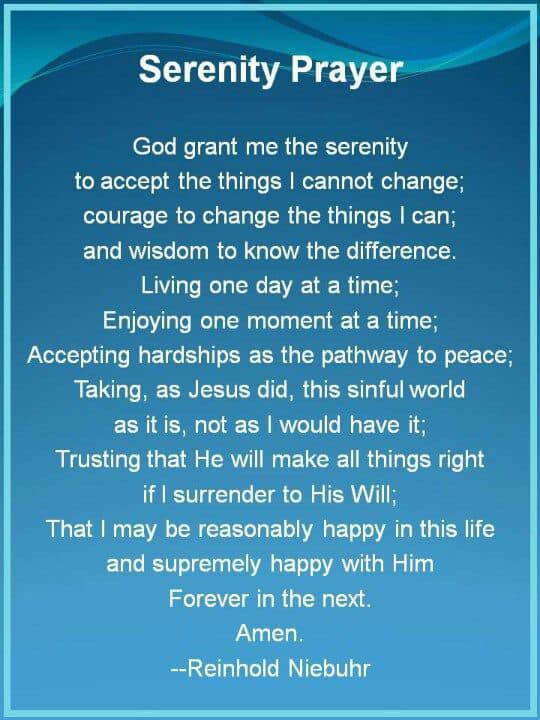
Who knew the well-known and respected Serenity Prayer could cause something other than peace – doubts, anxiousness, and many more questions? After sharing it on our Facebook page post-election, I have had many great and fruitful discussions about the theology behind it. On its face it sounds crazy to accept the world as it is. Yet, that is not really all that it says.
As I wrote someone recently, the Serenity Prayer was written as the US was battered by the Great Depression and the Nazis took over in Germany. Things looked grim. It began as an observation by Reinhold Niebuhr in 1932 as Roosevelt was elected: “The victorious man in the day of crisis is the man who has the serenity to accept what he cannot help and the courage to change what he must.”
The prayer challenges us to discern our unique individual call, as well as a call in community. We are to take stock of what we really can influence in the world, act accordingly in faith, and with any things that prove out of our hands, we are asked to trust that they remain in God’s. Many studies have shown that “letting go” can help us physically, emotionally, and mentally function better. Based on the teachings of Jesus, I always say that it benefits us spiritually too. Consider John 14:1 for one example: “Do not let your hearts be troubled. You believe in God; believe also in me.”
Lutherans also believe in a Theology of the Cross – the cross is seen as the best source of knowledge concerning who God is and how God saves. It also encourages us to take up our cross and follow Jesus. As the Lutheran theologian, pastor, and martyr, Dietrich Bonhoeffer wrote, “When Christ calls a man, he bids him come and die.” None of our recent posts are about “just getting along” or stopping our work for a more just world. We know the world is a mess. Loving others is difficult. In the face of reality, these prayers and teachings challenge us to trust and love God at all times, and love one another, even our enemies.
How we respond to perceived injustices might change when we trust God is always at work for our welfare. This theological lens invites us to find Christ’s peace and hold on to it, even if facing the worst evil. Our suffering and sacrifice can become sacred, not by our own power, but because of God’s promise that all things work for the good of those who love God (Romans 8). God will be with us in our suffering, but God also somehow will use it to bless us and the world. We are asked by Jesus not to lose hope when it seems like the world is ending. He taught that these things must happen (Matthew 24:6) before his Kingdom, a new heaven and earth, fully comes.
We can look toward our theological forbearers. They sometimes died for their faith. Some still do. In the US, there has been worst times of trouble – the Civil War being arguably the worst and most costly. (It took Spotsylvania County one hundred years to return to its pre-war census.) Working within the ebb and flow of history, we are called to pray and act, but always trust. God wills more for us. As Lutheran theologian Ernst Troeltsch writes, “God, therefore is always living, always creating. He is truly manifested not in being but in becoming; not in nature, but in history” [Troeltsh, E. (1991) The Christian Faith, p.120. Minneapolis: Fortress Press]. God is at work in and through us as we live in a Fallen World. God may seem like a hidden God, as Luther often called God, but God is awake and at work. It is not all up to us. God’s will will be done.
These beliefs, this kind of trust, often helps us extend our focus to see more possibilities of what we can do in hard or conflicted times – acting in love rather than just fear or anger. Acting in love does not mean there are never any consequences. For the sake of the weak, the vulnerable, really all our neighbors, sometimes some are called to respond more directly and forcefully than others. Yet as a former soldier and police officer, now a police chaplain, I see that violence is never a good thing – never without cost – even when violence becomes necessary. (Luther in discussing his Two Kingdoms theology or in his essay “Whether Soldiers Too, Can Be Saved?” speaks of these kinds of things.) We each have parts to play in making a more just world, but we each must discern how Christ is calling us with the gifts we have been given.
Still in Christ’s teachings, the call to be open to reconciliation, to even nurture it, is ever present. For me, my understanding of this broadened when I came to know and eventually live with Brother Roger of Taizé in France. Under the Vichy government, he helped Jews escape. He ultimately narrowly escaped the Gestapo’s arrest; going to Switzerland until the war was over. After the war, he came back. He cared for German soldiers (former POWs) as they made their way home. In the region, he was among some of the most anti-church people in France. Some Communists slaughtered a pig on the church steps in the nearby village each Good Friday to show their disdain for Jesus and his Church. Yet, he with other friends helped form a coop for the community anyway, and they cared for the sick and hungry. His authenticity, patience and love changed hearts and minds over time with God’s help. And I believe his witness eventually changed my way of seeing and being as well.
When we as Christians say, “all is well,” or “love your enemy,” we are ultimately affirming that Jesus is Lord. He lives, and that matters. In fact, it changes everything, so it must change how we respond to the world. Jesus promises that his Kingdom will come, but he is here with us now. It has broken into our world, but it is not in its fullness yet. We are already victorious even when we might suffer (1 Corinthians 15:57). This truth can free and empower us to respond to our Fallen world and our neighbors in surprising ways.
For, God is not done with us or the world yet. Yes, the poor will always be with us (Mark 14:7, John 12:8, Matthew 26:11), but we seek to feed and house them as Jesus also taught us. As we face those in opposition to us, we seek to bless those who curse us and pray for those who mistrust us (Luke 6:27-36). In the face of worldly reality, we seek to live in abundant, generous, and merciful faith, hope, and love. All is well, but all is not perfect…yet. As the body of Christ, we have work to do, but we trust most importantly that God is at work, too. We need not be afraid.
Parts of this reflection originally were published in the November 18, 2024 weekly newsletter, the Hub, of Christ Lutheran Church, Fredericksburg, VA as well as sections in a Facebook post that I shared.
So many people – both “blue” and “red” (plus other political colors as well) – have been anxious this election cycle. Unfortunately, anxiety can turn into anger rather quickly. Now, hear me clearly, anger is not a sin according to scripture, but we as humans can too swiftly ride the tide of our emotions into the vortex of sin when we feel insecure, unmoored from what usually grounds us. As animals, fight or flight responses can take over. Biologically, we focus on what we think a threat. This is meant to be a safety skill built into us, but it can become our downfall. We can miss the bigger picture. We might abuse others who don’t deserve such treatment. We can begin to wear blinders so that we miss out on facts or observations that might help us avoid loss of relationships or our sanity. We can hurt ourselves and others in ways we never imagined possible. Anticipatory stress can prove a real trap hurting our overall health.
When I was a child growing up in a family with many challenges, I learned to be vigilant for signs of potential trouble whenever I entered my home. As a soldier in the National Guard, I was trained to watch for ambushes and danger. When a finally became a police officer, I found that I sometimes had a hard time “turning off” after my shift. It was a violent time in the Metro-DC area. I eventually learned how to keep this hypervigilance in check after some help from others. Yet, I discovered my greatest gift to combat such issues proved to be faith. Faith is more than just an intellectual trust in the Lord. It is at its best a deep and growing trust that our gracious God loves us and will never abandon us – even as we face death. This gift of faith certainly helped me lower any anxiety or anger which might pop up. I became calmer and less reactive. Instead, I saw more options and possibilities in a fallen world. I grew in empathy, compassion, and patience. I learned better how to love myself and others in stressful situations, and people began to notice.
Why this dramatic change? I started to see beyond the problems facing me in the world. I think it was because the Holy Spirit longs to help us learn that (as others taught me) the God behind us is bigger than any problems facing us. Indeed as Brother Roger of Taizé used to teach, God is already in our future waiting for us – no matter how dark it might appear – ready to embrace us. We need not be afraid (as scripture so often reminds us). Everything – even our own sin – can be used by God to bless us (Romans 8:28). We can act instead of react. We can choose love. This is because God promises to love us…always.
Yet sometimes we can feel like one of the characters in Animal House, a movie I saw as a teen. For years, if anyone were to say, “Remain calm. All is well,” I thought of the ROTC cadet, played by Kevin Bacon, standing in the midst of a parade crowd running amok. Things did not seem well at all. It is not easy when the world seems in chaos to hold on to this “hope as an anchor for the soul” (Hebrews 6:19). others might even think that we are foolish. Ultimately, we need the Spirit’s help to know and trust that all is well. This assurance can be found through prayer, our study of scripture, as well as beloved community. We need to risk believing as Luther taught, “Jesus does not lie.” Then, the Spirit will do its work. As Paul points out, when we feel tempted to sin or give up, when all seems lost, it is ultimately God who will give us a way out (1 Corinthians 10:13).
At this time of cultural shift and uncertainty, when the United States population seems so at odds, it is important that we not play by the world’s rules. I shared this with my congregation on social media:
For those celebrating the election, remember not to gloat (Prov. 24:17) and to seek to love those you think in opposition to you (Matthew 5:44). For those grieving, remember we are never alone on good days or bad, or when the world seems confusing or disappoints (Matthew 28:20). As believers, all of us have work to do together (Micah 6:8). More importantly, God is at work through us and all that happens in the world (Jeremiah 29:11). We can choose to live in hope because of God’s love for us (1 Peter 1:3). As Church, we are called to be ambassadors for Christ and agents of reconciliation in our conversations and social media posts (2 Corinthians 5:16-21). We are called to love one another as Jesus loved us first (1John 4:19). “Be kind to one another, tenderhearted, forgiving one another, as God in Christ forgave you” (Ephesians 4:32). Especially as Lutherans, we know that “though the earth give way and the mountains fall into the heart of the sea, though its waters roar and foam and the mountains quake with their surging…The Lord Almighty is with us; the God of Jacob is our fortress” (Psalm 46). Jesus lives and reigns forever (Hebrews 7:24-25), and together, we are called to be his witnesses to the ends of the Earth (Acts 1:7-8). Life together in any community can prove difficult, but with God, all things are possible (Matthew 19:26). All is well.
I might still remember the humor of Kevin Bacon being overrun, but I trust in the observation of Julian of Norwich that all is well. As she reflected long ago:
All shall be well, and all shall be well, and all manner of things shall be well…For there is a Force of love moving through the universe that holds us fast and will never let us go.
In our fallen world, there might be negative consequences at any time. We will suffer at times or potentially face abuse or persecution. It might prove time to take up our cross or fight the good fight for justice. Real life is never easy. We are not asked to fake our happiness, just not get stuck in or sin in our feelings. For, we have a real God who is with us and loves us.
Weinachts gurke, Christbaumschmuck der Firma Inge-Glas, Neustadt bei Coburg, Deutschland, CC BY-SA 3.0 via Wikimedia Commons.
This Christmas sermon inspired by the popular pickle ornament was preached on Luke 2:1-20 at Christ Lutheran Church (Fredericksburg, VA) on Christmas Eve, December 24, 2023. You can also find a recording of this post at my 2 Penny Blog Podcast.
Sadly, there is no children’s message tonight, but we are all Children of God, and this is Christmas Eve, so I have something to show you. [Displaying pickle Christmas ornament.] Can anyone tell me what this is? —- That’s right, it is a pickle ornament, but in this case, it has a pickle flavored gummy candy inside. (Yum, right?) As I shopped for gifts this year, both in Walmart and Target, I discovered versions of this tasty “gift” inspired by the popular Christmas ornament – the pickle.
Now, there are several different origin stories attributed to the tradition of hanging a pickle on one’s tree, including one claiming an origination in Germany. This has been largely discounted by those who study such things, and it is now thought to be a German-American tradition created in the late 19th century – perhaps during the Civil War – right here in the US. Yet however it started, the idea remains that on Christmas morning, the first person to find the pickle on the tree will receive an extra present from Santa Claus or (they say) you will have a year of good fortune ahead.
In any case, seeing this pickle candy ornament got me thinking. It has a sour and sweet taste. Some will like it. For others, it might be hard to swallow. And in that tension – stick with me now – we might just have a perfect allegory for Christmas. You see, the story of Christmas is not really one of just lights, triumphant song, and gifts. We celebrate something much more complex. The story of Jesus is both sweet and sour, joyous and sad, easy for some to hold on to and hard for others to dare hope in.
When we look closely at the story itself, when we ponder it perhaps as Mary and Joseph truly experienced it, we witness a couple who had to accept the impossible – a virgin birth. They did so at the risk of accusations of sins such as adultery. This could make Joseph appear the cuckolded fiancé to his peers or one who took advantage of poor, young Mary, thus he would dishonored, a pariah, in an honor-based society. Worse, it perhaps could have resulted in Mary’s stoning for adultery – for a relationship outside of marriage was deemed a reason for death. Who among their family, friends and neighbors would believe such a crazy story as a virgin birth? Despite the risks, they accepted their fate. They trusted God, and therefore, both Mary and Joseph said yes to God.
Then, they faced another challenge – that of the census and its associated taxes. They had to travel to Joseph’s ancestral, tribal home of Bethlehem. They embarked on what was likely a four to seven day journey over about 90-miles. Remember, there were no paved roads, cars, trains, planes, nor were there rest-stops along the way.[i] Lyft and Uber were not options. They traveled on rocky, dirty, dusty paths. They traveled through a land under military occupation by the Romans, who could sometimes randomly be bullies to the native peoples. Not only that, Mary and Joseph also faced the very common risk of rebels and robbers harassing them as they traveled as well.
And let us not forget that Mary traveled even as Jesus’ birth was imminent. She was in her third trimester. If Joseph cared about Mary and the baby, the pace would have likely been slower with many stops for the bathroom, rest, and food. So, some specuilate that the trip might have taken a week traveling at the less than the rocket pace of about 2-mph.[ii] Despite facing many challenges in trusting in the great promise of Jesus, if not experiencing very real fear at the political and religious threats around them, both Mary and Joseph continued to say yes to God. They stepped out bravely in faith, for God had promised to be with them on their journey.
And once they arrived, more challenges appeared. There was no room at the inn. This small, backwater village of Bethlehem did not seem to have the capacity for all those who returned to be counted. They found themselves instead in a stable. Archeology and historical studies in the area indicate these stables were often more like caves. They offered the smallest amount of protection and comfort. Yes, the newborn king was not yet widely celebrated. He was laid somewhat quietly in a manger…a trough for animals, surrounded by noisy animals and filth. No, there were no robes or crowns for Jesus. Luke reports he was wrapped in bands or strips of cloth – essentially “wrapping” Jesus tightly…swaddling him…in what meager things they had.
There’s a common and ancient Christian belief that being born in this cave and wearing his swaddling clothes foreshadow Jesus’ future burial in a stone tomb. As cute as Jesus must have been, as warm as the loved shared between parents and child could ever be, we should not forget why our Messiah came. This innocent baby, born without sin, would be hated by many, find no roof to call his home for the last years of his life, and he would ultimately suffer and die for our sake. (Thus, you will often see Eastern Orthodox icons and ancient European art shockingly portraying Jesus as an infant wrapped tightly within his burial cloth.)
Even as Jesus started his life among us, scripture suggests he and his family were poor. They had no finery. And yet, again, Mary and Joseph made do with what they had. They trusted God to supply their every need, and they shared what they had including all their love with Jesus. Yes, they trusted God with their lives, and despite the many threats and challenges, they sought to live in expectation and hope. (Of course, this doesn’t mean they never cried, or suffered, or felt fear. They were human after all, but the power of such times did not control them. They knew they were in God’s loving hands, and that truth helped them to act free of fear to do the right thing – as that same truth might do for us.)
So, we see that the story of the nativity is in a great part one of threat, struggle, poverty, and suffering…There’s a sourness to it. Our modern sensibilities might not like it, but that is the way it was. That’s the way our lives can be today in part. We might not want to think about the hard things that come with life. We probably prefer the happy, but Jesus came to share our lives fully – even the bad parts, including death – even as he remained our God. And Mary and Joseph? This was a couple who likely experienced much joy, but they also knew what it meant to be a human in a very fallen and unfair world. They, my friends, as great as they were, were much like us.
However, before we lose hope, remember that there is much sweetness in this story too. There proves much reason for joy. For Jesus came as Immanuel, God with us. Jesus has come to ultimately save us from harm and every evil – even our own struggle with sin. And we can also see that Mary and Joseph’s own love and faith sustained them – much as such faithful, loving relationships with others can help empower and sustain us. Mary and Joseph proved stronger due to these social bonds, and so can we.
And we learn as the Gospel unfolds that many others who are oppressed, forgotten, alone, sick or suffering – perhaps again people like us – came to see Jesus as he truly is over time…see him as Mary and Joseph did as the Holy Spirit opens eyes, minds, and hearts. Jesus is not you average baby. He is the Messiah, our Savior, our Redeemer, our way to forgiveness, joy, and everlasting life…He’s meant to be our everything. And because of Jesus’ call for us to be one, these newly enlightened ones sought to be one no matter what they have done or failed to do, and they invited others to be in relationship with Jesus – as we should strive to do.
If that wasn’t enough, the angels remind us of the eternal import of this baby’s birth as they sing, “Glory to God in the highest heaven, and on earth peace to those on whom his favor rests.” We can’t trust our feelings. We cannot look to our situation or the world for a final clue. No, God loves us so much, God comes to us…as one of the most vulnerable among us…a baby…and angels (God’s messengers) point the way. Our Father in Heaven declares that it is upon us that his favor rests…us! Can you believe it? God in Jesus has come to us and for us. Wow!
The world can seem so daunting at times, perhaps even against us, but it is at Martin Luther observed so long ago now, “The incarnation is proof that God is not against us.” No, as bad as life can get, God always loves us and promises a future filled with hope ahead of us. God comes to us in our need over and over again. Is it any wonder that the shepherds left amazed, and Mary treasured these mysteries and pondered them? There is so much sour in our world. It can be hard to believe that good exists, never mind believe that the baby laying at her breast was God.
Faith is hard. Trusting is a risk. And so sometimes as a human as I face difficulties, I just want to spit all the sour out; throw up my hands and walk away. Even as Advent started, as many of you know, I was reminded of the sting of death as someone incredibly important to me died. And many here have faced their own losses, disappointments, negative diagnoses, financial problems, perhaps even worse this past year. Each of us has a unique story, but I know we are all human in a broken world. Even with faith, life is hard. The imperfections of our world and our life are always present. They remain almost easier to identify than our blessings. They can capture our attention and hold us hostage. Much as our sin can do, our problems might also bind and blind us.
In response, God’s messengers again shout for our attention, “in the town of David a Savior has been born to you,”…for you. In some ways, Christmas seems most especially for the sad ones among us…Those of us walking through a “Bleak Midwinter” can see a light beckoning us on, warming our hearts, and calling us toward trust.[iii] Like Mary and Joseph, understanding that God is Love, a Love that has and will continue to reach out to us, we can seek to trust the promises of God to be with us, and for us, even if we must do so through tears at times.
Thus, no matter who we are or our situations, we, too, can step out in faith as Mary and Joseph once did. Like the shepherds, we might not fully understand, we might struggle to trust, but we can seek this hope we have heard testified to us. We can try to share our experience, strength, and hope with others. For in seeking Jesus with the eyes of faith, we will find that Jesus is already and always will be reaching out to us before we even recognize him – much as he came unnoticed by most of the world on that first Christmas Eve.
I, for one, think we need to both notice his birth and look for Jesus in our lives each day. As a young adult from the Slovak Republic reminded me through a meditation she shared while I faced my own grief, “When we are feeling hopeless, we are not facing the God that is giving us hope, [instead] we are facing the world that is giving us these hopeless feelings.”[iv] In effect, we are believing in the power of the world more than God’s power. We are in a way worshipping the world instead of God, giving it power over our lives. Instead, we have the choice to turn to our God and live.
And so, in both good times and bad, God calls us back to the manger – to take another look. Amidst the sour of this world, the sweet cries of Jesus lying in the manger were calling us by name before we were even born; imploring us to trust in him today and always. Times might be hard, we might feel like we are in a pickle (you knew I had to go there), but through that baby in a manger, we always have access to a hope we can concretely hold onto. Jesus is here. God became human in the flesh. Heaven has broken into our world. In this, we can rejoice. We might only get a foretaste of this glory for now, but life – thanks to Jesus and his promises – remains very sweet indeed. Amen.
I recently read an article that indicated more than half the population has experienced sleep disruption due to the pandemic, protest violence, economic fears and more. And this finding came before the recent events at the Capitol! Most certainly, we tend to be a stressed, fearful and tired people these days. (And if statistics prove true, I suppose I do not really need to tell you that.)
So, where can we find rest? How is hope and peace possible during these times? I often start with a promise made by Jesus, “You will hear of wars and rumors of wars, but see to it that you are not alarmed. Such things must happen, but the end is still to come (Matthew 24:6).” To some, this might sound like a threat, but with open hearts, we hear these words with joy. Whatever happens today or tomorrow, the end will come. Nothing including our pain will last forever. We are due for an end with no ending; an eternal joy made complete. For the end Jesus speaks of is a new heaven, new earth, and our eternal, perfect life with him.
It won’t be easy as we wait for that day. I can’t tell you exactly what tomorrow will bring, but I know Jesus is already there in the future waiting to welcome us. And so, when I get anxious or afraid, that is who I turn to through scripture, songs of faith, and prayer. When I do so, I taste peace. I feel like I can stare down death in its face. It must be a bit like the Transfiguration experience of long ago. To be honest, I don’t want to leave those moments where grace breaks through. I want to escape the world and all its difficulties; to stay. Yet I know like the first Apostles, I cannot stay up on that mountain. I have work to do down below. The days of lasting peace are yet to come.
Through such spiritual disciplines, I can draw strength for my day from the Water of Life. I am reminded that I am not alone in any pain or my work, and my hope will not disappoint. Indeed, it helps change how I see my place in the world, as I find hope blooming like spring. I remain in communion with others of the Church. Despite all the rumors and threats always around us, we are never alone in seeking to watch, and wait, and love. Creation itself “waits with eager longing” (Romans 8:19-23).
As humans, we might wish to keep the pain of life far away, but what kind of life would that be? Jesus’ current work is in the valley. For now, anyway, that is perhaps where we might just need to be – with him – in order to serve and grow. And no matter our situation, others stuck in the valley need our loving witness, support, and prayer as well.
When a child, I used to pray for God to keep me as I slept. I trusted then that Jesus heard such prayers. Despite the angry adult voices and threats around us, he still does. God is only love, and it is God that loves us in our worry, sadness or joy. So sleep well, dear Church. Try to close your eyes and rest easy in the arms of Christ, even if you can only muster it for a few moments. For I find wisdom in what Victor Hugo is reported to have once observed:
“Have courage for the great sorrows of life and patience for the small ones; and when you have laboriously accomplished your daily task, go to sleep in peace. God is awake.”
This pastoral letter was originally published in Christ Lutheran Church’s February 2021 newsletter.
Husband, Pastor, Law Enforcement Chaplain, and member of the Clerical Errors (aka "The Three Priests"), I'm sharing my two cents with anyone who cares...
You can also find me on social media as Loudluthrn (Lou-d-Luthrn or Lou the Lutheran). It is a moniker given me while attending a Presbyterian Seminary, but I'm a loud and proud Lutheran too (just not too loud and proud, mind you).







 2pennyblog