These Ukrainian eggs were gifted to my in 1995 while volunteering in France.
The below is a reposting of an earlier blog (May 17, 2022) – an item originally for my congregation as the war against Ukraine’s independence and sovereignty escalated. As I recently posted on Facebook, no, Ukraine didn’t start the war no matter what the President or anyone else says. Way back as Russia hosted the Olympics in 2014, I wrote Russia would attack Ukraine, and they did. I wasn’t a prophet. It was clear, and I wasn’t alone in my prognosticating. Russia wanted to reestablish its empire, secure Black sea access, and acquire more economic benefits. Things escalated in 2022 with a total invasion marked by many war crimes and actions that international law calls genocide. Personally, I believe based on my experience and past training in the military, an unjust peace will only encourage Russia to push further for their advantage down the road. They have already been sabotaging industry and communications in the West. Ukraine’s wanting to be part of the EU or NATO isn’t an excuse for Russia’s invasion, kidnapping children, raping women, bombing noncombatants and hospitals, starving/torturing/killing prisoners, taking or destroying cultural heritage or using human shields. War crimes and crimes against humanity are never virtuous no matter the result or perceived benefits. Christians must denounce them. And if you think we can trust old Vlad as an ally, I would ask you to think again. “Woe to those who call evil good and good evil, who put darkness for light and light for darkness, who put bitter for sweet and sweet for bitter” (Isa . 5:20). And yet, with all I have said, the below reflection still proves true. With all the dark clouds of war, I remain hopeful – not in humanity, but in Christ’s promises. It haunts me that the man in my story might have become a casualty of the war, but I trust nothing separates us from the Love of God, not even death. The man was right to live out his faith as he did. Lord have mercy. +
When I served as a volunteer with the Ecumenical Community of Taizé in the mid-1990s, it was an exciting time. The Berlin Wall had just come down, and the Eastern Bloc nations had recently transitioned from tyranny toward freedom. With this change, Christianity in the east of Europe and into Russia experienced what one might call a little springtime – a true rebirth of faith.
So, almost naturally, many Eastern Europeans decided to visit the community on pilgrimage. Since the end of World War 2, it had become a yearly event for the hillside that was home to the monks of Taizé living in the province of Burgundy to flower with multicolored tents helping to welcome young Christians from across the denominations and continents. The village could swell from 200-plus people in the winter to several thousand each week from Easter through summer. Now, the brothers welcomed Eastern Europeans among their many guests.
Indeed, the ecumenically minded Pope John XXIII loved the community and what the Spirit was doing there so much, he once greeted Brother Roger, the Prior, shouting, “Ah, Taizé, that little springtime!” Spending a week with the monks (fifty percent Protestant and fifty percent Roman Catholic), helping with their daily work welcoming and supporting visitors and local ministries, participating in small group discussions over scripture guided by the brothers, and praying their beautiful chants in community three times a day was more than just busy work or a distraction. Over time, people often heard God’s call in their lives better, including the call to love one another in community.
Yet, how difficult it might prove to have Estonians, Ukrainians, and Russians arrive at the same time for a week’s visit among other guests. Bitterness still existed over mistreatment of the recently deceased Soviet imperial power. As much as the Estonians and Ukrainians were overjoyed and boisterous, the Russians appeared as a defeated people: quiet, suspicious, and tending to stay among themselves. (Certainly, religious, economic, and cultural differences with the Western Christians present didn’t help.)
Surprisingly, during the week, I witnessed firsthand what can happen when people get to know one another as individuals. In reflecting upon scripture and sharing one’s understanding, hopes and struggles, the Word went to work. Friendships formed. Attitudes changed. Forgiveness and grace were shared. It is no wonder the brothers had become known for their work – really Christ’s work – of reconciliation and trust. They had even worked secretly in support of Christian young people behind the Iron Curtain at times.
I remember one Ukrainian teacher who stood out from the crowd of pilgrims that week. He told me he made about $25 USD per month (about $50 today). He recalled the horrors and worry over Chernobyl. He remembered the fear that came with Soviet domination and its prescription against almost any signs of faith. And yet each day, I would see him rejoicing among new people, including Russian people. He gave away gifts – small flags of the now independent Ukraine as well as small sets of Ukrainian Easter Eggs. An ancient folk art, the eggs had moved in meaning as his country became Christian in the Middle Ages from representing the rebirth of the Earth each spring to the rebirth of humanity through Christ’s resurrection.
I still treasure that man’s joy, openness, and generosity. As the war in Ukraine continues, as political divisions and violence challenge us in the USA, as even within our church families we might encounter people tending to judge and withdraw rather than offer grace, I stare at his eggs gifted to me and many others that week now long ago. Through his past witness, hope comes back to me today. Without a doubt, I believe springtime will come again. Jesus will come again. Signs of spring can be found everywhere if we dare look through the eyes of faith and seek to love one another – even our enemies.
Originally published in The Hub, a weekly email of Christ Lutheran Church, May 17, 2022 edition. Christ Lutheran Church is located in Fredericksburg, Virginia.
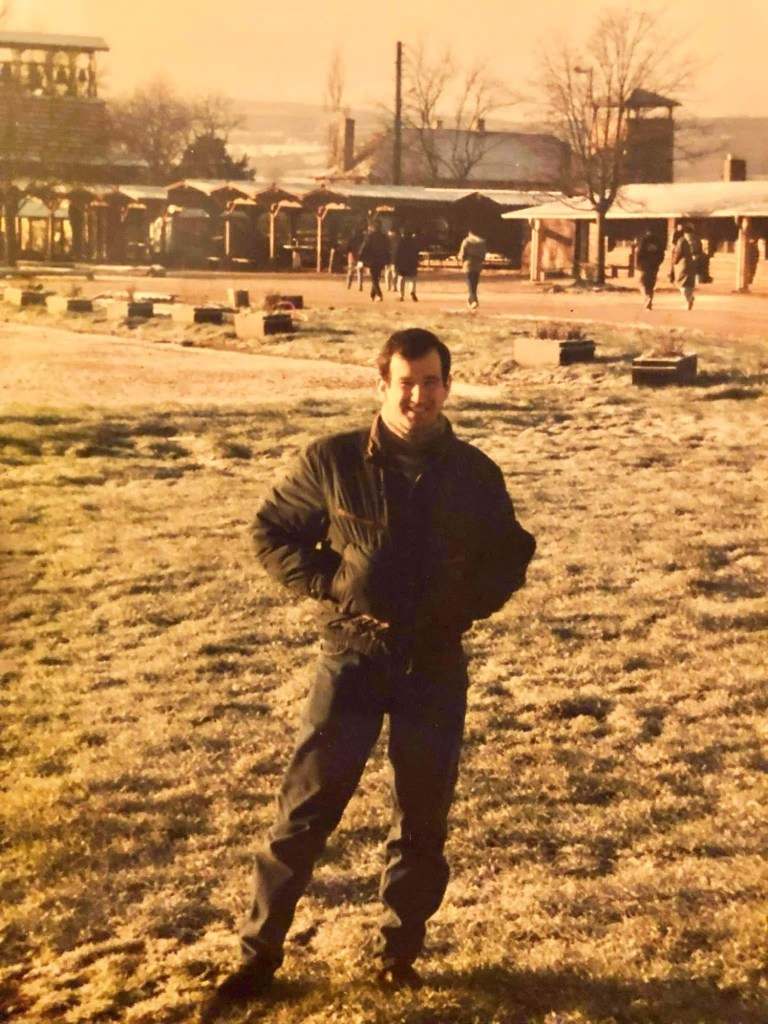
This is me in Taizé shortly after my arrival, perhaps January 1995. A new Lithuanian friend who was a former draftee in the Soviet Army took the photo for me. I finished my own US Army commitment in 1994. Enemies can become friends.
“Ah, Taizé, that little springtime,” remarked Pope John XXIII about the ecumenical monastic community nestled on a hill in Burgundy, France. Being there definitely was a springtime experience for me. I have recently been thinking about my time there a lot. For, I moved to Taize’ in France on December 5, 1994 – 30 years ago!
I first met the brothers escorting Mary Washington College students to their first large meeting ever held in the US at Dayton University. Several thousand young adults from across the US gathered across denominational lines. As part of “the Pilgrimage of Trust,” we stayed with local families where conversations would continue.
I had no idea how my heart would open when I first volunteered to go as a chaperone and participant. My experience changed the way I looked at life and the Church – how I understood myself as well. People sharing their faith, positive interactions with people who were previously “other” to me, and a more intimate prayer life energized me.
I read much about the Ecumenical Community of Taizé and from Br. Roger, the founder, after that. I continued to pray with chants at home and with friends. I went to a few smaller regional meetings. It slowly became a part of me. I’d even catch myself singing their chants (ultimately prayers) as I drove to emergency calls or in quiet moments of my day. Like the prophet, Nehemiah, my prayer life and work life merged. I found myself praying all the time. As I found more peace, I became more patient and discerning when working with others or arresting people. I discovered peace even when amidst the thick of things. Even my sergeant noticed the change. He said during my review, “I don’t know what you are doing, but keep it up.” I think it was more what God was doing in my life, but his observations affirmed for me that I was in a better place and heading in the right direction. Whatever my future, God was with me.
All the while, I began to wonder if I was being called to become a brother. When younger, I had investigated becoming a priest while Roman Catholic. Yet like many young adults, with unaddressed trauma, grief and sin from the past, I had wondered far. I finally became open to radically trusting God after a crisis. Thanks to seeds planted in my past, faith-filled friends, and intentional spiritual, mental, and emotional work, I found my way back home. The Dayton meeting came when the time was right and catapulted me forward toward a new, radical trust in God. Now, I also understood the Church was more than my denomination. I came to believe my past errors need not hold me back. I was and remain forgiven and free. I became determined to address the issue of serving in the Church once and for all wherever God might lead me. For God had been faithful to me, and again, I trusted the Spirit would set me on the right path.
During this time of growth, I had come to know Br. John. Br. John is one of the community’s American brothers, and he is often asked to go abroad. He had introduced me to a Croatian immigrant in Alexandria who hoped to have a meeting in the DC region where I then lived. Certainly, I would help! It proved such a special event. Only about 100 attended, but the impact was similar to my time in Dayton. As I spoke with Br. John during a break, I tentatively told him of my vocational search over the years – on and off. My friend Tony and I would be visiting Taizé in France for the first time, and I wondered – although I can’t sing well or speak French – maybe there was still an answer for me there?
Brother John did not laugh at me as I feared. I was not rejected, but instead taken seriously in my search. Although I had not been before to the community, Br. John said that as I was in a different place than many in my search (I had done a lot of work regarding my repentance, healing, and discernment) perhaps I should spend a week in silence. I still would go to the three daily prayers. I would have moments of conversation. Yet mostly, I would spend time in silence or speaking with my future contact brother, Br. Francois, who would serve as a kind of spiritual director. (He was an early brother, and much later, I learned he was also a Lutheran pastor.)
My contact brother, Brother Francois
Of course, most of my time was indeed spent meditating on scripture, praying, or going for walks. Yet, I was invited to eat with Br. Roger and the brothers once during this first visit as well. A brother who did not know me introduced himself and said, “You are in a week of silence aren’t you?” I said yes, but asked how he knew. He said that people experiencing a week of silence often had a glow about them. (Although I did not understand it at the time, I would later see that glow on other faces.) My growing trust and peace showed.
As my week closed, I told Br. Francois that I thought perhaps I should come for a longer time for more discernment. This would necessitate my resigning from the police department. My eyes and heart had opened wider, so I understood it was time to take a leap of faith. I felt pulled there. He said after a short time of discussion, “We cannot know yet what the answer will be, but we have similar hearts. You must come.” And so, long story very short, I resigned from the police department and came. I began my service as a long term volunteer, “a permanent” in Taize’ parlance, primarily working among the campsites and with meeting preparations.
Upon arrival, I continued to meet with Br. Francois, and there were many, many more important friendships and memories made during my time there including at the Paris European Meeting with over 100,000 young adults!
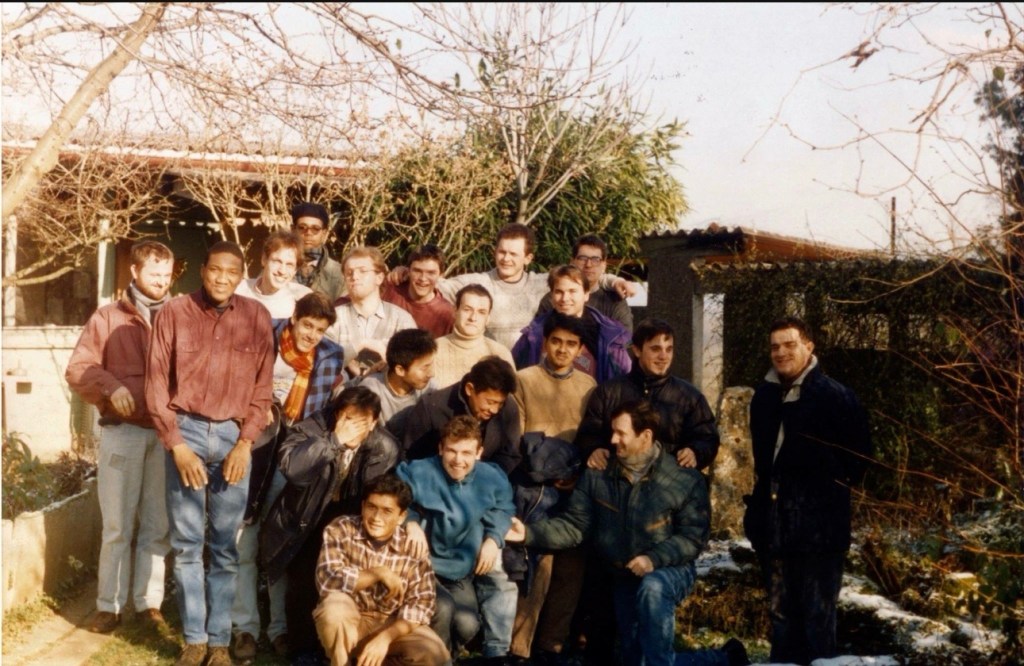
A group photo of the male Permanents at the time from all over the globe. Br. Mathew, a “young brother” in charge of caring for us, is now the Prior of the community (far right). Great memories!
Yet after about seven months, it became clear that I was not to stay, but I never doubted that I had been called there. I came to that little hill, and I saw Christ more clearly than ever before. I just now knew he was calling me to something else. Back to the valley for me! This led me to other people, and thus more new understandings of God’s love, but that’s for another time to share.
I have not been back to what I still consider my spiritual home, but my wife, Kristine, and I did make it to a European Meeting in Barcelona. (It was the last time I saw Br. Francois. He died a few years ago.) I also was able to welcome Br. John and Br. Emile for a meeting at my church in the Richmond area in 2019. I hope our paths will cross again, but as I have written to my many dear fellow volunteers now across the globe, it’s ok if I don’t meet them again. I still sense the deep, living communion which we share any time I hear Taize’ chants, see a photo, or think of them. The Spirit works this way among the Church, a communion of saints. That communion spoken about in the creeds of the Church is tangible.
Yes, we are together still. It’s hard to explain, but it is true. I trust – thanks be to God – that it will be so forever.
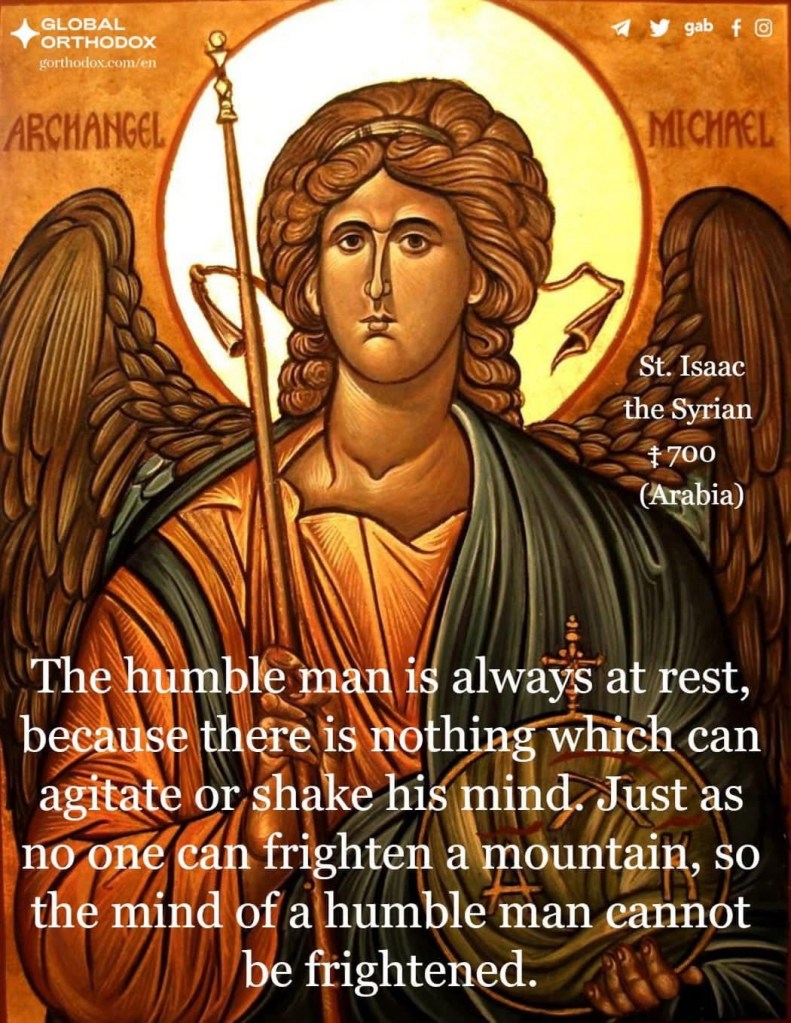
St. Isaac the Syrian knew what he was talking about. For the Orthodox and many other Christians (sadly not all) humility isn’t docileness. It’s an understanding and deep trust that all we have comes from God. We are sinners in need of God’s mercy and direction. Yet because God is love and loves us, we can find peace. We can be nonanxious as others rage. We can rest in Jesus even as we work hard for justice, mercy and truth. We can be patient with those who don’t see the world as we do. We know who we are but also whose we are. This doesn’t mean we don’t struggle with fear at times or never fail or fall, but we find the strength in God’s Spirit to keep trying; to seek to love as God loves us; to keep moving forward knowing we don’t walk alone. Some people will see Christ in us and want the peace we have. Many more might reject us as they do Jesus and his message through word or deed, even as they might call themselves “Christians.” That matters not. Embraced by Christ, we can do no other than cling to Christ and our call nonetheless, even as we fight the interior whisper of demons telling us we aren’t good enough, don’t have the strength, must give up. Yet how can we give up when we have everything in Jesus who has already made us victorious? In that shared victory, we ought not judge or puff ourselves up. We must love the other. We should forgive. We should nurture peace. We do this from a God-given humility, not out of our willfulness. “What is hell as compared with the grace of resurrection?” St. Isaac once asked. Nothing. We can always choose to live in hope by God’s help. And through the power of his Spirit, God will.
Mosaic in El Moallaqah Coptic Orthodox Church: The Flight to Egypt, Cairo, Egypt by Unknown. c. 9th Century AD.
Whoever said the Middle Ages weren’t fun? I bring you glad tidings and happy greetings on this Feast of the Ass.
Yes, according to a blog post by Fr. John Zuhlsdorf: “The feast which became popular in France, could have stemmed from the so-called ‘feast of fools.’ It may tendrils into biblical donkeys, or the integration of the ass into the nativity narrative. It could have been in part inspired by a sermon of pseudo-Augustine. The day included the tradition of a parading a couple of kids (not goats) on an ass (not a Jesuit) right into the church, next to the pulpit during the sermon. The congregation would respond with loud ‘hee haws.’”[i]
This sounds a bit like an early version of Vacation Bible School or maybe fiction, but nope, this liturgical feast was the real deal. It was meant to commemorate the Holy Family’s flight into Egypt. So, on and near the day appointed, congregations would hear donkey-related stories in the Bible including the escape into Egypt (Matthew 2:13–23). Problematically, scripture never explicitly mentions a donkey in the narrative of Christ’s birth or the flight, but that’s firmly in the cultural memory. Why?
Well, donkeys were a symbol of humility and peace while horses were symbols of earthly power and war. Also, through many prophetic texts speaking to ancient Israel, we learn that God did not desire the Holy People of Israel to trust in horses and chariots, as Egypt did, but in the Lord (i.e. Psalm 20:7). Instead, they commonly utilized donkeys also known as asses. Donkeys are also one of the earliest and most frequently mentioned animals in the Bible through multiple texts. In the book of Job, the donkey is one of the fourteen animals that the Lord uses to illustrate God’s own power and creativity to Job (Job 39). Then, Balaam’s donkey actually speaks (Numbers 22:23). The only other animal ever to speak is the serpent of Genesis. Indeed, many verses urge people to be good to their beasts including their donkeys (i.e. Exodus 20:10, Deuteronomy 5:14, Proverbs 12:10).
Yet perhaps most importantly, the donkey was connected to the Messiah as a sign: “Rejoice greatly, O daughter of Zion; shout, O daughter of Jerusalem: behold, thy King cometh unto thee: he is just, and having salvation; lowly, and riding upon an ass, and upon a colt the foal of an ass” (Zechariah 9:9). Jesus embodies this as he rode into Jerusalem for his final Passover. If Jesus ends his life with a ride on a donkey, it does not take a great deal of creativity to imagine Jesus (through his expectant mother, Mary) rode one as he entered into our world incarnate. (It is likely one was not only available but used.)
So, if anyone ever says you are acting like an ass, or you feel like one, don’t be too quick to take offense or lose heart. Think of the humble donkey and give God thanks. For all their drawbacks, the ass remains a valuable animal, born with a purpose, and dearly loved by God. If God can use an ass, God can surely use you or me. The Bible tells us so.
Yes, this feast might no longer be on the liturgical calendar, but blessed Festum Asinorum, Feast of the Ass Day, to one and all!
Epilogue:
Hear is a song from Italian history with the feast to help brighten your celebration.[ii] As the feast was seemingly associated with the Feast of Fools, it is quite jolly unlike other liturgical music of the day. An Italian troubadour version of ‘Orientis Partibus’ with braying chorus.[iii]
Translation:
From the country of the East, Came this strong and handsome beast: This able ass, beyond compare, Heavy loads and packs to bear.
Chorus: Now, seignor ass, a noble bray, Thy beauteous mouth at large display; Abundant food our hay-lofts yield, And oats abundant load the field. Hee-haw! He-haw! He-haw!
True it is, his pace is slow, Till he feels the quickening blow; Till he feel the urging goad, On his hinder part bestowed.
Chorus: Now, seignor ass, &c.
He was born on Shechem’s hill; In Reuben’s vales he fed his fill; He drank of Jordan’s sacred stream, And gambolled in Bethlehem.
Chorus: Now, seignor ass, &c.
See that broad majestic ear! Born he is the yoke to wear: All his fellows he surpasses! He’s the very lord of asses!
Chorus: Now, seignor ass, &c.
In leaping he excels the fawn, The deer, the colts upon the lawn; Less swift the dromedaries ran, Boasted of in Midian.
Chorus: Now, seignor ass, &c.
Gold from Araby the blest, Seba myrrh, of myrrh the best, To the church this ass did bring; We his sturdy labours sing.
Chorus: Now, seignor ass, &c.
While he draws the loaded wain, Or many a pack, he don’t complain. With his jaws, a noble pair, He doth craunch his homely fare.
Chorus: Now, seignor ass, &c.
The bearded barley and its stem, And thistles, yield his fill of them: He assists to separate, When it ‘s threshed, the chaff from wheat.
Chorus: Now, seignor ass, &c.
With your belly full of grain, Bray, most honoured ass, Amen! Bray out loudly, bray again, Never mind the old Amen; Without ceasing, bray again, Amen! Amen! Amen! Amen! Hee-haw! He-haw! He-haw!’[iv]
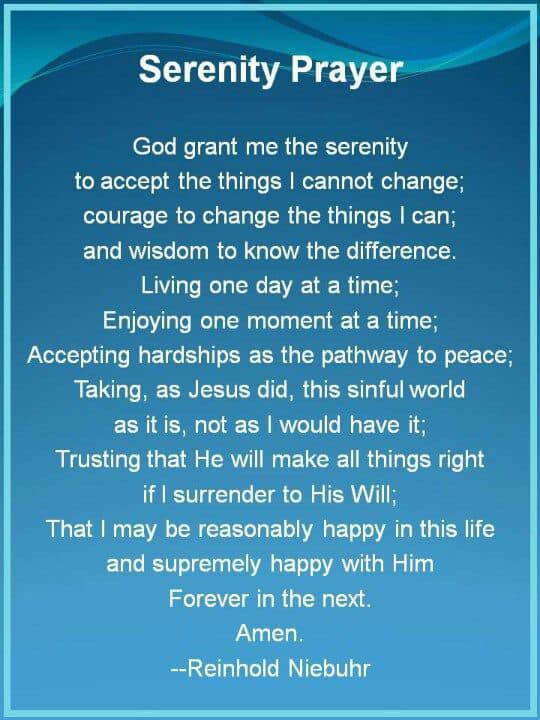
Who knew the well-known and respected Serenity Prayer could cause something other than peace – doubts, anxiousness, and many more questions? After sharing it on our Facebook page post-election, I have had many great and fruitful discussions about the theology behind it. On its face it sounds crazy to accept the world as it is. Yet, that is not really all that it says.
As I wrote someone recently, the Serenity Prayer was written as the US was battered by the Great Depression and the Nazis took over in Germany. Things looked grim. It began as an observation by Reinhold Niebuhr in 1932 as Roosevelt was elected: “The victorious man in the day of crisis is the man who has the serenity to accept what he cannot help and the courage to change what he must.”
The prayer challenges us to discern our unique individual call, as well as a call in community. We are to take stock of what we really can influence in the world, act accordingly in faith, and with any things that prove out of our hands, we are asked to trust that they remain in God’s. Many studies have shown that “letting go” can help us physically, emotionally, and mentally function better. Based on the teachings of Jesus, I always say that it benefits us spiritually too. Consider John 14:1 for one example: “Do not let your hearts be troubled. You believe in God; believe also in me.”
Lutherans also believe in a Theology of the Cross – the cross is seen as the best source of knowledge concerning who God is and how God saves. It also encourages us to take up our cross and follow Jesus. As the Lutheran theologian, pastor, and martyr, Dietrich Bonhoeffer wrote, “When Christ calls a man, he bids him come and die.” None of our recent posts are about “just getting along” or stopping our work for a more just world. We know the world is a mess. Loving others is difficult. In the face of reality, these prayers and teachings challenge us to trust and love God at all times, and love one another, even our enemies.
How we respond to perceived injustices might change when we trust God is always at work for our welfare. This theological lens invites us to find Christ’s peace and hold on to it, even if facing the worst evil. Our suffering and sacrifice can become sacred, not by our own power, but because of God’s promise that all things work for the good of those who love God (Romans 8). God will be with us in our suffering, but God also somehow will use it to bless us and the world. We are asked by Jesus not to lose hope when it seems like the world is ending. He taught that these things must happen (Matthew 24:6) before his Kingdom, a new heaven and earth, fully comes.
We can look toward our theological forbearers. They sometimes died for their faith. Some still do. In the US, there has been worst times of trouble – the Civil War being arguably the worst and most costly. (It took Spotsylvania County one hundred years to return to its pre-war census.) Working within the ebb and flow of history, we are called to pray and act, but always trust. God wills more for us. As Lutheran theologian Ernst Troeltsch writes, “God, therefore is always living, always creating. He is truly manifested not in being but in becoming; not in nature, but in history” [Troeltsh, E. (1991) The Christian Faith, p.120. Minneapolis: Fortress Press]. God is at work in and through us as we live in a Fallen World. God may seem like a hidden God, as Luther often called God, but God is awake and at work. It is not all up to us. God’s will will be done.
These beliefs, this kind of trust, often helps us extend our focus to see more possibilities of what we can do in hard or conflicted times – acting in love rather than just fear or anger. Acting in love does not mean there are never any consequences. For the sake of the weak, the vulnerable, really all our neighbors, sometimes some are called to respond more directly and forcefully than others. Yet as a former soldier and police officer, now a police chaplain, I see that violence is never a good thing – never without cost – even when violence becomes necessary. (Luther in discussing his Two Kingdoms theology or in his essay “Whether Soldiers Too, Can Be Saved?” speaks of these kinds of things.) We each have parts to play in making a more just world, but we each must discern how Christ is calling us with the gifts we have been given.
Still in Christ’s teachings, the call to be open to reconciliation, to even nurture it, is ever present. For me, my understanding of this broadened when I came to know and eventually live with Brother Roger of Taizé in France. Under the Vichy government, he helped Jews escape. He ultimately narrowly escaped the Gestapo’s arrest; going to Switzerland until the war was over. After the war, he came back. He cared for German soldiers (former POWs) as they made their way home. In the region, he was among some of the most anti-church people in France. Some Communists slaughtered a pig on the church steps in the nearby village each Good Friday to show their disdain for Jesus and his Church. Yet, he with other friends helped form a coop for the community anyway, and they cared for the sick and hungry. His authenticity, patience and love changed hearts and minds over time with God’s help. And I believe his witness eventually changed my way of seeing and being as well.
When we as Christians say, “all is well,” or “love your enemy,” we are ultimately affirming that Jesus is Lord. He lives, and that matters. In fact, it changes everything, so it must change how we respond to the world. Jesus promises that his Kingdom will come, but he is here with us now. It has broken into our world, but it is not in its fullness yet. We are already victorious even when we might suffer (1 Corinthians 15:57). This truth can free and empower us to respond to our Fallen world and our neighbors in surprising ways.
For, God is not done with us or the world yet. Yes, the poor will always be with us (Mark 14:7, John 12:8, Matthew 26:11), but we seek to feed and house them as Jesus also taught us. As we face those in opposition to us, we seek to bless those who curse us and pray for those who mistrust us (Luke 6:27-36). In the face of worldly reality, we seek to live in abundant, generous, and merciful faith, hope, and love. All is well, but all is not perfect…yet. As the body of Christ, we have work to do, but we trust most importantly that God is at work, too. We need not be afraid.
Parts of this reflection originally were published in the November 18, 2024 weekly newsletter, the Hub, of Christ Lutheran Church, Fredericksburg, VA as well as sections in a Facebook post that I shared.
So many people – both “blue” and “red” (plus other political colors as well) – have been anxious this election cycle. Unfortunately, anxiety can turn into anger rather quickly. Now, hear me clearly, anger is not a sin according to scripture, but we as humans can too swiftly ride the tide of our emotions into the vortex of sin when we feel insecure, unmoored from what usually grounds us. As animals, fight or flight responses can take over. Biologically, we focus on what we think a threat. This is meant to be a safety skill built into us, but it can become our downfall. We can miss the bigger picture. We might abuse others who don’t deserve such treatment. We can begin to wear blinders so that we miss out on facts or observations that might help us avoid loss of relationships or our sanity. We can hurt ourselves and others in ways we never imagined possible. Anticipatory stress can prove a real trap hurting our overall health.
When I was a child growing up in a family with many challenges, I learned to be vigilant for signs of potential trouble whenever I entered my home. As a soldier in the National Guard, I was trained to watch for ambushes and danger. When a finally became a police officer, I found that I sometimes had a hard time “turning off” after my shift. It was a violent time in the Metro-DC area. I eventually learned how to keep this hypervigilance in check after some help from others. Yet, I discovered my greatest gift to combat such issues proved to be faith. Faith is more than just an intellectual trust in the Lord. It is at its best a deep and growing trust that our gracious God loves us and will never abandon us – even as we face death. This gift of faith certainly helped me lower any anxiety or anger which might pop up. I became calmer and less reactive. Instead, I saw more options and possibilities in a fallen world. I grew in empathy, compassion, and patience. I learned better how to love myself and others in stressful situations, and people began to notice.
Why this dramatic change? I started to see beyond the problems facing me in the world. I think it was because the Holy Spirit longs to help us learn that (as others taught me) the God behind us is bigger than any problems facing us. Indeed as Brother Roger of Taizé used to teach, God is already in our future waiting for us – no matter how dark it might appear – ready to embrace us. We need not be afraid (as scripture so often reminds us). Everything – even our own sin – can be used by God to bless us (Romans 8:28). We can act instead of react. We can choose love. This is because God promises to love us…always.
Yet sometimes we can feel like one of the characters in Animal House, a movie I saw as a teen. For years, if anyone were to say, “Remain calm. All is well,” I thought of the ROTC cadet, played by Kevin Bacon, standing in the midst of a parade crowd running amok. Things did not seem well at all. It is not easy when the world seems in chaos to hold on to this “hope as an anchor for the soul” (Hebrews 6:19). others might even think that we are foolish. Ultimately, we need the Spirit’s help to know and trust that all is well. This assurance can be found through prayer, our study of scripture, as well as beloved community. We need to risk believing as Luther taught, “Jesus does not lie.” Then, the Spirit will do its work. As Paul points out, when we feel tempted to sin or give up, when all seems lost, it is ultimately God who will give us a way out (1 Corinthians 10:13).
At this time of cultural shift and uncertainty, when the United States population seems so at odds, it is important that we not play by the world’s rules. I shared this with my congregation on social media:
For those celebrating the election, remember not to gloat (Prov. 24:17) and to seek to love those you think in opposition to you (Matthew 5:44). For those grieving, remember we are never alone on good days or bad, or when the world seems confusing or disappoints (Matthew 28:20). As believers, all of us have work to do together (Micah 6:8). More importantly, God is at work through us and all that happens in the world (Jeremiah 29:11). We can choose to live in hope because of God’s love for us (1 Peter 1:3). As Church, we are called to be ambassadors for Christ and agents of reconciliation in our conversations and social media posts (2 Corinthians 5:16-21). We are called to love one another as Jesus loved us first (1John 4:19). “Be kind to one another, tenderhearted, forgiving one another, as God in Christ forgave you” (Ephesians 4:32). Especially as Lutherans, we know that “though the earth give way and the mountains fall into the heart of the sea, though its waters roar and foam and the mountains quake with their surging…The Lord Almighty is with us; the God of Jacob is our fortress” (Psalm 46). Jesus lives and reigns forever (Hebrews 7:24-25), and together, we are called to be his witnesses to the ends of the Earth (Acts 1:7-8). Life together in any community can prove difficult, but with God, all things are possible (Matthew 19:26). All is well.
I might still remember the humor of Kevin Bacon being overrun, but I trust in the observation of Julian of Norwich that all is well. As she reflected long ago:
All shall be well, and all shall be well, and all manner of things shall be well…For there is a Force of love moving through the universe that holds us fast and will never let us go.
In our fallen world, there might be negative consequences at any time. We will suffer at times or potentially face abuse or persecution. It might prove time to take up our cross or fight the good fight for justice. Real life is never easy. We are not asked to fake our happiness, just not get stuck in or sin in our feelings. For, we have a real God who is with us and loves us.
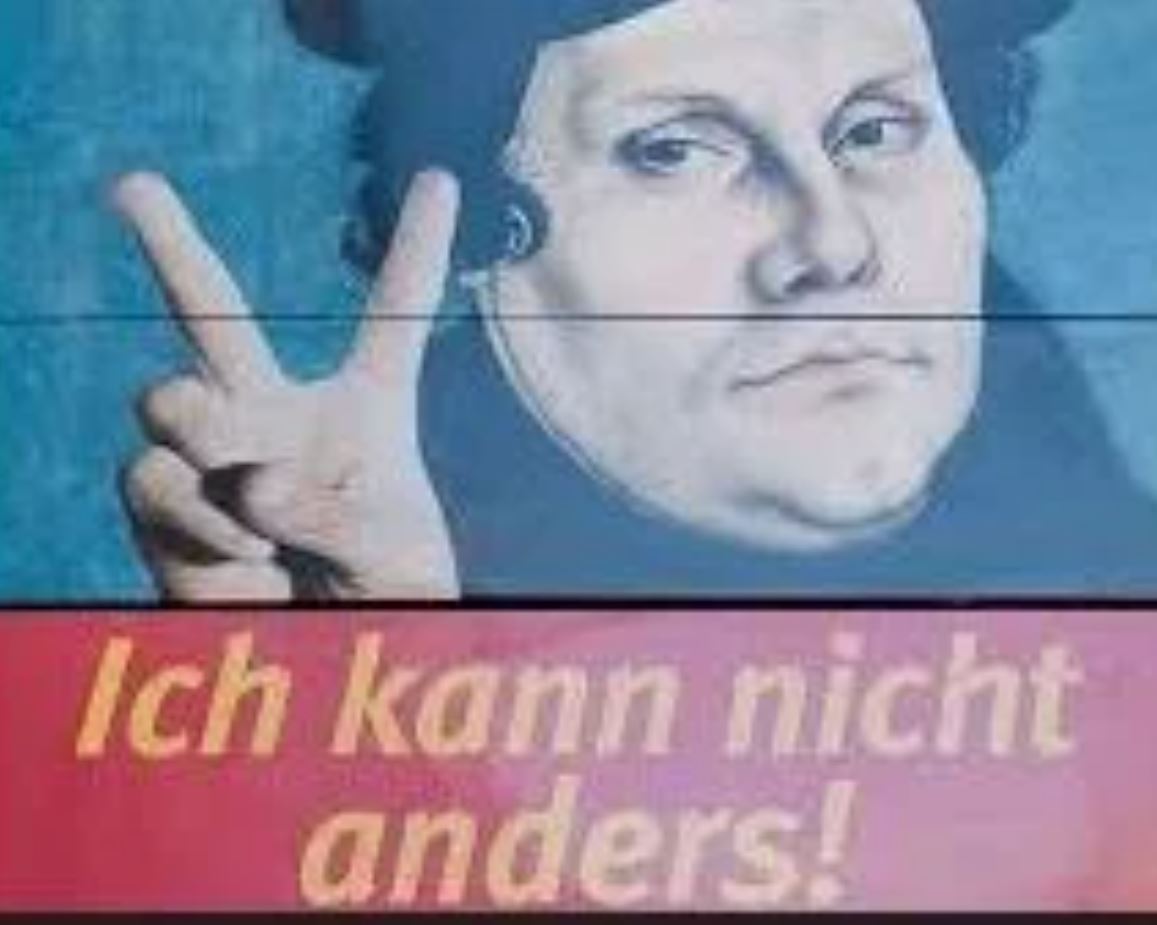
Another Reformation Day is upon us, and so one might wish to ask in the spirit of Martin Luther’s Small Catechism, “What does this mean?”
Reformation Day is a church festival that recalls how the Holy Spirit moved through Martin Luther and other Reformers to spur a religious, political, and cultural reform movement that reshaped modern history and had many lasting effects.
Many mark the feast through worship on the Sunday prior to October 31st calling it Reformation Sunday. Because we believe it was Spirit led, the liturgical color of the day is red recalling the fires of Pentecost. In 1517 on All Hallows Eve (All Saints Eve today), professor and monk, Martin Luther, posted his 95 Theses in Wittenberg, Germany, listing points of debate and inquiry regarding the practice of indulgences by the Medieval Roman Catholic Church and its associated abuses. It sparked a fire leading to a reexamination of all Medieval church practices in the West, and as a result, some unintended fractures came to pass. Yet, it also bore the fruit of a purified theology in a Church seeking to resist superstition, ignorance, and abuse. Biblical scholarship of today originates with the Reformation witnesses, especially Martin Luther.
Although others before Luther had suggested sharing the scriptures and worship in the common, local tongue, it stuck as a widely accepted norm after Martin Luther’s efforts to translate the Bible into German. Where the Medieval church had stopped allowing laity to share the blood of Christ (the reason is lost to us), the Reformation emphasized a return to Christ’s teaching that the body and blood be shared among all baptized believers. The spiritual equality of laity and ordained person as one within a “priesthood of all believers” became a force in the daily life of the Church, and with that, laws, schools, and governments saw reforms helping to lead Western Europe out of the dark ages. Everything was on the table for review, such as what books should be considered scripture or what of the seven major ministry practices of the Church should be considered sacrament. (Martin Luther came to argue that only baptism and the Eucharist were sacraments, although confession was held up as a sacrament in his earlier catechisms.) Perhaps the biggest change was understanding that we are saved by grace through faith in Jesus Christ, not by any works on our part.
Certainly, this is a broad brushstroke, as there remained many voices arguing over theological nuances and details right up through today. Even among those Christians coming to be known as Lutherans, there were arguments. Philip Melanchthon, a coworker with Luther who is largely responsible for the famous Augsburg Confession defending the Reformers’ faith, was even blacklisted by some for his attempts to reconcile with followers of John Calvin. Later, Lutherans would divide over local or national practices, how strictly one should adhere to the Lutheran confessions (the central writings of the Lutheran faith), as well as how “orthodox” (traditional, usually more high Church) worship should be or Pietistic (heart centered, often low Church). Luther himself has rightly come under some criticism for his support of government suppression of the German Peasant Wars, his approval of the persecution of Anabaptists, and later in life, his hardening heart against his Jewish neighbors. (These issues merit a separate essay of their own.) Luther like all of us is a sinner-saint at best.
Yet, Lutheran witnesses would positively influence the larger Church and world too. The Lutheran pastor, Martin Bucer, influenced Anglican worship and the formation of the Book of Common Prayer. William Tyndale who is credited with creating the first English biblical translation that was mass-produced studied in Wittenberg. The Thirty-Nine Articles, the historically defining statements of doctrines and practices of the Church of England, largely reflect the arguments of the Augsburg Confession. The oppressed Moravian Church was saved by a Lutheran, and they now adhere to Martin Luther’s Catechism. (They are one of six denominations with which the ELCA shares full communion.) They, in turn, introduced John Wesley to Luther’s Commentary on Romans which “strangely warmed his heart” resulting in what we now know as Methodism. A Lutheran helped influence the foundation of Alcoholics Anonymous, while another Lutheran helped form the Gideons. The Lutheran understanding of justification by faith has now led to The Joint Declaration on the Doctrine of Justification (JDDJ) signed by the Lutheran World Federation and the Roman Catholic Church on October 31, 1999. Twenty-five years later, the World Methodist Council, the Anglican Communion, and the World Communion of Reformed Churches have also signed. (There are still some issues with details and practice, but we formally agree that only God’s grace can save us.) Even our Roman Catholic siblings have adopted many of our 16th Century Reforms after their council gathering now known as Vatican Council II (in the 1950s). Lutherans have also been center stage when it comes to relief efforts and work with Refugees. In fact, one in five Americans receive assistance through Lutheran ministries/nonprofits under the banner of Lutheran Services in America, one of the nation’s largest and most respected health and human services networks.
The impact of the Reformation is still being worked out in our lifetimes. It has faced many bumps in the road, we can fall short, but God is still at work. On Reformation Day, it is ultimately God who we celebrate. You might like to explore some of these resources to learn more:
By Heart: A conversation with Martin Luther’s Small Catechism was written by one of my former professors, Dr. Kirsi Stjerna, and several others. It is an excellent, accessible, highly readable unpacking of Lutheran core beliefs.
The ELCA publisher Augsburg Fortress points out, “Martin Luther posted his Ninety-five Theses on the church door at Wittenberg in 1517. In the three years that followed, Luther clarified and defended his position in numerous writings. Chief among these are the three treatises written in 1520.” They still apply today, and you can find them in one text at the Augsburg Fortress website, Amazon, or through other vendors. His Three Treatises (“To the Christian Nobility of the German Nation” asking leaders to play a part in the Reformation; “On the Babylonian Captivity of the Church” particularly focusing on the Sacraments; and “On the Freedom of the Christian” about living the Christian life) are fundamental to understanding the Reformation. As a former Roman Catholic, I can testify that they still have application in our times.
You might also like Heiko Oberman’s Luther: Man Between God and the Devil, a deep, psychological and spiritual treatment of Luther.
The Annotated Luther Series illuminates the essential writings of Martin Luther. You can find it here: Annotated Luther Series.
If you want to go all in, Logos.com offers the collection of Luther’s writings (55 volumes) for online access at $259. Since this collection was created, several more volumes have been added as his works were translated from German. Those are available at an extra charge.
Lutherans solidified their faith by agreeing on core documents collected now in our book of confessions called The Book of Concord, meaning book of unity. You can see it for free online at several sites, or buy it at Augsburg Fortress or another vendor of your choice.
If you prefer podcasts, try the Doth Protest Podcast. It focuses on church history and how the theology of the 16th-century Reformers can inform us today. Many Lutheran scholars are interviewed among others from varied traditions. A friend of mine, a local Episcopal priest, is one of the hosts.
For heavier theology, you might enjoy the Queen of the Sciences Podcast: Conversations between a Theologian and Her Dad. Rev. Dr. Sarah Hinlicky Wilson is Associate Pastor at Tokyo Lutheran Church and the Founder of Thornbush Press. Her father is Paul Hinlicky who after 22 years of service has retired from Roanoke College as the Tise Professor of Lutheran Theology. He is currently Distinguished Fellow and Research Professor of the Institute of Lutheran Theology.
Then, of course, there are many movies about the Reformation. Luther (2003) is among the most recent starring Joseph Fiennes, Bruno Ganze, and Peter Ustinov. You can find many past documentaries streaming as well.
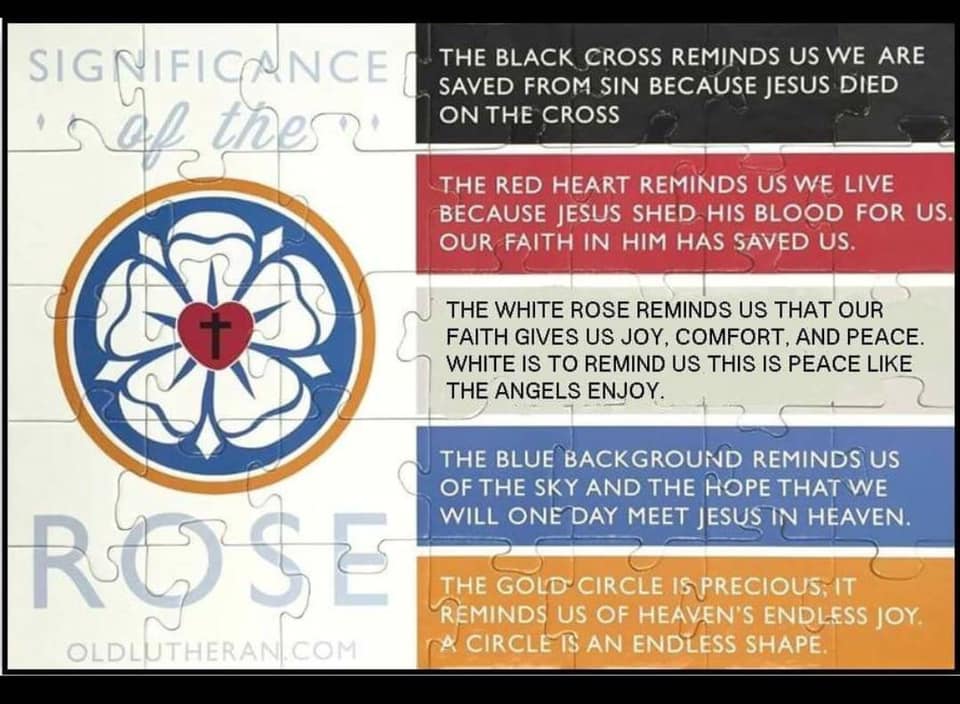
Have you ever seen the rose image on the floor in our Christ Lutheran entryway? The Luther rose or Luther seal is a widely recognized symbol for Lutheranism. It is the seal that was designed by Martin Luther while Luther was staying at the Coburg Fortress during the Diet of Augsburg. Martin Luther thought it a summary of our Lutheran faith. See the image below for an explanation. (Source: OldLutheran.com)
Originally published in the October 22, 2024 weekly newsletter, the Hub, of Christ Lutheran Church, Fredericksburg, VA.
Weinachts gurke, Christbaumschmuck der Firma Inge-Glas, Neustadt bei Coburg, Deutschland, CC BY-SA 3.0 via Wikimedia Commons.
This Christmas sermon inspired by the popular pickle ornament was preached on Luke 2:1-20 at Christ Lutheran Church (Fredericksburg, VA) on Christmas Eve, December 24, 2023. You can also find a recording of this post at my 2 Penny Blog Podcast.
Sadly, there is no children’s message tonight, but we are all Children of God, and this is Christmas Eve, so I have something to show you. [Displaying pickle Christmas ornament.] Can anyone tell me what this is? —- That’s right, it is a pickle ornament, but in this case, it has a pickle flavored gummy candy inside. (Yum, right?) As I shopped for gifts this year, both in Walmart and Target, I discovered versions of this tasty “gift” inspired by the popular Christmas ornament – the pickle.
Now, there are several different origin stories attributed to the tradition of hanging a pickle on one’s tree, including one claiming an origination in Germany. This has been largely discounted by those who study such things, and it is now thought to be a German-American tradition created in the late 19th century – perhaps during the Civil War – right here in the US. Yet however it started, the idea remains that on Christmas morning, the first person to find the pickle on the tree will receive an extra present from Santa Claus or (they say) you will have a year of good fortune ahead.
In any case, seeing this pickle candy ornament got me thinking. It has a sour and sweet taste. Some will like it. For others, it might be hard to swallow. And in that tension – stick with me now – we might just have a perfect allegory for Christmas. You see, the story of Christmas is not really one of just lights, triumphant song, and gifts. We celebrate something much more complex. The story of Jesus is both sweet and sour, joyous and sad, easy for some to hold on to and hard for others to dare hope in.
When we look closely at the story itself, when we ponder it perhaps as Mary and Joseph truly experienced it, we witness a couple who had to accept the impossible – a virgin birth. They did so at the risk of accusations of sins such as adultery. This could make Joseph appear the cuckolded fiancé to his peers or one who took advantage of poor, young Mary, thus he would dishonored, a pariah, in an honor-based society. Worse, it perhaps could have resulted in Mary’s stoning for adultery – for a relationship outside of marriage was deemed a reason for death. Who among their family, friends and neighbors would believe such a crazy story as a virgin birth? Despite the risks, they accepted their fate. They trusted God, and therefore, both Mary and Joseph said yes to God.
Then, they faced another challenge – that of the census and its associated taxes. They had to travel to Joseph’s ancestral, tribal home of Bethlehem. They embarked on what was likely a four to seven day journey over about 90-miles. Remember, there were no paved roads, cars, trains, planes, nor were there rest-stops along the way.[i] Lyft and Uber were not options. They traveled on rocky, dirty, dusty paths. They traveled through a land under military occupation by the Romans, who could sometimes randomly be bullies to the native peoples. Not only that, Mary and Joseph also faced the very common risk of rebels and robbers harassing them as they traveled as well.
And let us not forget that Mary traveled even as Jesus’ birth was imminent. She was in her third trimester. If Joseph cared about Mary and the baby, the pace would have likely been slower with many stops for the bathroom, rest, and food. So, some specuilate that the trip might have taken a week traveling at the less than the rocket pace of about 2-mph.[ii] Despite facing many challenges in trusting in the great promise of Jesus, if not experiencing very real fear at the political and religious threats around them, both Mary and Joseph continued to say yes to God. They stepped out bravely in faith, for God had promised to be with them on their journey.
And once they arrived, more challenges appeared. There was no room at the inn. This small, backwater village of Bethlehem did not seem to have the capacity for all those who returned to be counted. They found themselves instead in a stable. Archeology and historical studies in the area indicate these stables were often more like caves. They offered the smallest amount of protection and comfort. Yes, the newborn king was not yet widely celebrated. He was laid somewhat quietly in a manger…a trough for animals, surrounded by noisy animals and filth. No, there were no robes or crowns for Jesus. Luke reports he was wrapped in bands or strips of cloth – essentially “wrapping” Jesus tightly…swaddling him…in what meager things they had.
There’s a common and ancient Christian belief that being born in this cave and wearing his swaddling clothes foreshadow Jesus’ future burial in a stone tomb. As cute as Jesus must have been, as warm as the loved shared between parents and child could ever be, we should not forget why our Messiah came. This innocent baby, born without sin, would be hated by many, find no roof to call his home for the last years of his life, and he would ultimately suffer and die for our sake. (Thus, you will often see Eastern Orthodox icons and ancient European art shockingly portraying Jesus as an infant wrapped tightly within his burial cloth.)
Even as Jesus started his life among us, scripture suggests he and his family were poor. They had no finery. And yet, again, Mary and Joseph made do with what they had. They trusted God to supply their every need, and they shared what they had including all their love with Jesus. Yes, they trusted God with their lives, and despite the many threats and challenges, they sought to live in expectation and hope. (Of course, this doesn’t mean they never cried, or suffered, or felt fear. They were human after all, but the power of such times did not control them. They knew they were in God’s loving hands, and that truth helped them to act free of fear to do the right thing – as that same truth might do for us.)
So, we see that the story of the nativity is in a great part one of threat, struggle, poverty, and suffering…There’s a sourness to it. Our modern sensibilities might not like it, but that is the way it was. That’s the way our lives can be today in part. We might not want to think about the hard things that come with life. We probably prefer the happy, but Jesus came to share our lives fully – even the bad parts, including death – even as he remained our God. And Mary and Joseph? This was a couple who likely experienced much joy, but they also knew what it meant to be a human in a very fallen and unfair world. They, my friends, as great as they were, were much like us.
However, before we lose hope, remember that there is much sweetness in this story too. There proves much reason for joy. For Jesus came as Immanuel, God with us. Jesus has come to ultimately save us from harm and every evil – even our own struggle with sin. And we can also see that Mary and Joseph’s own love and faith sustained them – much as such faithful, loving relationships with others can help empower and sustain us. Mary and Joseph proved stronger due to these social bonds, and so can we.
And we learn as the Gospel unfolds that many others who are oppressed, forgotten, alone, sick or suffering – perhaps again people like us – came to see Jesus as he truly is over time…see him as Mary and Joseph did as the Holy Spirit opens eyes, minds, and hearts. Jesus is not you average baby. He is the Messiah, our Savior, our Redeemer, our way to forgiveness, joy, and everlasting life…He’s meant to be our everything. And because of Jesus’ call for us to be one, these newly enlightened ones sought to be one no matter what they have done or failed to do, and they invited others to be in relationship with Jesus – as we should strive to do.
If that wasn’t enough, the angels remind us of the eternal import of this baby’s birth as they sing, “Glory to God in the highest heaven, and on earth peace to those on whom his favor rests.” We can’t trust our feelings. We cannot look to our situation or the world for a final clue. No, God loves us so much, God comes to us…as one of the most vulnerable among us…a baby…and angels (God’s messengers) point the way. Our Father in Heaven declares that it is upon us that his favor rests…us! Can you believe it? God in Jesus has come to us and for us. Wow!
The world can seem so daunting at times, perhaps even against us, but it is at Martin Luther observed so long ago now, “The incarnation is proof that God is not against us.” No, as bad as life can get, God always loves us and promises a future filled with hope ahead of us. God comes to us in our need over and over again. Is it any wonder that the shepherds left amazed, and Mary treasured these mysteries and pondered them? There is so much sour in our world. It can be hard to believe that good exists, never mind believe that the baby laying at her breast was God.
Faith is hard. Trusting is a risk. And so sometimes as a human as I face difficulties, I just want to spit all the sour out; throw up my hands and walk away. Even as Advent started, as many of you know, I was reminded of the sting of death as someone incredibly important to me died. And many here have faced their own losses, disappointments, negative diagnoses, financial problems, perhaps even worse this past year. Each of us has a unique story, but I know we are all human in a broken world. Even with faith, life is hard. The imperfections of our world and our life are always present. They remain almost easier to identify than our blessings. They can capture our attention and hold us hostage. Much as our sin can do, our problems might also bind and blind us.
In response, God’s messengers again shout for our attention, “in the town of David a Savior has been born to you,”…for you. In some ways, Christmas seems most especially for the sad ones among us…Those of us walking through a “Bleak Midwinter” can see a light beckoning us on, warming our hearts, and calling us toward trust.[iii] Like Mary and Joseph, understanding that God is Love, a Love that has and will continue to reach out to us, we can seek to trust the promises of God to be with us, and for us, even if we must do so through tears at times.
Thus, no matter who we are or our situations, we, too, can step out in faith as Mary and Joseph once did. Like the shepherds, we might not fully understand, we might struggle to trust, but we can seek this hope we have heard testified to us. We can try to share our experience, strength, and hope with others. For in seeking Jesus with the eyes of faith, we will find that Jesus is already and always will be reaching out to us before we even recognize him – much as he came unnoticed by most of the world on that first Christmas Eve.
I, for one, think we need to both notice his birth and look for Jesus in our lives each day. As a young adult from the Slovak Republic reminded me through a meditation she shared while I faced my own grief, “When we are feeling hopeless, we are not facing the God that is giving us hope, [instead] we are facing the world that is giving us these hopeless feelings.”[iv] In effect, we are believing in the power of the world more than God’s power. We are in a way worshipping the world instead of God, giving it power over our lives. Instead, we have the choice to turn to our God and live.
And so, in both good times and bad, God calls us back to the manger – to take another look. Amidst the sour of this world, the sweet cries of Jesus lying in the manger were calling us by name before we were even born; imploring us to trust in him today and always. Times might be hard, we might feel like we are in a pickle (you knew I had to go there), but through that baby in a manger, we always have access to a hope we can concretely hold onto. Jesus is here. God became human in the flesh. Heaven has broken into our world. In this, we can rejoice. We might only get a foretaste of this glory for now, but life – thanks to Jesus and his promises – remains very sweet indeed. Amen.
This sermon on Isaiah 5:1-7; 11:1-5 and Mark 12:1-3 was preached at Christ Lutheran Church (Fredericksburg, VA) on the Twenty-fifth Sunday after Pentecost, November 19, 2023. You can also find a recording of this post at my 2 Penny Blog Podcast.
In my work as a volunteer police chaplain or in pastoral counseling, I can run into people with a vision problem. No, they don’t need an eye doctor. Their way of looking at life can be out of focus. The person might suffer from bent thinking where it is like looking at your submerged legs as you stand in the water above. Your legs are the same as they have always been, but you perceive them as losing definition and perhaps they seem disjointed or cut off from the rest of your body. Unfortunately, as humans, as we experience traumas (big or small), or as we seek to control things that aren’t controllable, or as we try to cope with stress or loss in unhealthy ways, our vision of reality tends to be negatively impacted. We don’t see our life, our options, or who we are accurately. Our focus on what’s bad or hard begins to overshadow the goodness of life…and my friends, believe it or not, there is always goodness to be seen…even as we face death. I have seen this as a hospice chaplain.
To be frank, I find these symptoms of an imperfect humanity in a difficult world to be like those of us with post-traumatic stress symptoms. (Sure, maybe the symptoms might not be as severe for everyone, but they are often similar.) Over time, we can wrongly personalize things saying things like, “the world is against me,” “nobody likes me,” or we might believe that “I am the unluckiest person in the world.” Along with negative self-talk, maybe we imagine slight or expect betrayal when there is none. Or, we might simply take on blame when something bad happens to us or those we love even when there is no blame. Things can go wrong even when we do everything perfectly because life isn’t fair. Even Jesus, perfect and without sin, died on a cross. That was pretty unfair to be sure.
Conversely, we might hear a criticism of someone or some group we are associated with, and we allow ourselves to become deeply wounded by something we have no connection to. Those times are examples of personalizing things, but we can also catastrophize things: “If I fail this test, my life will be ruined.,” “If (insert a name) breaks up with me, I have no future.” We begin to see our world simplistically and dualistically. (And by that, I mean we tend to see events as all good or all bad – nothing falls in between.) Life just is not that way.
If this sounds familiar to you, I am not surprised. As humans, we all can feel this way at times. The darkness of this world can whisper in our ears, and we might listen too long. The problems become more significant and life threatening (to one’s own quality of life or concretely a danger to one’s life or others) when we get stuck in this pattern of thinking. We stop seeing the big picture – that life is long. Our life course can change at any time. It is only a bad day, not a bad life. More than that, perhaps more harmful, we forget that we have a God behind us that is bigger than any problems we face, even death. And that God, our God, has promised to love us and care for us always, because we are God’s people. Remember, Jesus actually calls us his family.
When we look at prophetic texts forecasting doom, it is dangerous to view them in isolation. Martin Luther argued (and those who join me for Bible study on Monday nights hear this over and over again), we need scripture to interpret scripture. What we are reading is not meant to be heard in isolation, for it is just part of a much larger, all-encompassing story which isn’t just in the past. This story, God’s love for us, embraces us in the present…even on the worst of days. “God is with us,” Immanuel. We learn this with Jesus…but God was always with those and for those God so lovingly created and called. Most assuredly, you have likely heard someone at some time use such passages to try to scare people straight…you toe the line or suffer in hell eternally, as you deserve….Yet as true as hell and consequences might prove, those kind of threats never worked for me. I just lost hope. It is only God’s love and grace that ultimately turns most lives around.
As we look at Isaiah’s prophecy today, we need to read it with the proper lens and context. Just as we heard the prophet Hosea call the Northern Kingdom of Israel to account, Isaiah’s task was to seek the repentance of the Southern Kingdom of Judah. Yet, the prophet Isaiah begins with a somewhat strange literary motif of his day. His warning is hidden within the guise of an ancient Hebrew love poem.
Long ago, the vineyard was a symbol of a nurturing, sweet, growing love. And so, we hear of God being like a planter. God expected a great deal from the love he planted in the lives of this chosen people. God’s time had been invested selecting the richest soil, digging, pruning, and watering throughout their history and present. To protect them, there would be a watchtower, and hedges and walls (perhaps these represent his power, angels, laws, and of course grace). The ancient vineyard required hard, intentional work for the grapes to flourish (much as with any healthy relationship). Symbolically, the poem represented God’s work and God’s blessing benefitting God’s people…those God loved.
Yet, surrounded by international and natural threats, the people were afraid. They forgot God’s promises. They did not trust them. And so, the people reached out to false gods to help them feel in control and safe – sometimes idol worship and superstition, but also sinful actions and distractions can become idols too. Yes, there was evil in the world striking out at them through the Assyrian and later Babylonian Empires…but they themselves had also torn down the fences and stomped on the grace of God with the daily choices they made. A people who should have born good fruit began to bear rottenness, selfishness, and other sins. Jesus would echo Isaiah in John 15 with his own parable of the vineyard saying, “My Father is glorified by this, that you bear much fruit and become my disciples. As the Father has loved me, so I have loved you; abide in my love.” As with the vineyard prophesy in Mark, Jesus would recall how the people had a tendency to reject the fruit of love from God – not only prophets, but also himself.
Sadly through Isaiah, we learn that Judah has failed to abide in God’s love…failed to love God and neighbor. That’s their primary sin. And so Isaiah’s song or parable of the vineyard will go on to enumerate their sins and consequences to leave no doubt; much like a prosecutor before the judge who is God: Covetousness and greediness of worldly wealth and land where the poor were ignored shall be punished with famine (v. 8-10); rioting, drunkenness, and lives of excess (v. 11, v. 12, v. 22, v. 23) shall be punished with captivity and all the miseries that attend it (v. 13-17); presumption in sin, and defying the justice of God (v. 18, v. 19); confounding the distinctions between virtue and vice, and so undermining the principles of their faith (v. 20); Self-conceit and lack of reliance upon God (v. 21); perverting justice, for which with the other instances of reigning wickedness among them, for these sins a great and general desolation is threatened, which would lay all waste (v. 24-25). This would come to be through a foreign invasion (v. 26-30), referring to the havoc which would come by Assyria’s army and the later Babylonian Empire.[i]
Despite God’s intention of blessing and life, their choices were leading to death. Isaiah warns that Sheol, the place of the dead, shall open its mouth wide and swallow them all. Their own bad choices and lack of vision would see to that. Is it any wonder that the people felt afraid as their world was falling apart…as if they had been abandoned by God? This is so human! Yet, God still longed for them…hoped for them. “Turn to God and live!” prophets would cry out. Still, they tended to blame the messengers or others…anyone but themselves. And so, the Assyrians would come…and then the Babylonians…and finally about six decades of exile and suffering would come as well. In this prophecy of doom and through the shortsightedness of the people, sure, we can see and understand parallels within our own lives. Our similar actions might result in similar consequences, but let’s cast a wider glance.
As Isaiah shares about the consequences of sin or a fickle faith with his people, he also points the people’s vision toward God. If God didn’t love them, would God have sent prophets to call them back into relationship? And so, he shares his call story in the next chapter. Then, he encourages the King and the people. He proclaims, “the Lord himself will give you a sign. Look, the young woman is with child and shall bear a son and shall name him Immanuel.” Although Christians see Jesus in this ongoing promise, Isaiah pointed to the birth of a son to inherit the throne as a sign and promise for a future filled with hope in his time. And even as lack of faith will lead to periods of loss and suffering, as all bad choices do at some level, Isaiah urges them not to give up hope. Justice will surely come because God’s love is already at work in their midst. And because God is just, those leaders and powerful who take advantage of or abuse others, and even arrogant Assyria, will all eventually face the consequences of their behaviors and haughtiness, too.
Yet those who remain faithful, who are imperfect but strive for justice and peace, who seek to love God and neighbor, all will be well. All is well, for God always loves them. Even today as we face our problems and pain, Paul, too, assures us that we are already victorious. Why? It is not because of anything we do or don’t do. It is because God has chosen to love us, and Jesus came – not for himself – but for us and our benefit…to do what we cannot…save us.
As we wrestle with harsh realities all around us, God is with us…God promises to be with us! Bad times will pass. Death has lost its sting. Sins can be forgiven, and lives restored. And so today, we jumped a bit forward a bit and also heard from Isaiah as recorded in chapter 11. Professor Michael Chan of Luther Seminary points out, “The concrete expression of this new future is a ruler on whom the spirit will rest (verse 2). Promise comes to Israel in the form of a person—a human king who embodies the best of Israel’s traditions: He is wise and understanding (verse 2), powerful in war (verses 2, 4), able to judge for the benefit of the poor (verses 3-4), and obedient to God (verses 2, 5).”[ii] God will elect leaders to lead them toward a more peaceable kingdom. More than that, beyond Isaiah’s own hope perhaps, Christ will come. Later Christians, struggling as Jewish believers before them had, will see Jesus’ work hidden within these same passages.
Pastor Chan goes on, “At the end of the day, Isaiah 11:1-9 does allow us to celebrate Jesus’ ministry in the past and especially in the present, but the text also urges us to the place of intercession, where we long for creation’s promised destiny, as a place where peace, justice, and grace have the final word.”[iii]
You see, the promised new heaven and new earth with Jesus’ return is still yet to come. Sin and death though defeated are in their death throes around us. Life can still hurt. People can still fail us…We can fail ourselves. Crosses might yet need to be carried. Still, never fear. Although sometimes hidden or hard to see clearly, God is here. You are loved. And nothing, not even death, will have the final say. For through our faith and baptism, don’t you see, we are part of God’s story. Despite how things might look at times, God loves us and has promised to never let us go. Even now, God is doing a new thing. God is leading us home. Amen.
St. Peter and St. Paul etching from the Roman Catacombs containing an ancient Chi-Rho symbol, a christogram representing the first letters of “Christ” and thus Jesus himself.Etching CC BY-SA, Image source worldhistory.org.
This sermon was preached at Christ Lutheran Church (Fredericksburg, VA) on the Sixth Sunday in Easter, May 14, 2023.You can find the text of this sermon and a video of me preaching it below.
As humans, we can hope for all kinds of things. We can hope it doesn’t rain. We can hope we get good grades. As in so many Disney movies, we might hope that one day our prince or princess might come. We may even hope just to get through another difficult day.[i] As humans, we would love to be in control of our future. And in some ways, yes, our decisions and efforts can impact our outcomes positively or negatively. Yet, there’s much more that we cannot control. People who we count on might fail us, or gremlins seem to take over the mechanisms of our day. Unexpected storms come too.
Therefore, some people go beyond the entertainment of astrology and seek to use it as a guide. There are still people today who cast spells and make incantations hoping for their desired outcome. We might also know Christians that hang onto a religious medal or a cross as if they were a lucky rabbit’s foot. We all can fall into such traps at times. Hopeful thinking can easily become wishful thinking or even magical thinking. “If I do this just right, God will surely give me that or do this” – as if we cantrol God. There’s a reason scripture argues against such things. God wants us to remember that we aren’t God. We cannot control everything no matter how hard we try. We cannot bribe God to love us more than God already does. No amount of manipulation or preparation or wishing can make us perfectly prepared for the life that lies ahead. Only God’s love has that power. So, why don’t we trust in God’s love offered to us so freely?
Isn’t it interesting that Paul writes so much about hope? He does so because Paul’s concept of hope isn’t made of powerless wishes. It is based on jesus. Paul hopes because he trusts in the Triune God: a god who created us out of love, who died for our sake, and who is with us now (loving and trying to guide us!) amidst any suffering or challenge. It is that god, our God, who will never let us go – who promises to help us get through our days. Paul knows full well that things will go wrong (not might go wrong but will go wrong at times). He has had friends die. He was almost stoned to death himself and was shipwrecked in a storm. He was imprisoned. he was abused. Paul knows life is hard and unfair, but he also knows with his head, and more importantly trusts deep in his heart, that a God who is love will never fail or abandon us; will never lie to us. God in Jesus Christ has promised to never do so with his blood; dying for our sake.
Certainly, we must remember that Paul was incredibly gifted at the art of rhetoric. As a Pharisee, he had to be, and those skills helped him as a converted Apostle. We startg today in Chapter 3 of his “Letter to the Romans.” That’s his latest and last letter that we know about, likely reflecting his most developed understanding of God’s love. It it he proclaims Good News. After unpacking our common sins…that we can make almost anything an idol and we struggle with sin in both body and mind….after warning about hypocrites (perhaps you and me at times) who call out people for sin while blind to their own…Paul proclaims Good News for all of us in our shared sinfulness: A person is justified by faith apart from any works that we can do. Whew, the pressures off! God is not expecting perfection from us, because we cannot attain it.
In Christ, God had promised grace and peace for us, not toil and burden. In return, all that Christ asks of us to be his agents of peace and reconciliation in the world (2 Corinthians 5:11-21) reflecting God’s own love for us. One scholar writes, “Romans as a whole is about Paul’s appeal to new relationships, of which human beings fail to extend to others outside of their cultural circles.”[ii] We tend to judge people. Remember, it seems that perhaps Jewish-Christians and Gentile-Christians in that Roman community experienced tension and mutual condemnations at times. As with so many of Paul’s letters, he is concerned with our unity in the body of Christ. As God is one, we are to try to be one. Not only that, but God will also save us in the same way. Paul writes, God “will justify the circumcised on the ground of faith and the uncircumcised through that same faith” (Romans 3:30, emphasis mine). Faith is the key.
Digging deeper into his very dense writing style and theology, we see the name of our Lord Jesus Christ begin and end this important section of Chapter 5 like two bookends. Everything in our lives, he will argue, is encompassed by Christ, the Alpha and Omega. Everything is based upon “God’s faithfulness through Jesus and how our lives are different under Jesus’ lordship.”[iii] This is the point in his argument where he will pivot from the problem of sin and disunity and point us toward what God is doing now and will come next – our assurance of salvation and ongoing transformation by the Holy Spirit through our faith in Jesus Christ. Jesus death and resurrection has changed everything for us. We are not in the same situation due to Christ’s death and resurrection. There’s an access to God in a new way…our relationship has changed. He points to what God is doing now and what will happen next. We find even now that we are already loved….already victorious. He addresses the past, present, and future where our God has been and will be proven always faithful even as we struggle to be faithful ourselves.
Already, Paul has alluded to the faith of Abraham and God’s covenant with the Jewish people. God made a promise to Abraham and his descendants. God has made a similar promise through Christ. This timeless promise is being offered to all, for God’s love is an expansive, growing, encircling love…embracing love. For not only did God make a promise to Abraham, God promised in the Jewish Testament that the Jewish people would be used to bless all the world’s people so that they could be included in this promise too. As argued elsewhere, “Paul insists that God is the God of Israel specifically.” (in the Hebrew scriptures the Lord is called our God remember), yet God is “not ‘only’ the God of Israel.”[iv] Indeed, in and through Jesus Christ, “God has been faithful to both Israel and the Gentiles simultaneously.”[v]
True, a critical symbol of that faith and covenant for the Jews was circumcision. Some in that ancient time argued circumcision was helpful for hygiene but also helpful for procreation. We might debate these beliefs today with our understanding of medical science, but symbolically what we have is a covenant not just about a promised land but also about people[vi], a people God promised would be numbered more than the grains of sand on any beach or stars in the heavens. In the ancient Jewish understanding, “the particular aspect of circumcision that saves is said to be the blood that is shed.” It is a kind of ancient blood pact between God and God’s people. In fact, the ritual requires at least one drop of blood to symbolize this joining of God and God’s people. As the bleeding occurs, the circumciser quotes Ezekiel 16:6, “As you lay in your blood…live.”
No, Paul doesn’t rail against circumcision. He has just come to understand that the act isn’t saving in and of itself. He remembers Genesis 15:6 (recounting a time before Abraham was ever circumcised) where “Abraham already had faith in the Lord, who reckoned it to his merit.” (It was a justifying, saving faith.) For Paul, through Christ’s own sacrifice, he has come to understand faith in God is what saves. Through the cross, Christ’s own blood is poured, and with it, a promise of new life was declared. Something did change with Jesus’ dying and rising in a way not even Abraham dared hope for. The Holy Spirit can now reside in our hearts. That’s all true, Jesus acted to save us and fulfill the Law. Still, trust in Christ’s final sacrifice saves us, as much as Abraham’s trust in God saved him. In trusting God’s love and promises for us, we become part of God’s plan…claimed by God “for a future filled with hope” (Jeremiah 29:11)…We enter into a life where all things become possible for those who believe (Mark 9:23).
In our modern world, we tend to delude ourselves that we control our destiny. We can seek to avoid suffering, but suffering and disappointment will come for us all at times. We might even confuse God’s love as if it is the absence of suffering. (Why would we do so, when Jesus and the early Apostles who he loved suffered so much. The absence of suffering does not prove God’s love.) Yet looking back through the history of salvation, Paul recognizes something else entirely. He sees that God uses all of it – both good and bad. Through those experiences, God will make good come for the glory of God and our ultimate benefit (Romans 8:28). In his mind, Paul has come to understand that “suffering produces endurance, and endurance produces character, and character produces hope, and hope does not disappoint us, because God’s love has been poured into our hearts through the Holy Spirit that has been given to us.” Justified by Christ’s blood, redeemed by his own sacrifice, God will never forsake us or forget us even if our parents were ever to do so (Psalm 27:10). We are never asked to be perfect. We are only asked to trust and try…try in response to love as God has loved us (1 John 4:19) in thanksgiving.
As the weights of this world oppress us, whatever those weights might be for you, we can live in hope – not in magical thinking, not in others, not even in ourselves. Like Paul, we can hope in God’s steadfast love and promise at work even now. God’s love has been poured out to bring us peace…to live in us and flow through us out into the world. Faith…trust…in this new reality…turns the worst of our days into a new day of hope where we will live to witness that God’s love never fails (1 Corinthians 13)…where we will experience firsthand and eternally “God with Us.” Amen.
[iv] Levine, A. and Zvi Brettler, M., Editors (2017). The Jewish Annotated New Testament 2nd Edition. “God is one for all humanity (Rom. 3:30).” New York: Oxford University Press USA.
[v] Ibid., “God is one for all humanity (Rom. 3:30).”
My children’s sermon begins at about the 17:35 minute mark. My sermon begins at about the 25:45 minute mark. Preaching text: Romans 3:28-30 and 5:1-11.
Husband, Pastor, Law Enforcement Chaplain, and member of the Clerical Errors (aka "The Three Priests"), I'm sharing my two cents with anyone who cares...
You can also find me on social media as Loudluthrn (Lou-d-Luthrn or Lou the Lutheran). It is a moniker given me while attending a Presbyterian Seminary, but I'm a loud and proud Lutheran too (just not too loud and proud, mind you).









 2pennyblog