Tag Archives: hope

It Can Always Be Springtime

These Ukrainian eggs were gifted to my in 1995 while volunteering in France.

The below is a reposting of an earlier blog (May 17, 2022) – an item originally for my congregation as the war against Ukraine’s independence and sovereignty escalated. As I recently posted on Facebook, no, Ukraine didn’t start the war no matter what the President or anyone else says. Way back as Russia hosted the Olympics in 2014, I wrote Russia would attack Ukraine, and they did. I wasn’t a prophet. It was clear, and I wasn’t alone in my prognosticating. Russia wanted to reestablish its empire, secure Black sea access, and acquire more economic benefits. Things escalated in 2022 with a total invasion marked by many war crimes and actions that international law calls genocide. Personally, I believe based on my experience and past training in the military, an unjust peace will only encourage Russia to push further for their advantage down the road. They have already been sabotaging industry and communications in the West. Ukraine’s wanting to be part of the EU or NATO isn’t an excuse for Russia’s invasion, kidnapping children, raping women, bombing noncombatants and hospitals, starving/torturing/killing prisoners, taking or destroying cultural heritage or using human shields. War crimes and crimes against humanity are never virtuous no matter the result or perceived benefits. Christians must denounce them. And if you think we can trust old Vlad as an ally, I would ask you to think again. “Woe to those who call evil good and good evil, who put darkness for light and light for darkness, who put bitter for sweet and sweet for bitter” (Isa . 5:20). And yet, with all I have said, the below reflection still proves true. With all the dark clouds of war, I remain hopeful – not in humanity, but in Christ’s promises. It haunts me that the man in my story might have become a casualty of the war, but I trust nothing separates us from the Love of God, not even death. The man was right to live out his faith as he did. Lord have mercy. +

When I served as a volunteer with the Ecumenical Community of Taizé in the mid-1990s, it was an exciting time. The Berlin Wall had just come down, and the Eastern Bloc nations had recently transitioned from tyranny toward freedom. With this change, Christianity in the east of Europe and into Russia experienced what one might call a little springtime – a true rebirth of faith.

So, almost naturally, many Eastern Europeans decided to visit the community on pilgrimage. Since the end of World War 2, it had become a yearly event for the hillside that was home to the monks of Taizé living in the province of Burgundy to flower with multicolored tents helping to welcome young Christians from across the denominations and continents. The village could swell from 200-plus people in the winter to several thousand each week from Easter through summer. Now, the brothers welcomed Eastern Europeans among their many guests.

Indeed, the ecumenically minded Pope John XXIII loved the community and what the Spirit was doing there so much, he once greeted Brother Roger, the Prior, shouting, “Ah, Taizé, that little springtime!” Spending a week with the monks (fifty percent Protestant and fifty percent Roman Catholic), helping with their daily work welcoming and supporting visitors and local ministries, participating in small group discussions over scripture guided by the brothers, and praying their beautiful chants in community three times a day was more than just busy work or a distraction. Over time, people often heard God’s call in their lives better, including the call to love one another in community.

Yet, how difficult it might prove to have Estonians, Ukrainians, and Russians arrive at the same time for a week’s visit among other guests. Bitterness still existed over mistreatment of the recently deceased Soviet imperial power. As much as the Estonians and Ukrainians were overjoyed and boisterous, the Russians appeared as a defeated people: quiet, suspicious, and tending to stay among themselves. (Certainly, religious, economic, and cultural differences with the Western Christians present didn’t help.)

Surprisingly, during the week, I witnessed firsthand what can happen when people get to know one another as individuals. In reflecting upon scripture and sharing one’s understanding, hopes and struggles, the Word went to work. Friendships formed. Attitudes changed. Forgiveness and grace were shared. It is no wonder the brothers had become known for their work – really Christ’s work – of reconciliation and trust. They had even worked secretly in support of Christian young people behind the Iron Curtain at times.

I remember one Ukrainian teacher who stood out from the crowd of pilgrims that week. He told me he made about $25 USD per month (about $50 today). He recalled the horrors and worry over Chernobyl. He remembered the fear that came with Soviet domination and its prescription against almost any signs of faith. And yet each day, I would see him rejoicing among new people, including Russian people. He gave away gifts – small flags of the now independent Ukraine as well as small sets of Ukrainian Easter Eggs. An ancient folk art, the eggs had moved in meaning as his country became Christian in the Middle Ages from representing the rebirth of the Earth each spring to the rebirth of humanity through Christ’s resurrection.

I still treasure that man’s joy, openness, and generosity. As the war in Ukraine continues, as political divisions and violence challenge us in the USA, as even within our church families we might encounter people tending to judge and withdraw rather than offer grace, I stare at his eggs gifted to me and many others that week now long ago. Through his past witness, hope comes back to me today. Without a doubt, I believe springtime will come again. Jesus will come again. Signs of spring can be found everywhere if we dare look through the eyes of faith and seek to love one another – even our enemies.

Originally published in The Hub, a weekly email of Christ Lutheran Church, May 17, 2022 edition. Christ Lutheran Church is located in Fredericksburg, Virginia.

© 2025 The Rev. Louis Florio. All content not held under another’s copyright may not be used without permission of the author.
1 Comment

Filed under hope, Pastoral Letter

My little springtime

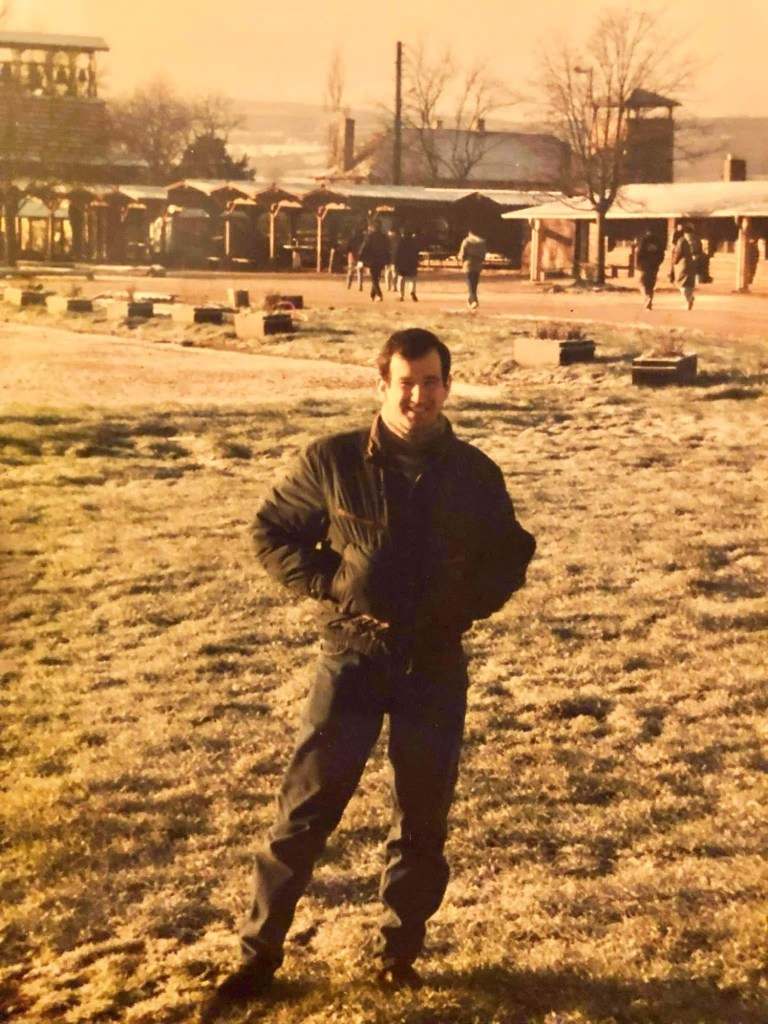
This is me in Taizé shortly after my arrival, perhaps January 1995. A new Lithuanian friend who was a former draftee in the Soviet Army took the photo for me. I finished my own US Army commitment in 1994. Enemies can become friends.

“Ah, Taizé, that little springtime,” remarked Pope John XXIII about the ecumenical monastic community nestled on a hill in Burgundy, France. Being there definitely was a springtime experience for me. I have recently been thinking about my time there a lot. For, I moved to Taize’ in France on December 5, 1994 – 30 years ago! 

I first met the brothers escorting Mary Washington College students to their first large meeting ever held in the US at Dayton University. Several thousand young adults from across the US gathered across denominational lines. As part of “the Pilgrimage of Trust,” we stayed with local families where conversations would continue. 

I had no idea how my heart would open when I first volunteered to go as a chaperone and participant. My experience changed the way I looked at life and the Church – how I understood myself as well. People sharing their faith, positive interactions with people who were previously “other” to me, and a more intimate prayer life energized me. 

I read much about the Ecumenical Community of Taizé and from Br. Roger, the founder, after that. I continued to pray with chants at home and with friends. I went to a few smaller regional meetings. It slowly became a part of me. I’d even catch myself singing their chants (ultimately prayers) as I drove to emergency calls or in quiet moments of my day. Like the prophet, Nehemiah, my prayer life and work life merged. I found myself praying all the time. As I found more peace, I became more patient and discerning when working with others or arresting people. I discovered peace even when amidst the thick of things. Even my sergeant noticed the change. He said during my review, “I don’t know what you are doing, but keep it up.” I think it was more what God was doing in my life, but his observations affirmed for me that I was in a better place and heading in the right direction. Whatever my future, God was with me.

All the while, I began to wonder if I was being called to become a brother. When younger, I had investigated becoming a priest while Roman Catholic. Yet like many young adults, with unaddressed trauma, grief and sin from the past, I had wondered far. I finally became open to radically trusting God after a crisis. Thanks to seeds planted in my past, faith-filled friends, and intentional spiritual, mental, and emotional work, I found my way back home. The Dayton meeting came when the time was right and catapulted me forward toward a new, radical trust in God. Now, I also understood the Church was more than my denomination. I came to believe my past errors need not hold me back. I was and remain forgiven and free. I became determined to address the issue of serving in the Church once and for all wherever God might lead me. For God had been faithful to me, and again, I trusted the Spirit would set me on the right path. 

During this time of growth, I had come to know Br. John. Br. John is one of the community’s American brothers, and he is often asked to go abroad. He had introduced me to a Croatian immigrant in Alexandria who hoped to have a meeting in the DC region where I then lived. Certainly, I would help! It proved such a special event. Only about 100 attended, but the impact was similar to my time in Dayton. As I spoke with Br. John during a break, I tentatively told him of my vocational search over the years – on and off. My friend Tony and I would be visiting Taizé in France for the first time, and I wondered – although I can’t sing well or speak French – maybe there was still an answer for me there? 

Brother John did not laugh at me as I feared. I was not rejected, but instead taken seriously in my search. Although I had not been before to the community, Br. John said that as I was in a different place than many in my search (I had done a lot of work regarding my repentance, healing, and discernment) perhaps I should spend a week in silence. I still would go to the three daily prayers. I would have moments of conversation. Yet mostly, I would spend time in silence or speaking with my future contact brother, Br. Francois, who would serve as a kind of spiritual director. (He was an early brother, and much later, I learned he was also a Lutheran pastor.) 

My contact brother, Brother Francois

Of course, most of my time was indeed spent meditating on scripture, praying, or going for walks. Yet, I was invited to eat with Br. Roger and the brothers once during this first visit as well. A brother who did not know me introduced himself and said, “You are in a week of silence aren’t you?” I said yes, but asked how he knew. He said that people experiencing a week of silence often had a glow about them. (Although I did not understand it at the time, I would later see that glow on other faces.) My growing trust and peace showed.

As my week closed, I told Br. Francois that I thought perhaps I should come for a longer time for more discernment. This would necessitate my resigning from the police department. My eyes and heart had opened wider, so I understood it was time to take a leap of faith. I felt pulled there. He said after a short time of discussion, “We cannot know yet what the answer will be, but we have similar hearts. You must come.” And so, long story very short, I resigned from the police department and came. I began my service as a long term volunteer, “a permanent” in Taize’ parlance, primarily working among the campsites and with meeting preparations. 

Upon arrival, I continued to meet with Br. Francois, and there were many, many more important friendships and memories made during my time there including at the Paris European Meeting with over 100,000 young adults! 

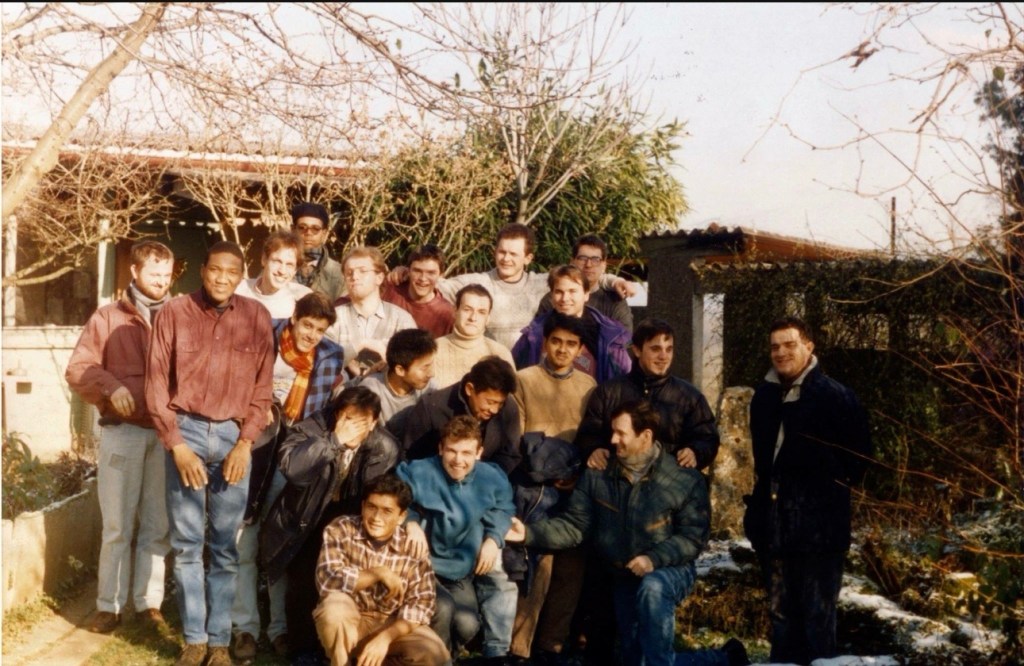
A group photo of the male Permanents at the time from all over the globe. Br. Mathew, a “young brother” in charge of caring for us, is now the Prior of the community (far right). Great memories!

Yet after about seven months, it became clear that I was not to stay, but I never doubted that I had been called there. I came to that little hill, and I saw Christ more clearly than ever before. I just now knew he was calling me to something else. Back to the valley for me! This led me to other people, and thus more new understandings of God’s love, but that’s for another time to share. 

I have not been back to what I still consider my spiritual home, but my wife, Kristine, and I did make it to a European Meeting in Barcelona. (It was the last time I saw Br. Francois. He died a few years ago.) I also was able to welcome Br. John and Br. Emile for a meeting at my church in the Richmond area in 2019. I hope our paths will cross again, but as I have written to my many dear fellow volunteers now across the globe, it’s ok if I don’t meet them again. I still sense the deep, living communion which we share any time I hear Taize’ chants, see a photo, or think of them. The Spirit works this way among the Church, a communion of saints. That communion spoken about in the creeds of the Church is tangible.

Yes, we are together still. It’s hard to explain, but it is true. I trust – thanks be to God – that it will be so forever.

“The Hill,” the village of Taizé in Burgundy, France.

Reflection expanded upon from a Facebook post shared on the 30th anniversary of my arrival to the Ecumenical Community of Taize’.

© 2025 The Rev. Louis Florio. All content not held under another’s copyright may not be used without permission of the author.

2 Comments

Filed under Memories

I will try to trust in God

Original image by Annie Spratt on Unsplash. Used by permission.

[Job cried out,] “Though he kill/slay/murder me, yet will I trust in him” (Job 13:15a).

The world seems a scary place right now, filled with violence, fear, and grief for many. (To some extent, this is always true, but it is harder for me to ignore evil as I write.) Hamas terrorists have just mercilessly attacked Israeli civilians. Israel in return is preparing to enter Gaza. I’ve seen some people call for a nuclear response. I’ve witnessed neighbors turn on neighbor. War might spread. Things are grim, and we might feel a bit like Job. “Is God against us? Why are we suffering? Where is God?”

Evil can be prevalent in the world and capture our vision at times. It can blind us to God’s love, but we are promised by Jesus that God is always reaching out to save us. As a Christian song (Hallelujah, You are Good, by Steven Curtis Chapman) proclaims to God in an early version, “You are with us, You are for us, Hallelujah, You are good.” This song was written sometime after the musician had lost his beloved daughter in an accident. A sibling backed over her as she played in the driveway, and his daughter died.

What kind of faith is this that can trust even when one’s heart is broken? It is the faith we are invited to share. It is a faith in a God who promises to bind up the injured, heal the sick, and free the captives. It is faith in a God who comforted Joseph in prison and freed his descendants and extended family from slavery. It is faith in a God who was willing to die for us, so that we can truly live.

Yes, as the song says, faith will give way to fear at times. We won’t always feel God near, and what we dread most might come to pass (and with it tears). Yet, Steven Curtis Chapman and his family decided to seek to trust God’s heart, a divine heart that seeks to embrace us in love and give us new life. This is a bit of the faith of Job who lost all his family. There was no good reason for this evil and loss. Job could not understand. He was in shock and despair. Despite his tears and pain, he worshipped God anyway. He strove to trust, and he recognized evil does not come from God, a God who we learn from Jesus is only love. No, God is our Comforter, and God will be made manifest to us in times like these. “Even now my witness is in heaven; my advocate is on high” (Job 16:19).

I don’t know answers to the pains of this world – perhaps only hints at best – but I know our Redeemer is alive and lives for us. We are told this by God repeatedly. And I know as the Body of Christ, called, claimed, and baptized, we must remind ourselves and others amidst our pain that God is with us always. We can show this through words and deeds as we seek to share hope with the hopeless – even as we might struggle with hope ourselves.

Facing the calamities of his own time, a prophet once said on God’s behalf, “Remember the former things of old; for I am God, and there is no other; I am God, and there is none like me” (Isa. 46:9). Age to age, God remains the same, and it is this same God who loves us now. And so, with Job, I place my “hand over my mouth.” I will try to wait, watch, listen, and trust. I will seek love my neighbor as myself. Death has already lost, and in Christ, we have already won. Hallelujah, God is good. God is ours. And may we never forget, we remain God’s forever. This truth can give us courage.

Originally submitted for publishing in the November newsletter of Christ Lutheran Church, Fredericksburg, VA.

© 2023 The Rev. Louis Florio. All content not held under another’s copyright may not be used without permission of the author.

Steven Curtis Chapman’s song….

https://www.facebook.com/plugins/video.php?height=314&href=https%3A%2F%2Fwww.facebook.com%2Fsaddlebackchurch%2Fvideos%2F10155101538943544%2F&show_text=false&width=560&t=0

Leave a comment

Filed under Pastoral Letter

Death is in the air

This image has an empty alt attribute; its file name is smoke_lent5c_incense_710x340px.jpg

The following is a sermon preached at Christ Lutheran on the Fifth Sunday of Lent, April 3, 2022. You can listen to the audio of the text here (recorded at the 9 am worship service) or watch the video from the 11 am worship service posted below. Photo credit: Pascal Meier on Unsplash; licensed under CC0 as found at WorkingPreacher.org.


Grace and peace to you from God our Father and from the Lord Jesus Christ. Amen.

        When we think about this passage…if I were to ask you as I did our weekly Bible study group what stands out to you…it is likely that two answers would emerge: 1) the selfishness of Judas; and 2) the lavish generosity of Mary. In the same room…facing the same future possibilities…there’s a clear tension here between Judas who is false and Mary who is true. And within that tension, we have a scene also pointing us forward. Mary’s washing of Jesus’ feet foreshadows the time when Jesus will wash his disciples’ feet in loving service. Judas’ desire for money prefigures the time when he will betray his friend for thirty pieces of silver. And in this situation, we are also reminded of our own.

        Yes, John shares this scene with us…not just to report history…but to help us wrestle with our present and future. We are in that very room in a sense to stare down death with Jesus. In the face of current or upcoming hardship, struggle, or loss – and in life we experience all these things for we cannot avoid them – will we choose the extravagance, pleasure, effusiveness, and exuberance of Mary’s choice, as one pastor[i] calls it, or will we be overly concerned with self-preservation, practicality, and getting what we think we deserve? Will we echo Mary’s loving actions in our life, or will we choose Judas’ path? What will be our legacy? Each and every day, if not moment, we must choose between death and life…selfishness and generosity…isolation (with its me first attitudes) or community (loving God and neighbor as oneself).

        If life were a dinner party, it certainly would be like the room we enter through this story today. You see, the stench of death is in the air of that room, just as it lingers and taunts us in our lives. Remember, Jesus has announced he would be entering Jerusalem even though he knows he will die. Much as Thomas verbalizes elsewhere, Jesus followers expect to perhaps die with him. At the best, they know whatever comes will likely hurt. Lazarus, who was only recently raised from the dead was there eating with them. His presence is a consistent reminder of death. Judas is a prime mover in today’s passage. For the early Christians who heard this passage just as we have, they know what he will soon do. He is a betrayer and false friend. His actions no matter how one might rationalize them or try to understand them helps lead to only one outcome…Jesus’ crucifixion…and perhaps Judas might remind us of people who have been false to us…or how we have been false to others. And the smell of that perfume – oh, that perfume – one used commonly for preparing the one you love for burial…it lingers thickly, perhaps suffocatingly, in the air. Some dinner party! If you have ever said a final goodbye to someone you love, you know a bit of what it was like to be in that room.

         Now, I know I likely have a different intimacy with death than some of you. (And, I don’t share this to shock you, but it helps explain my point of view.) I first encountered death in kindergarten. Death was part of the daily reality of my military and police service – potential death and actual death as when a police colleague of mine was violently slain – and in total, in and out of police work, I have had four people – four people – I know and love who have been murdered. I later served as a hospital and hospice chaplain accompanying people as they died. In doing so, they have become part of me, because I came to love them. In my missionary work among Native youth, I had children die…children die…long before what should have been their time. Yet, despite all this experience with death, I do nit and will not claim any comfort with death. (It is always uncomfortable and painful, no matter how hard we might try to hide it.) I don’t claim to understand all about it. (No one can.) Still, I do seek to accept a Lenten, hopeful, realism about it. (Yes, it can be hopeful.) “Remember you are dust, and to dust you shall return.”

        With that in mind, let me explain further. I recall an older friend who was immensely popular in his region; loved and respected for his work, generosity, and loyalty. He was a steadfast friend and loving person, so as people were sick or entered the hospital, he would surely go visit and offer support. And if they were to die, he would be there to grieve, but also to honor the love shared with his friend by seeking to extend that love to the friend’s family and other mourners assembled. Yet as he aged, and more and more friends died – and he had so many – he felt like he was always going to funerals. It was rightly depressing. And one day he asked me about it. It seemed sort of unfair…hard to escape. Why does God allow so much pain in the world? Why does the smell of death linger so?

        I don’t know in detail the answer to his question, but I did point to Jesus. He humbled himself to share in our life and our death. He suffered for our sake, so that we could live eternally. He chose to love in the face of misunderstanding, rejection, and outright hatred for our sake. Whatever the cost, even death, Jesus chose to love everyone. And in accepting his death on the cross, he knew that it could only lead toward more light and love than we could ever dare hope for.

        Somehow, mysteriously, God has a plan to restore us from our fallen, sinful, selfish nature, into the children of God. Part of that plan is for us to follow Jesus in faith…into and through death…accepting our own sacrificial crosses on the way…and in the manner we choose to love God and others…in the way we pray and live…“Father, not my will, but your will be done.”

        No, we aren’t ever to accept death any more than Jesus does. We don’t seek to accommodate it. And we certainly don’t ignore it…Death is in the room…but as Christians, we choose to resist and fight death. Now, we don’t do so by clinging to life (selfishly, desperately holding on). Instead, we choose to surrender our lives. We offer our lives – our body, mind and soul and all that we have – because death has absolutely no real and lasting power over us. We can always choose to love. There is a grief author (Megan Devine) that observes: “When we choose to love, we chose to face death and grief and loss, again and again and again. Just as much as we welcome the friendlier parts of love, it’s all there, present and contained in everything.”

        Yes, Jesus says there will always be poor with us, but we are to choose to share what we have with them anyway. There will always be war until Jesus comes again, but we are asked to seek and nurture peace instead. There will always be disease, but we are charged by Jesus to comfort the sick and dying. We are to do so because even with the smell of death persistent in our nostrils…death is not the only thing in the room. Jesus is there too…the one who has conquered sin and death through his resurrection and who will not rest until sin and death is utterly destroyed…trampled underoot…gone from our lives forever.

        As the disciples gathered, they had every right to be sad. Jesus had made it clear that they were about to face some very difficult days ahead…just like us. (We cannot avoid this condition, try as we may.) Thus, let us find courage as we remember that in the face of death, God has chosen to gift us with life. We bathe in the grace of baptism where it is God  – not the pastor – who baptizes us and claims us forever. We eat of it at the Lord’s Supper, where again we truly encounter the very real body and blood of Jesus along with forgiveness of sin and promise of eternal love and life. We meet and interact with Jesus as we gather as one body…in the best of times and worst of times, never alone…for Jesus promises to be with us whenever two or three gather in his name. More than that, he promises to be always with us with his ever-present Spirit finding a home in our hearts.

        Graciously, we walk wet through the power of our baptism[ii] – claimed, empowered, and loved by God – throughout our life and beyond our death. For as Luther wrote, baptism is that “which delivers us from the jaws of the devil and makes us God’s own, suppresses and takes away sin, and then daily strengthens” us. Baptism remains always efficacious to us, for even if we were to fall away, Jesus loves those entrusted to his care. He will constantly seek us out. Baptism empowers us to love in the face of death, because it along with the Lord’s Supper gives us the grace which we need to help us daily choose to love as God loves us. These Sacraments change us and our experience with death. For nothing, not even death has the power to separate us from a love like Jesus has for us. In Jesus, God remains extravagantly, lavishly, effusively generous to us.

        Yes, “Remember that you are dust, and to dust you shall return.” Yes, the stench of death is in the room, and it seeks to accost our sensibilities and frighten us. Lent reminds us of this. And yet, that is not everything we are to remember…We are to remember Jesus…I think Professor Powery of Messiah College summarizes this passage and the daily choice before us well. “John 12 is a reminder that death will not have the final word. Lazarus is a reminder of that promise, even though his human body will die again. The ointment is a reminder of that promise. The people who gathered for another meal are a reminder of that promise. The prepared, anointed body of Jesus, of course, is the ultimate reminder of that promise. Death will not have the final word. During the season of Lent, we remember that death will not have the final word.”[iii] Amen.

The recorded 11 am worship service can be found below. The service starts at about the 7:30 minute mark…


[i] Skinner, M. (March 21, 2010), Commentary on John 12:1-8. Downloaded from https://www.workingpreacher.org/commentaries/revised-common-lectionary/fifth-sunday-in-lent-3/commentary-on-john-121-8  on April 1, 2022.

[ii] Bishop James Mauney of the Virginia Synod used to often preach about the ongoing power of our baptism by proclaiming that we “walk wet.”

[iii] Powery, E. (April 3, 2022). Commentary on John 12:1-8. Downloaded from https://www.workingpreacher.org/commentaries/revised-common-lectionary/fifth-sunday-in-lent-3/commentary-on-john-121-8-5  on April 1, 2022.

Many thanks to Professor Powery for his splendid essay on Working Preacher which very much served to inspire this sermon and me. Death is truly in the air, but it does not have the final word.

[iii] Powery, E. (April 3, 2022). Commentary on John 12:1-8. Downloaded from https://www.workingpreacher.org/commentaries/revised-common-lectionary/fifth-sunday-in-lent-3/commentary-on-john-121-8-5  on April 1, 2022.

Many thanks to Professor Powery for his splendid essay on Working Preacher which very much served to inspire this sermon and me. Death is truly in the air, but it does not have the final word.

Unless otherwise indicated, all scripture quotations for this post are from the New Revised Standard Version (NRSV) translation.

© 2022 The Rev. Louis Florio. All content not held under another’s copyright may not be used without permission of the author.


Leave a comment

Filed under Sermon

Another Christmas in “No Man’s Land”

One of my favorite Christmas stories comes from World War 1. As the troops on opposing sides prepared their trenches for a meager Christmas, the story goes, the Germans put up Christmas trees and began to sing “Silent Night.” Amidst all that suffering, death and decay, a little light broke in at least for a time. The British troops facing them began to respond with well wishes and songs of their own. Eventually someone (no one is sure who) decided to take the very real risk of reaching out across No Man’s Land. An informal, unapproved, and joyful truce began that lasted several days until the powers that be regained control.

As we enter Advent and Christmas, we once again do so amidst travail and trouble. There’s darkness seemingly surrounding us and perhaps enemies of all kinds – economic, political, health and family issues of all kinds. And yet, the world needs someone to step out and declare the new reality of Jesus’ birth once again. There’s a risk to it, I suppose. Some might think we are frivolous or blind. “Don’t you see what’s going on around us?” “Why, yes, I do,” I would reply, “Jesus has brought light into the world, and the powers of darkness are on the run.” I think that’s worthy of celebration. It might warrant putting down our weapons of harsh words and judgement of our neighbor to take part in God’s songs of reconciliation and peace. God wants us to enter the No Man’s Land before us to declare that Jesus has been born for us and for all. We need not fight anymore. We need not listen to our fears. Love has spoken the final word. His name is Jesus.

Kristine and I wish you a joyous Christmas. We know that it has been a hard year (plus) for many of us, and there might be more challenges ahead. In such a context, the light of Christ might seem to come and go, but make no mistake. On that Christmas long ago, Jesus entered our world with all its troubles, and he is still here at work. A bright and constant dawn lies before us. As in the old Christmas hymn, Good Christians All, Rejoice and Sing, let us sing with our lives, “We praise in songs of victory that Love, that Life, which cannot die, and sing with hearts uplifted high: ‘Alleluia! Alleluia! Alleluia!’

Merry Christmas, dear Church. All is well, because we have Christ’s love, and we have this time to rightly celebrate. I pray it proves among your best Christmases ever.

Originally published in the December 2021 newsletter of Christ Lutheran Church, Fredericksburg, Virginia.

© 2021 The Rev. Louis Florio. All content not held under another’s copyright may not be used without permission of the author.

Leave a comment

Filed under Pastoral Letter

A sign of hope

Photo by author using Iphone11 Promax. All rights reserved.

Do not fear, for I have redeemed you; I have called you by name, you are mine.” Isaiah 43:1b

While taking Boomer for a walk yesterday, I caught sight of what appeared to be a red fireball in the sky. Only, it was not the sun or a meteor. It was the moon! I’ve seen reddish colored moons before, but I don’t recall ever seeing anything like this. The first thing that popped in my mind was a prophesy shared by Joel (2:31), “The sun shall be turned into darkness, and the moon into blood, before the great and terrible day of the Lord.” Yet in mere moments, I thought better of it. Fires in the west have caused a great plume of smoke to pass over our state, and refracted light likely caused the fiendish, end of times worthy glow. There was nothing to fear.

It is funny how quickly our minds can go to the most frightening or worst-case scenarios. Yet most often, our expectations prove wrong. Much like the Halloween costumes so popular this time of year, look under the mask or hood, and we find nothing threatening. We might even find a friend. I think Jesus would love us to approach all our troubles in a similar way. Even when we cannot figure out an answer on our own or trouble hangs around, Jesus has said in varied ways, “Let nothing trouble you. Trust in me.” Indeed, at just the name of Jesus, demons are said to flee. That might not prove so with all our earthly troubles – at least not right away. Sometimes, troubles of this life stick around with seeming finality. Still, Jesus says, whatever we hear or see, he will be with us, and we have nothing to ultimately fear even if we face death itself.

Martin Luther argued that our faith and baptism makes all the difference. It is like an eternal lifeline that nothing, not even our own sinfulness, can cut. “In this faith,” Luther says, “I stand and live. I eat and drink, sleep and wake, rule, serve, labor, act, and suffer, all in the faith that I am baptized.” And through our faith and baptism, the Spirit claims us and will never abandon us. Indeed, God will make good come from even the biggest bad because we are loved. How can a vine which is connected to the branch called Jesus not bear fruit? How can pure love ever let us go? That’s impossible! Luther ponders, “The life of such a person, whether great or small and no matter what it is called, is nothing but fruit and cannot be without fruit; for in Christ that person has been born into a new existence, in order to be constantly full of good fruit.”

With fall upon us, we are in a season of growing darkness. With the news, some might suggest our days are dark too. Yet, this is also the season where we harvest fruits of the earth. Jesus has saved us, and he will continue to save us. Our call is to trust that no matter how dark the days of our lives might grow the good fruit that we are shall never be cast aside. We belong to Jesus.  

Originally published in the October 2021 newsletter of Christ Lutheran Church, Fredericksburg, VA.

Unless otherwise indicated, all scripture quotations for this post are from the New Revised Standard Version (NRSV) translation.

© 2021 The Rev. Louis Florio. All content not held under another’s copyright may not be used without permission of the author.

Leave a comment

Filed under Pastoral Letter, Uncategorized

Always a Blessed Easter

CHRIST’S DESCENT INTO HELL, Nun Kassiane at the Holy Monastery of the Annunciation, at Patmos island.

I want to thank the many people that reached out to me or prayed for me and my family at the time of my mother’s death. Her death was not expected, and as can often prove the case, it was a difficult experience on many different levels. As I write, the trees in my yard are about to burst forth with green. Flowers are poking through the ground. Holy Week and Easter lie before us. I cannot explain why God allows suffering and death, but I trust the signs of springtime around us are herald signs of what is yet to come. We know from scripture – and perhaps upon reflection about the grace active in our own lives – that God has the power to bring healing from sorrow and new life from death. God is only love, and Jesus promises that we who believe will share in his resurrection joy. With the losses in my life and in the lives of many around me, both large and small, we might be tempted to see only struggle. Yet, a resurrection day was to come for Jesus beyond his cross. He promises that a resurrection day will come for us all. It has already begun through faith. I sincerely wish you a hope-filled Easter. Jesus is risen. He is risen indeed. I pray we all see the joy and peace of Jesus – even if for a moment we must see through tears in our eyes.

Peace be with you, and thank you, for walking with me toward Resurrection Day.

Pastor Lou

Image: Artwork available on etsy.com, ReligiousIconsGR retains all rights to the above image and icon. I am not associated with the seller and do not receive any benefits from sharing this icon. Order at your own risk.

Originally published in the April newsletter of Christ Lutheran Church, Fredericksburg, VA.

© 2021 The Rev. Louis Florio. All content not held under another’s copyright may not be used without permission of the author.

Leave a comment

Filed under Pastoral Letter

God remembers

O give thanks to the Lord, call on his name, make known his deeds among the peoples. Sing to him, sing praises to him, tell of all his wonderful works. Glory in his holy name; let the hearts of those who seek the Lord rejoice. Seek the Lord and his strength, seek his presence continually. Remember the wonderful works he has done, his miracles, and the judgments he uttered, O offspring of his servant Israel, children of Jacob, his chosen ones. – 1 Chronicles 16:8-13 (NRSV)

After the followers of David defeated their enemies and settled in Jerusalem, David wanted a place for the Lord to live among God’s chosen people. At first, the Ark of the Covenant was brought to a specially prepared tent pitched centrally among them. David’s instructions echoed the formation the Israelites had used under Moses as directed by God to travel through the wilderness. The central placement of the Tent of Meeting was to symbolically remind them that God’s ways must remain central in their individual, familial and communal life.

The Israelites had been through a precarious time, but God had led them this far. More difficulties certainly lay ahead, but they trusted God would continue to lead them. Their vision remained clouded and eclipsed by challenges of many kinds including their own sinfulness. Yet as has always been true for those who trust in God, “for you who fear my name, the sun of righteousness shall rise with healing in its wings” (Malachai 4:2a). No matter the time or place, we are to seek God, give thanks, and try our best to share the light of God’s grace and love as called and able, because God continues to know, claim and love us.

As our own way forward seems currently clouded by pandemic fears, social injustice or unrest, and perhaps other doubts galore, remembering the past faithfulness of God’s love at work in our lives, our family, and within the history of our family of faith can prove helpful. As we have talked about before, among the many words God offers us through scripture, we find the word “remember” to be among those most often used. The same God who loved us and our forebearers of the past, loves us now, and God promises to love us for eternity. The proof? We can find it in God’s steadfast love for us throughout the ages.

Life will be hard, and our way forward remain uncertain at times, but God is with us and at work. We are chosen and claimed, placed in this time and context, to reflect God’s own light while being used to help fulfill God’s plans for all people. Through our faith and baptism, God has forgone a tent or building located in the heart of a community and desires to reside in and work through our hearts instead. God has prepared a place in us because God always remembers us and longs to be with us. More wonderful works, miracles and judgments are surely yet to come. 

Originally published in the July/August 2020 newsletter of Christ Lutheran Church, Fredericksburg, VA.

© 2020 The Rev. Louis Florio. All content not held under another’s copyright may not be used without permission of the author.

Leave a comment

Filed under Pastoral Letter

Of Arks and Ashes

The following is my Ash Wednesday sermon (2020) reflecting upon the findings of the investigation of Jean Vanier, founder of L’Arche, in relationship to our Lenten and life’s journey. It was preached at Christ Lutheran Church in Fredericksburg.

As last week ended, I learned of some horrifying, disappointing, maddening news. A man, Jean Vanier, who had earned enormous, international respect for starting a non-profit centered around those with intellectual disabilities…who was deemed a living saint by many and inspired a worldwide movement…whose books were often assigned reading in seminaries and among social workers…who was known to be friends with Mother Teresa, Br. Roger of Taizé, Popes and Archbishops of Canterbury as well as international political figures…was discovered after his death to have misused his place of authority to abuse at least six female coworkers or volunteers who had come to him for spiritual care. He had used his position of trust not only to do good over many years – and there was and still remains much good being done in those communities called L’Arche – but ultimately, he also greatly harmed others who were extremely vulnerable. His actions still negatively impact those victims’ lives and likely will for years to come. The sin perpetrated, as sin always does, had a ripple effect. Many of those who looked up to him or were inspired by him suddenly felt violated themselves. Their volunteering or vocation, perhaps even their personhood, felt threatened. Their faith itself often came under assault. If this supposedly great man couldn’t be trusted, then who can be? People are rightly grieving openly at their sense of betrayal, disappointment, anger, and loss.

I didn’t personally know Jean Vanier, but I have known throughout my later adult years many who served in L’Arche…who are L’Arche. I worked very closely with those who formed L’Arche Metro-Richmond as they sought to successfully create a community where people with and without intellectual disabilities can be found living, working, praying, and playing together. That’s a good thing, the work of many loving people and not just one person. Ultimately, I believe the love and joy found there is evidence of the Holy Spirit at work. The Ark (L’Arche means “ark” in French) might be badly scorched, but it hasn’t been consumed. It is a work that must remain ongoing no matter who might sin and fail among us or in whatever new form the future might bring. God intends to make good come from even the ash heaps of our lives.

I remain glad that my faith is in Jesus and not in humanity. I learned as a police officer long ago that people can always let you down, sometimes in shocking ways, as they struggle with their own darkness….or perhaps start perpetuating wounds they themselves have received. Knowing this doesn’t make it easier when we are hurt by sin, but it might help us accept that bad things can happen to good people in a fallen world. In time, it might even help us forgive or move forward.

The failures of others to love need not stop us from looking to Jesus who asked us to serve as light among the darkness. This is a real darkness at work in the world often through ordinary people. Yet over those years, I also came to recognize that sin and death were also always at work in me. That’s why I came back to the Church. I needed more than just comfort or correction, some plan for doing better. I needed grace, forgiveness and salvation. I needed it not just once, but time after time each day. The darkness that we face or struggle with as Church should never keep us from striving toward the Light which is Jesus. You see, God desires to help us. Its why Jesus came to us.

That human condition reflects a bit about why we gather here tonight. No matter who we are, we as Lutheran-Christians understand that we are at our best sinner-saints. We tend to be bent inward on ourselves, Luther argued, always struggling with sin and never proving quite enough on our own to be the people we hope we can be…the people God desires us to become. Whether large sins or small sins, they come with a cost. We separate ourselves from God and neighbor. We hurt others, sometimes unintentionally, but its real hurt none the less. We experience the heavy reality of sin through bullies in school and negative, condemning self-talk in our heads, in addiction, misuse of what God has given us (even friendships and family relationships meant to be a gift from God are abused) and so much more.

This is largely unavoidable as humans, but it isn’t because we are a total mess or unredeemable…it is because we are human. Still as much as we humbly accept this fallen reality, we are asked by God to accept even more. We are fallen yet loved humans. Each year as we enter Lent, we are asked to contemplate how Jesus suffered and died for us (“for our sin” some say) in order to free us from the power of sin, death and the Devil. We are invited, not forced, to practice the disciplines of Lent: to cooperate with the grace offered us through prayer (justice towards God); fasting (justice towards self); and almsgiving (justice towards neighbors). We are called to repentance, to serve others, to offer ourselves up before God and ask God to transform our lives and community. God does so through his Spirit; making us holy.

In the early days of Christianity, the ancient practices of mourning in sackcloth and ashes became a new symbol of this season called Lent. It is a word meaning springtime, and it is meant for renewed life through loving God and neighbor as ourselves. Its not that we are asked to literally sit in ashes and dress in sackcloth like the prophets of old, but we are invited to receive a small cross made of oil and ash on our foreheads. Much like those who had been excommunicated in the early church for grave sin, we wear ashes as a sign of our modern regrets and hope for restoration. We remember the promises of our baptism where, yes, we made promises to God…promises we often fail in…but also where God made lasting, perfect promises to us. The Holy Spirit has claimed us. We have become by God’s power and proclamation beloved children of God, and God will never let us go.

I will never condemn anyone for crying over sin in the world or in ourselves. We have much to regret, and life often hurts. There’s much evil to contemplate, fear and cope with. Still, all is not lost. Jesus suffered and rose for our sake. The cross he bore…the life we live with all its problems and our fears…leads us to one certain end… Resurrection Day with a new and eternal life shared with Jesus.

As Paul so powerfully argues, we are as the dying, and see, we are alive. We might seem to have nothing, and yet we have everything. Yes, we have the love of Jesus, our Savior, our Redeemer, our God. We can open wide our hearts to God and neighbor with courage, even as we might grieve sin and death. For with God, all things are possible including new starts and our salvation as gift. No matter what we see, feel, or fear, we can trust that God is making all things new. We can trust in Jesus even when we cannot trust ourselves. Amen.

© 2020 The Rev. Louis Florio. All content not held under another’s copyright may not be used without permission of the author.

Leave a comment

Filed under Sermon, Uncategorized

Among the Ashes

The Hub, April 17, 2019

Image (c) Mirror.com.uk find their original article here.

Perhaps like many of you, I watched the burning of Notre Dame with great sadness. Whether we have been there or not, it remains an enduring part of our shared cultural heritage. Yet, we also should ponder signs of hope among the ashes: in the bravery of the firefighters striving successfully to preserve the main structure; in the crowds gathered kneeling, praying and singing together; and among the ruins, finding a cross preserved and shining forth from the ashes.

Although we do not know the cause of the fire yet, people are already coming forward to fund the rebuilding of this cathedral. The heart of the building, its faith community (and their connection to the communion of saints reaching far beyond Paris), lives on. This all reminds me of a sacred promise, “The light shines in the darkness, and the darkness did not overcome it” (John 1:5).

This is a statement of what was, what is and what yet shall be through the power of the ancient events of Holy Week and the first Easter. It’s a power alive and at work in our community and in all who believe. Our world needs signs of Christ’s light amidst so much ash and decay. Through our fellowship, service and worship, God is doing something new. Jesus, who shared our sorrows, will share his risen joy.

Please be with us, in prayer and in person as you are able, this Holy Week and beyond. For our decaying world needs to find such signs of hope. People need to see that Christ is truly risen and alive in us, and its likely we need to be encouraged in our faith, hope and love as well. For dust we are, and unto dust we shall return, but we remain in sure and certain hope of the Resurrection to eternal life, through our Lord Jesus Christ. Amen.

Christ Lutheran’s (Fredericksburg, VA) worship schedule for the Triddum can be found at:
http://www.christ-lutheran-church.org/

Originally published in The Hub, a weekly email of Christ Lutheran Church, Fredericksburg, VA.

© 2019 The Rev. Louis Florio. All content not held under another’s copyright may not be used without permission of the author.

Leave a comment

Filed under Uncategorized