Tag Archives: Jesus

Jesus is Risen! Now what?

empty_tomb

We welcome Easter morn with shouts of “Jesus is risen. He is risen indeed!” As they echo through our sanctuary, I wonder if that truth will continue to resonate through our lives. Jesus is risen, we proclaim. His resurrection is to be a new, ongoing reality for us; one that changes our actions and very being. This is present tense, touching our here and now; in our lives, our world, and his holy universal church.

Yet like those first disciples surprised by the empty tomb, we can instead get lost in that past moment of time. The resurrection tends to serve as a historical marker rather than a living sign for our present reality. We remain stuck in our shock and fear trying to make sense of things. What can such a resurrection mean? Perhaps more so, what can it mean for me?

Soon after that first Easter morning, Peter preached that Jesus was not abandoned to the realm of the dead, nor did his body see decay. Paul explains to us in many of his letters that through faith the power of that resurrection makes us a new being, a child of God, and we will be heirs to Christ’s victory to share in that resurrection forever.

This is all true, yet neither great Apostle came to understand the resurrection as a singular past event or one all about our far off future with Christ. Instead, the Risen Christ and the Holy Spirit woke them from their initial shock. It was revealed that they were to share in the living resurrection for eternity – starting now. Christ’s light is to shine through us as we walk with him and talk with him, but unlike that old Gospel song (In the Garden), we cannot tarry there.

Jesus instead tells us, “I have come that you may have life, and have it abundantly.” This resurrected life isn’t one found by standing alone; mute and in shock. It isn’t a life solely about what Jesus can do for us as individuals or a community. It calls us to action.

The resurrected life that we are invited to share is one of living relationship. It is one of service, fellowship, and corporate worship. It is one where we seek to follow Jesus each day and introduce him to others. It is one where we might even be called to share in the sting of Christ’s sacrifice and cross out of love.

Let’s not just stand here pondering. Let’s live like we believe in the resurrection. As the Father has sent him, he sends us now. Among the greatest miracles, Jesus has chosen to make the resurrection universal and eternal through our own unworthy love and lives. We must now go and share that miracle with others, for Jesus is truly risen in us. We are to live as his risen body, a resurrected people, forever – starting now.

Christ’s peace be with you always,
Pastor Lou

Unless otherwise indicated, all scripture quotations for this article are from the New Revised Standard Version (NRSV) translation.

© 2013 The Rev. Louis Florio. All content not held under another’s copyright may not be used without permission of the author.


2 Comments

Filed under Church History, Lectionary, Liturgical Year, Pastoral Letter

Where in the world was Jesus on Holy Saturday?

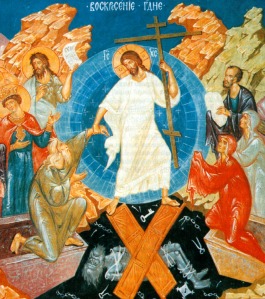
Harrowing of Hell
Harrowing of Hell

As the Passion ends, we leave with Jesus laid in the tomb. Was he asleep? No, scripture clearly strives to prove and proclaim that Jesus truly died on that cross. Did he go to heaven? Actually, scripture leads us to believe that Jesus was somehow still miraculously at work but not in heaven.

Our Lutheran confessions state that “we believe simply that the entire person, God and human being, descended to Hell after his burial, conquered the devil, destroyed the power of Hell, and took from the devil all his power.” (See Solid Declaration, Art. IX.) Luther seems to have believed it an ultimate mystery that Jesus descended. Nothing tells us if he did so in “humiliation” or in glory, but we should just believe the faith in which we baptize (see the Apotles’ Creed: Jesus descended into  sheol – in Hebrew the place of the dead, sometimes called hades).

Early Christianity believed this and scripture alludes to it in such passages as 1 Peter 3:18-20: For Christ also suffered for sins once for all, the righteous for the unrighteous, in order to bring you to God. He was put to death in the flesh, but made alive in the spirit, in which also he went and made a proclamation to the spirits in prison, who in former times did not obey, when God waited patiently in the days of Noah, during the building of the ark, in which a few, that is, eight people, were saved through water.”

In the Old English, harrowing was the term used to describe Christ’s descent. Ancient icons often show Jesus amidst previous saints of the Jewish Testament, standing on the gates of sheol now opened. The gates are often an “X” or Chi in Greek, reminding us that Jesus is Χριστός, or Christ – the Annointed One and our Messiah come to save us from sin, death and the Devil.

Christians may debate whether Jesus entered triumphantly or suffered more indignities, but mainstream Christianity looks to both scriptures and the faith handed down to us. Jesus’ entrance into the grave was not the last of his journies for us. With sundown, his burial was complete. The Jewish sabbath had begun, and Jesus went to work. The Saturday of our Holy Week is indeed good (holy), and we rightly rejoice even as we wait for the Day of Resurrection. Jesus has come to save all his people.

Unless otherwise indicated, all scripture quotations for this article are from the New Revised Standard Version (NRSV) translation.

© 2013 The Rev. Louis Florio. All content not held under another’s copyright may not be used without permission of the author.

Leave a comment

Filed under Lectionary, Liturgical Year, saints

Is Lent biblical?

Palm Sunrise at Viera Wetlands (Some rights reserved by photographer, Used by permission)

Palm Sunrise at Viera Wetlands,
by Matthew Paulson
(Some rights reserved by photographer, Used by permission)

The following sermon was preached during our Ash Wednesday service at Messiah Lutheran Church and School on February 13, 2013.

Texts:
Joel 2:1-17;
2 Corinthians 5:20b–6:10;
Matthew 6:1-21

Grace and peace to you from God our Father and from the Lord Jesus Christ. Amen.

Every year as we approach Lent, I am surprised at how many comments I hear or read about indicating that “Lent is not biblical.” When I come across such comments, I bristle a bit. I feel disappointment and frustration, and yes, sometimes even some anger when the person is particularly snarky about it. Of course, it isn’t biblical! No one is claiming that the season of Lent is biblical. It is no more biblical than Christians arbitrarily deciding upon December 25th as a good day to remember Jesus’ birth is biblical – not in the strictest sense anyway.

Yet, I fear these folks are missing the forest for the trees. They are sadly missing an opportunity to be blessed. There is no specific call for Lent in the Bible (no one is arguing that), and still, isn’t it remarkable that the earliest Christians found designating such a season spiritually helpful? During these forty days (not counting Sundays which are remembered as days of Resurrection), special disciplines are encouraged as they serve to nurture faith in the individual even as they might serve to witness to our faith and grow Christ’s Church. This season…a season designated by the community of faith for the good of all and to honor God…was found to be a meaningful, beautiful time of preparation for Easter. So, it became a yearly practice and was given a suitable name. The season became known as Lent, an old English word meaning spring.

Yes as with spring, we may witness new growth and new life during Lent. This is what we hope for during these forty days, but we may prevail upon its disciplines at any time of year. Such disciplines don’t lead to a reward for our goodness. They aren’t something we do to become holy, for we cannot become holy by our own power. Instead, such practices become our opportunity to “live in Christ” – to live out our faith concretely nurturing our love for God and others and thereby offering us a chance dwell in God’s grace and love for us. It is for that reason that we find such disciplines commended in the Law and the Prophets, and even by Jesus himself.

The Psalms[1] are filled with such spring-like imagery as are the prophetic texts[2], and some of Jesus’ own parables[3]. Our life with God is always filled with bounty and blessing, often symbolized by natural things: the streams that refresh us; or the trees that serve as protection or a home for God’s beloved creatures. For the many disciplines of Lent – reflection upon one’s life and repentance, fasting, prayer, and most certainly almsgiving and acts of mercy – they can become like the tall cedars of our faith providing us a safe dwelling place in this world of trouble…a place of comfort and shade, strength and renewal. Amidst their many branches, God embraces us. God can even transform us. This Lenten invitation to take actions rooted in our faith in Christ serves only as a reminder of what Paul said in his letter to the Romans, “God’s kindness is meant to lead us to repentance.”[4] It leads us toward a deepening unity with Jesus, both his life and in his church.

Indeed as someone said recently, “Ashes don’t say we’re holy. They say we’re sinners.” They are to reflect the ongoing prayers of our hearts, “I’ll try to be better. I’ll do what Lent asks: more prayer, more sacrifice, more almsgiving.”[5] Western Christians whether Roman Catholic or Protestant desire to remember their total reliance upon God’s grace. “Remember you are dust, and unto dust you shall return,” we are told. This life is fleeting, sometimes dangerous, and we at our best are only sinner-saints.[6] We need the grace of Jesus Christ to help us make it through. The church as a community, as the body of Christ, commends these practices to us. Through them, we may be built up by God and encouraged to build up one another.

Using varied words throughout Christ’s diverse and universal Church, we hear as much during community worship on Ash Wednesday. For example, the Episcopal Book of Common prayer (not too unlike our Lutheran commendation to a holy Lent heard earlier tonight) rightly proclaims, “The first Christians observed with great devotion the days of our Lord’s passion and resurrection, and it became the custom of the Church to prepare for them by a season of penitence and fasting. This season of Lent provided a time in which converts to the faith were prepared for Holy Baptism. It was also a time when those who, because of notorious sins, had been separated from the body of the faithful were reconciled by penitence and forgiveness, and restored to the fellowship of the Church. Thereby, the whole congregation was put in mind of the message of pardon and absolution set forth in the Gospel of our Savior, and of the need which all Christians continually have to renew their repentance and faith.”[7]

So, we begin this season of Lent with ashes – a broken, struggling people – but also gathered together as one holy people of God. Our sin is systemic, shared and individual, but we are also chosen and loved. God plans for our redemption. In a time of trial for the nation of Israel, Joel commended these same types of behaviors.[8] By their apathetic faith, unholy alliances with powers of this world, and acts of selfishness and sin, the people of God were at risk in those days. They were weakened as a nation by such behaviors, and a terrible plague of locusts put them further at risk – at risk of invasion, starvation, and suffering. Joel hoped that by immediate repentance the advancing threat would be turned aside by God.

Well, hear the Good News! Thanks be to Jesus Christ, we need not just hope. Salvation is ours. Forgiveness is possible, and it isn’t too late. No matter who we are, what we have done or failed to do, the grace of Jesus Christ invites us into his loving arms. These are days not of gloom and doom but of growing light. They are days to be celebrated. Through Christ’s cross, the sin of all who trust in him has been redeemed. His cross previously an instrument of torture and death became for us a forgiving place of shade where we can invite our friends and neighbors to also find rest. Through our baptism, we are clothed in Christ, the finest of garments, given new life and a new family of God. This is much as Zachariah and other prophets have promised throughout the ages.[9] It is a new day, a final age where Jesus is coming back to complete his work, and we are invited. In our hearing, all God’s promises have been fulfilled in Jesus Christ.[10]

As unworthy as we all might be, we are still loved by Jesus! And since we are so loved – loved unto his own death, Jesus invites us to gather, remember, and experience new life: remember our need for God; remember our failings and all the ways we turn away from God; and not least of all, remember all the grace-filled ways Jesus reaches out to us, drawing us back.[11] We have this shared forty-day journey to re-experience Jesus’ parable of the vine and the branches.[12] In this season, we will bear fruit by intentionally striving to remain in the vine which is Jesus. We admit openly that without Jesus we can produce no fruit, and so we turn to him all the more and hold on in faith. We will seek intentionally to better love God and our neighbor. We desire that this dedication and fruitfulness will not fade after forty days but instead last a lifetime. It will be Jesus who will use this time to prune us and bring new life. His light will overcome our darkness, and it will shine more and more brightly.

This is our Lent, our springtime given us as a gift in the present even as we await the eternal Easter of our future. Lent is more than a season of time. It is a call to a way of life, Christ’s way. It goes well beyond the Bible even as it is rooted in it, because together on this journey, we have the opportunity to personally encounter anew the living Word of God, Jesus Christ, our Lord and Savior. Amen.


[1] i.e. Psalm 104

[5] Sr. Mary Ann Walsh (February 12, 2012). Ashes for the unabashedly Catholic. WashingtonPost.com

[6] Martin Luther suggested believers are “simultaneously sinner and saint.” To learn more about this, read this short article: Saints and Sinners: Sin & Forgiveness from 2003.

[8] Joel 2: 1-17. This text speaks of a plague of locusts using quite powerful imagery as if it was an army of God.

[11] Lutheran Church of the Master , ELCA (Troy, MI) , Lenten reflection for Ash Wednesday. 2013.

[12] John 15

The above pastoral letter was originally published in Messiah Lutheran Church and School’s newsletter, The Messenger (June 2013 edition). To view the entire issue of The Messenger or to see the full calendar of events, visit: http://www.mlcas.org

Unless otherwise indicated, all scripture quotations for this article are from the New Revised Standard Version (NRSV) translation.

© 2013 The Rev. Louis Florio. All content not held under another’s copyright may not be used without permission of the author.

Leave a comment

Filed under Lectionary, Liturgical Year, Sermon

Rejoicing in the Light of Christ

Transfiguration of Jesus, Carl Bloch (d.u.)

On Transfiguration Sunday, we remember a very special miracle. Jesus is transfigured – his appearance changes to clearly reflect his divine persona. With him stands Elijah, the greatest of all prophets, and Moses, who was given the law. As Jesus came to fulfill the law and the prophets, the importance of their presence should not be overlooked. Through this miracle, we and the apostles catch a glimpse of heaven breaking into the real world with all its promises. This foreshadows the new heaven and new earth which will surely come through Christ.

Recalling Jesus’ baptism as the season after Epiphany began, we heard God’s voice affirm Jesus as his Son. This last Sunday of the season after Epiphany, God’s voice is again heard proclaiming, “This is my Son, whom I love; with him I am well pleased. Listen to him (Matthew 17:5)!” Throughout the weeks ahead, we will hear how the apostles failed to do just that. Over and over again, they will fail to listen. They will fail Jesus; the one they claim to love.

We all fail Jesus at times. Thus as we leave that mountain behind after our services for the Transfiguration, we are asked to descend toward Lent, a time designated for repentance and renewal. Lent helps lead us toward a day of resurrection, Easter, and the promises of a new beginning available now. As we strive to worship Jesus this Lent – no matter what we have done or failed to do, even as we might struggle with significant shortcomings and sin – Jesus will say to us just as he does to the prostrate Apostles (in the Greek), “Be raised. Do not be afraid. (Matthew 17:7)”[1] Let nothing stop you. Repent, rejoice and be glad, for all of us who trust in Christ will be made new through faith alone – never by our obtaining perfection. Basking in his light, we can go forward with trust that forgiveness and new life is ours to receive. “Indeed, God did not send the Son into the world to condemn the world, but in order that the world might be saved through him (John 3:17).”


Bibliography

Bloch, C. (u.d.) Transfiguration of Jesus. As downloaded from Wikimediacommons (http://commons.wikimedia.org/wiki/File:Transfiguration_bloch.jpg) on March 4, 2011.

Keck, L.E. (Ed.). The New Interpreter’s Bible: Matthew – Mark (Vol. 8). (1995). Nashville, TN: Abingdon Press.

Mays, J.L. (Ed.). (2000). The HarperCollins Bible Commentary. New York: HarperCollins Publishers.

Meeks, W.A. (Ed.). (1993). The HarperCollins Bible: New Revised Standard Version. New York: HarperCollins Publishers.

Tunseth, S. (Project Dir.). (2009). Lutheran Study Bible: NRSV Translation. Minneapolis, MN: Augsburg Fortress.

Lose, D. (2011) Commentary on Matthew 17:1-9. As downloaded from workingpreacher.org on February 28, 2011.

Unless otherwise indicated, all scripture quotations are from the New Revised Standard Version (NRSV) translation.


This piece is adapted from an item created for the Sunday bulletin at Messiah Lutheran Church, Mechanicsville, VA.

© 2011 The Rev. Louis Florio. All contents not held under another’s copyright may not be used without permission of the author.


[1] Lose, D. (2011). Commentary on Matthew 17:1-9. As downloaded from workingpreacher.org on February 28, 2011.

Leave a comment

Filed under Lectionary