Tag Archives: justice

Deliver us from evil…including our own

“You, my brothers and sisters, were called to be free. But do not use your freedom to indulge the flesh; rather, serve one another humbly in love.” Galatians 5:13

Left or right or in between in the US, we all are a sinful, stiff necked people in need of grace; called to become more through Christ. As a culture and fallen people, we historically swing dysfunctionally between political poles of excess and denouncing the “other,” hurting ourselves and those entrusted to our care all the while. Platforms tend to become more important than people, for we rest in the assurance that we are “right,” and we want to defeat the “other.” We self righteously think, “They are the evil ones after all.” In doing so, we often forget that true justice requires mercy and the least of these are indeed our responsibility. At the same time, or perhaps because of this plank in our eye, we tend not to like to reflect deeply on our own sins – what we have done and failed to do – with the gift of holy wisdom at our disposal. We prefer passion and group-think over the Holy Spirit’s guidance and light.

It ultimately doesn’t matter what wrong was done in the past. We must let it go instead of letting anger metastasize. We are called to love one another in the present, not ignoring or enabling wrongs, but striving with God’s help to see the Christ in others and treating them with gentleness, patience, and the love we ourselves have received first. As I’ve said before, it is a habit of life which takes practice. We are to forgive and forgive again when wronged. “Seventy times seven” times according to Jesus, we should forgive. This means we should forgive others without limit even when they don’t deserve it. For Jesus died for our sin – that which we have been born into or done, those we struggle with today, and the sins we’ve yet to do – when we still don’t and never will deserve it.

And what about us? Our recalcitrance in regard to all the teachings of Jesus including doing good to those whom hate us? What evil is at work in and through us and our choices as we face the fears and pressures of our day? How might we be making a bad situation worse? Who are we to condemn people to hell in our hearts or cause others to suffer through our actions? Each day in a similar way to our siblings in Twelve Step programs, we who are addicted to sin and selfishness can take a searching and fearless moral inventory of ourselves. Then, we ask for God’s forgiveness, seek to repent of our wrongs (turning back to God), make amends as we can (as we are empowered by God). We do so because Jesus said he wants us to have his abundant life and peace, and this is the Way.

We might feel caught in an impossible situation, but all things remain possible with God. We can make choices to help change our behaviors and attitudes for the better today; repenting of our wrongs and positively influencing others. God’s Spirit has already been sent to help us, residing in our hearts through the gifts of our faith and baptism. Most importantly, Jesus promises that we are never alone. He will carry our cross when we cannot. He already has!

Jesus once said, “People do not light a lamp and put it under the bushel basket; rather, they put it on the lampstand, and it gives light to all in the house. In the same way, let your light shine before others, so that they may see your good works and give glory to your Father in heaven.” In times of trouble and discord, this is even more true. We need our yes to mean yes and to seek to love God and others as ourselves no matter the cost. It is Jesus who has called us to this time and place to be his body. Don’t be afraid.

Whatever happens around us or to us, our first allegiance as a Christian is always to Jesus. As we American Christians look upon fireworks tonight celebrating Independence Day, never forget that Jesus always wants us to reflect his light…always. Sinning in our anger is never his way. Political waffling is not his style. We can be better as a person and a nation. We can be healed. We live in hope thanks be to God.

I wish you a happy and safe Independence Day, while remembering and seeking to serve the only One who truly makes us free.

Peace+, Pastor Lou

Leave a comment

Filed under Pastoral Letter

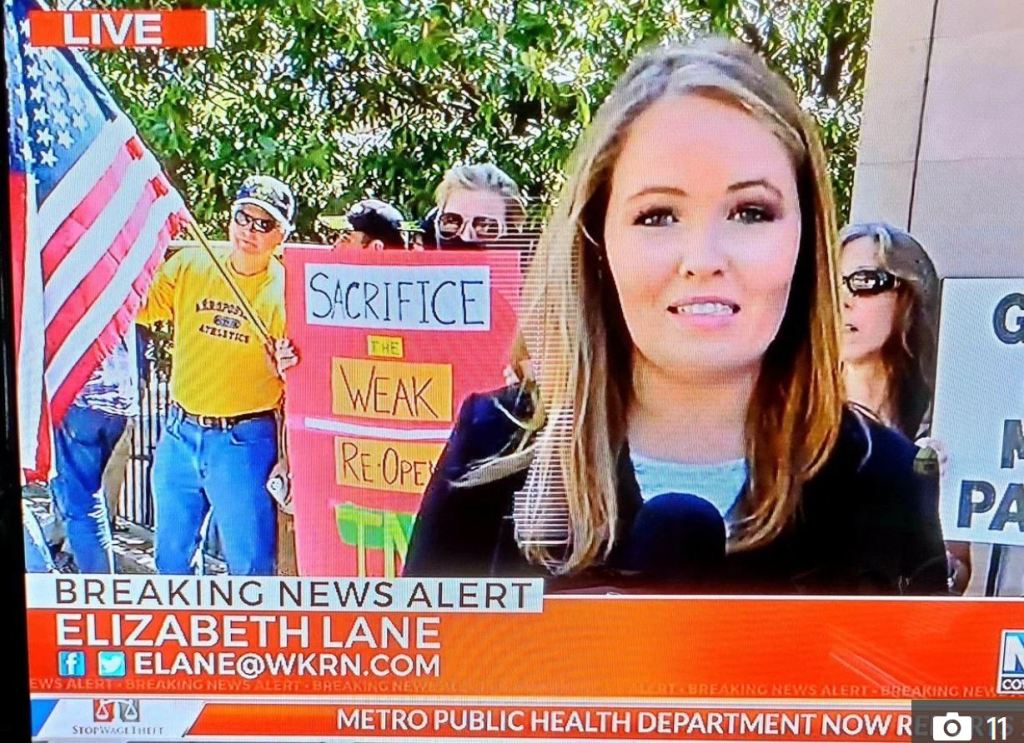
Invite the weak. Don’t sacrifice them.

Photo credit: WKRN screenshot

I wouldn’t post this if it weren’t for the fact I see too many friends on Facebook expressing the same opinion in not so many words. “Sacrifice the weak. Reopen the economy.” A simple, utilitarian approach is antithetical to Christian faith.

No, we need not unnecessarily “martyr” the economy nor “sacrifice the weak.” Yes, I understand that sacrifices will need to be made, among all, and these sacrifices won’t always be perceived as fair. Life isn’t fair. Yet, we do need to remember the “least of these” and the most vulnerable of our society as we seek a way forward. They must remain an important part of our “equation.”

Out of love for our neighbors, some freedoms and prosperity might need to be given up freely; not out of obligation but in love, at least for a time. There is no other way forward if we want to walk with Christ. Loving your neighbor cannot be based solely on death counts or the perceived liabilities of “others.” Who rightly judges who is “weak” and without worth? That’s the way of that past in Nazi Germany and the Soviet Union.

Tough economic decisions can’t be based solely on fear of the virus nor fear about where our daily bread will come from. We can and must do better. Jesus said, “…But when you give a banquet, invite the poor, the crippled, the lame, the blind, and you will be blessed. Although they cannot repay you, you will be repaid at the resurrection of the righteous” (Luke 14:13-14). If you hope to someday celebrate an economic recovery, you might just want to invite these folks as well.

© 2020 The Rev. Louis Florio. All content not held under another’s copyright may not be used without permission of the author.

Leave a comment

Filed under Uncategorized

A Statement of Unity

The following speaks of my pastoral response to the recent violent incidents involving racism, antisemitism, and anarcho-communism  in Virginia. It is a slightly revised (see endnote) version of an article in our September edition of Messiah Lutheran’s newsletter, The Messenger:

The Bishop and Bishop-elect of the Virginia Synod of the ELCA, the Bishop of the Delaware-Maryland Synod of the ELCA, as well as about twenty local ELCA pastors attended a simultaneous, peaceful ecumenical clergy protest in opposition to white supremacists gathering in Charlottesville. All Virginia Synod clergy were asked to consider attending by Bishop James Mauney.

Following the violent and deadly events in Charlottesville, Pastor Lou spoke at length at the beginning of worship the next day as to why – although invited – he did not choose to participate in the protest. Due to the personal and pastoral nature of his comments, they have not been published in detail or recorded, but as Messiah members, you may request to speak with him at any time. It will be a better discussion face to face. As a local law enforcement volunteer chaplain, he was also asked by a local coordinator* of the International Conference of Police Chaplains to be on stand-by to support local police chaplaincy efforts as needed, but he was not called upon to respond.

Among his comments, Pastor Lou spoke of the need for us as Christians to explicitly condemn the sin of white supremacy in any form. He also condemned the sin of some of those (not involved in the clergy protest) claiming to be confronting hate groups with their own violence – sometimes using such violence against first responders and other innocent people present.** As baptized children of God, he argued that we each should intentionally, prayerfully and boldly discern how we are called personally to work against such sin: prayer, protest, advocacy, voting, letters to the editor, cooperating with law enforcement, confronting its everyday forms as encountered in our relationships or work – there is no one way God might seek to use us.

In response to Charlottesville, you may wish to follow or volunteer with the efforts of the Virginia Synod’s Tapestry Team. This team’s mission is “to empower congregations in the Virginia Synod to be Ambassadors for Christ in matters of diversity and inclusion, walking with God, and guided by the Holy Spirit to bring healing, reconciliation, and justice.” The team provides “resources, facilitates conversations, and fosters networking across the Synod in order to advocate for God’s desire to weave a rich and diverse Body of Christ.” There are also many other worthy groups with which you might choose to support or volunteer.

As Hanover County is considered part of the Metro-Richmond area, Pastor Lou has signed the “Metro Richmond Pastors and Ministry Leaders’ Statement of Unity.” This represents his endorsement only, and it does not imply anyone else’s agreement other than those clergy who signed it. This statement seeks: to explicitly affirm that all people are created in the image of God; condemn the ideology of white supremacy, including antisemitism, as an unqualified evil, as well as that any teaching suggesting that one people, race or nation are inherently superior to others “for God desires all people to be saved and come to a knowledge of the truth”; and to have the signers repent of their own and church’s historical or present complicity (intentional or unintentional) in the sins related to racism. In closing, the signers promise to promote healing and reconciliation; leading “in the way of love, and to seek ways to heal the divisions that separate races and cultures in our city.” The statement is a local, grass roots effort attached to no one organization. It is ecumenical, bipartisan, and avoids accusatory or “revolutionary” language found in many such documents of late. The statement does not directly address the local and statewide issue of Confederate statues and memorials. The complete text can be read here: richmondpastorsstatement.org.

Inspired by 2 Cor. 5:11-21, our Virginia Synod has called for its members to be ambassadors for Christ. The ministry of reconciliation is shared by us all. Please continue to pray for those who mourn the deaths of Heather Heyer, Lt. H. Jay Cullen and Trooper Berke M.M. Bates, all those injured, as well as peace, justice and reconciliation in our commonwealth and nation.

* I inserted the words “a local coordinator” for clarity

**In error, the published article indicated those coming prepared to use violence in Charlottesville under the guise of fighting fascism might have also assaulted clergy. I have been told of attacks on clergy by hate-group supporters, but I’m aware of no attacks on clergy by others. Supporters of Anti-fa (who describe themselves as Anarcho-communists, or claiming an anarchist and communist blended philosophy) and others did (as reported in open sources) come prepared for violence, and assault and battery did occur against law enforcement and others not directly involved with the hate group sponsoring the original rally.

Originally published in Messiah Lutheran’s newsletter, The Messenger (September 2017). Revised version here is dated 24 August 2017. 

© 2017 The Rev. Louis Florio. All content not held under another’s copyright may not be used without permission of the author.


Leave a comment

Filed under Community Life, peace, social justice

No Human is a Pig

fergusonThese images from a recent Daily Mail article reminded me of something Br. Roger of Taize’ once shared while I was a volunteer with his community in France.

When the community was forming, a group of French communists in a nearby village wanted to protest the injustice and riches of Christianity. So, they killed a pig on some church steps one Good Friday. The pig was supposed to be Jesus.

Now, no police officer is Jesus per se, but it strikes me that systemic injustices (no matter how true or not) can’t be addressed by effigies reflecting personal agendas, ignorance, anger or hate. In doing so, we tend to objectify and dehumanize our “enemy”, which makes it harder to recognize any of our own wrongs. We also tend to promote conflict rather than justice and peace. A poet in the 1960s (Ginsberg?) said something like this: “If you call a person a pig enough, they’ll surely become one.”

Like Br. Roger, I’ll strive not to waste time with anger in response. I’ll seek all the more for reconciliation, justice and peace. I will pray for all in Ferguson and our nation, even those who might wish to be my enemy, for I think we all know not what we do when it comes to our current racial divide. I’ll take stock of my behaviors and try to repent where I can identify any of my wrongs. To be sure, there’s enough sin and stupidity to go around, because we all are human.

Perhaps instead of angrily talking, tweeting, posting and pointing fingers, we should try to listen better to one another and learn. Perhaps we should try to seek and recognize the love of God which is planted like a seed within each of us. We are all part of the problem, and we all have a lot to learn from one another.

Entering relationship with one another – as difficult as it might sound – is the way forward. I have seen its power at work through Taize’ prayers and gatherings time and again. Relationship is how Jesus often changes our lives and our lot. It is harder to hate our neighbor when we get to know them, but to do so, requires we put our anger, agendas and arrogance aside. We have to be willing to reflect upon and admit our own sin.

“A fool takes no pleasure in understanding, but only in expressing personal opinion.” Proverbs 18:2

“Love your enemies and pray for those who persecute you…” Read Matthew 5:43-48

Unless otherwise indicated, all scripture quotations for this article are from the New Revised Standard Version (NRSV) translation.

© 2015 The Rev. Louis Florio. All content not held under another’s copyright may not be used without permission of the author.

Leave a comment

Filed under peace

Why L’Arche for Lent?

Logo of L'Arche ("The Ark") Communities, downloaded from larche.org

Despite the heated language in our polarized world, justice and peace are Gospel values. People too often use such words like a weapon for their political agenda (conservative or liberal, believer or non-believer) rather than listen to them with a holy fear. These words are powerful, spoken from the mouth of God to our hearts. Lived out, they change us and the world. We are to love the poor, the oppressed, the widow and the orphan. We are even to love or enemy. We should never let ourselves be led away from these words and who first spoke them just because they are sometimes misused. Instead, we should seek their depths in the wellspring which is Christ and his community, the church. We should strive to live them out every day, so we and the world can be transformed by love.

One of the most powerful ways to grow into love is to experience it in the real world. Recognizing our own need for love, we must allow ourselves to be rooted into the gospel message as the Spirit moves. Through situations, people, and places, as well as our own weakness, the Spirit intends to drive us into the wilderness. The Spirit calls us to experience new life there. I believe Gospel stories become Gospel realities as we seek to live them out concretely in our lives; sometimes in places where we are not so comfortable. Through sacred but small moments, our relationship to the world and each other will be transformed.

As a community of faith over the last few seasons of Lent, Messiah has been examining the Christian life and witness of well known figures of the last century. We do so hoping to grow as individuals and a community. As pastor, I have tried to identify people who shared different yet compatible visions of community: Dietrich Bonheoffer, Brother Roger of Taizé, and this year, Jean Vanier and the community members of L’Arche. Each has been given a vision by God of what community can be. Through their lives, they exemplified what Br. Roger so often described as a “parable of community” that teaches us and the world new possibilities.

L’Arche literature and websites proclaim that community isn’t an ideal but you and I. Despite our differences in politics, theology, or ability; we are called to be one with each other and with God. A local L’Arche community describes their shared life in this way:

L’Arche Blue Ridge Mountains mission is to create fully-accessible homes where people with and without disabilities share life in a spiritually based community. We strive to make these homes places of caring and faith, where individuals’ unique callings and abilities are brought out.[1]

Through their words, I can hear an invitation of what “church” can become in a real and too often difficult world. I first became fully aware of L’Arche while volunteering with the Community of Taizé. (I had heard of them and a famous member of their community, Henri Nouwen, but I hadn’t gotten to know them well.) A group from the original home at Trosly-Breuil came to visit, and a young man proudly and joyfully told me about his life there. Pasquel (I still remember his name, a name which means Easter) ended his witness by offering me a new beginning. He invited me to live with them. I was unable to accept the invitation at the time, but I remain deeply touched by his testimony and openness. Somehow, I still feel in communion with him and his hope and vision for tomorrow, even as I feel called in the here and now to be at Messiah Lutheran in Mechanicsville. Who knows what tomorrow might bring? Yet, I believe we all can live that hope out no matter where we are.

Personally, I know his vision can be a reality. Long before I knew Pasquel, I knew the love of my grandmother. Her firstborn, my aunt, was born with a serious mental disability. At the time (the 1930s), people encouraged her to put my Aunt Theresa into an institution. She wouldn’t hear of it. Instead, she chose to respond to her call to love. With time, patience and effort, Aunt Theresa grew to be a beautiful lady with much love to share. She held a job, learned to drive, and even helped care for my grandparents as they grew older. I believe my grandmother, my aunt, and my family were transformed by grace; a grace that saw past the dark realities and allowed us to live in the light of hope. I never saw my aunt as disabled although I couldn’t avoid her disability. Only love stands out when she comes to mind.

With these varied experiences now part of me, I hope to nurture that similar love which is already active at Messiah by sharing in an exploration of the Christian life and witness of Jean Vanier and L’Arche. During Lent, we’ll read Jean Vanier’s writings, watch some videos, discuss our impressions, but most importantly (if things go as planed), we will worship and fellowship with members of L’Arche Blue Ridge Mountains to help celebrate the season of Easter. Both communities have much love to share and much more to learn about love. Together, I think our Lenten journey will be a true adventure; an adventure more deeply into the love which is Christ. We will be blessed to share in the resurrection more concretely through a new life with God and each other.

To learn more about L’Arche, visit:

L’Arche International                            http://www.larche.org/

L’Arche USA                                                http://www.larcheusa.org

L’Arche Blue Ridge Mountains           http://www.larchebrm.com

Or, listen to “Jean Vanier: The wisdom of tenderness” (radio interview, American Public Media): http://being.publicradio.org/programs/wisdomoftenderness/

© 2011 The Rev. Louis Florio. All contents not held under another’s copyright may not be used without permission of the author.


[1] L’Arche Blue Ridge website at http://www.larchebrm.com . Downloaded on March 12, 2011.

Leave a comment

Filed under Liturgical Year

Learning as we love

The following is a sermon I preached on Sunday, February 13, 2011. Touching upon the all too difficult issues of adultery and divorce, I had several requests for copies. I don’t usually post my sermons, but I am this week. I hope it sparks some healing reflections and conversations.

Lectionary lessons: Deuteronomy 30:15-20; 1 Corinthians 3:1-9; and Matthew 5:21-37.

Each and every day we wake up, we face a number of critical choices to be made. In big and small ways, we must choose life and prosperity or death and destruction (See Deuteronomy 30). We do this over and over again throughout our day. Each choice we make affects us and our world. Our relationships are fragile. Life itself is fragile, and so even the little choices we make can sometimes break down or destroy the things and people we should love. God desires more for us…desires us to make good and godly choices…so that we can truly live. Too often, such a standard sadly proves beyond our reach, but we are never beyond the reach of God no matter how low we might sink.

Due to the reality of our human weakness, God gave the law to help and guide us (not condemn us to Hell or keep us down). First, the Ten Commandments and other such laws are meant to help restrain the wicked. They have a political and civil use. They have practical applications as a family or as part of a larger community. Second, such laws help us recognize our own weakness. They indict all of us, because we can never fulfill the law perfectly despite our best intentions. Therefore as we struggle with our sin, our eyes might look to the hills for help. Through this theological use of the law, we recognize our need to repent, and even more so, our need for a savior. The pain of sin helps break open our hearts as we recognize our need, and our hearts might open to welcome Christ and his grace. Third, the law teaches. It helps shape a vision and means of how we should live together. In Dietrich Bonhoeffer’s words, the law is provided “as God’s merciful help in the performance of the works which are commanded.” Simply put, God didn’t give us law to burden us or to destroy us. Our loving God longs for us to live, and so the law (as scripture itself attests to in both Old and New Testament) is meant as a blessing, not a curse.

Over the last few weeks, we have been reexamining Jesus’ Sermon on the Mount. Recall that this large body of teaching begins with Jesus going up that mountain like Moses, and yet he is not presented any laws. Instead, Jesus proclaims laws as God himself – for he is fully human yet fully divine. This new community being formed (his church) needs guidance like the people of Israel, and his laws and teachings will prove a blessing. The Beatitudes on their face are a series of blessings, but they speak of difficult ethical actions that all Christians should strive for during their life. These are both blessings and laws. Saved by grace through faith…empowered by the Holy Spirit…we will find the grace and opportunity to live them out. We are blessed to be a blessing, called to live out these ethical commandments further blessing ourselves and God’s world.

Then, Jesus commissions us. We are the light of the world. We are the salt of the earth. He declares this! Despite any imperfections, Jesus’ perfect love will work through us. Even our need for grace will witness to the world of God’s love. Yet, this doesn’t mean that all the old ways should be thrown away. Yes, Jesus came to make things new, but he clearly teaches that his way is God the Father’s way. He hasn’t come to abolish the law, but rather, he came to fulfill it. Our righteousness must be greater than that of the Pharisees and other teachers of the law. It must reflect who we are in our hearts. It must witness to the light of Christ within us and bring flavor, life, and healing to the world. The gift of faith is what makes us righteous (not our actions), but faith without works (we are reminded) is dead.

Building off of these teachings, we now come to what some scholars call an antithesis of the Beatitudes. The law is clearly taught, and so at this moment, the law can frighten us and even stop us in our tracks. How are we ever going to be so perfect? Like the people of Moses’ time, we can hear the law and think that we are cursed, but don’t be so fast! Again, remember the law is a gift. Jesus connects his newer, fuller teachings concretely to the laws shared through Moses. If we open our eyes from our fear of failure and self-condemnation just for a moment and calm down, we can hear love spoken to us. We need not get stuck in our sin. As he will do over and over again, Jesus reminds us that the fulfillment of all the law is love alone. Love God with your entire being (your mind, heart and soul), and love others as yourself (not better than yourself, but as yourself).

Looking at today’s lesson, note that Jesus begins with a shocking accusation; murder. To this very day, murder is commonly perceived to be among the worst and most dreadful offenses in society. It is so horrid that most of us believe ourselves free of that sin. Yet here, Jesus expands upon our simplistic understanding of the law. Just as Luther will mimic later in his Large Catechism, Jesus talks about murder in relationship to our anger and reconciliation. He expands our understanding. To follow Jesus infers that we must strive to be agents of peace and reconciliation whenever and wherever possible. To do otherwise can kill relationships. We become murderers. We can kill the spirit and love within other people through our angry words and self-centeredness if we are not careful. Anger itself is not a sin according to scripture, but we are not God. Righteous anger can turn into self-righteous, sinful, over reaching anger in a blink of an eye. Just like murder, the repercussions are severe for the individuals involved and the entire community. So, Jesus commands us, even when angry or when we have earned the anger of others, “Love others as yourself…always.”

After that, Jesus shocks us again. Even in the best and most appropriate of circumstances, adultery and divorce causes hurt, yet they are all too familiar in our fallen world. Just like murder, they are a scandalous indictment shared by each and every one of us. Among all the reasons for divorce, adultery seems the most acceptable. It is a terrible betrayal of a covenant made between two persons in love no matter why it happens. It often kills relationships and affects the entire community. Yet, look deeper. The charge of adultery is reflected in scripture to include any misuse of our sexuality and misdirection of our hearts. Jesus expands upon our understanding once again. Like murder, it is easy to say, “Well, I wouldn’t commit adultery. I wouldn’t ever cheat on my spouse.” Perhaps some of us wouldn’t. Yet in our sin, we are all at times adulterers. Doubt it? Than listen more closely to how Jesus teaches today. “You have heard that it was said, ‘You shall not commit adultery.’ But I say to you that everyone who looks at a woman with lust has already committed adultery with her in his heart.” (NRSV translation) Adultery actually occurs whenever our hearts wander. So, it shouldn’t surprise us that God accused the Jewish people of adultery through the prophets when the people made idols in their lives…when they made anything more important than loving God and their neighbor. Whenever we do the same…when we act unjustly or ignore the needs of others…when we don’t love those entrusted to us or love and respect our bodies…Jesus says (like all the prophets before him) that we are adulterers.

In relationships and life, such wondering happens. We are all imperfect despite our best intentions. So, we find divorce is practiced today much as with faithful Jews of biblical times. Throughout time, divorce reflects the fallen realities of our communal life in this world. Loving others as ourselves is hard. Even in what might be deemed the best and most appropriate of circumstances (cases of adultery, times when a spouse is being abused or beaten, circumstances where a person’s heart loves liquor better, their job better, or anything – even themselves – better than the spouse and family they have promised to love)…divorce can not truly be celebrated. It might be a relief and offer safety, but wounds remain for the family and community; sometimes for years if not a lifetime.

Yes, we might try our best and still fail. Things might happen in this fallen world beyond our control or beyond our ability to repair, but we are asked to love anyway. So, Jesus teaches us of these laws and consequences clearly, but at the same time, we should never forget his words to the adulteress long ago. Similar words are also spoken to us in all our failings and imperfection. “Get up. Go and strive to sin no more. I do not condemn you.” (Paraphrase of personal translation for John 8: 1-11) Continue to love as best as you are able even in your brokenness. Make amends as possible. Try to seek and offer forgiveness. When you sin, repent and ask forgiveness form God and others. Such love will change our lot even when relationships cannot be mended.

In the Ten Commandments, the community, family, individual, and God are always intimately linked. The other ethical, communal commandments about stealing, false witness and gossip, as well as coveting…they all relate to what Jesus reflects on today. Our witness to Christ isn’t meant to be just with our mouths. If we are truly the body of Christ through faith, everything we do or fail to do matters. If our hearts are oriented inward upon ourselves and our self interests rather than God and neighbor, we dishonor God. So, Jesus connects all our oaths, actions and relationships back to the first Mosaic commands to honor God. How we live should reflect who we are called to be…who we are created to be through faith. Let your yes be yes, and your no mean no. Let all your actions and statements reflect your love for God and neighbor as yourself. Doing so, people will see an authentic witness to faith by the way we love one another. If we can forgive others and treat others as we would want ourselves treated, we honor them as God’s creation, and thus we honor God. When we seek to act as if we respect and honor our own lives and bodies as the children of God, we honor God. So Jesus teaches us to be authentic in our faith. Jesus might as well have said, “Love God. Love your family. Love others as yourself (not better than yourself but as yourself).” That is how I often summarize the Ten Commandments for children, and it echoes Jesus’ own teaching in scripture on how to fulfill the law and the prophets.

Today’s lesson is indeed a difficult one. Hearing the law spoken so clearly, the law reminds us that love is hard for mortals. Yet, Jesus asks us to love anyway. We can never succeed in being perfectly like Jesus, for we are not God. So give up that vain hope, but never give up on God. Believe as Jesus teaches that God has not and will not give up on you. Instead, God gives us more than the law. We are given Jesus Christ. He offers us grace and forgiveness. His love is at work in our lives in a way that will not fail to help us grow. Never perfect in this life, we will be empowered to progress in his ways. We are given what we could never deserve or earn on our own…the perfect, life giving love of Christ. You see, both the law and gospel remain proof of God’s love for us. They cannot be separated…ever. Together, Christ will use them both to make us and all things new. Not even sin or death will ever separate us from such a love. That’s the promise of Christ to each of us as his children, and he does not lie. Amen.

Bibliography

Bibleworks for Windows (Version 7) [Computer software]. (2006). Norfolk, VA: BibleWorks, LLC.

Engelbrecht, E.A. (Gen. Ed.) (2009). Lutheran Study Bible: English Standard Version. (2009). St. Louis, MO: Concordia Publishing House.

Keck, L.E. (Ed.). The New Interpreter’s Bible: Matthew – Mark (Vol. 8). (1995). Nashville, TN: Abingdon Press.

Kolb, R., and Wengert, T.J. (2001). The Book of Concord: The Confessions of the Evangelical Lutheran Church (2d edition). Minneapolis: Augsburg Fortress.

Mays, J.L. (Ed.). (2000). The HarperCollins Bible Commentary. New York: HarperCollins Publishers.

Meeks, W.A. (Ed.). (1993). The HarperCollins Bible: New Revised Standard Version. New York: HarperCollins Publishers.

Tunseth, S. (Project Dir.). (2009). Lutheran Study Bible: NRSV Translation. Minneapolis, MN: Augsburg Fortress.

Unless otherwise indicated, all scripture quotations are from the New Revised Standard Version (NRSV) translation.

Thanks also to Messiah Lutheran’s Daily Discipleship Group. Their honest and wise insights and personal stories of faith and struggle always inspire and teach me.

© 2011 The Rev. Louis Florio. All contents not held under another’s copyright may not be used without permission of the author.

Leave a comment

Filed under Law and Gospel

Waking from the dark

Recently, I had the good fortune of attending a momentous and joyous event. A past coworker and forever dear friend of mine was retiring from the City of Alexandria (VA) Police Department. I arrived in the city early, so I visited all the old haunts from my patrol days. The neighborhoods I used to patrol have really changed, but the memories linger. Faces, emotions, and more vividly came back to me as I drove – not all of them bringing joy: the place where I handled my first homicide; a telephone pole where two college students died tragically; a courtyard where a brave fellow officer was shot and killed. For a police officer, such memories reflect much of one’s life on the street. It is often frustrating, sad, and sometimes even briefly terrifying. Such memories tend to linger in your days and sometimes even during your nights.

As I arrived at the restaurant to honor my friend, I rejoiced at meeting several old comrades; many who I had not spoken with for sixteen years. The bonds of the life we shared were still strong, and it was like I had never left except for the many new (and younger) faces of police officers in the room. Soon, one younger man came up to me. I recognized the face, but I couldn’t quite place him. He was a captain now, but I had been his Field Training Officer for two weeks as he started his service just before I resigned to enter ministry. After some catching up, he pointed out that I might be back for a lot of retirements in the next few years, for all my contemporaries are at the age to retire. (Police work can prove hard on the body, soul and your family, so officers often retire at a younger age than other professions.) The bittersweet truth of what he said really hit home. My ties to this city and the brave men and women who served it would soon seem to be fully cut.

Along with a great lunch and fellowship, my friend entering retirement gave us some wonderful food for thought. As he sometimes tearfully shared about his many years with the force, the tears were of joy and thanksgiving. He didn’t focus on the bad times, even if he couldn’t forget them. He lifted up the relationships that had blessed him in his vocation, family, and life. We were officers together when violent crime was at its height in the twentieth century. It was an exciting time and a meaningful time. It brought us together in ways few people will ever understand. Together, love for one another had not only helped us survive but also thrive. Speaking to the younger officers, he shared the things that mattered most at the end of the day, especially going home safe to your family and friends. He lifted up those whose dedication to service had inspired him, and by honoring them, he hoped to inspire those who remained on the force after he left.

As I listened, I sensed the sacred at work in and through our shared life. As difficult as the past had been at times, I could see more and more clearly the light of Christ shining even among those many darker memories. Ours had always been a road of blessing, not curse. We were bonded to others of the past and the future through the service we shared. We are bonded to one another forever. The love of God at work, even when you don’t see it at first, has a way of unifying things and making them new. Although imperfectly at times, we had sought together to do our best out of love – acted justly, loved mercy, and walked humbly with our God – and it all mattered. The good and the bad times mattered. God had used them all. Now, the world and I will never be the same. Thanks be to God.

From Psalm 71 (NRSV translation):

16 I will come praising the mighty deeds of the Lord God,
I will praise your righteousness, yours alone.
17 O God, from my youth you have taught me,
and I still proclaim your wondrous deeds.
18 So even to old age and gray hairs,
O God, do not forsake me,
until I proclaim your might
to all the generations to come.
Your power 19and your righteousness, O God,
reach the high heavens.
You who have done great things,
O God, who is like you?


© 2011 The Rev. Louis Florio. All contents not held under another’s copyright may not be used without permission of the author.
1 Comment

Filed under Law Enforcement