I pray with my friends in France for world peace (see link in comments as it wouldn’t post), and I’m praying for those impacted by today’s political violence in the US. Sad is an understatement. We might feel impotent in the face of such senseless violence, but we aren’t. Loving our neighbor including our enemies can be lived out through our lives. If enough people do, just as bad or hate filled sentiment can spread like a disease, so can faith, hope and love from person to person. As hard as it is, try to pray for your political opponents and try to treat them with respect as human beings even as we might think they live in grave error. Ask the Spirit to use you as an agent of reconciliation and peace in your context. Pray for the person or persons who did this for they do not know what they do even as we pray for justice. And seek to defeat evil with good. Sounds easy enough, but it’s a biblical intentional practice often in tension against our baser instincts. Yet if we seek to practice over and over, with God’s help, it will become a habit – a new instinct or gift from the Holy Spirit dwelling within you. Jesus said to his anxious friends, “Peace I leave with you; my peace I give you. I do not give to you as the world gives. Do not let your hearts be troubled and do not be afraid” (John 14:27). He’s still saying that to us today.
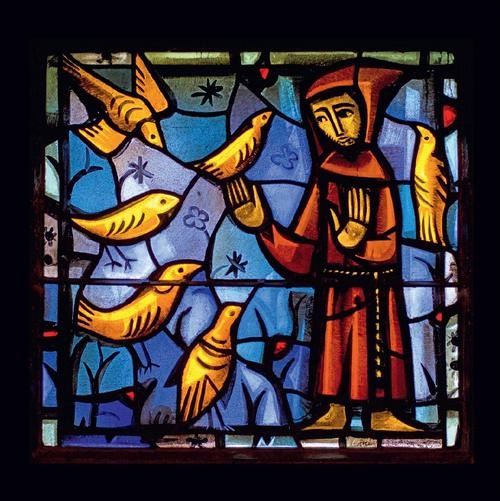
Stained glass window in L’Eglise de la Réconciliation
These Ukrainian eggs were gifted to my in 1995 while volunteering in France.
The below is a reposting of an earlier blog (May 17, 2022) – an item originally for my congregation as the war against Ukraine’s independence and sovereignty escalated. As I recently posted on Facebook, no, Ukraine didn’t start the war no matter what the President or anyone else says. Way back as Russia hosted the Olympics in 2014, I wrote Russia would attack Ukraine, and they did. I wasn’t a prophet. It was clear, and I wasn’t alone in my prognosticating. Russia wanted to reestablish its empire, secure Black sea access, and acquire more economic benefits. Things escalated in 2022 with a total invasion marked by many war crimes and actions that international law calls genocide. Personally, I believe based on my experience and past training in the military, an unjust peace will only encourage Russia to push further for their advantage down the road. They have already been sabotaging industry and communications in the West. Ukraine’s wanting to be part of the EU or NATO isn’t an excuse for Russia’s invasion, kidnapping children, raping women, bombing noncombatants and hospitals, starving/torturing/killing prisoners, taking or destroying cultural heritage or using human shields. War crimes and crimes against humanity are never virtuous no matter the result or perceived benefits. Christians must denounce them. And if you think we can trust old Vlad as an ally, I would ask you to think again. “Woe to those who call evil good and good evil, who put darkness for light and light for darkness, who put bitter for sweet and sweet for bitter” (Isa . 5:20). And yet, with all I have said, the below reflection still proves true. With all the dark clouds of war, I remain hopeful – not in humanity, but in Christ’s promises. It haunts me that the man in my story might have become a casualty of the war, but I trust nothing separates us from the Love of God, not even death. The man was right to live out his faith as he did. Lord have mercy. +
When I served as a volunteer with the Ecumenical Community of Taizé in the mid-1990s, it was an exciting time. The Berlin Wall had just come down, and the Eastern Bloc nations had recently transitioned from tyranny toward freedom. With this change, Christianity in the east of Europe and into Russia experienced what one might call a little springtime – a true rebirth of faith.
So, almost naturally, many Eastern Europeans decided to visit the community on pilgrimage. Since the end of World War 2, it had become a yearly event for the hillside that was home to the monks of Taizé living in the province of Burgundy to flower with multicolored tents helping to welcome young Christians from across the denominations and continents. The village could swell from 200-plus people in the winter to several thousand each week from Easter through summer. Now, the brothers welcomed Eastern Europeans among their many guests.
Indeed, the ecumenically minded Pope John XXIII loved the community and what the Spirit was doing there so much, he once greeted Brother Roger, the Prior, shouting, “Ah, Taizé, that little springtime!” Spending a week with the monks (fifty percent Protestant and fifty percent Roman Catholic), helping with their daily work welcoming and supporting visitors and local ministries, participating in small group discussions over scripture guided by the brothers, and praying their beautiful chants in community three times a day was more than just busy work or a distraction. Over time, people often heard God’s call in their lives better, including the call to love one another in community.
Yet, how difficult it might prove to have Estonians, Ukrainians, and Russians arrive at the same time for a week’s visit among other guests. Bitterness still existed over mistreatment of the recently deceased Soviet imperial power. As much as the Estonians and Ukrainians were overjoyed and boisterous, the Russians appeared as a defeated people: quiet, suspicious, and tending to stay among themselves. (Certainly, religious, economic, and cultural differences with the Western Christians present didn’t help.)
Surprisingly, during the week, I witnessed firsthand what can happen when people get to know one another as individuals. In reflecting upon scripture and sharing one’s understanding, hopes and struggles, the Word went to work. Friendships formed. Attitudes changed. Forgiveness and grace were shared. It is no wonder the brothers had become known for their work – really Christ’s work – of reconciliation and trust. They had even worked secretly in support of Christian young people behind the Iron Curtain at times.
I remember one Ukrainian teacher who stood out from the crowd of pilgrims that week. He told me he made about $25 USD per month (about $50 today). He recalled the horrors and worry over Chernobyl. He remembered the fear that came with Soviet domination and its prescription against almost any signs of faith. And yet each day, I would see him rejoicing among new people, including Russian people. He gave away gifts – small flags of the now independent Ukraine as well as small sets of Ukrainian Easter Eggs. An ancient folk art, the eggs had moved in meaning as his country became Christian in the Middle Ages from representing the rebirth of the Earth each spring to the rebirth of humanity through Christ’s resurrection.
I still treasure that man’s joy, openness, and generosity. As the war in Ukraine continues, as political divisions and violence challenge us in the USA, as even within our church families we might encounter people tending to judge and withdraw rather than offer grace, I stare at his eggs gifted to me and many others that week now long ago. Through his past witness, hope comes back to me today. Without a doubt, I believe springtime will come again. Jesus will come again. Signs of spring can be found everywhere if we dare look through the eyes of faith and seek to love one another – even our enemies.
Originally published in The Hub, a weekly email of Christ Lutheran Church, May 17, 2022 edition. Christ Lutheran Church is located in Fredericksburg, Virginia.
As August ends, I am participating in a community worship service and national
ringing of church bells. Sunday, August 25, will mark four hundred years since
the first Africans arrived by force at Fort Monroe, Virginia. Slavery is a
tough subject to address, and when you add the many ongoing sins related to
slavery, Jim Crow Laws, segregated communities, and other signs of personal and
systemic racism, it becomes even more difficult.
Whether racism or any other hot button issue, it is helpful to remember
that forgiveness is already ours. We need not get stuck in shame whether it is
our sin, the sin of others or of the world. Nor should we fear acknowledging
guilt. Instead, humility calls us forward into a future together with Christ. We
who have been reconciled to God through Christ have also been entrusted with a
ministry of reconciliation (see 2 Cor. 5: 11-21). We can indeed address
hurtful, “hot button” issues without defensiveness or unholy anger.
As election fever rises again and troubles of the world present
themselves, I find it helpful to listen more than talk. What is really being
said and why? Is my momentary adversary speaking from their own woundedness and
therefore wounding me? Sometimes angry people facing compassion and gentleness
can be moved toward compassion and gentleness themselves. In speaking, I try to
avoid blanket statements, as hot button issues are often multilayered, nuanced
and intersect with others. As a flawed human, I might even be wrong, so I try
to consider both what I might need to learn and where we might be able to find
areas of agreement. Although Lutheran Christians have always been encouraged to
engage the world and call authorities to account when necessary, regarding the Eighth
Commandment (as Lutheran’s count them, the admonition to avoid bearing false
witness), Martin Luther cautions, “We are to fear and love God, so that we do
not tell lies about our neighbors, betray or slander them, or destroy their
reputations. Instead we are to come to their defense, speak well of them, and
interpret everything they do in the best possible light” (Small Catechism).
And then, of course, we have Christ’s own teaching and example, “You
have heard that it was said, ‘Love your neighbor and hate your enemy.’ But I
tell you, love your enemies and pray for those who persecute you, that you may
be children of your Father in heaven.” Praying for those we oppose might not
always result in an observed change in their behaviors, but I always find it
brings a change in me – in attitude toward them and the world, in my own
general peace, or sometimes in my own repentance. Consider praying before you
hit that post button or begin a difficult conversation. Or, just step away, and
then come back to address things after some prayer and reflection. It is
amazing how the Spirit can give us just the right words.
Like the Psalmist in Psalm 27, “I believe that I shall see the goodness of the Lord in the land of the living.” Sometimes that goodness will enter the world through us.
Originally published in the June 2019 newsletter of Christ Lutheran Church, Fredericksburg, VA.
Unless otherwise indicated, all scripture quotations for this article are from the New Revised Standard Version (NRSV) translation.
Husband, Pastor, Law Enforcement Chaplain, and member of the Clerical Errors (aka "The Three Priests"), I'm sharing my two cents with anyone who cares...
You can also find me on social media as Loudluthrn (Lou-d-Luthrn or Lou the Lutheran). It is a moniker given me while attending a Presbyterian Seminary, but I'm a loud and proud Lutheran too (just not too loud and proud, mind you).




 2pennyblog