Tag Archives: Lutheran

Still Risen

Photo by Kelly Sikkema on Unsplash. Used by permission.

You can listen to a podcast version of this post on anchor.fm, season 1, episode 16.

As we move further into spring after Easter each year, we ponder the earliest stories of the Church. We see Peter grow from a struggling fisherman to a skillful shepherd. We meet Stephen, the first martyr, and encounter a new Apostle, at first a persecutor of the Church and now surprisingly called to serve the gentiles. His name will be changed from Saul to Paul; reflecting the change in his heart and understanding. We learn of resurrections of the dead such as Tabitha (raised through Peter’s faith) and Eutychus (raised through Paul’s faith). Such events don’t become a norm, but these miraculous healings, exorcisms, and resurrections serve as a sign of the truth to what God has done through his only Son, Jesus. In all these things, people will not only come to believe, but they will also continue to grow in belief as they maintain their walk with Jesus.

The liturgical season of Easter is only fifty days, lasting through Pentecost (on June 5th this year), but the impact of the resurrection is eternal. The story is not over, for it continues to be spoken by God in and through our lives. We find that we aren’t so different than those who came to believe so long ago. We face disease, war, poverty, and all kind of sin as they did. We struggle to believe at times just like them. And yet through it all, at any time, Jesus can appear to us. His words remembered can strengthen us. We encounter him in the Word heard preached and our participation in the Sacraments. We can meet the Risen Christ through those who need us, and those we need. Even in the face of those whom we don’t like, Jesus might be staring into our eyes asking forgiveness. Jesus is risen. His resurrection speaks to us of a present and future with him.

As school ends and summer begins, as Easter turns into the Season after Pentecost, we will be likely traveling more and having more opportunities for fun. Yet as you rightly enjoy these things, I encourage all of us to look for Jesus wherever we might be and whatever our circumstances. Remember the assembly and your call to service. Consider how work, sport, and all your activities, even rest, might serve the Risen Christ and proclaim his glory. Faith is not just for a season. It leads to life itself. Jesus is and remains risen so that people may experience abundant and eternal life in him.

Originally published in the May 2022 newsletter of Christ Lutheran Church, Fredericksburg, Virginia.

© 2022 The Rev. Louis Florio. All content not held under another’s copyright may not be used without permission of the author.

Leave a comment

Filed under Pastoral Letter

Jesus is the Final Word

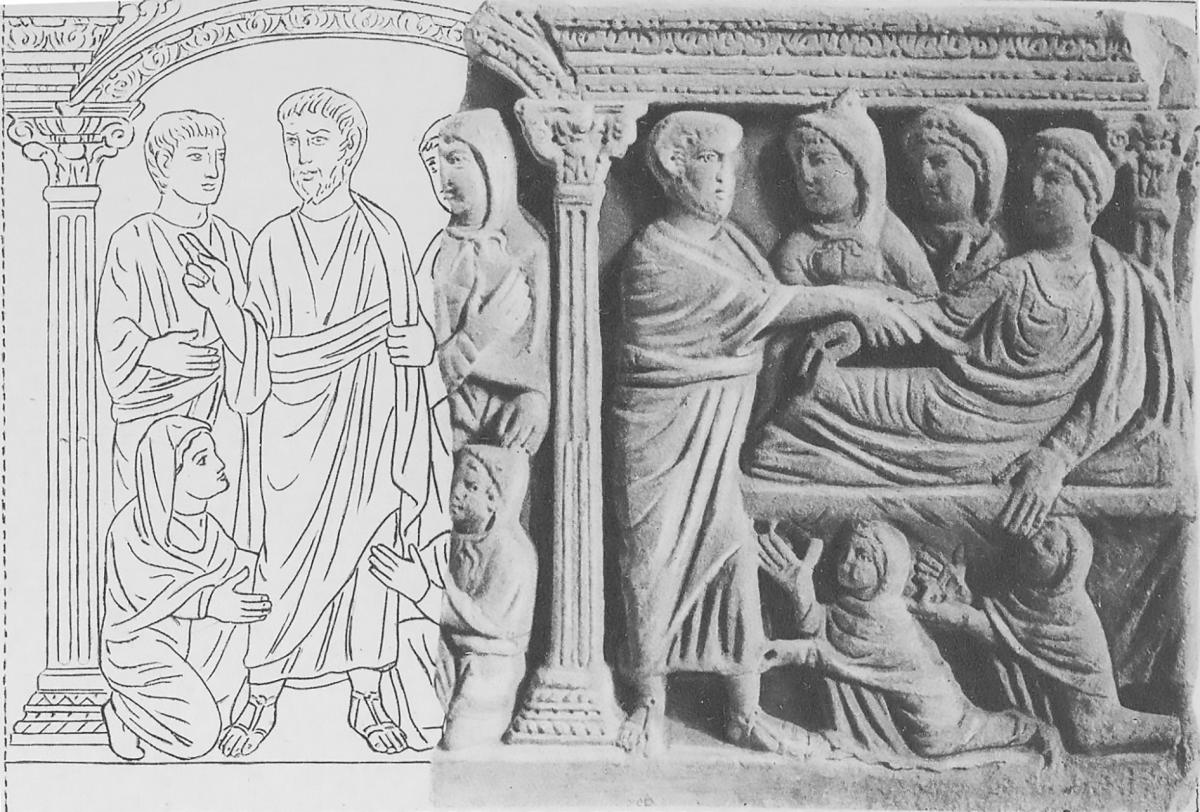
Raising of Tabitha, sarcophaus fragment, Musee de La’Arles Antique, 4th century AD. Giuseppe Wilpert. Rome: Pontificio Istituto di Archeologia Cristiana, 1929. Plate CXLV, no 6.

This sermon was preached on the Fourth Sunday in Easter (May 8, 2022) at Christ Lutheran Church in Fredericksburg, VA. Currently the worship video is not available due to a techincal issue. You can listen to the sermon on my companion podcast: S1,E15.

Grace and peace to you from God our Father and from the Lord Jesus Christ. Amen.

        As the Book of Acts recounts the anecdotes of the early Church, we see Jesus’ teachings play out, become real, and even be expanded upon if not clarified within ordinary, everyday human lives. God works in history, yet these stories aren’t meant to be historical in the modern sense. In short, Acts is primarily a theological treatise hoping to spark and sustain faith.

        Indeed, the author of Acts, St. Luke, writes that he set pen to paper to help provide the world with “an orderly account” of the promises that had been fulfilled among them as the early Church (see Luke 1:1). Starting in his gospel account of Jesus and extending into life amidst Christ’s earliest followers, Luke supplies us with a kind of “apologetic historiography” that helps establish and justify the origin and development of Christian peoples among the many faith traditions and cultures of his time.

        Basically, as Professor Carl R. Holladay outlines in one of my favorite scholarly journals called Interpretation: A Journal of Bible and Theology[i], Luke seems to tell his story in such a way to help the hearers believe, but also he wishes to help us identify divine cause and effect. For example, Paul’s mission to eastern Asia Minor leads to the Jerusalem Conference (Acts 15) to discuss the future of Gentiles in what has primarily been a Jewish movement at that point. Then, the decisions made at that conference lead directly to Paul’s mission in the region of the Aegean Sea and eventually toward Rome. Indeed, in Luke’s understanding, just as the prophets’ life and testimony pointed to and connects with Jesus’ own glory, it is Jesus who animates and sends us out into the world. Our story is sewn into this larger, eternal story. Christ’s love at work in our lives leads to miracle upon miracle.

        And in approaching history in this way, Luke understands that God’s ways are woven into all the tapestry of history, including individual lives and the smallest events. There’s both a personal intimacy and an overarching divine purpose being worked out among us…being fulfilled among us. We aren’t subjected to dumb luck or coldhearted fate; God has a loving plan for us…each and every one of us. And although bad things can happen to good people in a fallen world, or we can make bad choices hurting ourselves and others, it remains ok. God has the power and God wills to ultimately work things out for our welfare and to God’s glory. That’s partly why Luke doesn’t account for the Apostle Mark’s work establishing the Church in Egypt, or St. Thomas’ work in India, or other important Apostolic stories. It isn’t that these events weren’t significant or that miracles didn’t happen. No, Luke’s focus is on the grand design that wishes to spread faith from the center of the Jewish world, Jerusalem, into and throughout the gentile world as represented by Rome. Luke wants to clarify the Church’s role in the world in comparison to its two primary, contemporary accusers, Judaism and Roman religion and culture. So, his tale tends to follow Peter and Paul in their roller coaster ride toward Rome.

        Certainly, Luke is not recounting some dull and dusty history. Luke is telling the story of Jesus Christ, Son of the Living God, who died and is risen from the dead…for you and for me. And Jesus’ power is still at work in, through, and around us. Luke sees a connection between what happened in “former times,” what is happening in his day, and right through our lives to “the last days” – the end of time. There’s a singular, loving purpose connecting all lives and moving us toward an ancient promise yet to be fulfilled – the resurrection of the dead and establishment of a new heaven and earth where we will live eternally with God in glory. As such, the Book of Acts incorporates the stories of many diverse individuals, and again, Luke assumes we play a part in this narrative too.

        And so, we now come to the story of Tabitha – a life linked to the story of Jesus and our own. A fellow graduate student of mine, now a seminary professor, Dr. Raj Nadella, succinctly summarized the scene: “The story of Peter raising Tabitha from the dead parallels the story of Jairus’ daughter in Luke 8:40-56. While Jairus’ people advocated for his daughter in Luke 8, believers at Joppa advocate for Tabitha in this chapter. In both stories, the miracle occurs in a private setting. Just as Jesus sends everyone except Peter, James, and John out of the room prior to the miracle, Peter sends everyone out in this story. In both accounts, the deceased comes back to life after being ordered to get up. It is as if Peter, who was present when Jesus raised Jairus’ daughter from the dead, replicates a similar miracle at Joppa.”[ii] Do you hear the recurring, reverberating sound of God’s love at work as Luke tells it? God’s love echoes throughout time. As so many observe, Luke sees that history repeats itself. Yet, it is not exactly the same story, is it? Things have changed. Most importantly, Christ is risen! (Christ is risen indeed! Alleluia!) That Easter promise is still unfolding; the Kingdom of God birthing into our world through our lives. In this incident of resurrection, people with the help of the Spirit can understand that Christ’s authority has been truly shared with his followers. It is a hope-filled experience where Luke sees the victory of God and God’s people over the forces of death. Luke’s expectation and hope is that those who hear it for the first time or remember it in the future will come to an ever-deepening trust in Jesus as Lord.

        Sadly, there are some who argue against the truth of such stories because they have never seen such things. Others in their enthusiasm or greed, sell videos on how you, too, can raise the dead. (It is true. As crazy as it might sound, I’ve seen them, and I know of someone who fell for this scam.) Yet even the Bible indicates raising from the dead is a rare thing. Surely, it wouldn’t be deemed such a big miracle if rising folks from death was a norm. It is important for us to recall that with the thousands of years covered, the Hebrew scriptures only preserves a handful of resurrection accounts enabled through the faith of prophets. Perhaps more surprisingly, Jesus himself is reported to have raised only three people from the dead during his earthly ministry (the widow’s son at Nain, Jairus’ daughter, and Lazarus). When someone is raised from the dead or miraculously healed…or not…one can always be sure that God has a very good and special reason for what God does or does not do. Somehow, God’s answer to our prayer – whether yes or no – will always be informed by God’s love for us and the world.

         And so despite doubters, one can certainly find stories here and there of those risen from the dead or miraculously healed or helped if one looks. In my own life, there was a time when I served as a hospice chaplain to a person actively dying. (This means there were medical signs of impending death as judged by competent medical authorities). The family was Christian, but they had a hard time accepting his death and prayed for a miracle. As I prayed, they started to take over. They begged, pleaded and cajold hoping against hope that they could have even one more day with the one they loved. As I left that night, he was in a comatos-like state. When we were done praying, I said my goodbyes and went home. The next day, I received a call from a nurse. Somehow, someway, he was up and walking around, alert and talking, the next morning. The man’s doctor, nurse and hospice staff were rightly amazed. I was amazed. Science could not explain it. Yet the family that prayed so diligently, so passionately, with me that night saw this clearly as an affirmation of their own faith and hope. They gave thanks to God. All good things come from God, so who can say – however it happened – that they are wrong. I certainly will not! Strange things happen…miraculous and unusual things. Yet with all such miracle stories – whether Lazarus, Tabitha, or even the man I knew who was actively dying – the people involved eventually died. This incident wasn’t the End Times’ eternal, resurrected life with Jesus that we have in this passage. No, these miracles happen to call people into or affirm faith while we wait for that day. That’s what God uses miracles for. The love of God shows itself in a unique, concrete, if not intimate way for a particular and greater purpose. And so perhaps today’s account isn’t ultimately about Peter’s exemplary faith or Tabitha’s getting up from being dead after all? These details remain important, but I would like to suggest with others that Luke is pointing us toward something more. Again, this story is our story.

        In Tabitha, we have a poor woman (a person at the margins of society likely due to her social and economic status and sex), and yet, our mighty God graciously, unexpectedly chooses to work miracles in her life. By that, I don’t mean God worked just through her resurrection (for that’s the low hanging fruit of the story). No, humble Tabitha, named Dorcas in Greek, was a seamstress who was known for her “good works and acts of mercy.” She echoed God’s love throughout her life. Her life and faith touched the lives of others and changed them for the better through relationships built on love. As Dr. Nadella also notes, “Her compassion and care allowed her to build a beloved community that became her family.”[iii] That’s the big and lasting miracle here – her legacy of love…ultimately Jesus’ legacy. Tabitha would experience death again, but in Christ, through her love shared and still being passed on through the Church, she lives on. And one day, Christ promises that we will all stand with him resurrected in his glory forever. Her story, our story, in no way ends with death.

        For some, no matter what is said or how one tries to account for it, the story of Tabitha will remain an old wives’ tale. Yet, I believe with the early Church that the same divine love which raised her to life can be found at work in the lives of all those ordinary people who trust in Jesus – including yours and mine. That love was at work in Tabitha all along even before she or others perhaps recognized it, and it is still at work now. It is always at work even when we don’t see it or fully understand it. As a past seminary professor of mine attests, “God’s love creates, redeems and sustains without ceasing.”[iv] Through a faith, hope, and love lived out…echoing from and embodying Christ’s own life given for us…we become one with Christ’s story, power, and purpose…one with his love. We are transformed through that love into a resurrected people, walking in the world to change it, sharing in a legacy of love that will ripple throughout time without end. We can live generously like Tabitha, assured that death does not have the final word, because Jesus is the final word. And, it is he who has claimed us as his own forever. Amen.


[i] Holladay, C.R. (July 2012). “Interpreting Acts.” Interpretation: A Journal of Bible and Theology, 66(3), 245-258. Washington, DCs: Sage Publications

[ii] Nadella, R. (May 2022). Commentary on Acts 9:36-43 as downloaded from workingpreacher.org on May 5, 2022.

[iii] ibid

[iv] Stjerna, K.I. (2010). “Editors Introduction” in Two Kinds of Love: Martin Luther’s Religious World, by Mannermaa, T. p. XI.

Unless otherwise indicated, all scripture quotations for this post are from the New Revised Standard Version (NRSV) translation.

© 2022 The Rev. Louis Florio. All content not held under another’s copyright may not be used without permission of the author.

1 Comment

Filed under Sermon

What can one say? Christ is risen!

By Luca Giordano – Web Gallery of Art:   Image  Info about artwork, Public Domain, https://commons.wikimedia.org/w/index.php?curid=15454818

This sermon was preached on the Feast of the Resurrection of our Lord (April 17, 2022) at Christ Lutheran Church. Currently the recording and video is not available due to a techincal issue.

Grace and peace to you from God our Father and from the Lord Jesus Christ. Amen.

        On a perfect Easter morning, as the sun rises and sanctuaries overflow with the scent of spring flowers…as we hear the giggles and screams of children searching for all those elusive Easter eggs…it is easy to be caught up in all the excitement. The music, the greetings, songs and prayers, even the food shared…all of this creates a tone of celebration if not victory. Rightly so, for Christ is risen! (Christ is risen indeed! Alleluia!).

        And yet at the same time, how far away from that first Easter morning we can thus find ourselves. No, nothing was certain or celebratory on that first Easter morning. People only understood that Jesus had died. Those who loved him had hurriedly placed him in the tomb before the start of the sabbath, and now on the first day of the Jewish work week, women who loved him, disciples, came to finish their job preparing Jesus’ body for eternal rest. Amidst the pain and worry of the last week, Jesus’ promises of resurrection had been pushed aside…if not forgotten. The immediacy of the threats around them captured their attention. The grief related to his tortuous death consumed them. There was no celebration as they came to the tomb. They expected the worse. They expected death. Indeed, most of Christ’s disciples had abandoned him at his arrest and remained in hiding.

        Yet when times get hard, why do we look for the living among the dead? We are much like those first disciples – those in hiding and those women trying to muddle through by doing just what they need to do to get through their day. We can forget about Christ’s resurrection promises. We can focus on our need, our grief, or our obligations and worry instead. We get lost in the present when Jesus and his Spirit all along keep trying to point us toward a future filled with hope. Yes, how humbling…those disciples are much like us. We can struggle to believe. We can wrestle with our faith. We can doubt.

        And at such low points in our lives, the empty tomb lies before us. Its legacy reaching through the ages to confront our unbelief, our doubts and darkness. Again, why are we looking for the living among the dead? Why don’t we live as if Jesus lives? As we spoke about a few weeks ago, the stench of death is always floating around us, taunting us…telling us to be afraid. And yet so much more is going on. Jesus rose to defeat sin and death and guarantees us (guarantees us!) that even as we might struggle for our daily bread…or hope…an abundant, fruitful life can be ours starting now – from the very moment we believe. Amidst death, we can choose life…we can choose to trust in Jesus…because Jesus lives.

        Much like those women, if we come to belief in Christ’s resurrection, we will likely struggle with our words. It might seem an idle, foolish tale to even our friends and family. It might be hard for us to believe never mind express. Christ is risen! (He is risen indeed!) Yet what does that mean for us…to us? How does his victory over sin and death resonate if not resound in and through our lives? Christ’s resurrection should matter with our every breath and transform each of our steps into sacred ones. Yes, “As it is written, ‘How beautiful are the feet of those who bring good news!’” (Romans 10:15).

         With the resurrection of Jesus, everything has changed. All is new. Truly, St. Paul called it the start of a new and final age of history…a time for expectation to replace fear. We understand from scripture that the Kingdom of God is no longer just near, it has broken into our world and is still rushing in until it reaches its fullness. Imagine, heaven in the real world! It seems preposterous…impossible… and yet that is what the resurrection proclaims to us. In the risen body of Jesus transformed from death to life, we are asked to find an affirmation of all that Jesus taught and promised. Facing the empty tomb with these women disciples and Peter, we are asked to remember Jesus’ words and choose to believe.

        Prior to Jesus’ death, he asked his disciples, “Who do you say that I am?” That question has only now grown in importance. We know what others might say, but who do you (Robert, Judy, John, Anne and Lou, whoever you may be)… Jesus is asking, “Who do you say that I am?” We cannot explain the mystery of the resurrection, so why do you…why do we…believe? That’s a sobering question because we can never know enough about Jesus. As imperfect humans, we can never understand enough or become worthy enough. At some point, we must surrender our need for knowledge and explanation; throwing our lives into the arms of our Risen Lord who is waiting to welcome us. In our weakness and want, we can only trust.

        Having come to belief, the women did not know and understand all. As they went to tell others, they struggled with their words. The other disciples wrestled to trust in their story. Peter himself ran to the tomb to see for himself…only to find it empty…and with all that he had heard and seen, he walked away – not confirmed in his faith – but amazed…amazed! He was scratching his head…rubbing his eyes…trying to make sense of it all…wondering if his hope could really prove true. These great saints, the first of Christ’s chosen ones, struggled with faith. And so perhaps we can go easy on ourselves if we struggle at times too. Yet although gentleness might be called for, we are asked to share in not just their amazement and wonder but also their courage and hope. We are invited to believe without seeing and have our lives transformed.

        As I’ve said elsewhere, the resurrected life that we are invited to share in is one of living relationship and experience. Faith must be lived. According to Jesus, ours is to be a resurrected life of service, fellowship, and corporate worship. It is one where we seek to follow Jesus each day as best as we can and introduce him to others even as we stumble in our telling. It is one where we might yet be called to share in the sting of Christ’s sacrifice and cross out of love for God and others. In hoping, believing, seeking…in daring to live for Jesus without all our questions being answered…Jesus will make himself known to us on our way. Jesus will prove true to his promise because Jesus does not lie.[i]

        Yes, for our part, we are asked only to dare to hope…dare to hope…that this two thousand plus year story is true. It has come to us from person to person – against all odds – from people who had their lives changed for the better through belief while often under severe persecution. It has been affirmed through reported miracles. And indeed, some of these miracles were great, but most often miracles are ordinary things…small things…understood in an extraordinary, grace-filled way. I’ve also seen the resurrection testified to through the lives of others…great saints and ordinary ones…like my friends’ parents who loved me as a troubled youth and testified to Jesus in the way they did so…or as with the Ethiopian pastor who I met who rather than recant his faith suffered imprisonment and torture…or my friend from Bosnia who escaped genocide (crossing snow covered mountains on foot) under the threat of death because he knew he could not…would not…give up his resurrection hope in Jesus. For centuries before us, people have been willing to testify to the resurrection with their lives…risking their lives…stretching their lives to welcome others in Christ’s name…They did so because they dared believe in Christ’s resurrection. Such people and stories encourage me to risk believing and loving daily. As I recall such people and their stories, they help me walk on in faith.  

        Yes, the conundrum of the resurrection will never be solved by science. It cannot be proven beyond the shadow of a doubt with any human words. Yet, its truth can only be found through faith…in daring to live as if it is true…and the Risen Christ, because he loves us, will reveal himself to us…not just in times of victory but also amidst our times of doubt and darkness too. Christ is risen! (Christ is risen indeed! Alleluia!) Jesus is no longer amidst the dead. He is heaven in our very real world, inviting us to follow him…to walk with him…and to come see his glory for ourselves. As a friend wrote, “It is he, the Risen Lord, who brings us together. Although he remains invisible to our eyes, he can be mysteriously present for every human being, for each one of us.”[ii] We gather, and serve, and hope because Christ is Risen! (Christ is risen indeed! Alleluia!) Amen.


[i] “Jesus does not lie” was a favorite saying of Martin Luther.

[ii] The Risen Christ Makes Us Passionate Seekers of Communion, by Brother Alois of Taizé, 19 April 2014 as downloaded at https://www.taize.fr/en_article16665.html.

Unless otherwise indicated, all scripture quotations for this post are from the New Revised Standard Version (NRSV) translation.

© 2022 The Rev. Louis Florio. All content not held under another’s copyright may not be used without permission of the author.

1 Comment

Filed under Sermon, Uncategorized

Arising love

Image edited from a photo by Wolfgang Hasselmann on Unsplash

The audio version of this post can be found here.

What must it have been like for those first disciples? Facing defeat, struggling to accept that Jesus had been crucified, feeling exhausted, frightened and alone, they must have been devastated and in shock. Yet, the story doesn’t end there. Despite the threat of arrest or even attack, some came to the tomb to care for the body of Jesus. (In those days, families and friends directly cared for the burial of loved ones.)

Death could not stop their love for Jesus. And lo and behold, they were met by an angelic being who asked, “Why are you looking for the living among the dead?” On this Resurrection Morning, everything had changed. Sin and death had been defeated, and a new life was now possible thanks to Jesus. The Kingdom of Heaven had broken into the real world like a spring tulip or shaft of wheat might break through the ground. We still can only see the first signs, but once Jesus rose, there was no going back. “He *is* risen!” we shout. Jesus lives and remains lovingly at work in the world, even as he awaits the day when he comes again in glory.

So perhaps instead of focusing too much on what is bad with the world or our individual lives, we can use our time to look for Jesus among the living: as we seek to serve refugees, feed  our hungry neighbors, care for the homeless, volunteer with friends at local nonprofits, watch and wait with others in medical centers or prisons, share in sabbath rest or fellowship together, even as we might pray for peace in our world. In all things, we can look for the Risen Christ and make him known. As Paul advised long ago in the face of persecution, “…whatever is true, whatever is honorable, whatever is just, whatever is pure, whatever is pleasing, whatever is commendable, if there is any excellence and if there is anything worthy of praise, think about these things.” (See Phil. 4:1-9)

No, Jesus is not among the dead. Nor is Jesus lounging in some remote heaven far above and away from us. Jesus might seem hidden at times, but he promises that he is with us always – in those we need and those who need us, and yes, in our hearts, too. Therefore, he’s ready to surprise us as he bursts into our lives, much as he busted out of that cave-like tomb. Like the first disciples, we will probably be surprised. Whatever is happening in your life – good, bad, or indifferent – rejoice and be glad, for Jesus has risen for you…is risen for you. Death cannot stop his love for us, and it never will. “Love is come again like wheat arising green.” (1)

Blessed Holy Week and Easter,

Pastor Lou

(1) Now the Green Blade Rises – Evangelical Worship, Hymn #379

Originally published in the April 2022 newsletter of Christ Lutheran Church, Fredericksburg, Virginia.

Unless otherwise indicated, all scripture quotations for this post are from the New Revised Standard Version (NRSV) translation.

© 2022 The Rev. Louis Florio. All content not held under another’s copyright may not be used without permission of the author.

Leave a comment

Filed under Pastoral Letter

Loved, Craddled, Blessed

Can a woman forget her nursing child, or show no compassion for the child of her womb? Even these may forget, yet I will not forget you” (Is 49:15). Image: Mother and child, from Clipartkey. Used by permission.

The following sermon was offered at Christ Lutheran Church on February 13, 2022, the 6th Sunday after Epiphany. Due to the positive feedback and discussion, that followed, I am posting the text here. I have also embeded the worship service below. Primary text: Luke 6:17-26, the Beatitudes.

Grace and peace to you from God our Father and from the Lord Jesus Christ. Amen.

Well, settle in. This is a critically important discussion today, and it is one I know will be difficult for me, and likely for some of you – hopefully touching our hearts deeply. So, I will try to do my best. With St. Valentine’s Day upon us, it is a happy coincidence that our assigned lectionary readings lead us to reexamine the Beatitudes. The early Church consider them formative values that should shape our life together in the world. Yet I clearly recall as a youth forced to memorize them for confirmation, I really didn’t get them. I looked at them as maxims or even law like – a pronouncement from some distant God up high and far away. Perhaps that’s partly because the Beatitudes aren’t really meant to be memorized. They are meant to be integrated into one’s heart and soul, and that might take a mature faith born of suffering.

At their simplest, you can understand the Beatitudes as sayings of Jesus. Some of you might know or recall that our Jewish siblings often call what we know as the Ten Commandments the “Sayings of God.” Yes, they are at some level laws on how the community of faith should get along with one another and the world, but recall what Jesus and prophets said before him. The fullness of the law is love – in particular loving God and others as oneself.

And so, if you read Martin Luther’s Large Catechism or Rabbinical interpretations, they don’t always sound like stark law or mandates. They are a way of love…a means of walking through life with more joy and peace…literally walking humbly in the way of and with our God. The sayings – not numbered in the Bible but by people after the fact – are sometimes numbered differently, yet they are not legal codes. They are unique because through them God speaks love to those he has chosen, so that that they might…just might…become a blessing of love at work in the world. You can find moral and ethical dimensions to be sure, but they are all wrapped up in love.

With such a gift, it can be such a shame that we lack the understanding, the spiritual maturity, that they are meant to be so much more than Law. There’s Gospel infused into them too, because God spoke them and gave them to Moses for the people of God as a gift. God wanted the Israelites…and now through faith us…to become the Holy People of God…עם האלהים, a phrase in the Hebrew scriptures mentioned exhaustively and one I thus lift up to you often. We are a people set apart, made holy by God, called to live in holy ways, but not for our own sake. We are charged with a loving purpose in a fallen world.

Well, as scripture reveals to us, and our own more recent history makes plain, we cannot do this on our own. Scripture is a help. Thou “shalts and shalt nots” might inform, guide and challenge us to do better, but perhaps you have noticed that we live in a challenging world. Everything isn’t cherubs and boxes of chocolate. (My apologies to Forest Gump!) Love can be hard, and even when we try our best, we can fall, fail or suffer.

And so, out of love for us, Jesus offers us new sayings, blessings. (That’s really what beatitude means anyway – blessing.) These blessing will serve to draw us closer, more intimately toward God and one another. Yet unlike Moses’ experience, they are not sayings given directly to a prophet and by extension to the People of God. No, Jesus is God incarnate, and so these sayings are beyond special. They are not mediated but given directly to us. In a fallen world, these blessings recognize our suffering, but they tell us…promise us…God’s love is with us! Always with us! More than that, these sayings remind us that nothing can separate us from such a love.

 In Luke’s telling, his witness, of the Gospel, there are some significant differences from the account in Matthew 5. (I’m not going to address those in detail today. I’ve tried to explain why such differences exist in detail on Facebook, my blog, Bible studies, and elsewhere recently.) Yet, consider who Luke was. He was a human just like you and me. He was of likely Greek descent, many think a Gentile, but some suggest perhaps that he was a Hellenized Jew. And in his life and time, he had the good fortune to become a doctor, meet Paul in his travels, and become a coworker with him. Luke inherited these stories, and so in the Gospel according to Luke, we hear his witness of Jesus. Much as if you or I were telling a story, the truth is transmitted through his lens (his context and experience), and he likely wanted it to relate to and be understood by his audience – those many Gentiles and Hellenized Jews we know surrounded him. (They are who he first wrote to.) In short, Jesus is a God of suffering. No, not causing suffering, but Jesus is willing to suffer for us and with us, and ultimately the answer to all suffering in the world.

Through Luke’s vocation (as doctor and servant of Christ with Paul), Luke knew the extreme suffering of his century. Luke would have been all too familiar with sickness, injustice, poverty, violence and death and the grief that always results. Thus, Luke recognizes the special nature of Jesus as God who has profoundly come to us as one of us. Jesus came to share in that suffering and reach out to the outsider (like gentiles and widows, immigrants, the lonely, the sick in body and spirit). Jesus was and remains God with us in our imperfection and suffering. At the same time, Jesus came as the answer to the Fall. Jesus came to heal and restore. This is exactly what Luke remembers and shares with us as Jesus prepares to share his most central of teachings. Luke points out to us in the opening verses, “Jesus heals! Jesus saves! Jesus loves those entrusted to his care amidst the evil and loss of our very real world!”

At this point in the story, people didn’t fully understand Jesus yet. (I’m not sure we really do today. I know I don’t!) Still, in hearing of his teaching and preaching, as well as the authentic love that he gifted to others, crowds came from all around the region often walking miles and miles and miles. Luke tells us that the people were desperate, so desperate for hope and healing, that they wrestled with one another reaching out to Jesus just in the hope of touching him, for “power came out from him and healed all of them.”

It is here that Jesus chose to share Good News with the crowd – and with those who might come afterward – to all those yearning to just touch the hem of his garment…to experience a little bit of hope if nothing else. Jesus knows not all of those in need could touch him in that sea of humanity any more than we might with him now ascended to heaven. Yet, Jesus wants us to listen and believe.

So, listen to what Jesus says. Reread it when you get home, and then over and over again. Treasure and ponder these words. In the beatitudes, Jesus is telling us that he already loves us amidst our suffering, and he invites us to love others as best as we are able. Whatever our sufferings are – big or small; transitory or seemingly permanent – he is God with us and already loves us. We can rejoice when our crops fail as the prophet Habakkuk announces. We can cast all our cares upon him for he cares for us, as Peter urges. We can recognize with Mary in her song, the Magnificat (also in Luke’s Gospel), that our soul magnifies the Lord, and we can rejoice in God our savior, as lowly as we might be. John says in Revelation, there will be a day when all our tears and suffering will be washed away, a future filled with hope Jeremiah called it, but John, too, acknowledges we aren’t quite there yet. All creation groans for redemption, as Paul tells us, so why are we surprised at suffering. Indeed, Jesus suffered for us. Yet suffering is not all that there is, for God is not only with us, God in Jesus is for us. We belong now to Jesus, and not one of his sheep will be lost.

What I am getting at is that all of scripture is filled with similar promises. The Beatitudes bring these promises into focus telling us that we should not trust our eyes or other senses. God is already blessing us with fortitude, hope, understanding and counsel and so much more. When we don’t have the words, we are promised the Holy Spirit lifts up our deepest needs and wounds to God. Life is hard…we might even at times rightly use more forceful, descriptive words than that…but don’t think for a moment that God’s love has abandoned us…abandoned you! Hope truly can be born of suffering.

At times, we might kid ourselves to think that we can just keep our chins up and make it through. We might internalize and deny our pain or the pain of the world. Yet we lie to ourselves when we share the old maxim, “God won’t give us anything more than we can handle,” for in the verse that inspires such hubris (1 Corinthians 10:13), we are instead told that our suffering is just part of our world…common at some level to one and all of us…but Paul actually writes, “God is faithful, and he will not let you be tested beyond your strength, [but if you are] with the testing he will also provide the way out so that you may be able to endure it.” Did you catch that? When we feel overwhelmed and cannot go on, when all hope seems lost, and we might feel like the biggest losers of victims in the world, dead inside, God will be there to bless us! Jesus plans our resurrection! It is God who will give us the way out and a way forward…always. It is God who will turn our suffering on its head and declare ultimate blessing. Even in suffering, more is going on than we can see or understand. God’s love for us overflows. Just hang on to the promise like a life preserver.

Now, I know I have gone on longer than normal, and I am the only thing standing between you and your Super Bowl fair, but please bear with me. After all, this is among the most important passages of promise offered us in scripture. As Christians we need to consider where we can testify to the Good News, and that can often come from our own stories and experience. So, I want to share one difficult but profound experience of grace from my life.

If you have experienced the death of a child, or experienced such deep loss in any way, you might relate to the seemingly inconsolable pain that such an experience can create. My wife and I have no children, which is a kind of loss for us emotionally, but I have experienced the death of beloved children at very young ages that I have had deep relationships with – a cousin at 16, and children and youth that I cared for in mission and other vocations. I have also seen children and infants brutalized and sometimes die. And as a police, hospital, and hospice chaplain, I have walked alongside officers, and nurses and families that have shared in such tragedies and walk wounded afterward as a result…often brought to tears just at the memory. How can we speak love at such times? Well, we can try to because God is there…perhaps hidden…hard to see…but our God who is love is there. So, we are asked to press on, reach out, and watch and wait for Jesus.

As a young chaplain, I was called to the hospital from home. A newborn infant had just died, and the family was gathered. The family had already been presented a memory box with a hand and footprint, a lock of hair and other small mementos of an all too short life. I came into the room not knowing exactly what to expect. I didn’t know what I could say, as I’m pretty sure no human words are ever good enough. As I turned the corner, almost startling me from my thoughts…there was the mom, held by the dad, right in front of me. The mom in her turn was lovingly, ever so gently, cradling her baby’s body in her arms. (It is an image I will never forget.) They had been praying…praying so very hard…and yet their beloved child had been taken from them. It was brutal. It was unfair. It remains beyond understanding. “That God would take a child from its mother as she prayed” was appalling.[i] I think a little bit of me died in that room in that moment.

Then awkwardly, hopefully, the mom reached out to me. She asked me to hold the baby in my own arms and bless the gift that it was and remained to them. And in that sacred moment, and still today, I know that as hard as it was to see through their tears and now my own, God was with us. God was in that shared love found in family and community. God was in the mom’s eyes looking at me with love and hope. God was in the caregivers and volunteers who supported them and those like them. I discovered that God was even trying to break into the world through me and my own heart which was now being torn apart. It wasn’t being torn for the sake of suffering. No, in that suffering, my heart was being opened so that that I could better welcome and embrace those in need before me.

 This was a difficult, horrific event, perhaps one of the worst of my life and certainly their own. Why did this happen? I had and have no answer. Yet with that small body cradled in my arms, I recognized (perhaps it was God speaking) that God was cradling us in our suffering. It wasn’t about me and my abilities as a chaplain or human at all. God was at work, and Jesus opened my eyes to it. And so, I found I was empowered to bear this moment and perhaps somehow serve as a sign of grace to try to bear them up too…perhaps simply by my presence then…and perhaps now in my testifying of this sacred moment to you…As I walk on from it, even as it wounded me, healing was and is still entering the world.

As a Christian singer who experienced the loss of her own baby wrote in a song I deeply love and appreciate: “This is what it means to be held; How it feels when the sacred is torn from your life; And you survive. This is what it is to be loved; And to know that the promise was; [that] When everything fell, we’d be held.”[ii] I wish I could speak a word, and all your pain and the pain of the world would be gone. And, I don’t pretend to know why God has allowed things to be this way with so much suffering and pain. Yet I do know this…“Blessed are you who are poor, for yours is the kingdom of God. Blessed are you who are hungry now, for you will be filled. Blessed are you who weep now, for you will laugh.”

My beloved, God is with you and loves you. It is Jesus, after all, who said this, and proved it through his own suffering, death, and resurrection, so that we might experience life with him. These blessings are not about you, your strength of faith, or your perfection. They aren’t really about suffering either, even as they call us to be something (someone) more in the face of the suffering that is in the world. These blessings are about a new reality whether you believe it or not…God is active in our lives and our world – a God who is only love.

Go to Jesus as you can, not as you hope that you might. Reach out to him even when he seems too far away (if not hidden) from you, or when you think your suffering might be more or less than the crowd around you. For you and your struggles matter to Jesus, and he is already reaching out to you. Jesus is with you, always with you, and it is he who cradles you lovingly in his arms. Receive the blessing and believe. Amen.

Listen to this sermon on anchor.fm or Spotify LISTEN HERE

Watch on Youtube below:


[i] Natalie Grant, “Held” (2006).

[ii] Natalie Grant, “Held” (2006).

© 2021 The Rev. Louis Florio. All content not held under another’s copyright may not be used without permission of the author.

Leave a comment

Filed under Sermon

Shedding a Light on Candlemas

An audio version of this post can be found here.

There’s definitely some confusion when it comes to Candlemas each February 2. Not only is it overshadowed by Groundhog Day, but it also remains rather obscure to many modern Christians and most certainly non-Christians. Candlemas is perhaps most properly or commonly called the Feast of the Presentation of Jesus. The Church remembers Mary and Joseph taking Jesus to the Temple forty days after his birth to complete Mary’s ritual purification after childbirth and to perform the redemption of the firstborn son as reported in Luke 2:22-40.

Photo by Sixteen Miles Out on Unsplash; licensed under CC0.

Candlemas is an old feast of the Church, a kind of holiday or holy day one might say. Normally, a feast day commemorates a person or event. Unfortunately, with Candlemas, it appears multiple, closely related meanings have been attached to it over the centuries and events perhaps merged. In a web search, you will quickly learn that Candlemas can not only be called Feast of the Presentation of Jesus, but it can also be known as the Feast of the Purification of the Blessed Virgin Mary, or the Feast of the Holy Encounter.

In Leviticus 12:2-8, we learn “A woman who becomes pregnant and gives birth to a son will be ceremonially unclean for seven days, just as she is unclean during her monthly period. On the eighth day the boy is to be circumcised. Then the woman must wait thirty-three days to be purified from her bleeding. She must not touch anything sacred or go to the sanctuary until the days of her purification are over.” (There are separate requirements for the birth of a girl child.) For the male, a year-old lamb was to be offered for a burnt offering and a young pigeon or a dove for a sin offering. If the mother and her family could not afford a lamb, she was to bring two doves or two young pigeons, one for a burnt offering and the other for a sin offering. God was thought to be a God of life. Things that smacked of death and illness such as blood were deemed unclean. In sacrificing the offering as part of the ritual in faith with prayer, the priest was thought to be atoning for any of her sins. A person was being made fit to be in the presence of God and among God’s Holy People.

The first male child held special significance to the early Hebrews. With their cultic life and practice centered around priestly activities and offerings relating to the Ark of the Covenant and Ten Commandments, members of the twelve tribes were expected to support the work of the Tent of Meeting and later the Temple in Jerusalem. As the people became more numerous and the cultic practices more established, it was recognized that not every first male child need to serve with the priests. Indeed, sometimes families making a subsistence living might need him more just to survive.

Exodus 13:2-15 describes another ordinance. Through Moses, God was believed to have commanded, “Consecrate to me every firstborn male. The first offspring of every womb among the Israelites belongs to me, whether human or animal.” All the firstborn males of their livestock were also to belong to the Lord. When people asked why, they were to explain, “Pharaoh stubbornly refused to let us go, the Lord killed the firstborn of both people and animals in Egypt. This is why I sacrifice to the Lord the first male offspring of every womb and redeem each of my firstborn sons.”

In Numbers 18:15-16, it says, “The redemption price for firstborn non-Levites was set at 5 shekels.” Today, this practice is known as the pidyon haben, the redemption of the first-born son, and silver coins are used. It is only conducted for male babies but not if the baby was delivered by cesarian section. In effect, the father “buys” or “redeems” his son from the priest and the expected, traditional service. (The Temple no longer exists, so it is more symbolic than in the past.) At least under rabbinical practice today (if not earlier), this obligation only exists if the parents are not Levites or part of the priestly class.  In a quick review of scripture, I see no date for this to be held in scripture, but today the obligation begins when the baby is 30 days old, and so the ceremony often occurs on the thirty-first day after birth. If included parents do not redeem the child for whatever the child becomes responsible for his own redemption at thirteen years of age. (See the article Redeeming firstborn sons for more details.)

Certainly, Luke seems to confuse these two practices – the redemption of the first male child and the purification of the mother forty days after birth. In fact, Luke has the fee for the purification of the mother become the redemption price for the son. Remember, Luke did not observe these events. He was a Greek doctor who had come to believe in Jesus and served with Paul for a time. To me, it certainly seems reasonable that he didn’t fully understand Levitical codes. I’ve read some articles suggesting that there was no such custom of presenting a Jewish male child in the Temple back in the first Century, but with the redemption needing to be made to a priest, perhaps a child need not be there, but I would certainly not be surprised if a family did. I see no reason to doubt the ultimate truth of the passage. Jesus was presented in the Temple. Simeon and the prophet Anna could have certainly encountered Jesus and through the Spirit’s revelation understood his import. (Hence, Candlemas can also be known as the Feast of the Holy Encounter.)

Whether we focus on some kind of presentation of Jesus including most likely the story of his redemption, the purification right of Mary, or Jesus being revealed as the Messiah to Simeon and Anna, I hope we remember all these early stories and practices amidst their variations. They help make Jesus and his family come alive in context of their time. February 2 being forty days Christmas remains the perfect day to do so. Indeed, as I have written elsewhere, the date was once was considered the end of what was called the Season of Epiphany, and any remaining Christmas greens were taken down. (Today, most denominations don’t have a season of Epiphany but have January 6 as the Feast of Epiphany and what is now called the start of the Season after Epiphany.)

So that all said, with all those names and remembrances possibly now making more sense, why is the day also called Candlemas? Well, in past days, Christian families would commonly bring candles to the church as we remembered Jesus as “a light for revelation to the Gentiles, and the glory of [God’s] people Israel.” Much as we bless food to our use or dedicate worship items through prayer, families would ask that the candles used in the home for light be blessed.

Happy Candlemas everyone! As Jesus urged, “let your light shine before others, so that they may see your good works and give glory to your Father in heaven.”

Unless otherwise indicated, all scripture quotations for this post are from the New Revised Standard Version (NRSV) translation.

© 2022 The Rev. Louis Florio. All content not held under another’s copyright may not be used without permission of the author.

Leave a comment

Filed under Church History, Lectionary, scripture, worship

If the Gospels are inspired, why do they differ?

Edited version of a photo by Aaron Burden on Unsplash, Licensed under CC0.

An audio version of this post can be found here.

Recently in a Bible study, we examined Luke 4:21-30. A participant asked why this account of Jesus being rejected by his hometown neighbors differed from other Gospels – particularly the threat to push him over the side of a cliff. Where were his disciples?

In following up with that question, I used a book called “Synopsis of the Four Gospels” (K. Arland, Ed., 1985) which tries to line the stories up as they parallel. In doing so, you find some of the stories are seemingly out of sync chronologically or even in detail. For example, Jesus chasing the money changers out of the Temple courts happens very early in John (the start of Jesus’ ministry). In the other Gospels, it happens during Holy Week (at the end of Jesus’ ministry).

Why do they differ? Scholars wrestle with this as do everyday believers. Some suggest that these versions were inherited oral stories from the source before being written down. So, errors occurred. Others argue that the named persons wrote them, but they tell the story as they remember or in a way that makes the story flow. (Minds do play tricks on people when it comes to memories.) Still, others attribute it to who wrote them and when they were written. Not all the Gospel writers knew Jesus or walked with him.

The Gospels were likely written in this order: Mark, Matthew, Luke and John. The Gospel of Mark is thought to be written by a companion of Paul named John Mark or Marcus. Matthew’s Gospel was traditionally attributed to the Apostle. Some suggest there might have been an earlier edition lost to us in Aramaic. Luke was another companion of Paul, a doctor from Asia minor with Greek heritage. He also wrote the Book of Acts, and some scholars like to consider it as Luke-Acts, a kind of continuing story. John is commonly believed to be written by the Apostle. Tradition states that he cared for Mary, the Mother of God, after Christ’s death. Other texts are also attributed to him.

When you look at a parallel synopsis of the four Gospels, one thing becomes clear. The stories paralel in many places, but there are many differences as well – some important, some less so. In the case of Luke 4:21-30, they are synced in my resource with Matthew 13:53-58, Mark 6:1-6a, and John 7:15, 6:42, and 4:44. In Luke, the incident happens before the call of the disciples. In Matthew, Mark and John, an incredibly similar incident (or wording) happened after the call of the disciples.

The Gospel writers are indeed inspired by the Holy Spirit, but they aren’t puppets or zombies of the Holy Spirit. Like anyone else including your pastor, the testimony of the Gospel was transmitted through a human lens and can come out differently as best as one understands the stirring of the Spirit or within the limitations of the human mind and vocabulary. As I have argued before, it is like multiple witnesses in a court case. They might all tell the story differently, but they aren’t necessarily lying.  In evaluating all the stories together, one might come closer to the truth of things.

With any such discrepancy, there is the possibility that a similar incident happened more than once, but with what we have, we cannot definitively know that. Some early Christians wanted to harmonize the stories similar to the way modern movies might, but as these texts were deemed sacred and inspired, the early Church rejected this. For two thousand years, the texts, apart from the unintentional errors of scribes, have not been changed. People went to great effort to copy them exactly. Most often, multiple versions of manuscripts written over years if not centuries apart coincide with little variation, but in some cases, as with the ending of Mark, earlier manuscripts differ significantly from later ones. Bible editors often highlight these differences with brackets or footnotes perhaps saying, “other ancient sources indicate (insert the difference).”

Amidst such differences, we accept them as they are, and we have to deal with the very real inconsistencies through faith and scholarship. In this coming Sunday’s Gospel passage, perhaps it is a different but similar incident or Luke inherited the story from Paul but erred in the chronology of it. We just cannot know. For those that argue such inconcitencies indicate the Bible is false, I think it important to recognize how liars normally behave. Conspirators often try to “get the story straight.” Here, the Christian community refused to do so fully aware of textual tensions and disagreements. Perhaps this actually is an argument for their veracity!

An error on the part of an Evangelist might seem heresy to a fundamentalist needing every word, phrase, and sentence to be true in isolation. Yet in our Lutheran tradition, I think we take a better approach – one Martin Luther introduced and popularized in the 1500s. We seek an exegesis of the text. We consider context and how scripture interacts with and interprets scripture. We look at varied manuscripts written over time with an eye for any differences. Here, we examine the testimony of scripture in light of proximity to the incident and firsthand accounts. Accounts written earlier might be more authoritative. We also consider the author’s social placement and characteristics. For example, Luke’s vocation as a Gentile doctor likely encouraged him to share stories mentioning women, gentiles, and physicality in more detail than other Gospel writers. We also evaluate language and phrases used. In ancient times, it was not consider deceitful to write in anothers name, particulalry one’s teacher or mentor. Who wrote the text and when can impact its accuracy. We draw from and compare archeology and outside contemporary texts, and we even consider sociological and literary approaches. In the end, Gospels are not meant to be histories. They are theological witnesses. The details do not matter as much as the ultimate truths they reveal.

Thus, a discrepancy need not indicate a falsehood nor even technically an error. The storyteller (witness) is telling the story through a lens reflecting their experience, interests, culture, or maybe what they deem most important to share. Memories might differ. Styles won’t be the same. Yet taken together, one might note how these accounts corroborate one another. And some scholars suspect they might at times even rely on one another as source material. For example, Luke and Matthew seem to echo Mark’s earlier account. Scripture might be inerrant in substance (ultimate truth) without being exactly the same in detail.

True, an interpreter can certainly err as well. Group think or assumptions might interefere with how we hear and understand the Word of God. Or, new discoveries can transform our understanding. Someone helped by the Spirit might even come up with brilliant new insights. Yet, this all reinforces the critical need to interpret scripture in community with others. Further, we should consider the voices and perspectives of past believers as well as the present Christian community. In the mind of Martin Luther, scripture trumped traditions, but he did not mean to say that past understandings don’t matter. We should evaluate them to benefit from the good and reject the bad. In the end, we might not be able to understand why things are the way they are in scripture at times. When this happens, we will have to rest in the tension that exists. Faithful people might need to disagree at times, humbly recognizing that we might be the one who is wrong. Still, we trust scripture to be a gift from God and normative lens for our Christian life above all others.

I hope this short essay helps Bible readers better understand what is going on with the Fourth Sunday after Epiphany’s (Revised Common Lectionary, Year C) Gospel text. It might also help as one seeks to address other texts encountered in the future. We should remain honest admiting that we can never know all we need to about the Bible, but we trust in the One who does. Our faith is ultimately in God – Father, Son and Holy Spirit – not the Bible. And as an earlier believer once said, “God is still speaking.”

Reference:

Aland, K. (1985, Rev.). Synopsis of the Four Gospels, English Edition. “33. Jesus’ Preaching in Nazareth.” Swindon, United Kingdom: United Bible Societies, p. 31-33.

This blog post was expanded from an email written to members of a Christ Lutheran Bible study on January 26, 2022.

© 2021 The Rev. Louis Florio. All content not held under another’s copyright may not be used without permission of the author.

Leave a comment

Filed under Pastoral Letter, scripture, Uncategorized

Called by Name

Image source: https://uechurch.org/. Used by permission.

Prefer to listen to this post? You can at the new 2 Penny Blog Podcast!

“Lord, our Lord, how majestic is your name in all the earth!” (Psalm 8:9)

On January 1, the Church celebrates the Feast of the Name of Jesus as recorded in Luke 2:15-21. On the eighth  day after our Lord’s birth, Joseph and Mary took Jesus to the Temple as prescribed by Mosaic Law. There, he would be circumcised, a sign that he belonged to the ancient covenant between God and Abraham. Circumcision was an initiation for males into the Jewish tribes, but more importantly, into all of God’s plans and promises. The Jewish people had been chosen and set apart to glorify God and bless the world. It was also at this time that Jesus formally received the name the angel had given him. In ancient Hebrew, his name was Joshua. In the Greek of the New Testament, his name is translated as Jesus. In any language, his name means “God is salvation.” Through the Jewish people, the world’s hope had become manifest.

Perhaps it is appropriate to hear and remember his name in its many forms. Jésus (French), Jesús (Spanish), Jézus (Hungarian), Yexus (Hmong Daw), İsa (Azerbaijani), Tsisa (Cherokee), and many more variations exist in the more than 6,500 languages of our world. For “when the fullness of time had come, God sent his Son, born of a woman, born under the law, in order to redeem those who were under the law” – all peoples of the Earth – “so that we might receive adoption as children” (Galatians 4:4-5). God’s plan was never to limit love to the Jewish people but to spread love throughout the earth and into our individual hearts.

No matter our genetic heritage, whatever our family name, through our faith and baptism, we are claimed and gifted with a new name; that of “Christian.” The ancient name Christian means “Christ bearer.” Much like our siblings of the Jewish faith, we are grafted into their ancient, shared call, and wrapped in God’s promises and glory. As we start this new year, our lectionary reminds us that we “are no longer a slave but a child, and if a child then also an heir, through God” (Galatians 4:4-7). We are now part of God’s family – never forgotten, never alone. We are allowed to know and claim God as Abba, Father.

What wonderous news to begin our year with! God calls our individual names in love. God’s word shapes us into community. Together with all God’s peoples, we share a sacred purpose – God’s purpose. This means that in good times or times of suffering, every moment of our life matters to God, and Christ will somehow be made known. For wherever this year leads us, Jesus walks with us. He will never forget our names, those whom he lived, suffered, and died for. He will never reject us and will always speak love to us.

Like you, I cannot tell what the future will bring in detail, but I know this, Jesus is Lord. Nothing can truly harm us, not even death. He has called us by name. So let us lift up our heads and look for God’s presence. God is here and now. God is waiting to welcome us into the future. God is our salvation. For we have been declared and made God’s own, and he will never forget our names. In fact, God love us so much that God has inscribed our names in the palms of his hands (Isaiah 49:16). Our names remain before God’s eyes and in God’s heart forever.  

Happy New Year, dear Church! I look forward to what God will do.

Originally published in the January 2022 newsletter of Christ Lutheran Church, Fredericksburg, Virginia.

Unless otherwise indicated, all scripture quotations for this post are from the New Revised Standard Version (NRSV) translation.

© 2022 The Rev. Louis Florio. All content not held under another’s copyright may not be used without permission of the author.

Leave a comment

Filed under Pastoral Letter, Uncategorized

Another Christmas in “No Man’s Land”

One of my favorite Christmas stories comes from World War 1. As the troops on opposing sides prepared their trenches for a meager Christmas, the story goes, the Germans put up Christmas trees and began to sing “Silent Night.” Amidst all that suffering, death and decay, a little light broke in at least for a time. The British troops facing them began to respond with well wishes and songs of their own. Eventually someone (no one is sure who) decided to take the very real risk of reaching out across No Man’s Land. An informal, unapproved, and joyful truce began that lasted several days until the powers that be regained control.

As we enter Advent and Christmas, we once again do so amidst travail and trouble. There’s darkness seemingly surrounding us and perhaps enemies of all kinds – economic, political, health and family issues of all kinds. And yet, the world needs someone to step out and declare the new reality of Jesus’ birth once again. There’s a risk to it, I suppose. Some might think we are frivolous or blind. “Don’t you see what’s going on around us?” “Why, yes, I do,” I would reply, “Jesus has brought light into the world, and the powers of darkness are on the run.” I think that’s worthy of celebration. It might warrant putting down our weapons of harsh words and judgement of our neighbor to take part in God’s songs of reconciliation and peace. God wants us to enter the No Man’s Land before us to declare that Jesus has been born for us and for all. We need not fight anymore. We need not listen to our fears. Love has spoken the final word. His name is Jesus.

Kristine and I wish you a joyous Christmas. We know that it has been a hard year (plus) for many of us, and there might be more challenges ahead. In such a context, the light of Christ might seem to come and go, but make no mistake. On that Christmas long ago, Jesus entered our world with all its troubles, and he is still here at work. A bright and constant dawn lies before us. As in the old Christmas hymn, Good Christians All, Rejoice and Sing, let us sing with our lives, “We praise in songs of victory that Love, that Life, which cannot die, and sing with hearts uplifted high: ‘Alleluia! Alleluia! Alleluia!’

Merry Christmas, dear Church. All is well, because we have Christ’s love, and we have this time to rightly celebrate. I pray it proves among your best Christmases ever.

Originally published in the December 2021 newsletter of Christ Lutheran Church, Fredericksburg, Virginia.

© 2021 The Rev. Louis Florio. All content not held under another’s copyright may not be used without permission of the author.

Leave a comment

Filed under Pastoral Letter

Living Amidst Wars and Rumors of Wars

The following sermon was offered at Christ Lutheran Church on November 14, 2021, the 25th Sunday after Pentecost. Due to the positive feedback and discussion, that followed, I am posting the text here. I have also embeded the worship service below. In the video, the sermon starts at approximately the 10:50 minute mark. Primary text: Mark 13:1-8.

Image by Justin on Unsplash. Used by permission.

Grace and peace to you from God our Father and the Lord Jesus Christ. Amen.  

As our church year comes toward an end, our lectionary circles back to some topics and stories that come from the end of Jesus’ life – things we would often here in Lent just before the victory of Easter. Today, Jesus has entered Jerusalem for the Passover Festival, and he knows it will be for the last time. He fully understands that he is there to die. As Mark’s account starts out, Jesus was tempted three times by Satan, and here the cosmic battle will be settled once and for all. Jesus will tramp the devil under his foot, not by being a king in the earthly sense, but through his suffering, death on the cross, and ultimate resurrection.

Yet in the face of this tension, he’s teaching his disciples about what is to come – at some level, what to expect – but also why to maintain our hope. Through Jesus, God reveals what one scholar calls “a future toward an end.”[i] It is a linear faith in a way. Thanks to the teachings of Jesus and the scriptures, we know the starting point (the Fall) and on the other extreme we know the ending point (full restoration as Jesus comes again). “God is shaping a future toward an end,” yet there are not many timeline details.[ii] As Luther noted, our peace during this time of temptation and tribulation comes from a God who seems often hidden. We “are going uphill and downhill and uphill again. One moment it is night, the next day, and then it is soon night again.”[iii] Martin Luther did not know of such things, but what he is basically describing is that this unfolding of history can seem like a terrifying roller coaster ride.

While it is true that I jumped out of planes in the US Army, and I’ve rappelled from great heights and faced dangerous circumstances at times in my previous vocations, I’m not a big fan of roller coaster rides. There’s just something about them that bothers me – not so much the height, nor the twist and turns, nor even any light show modern coasters might offer us…mostly, I hate the feeling of lost control. We must depend on the architects, engineers, and maintenance people to keep us safe. We are just along for the ride.

That said, I will go on one when someone like a niece or nephew begs me too, but I will tell you my survival secret. I just try to keep my sight on one direction or point before me and quiet the voices within me through prayer. I know the goal, and I trust that I will make it. That’s not too unlike life. As children of God, it is helpful to keep our eyes on Jesus and the victory before us, and when the voices of doubt and darkness spring into our head, we must try to shout them down with God’s promises. “Get back Satan! We are loved. We are saved even as we are being saved.” God is helping us no matter what we can see with our eyes, and we are already victorious through our faith and baptism. No matter what happens, good, bad or indifferent, all is well, because God will give us “the power to win through to the end.”[iv]  

If we judge our situation purely by reason or experience, we will always be wrong. Jesus teaches that faith is the key to true understanding. So, when Jesus’ disciples begin to marvel at the architecture and enormity of the Temple, they were not wrong. It was truly something with some of its stones weighing tons and individual stones proving a larger in size than some homes of the day. They were right to be amazed! King Herod the Great had expanded the Second Temple into his own work of art and glory. It was meant to be a testimony not simply of the supremacy of the Hebrew God, not only speaking of the place of the Jewish nation in the world…It also screamed of his greatness. The Jewish Temple existed as a centerpiece of Jewish identity and meaning – politically, culturally, and religiously. All sacrifices to God were meant to be made there and nowhere else. It was the place where their all-powerful God was meant to reside literally and figuratively at the center of God’s chosen people.

Yes, the Philistines had destroyed the previous Tent of Meeting and stolen the Ark of the Covenant when some priests had been unfaithful, but God gave it back. And when the people lost their way, had turned against God, the Babylonians did come in and destroy Solomon’s Temple, the First Temple that replaced the Tent of Meeting, and forced a 70-year exile of the Jewish people, but God had forgiven them. God brought them home after 70 years for a new Temple to be constructed and better days ahead. The idea of this third great Temple, the widely expanded and ornate Temple of Herod the Great, would ever be destroyed was unbelievable for most people. To destroy the Temple with its cultic and national significance, as a wonder of the world, seemed an utter impossibility. It would be an unbelievable threat to the truth of God’s promise that God would love and protect them forever.

And so, as the disciples cry out in wonder, “Look at that Temple!” Jesus deeply shocks them to their own foundations by saying, “It is not going to last. It will be destroyed.” Not only that, but he also uses this prophesy to open the door to a greater mystery yet. Jesus will die. In the eyes of the world, he will be destroyed, but he will rise again. His closest and oldest friends, his most intimate group of Apostles, have come far enough in faith not to doubt him even if this makes them fearful. When they have a chance to speak alone with him, Peter, James, John, and Andrew ask when this will be and what signs should they look for. They want to be ready. They hunger for some sense of control. In a sign of some mercy, Jesus tells them there are basically four signs: false messiahs; wars and rumors of wars; earthquakes and other disasters; and persecution.[v]

Notice, as with scripture itself, Jesus doesn’t provide details. It will all be revealed to his followers when the time is right, and as we are ready. Indeed, at some level, his prophesy came true by 70 AD. There were false prophets and calamities and persecution immediately following Jesus’ death and resurrection. The Church faced many growing pains and threats as did the Jewish people. And finally, the Roman Empire grew tired of the rebellious Jews in Judea, and the Romans destroyed everything. The great city of Jerusalem was sacked, the people scattered in an exile reaching into the twentieth Century after World War 2, and the Temple torn down. The riches that had been dedicated to our God of life and love would now be used to help build the famous Colosseum of Rome, a place of persecution, battle, and death. All that is really left of the Temple are some foundation stones, commonly called the Western Wall today.  

As a result, many contemporaries, even Paul who died in about 67 AD, assumed Jesus would return and the dead would be resurrected soon and very soon. Still, time is relative when it comes to God. That day has not yet come to pass. Like the original believers, we are left to wait in hope…to hold on to our shared belief. God’s plan was and is yet unfolding, and nothing, not even death itself, will stop God’s love from coming to its full fruition.

This section of Mark’s Gospel is often called his “Little Apocalypse.” He briefly shares Christ’s teaching not just about the end of the Temple but seemingly also about the end of the world. The ending of the world is still going on all around us. We see those four signs! I think a theologian from Valparaiso University (a Lutheran school in Indiana) is correct when she asserts that we all experience our own “Little Apocalypses” throughout our life.[vi] We have days when we wonder, “How can I do this? What’s going to happen to me?” Or, as a pastoral care professor of mine used to remind us that we suffer a little bit of death every day.[vii]

“The Devil is in the details,” people say, and when it comes to the end of the world (or when and how our own life will play out), it is likely a blessing God doesn’t let us fully in on the details of what lies before us. It might distract us from the blessings of today or cause us unnecessary fear. Instead, Jesus provides us the key to it all in verse 7, “do not be alarmed; this must take place.” This must take place. We don’t fully know why. We cannot fully understand where and when or even how. Yet, we know this, we are and remain God’s beloved. This…God has promised us. We are only asked to trust the architect, builder, and maintainer of our lives.

I wish that I could tell you that we will experience no more suffering, loss, or failure ahead, but that would be a lie. It would be unbiblical. Even Jesus had to die, so why do we resist that we must too? All the powers of the world remain against him, and if we cling to him, they will resist us too. We are part of this cosmic battle being played out to its end,[viii] and we are gifted the power to choose whose side we want to be on. We can choose to trust Jesus or not.

Last week, I saw a man on television who claimed to be sent from Jesus while peddling his “miracle water.” Used appropriately, it was said to save you from poverty. Although claimed to be “free,” I discovered through research that it has somehow made him a very wealthy man. False prophets are among us still, and some people give them power over their lives. Of earthquakes, and famines and plagues, wars and rumors of war, oh, we have had our fill. Just watch or read the news if you dare. Yet, God isn’t done with us or the world yet. We don’t know why, but the end is still to come. With that end, a new heaven and earth will come too – a new beginning. More is in store than what we can see, understand, or even imagine.

A reading from The Word in Season (those little daily devotional guides available in our welcome area) gave me a lot to think about recently. On November 6, an entry really challenged me, as I faced the life and death struggle of yet another friend from COVID-19. The author pointed out that Jesus was indeed a master storyteller. As when he spoke about the lilies of the field, he was a great poet. “But when necessary, he was able to speak with simple directness, ‘Have faith in God.’” Have faith in God. There’s an urgency there and a call to utter dependence if not total surrender. Do we trust our God who is love or not? “‘Have faith in God,’ said Jesus, and live the love that can make the whole world whole.”[ix] That’s all we can ultimately do – trust while seeking to live in love. Other than that, strap in and hang on. With God in control, we are in for one awesome ride – one which can only end in joy and laughter over all we have been through together….all that God has gotten us through together. That is God’s promise to us. That is God’s plan, and we can trust it. Amen.  


[i] Brobst-Renaud, A. (November 14, 2021). Working Preacher. Commentary on Mark 13:1-8.

[ii] Langknecht, H. (November 15, 2009). Working Preacher. Commentary on Mark 13:1-8.

[iii] Luther, M. Sermon on St. Peter and St. Paul’s Day,” EA6:294f.

[iv] Ibid.

[v] Card, M. (2012). Mark: The Gospel of Passion. Intervarsity Press: Downers Grove, IL. p. 159.

[vi] Brobst-Renaud, A. Working Preacher.

[vii] His name was The Rev. Charles Brown, PhD, Union Theological Seminary.

[viii] We believe as Lutherans that the battle was won with Jesus’ cross and resurrection, but the powers of sin, death and the Devil fight on it their death throws until Jesus returns.

[ix] Word in Season (October, November, December 2021 edition). p. 39.

As noted above, our worship service can be found below. The sermon begins at about the 10:50 minute mark.

Leave a comment

Filed under Sermon