
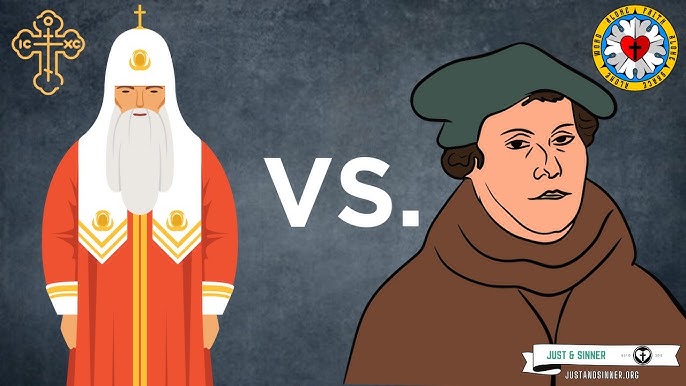
The following is a much expanded essay on “Why didn’t Lutherans reform back to Orthodoxy?” When I first posted this blog in 2021 on Lutherans and Orthodoxy (the Eastern tradition of Christianity), I had no idea that an off the cuff post would become consistently my most popular. I suspect there are many reasons for this, but here are a few.
First, The Moscow-Constantinople Schism of 2018 has continued to rear its ugly head in news thanks to the invasion of Ukraine by Russia. In Ukraine, the two main Orthodox churches are the Ukrainian Orthodox Church of the Moscow Patriarchate (UOC-MP) and the Ukrainian Autocephalous Orthodox Church (UAOC), which later merged with the Kyiv Patriarchate to form the Orthodox Church of Ukraine (OCU). The OCU, no surprise, has no real interest to be under the care of the Russian Patriarch, someone whom is largely believed to have served with the KGB as an informant while a priest in the 1970s and a spy in Switzerland, whom has declared that those that are fighting for Russia and are killed in Ukraine will be martyrs gaining access to heaven (partly to help with Army recruitment), and whom is pals with Vladimir Putin. The native Ukrainians also have an historic but disputed by Moscow claim to religious independence. Yes, as Ukraine fights for its existence, some holy places have been forcibly reclaimed from the Russian-friendly Orthodox, and some priests suspected of cooperating with the Russians arrested or deported. This is often the undercurrent for the claim that the Ukrainian government is anti-Christian. It is likely more specifically anti-Russian. Let’s just say that wherever you fall on this international disagreement, it has attracted attention to Orthodoxy.
Numerous surveys also indicate that while many other denominations in the United States have faced losses, the Orthodox Church in America (OCA) has experienced some growth. Of course, it remains a small entity domestically, so when throwing around percentages, one needs to keep things in context. When an article states that young men are joining Orthodoxy in “droves,” understand that droves is a relative term. Such articles often suggest this growth is particularly due to young adult males seeking peace and more certainty in their lives. Less complimentary, others think some of those moving toward Orthodoxy are from the far-right, attracted by its connection to what they read about Russia and Putin.
Then, this year is the 1700th anniversary of the Nicaean (or Nicene) Creed. As people fought over who Jesus was, this creed became a seminal, theological lens to help us interpret and confess our shared faith as Christians. It holds much significance as it came from a council before the Great Schism of Eastern and Western Christianity. People, at least some people, want to understand why the Church fractured and what is all the hubbub about the filioque. (In our podcast, we jokingly say the west is Fili-ok, and the East is Fili-no way.)
Adding to confusion is the Orthodox world itself. They often say they never change, but they certainly fight among themselves. Yes, there are issues between Eastern Orthodoxy and Oriental Orthodoxy. Yet, jurisdictions (patriarchates) can get mad at one another thanks to theological differences often couched in deeper cultural or nationalistic issues. At such times, they may condemn one another as heretics (such as with the Moscow-Constantinople Schism mentioned above) or simply not recognize one another. The Orthodox Church in America (OCA) is itself in such a dilemma. In 1970, the Russian Orthodox Patriarchy approved the OCA’s request to become autocephalous. Constantinople felt the Russians overstepped their bounds due to lack of consultation. To this day, some Orthodox jurisdictions recognize the OCA as autocephalous while others don’t. The Orthodox world tends to not like being called denominations as they see themselves as the one and only Church, but they sure can treat one another roughly as if varied denominations. The unity of Orthodoxy proves to be on shaky ground historically.
Let me be clear, there’s no doubt in my mind or heart that Orthodoxy is a beautiful expression of Christianity with a rich theological heritage incorporating wonderful art, music, and ultimately worship into community life. God is at work. I have been to their worship several times, and as my friend Fr. Adam, an OCA priest, gleefully, playfully reminds me, a godson of mine converted to Orthodoxy not too long ago. Orthodoxy is too often ignored in the West when we should listen to them. We might not ever fully agree, but we should listen. As a valid member within the body of Christ, they have much to teach us!
So yes, I understand the attraction and positive aspects of Orthodoxy even if it is still not the place for me. And although the Orthodox might assess me as a Lutheran or Western Christian to be deficient – at risk of damnation for not being part of “the Church” as they define it – I look at them perhaps as Martin Luther did with some esteem and love. They are Christians, even if I profoundly disagree with them at times. Indeed, I have learned a lot from them particularly about the early Church voices and practices. If you ever listened to our Three Priests Walk in a Bar Podcast, you have heard some wise and gentle words from Fr. Adam. (I know…surprising, right?!) He says, “We know where Christ is [in his mind, Orthodoxy], but not where Christ is not [that Christ might be active somehow in the other Christian expressions, but yes, they are outside the Church].” Our podcast is on an undefined hiatus, but I have continued to try to learn about Orthodoxy to hopefully affirm, stretch, or even correct my faith beliefs. If one seeks to be humble, one should recognize that there’s always something to learn.
This leads us to my previous blog (2021) on this issue. Immediately below, I am sharing part of a Facebook discussion that occurred between my dear friend, Fr. Adam, me, and others regarding a famous Martin Luther quote cited often by the Orthodox or incorporated into a meme around Reformation Day each year:
“The Greeks [Orthodox] . . . are not heretics or schismatics but the most Christian people and the best followers of the Gospel on earth.” Martin Luther (1999). Vol. 32: Luther’s Works, vol. 32: Career of the Reformer II (J. J. Pelikan, H. C. Oswald & H. T. Lehmann, Ed.) (59). Philadelphia: Fortress Press.)”
A most common version of the meme often simply quotes, “The truth lies with the Greeks.”

That proves somewhat ironic when it comes from a person who is Russian Orthodox or participates in another jurisdiction in schism with the Greek Orthodox. It certainly does not reflect the whole story. Their use of the quote proves too simplistic if not misleading.
So, one Orthodox person in our past podcast’s Facebook group asked in response:
“Why didn’t they [Lutherans] reform back to Orthodoxy?” That’s a most excellent and complicated question. There are many people and groups trying to address this troubled history theologically and through formal and informal conversation. Many Christians long for the unity Christ prayed for, but it is never easy.
My immediate response (with some current edits and updates) was basically as follows:
The short, quick (?) answer, since [name withheld] asked: Lutherans who saw themselves as reforming back to earlier roots of the universal Church assumed (always a bad thing) that the cultural and religious differences between the East and West would not be too hard to work through. What they found instead was that the Orthodox in some areas were (in their view) too much like the Papists, and the Orthodox found the Lutherans in some areas too much like the Papists. So, you had a theological, religious and cultural divide much larger than first anticipated.
The quote is best understood in this context. Luther seems to have hoped to be reconciled with the Orthodox and earn their support, but even perhaps more so, he wanted to win his arguments with those that supported Rome’s supremacy. The above, “often-cited-by-the-Orthodox” quote seems to be shared in order to assert a sort of superiority (Orthodoxy over other Christians) sometimes for humor and sometimes not so graciously. This proves especially so around the time of Reformation Day. (So much for humility, Fr. Adam Sexton, but you know I love you anyway.)
Instead, the statement by Martin Luther was offered within a debate with Johann Eck, a Roman papal representative. Eck argued that the fullness of the Christian Church lay only in Rome under the authority of the Pope. Martin Luther’s complement seems intended to push back such claims and reinforce the universality of Christendom and the Lutheran right to descent.
The complete history of actual early dialogue and interaction between Orthodoxy and Lutherans appears largely lacking from what I can immediately see. For example, one Orthodox resource on the web suggested the East really didn’t interact with Lutheranism in any intentional manner until about 50 years after Luther’s death. (I can’t validate this as of yet.) Orthodox-Lutheran dialogue was picked up again in later years and is ongoing.
For the 90+% of all world Lutherans represented by the Lutheran World Federation (LWF), a communion of Lutheran religious bodies, it is primarily conducted through the LWF. These church bodies understand that scripture has primacy over the Lutheran confessional documents. They only hold true as far as they agree with scripture. Thus, although our disagreements might be important, the church bodies see no issue entering conversations with the Orthodox, and if shown to be wrong, changing the accepted understanding of theology and practice.
“Confessional Lutherans” (about 10% of Lutheranism) would see Orthodoxy as in error as with anyone else that doesn’t fully agree with the Lutheran Confessions, the Book of Concord. They see the Lutheran Confessions as a true reflection of scripture. Thus, their approach to the confessions is almost fundamentalist. (This might be an oversimplification, but if you disagree with the Lutheran confessions, you aren’t fully in the Christian club.) They tend to loathe to disagree with any point, change, or expand upon the wording of the confessions.
The World Council of Churches, which many Lutheran bodies belong to, has some ongoing discussions with Orthodoxy, but there are also some conversations held directly between the Evangelical Lutheran Church in America (ELCA) and Orthodoxy (including the Orthodox Church in America). Although shrinking, the ELCA remains the largest Lutheran church body in the United States. (In Virginia, it has been growing smaller in membership at about the same rate as Evangelical and Baptist communities according to a PEW study, so it might not just be “liberal” theology and behaviors that are the root cause of decline. Even as the ELCA might prove unsustainable by some of its own estimations, I don’t think Lutheran theology – whether more liberal or orthodox – will disappear. It remains an important witness of the Church.)
If you do a search, you can also easily find many Orthodox blogs on Lutheranism and Orthodoxy, but I find many of these authors honestly misunderstand (or perhaps intentionally remain ignorant toward) Lutheran theology and practice. Yet, be aware these authors might also often conflate variations of “Protestants” as if sharing one theology. They lack understanding if not education on what “Protestants” are or believe. The Orthodox tend not to play well with others theologically and cut off from interfaith dialogue. The word ecumenism to the Orthodox only applies to those within the Orthodox world, so errors are likely.
In Luther’s time, those called Evangelicals (not in the modern US sense, but as a people trying to live according to scripture) and Protestants (those protesting Roman Catholic errors in theology and practice in the West) were first and foremost early Lutherans. The term “Lutheran” was eventually projected on to them as the Reformation progressed. Over time, some of these early Luther-friendly Christians began to wear the name Protestant and Lutheran with pride, although “Evangelical” often remains part of denominational and congregational names. Interesting to note, Martin Luther argued against using his name to represent any church body, and so one can still run into “Lutheran” denominations bearing other words or phrases as part of their names such as churches “of the Augsburg Confession.” (The Augsburg Confession is the primary confessional document of faith for the Lutheran Church, presented to the Holy Roman Emperor Charles V at the Diet of Augsburg on June 25, 1530.)
Over time, Protestant became a big umbrella term for all those protesting Rome’s church and resulting break off groups – including Anabaptist traditions, English separatist movements, and the bodies leading toward and including modern American Evangelicals and Pentecostalism. In the time of the Reformation, people generally identified branches of Christendom as Papists/Roman, Evangelicals/Protestants/Lutherans, Calvinist/Reformed, and Radicals/Anabaptists, and of course Orthodox.
The modern, US understanding of “evangelicalism” tends to be anabaptist or separatist in theology and often very conservative politically. It is often a far cry from Lutheran theology in many areas, including the more conservative Lutheran bodies. Some who claim the title Protestant are not so in the traditional sense any more than some Anglicans claiming to be Catholic are a perfect fit. See for example, my recent blog post on the New Apostolic Reformation. The many western branches of Christendom often have some touchstones of faith and practice – thus the umbrella use of the term – but perhaps this is in a similar way that varied Orthodox bodies cross-condemn one another although sharing some beliefs.
Convince a Lutheran by both scripture and reason, and you might yet see a Reform back to Orthodoxy. Yet with much of Orthodoxy often fighting among themselves throughout history, and with ongoing cultural differences and approaches to scholarship, I don’t think that could be easily done. (Fr. Adam, I again assert that this is where I duck for incoming abuse and scorn from your friends…if so, you owe me a beer.)
My wrestling with Orthodoxy continues, because I think they have some things to teach me, and perhaps I have something to teach them. When quoting the Lutheran confessions, I often have Orthodox folks say, “That sounds very Orthodox.” In return, I might at times say, “That’s very Lutheran of you.” Despite differences, we should not be surprised of any overlapping theology. Jesus’ prayer for unity will be fulfilled in perhaps some surprising ways. Indeed, there was actually a reported movement of many LCMS toward the Orthodox in the 1990s according to Dr. Jordan B. Cooper. (Lutherans tend not to move toward Roman practice, but some do.) Anything is possible when the Spirit is involved.
The filioque debate (in Ecclesiastical Latin pronounced filiˈokwe; meaning “from the Son” as used by the West in the later Nicene Creed without Eastern agreement) remains a huge issue, even as the LWF and ELCA have shown some willingness to lean into or accommodate the Orthodox take. Ongoing cultural differences, respected Western voices like Augustine of Hippo (who used the Latin Vulgate as opposed to the Greek scriptures causing some interpretive issues for the Orthodox), and many other interpretive issues remain serious hurdles.
Yet, there are similarities too. As widely noted, there is a tendency of both Lutherans and Orthodox to hold Thomistic scholasticism in disdain. I think I have made that clear in our podcast particularly when conversing with Fr. Nik who loves Thomas. While I appreciate Thomas Aquinas’ intellect, I think he goes too far at times in his attempts to define “mystery.” One cannot clearly see them as explicitly biblical, therefore once can disagree. Lutherans, including Martin Luther himself, have traditionally understood and valued the mystical nature of the Spirit’s work among us and in us. (See the book, Theology of the Heart or Luther and the Mystics by Bengt R. Hoffman to learn more.) Yet, we historically hesitated to go into any specificity. Traditional Lutherans might still use or appreciate scholasticism at times, but as a whole, Lutherans have been suspicious of overuse of our reason. This is all not unlike many Orthodox believers. And like the Orthodox, Martin Luther never intended biblical interpretation to be done in isolation. We listen to the voices of the past such as the Church Patriarchs, the voices of Christians around us (Lutherans would look to a more diverse group, of course), and then form and share our own opinions as we listen for the Spirit’s guidance to truth. In cooperation with God and one another, we discern truth.
If you wish to dig into this topic further, I highly recommend the following:
Although he falls theologically to my right, I very much admire and give thanks for the scholarship of Dr. Jordan B. Cooper. He is a pastor in the American Association of Lutheran Churches, a small (16,000 member) confessional, Lutheran body. He draws upon, compares and contrasts many sources quite fairly in my view. Watching his video, A Lutheran Response to Eastern Orthodox Theology, will likely be a fruitful use of your time. The image used for this blog post is from that video.
You can find news and joint statements between Lutherans of the LWF and Orthodoxy (primarily Greeks) on their page about Lutheran-Orthodox Dialogue. This includes a recent important document, Lutheran-Orthodox Common Statement on the Filioque (July 2024), where in regards to the Nicene Creed they “suggest that the translation of the Greek original (without the Filioque) be used in the hope that this will contribute to the healing of age-old divisions between our communities and enable us to confess together the faith of the Ecumenical Councils of Nicaea (325) and Constantinople (381).”
For the Orthodox bilateral conversations with the ELCA and/or their representatives, you can visit their website’s page on “bilateral conversations.”
As we discern together, I think we must be mindful of Paul’s heartfelt request from Ephesians 4:1-6: I, therefore, the prisoner in the Lord, beg you to walk in a manner worthy of the calling to which you have been called, with all humility and gentleness, with patience, bearing with one another in love, making every effort to maintain the unity of the Spirit in the bond of peace: there is one body and one Spirit, just as you were called to the one hope of your calling, one Lord, one faith, one baptism, one God and Father of all, who is above all and through all and in all.
© 2025 The Rev. Louis Florio. All content not held under another’s copyright may not be used without permission of the author.

 2pennyblog