Tag Archives: pastoral letter

Deliver us from evil…including our own

“You, my brothers and sisters, were called to be free. But do not use your freedom to indulge the flesh; rather, serve one another humbly in love.” Galatians 5:13

Left or right or in between in the US, we all are a sinful, stiff necked people in need of grace; called to become more through Christ. As a culture and fallen people, we historically swing dysfunctionally between political poles of excess and denouncing the “other,” hurting ourselves and those entrusted to our care all the while. Platforms tend to become more important than people, for we rest in the assurance that we are “right,” and we want to defeat the “other.” We self righteously think, “They are the evil ones after all.” In doing so, we often forget that true justice requires mercy and the least of these are indeed our responsibility. At the same time, or perhaps because of this plank in our eye, we tend not to like to reflect deeply on our own sins – what we have done and failed to do – with the gift of holy wisdom at our disposal. We prefer passion and group-think over the Holy Spirit’s guidance and light.

It ultimately doesn’t matter what wrong was done in the past. We must let it go instead of letting anger metastasize. We are called to love one another in the present, not ignoring or enabling wrongs, but striving with God’s help to see the Christ in others and treating them with gentleness, patience, and the love we ourselves have received first. As I’ve said before, it is a habit of life which takes practice. We are to forgive and forgive again when wronged. “Seventy times seven” times according to Jesus, we should forgive. This means we should forgive others without limit even when they don’t deserve it. For Jesus died for our sin – that which we have been born into or done, those we struggle with today, and the sins we’ve yet to do – when we still don’t and never will deserve it.

And what about us? Our recalcitrance in regard to all the teachings of Jesus including doing good to those whom hate us? What evil is at work in and through us and our choices as we face the fears and pressures of our day? How might we be making a bad situation worse? Who are we to condemn people to hell in our hearts or cause others to suffer through our actions? Each day in a similar way to our siblings in Twelve Step programs, we who are addicted to sin and selfishness can take a searching and fearless moral inventory of ourselves. Then, we ask for God’s forgiveness, seek to repent of our wrongs (turning back to God), make amends as we can (as we are empowered by God). We do so because Jesus said he wants us to have his abundant life and peace, and this is the Way.

We might feel caught in an impossible situation, but all things remain possible with God. We can make choices to help change our behaviors and attitudes for the better today; repenting of our wrongs and positively influencing others. God’s Spirit has already been sent to help us, residing in our hearts through the gifts of our faith and baptism. Most importantly, Jesus promises that we are never alone. He will carry our cross when we cannot. He already has!

Jesus once said, “People do not light a lamp and put it under the bushel basket; rather, they put it on the lampstand, and it gives light to all in the house. In the same way, let your light shine before others, so that they may see your good works and give glory to your Father in heaven.” In times of trouble and discord, this is even more true. We need our yes to mean yes and to seek to love God and others as ourselves no matter the cost. It is Jesus who has called us to this time and place to be his body. Don’t be afraid.

Whatever happens around us or to us, our first allegiance as a Christian is always to Jesus. As we American Christians look upon fireworks tonight celebrating Independence Day, never forget that Jesus always wants us to reflect his light…always. Sinning in our anger is never his way. Political waffling is not his style. We can be better as a person and a nation. We can be healed. We live in hope thanks be to God.

I wish you a happy and safe Independence Day, while remembering and seeking to serve the only One who truly makes us free.

Peace+, Pastor Lou

Leave a comment

Filed under Pastoral Letter

This all is for the good…

Image: Jerzy Hulewicz, Detail from “The Cross.” 1918; public domain

This April, our Jewish siblings recall several major events in their history once again. Among them, Passover Festival is from sundown, April 12, through sundown, April 20 this year. This marks the passing of the Angel of Death over Jewish homes and their subsequent flight from slavery. On April 12, 1951, the Knesset passed a resolution establishing 27 Nisan on the Jewish calendar, a week after Passover, and eight days before Israel’s Independence Day, as the annual Yom HaShoah or Holocaust Remembrance Day. In 2025, this begins on Wednesday, April 23rd. Yet in 1943, 27 Nissan was also the day of the brave Warsaw Uprising against the Nazis. It occurred on April 19 during that year.

Remembering the sadness of slavery and the evils of the Holocaust with them, you will often read or hear the words “gam zu latova” in Hebrew which means “this too is for the good.” Most certainly in the face of such horrors and ongoing struggles, it seems a bit difficult to say such hopeful words. Yet, these words are shared out of deep trust despite what is seen, reason, or any emotion. It is about God’s glory but also God’s pledged steadfast love to the descendants of Abraham. God will always be faithful, and God will make good eventually come from any bad.

It is a similar theological belief that had Paul, a former Pharisee, write, “We know that all things work together for good for those who love God, who are called according to his purpose” (Romans 8:28). One of my favorite passages, it reminds us that while we face any family discord or rift, struggle with sin, or threat from any evil, persecution or death itself, God will not let us down. God will change curse into blessing much as he did with Balaam’s curse of Israel in Deuteronomy 23:5. God does this because our Lord God loves us. It is just who God is.

As we have entered another Holy Week and face any stressors and discord internationally, nationally, or within our personal lives, we come to remember Jesus’ own suffering and death. In the face of defeat with our Lord Jesus on the cross, his disciples scattered and afraid, only a few daring to watch and wait amidst tears and wailing. As Jesus shouts (quoting the Psalmist), “Why have you forsaken me!” toward God the Father in heaven, we might struggle to call Holy Week holy or Good Friday good. Yet, we now know this barbarous, desolate scene is not the end of the story. As an old sermon proclaims, “It is Friday…but Sunday is coming.”

Although Jesus is now risen, a bigger and more perfect “Sunday” is still yet to come. We live in an in between time of Jesus’ Resurrection and Ascension and his coming again to make all things new. Only then, when the time is right, will Jesus end suffering and death and wipe away every tear (Revelation 21:4). This time that we find ourselves within is often hard. It might be appropriate to grieve. Yet, it is not the entire story. Jesus is coming, and we pray in hope and love that he comes soon.

Until then, we walk step by step in faith, trusting in what has not yet come to pass, sharing hope and love with others, because Jesus loves us and will not abandon us. It is just who Jesus is. It is who we are called to be. And although God might seem hidden, we can trust that God’s ultimate will for us, our perfect joy, is being somehow worked out in our present.

Despite his own experience with desolation and abandonment, overcoming death, Jesus promises that we are not and never will be alone. We will overcome too, thanks be to his unending love for us. We can sing with the ancient Church and Church yet to be, “Christ has died. Christ is risen. Christ will come again,” for it is true. Jesus does not lie. This life we share, hard as it might prove at times, will all be for the good.

Adapted from an essay written for the April 15, 2025 weekly newsletter, the Hub, of Christ Lutheran Church, Fredericksburg, VA.

© 2025 The Rev. Louis Florio. All content not held under another’s copyright may not be used without permission of the author.

Leave a comment

Filed under Uncategorized

Of Lions, Lambs & Love

Image Used with Permission (c) Clipart.email

Although written in 2020, Lent once again begins the first week of March. This has been popular of late, so I am reposting it. Blessings this Lent and always. PL

Although we have had a mild winter (as I write this), we likely enter March with the old adage, “March comes in like a lion, but goes out like a lamb,” entering our minds. Although not a phrase related to faith, it recently struck me that it very well could serve as one. For this year with March, we have also just entered Lent.

Some people are intimidated by Lent. They don’t want to think about sin and death. Yet as Christians, we should. Jesus came to defeat these dark powers over our lives. Recognizing our need is not only being honest and humble but an opportunity to increase our gratitude.

Lent isn’t just about more sacrifice and activity. It is a chance for us to reflect upon the story of salvation at work in the past and in each day of our lives. We are sinners yet simultaneously saints. Struggling yet free. Dying yet growing in our experience of a new life that will last eternally. Through the grace-filled moments and disciplines of Lent, God helps us grow in our love for God, our neighbor and of ourselves.

The lion which is sin proves a ravenous foe. Its roar is ignored at our peril, but it need not be a roar lasting in our ears or misshaping our lives. For the Lamb of God has come and speaks love to us. A name given Jesus by John the Baptizer, the Lamb of God reflects the sacrificial lamb, an atonement for sin, during the Temple period. The image is so powerful, the meaning so important, the symbol of a lamb carrying a Roman banner of victory became synonymous with Jesus. The Risen Christ has conquered death for us and for all who trust in him. It is the certainty of this truth that inspired Paul to write the church in Rome, “Yet in all these things [all the suffering and struggles of our worldly experience] we are more than conquerors through Him who loved us.” We already share his victory, and we can thus walk on in his peace.

The lion and lamb (as I am using them today) remain part of the story of our salvation and always go together. They cannot be separated for they prove both our history and inheritance. No surprise, the lion has thus commonly come to symbolize Christ, both in his suffering and his triumph. Echoing prophecy, the lamb and lion laying together have become a rightful symbol of paradise. It’s both resurrected life and a promised paradise that we will celebrate on Easter. I wish you all the blessings of a fruitful Lent, an experience graciously magnified by our shared Easter joy. Come, Lord Jesus, come!

Originally version published in the March 2020 newsletter of Christ Lutheran Church, Fredericksburg, VA.

© 2020 The Rev. Louis Florio. All content not held under another’s copyright may not be used without permission of the author.

Leave a comment

Filed under Pastoral Letter

Serenity Now

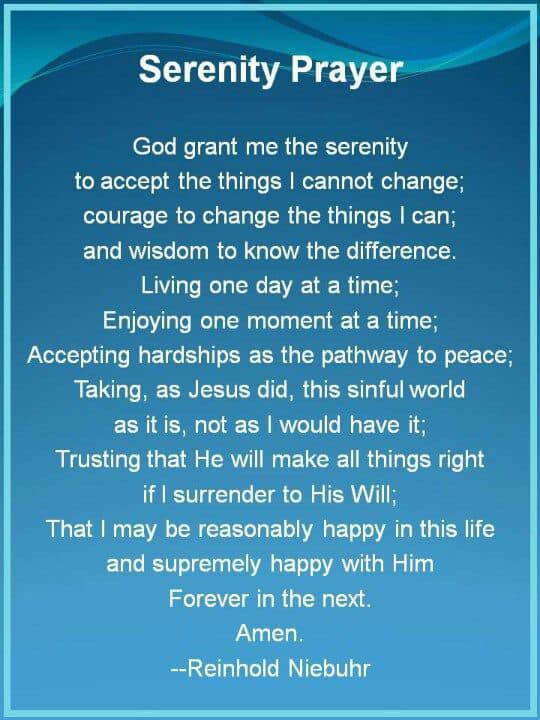
Who knew the well-known and respected Serenity Prayer could cause something other than peace – doubts, anxiousness, and many more questions? After sharing it on our Facebook page post-election, I have had many great and fruitful discussions about the theology behind it. On its face it sounds crazy to accept the world as it is. Yet, that is not really all that it says.

As I wrote someone recently, the Serenity Prayer was written as the US was battered by the Great Depression and the Nazis took over in Germany. Things looked grim. It began as an observation by Reinhold Niebuhr in 1932 as Roosevelt was elected: “The victorious man in the day of crisis is the man who has the serenity to accept what he cannot help and the courage to change what he must.”

The prayer challenges us to discern our unique individual call, as well as a call in community. We are to take stock of what we really can influence in the world, act accordingly in faith, and with any things that prove out of our hands, we are asked to trust that they remain in God’s. Many studies have shown that “letting go” can help us physically, emotionally, and mentally function better. Based on the teachings of Jesus, I always say that it benefits us spiritually too. Consider John 14:1 for one example: “Do not let your hearts be troubled. You believe in God; believe also in me.”

Lutherans also believe in a Theology of the Cross – the cross is seen as the best source of knowledge concerning who God is and how God saves. It also encourages us to take up our cross and follow Jesus. As the Lutheran theologian, pastor, and martyr, Dietrich Bonhoeffer wrote, “When Christ calls a man, he bids him come and die.” None of our recent posts are about “just getting along” or stopping our work for a more just world. We know the world is a mess. Loving others is difficult. In the face of reality, these prayers and teachings challenge us to trust and love God at all times, and love one another, even our enemies.

How we respond to perceived injustices might change when we trust God is always at work for our welfare. This theological lens invites us to find Christ’s peace and hold on to it, even if facing the worst evil. Our suffering and sacrifice can become sacred, not by our own power, but because of God’s promise that all things work for the good of those who love God (Romans 8).  God will be with us in our suffering, but God also somehow will use it to bless us and the world. We are asked by Jesus not to lose hope when it seems like the world is ending. He taught that these things must happen (Matthew 24:6) before his Kingdom, a new heaven and earth, fully comes.

We can look toward our theological forbearers. They sometimes died for their faith. Some still do. In the US, there has been worst times of trouble – the Civil War being arguably the worst and most costly. (It took Spotsylvania County one hundred years to return to its pre-war census.) Working within the ebb and flow of history, we are called to pray and act, but always trust. God wills more for us. As Lutheran theologian Ernst Troeltsch writes, “God, therefore is always living, always creating. He is truly manifested not in being but in becoming; not in nature, but in history” [Troeltsh, E. (1991) The Christian Faith, p.120. Minneapolis: Fortress Press]. God is at work in and through us as we live in a Fallen World. God may seem like a hidden God, as Luther often called God, but God is awake and at work. It is not all up to us. God’s will will be done.

These beliefs, this kind of trust, often helps us extend our focus to see more possibilities of what we can do in hard or conflicted times – acting in love rather than just fear or anger. Acting in love does not mean there are never any consequences. For the sake of the weak, the vulnerable, really all our neighbors, sometimes some are called to respond more directly and forcefully than others. Yet as a former soldier and police officer, now a police chaplain, I see that violence is never a good thing – never without cost – even when violence becomes necessary. (Luther in discussing his Two Kingdoms theology or in his essay “Whether Soldiers Too, Can Be Saved?” speaks of these kinds of things.) We each have parts to play in making a more just world, but we each must discern how Christ is calling us with the gifts we have been given.

Still in Christ’s teachings, the call to be open to reconciliation, to even nurture it, is ever present. For me, my understanding of this broadened when I came to know and eventually live with Brother Roger of Taizé in France. Under the Vichy government, he helped Jews escape. He ultimately narrowly escaped the Gestapo’s arrest; going to Switzerland until the war was over. After the war, he came back. He cared for German soldiers (former POWs) as they made their way home. In the region, he was among some of the most anti-church people in France. Some Communists slaughtered a pig on the church steps in the nearby village each Good Friday to show their disdain for Jesus and his Church. Yet, he with other friends helped form a coop for the community anyway, and they cared for the sick and hungry. His authenticity, patience and love changed hearts and minds over time with God’s help. And I believe his witness eventually changed my way of seeing and being as well.

When we as Christians say, “all is well,” or “love your enemy,” we are ultimately affirming that Jesus is Lord. He lives, and that matters. In fact, it changes everything, so it must change how we respond to the world. Jesus promises that his Kingdom will come, but he is here with us now. It has broken into our world, but it is not in its fullness yet. We are already victorious even when we might suffer (1 Corinthians 15:57). This truth can free and empower us to respond to our Fallen world and our neighbors in surprising ways.

For, God is not done with us or the world yet. Yes, the poor will always be with us (Mark 14:7, John 12:8, Matthew 26:11), but we seek to feed and house them as Jesus also taught us. As we face those in opposition to us, we seek to bless those who curse us and pray for those who mistrust us (Luke 6:27-36). In the face of worldly reality, we seek to live in abundant, generous, and merciful faith, hope, and love. All is well, but all is not perfect…yet. As the body of Christ, we have work to do, but we trust most importantly that God is at work, too. We need not be afraid.

Parts of this reflection originally were published in the November 18, 2024 weekly newsletter, the Hub, of Christ Lutheran Church, Fredericksburg, VA as well as sections in a Facebook post that I shared. 

© 2024 The Rev. Louis Florio. All content not held under another’s copyright may not be used without permission of the author.

Leave a comment

Filed under Pastoral Letter, Uncategorized

Anticipation

Photo credit: https://x.com/HeinzTweets.

During the late 1970s and into the early 1980s, a popular television commercial jingle for Heinz remained highly ranked among all the “ear worms” of the world. The ad showed a bottle of Heinz being poured, and all so slowly, a closeup showed the red, luscious ketchup mouthwateringly meandering out of the bottle. All the while, you heard Carly Simon sing her hit, Anticipation: “Anticipation; Anticipation; Is making me late; Is keeping me waiting.”

Anticipation is part of life. As children, we could likely not wait for summer. Then, in a short time, we began to start to miss our friends and want to return to school. The world is never perfect. Our hungers (literal or figurative) are never fully satisfied. We watch and wait for the next best thing. Paul plays off this experience as he writes about waiting for Christ’s return, “Rejoice in hope; be patient in affliction; persevere in prayer” (Romans 12:12). As Christians waited expectantly, he asks that they do so in hope – fully trusting and relying in their loving God’s provision and support. Yes, Christ has been victorious. We are also conquerors through our faith in him. And yet…and yet…we wait.

Anticipation can be either a positive experience, a negative one, or a mix of emotions. Indeed, many of us struggle at times with what psychology calls “anticipatory stress.” We worry about the “what ifs” of life and all that can potentially go wrong. Professionals of that discipline will encourage us to use compassionate and positive self-talk (“I have survived many things. I will get through this too.” “This is going to be hard, but I know how to face a challenge.”) They encourage people to take care of themselves (with sleep, diet, socially, etc.) as people will tend to fair better. Surrounding yourself with positive people is proven to help too. Being a downer is contagious, but so is positivity! Then, we can learn mindfulness exercises, helping us to stay in the present.

Paul’s own advice to his churches echoes many other parts of scripture and predate these helpful, valid tools. In fact, religious disciplines incorporate the above (for example, Christian music or chants, memorizing encouraging scripture verses to recite when anxious, coming to participate in the life of Christ’s body, meditation, fellowship of the Church, etc.). Further, Jesus encourages us to not worry about tomorrow just like the Psalmist’s teachings shared before his earthly ministry – “Be still, and know that I am God” (Psalm 46:10).

The Christian faith is meant for the real world, not just eternity. It is a true gift in a hard world. With Paul, we know life is hard, but God is always good. We can seek to remind ourselves with Luther (as when he was afraid or doubted), “remember that we are baptized.” We are Christ’s. So, all is well, no matter what our anxieties or doubts might say. Through prayer, community, and trusting in the promises of scripture, we are reminded that we are loved. We need not let our fears rule us anymore. We can anticipate a better tomorrow through our life found in Christ Jesus.

Unless otherwise indicated, all scripture quotations for this post are from the New Revised Standard Version (NRSV) translation.

Adapted from an article originally published in the Aug/Sept/Oct 2024 newsletter of Christ Lutheran Church, Fredericksburg, VA.

© 2024 The Rev. Louis Florio. All content not held under another’s copyright may not be used without permission of the author.

1 Comment

Filed under Pastoral Letter

Learning about love

Photo by Hans Veth on Unsplash

You can also find a recording of this post at my 2 Penny Blog Podcast.


We know love by this, that he laid down his life for us—and we ought to lay down our lives for the brothers and sisters. (1John 3:16)

During a recent children’s message, I introduced the children present to my stuffed animal friend, Tommy Tatanka. (Tatanka means buffalo in the Lakota language, and that’s what Tommy is.) I bought Tommy when visiting the National Buffalo Museum in Jamestown, ND, because I thought seeing it would help me remember my Lakota children and youth at St. Joseph’s Indian School. The motto for the school is: “We serve and teach. We receive and learn.” This reminds us that our relationships are meant to be reciprocal, and I received and learned much from the Native students and their families. I mentioned during the children’s message as we explored the story of the creation of the first family in Genesis 2 that the Lakota had a saying used often in prayer, sacred story, and at other times: Mitakuye Oyasin (“We are all related”). They seek to remember that the human family remains in relationship with one another and all of creation much as many Psalms and other biblical citations suggest.  

In Lakota Christian communities, you might often see this concept represented concretely. Amidst traditional Christian symbols of the cross, candles (representing the light of Christ), Christograms (such as the ancient Alpha and Omega symbol for Jesus ), a butterfly (a more modern symbol of resurrection and new life), or perhaps an ichthys fish symbol (reportedly used by ancient Christians to help people recognize churches and other believers during a time when they faced persecution in the Roman Empire), among all these things and more, you might find Native religious symbology as well. For example, one might see a buffalo skull. Why a buffalo skull? In past times, the buffalo was hunted for food, but every part of the buffalo would be used by the tribe for clothing, shelter, or tools. Nothing would be wasted. The Lakota still believe that because of the American buffalo’s great importance to the people, a buffalo skull should rightly be present at sacred Lakota rituals. The skull represents a powerful animal that gives completely of itself for others. The buffalo is a symbol of self-sacrifice, and for Lakota Christians, the skull often helps remind them of Jesus’ own sacrifice for our sake.

Yet, the buffalo proved an important role model to our students as well. In the fierce winter storms, the buffalo always faces the wind. It survives by addressing things head on. This becomes inspirational for the students as they face new challenges or experiences, or as they deal with losses or trauma. For Christian Lakota, it can remind them to pick up their cross as Jesus did in the service of others.

As I write this, St. Joseph’s Indian School is about to have their annual student pow wow. It serves as a reunion of sorts, but it also becomes a time for families of the community and from across the US to gather. The children and youth dance and sing remembering their relatives of the past proudly even as they sing with hope for the future. In loving one another, we find hope. I discovered that we can even meet Jesus.

Happy Native American Heritage Month to one and all!

Unless otherwise indicated, all scripture quotations for this post are from the New Revised Standard Version (NRSV) translation.

Adapted from an article originally published in the October 2023 newsletter of Christ Lutheran Church, Fredericksburg, VA.

© 2023 The Rev. Louis Florio. All content not held under another’s copyright may not be used without permission of the author.

1 Comment

Filed under Pastoral Letter, Uncategorized

What does Lent mean?

Photo by Francisco Gonzalez on Unsplash. Used by permission.

You can find a recording of this post at my 2 Penny Blog Podcast.

As Lent approaches once again, I recall my return to the Church during a similar Lent about thirty years ago. As I have already mentioned in worship, life had banged me up pretty well. Growing up, I faced many challenges, and as a young police officer, I was often subjected to violence, loss, and death. Indeed, I escaped near death experiences several times. Like many young adults, I had also made some bad choices, but I had likewise allowed myself to drift aimlessly from the faith community. I was easily distracted from faith matters by what seemed more accessible and important – things of this world. My faith, for the most part, had become just words.

My heart was sick although I did not realize it. When things seemed the worst, memories of what I had learned in campus ministry, youth groups, and even long-ago Sunday school classrooms spoke to me. These memories of relationship and seeds planted called me back. I was able to contact some of these past people who had befriended me on my earlier faith journey, and they became touchstones to help me find my way back to Christ. A lot of life has happened since, and it hasn’t often been easy. Yet with God’s help and the help of others, my “face has been set like flint” (Isa. 50:7) toward something greater than myself, a God who loves me.

Perhaps I experienced a synthesizing of faith more than a conversion, as I was baptized and grew up in the Church, but something significant and life-changing happened on the evening of March 7, 1992. (Ash Wednesday was March 4th that year.) I decided whatever the implications, I would commit to follow wherever Jesus led. Lent was a perfect time of year for this new start. As a community and individuals, we join Jesus as he sets his face toward Jerusalem, and we are asked to turn to the Lord and live. In worship, we often hear of prophets speaking of a God who, although wounded by our indifference if not antipathy, only has love for us. We learn of Jesus who seeing the marginalized and lost, rather than judging them, befriends them as his own and heals them. Through scripture and song, we discover a God who gives all out of love for us. By his death, with Christ’s last breath, we experience this. Jesus doesn’t curse us, but instead asks, “Father forgive them, they know not what they do” (Luke 23:24).

Lent is not meant to be a burden. It isn’t about feeling sorry for ourselves or judging ourselves harshly. It serves like a voice in the wilderness where God uses the Church community to call us home. Years can take us far away, but no matter how far we have strayed from our path following Jesus, somewhere in the depths of our heart, the Spirit is calling. Do we notice this quiet whisper of our name? This Lent, I hope each of us experience or rediscover the deepest meaning of Lent. God loves us and wants us to come home. God wants us to love like Jesus loves us – with more than words.

Unless otherwise indicated, all scripture quotations for this post are from the New Revised Standard Version (NRSV) translation.

Originally published in the February 2023 newsletter of Christ Lutheran Church, Fredericksburg, VA.

© 2023 The Rev. Louis Florio. All content not held under another’s copyright may not be used without permission of the author.

1 Comment

Filed under Lent, Pastoral Letter

God has you covered

Photo by Liv Bruce on Unsplash

You can listen to the podcast version of this post at 2 Penny Blog on Anchor.fm.

“Who will separate us from the love of Christ? Will affliction or distress or persecution or famine or nakedness or peril or sword?…No, in all these things we are more than victorious through him who loved us.” (Romans 8:35 and 37)

With the new year, people tend to wonder about what the future will bring. “Will the economy improve? Will I remain healthy? What might go wrong?” In the face of many uncertainties, we tend to set goals about more exercise, more Bible reading, more self-improvement across the board. We want to control our future – at least in some small way. Surveying history, we know one thing if nothing else. We are in for surprises, and we can only control so much. So, isn’t it wonderful that we have a God who holds us and carries us through our uncertainty? A God who loves us controls what we cannot.

Yes, God is filled with a steadfast love for you…for us and the world. Jesus said, “Why, even the hairs of your head are all numbered” (Luke 12:7 NRSVue). As God’s chosen people, Isaiah tells us that the Lord called us from the womb, from the body of our mothers God already knew us by name (Isaiah 49:1 NRSVue). Paul assures us that long ago, even before God made the world, God chose us to be his very own through what Christ would do for us. Before any human every took a breath, God decided then to make us holy in his eyes, without a single fault—we who stand before him covered with his love (Ephesians 1:4 NLT).

At the Virginia Military Institute, we used to call the months before us the Dark Ages. We would get up in the dark for breakfast, and we would end our duties in the dark. There would be few holidays but plenty of work to do. The darkness seemed to hide our future from us. Yet whatever our darkness or time of year, the light of Christ is still shining. Dark and uncertainty can never overcome it. We are loved, and although Christmas celebrations might be a memory, Jesus remains “God with Us.”

We are deeply loved. We are not alone. The darkness has no real power over us. Christ is the light. As we enter an uncertain new year, may the Spirit help us trust in the certain power of God’s love holding us and guiding us forward. We can pray with confidence like St. Augustine, “Let not my doubts and darkness speak to me. Let my heart always welcome your love.” For God already loves us, and whatever happens good or bad, always will.

Originally published in the January 2023 newsletter of Christ Lutheran Church, Fredericksburg, Virginia.

Unless otherwise indicated, all scripture quotations for this post are from the New Revised Standard Version Updated Edition (NRSVue) translation.

© 2022 The Rev. Louis Florio. All content not held under another’s copyright may not be used without permission of the author.

2 Comments

Filed under Uncategorized

Still Risen

Photo by Kelly Sikkema on Unsplash. Used by permission.

You can listen to a podcast version of this post on anchor.fm, season 1, episode 16.

As we move further into spring after Easter each year, we ponder the earliest stories of the Church. We see Peter grow from a struggling fisherman to a skillful shepherd. We meet Stephen, the first martyr, and encounter a new Apostle, at first a persecutor of the Church and now surprisingly called to serve the gentiles. His name will be changed from Saul to Paul; reflecting the change in his heart and understanding. We learn of resurrections of the dead such as Tabitha (raised through Peter’s faith) and Eutychus (raised through Paul’s faith). Such events don’t become a norm, but these miraculous healings, exorcisms, and resurrections serve as a sign of the truth to what God has done through his only Son, Jesus. In all these things, people will not only come to believe, but they will also continue to grow in belief as they maintain their walk with Jesus.

The liturgical season of Easter is only fifty days, lasting through Pentecost (on June 5th this year), but the impact of the resurrection is eternal. The story is not over, for it continues to be spoken by God in and through our lives. We find that we aren’t so different than those who came to believe so long ago. We face disease, war, poverty, and all kind of sin as they did. We struggle to believe at times just like them. And yet through it all, at any time, Jesus can appear to us. His words remembered can strengthen us. We encounter him in the Word heard preached and our participation in the Sacraments. We can meet the Risen Christ through those who need us, and those we need. Even in the face of those whom we don’t like, Jesus might be staring into our eyes asking forgiveness. Jesus is risen. His resurrection speaks to us of a present and future with him.

As school ends and summer begins, as Easter turns into the Season after Pentecost, we will be likely traveling more and having more opportunities for fun. Yet as you rightly enjoy these things, I encourage all of us to look for Jesus wherever we might be and whatever our circumstances. Remember the assembly and your call to service. Consider how work, sport, and all your activities, even rest, might serve the Risen Christ and proclaim his glory. Faith is not just for a season. It leads to life itself. Jesus is and remains risen so that people may experience abundant and eternal life in him.

Originally published in the May 2022 newsletter of Christ Lutheran Church, Fredericksburg, Virginia.

© 2022 The Rev. Louis Florio. All content not held under another’s copyright may not be used without permission of the author.

Leave a comment

Filed under Pastoral Letter

Sackcloth, Ashes and Joy

Prefer to listen? Visit and follow anchor.fm/2pennyblog/.

With spring comes new life, better weather, and spring cleaning. Lent also comes along. As I have probably told you before, the word “lent” comes from an Old English word lencten (related to “lengthen,” referring to the lengthening of days) that simply referred to the season of spring. It is fitting that days lengthen as we remember the Light of the World’s victory over sin and death and a future filled with hope opened up before us. The season also lends itself to some spiritual spring cleaning as we prepare for Easter.

No, our spiritual disciplines never earn us credit for heaven. We can’t overshadow the light of the resurrection, but we can cooperate with it’s grace. We can seek to listen more closely. We can try humbly walk more in sync with our God. (See Micah 6:8.) We can even love because Jesus loved us first! (See 1 John 4:19.) For forty days before Easter – not including Sundays which are liturgically each a kind of “little Easter” – the Church is encouraged to dust up on Ash Wednesday as we recall the old practice of sackcloth and ashes as a sign of repentance. (See for example Job 42:6, one of twenty-three scripture references.) We also remember the ash heap of our sin, hurting God, ourselves and others, and the dust that we are and to which we will return one day. (See Matthew 7:12 and Genesis 3:19.) Then, we get to work.

Perhaps we fast. Fasting can be giving up food or activity. As we “hunger” for these things, we might recall hunger in the world, our spiritual hunger and needs, and the needs of the world better. Or maybe we reflect on scripture and the story of Jesus more – study with others might be best. We could even seek to experience the suffering and death of Jesus in a new way through art, poetry, walking the Way of Jesus (also known as the Stations of the Cross) mentally or physically. In doing so, we hopefully will be graced with the gift of an enlivened Spirit as we better understand what Jesus has done for us. We might even serve or give more as we are called and able, loving just a bit more like Jesus. And as both Pastor Ethan and Pastor Anne have been recently reminding us, we could even seek some holy rest. Sometimes, we just need to be still and know that God is God as commended to us in the Psalms. Or maybe during such times of quite, we will hear a still small voice as Elijah did. One never knows.

Whatever you choose to do or not do, trust that Jesus has chosen to die for you. Jesus loves you and longs to share his life with you. Risk following him more earnestly and see where he just might lead you. Wherever that might prove to be, whenever Jesus decides to reveal himself more to you, I trust you will find joy on the journey. I pray that Jesus shines more brightly in both your days and at times of night.

“Sackcloth and Ashes Crown of Thorns” Learn more about this art project here

Originally published in the March 2022 newsletter of Christ Lutheran Church, Fredericksburg, Virginia.

Unless otherwise indicated, all scripture quotations for this post are from the New Revised Standard Version (NRSV) translation.

© 2022 The Rev. Louis Florio. All content not held under another’s copyright may not be used without permission of the author.

Leave a comment

Filed under Lent