Tag Archives: police

No one is trash to Jesus (Sermon)

The below sermon was offered at Christ Lutheran Church in Fredericksburg on February 23, 2025. It proved a difficult sermon for me to preach on several levels, but it was received extraordinarily well by people I know as left, right, and in between. I don’t post all my sermons, but based on that response and the many people that I have already spoken with because of my sermon at our two services, I suspect it might resonate with many others as well. So, here I post. I hope it somehow blesses you. If you prefer to listen to the sermon, a recording of our worship service follows the below text.

The woman that we meet today in Luke’s account proves a bit of a mystery, and everything about this meeting seems a bit unorthodox for that day. Here, we have an unescorted, unnamed woman of low rank and reputation barging into a high-ranking citizen’s home, a rabbi’s home, to approach a great religious teacher, Jesus. Then, she unceremoniously baths his feet in perfumed oils and her tears…drying them with her hair…kissing the feet that Peter would later say he was unfit to wash. How dare she presume such a scandalous interaction?

Well, she does so because she is thankful beyond words. Jesus commends her and identifies her actions as a sign of her gratitude for being forgiven of many sins…many sins…potentially very grave and serious sins…yet sins which are never explicitly named in Luke…any more than the woman herself.[i]

As I have shared before, when I was a teen and young adult, I often felt unlovable and unworthy. I imagined my sins were too great even for the power of the cross. So, as I came back into the Church, finally trusting in the forgiveness of all my sins, it proved easy for me to imagine myself in the place of that woman. Thinking of it, I can still experience a joy that can bring me to tears at times.

This realization of forgiveness changed the direction of my life, but I had much still to learn. You see, I could still play the part of the Pharisee. Sure, I finally trusted Jesus’ promises, and it had changed my life in remarkable ways…ways that others even began to notice. Yet, notwithstanding Paul’s encouragement to forgive one another, as God in Christ forgave us (Ephesians 4:32), it proved terribly hard to put forgiveness into practice.

I had been through a lot of traumatic experiences in my family of origin. I have experienced much trauma later through my police service. Such wounds of the world can last. The sin and unfairness we face can warp the way we look at ourselves and others. Despite my best intentions, I could judge people harshly. I could objectify them. I still could return hatred for the hate that I encountered on patrol, because I was prone to only see the sin and not the struggling, wounded person underneath…a person who through grace could be forgiven by Jesus too.

This past week on social media, I expressed to a friend that I was really concerned with the immediate cessation of all aid overseas. I suggested that perhaps some people who urgently needed help might suffer and die. A person unknown to me chimed in, “I chalk that up to [stuff] happens.” (Now, he used a different word than stuff, but we are in church.) Stuff happens? Well, my first response was, yes, stuff does happen to the just and the unjust alike just as Jesus taught (Matthew 5:45). That’s partly why God calls us to care for one another, because stuff happens.

I came across others who called government workers vermin and parasites. And yet although some government workers might fail in their duties, I look around here in this sanctuary, seeing current and past government workers that I know well, and I see people who are nothing of the kind. They are people who work hard and honorably. I don’t see vermin… I don’t see parasites, no matter any failings that might have…No matter any failings, I see Children of God, imperfect but loved siblings in Christ whom I must love…who I do love.

Then, I encountered others who thought anyone who supported the President at any level must be white trash and racist, ignorant or cruel…perhaps even a Nazi. And yet I see people here that I know have voted for president Trump…who are supportive of some of his policies…and I know them differently. They are nothing of the kind. These people are prone to generosity and love, who just want what they think is best for their country, and so they voted that way. No matter any failings, I see Children of God, imperfect but loved siblings in Christ whom I must love…who I do love.

You know…y’all are messed up! …We are all messed up in our own way. And yet I love you…and I hope that comes across…I love you. And I hope you can love the mess that is me. For, we are only human even at our best. We fail often. We can be selfish or shortsighted, and we always need one another’s love and forgiveness. We can also just be plain and blindly wrong at times.

Yet as tribal, sinful humans, we can be awful to one another…truly, abysmally awful. We can close off our hearts…And those we should love, we push away…We judge…We coldly condemn…We see evil, but we fail to see evil at work within our own hearts. And those who hate us, we might tend to hate all the more. This might surprise many in the world, but we can actually say we think someone or something is wrong without hating or objectifying. In fact, the Bible says for us to defeat evil with good (Romans 12:21), not with name calling or insulting memes.

Not doing good with our words and actions can have unintended, deadly consequences. For with such sin, as Luther teaches, we can become murderers killing peace, relationships, and in some cases, killing the spirit of others. This sin is like a disease that can spread from person to person. Perhaps this is partly why an eleven-year-old girl died by suicide in Texas after being taunted over her immigration status by other children. We can become murderers, Luther argues, through the simmering anger, hatred, and contempt hidden in our hearts, and others like our children might just pick up on that and go further than we ever intended.  

So, Luther states passionately in his Large Catechism, that “Thou shall not murder” goes way beyond actually stabbing someone. “God wishes,” he writes, “to remove the root and source by which the heart is embittered against our neighbor…[urging us] to commit to [God] the wrong which we suffer. Thus, we shall [put up with] our enemies to rage and be angry, doing what they can, and we learn to calm our [own] wrath, and to have a patient, gentle heart, especially toward those who give us cause to be angry, that is, our enemies.”

Thus, this week, I thought of my own hard and terrible lesson about this sin that works within me. As a police officer in the 1980s and 1990s, I told you before that my heart had grown hard. I was on bicycle patrol one night with my partner and close friend, Willie, when a burglary of an athletic store occurred. The thieves had gone through the roof, stole a lot, and they had successfully gotten away. Hours later in the early morning…hours before any commuters had awoken…Willie and I saw a young male walking with an athletic bag. His clothes were covered in black pitch and tar, and the bag was stuffed to the brim with items. In the context of the recent theft, this seemed like reasonable suspicion for a stop.

Yet soon after we began to speak to him, the suspect got nervous and began to fight us with all his might. He was big. He was strong…very strong…and it took all we had to try to contain and restrain him. And during the fight, the suspect reached for my weapon and tried to wrench my weapon multiple times out of its holster violently. I was fighting with all my might to keep control of it. It came to my mind that if I lost this fight I might die. (I can remember this moment so unbelievably clearly.)

He broke away almost as quickly as he had begun to attack us, and a pursuit by foot and bicycle began. We had already called a Signal 13 which in Alexandra meant an officer was in dire trouble, and units were screaming their way toward us from all over the city. As we sought to cut off and corner the man, Willie and I were separated during the chase, and in the midst of the pursuit my radio went dead just as a large bang could be heard echoing through the darkness. (I remember that clearly too.) A friend told me later that with no one able to reach me, he feared that I had been shot and killed.

So, it was chaos. There was adrenaline pumping, and there was fear. And there was righteous anger, too. After all, he was a thief. He had fought the police. He had even fought for my gun likely to use it against us. This man was caught hiding in a dumpster. (That was the loud bang that people heard.) Yet to arrest him, a police K9 had to be deployed. And as the man fought more and more, the dog bit him more and more…He was damaged pretty badly…until he submitted.

So when I came up to the group, there he was, my enemy, on the pavement in cuffs, profusely bleeding and waiting for an ambulance. He was in pain…that’s for sure…but what I remember very clearly was looking at his eyes and seeing a lot of anger and hatred. (A look that I will not forget…a lot of hatred.) And as I surveyed him in all his suffering, I thought in the depths of my heart, “Good. I am glad he is hurt. He deserves to suffer. He deserves to die. He is trash.” I am ashamed to say it. It is ugly, but it is true. I would have been happy in that time of my anger if he had died.

Yet it was at that very moment, like a voice in my head, I heard the words, “How can you condemn him, after all that I have forgiven you? He could be with you in heaven someday.” Whether that voice was the Spirit of God, or my mind’s synapses had finally made a new but powerful connection between scripture and my life[ii]…I knew I was a murderer…a sinner…a person who must repent. And although I know that the use of force was necessary, and the arrest was ultimately for the community and even the man’s safety (stopping him from harming himself and others more), my heart immediately softened. I saw myself in him, and I began to have compassion for him…to love him…wanting him to have the love and forgiveness that I had myself received. Now, this did not mean that I regretted any consequences for him that he faced. (Consequences can be necessary or unavoidable.) Yet, I recognized that more was going on in that situation…something eternal.

Years later, I have no idea what became of this man, but I still pray for him when he comes to mind. And he often does whenever I struggle to forgive someone, or whenever I start to objectify someone, or whenever I call someone a jerk. I catch myself thinking of that moment and of him. This was a life-changing event for me. It is one still difficult to share, especially in the context of what happened in Virginia Beach this past week.[iii] But it is also difficult to share because I am ashamed of my sin. And yet at this time, where people are failing in love so often and to such a great extent, painting groups of people with a broad brushstrokes with little or no discernment of their unique differences or situations, I see so many strong parallels.

You likely have seen it or experienced it yourselves. We tend cut off from one another in judgement and hate…where an adult child might not wish to speak to a parent due to disagreements over hot button political issues of our day. And after arguments, longtime friendships have died. I thought it important to confess my sin once again…this time to you. To acknowledge that I struggle at times to resist becoming the Pharisee of this tale, the one saying, “Doesn’t Jesus know who these people are, these sinners?”

Why, yes…yes, he does. They are the people he has come to love and save. Jesus taught us in his Beatitudes, as children of the Kingdom of God, saved-sinners, that we must love our neighbor as ourselves, even our enemies. In fact, Jesus had just shared the Beatitudes in Luke’s account immediately before this dinner. As with the women in Luke, it might seem sometimes a mystery how others have found themselves struggling in sin or on another political side opposed to us. Yet the mystery of Jesus’ suffering, death, and resurrection for our sake, for all of us, points us only toward love for those whom we might otherwise judge without mercy or objectify.

My brothers and sisters, we live in a time of trouble. There are wars and rumors of wars – but not just overseas. These wars are happening in our communities, congregations, and within our families. People are turning against the ones they should love, forgive, and be gentle toward, and in their hearts, they start to think of others as trash…disposable. Our hearts have divided allegiances between Jesus’ way and the world’s way.

Yet, we who have been forgiven so much need not give in to the malevolent spirit of these times. By God’s help, whatever others say or do, we can be moved by the Holy Spirit toward patience, compassion, and forgiveness for those who might not deserve it in the eyes of the world. We can seek to protect and speak up for those who are maligned, objectified, or threatened even when those people are wrong. For we have been forgiven all our sin, because of what Christ suffered on the cross and nothing else…proving that no one is trash to Jesus, including you or me. Amen.


[i] Jane Schaberg, “Luke,” The Women’s Bible Commentary, ed. Carol A. Newsome and Sharon H. Ringe (SPCK, 1992), p. 285-286.

[ii] I know what I believe, that it was a theophany of sorts, but I will leave it up to you to decide for yourselves.

[iii] Two Virginia Beach Police officers died after being shot during a traffic stop the Friday night (February 21, 2025) before this sermon was delivered. The sermon was already written, but many police friends and I had been reflecting how such a loss impacted us. Losses from our own departments came back to haunt us. I lost four colleagues during my six years as an officer – two from being shot, one from suicide, and one from a unknown, preexisting heart condition after a foot pursuit. The death of any officer resonates through the police community plus their families in a way hard to describe. The grief sticks with us for the rest of our lives.

I am not sure of the original source of the above artwork. I found it at the Holy Smack blog. If you know the artist, please let me know. I’d like to give proper attribution.

If you would like to hear my sermon or watch our service, the video can be found below. The Gospel text and sermon begins at about the 17 minute mark.

© 2025 The Rev. Louis Florio. All content not held under another’s copyright may not be used without permission of the author.

1 Comment

Filed under Sermon

Walking a New Beat

The Hub, Mar. 13, 2019

Police officers in Fredericksburg still feel pain from the relatively recent murder of a friend while on duty. Officers and their families continue to experience repercussions and pressures from past and present systemic problems related to policing here as well in other communities far away. Dealing disproportionately with evil in society, officers everywhere need to be on guard that they aren’t overcome by that evil.

That’s where chaplains come in. They meet the officers where they are, walk with them and their families through the darkness, and seek to help them stay healthy and whole. Doing so, officers will hopefully experience a more abundant life, but it also helps them become healthier servants to all.

Considering my past experiences and training, Chief David Nye [of the Fredericksburg (VA) Police Department] recently asked me if I would be willing to serve our local law enforcement community as a chaplain, and I wholeheartedly agreed.

What does this mean for our congregation? I will be serving our police department’s officers, staff and families seeking to build resiliency and facilitate hope and healing when crises come. Yet, I will also be seeking to serve victims of crime, those recently arrested, people in need of all kinds of services, and everyone I meet.

It’s just another way to live into the beatitudes, to love even some who may now be our enemies, and to help establish peace and justice on earth. Through the Spirit, we are one. You will also be with me as I serve. This is an opportunity to make new and exciting connections in our community as we seek to love our neighbors and our God in new, expansive ways. Please pray for the success of this outreach and the safety of all.

Originally published in The Hub, a weekly email of Christ Lutheran Church, Fredericksburg, VA.

© 2019 The Rev. Louis Florio. All content not held under another’s copyright may not be used without permission of the author.
Leave a comment

Filed under Uncategorized

Early mourning thoughts and prayers…

AP_Ashley_Guindon_160228_DC_12x5_1600

Officer Guindon (center), Prince William County Police, died on her first shift during a domestic disturbance. She was shot and killed. Two other officer were injured.

I’m thinking a lot this morning about my first shift, my first arrest, and the many men and women who helped me have a great (if relatively short) law enforcement career. They actually helped me become who I am today, and so I always give God thanks for them and my experiences. It is why I volunteer as a police chaplain today – to try to give back.

And yet, I’m also recalling the joy my family felt having just seen me graduate from the police academy, and then on that same weekend, seeing their fear as I headed out to my first midnight shift. I also remember with love coworkers injured and killed as a result of their desire to serve others. Thus, Officer Guindon’s death is somehow personal to me, as with every law enforcement death. I can’t help it. I feel like a piece of me has died, although I know it doesn’t make much sense to many.

How many Officer Guindon’s are out there? How many such families sacrifice, live in fear, or are now grieving across our country? How must her Field Training Officer and fellow officers feel as this recruit died and as they try to make sense of it? They all need our active support and prayer.

And yet, I don’t know how to pray for this. She was on her first shift, and the hope of last Friday has turned into community shock and grief spreading across the Thin Blue Line. I remain at a loss for words, especially as law enforcement officers in our country continue to be so quickly and openly hated, condemned and needlessly die. And so, I find comfort in these words. “But if we hope for what we do not see, we wait for it with patience. Likewise the Spirit helps us in our weakness; for we do not know how to pray as we ought, but that very Spirit intercedes with sighs too deep for words.” (Romans 8:25-26).

To my brothers and sisters still fighting the fight, you are not alone. God has not forgotten you. God will make good come from this evil, although we do not yet know how. No life dedicated to the service and love of neighbor is a wasted one, no matter how short. I remain in communion with you, and you will all be with me at worship this morning in my heavy but hopeful heart.

The Rev. Louis Florio is a former member of the City of Alexandria Police Department and current volunteer law enforcement chaplain with Hanover County Sheriff’s Office and the Virginia State Crime Clinic. He currently serves as pastor at Messiah Lutheran Church and School, Mechanicsville, VA. This post may be shared freely with proper attribution.

2 Comments

Filed under Crime, policing

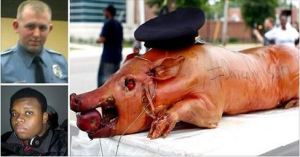
No Human is a Pig

fergusonThese images from a recent Daily Mail article reminded me of something Br. Roger of Taize’ once shared while I was a volunteer with his community in France.

When the community was forming, a group of French communists in a nearby village wanted to protest the injustice and riches of Christianity. So, they killed a pig on some church steps one Good Friday. The pig was supposed to be Jesus.

Now, no police officer is Jesus per se, but it strikes me that systemic injustices (no matter how true or not) can’t be addressed by effigies reflecting personal agendas, ignorance, anger or hate. In doing so, we tend to objectify and dehumanize our “enemy”, which makes it harder to recognize any of our own wrongs. We also tend to promote conflict rather than justice and peace. A poet in the 1960s (Ginsberg?) said something like this: “If you call a person a pig enough, they’ll surely become one.”

Like Br. Roger, I’ll strive not to waste time with anger in response. I’ll seek all the more for reconciliation, justice and peace. I will pray for all in Ferguson and our nation, even those who might wish to be my enemy, for I think we all know not what we do when it comes to our current racial divide. I’ll take stock of my behaviors and try to repent where I can identify any of my wrongs. To be sure, there’s enough sin and stupidity to go around, because we all are human.

Perhaps instead of angrily talking, tweeting, posting and pointing fingers, we should try to listen better to one another and learn. Perhaps we should try to seek and recognize the love of God which is planted like a seed within each of us. We are all part of the problem, and we all have a lot to learn from one another.

Entering relationship with one another – as difficult as it might sound – is the way forward. I have seen its power at work through Taize’ prayers and gatherings time and again. Relationship is how Jesus often changes our lives and our lot. It is harder to hate our neighbor when we get to know them, but to do so, requires we put our anger, agendas and arrogance aside. We have to be willing to reflect upon and admit our own sin.

“A fool takes no pleasure in understanding, but only in expressing personal opinion.” Proverbs 18:2

“Love your enemies and pray for those who persecute you…” Read Matthew 5:43-48

Unless otherwise indicated, all scripture quotations for this article are from the New Revised Standard Version (NRSV) translation.

© 2015 The Rev. Louis Florio. All content not held under another’s copyright may not be used without permission of the author.

Leave a comment

Filed under peace

We hasten in darkness…

As I think of and pray for the struggles in Baltimore, this simple chant from Taizé presented itself once again. It provides shape for my deep, inexpressible cries.

I cry out for those who mourn the death of Freddie Gray, for the police involved and those declared guilty by association, for those hurt by the riots and those hurt by historic, ongoing injustices, for all in Baltimore or places like Baltimore, for all the children of God who wound each other from their own woundedness out of ignorance or intentional malice.

Yes, we hasten in our darkness and amidst the darkness which surrounds us. We seek easy answers when love is never easy. The love of Christ calls us to love one another – even our enemy. We are to do good even to those who persecute us and always desire reconciliation. Is this possible? How shall we know if we don’t seek for it together?

People are thirsty for peace, all people. Yet for peace to happen, we need to first listen to God and one another even when difficult – without all the finger pointing and name calling; loving each other without preconditions even as we strive for justice. I have experienced such peace and witnessed such improbable miracles during and after my first sojourn with the Brothers of Taizé. It was a love that changed my life and called me out from isolation.

I learned peace is possible even now – an inner peace as well as with one’s enemy, a peace not of this world and yet within our reach. It begins with our humble and contrite heart, one we dare open to others who might reject us. Christ, too, was rejected, and yet he chose to love us to the end.

Let us search for this peace together no matter how hidden or distant it seems. We should not give up in our thirst, but instead be led onward. The darkness need not crush us.

Choose to love to the end, for the light who is Christ will reveal himself in such love. We will be refreshed. We will find new life where there was none. We’ll discover that we need not walk alone and afraid. We never did.

I invite you to pray along with this chant. The lyric translation of De noche iremos is: By night we hasten in darkness to search for living water, only our thirst leads us onward, only our thirst leads us onward.

And I close this post in prayer:

God of compassion, we give you thanks for Brother Roger’s life. In a world often torn apart by violence, through his life and those of his brothers he created a parable of communion. We give you thanks for his witness to the Risen Christ and for his faithfulness right up until death. Send your Holy Spirit upon us, that we may also be witnesses to reconciliation in our daily lives. Make of us builders of unity among Christians where they are separated, bearers of peace among people when they are opposed. Help us to live in solidarity with those who are poor, be they near or far away. With Brother Roger we would like to say: Happy those you abandon themselves to you, O God, with a trusting heart. You hold us in joy, simplicity, mercy.
(Prayer written by Brother Alois to commemorate the 100th anniversary of Brother Roger’s birth)

© 2015 The Rev. Louis Florio. All content not held under another’s copyright may not be used without permission of the author.

Leave a comment

Filed under Community Life, social justice

Life Work

National Law Enforcement MemorialMany social scientists call the work of emergency responders and others in the medical field “death work.” This applies to the law enforcement community for many reasons. We certainly deal with a great deal of violence and death, but we also face it head on.

As the recent Law Enforcement Memorial Day reminds us, some within our calling will pay the ultimate price. Indeed, I never really stop thinking about my three coworkers[1] that died over the six years I was a police officer. They and other heroes who I never had the honor to know have somehow become a part of me.

Reflecting upon such loss, I believe the term “death work” proves quite the misnomer. For as the National Law Enforcement Officers Memorial reminds us, “It is not how these officers died that made them heroes, it is how they lived.” Their legacy continues to challenge, inspire and shape our service to the community whether still active in law enforcement or retired from it. When I meet current law enforcement officers, I think of the important “life work” they do without often realizing it – whether finding a lost autistic child, helping a domestic violence victim, comforting those experiencing loss or without hope, or seeking justice in a world that is too often unfair.

I remember a police officer in the town I grew up in who planted positive seeds in my life (a somewhat delinquent one at the time) just through conversation and simple kindness. I recall the valor of those who so rightly earned awards for heroic deeds. I recall as well the kindness of other officers done without fanfare as they provided diapers for young families without or shared their own lunch with the homeless. I have seen those arrested for acts that were quite inhumane, and yet they were treated with human dignity by the officers they claimed as enemies.

These kinds of experiences taught me that the vocation that is shared by law enforcement officers is a sacred one, a holy summons to nurture life and shed light in what can seem a dark world. The long shifts, the thankless tasks, the time away from family and friends are very real costs, but it isn’t without benefit or meaning. It is a death to oneself and one’s desires so that others might live. It is life giving work embodying the truth of Jesus’ words, “No one has greater love than this, to lay down one’s life for one’s friends” (John 15:13).

Law enforcement is often a difficult life, but it is a life worth living and sharing with others.

[1] Two died in the line of duty and are listed at the National Law Enforcement Officers Memorial. A third died from an unknown congenital heart condition at home following a foot pursuit earlier that evening. A fourth died years later from medical complications after being shot while apprehending robbery suspects.

Originally written for the newsletter of the Hanover County (VA) Sheriff’s Office. 

Unless otherwise indicated, all scripture quotations for this article are from the New Revised Standard Version (NRSV) translation. This post was first published in The Messenger, the newsletter of Messiah Lutheran Church (June 2014). 

© 2014 The Rev. Louis Florio. All content not held under another’s copyright may not be used without permission of the author.

2 Comments

Filed under Law Enforcement

In those desert times

The Judean desert from Jerusalem the Movie (expected in 2013)

The Judean desert from Jerusalem the Movie (expected in 2013)

“From early Biblical times to the Middle Ages to the Present, the rugged, isolated beauty of the Judean Desert (Midbar Yehuda) has long attracted those seeking refuge, solitude or spiritual inspiration. According to the Bible, the prophet, Elijah, King David, John the Baptist, and Jesus all spent time here. Herod the Great built two fortresses here, Herodium and Massada, and during the Byzantine period (6th century A.D.), magnificent monasteries were built into its cliffs and rock crevices. Bordered by the Judean Mountains to the West and the Dead Sea to the East, the Desert’s 1,500 km landscape features canyons up to 500 meters deep and cliffs up to 300 meters high. Arid hills and valleys are contrasted with ancient springs that create oases such as Nahal Arugot, Nahal Prat, and Nahal David. It’s no wonder that this breathtaking, harsh and often surprising place has held the attention of so many for so long.” – as posted by Jerusalem the Movie on Facebook, March 8, 2013

Coming across the above picture of the Judean desert got me thinking…

As we walk these forty days of Lent, we remember the forty years that the Jewish people wandered in the desert due to their wandering hearts, as well as Jesus’ own forty days there fasting. As the note with this striking picture attests, the desert has often been a fruitful place for the people of God. Sadly, we need not travel far to find desert times in our lives. This can be so even when we practice “proper disciplines” and actively seek out God. Even in France, Br. Roger often compared the beautiful community, ministry and village of Taize’ to a desert, for no matter where we are, we can feel at times parched and long for the water of God.

I entered such a time once again this past week. Already tired from a new ailment recently diagnosed, I had two members of my congregation die within two days. During that same time, my mother called in tears to let me know my aunt had died. My mother’s melancholy increased as she came to realize she is the last of her generation in our family. My own grief grew as I realized that I couldn’t respond to New England to support her and my cousins due to my illness. Just when I thought I had had enough, I heard more tragic news – a member of my former police department had been shot during a traffic stop.

I remember well how such incidents tear at the heart of the entire police community. In fact while already grieving the present, I found myself thrust back in time to attend to other wounds now reopened. My soul cried out for my friends and the entire agency. I wondered, “Is it someone I knew?” I grieved anew the losses I remembered while serving with the Alexandria Police Department and elsewehere. I felt sad. I felt physically sick. I felt terribly and utterly alone in those moments.

Throughout the day, I prayed. I watched and wandered through my day. Yet, God seemed far away. Words of friends and family didn’t (couldn’t?) fully console me, and I longed for my hidden God. Yet all the while, many long past experiences reminded me of God’s faithfulness. Amidst the darkness, I clung to the light and love experienced in those times and the written promise of the steadfast love of God in scripture like a life preserver.

As the Bible assures us and Martin Luther reminded us, don’t trust our eyes, reason, or feelings. Trust Jesus. Hold onto him trusting that he will prove true to his promise that he holds on to us, guides us, and love us – always. As one of my favorite fictional crime fighters, Cadfael (a medieval monk and Sherlock Holmes rolled into one), was prone to say, “Sleep well, for God is awake.” Yes, even when we haven’t the strength to raise our heads, God looks kindly upon us. Life may still prove hard at times, but God’s love proves everlasting.

Since that day, I have been thinking a lot about my wandering, human heart. I am grateful that the officer shot is recovering. I am grateful for the spouse, family, friends, and congregation that joined me in prayer and waiting. I am thankful for the God who once again reminded me during a time of desert that our wanderings will come to an end, and healing will be ours.

Yet, another officer has been shot in Virginia and died; this time a Virginia State Trooper. Others in my congregation have faced new losses, and because I love them, I suffer with them. Still I hold on and wait, for to whom else can I go? Why should I hide? Instead, I’ll seek to serve, and worship, and love while I wander, for I’m called to live. I will find life within Christ’s community the church. I’ll seek to share hope and life outside of it. This desert time will end, for Jesus has already spoken the words of eternal life. Amidst the savage beauty of our desert wilderness, I trust we’ll discover the wonderous truth that Jesus never lies.

Through Isaiah, we hear God promise that our desert time can only lead to new life. Let’s, together, seek to remember these words as we walk on:

“The poor and needy search for water, but there is none;
their tongues are parched with thirst.
But I the Lord will answer them;
I, the God of Israel, will not forsake them.
I will make rivers flow on barren heights, and springs within the valleys.
I will turn the desert into pools of water, and the parched ground into springs.
I will put in the desert the cedar and the acacia, the myrtle and the olive.
I will set junipers in the wasteland, the fir and the cypress together,
so that people may see and know, may consider and understand,
that the hand of the Lord has done this,
that the Holy One of Israel has created it.” (from Isaiah 41)

Indeed, and the Holy One has created us as well. His hands will never let us go.

This is a trying time for all those in Virginia’s law enforcement community. Please keep all of them and their families in your prayers. If you would like to learn how you can better support law enforcement in your community during times of death and beyond, consider visiting and supporting:
Concerns of Police Survivors
National Law Enforcement Memorial Fund
International Conference of Police Chaplains
or, contact your local police agency to volunteer.

If you would like to help the Laboy family, you can drop off a donation at the Alexandria Police Department, 3600 Wheeler Avenue  Alexandria, VA 22304 or send a donation to:
Alexandria Police Association
c/o Peter Laboy
P.O. Box 1228
Alexandria, VA 22313

The Alexandria Police Association has also established a PayPal account for those who wish to give by debit or credit card.

If you wish to make a monetary donation to honor the memory of Trooper Walker, the Walker Family is asking you to make them to the Virginia State Police Association Emergency Relief Fund.

Thanks to Jerusalem the Movie for allowing me to use their photo. They remain in sole control of its use. The movie is due for worldwide release in 2013. Visit their website, follow them on Twitter or Facebook, and be sure to see it when released!

Unless otherwise indicated, all scripture quotations for this article are from the New Revised Standard Version (NRSV) translation.

© 2013 The Rev. Louis Florio. All contents not held under another’s copyright may not be used without permission of the author.

6 Comments

Filed under Community Life, Law Enforcement, Lectionary

St. Lucy – Innocent on all counts of burglary, witchcraft, & pagan roots

Lucy Before the Judge, by Lorenzo Lotto, 1523-32

Throughout Scandinavia and especially Sweden, the feast of St. Lucy on December 13th holds a special place on the liturgical calendar. Associated today with the lights and laughter of Christmas, the roots of this holy day are much darker.

Before science proved otherwise, December 13th was commonly considered the darkest point of the year. In nations where darkness reigns at wintertime due to their extreme northern location, a celebration developed to mark the transition from darkness to light. The pre-Christian season of Yule honored the winter solstice and the return of the sun through feasting, gift giving, and other gatherings. Such activities would hopefully keep one safe from the evil forces that lurked as an ever present danger.

One such danger was Lussi, a female demon who was thought to actively roam on December 13th. She would ride through the air with her followers, the Lussiferda. It would be dangerous to walk alone in the darkness. People feared falling asleep and becoming her victim. In some traditions, she might even come down the chimney to snatch away misbehaving children. Throwing all night parties seemed to remedy her threat.

Much later and far away in Italy, Lucy (sharing the Latin root for light, lux) was born in 283 CE. In Italian, she is known as Santa Lucia. Details of her life are sketchy and often tinged with myth, but she seems to have been a devoted Christian woman known for her generosity and faithfulness. The core of the story indicates she was pledged to a pagan for marriage. Lucy’s heart was elsewhere. She wanted to devote her life to Jesus Christ. Instead of using her dowry for marriage, she gave it to the poor. One story accounts that she wore a wreath with candles atop it to keep her hands free in order to deliver more assistance to her fellow Christians in the catacombs. Word came to her betrothed that she had found a more suitable bridegroom. In anger, he turned Lucy over to the local Roman authority, the magistrate Paschasius.

Here the stories vary, but what seems certain is that Lucy refused to marry her intended husband or reject Christ even under torture. She was perhaps blinded, thus hagiographic images of Lucy often show her eyes on a plate of some kind. Yet, this part of the story didn’t appear until the 15th Century in any known writings. However she met her end, it is uniformly reported she did so with faith in Christ even unto death in 304 CE. She is remembered as a martyr, thus her feast day’s liturgical color is red.

Lucy’s legacy is not that of Lussi, yet in the northern European lands, there stories somewhat merged. The light of Christ which shined so brightly through this young virgin’s life now became associated with the winter solstice. She doesn’t break into the home through the chimney. No one hides in fear. Instead a young girl is often selected to represent her and bear gifts (usually foods such as Lussekatt – a “St. Lucia Bun” – made with saffron) to her family, singing songs and wearing a wreath with lit candles around it. The song lyrics vary, but they have the Italian tune Santa Lucia. Today, many cities in Northern Europe have public processions to remember Lucy.

This is the English translation to one version called “Night Walks with a Heavy Step”[i]:

Night walks with a heavy step
Round yard and hearth,
As the sun departs from earth,
Shadows are brooding.

There in our dark house,
Walking with lit candles,
Santa Lucia, Santa Lucia!

Night walks grand, yet silent,
Now hear its gentle wings,
In every room so hushed,
Whispering like wings.

Look, at our threshold stands,
White-clad with light in her hair,
Santa Lucia, Santa Lucia!

Darkness shall take flight soon,
From earth’s valleys.
So she speaks a Wonderful Word to us:
A new day will rise again From the rosy sky…
Santa Lucia, Santa Lucia!

So whether in Italian (Santa Lucia), Swedish (Sankta Lucia), or English (Saint Lucy), this woman shouldn’t be confused with the burglarizing evil spirit or witch of old legends. Lucy is her own woman, not just a remake from paganism. She deserves to be remembered for her Christian witness through her ordinary life. She can serve as an inspiration for us to let the light of Christ shine through us. She is just one of a great cloud of witnesses God has used to break into the darkness of our world.

Like Lucy, we are children of that same light. We are innocent of all charges against us, real or imagined, through faith in the Son of God who came as a child in Bethlehem long ago. All powers of evil, sin and death raged against him then, but “The light shines in the darkness, and the darkness did not overcome it” (John 1:5). We are asked to serve as his living symbols, an assurance that he once came that Christmas long ago, but also proof that he is risen. We remain signs pointing to the truth that he will come again. We do this through boldly loving in his name, even unto death, for we know we shall share in his final victory. “Whoever loves a brother or sister lives in the light, and in such a person there is no cause for stumbling” (1 John 2:10). In Christ, we shall find forgiveness, new life, and a love we never dared hope for.

When Jesus finally does come at the end of the age, a new everlasting day shall rise. Darkness will forever take flight. “And there will be no more night; [those who trusted in him] need no light of lamp or sun, for the Lord God will be their light, and they will reign for ever and ever” (Revelation 22:5). With Lucy and all the communion of saints, we await and announce his coming.

Let us pray:
Lord God, Saint Lucy did not hide her light under a bushel, but let your light shine for the whole world, for all the centuries, to see. We may not suffer torture the way she did, but we are still called to let the light of our faith illumine our daily lives and the lives of others. Help us to have the courage to bring our faith into our work, our recreation, our relationships, our conversations, and every corner of this day. Amen[i]

Merry Christmas! Buon Natele! God Jul!

Pastor Lou


[i] Variation of a Roman Catholic prayer and one seen in a devotion by Bishop Kanouse of the Northern Texas-Northern Louisiana Synod, ELCA)

[i] Translation from http://www.mamalisa.com/blog/santa-lucia-day-song-and-saying-why-its-a-festival-of-light/


Unless otherwise indicated, all scripture quotations for this article are from the New Revised Standard Version (NRSV) translation.

© 2012 The Rev. Louis Florio. All content not held under another’s copyright may not be used without permission of the author.
Leave a comment

Filed under Church History, Community Life, Liturgical Year, Uncategorized

Seniors and Law Enforcement Together (SALT), 2012 Christmas Gathering

Click on the picture to learn more about the Henrico County Police SALT Program - Used under fair use for teaching - (C) 1996- 2012 Henrico County

Click on the picture to learn more about the Henrico County Police SALT Program – Used under fair use for teaching –      (C) 1996- 2012 Henrico County

On December 4th, I was invited to speak to the members of Henrico County Police Department’s Seniors and Law Enforcement Together (SALT) program. The SALT program seeks to empower seniors to be aware of and address crime problems they commonly face, as well as invites them to volunteer for the agency. This following is my prepared text:

When asked to speak this morning about my transition from law enforcement to being a pastor, I was hesitant. I am not too excited about talking about myself, and I am not sure how much it would interest you. So rather than just speaking on that issue, I wish to consider my journey in light of our shared call to community service. How do our own sacred life stories – and they are all sacred whether you realize it or not in my view – intersect with passions, interests, gifts, and ultimately our call or vocation?

The word vocation – at its root – indicates a mingling with the sacred…our purpose in life. It comes from the Latin root vocātiō, meaning a call or summons and inferring a higher power’s involvement. Now, vocations can and do indeed change during periods of our life just as mine did. We are much more than what we do, but I believe we all share a purpose to love God and our neighbor as ourselves in whatever we do.  At every moment of our lives, even facing death, God can use those moments to bless us and others.

So using my own story to begin this reflection, we begin in my younger years. I was part of a family with some serious problems – as many families have problems – and amidst those problems rooted in generational bouts of alcoholism and mental illness, there indeed was love; at least as well as people could love at the time with their own woundedness. Now my parents provided and cared for me very well in many respects, but the systemic problems we faced often distracted them and sometimes caused people in my family to make even more poor choices. As is often the case as a teen in such situations, I found myself dabbling in things that I had no business in. Most people had no idea, including my parents. Indeed at one point, I did find myself in juvenile court over a serious auto accident. Looking back, I realize I could have spiraled much lower. Yet when some parents had written me off as a trouble maker, others did not.

In one instance, I was being driven with a friend to an event by his mother. She began to talk about how good we were and unlike that boy who got into trouble. The only problem remained that unknown to her I was that boy. Yet, others did see past my problems to possibilities. Another friend’s father, a volunteer with a youth ministry, reached out to me, and he got me involved. At my workplace (a local 8,000 seat arena), a police officer always found time to talk to me, ask about my grades and my future plans. At school, one English teacher treated me with respect and helped me learn to begin to respect myself more. He challenged me to look at the world and myself through new eyes and with imagination.

Such interactions made a difference. I am sure these folks might not have known it at the time. They might not even remember me, but one never knows what kind word or ethical action observed might plant a seed. And seeds were planted. In time, I came to want to serve others, and attended the Virginia Military Institute, and after a short time on active duty for training as an Army Reserve officer, I transitioned into my own police career at the City of Alexandria Police.

Now at the time, crack was hitting cities hard. The metro-DC area news had body counts each day, and as I graduated from the academy, one of our officers, Corporal Charles Hill, was murdered in a drug related hostage situation. It was a wild time, and I grew up a lot. A sense of idealism was difficult to maintain with some of the things I saw and experienced. Yet again, thanks to friends, I was invited to participate in a loving church family and volunteer in some outside service activities: shop with a cop, bicycle helmet drives, other things of that nature, but also as an adult volunteer with a campus ministry at what is now the University of Mary Washington. Already, I had noticed a gift for working with youth from the housing projects during my midnight shift, but this volunteering really helped broaden and mature my view of the world, myself, and even God.

You probably already recognize that law enforcement officers face a disproportionate amount of evil on a daily basis. They see and experience what John Calvin would describe as humanity’s depraved nature or what Martin Luther would consider examples of the human tendency to be bent inward upon oneself (in other words selfish, and therefore not loving of God and neighbor as we should be). For some, this turns the officer into a fountain of cynicism. For others, they see humanity for what they are – not always the best they can be – but they recognize more is going on in the world. Goodness is still at work, and so in the face of evil and tragedy, they dedicate their hearts to make a difference. I witnessed this as fellow officers raised funds during the shift from other officers for a homeless couple who needed diapers for their baby. I saw it as people I knew volunteered with service projects in the community unrelated to policing; one even volunteering with a jail ministry.

This wasn’t naïve idealism. There were victory and losses to be sure, but the call to make a difference kept them trying. Hope kept them oriented on what could be rather than just settling. Like many of them, I found in volunteering that I got more than I gave. Working with the college students I rediscovered a more positive, hopeful way to look at the world and others even as I mentored them. I also found my faith in God grow stronger.

Eventually, I began to wonder if God was calling me to something else…something else not better mind you….just different. Through connections, I was eventually invited to spend some time volunteering and discerning with an international, ecumenical group that works with young adults in France called Taizé. So, I took my leave of law enforcement to test the waters of full time ministry. Although I didn’t stay with this ministry, I found my law enforcement and personal background and experience fit well with what they did. It helped me relate to young adults, many with troubled pasts or coming from violent areas throughout the world. As one brother told me, “We have similar hearts.”  Yet, I felt a strong pull to come back to the United States to use the gifts I had been identifying perhaps more fully.

My first weekend home, I attended my parent’s Roman Catholic Church, and coincidentally a bishop from South Dakota was thee seeking funds and/or volunteers. I had mentioned to my parents of my possibly seeking a mission stint in Eastern Europe, South America or Native Americans (areas of interest and places I had met friends from in France), so I went and spoke to the bishop, now Archbishop Chaput of Philadelphia. This “chance” meeting resulted in an invitation to have my resume past around state of South Dakota, and I found a new home and call at St. Joseph’s Indian School.

St. Joseph’s Indian School is a residential school serving at risk Native Youth from elementary age through high school, and recently into college aged young adults. I was to live as a house parent among the high school students, serving as the father figure, mentoring counseling, helping with homework and driving kids to places – most anything any parent would do. Yet once again, my past experiences helped me in the present.

Most of these kids were from among the poorest and most addicted places in America, where violence and sex crimes against children are much too common, and gangs have a strong foothold. We had kids that lived in home without heat in a place where -35 degrees could be the high for the day, or perhaps they had no toilet, or maybe they had no home at all and bounced from house to house as people became willing to take them in. At least one I worked with had all his possession including clothes fitting in a small brown paper grocery bag. It was a tough place, isolated and with extreme weather.

Many new employees quite, but I found that the kids responded well to me. My police work helped me meet them as they were, without shock or pity. I could understand what they would share with me without needing to ask what they would think of as stupid questions, and I respected them as my own mentors respected me. I understood that as messed up as their families might be, it was still there family, and that amidst all the violence and trouble, their culture and they themselves had much to offer me. In fact, the logo of the school reflects a truth I already mentioned. We often get more than we receive when we volunteer and serve others. The tag line for the logo was “We give and teach. We receive and learn.” Students and staff mutually benefited and grew from this relationship with one another.

After three and one half years, I had completed my initial commitment. I returned to Virginia to attend seminary. I entered a special dual program where I earned a Master of Divinity degree from Union Presbyterian Seminary and an MS from Virginia Commonwealth University. My thesis focus was upon how faith and mentoring can help mitigate delinquency, but this experience again brought home to me the reality that law enforcement for me was and remained a real ministry. It has continued to help me as I served in hospice chaplaincy and now in the parish. I am realistic about the challenges we face, but I am hopefully about the God we share. I maintain my foothold in the policing community as a chaplain for law enforcement, and I find my law enforcement experiences always helpful in the midst of the ordinary lives of people I serve – lives that often face significant troubles.

In law enforcement, we face sin and death head on. We seek to shine light in the darkness, restore family relationships, and bring justice to the community. We can find ourselves counseling or comforting a wayward teen, grieving family member or victim of violence at any time. In doing so, we have an opportunity to live out what Jesus said was the summary of all the law and the prophets, loving God with all we are and our neighbor as ourselves – even sometimes unto death.

As volunteers, you might not recognize the good you do, nor the eternal Good that works through you. Paperwork, small unrecognized tasks, or even a friendly, sincere hello might not seem like much, but one never knows what God might use to make the world and our community a better place and encourage others. Seeds can be planted through relationship. These small acts of love can free up others to love in some pretty difficult circumstances, so I argue your volunteering with the Henrico County Police Department has significant and eternal value. It is part of your vocational, sacred call in the present. Through this call, you have the opportunity to be a blessing to others and the community.

My experiences over the years has affirmed for me that we need to be united – faith communities, secular organizations, police agencies, and individuals – in bearing hope and love into our communities. It is a hope and love that I personally believe first came to us in a small town called Bethlehem long ago. A hope no one expected, an act of love that seemed so small, and yet it is a hope and love that remains with us and can work through us even on the darkest day.

In closing, I thank you again for your invitation and for your willingness to love. I wish you all a Merry Christmas and happy new year.

© 2012 The Rev. Louis Florio. All content not held under another’s copyright may not be used without permission of the author.

2 Comments

Filed under Community Life, Law Enforcement, Ministry, social justice

Crime Log: Nicholas of Myra

Mugshot of Suspect: Bishop Nicholas of Myra


Mugshot of Suspect: Bishop Nicholas of Myra.
Used under fair use guidlines – (c) Anand Kapoor, 2004
(Click the photo for more images from stnicholascenter.org)

Ladies and gentlemen, the report you are about to read is true. Only some names have been changed to protect the innocent…

Nicea Police Department – Crime Report

Date: On or about May 20, 325 AD

Offense: Assualt & Battery                                                       Case Number: 1225

1. Victim: Arius, Presbyter of Alexandria, Egypt

DOB: UD, 250 AD or 256 AD     National Origin: Central-North African

S: Male     Ht.: UK     Wt.: UK  Skin: Dark to Olive color

Other: Facial Hair – full beard; described as “tall and lean, of distinguished appearance and polished address.”

Previous Arrests & Torture: N/A

2. Suspect: Nicholas, Bishop of Myrna, Region of Lycia

DOB: UD, 270 AD     National Origin: Greece

S: Male      Ht.: 5′ 6″      Wt: 160 – 200 lbs.  Skin: Olive

Other: Facial hair – full beard; previously broken nose

Previous Arrests & Torture: During the persecution of Christians under Roman Emperor Diocletian

3. Disposition: Arrest

4. Incident Summary:

Presbyter Arius of Alexandria, Egypt reported that Bishop Nicholas of Myra (aka Nikolaos of Myra) did intentionally assault and batter him in the presence of multiple witnesses on or about the start of the Emperor’s church council in 325 AD. Witnesses included his royal highness, Flavius Valerius Aurelius Constantinus Augustus (aka Constantine I), Emperor of Rome, along with over 300 bishops, other clergy, scribes, servants, and attendees.

Presbyter Arius stated to officers that he was attending the First Ecumenical Council of Nicea to defend his position on the Trinitarian controversy over the nature of The Son, Jesus Christ, and his relationship to God the Father. Arius contended that Jesus as the Son of God was not the eternal God, but rather was created by God the Father – a denial of the more widely accepted concept of the Trinity.

Bishop Nicholas took issue with Arius’ position. He rejected the view of Arius and his followers that “there was once that when he was not” and was of the attendees arguing for the co-eternity of the Son with the Father. Also rejected was the position that Jesus was  “mutable or subject to change” in his essence. Bishop Nicholas agreed with those who maintained that the Son just like the Father was beyond any form of weakness or corruptibility, and most importantly that he could not fall away from absolute moral perfection.

At some unspecified point, the scholarly debate turned into an argument, and the victim along with mutiple witnesses from the assembled council (see supplement to this report to be filed later) stated that Bishop Nicholas did use his right hand or fist to punch or slap Arius, causing the victim to fall to the floor. Seeing the alleged offence, the Emperor and assembled bishops had Bishop Nicholas taken into custody, stripped of his bishop’s garments,  and thrown in prison to cool off.

Upon interview of the prisoner by this reporting officer, Bishop Nicholas admitted the offense done “out of love for Jesus Christ.” He stated he had grown tired of Arius’ insults to Christ’s full divinity. Further legal action is pending, but Bishop Myra is expected to return to his duties upon the request of Emperor Constantine in his role as Pontifex Maximus,  the high priest of the College of Pontiffs of Rome.

It should be noted that the suspect has reportedly been involved in previous altercations and incidents of public controversy, including but not limited to: saving young women from slavery, protecting sailors, sparing innocents from excecution, providing grain in a famine, and the rescue of a kidnaped boy.

Artist rendition of the alleged offense.

Artist rendition of the alleged offense.

Form NPD-CR1                           Reporting Officer: Centurion A. Brutus 

Happy Feast of St. Nicholas, December 6th!

© 2012 The Rev. Louis Florio. All content not held under another’s copyright may not be used without permission of the author.

Leave a comment

Filed under Church History, Liturgical Year, Uncategorized