Tag Archives: police chaplain

Early mourning thoughts and prayers…revisited.

AP_Ashley_Guindon_160228_DC_12x5_1600

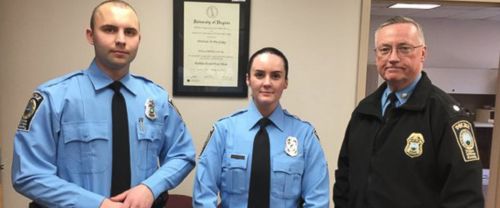
Officer Guindon (center), Prince William County Police, died on her first shift during a domestic disturbance. She was shot and killed on February 27, 2016. Two other officer were injured.

Ten years ago on the early morning of Sunday, February 28, 2016, I learned about the shooting of three Prince William County Police Officers as I prepared to head to my church (at the time in Mechanicsville, Virginia). One of the officers, Officer Guindon, had died from her wounds – just a day after becoming an officer.

Now, I had friends who worked with that department, and at times when an officer in Alexandria, I had served alongside Prince William police in training or some other task. Yet, I did not know her or those wounded. Still, the shootings angered me, and her death impacted me with surprising emotion and connection; bringing a sense of loss and memories of past, similar trauma.

There are reasons thousands of officers travel far, sometimes at their own expense, to honor fallen officers. Certainly, it displays solidarity and respect for the fallen. It’s meant to be a concrete sign of support to the family and department members in deep grief. A large crowd can help proclaim the message that the deceased’s life mattered and continues to matter. Much as the National Police Memorial indicates through its inscriptions, they will be honored, not for the way they died, but for how they lived.

As one police ministry in Texas notes on its webpage, The job is referred to as having ‘a mystique veiled by a sacred canopy.’ The symbolism, pageantry and tradition make our calling noble.” And certainly, the “final radio call” and the playing of bagpipes serve to honor the officer’s dedication to service, but they also serve as a profound expression of grief fostering an emotional connection between those presents and speaking memories of other people and places gone but still carried in one’s heart. Vincent E. Henry correctly notes in his book, Death Work: Police, Trauma, and the Psychology of Survival (2004), that these events force officers to confront their own mortality. Funerals act as a necessary, though painful, part of the process for the survivors. There always exists the psychological reality that it could have been you or someone you know and love.

At the time of Officer Guindon’s death, I suspect that many people sensed the added “wrong” of her just starting her job with hope and celebration only to die the next day. As with infant or child deaths, such unexpected, sudden officer deaths can become personalized. Thus, they can become more intense if not traumatic. As suggested in literature about grief such as The Burden of Loss: Unexpected loss of a loved one and psychiatric disorder across the life course in a national study (2015), unexpected losses can make processing grief more difficult. The proximity of death emotionally or identity can cause very real complications for some. At the same time, I would remind the reader that we never fully “deal” with the grief of those we feel connected too. Anniversaries or other reminders can make us grieve anew. Indeed, it’s important to say that no one person grieves the same way.

So, I suppose that’s the fuller context of Prince William County’s Facebook post this morning. Departments promise to “never forget.” There are certainly members of the department still working who knew her personally and remember the trauma and loss of that day as if yesterday. Based on comments, you can see how people in and outside the department are touched by personal grief. Such deaths tend to stick with you.

The below essay was written in haste before heading out my door that morning. It wasn’t masterful. It won’t win a prize for literature. Yet it was my real time response echoing what I wrote about above. I’m reposting it in her honor but also for other colleagues of mine who have been murdered or died by suicide. May they all rest in peace, and may our love for one another, sacred memories shared, and God’s grace bring ongoing healing and hope until Jesus returns to wipe away all tears (Rev. 21:4).

God bless Officer Guindon’s mother, and all those who continue to grieve. Please join me in praying for our officers, deputies and their families each day.

My original post follows:

I’m thinking a lot this morning about my first shift, my first arrest, and the many men and women who helped me have a great (if relatively short) law enforcement career. They actually helped me become who I am today, and so I always give God thanks for them and my experiences. It is why I volunteer as a police chaplain today – to try to give back.

And yet, I’m also recalling the joy my family felt having just seen me graduate from the police academy, and then on that same weekend, seeing their fear as I headed out to my first midnight shift. I also remember with love coworkers injured and killed as a result of their desire to serve others. Thus, Officer Guindon’s death is somehow personal to me, as with every law enforcement death. I can’t help it. I feel like a piece of me has died, although I know it doesn’t make much sense to many.

How many Officer Guindon’s are out there? How many such families sacrifice, live in fear, or are now grieving across our country? How must her Field Training Officer and fellow officers feel as this recruit died and as they try to make sense of it? They all need our active support and prayer.

And yet, I don’t know how to pray for this. She was on her first shift, and the hope of last Friday has turned into community shock and grief spreading across the Thin Blue Line. I remain at a loss for words, especially as law enforcement officers in our country continue to be so quickly and openly hated, condemned and needlessly die. And so, I find comfort in these words. “But if we hope for what we do not see, we wait for it with patience. Likewise the Spirit helps us in our weakness; for we do not know how to pray as we ought, but that very Spirit intercedes with sighs too deep for words.” (Romans 8:25-26).

To my brothers and sisters still fighting the fight, you are not alone. God has not forgotten you. God will make good come from this evil, although we do not yet know how. No life dedicated to the service and love of neighbor is a wasted one, no matter how short. I remain in communion with you, and you will all be with me at worship this morning in my heavy but hopeful heart.

The Rev. Louis Florio is a former member of the City of Alexandria Police Department and current volunteer law enforcement chaplain with Hanover County Sheriff’s Office and the City of Fredericksburg’s Police Department. This post may be shared freely with proper attribution.

(C) 2026 The Rev. Louis Florio. All content not held under another’s copyright may not be used without permission of the author. Scripture passages when used are from the NRSVue translation unless otherwise indicated.

1 Comment

Filed under Crime, policing

Law Enforcement Chaplains Help Keep the Peace

The Hub, July 30, 2019

Wichita’s Keeper of the Plains

Last week, I was fortunate to complete my Virginia Synod’s continuing education requirement through the International Conference of Police Chaplains’ Annual Training Seminar in Wichita, KS. This conference brought together approximately 500 law enforcement chaplains from across the United States and five other countries.  

Chaplaincy programs in the United States must pass the “Lemon Test” established by the Supreme Court (Lemon v. Kurtzman, 1971). Chaplains must have a secular purpose, must not excessively entangle the government with religion, and neither proselytize nor inhibit religion.

In effect, chaplains are to serve everyone. They can provide counseling and referrals. They can serve in support roles for crisis situations. Most often, they tend to serve through a ministry of presence; responding to emotional, mental or spiritual needs as they arise. Chaplains can pray and provide overtly spiritual counseling if requested, but religion is never to be pushed. Most often, chaplains help connect law enforcement, staff and citizens in need to spiritual or psychological resources of their choice – both secular and religious, quite often facilitating previously established relationships.

Duties vary but for the agencies I serve, chaplains often assist officers with death notifications, crime victim support, and homeless outreach. They go on regular “ride-alongs” with police where they get to know officers and their work better, but informal, confidential counseling might also occur. “Ride-alongs” might also help connect them with victims of crime, accidents or deaths. Chaplains also help facilitate community policing efforts, emergency relief, and law enforcement response to major crises. Chaplaincy is only one option to help with the general health, resiliency and retention of officers. They regularly help provide voluntary emotional, mental and spiritual care to law enforcement officers and their families serving alongside employee assistance programs, staff psychiatrists or psychologists, and peer support offerings.

Thus, the courses I took often overlapped with ministry needs of our congregation. This year, I received training in stress reduction, suicide interdiction and support, counseling techniques specific for varied generations, coping with death, building resiliency, funeral protocols, and more. I hope my continuing education helps me serve your needs better but also our neighbors in the greater community. Thanks to you and our council for supporting my attendance. With your support, I am better able to make a loving difference in our faith community and beyond.

Originally published in The Hub, a weekly email of Christ Lutheran Church, Fredericksburg, VA.

© 2019 The Rev. Louis Florio. All content not held under another’s copyright may not be used without permission of the author.

Leave a comment

Filed under Pastoral Letter

Walking a New Beat

The Hub, Mar. 13, 2019

Police officers in Fredericksburg still feel pain from the relatively recent murder of a friend while on duty. Officers and their families continue to experience repercussions and pressures from past and present systemic problems related to policing here as well in other communities far away. Dealing disproportionately with evil in society, officers everywhere need to be on guard that they aren’t overcome by that evil.

That’s where chaplains come in. They meet the officers where they are, walk with them and their families through the darkness, and seek to help them stay healthy and whole. Doing so, officers will hopefully experience a more abundant life, but it also helps them become healthier servants to all.

Considering my past experiences and training, Chief David Nye [of the Fredericksburg (VA) Police Department] recently asked me if I would be willing to serve our local law enforcement community as a chaplain, and I wholeheartedly agreed.

What does this mean for our congregation? I will be serving our police department’s officers, staff and families seeking to build resiliency and facilitate hope and healing when crises come. Yet, I will also be seeking to serve victims of crime, those recently arrested, people in need of all kinds of services, and everyone I meet.

It’s just another way to live into the beatitudes, to love even some who may now be our enemies, and to help establish peace and justice on earth. Through the Spirit, we are one. You will also be with me as I serve. This is an opportunity to make new and exciting connections in our community as we seek to love our neighbors and our God in new, expansive ways. Please pray for the success of this outreach and the safety of all.

Originally published in The Hub, a weekly email of Christ Lutheran Church, Fredericksburg, VA.

© 2019 The Rev. Louis Florio. All content not held under another’s copyright may not be used without permission of the author.

Leave a comment

Filed under Uncategorized

In those desert times

The Judean desert from Jerusalem the Movie (expected in 2013)

The Judean desert from Jerusalem the Movie (expected in 2013)

“From early Biblical times to the Middle Ages to the Present, the rugged, isolated beauty of the Judean Desert (Midbar Yehuda) has long attracted those seeking refuge, solitude or spiritual inspiration. According to the Bible, the prophet, Elijah, King David, John the Baptist, and Jesus all spent time here. Herod the Great built two fortresses here, Herodium and Massada, and during the Byzantine period (6th century A.D.), magnificent monasteries were built into its cliffs and rock crevices. Bordered by the Judean Mountains to the West and the Dead Sea to the East, the Desert’s 1,500 km landscape features canyons up to 500 meters deep and cliffs up to 300 meters high. Arid hills and valleys are contrasted with ancient springs that create oases such as Nahal Arugot, Nahal Prat, and Nahal David. It’s no wonder that this breathtaking, harsh and often surprising place has held the attention of so many for so long.” – as posted by Jerusalem the Movie on Facebook, March 8, 2013

Coming across the above picture of the Judean desert got me thinking…

As we walk these forty days of Lent, we remember the forty years that the Jewish people wandered in the desert due to their wandering hearts, as well as Jesus’ own forty days there fasting. As the note with this striking picture attests, the desert has often been a fruitful place for the people of God. Sadly, we need not travel far to find desert times in our lives. This can be so even when we practice “proper disciplines” and actively seek out God. Even in France, Br. Roger often compared the beautiful community, ministry and village of Taize’ to a desert, for no matter where we are, we can feel at times parched and long for the water of God.

I entered such a time once again this past week. Already tired from a new ailment recently diagnosed, I had two members of my congregation die within two days. During that same time, my mother called in tears to let me know my aunt had died. My mother’s melancholy increased as she came to realize she is the last of her generation in our family. My own grief grew as I realized that I couldn’t respond to New England to support her and my cousins due to my illness. Just when I thought I had had enough, I heard more tragic news – a member of my former police department had been shot during a traffic stop.

I remember well how such incidents tear at the heart of the entire police community. In fact while already grieving the present, I found myself thrust back in time to attend to other wounds now reopened. My soul cried out for my friends and the entire agency. I wondered, “Is it someone I knew?” I grieved anew the losses I remembered while serving with the Alexandria Police Department and elsewehere. I felt sad. I felt physically sick. I felt terribly and utterly alone in those moments.

Throughout the day, I prayed. I watched and wandered through my day. Yet, God seemed far away. Words of friends and family didn’t (couldn’t?) fully console me, and I longed for my hidden God. Yet all the while, many long past experiences reminded me of God’s faithfulness. Amidst the darkness, I clung to the light and love experienced in those times and the written promise of the steadfast love of God in scripture like a life preserver.

As the Bible assures us and Martin Luther reminded us, don’t trust our eyes, reason, or feelings. Trust Jesus. Hold onto him trusting that he will prove true to his promise that he holds on to us, guides us, and love us – always. As one of my favorite fictional crime fighters, Cadfael (a medieval monk and Sherlock Holmes rolled into one), was prone to say, “Sleep well, for God is awake.” Yes, even when we haven’t the strength to raise our heads, God looks kindly upon us. Life may still prove hard at times, but God’s love proves everlasting.

Since that day, I have been thinking a lot about my wandering, human heart. I am grateful that the officer shot is recovering. I am grateful for the spouse, family, friends, and congregation that joined me in prayer and waiting. I am thankful for the God who once again reminded me during a time of desert that our wanderings will come to an end, and healing will be ours.

Yet, another officer has been shot in Virginia and died; this time a Virginia State Trooper. Others in my congregation have faced new losses, and because I love them, I suffer with them. Still I hold on and wait, for to whom else can I go? Why should I hide? Instead, I’ll seek to serve, and worship, and love while I wander, for I’m called to live. I will find life within Christ’s community the church. I’ll seek to share hope and life outside of it. This desert time will end, for Jesus has already spoken the words of eternal life. Amidst the savage beauty of our desert wilderness, I trust we’ll discover the wonderous truth that Jesus never lies.

Through Isaiah, we hear God promise that our desert time can only lead to new life. Let’s, together, seek to remember these words as we walk on:

“The poor and needy search for water, but there is none;
their tongues are parched with thirst.
But I the Lord will answer them;
I, the God of Israel, will not forsake them.
I will make rivers flow on barren heights, and springs within the valleys.
I will turn the desert into pools of water, and the parched ground into springs.
I will put in the desert the cedar and the acacia, the myrtle and the olive.
I will set junipers in the wasteland, the fir and the cypress together,
so that people may see and know, may consider and understand,
that the hand of the Lord has done this,
that the Holy One of Israel has created it.” (from Isaiah 41)

Indeed, and the Holy One has created us as well. His hands will never let us go.

This is a trying time for all those in Virginia’s law enforcement community. Please keep all of them and their families in your prayers. If you would like to learn how you can better support law enforcement in your community during times of death and beyond, consider visiting and supporting:
Concerns of Police Survivors
National Law Enforcement Memorial Fund
International Conference of Police Chaplains
or, contact your local police agency to volunteer.

If you would like to help the Laboy family, you can drop off a donation at the Alexandria Police Department, 3600 Wheeler Avenue  Alexandria, VA 22304 or send a donation to:
Alexandria Police Association
c/o Peter Laboy
P.O. Box 1228
Alexandria, VA 22313

The Alexandria Police Association has also established a PayPal account for those who wish to give by debit or credit card.

If you wish to make a monetary donation to honor the memory of Trooper Walker, the Walker Family is asking you to make them to the Virginia State Police Association Emergency Relief Fund.

Thanks to Jerusalem the Movie for allowing me to use their photo. They remain in sole control of its use. The movie is due for worldwide release in 2013. Visit their website, follow them on Twitter or Facebook, and be sure to see it when released!

Unless otherwise indicated, all scripture quotations for this article are from the New Revised Standard Version (NRSV) translation.

© 2013 The Rev. Louis Florio. All contents not held under another’s copyright may not be used without permission of the author.

6 Comments

Filed under Community Life, Law Enforcement, Lectionary