
Recently at the National Religious Broadcasters (NRB) convention, Secretary of War Pete Hegseth praised President Trump as a “fighter for the people of faith.” He suggested the President’s policies were biblical. He proclaimed that Christ is King. Yet, he also condemned all those on the political Left as evil.
I agree with the Secretary of War that Christ is King. I concur that Christian voices need to be heard in politics. And like Luther, we both understand that earthly government structures can be (and are) used by God. Yet, Luther always understood that governments like the people that compose them are deficient. It’s not just that we might err. We will err, for we are always sinners and fallible even if truly saved by Christ. Fruits of the Spirit are not measured by political victories but by love, joy, peace, forbearance (patience), kindness, goodness, faithfulness, gentleness, and self-control. These fruits reflect if not embody Jesus. From what the Secretary of War too often says and posts, I suspect he might not agree while I do.
Whenever political figures (or religious ones) claim they represent God’s way but others are beyond salvation, “evil,” you can be relatively sure they have lost their own way. Left or right, their faith tends to be rooted in flawed human reason, politics, and power – even themselves – more than God. In contrast, humility demands that we need to be open to how we might be wrong.
Most certainly, Jesus focused on the in rushing of the Kingdom of God which challenges rather than aligns with the authorities of this world. Jesus consistently refused to side with partisan religious and political parties of his day, although he would often call out their faults and failures. Hence, those who should have known to listen to him did not. Instead, they conspired to kill him.
That said, the Secretary of War seems to ignore Christ’s call to such humility. The blessing of meekness, even as that word was used in the Bible to describe Jesus and Moses, is rejected. Sadly, his small denomination, more of an association called Communion of Reformed Evangelical Churches (CREC), is an abomination of overt Christian Nationalism, theonomy, extreme patriarchy, and other bad theological takes condemned by the majority of Christians across denominations and political orientation. Woefully in the politics of today, the groups combative, authoritarian manner (intentionally and openly encouraged by its leaders) is influencing others and becoming normalized. Such groups and their behaviors are being accepted as evangelical (reflecting scripture) no matter how far afield their own theology has gone from Christ’s own.
I’m gobsmacked and disheartened by how many Christians are suggesting the ends justify the means. They are willing to overlook certain vices and criminality as long as what they discern as right or good wins the day politically. And still, they can condemn others. This was never true for Jesus. He did not teach or model this. Why do we expect a different standard for us is ok? We are supposed to be agents of reconciliation; willing to suffer for what’s right rather than dominate others. We might be saying “Christ is King,” but we seek to take control of things. In doing so, ultimately fail to trust in God’s providential kingship and care. We can stray doing things that, as in the time of the Judges, are right in our own eyes.
In contrast, as I’ve written previously, Jesus explicitly warns about calling others “roca” (empty headed basically, but in his use unredeemable, beyond salvation, or unworthy of love, in effect “evil”). Every human is to be treated with dignity even when horribly wrong in our minds – even those who might try to kill us. So yes, do not be afraid. One is not implicitly doing evil for arguing for conservative or liberal values, but how we argue and fight for what we believe in matters if we wish to be Christlike. Are we able to be nonanxious, kind, or gentle when facing opposition? Sure, there is indeed a time to fight and anger is not a sin, just as the Bible states, but if we must escalate we must do so with caution. It’s easy for us to blindly fall into sin. The Bible warns us of this error as well.
If we are truly morally and ethically (dare I say biblically) right in our beliefs and actions, we should be trying to “defeat evil with good,” turning the other cheek, loving one another even when difficult, helping others open their eyes and not punching them symbolically or otherwise in the face. That’s being Christlike. His way is not the way of the world.
Patience is a virtue, described as a fruit (or gift) of the Holy Spirit, but we who claim to be Christian too often lose patience with one another. We embrace fear rather than our neighbors. We don’t listen to Jesus nor those who challenge us. Simply, we tend to sin in our self righteousness. All of us are in need of God’s grace.
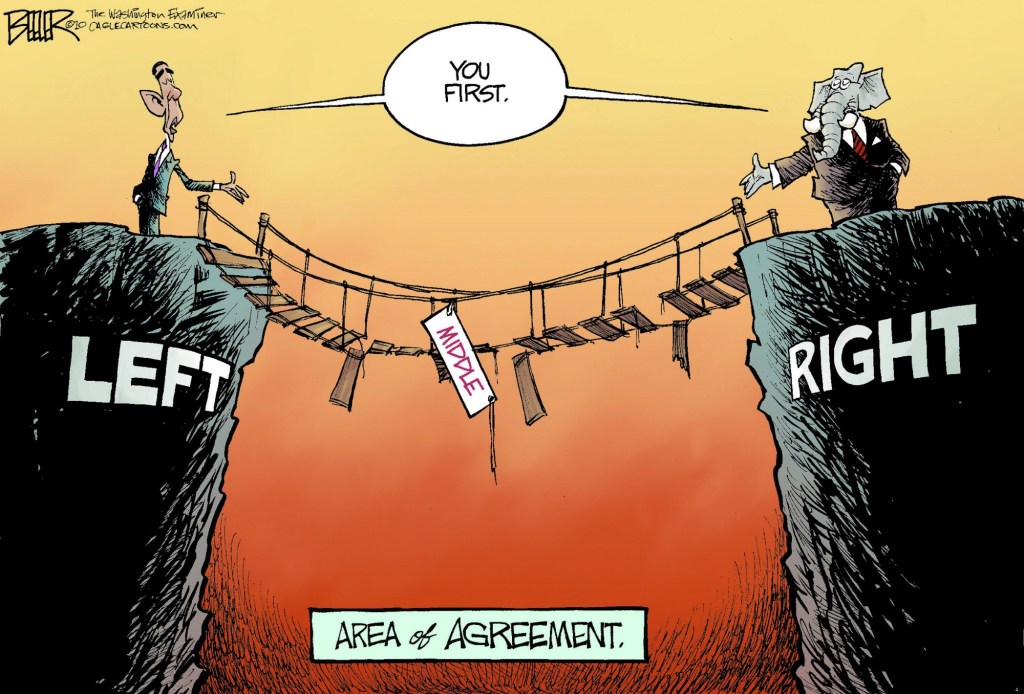
Please trust that my comments are not simple condemnation casting those who disagree with me into the abyss. I’d suggest the Left and Right are both right and wrong about many things. No person, denomination, or party is perfect. This is intended as a call for our collective, societal (as well as individual) repentance. It’s a warning to not be so sure of ourselves, for we can only be sure that Christ is King, and we are not.
In summation, we can always do better with God’s help. We must. As of now, our cold hearts and closed, certain we are right minds are making our world worse rather than better. People are rejecting Christ and his Church because we look more and more like the world rather than Jesus. We must repent (turn back) from our worldly ways toward Jesus; listening to him rather than the powers of this world; letting his voice and love transform us.
For, Jesus is truly King, but his kingdom is not of this world.
Post Script:
I just read a report by Dr. Brian Kaylor who wrote, “As part of the Secretary of War’s recent speech at a prayer breakfast, he argued, ‘The willingness to make sacrifices on behalf of one’s country is born in one thing: a deep and abiding belief in God’s love for us and his promise of eternal life,’ said Hegseth, who has crusader tattoos. ‘The passage says, “For whoever would save his life will lose it, and whoever loses his life for my sake and the gospel’s will save it.” The warrior who is willing to lay down his life for his unit, his country, and his Creator, that warrior finds eternal life.”
No, we are saved only by Christ’s work, never our own. This echoes the mindset of the Crusades which the Secretary of War often alludes to, but historically, they were problematic at best. This is not unlike the Patriarch of the Russian Orthodox Church declaring those who fight and die in the invasion of Ukraine are automatically Christian martyrs. It ignores that secularists and people of other faiths or no faith do and have always died to protect our nation. It is historically forgetful by not remembering mistakes made in the name of patriotism. It seems odd if not unholy that he uttered this at a prayer breakfast where the dictators of the Democratic Republic of Congo and El Salvador also spoke and were applauded.
Yes, it can be a holy act to die for the love of our neighbor, but it is never a saving one. It is also a mistake to assume that our acts of war or use of force are holy when war is never God’s will – even when a “necessity” or unavoidable in a fallen and dangerous world. I’m not a pacifist. I agree with Martin Luther that some are called to protect others using violence. Yet, that’s a sign we live in what can be an unholy world where war should be the last option never the first. It is partly why the Department of War was renamed the Department of Defense after World War 2. War is horrible and always tainted by sin. They hoped to recognize this. Hence, many warriors and law enforcement officers experience moral injury and post traumatic stress. Again, it is not God’s will. War is a curse, not a blessing, even when thrust upon us.
Along with many biblical passages and historical facts that came to mind to refute him, I thought of literature as well. First and foremost, Mark Twain’s The War Prayer (1905) came to mind. (If you’ve not read it in its entirety, please do using the link.) Challenging a congregation’s blindness, a man prays:
“…for our sakes who adore Thee, Lord, blast their hopes, blight their lives, protract their bitter pilgrimage, make heavy their steps, water their way with their tears, stain the white snow with the blood of their wounded feet! We ask it, in the spirit of love, of Him Who is the Source of Love, and Who is the ever-faithful refuge and friend of all that are sore beset and seek His aid with humble and contrite hearts. Amen.”
Does this sound like Jesus to you? Christian nationalism is not the way of Christ and his universal Church. It’s time to repent, as I indicated above, ultimately meaning to turn back toward God. We are heading in a very bad direction, but all is not lost. Jesus wants to guide us.
© 2026 The Rev. Louis Florio. All content not held under another’s copyright may not be used without permission of the author. Scripture passages when used are from the NRSVue translation unless otherwise indicated.


 2pennyblog