The Apocrypha including texts like the Book of Sirach is not considered part of the Protestant cannon of scripture, but Martin Luther did suggest the Apocrypha was “profitable and good to read.” The Apocrypha is a collection of works primarily in Greek, and they can help provide historical context for the period between what is identified as Jewish scriptures and the Christian scriptures. They also can help us better understand God and our world.
As they contain teachings that some traditions find unbiblical, they can be challenged. Jewish people of Luther’s time and today have consistently found that they are not the level of scripture. That said, the Roman Catholic and Orthodox world both consider the Apocryphal texts scripture, but they do recognize some different texts as part of those works. So, there’s no fully ecumenical or interfaith consensus. Our Lutheran bibles often include them with explanation (and we do study them in seminary), but I’ve read some Protestant editions began to drop them over time after the Reformation to help make the Bible more affordable. So, they aren’t always well known.
And still, some Evangelicals and others – like Pat Robertson who I saw once denounce them as dangerous – have had no use for them. It’s a minority voice among worldwide Christianity, and I have suggested that if such people don’t want you to risk reading the Apocryphal texts, then perhaps they should offer the same counsel about their own writings available for purchase. For, those aren’t scripture either.
I stand with Luther. There’s no consensus among Jewish traditions nor Christian ones regarding them. That gives me pause to consider them scripture. Yet, they are profitable and good to read, for historical insights or wisdom including this saying by Sirach about friends (Sirach 6:14-17):
14 A faithful friend is a sturdy shelter: he that has found one has found a treasure. 15 There is nothing so precious as a faithful friend, and no scales can measure his excellence. 16 A faithful friend is an elixir of life; and those who fear the Lord will find him. 17 Whoever fears the Lord directs his friendship aright, for as he is, so is his neighbor also.
Through chapter 6, he argues, “True friends are discerned not by prosperity (v. 11), but through the trials of adversity: distress, quarrels (v. 9), sorrow (v. 10) and misfortune (v. 12) (USCCB Daily Readings, 2025).
The Book of Sirach which was written in Hebrew remains the oldest example of such wisdom literature. It is absolutely applicable to modern times as it addresses friendship. Similar to Proverbs or Ecclesiastes, it offers helpful sayings about ethics written by Yeshua ben Eleazar ben Sira (Ben Sira), a Hellenistic Jewish scribe of the Second Temple period, yet it also can inspire or encourage.
Friends prove a treasure as other scriptural texts and my own life suggest. Friends helped me reconnect to the Church and lift me up after traumas in my past. Friends helped identify my call as a pastor, and they have concretely and through prayer supported my work. Friends helped me as I grieved the death of loved ones, faced cancer, or experienced past jobless periods in my life. In many ways, I discover Gospel truth and holy wisdom through them, not of the level of scripture but true nonetheless.
Friends, new and old, I covet your prayers always, and give thanks for you as I pray. Peace+ and love be with you this day and always. Yet if you ever find yourself doubting or afraid, if you ever feel like giving up, remember your trusted friends. For Christ is waiting in their hearts ready to help and embrace you.
Another Reformation Day is upon us, and so one might wish to ask in the spirit of Martin Luther’s Small Catechism, “What does this mean?”
Reformation Day is a church festival that recalls how the Holy Spirit moved through Martin Luther and other Reformers to spur a religious, political, and cultural reform movement that reshaped modern history and had many lasting effects.
Many mark the feast through worship on the Sunday prior to October 31st calling it Reformation Sunday. Because we believe it was Spirit led, the liturgical color of the day is red recalling the fires of Pentecost. In 1517 on All Hallows Eve (All Saints Eve today), professor and monk, Martin Luther, posted his 95 Theses in Wittenberg, Germany, listing points of debate and inquiry regarding the practice of indulgences by the Medieval Roman Catholic Church and its associated abuses. It sparked a fire leading to a reexamination of all Medieval church practices in the West, and as a result, some unintended fractures came to pass. Yet, it also bore the fruit of a purified theology in a Church seeking to resist superstition, ignorance, and abuse. Biblical scholarship of today originates with the Reformation witnesses, especially Martin Luther.
Although others before Luther had suggested sharing the scriptures and worship in the common, local tongue, it stuck as a widely accepted norm after Martin Luther’s efforts to translate the Bible into German. Where the Medieval church had stopped allowing laity to share the blood of Christ (the reason is lost to us), the Reformation emphasized a return to Christ’s teaching that the body and blood be shared among all baptized believers. The spiritual equality of laity and ordained person as one within a “priesthood of all believers” became a force in the daily life of the Church, and with that, laws, schools, and governments saw reforms helping to lead Western Europe out of the dark ages. Everything was on the table for review, such as what books should be considered scripture or what of the seven major ministry practices of the Church should be considered sacrament. (Martin Luther came to argue that only baptism and the Eucharist were sacraments, although confession was held up as a sacrament in his earlier catechisms.) Perhaps the biggest change was understanding that we are saved by grace through faith in Jesus Christ, not by any works on our part.
Certainly, this is a broad brushstroke, as there remained many voices arguing over theological nuances and details right up through today. Even among those Christians coming to be known as Lutherans, there were arguments. Philip Melanchthon, a coworker with Luther who is largely responsible for the famous Augsburg Confession defending the Reformers’ faith, was even blacklisted by some for his attempts to reconcile with followers of John Calvin. Later, Lutherans would divide over local or national practices, how strictly one should adhere to the Lutheran confessions (the central writings of the Lutheran faith), as well as how “orthodox” (traditional, usually more high Church) worship should be or Pietistic (heart centered, often low Church). Luther himself has rightly come under some criticism for his support of government suppression of the German Peasant Wars, his approval of the persecution of Anabaptists, and later in life, his hardening heart against his Jewish neighbors. (These issues merit a separate essay of their own.) Luther like all of us is a sinner-saint at best.
Yet, Lutheran witnesses would positively influence the larger Church and world too. The Lutheran pastor, Martin Bucer, influenced Anglican worship and the formation of the Book of Common Prayer. William Tyndale who is credited with creating the first English biblical translation that was mass-produced studied in Wittenberg. The Thirty-Nine Articles, the historically defining statements of doctrines and practices of the Church of England, largely reflect the arguments of the Augsburg Confession. The oppressed Moravian Church was saved by a Lutheran, and they now adhere to Martin Luther’s Catechism. (They are one of six denominations with which the ELCA shares full communion.) They, in turn, introduced John Wesley to Luther’s Commentary on Romans which “strangely warmed his heart” resulting in what we now know as Methodism. A Lutheran helped influence the foundation of Alcoholics Anonymous, while another Lutheran helped form the Gideons. The Lutheran understanding of justification by faith has now led to The Joint Declaration on the Doctrine of Justification (JDDJ) signed by the Lutheran World Federation and the Roman Catholic Church on October 31, 1999. Twenty-five years later, the World Methodist Council, the Anglican Communion, and the World Communion of Reformed Churches have also signed. (There are still some issues with details and practice, but we formally agree that only God’s grace can save us.) Even our Roman Catholic siblings have adopted many of our 16th Century Reforms after their council gathering now known as Vatican Council II (in the 1950s). Lutherans have also been center stage when it comes to relief efforts and work with Refugees. In fact, one in five Americans receive assistance through Lutheran ministries/nonprofits under the banner of Lutheran Services in America, one of the nation’s largest and most respected health and human services networks.
The impact of the Reformation is still being worked out in our lifetimes. It has faced many bumps in the road, we can fall short, but God is still at work. On Reformation Day, it is ultimately God who we celebrate. You might like to explore some of these resources to learn more:
By Heart: A conversation with Martin Luther’s Small Catechism was written by one of my former professors, Dr. Kirsi Stjerna, and several others. It is an excellent, accessible, highly readable unpacking of Lutheran core beliefs.
The ELCA publisher Augsburg Fortress points out, “Martin Luther posted his Ninety-five Theses on the church door at Wittenberg in 1517. In the three years that followed, Luther clarified and defended his position in numerous writings. Chief among these are the three treatises written in 1520.” They still apply today, and you can find them in one text at the Augsburg Fortress website, Amazon, or through other vendors. His Three Treatises (“To the Christian Nobility of the German Nation” asking leaders to play a part in the Reformation; “On the Babylonian Captivity of the Church” particularly focusing on the Sacraments; and “On the Freedom of the Christian” about living the Christian life) are fundamental to understanding the Reformation. As a former Roman Catholic, I can testify that they still have application in our times.
You might also like Heiko Oberman’s Luther: Man Between God and the Devil, a deep, psychological and spiritual treatment of Luther.
The Annotated Luther Series illuminates the essential writings of Martin Luther. You can find it here: Annotated Luther Series.
If you want to go all in, Logos.com offers the collection of Luther’s writings (55 volumes) for online access at $259. Since this collection was created, several more volumes have been added as his works were translated from German. Those are available at an extra charge.
Lutherans solidified their faith by agreeing on core documents collected now in our book of confessions called The Book of Concord, meaning book of unity. You can see it for free online at several sites, or buy it at Augsburg Fortress or another vendor of your choice.
If you prefer podcasts, try the Doth Protest Podcast. It focuses on church history and how the theology of the 16th-century Reformers can inform us today. Many Lutheran scholars are interviewed among others from varied traditions. A friend of mine, a local Episcopal priest, is one of the hosts.
For heavier theology, you might enjoy the Queen of the Sciences Podcast: Conversations between a Theologian and Her Dad. Rev. Dr. Sarah Hinlicky Wilson is Associate Pastor at Tokyo Lutheran Church and the Founder of Thornbush Press. Her father is Paul Hinlicky who after 22 years of service has retired from Roanoke College as the Tise Professor of Lutheran Theology. He is currently Distinguished Fellow and Research Professor of the Institute of Lutheran Theology.
Then, of course, there are many movies about the Reformation. Luther (2003) is among the most recent starring Joseph Fiennes, Bruno Ganze, and Peter Ustinov. You can find many past documentaries streaming as well.
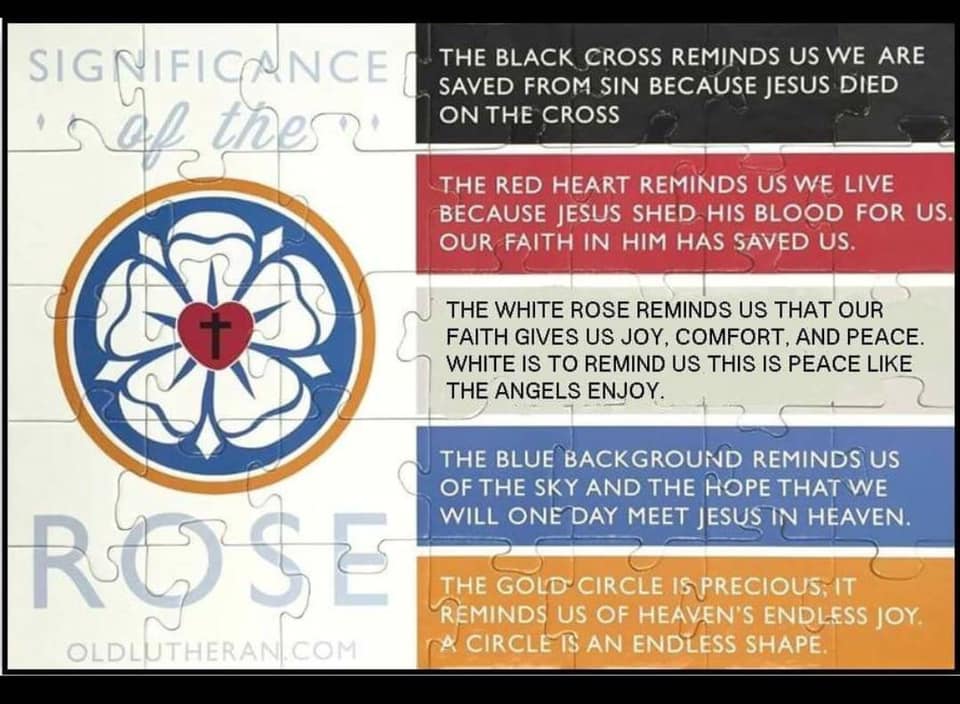
Have you ever seen the rose image on the floor in our Christ Lutheran entryway? The Luther rose or Luther seal is a widely recognized symbol for Lutheranism. It is the seal that was designed by Martin Luther while Luther was staying at the Coburg Fortress during the Diet of Augsburg. Martin Luther thought it a summary of our Lutheran faith. See the image below for an explanation. (Source: OldLutheran.com)
Originally published in the October 22, 2024 weekly newsletter, the Hub, of Christ Lutheran Church, Fredericksburg, VA.
Recently, a congregant received a mass card from Roman Catholic friends after her mother died. A certain number of masses are going to be said at a church community or through a religious community on behalf of the beloved departed. I often get the question in such circumstances, “What is this all about?”
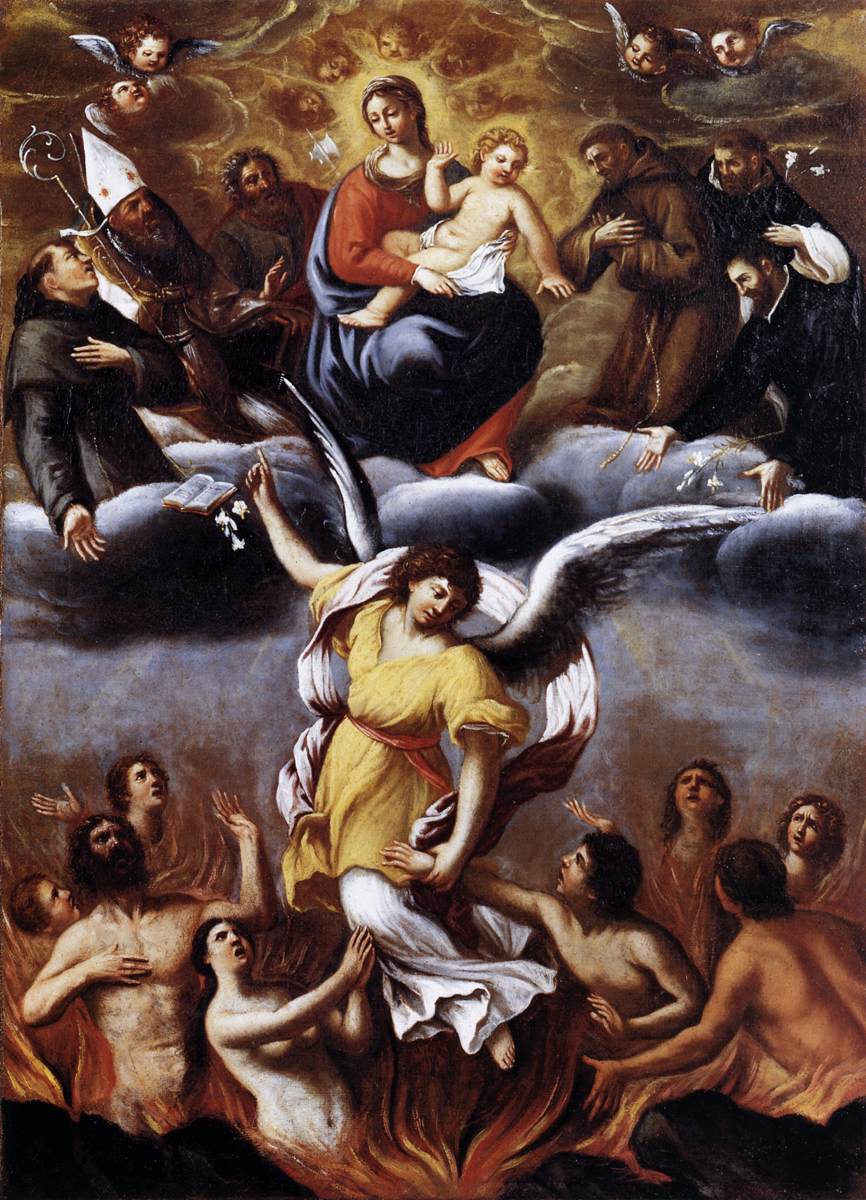
That’s a great and common question. It is all related to the idea of purgatory. From several verses in the Bible and the Apocrypha (Old Testament books not recognized at the level of scripture by Lutherans, but respected), Roman Catholics had developed the idea of purgatory – a place where our sins would be purged after death in order to make us worthy of living with God. More sin meant a longer time in purgatory perhaps hundreds or thousands of human years.
Thought to be a painful process or place, Roman Catholics discerned those languishing in purgatory might be helped with prayers offered for their sake. (Again, they did so using some scripture and Apocryphal sources, but also some questionable human mythic ideas that popped up over time.) In short, they began to think people could make sacrifices, pilgrimages, etc. to help the dearly departed or themselves. This eventually came to include paying money to satisfy any debt for sin. That’s where paid indulgences came into popularity and eventually Luther’s 95 Theses in opposition.
Although paid indulgences don’t exist as they did in the 16th Century, the Roman Catholic Church still holds onto the idea of purgatory and the need for additional satisfaction for sin. Although some modern Roman Catholic theologians now focus on purgatory being more of a process than a place, you still find literature and devotions allowing for a certain number of years off any time in purgatory based on prayers (rosaries said or novenas for example), masses said where the souls of those in purgatory are prayed for (usually for a donation), or specified approved service or pilgrimages (for example, some pilgrimage completed and 0 or 500 years off). At other times no such benefit is promised. The benefit is discerned by the Church leadership under the Pope, not locally. Despite some changes in or diversity amidst explanations offered, old ways die hard.
Although Lutheran’s often pray at the time of death, funerals, and committals that Christ accept the soul of the departed into his care and keeping, we don’t agree with the idea of purgatory per se. We don’t feel there is firm scriptural proof for it. Luther did for a time seem to hold onto the idea that some kind of purging would happen, but this did not necessarily mean a place existed nor was it anything faith in the death and resurrection of Jesus couldn’t cover. If there is any “purging” (or in effect “purifying”) this isn’t something we worry about or seek to describe. We are saved by grace through faith in Jesus. That’s all we know clearly from scripture. That’s what we trust in. Luther used to argue, “Remember you are baptized,” and “Jesus doesn’t lie.” If you are Jesus’ through faith and baptism, you are saved. Yet, Lutherans and other Protestants (particularly the Reformed) sometimes still talk in terms of “glorification” after death which might echo the Roman Catholic view somewhat. Yet again, we all basically reject the Roman Catholic construct of purgatory.
That said, when someone Roman Catholic has paid for masses to be said for the soul of someone who has died, a “mass card” is often sent to let the bereaved family members know. The mass is said as an offering for the person to be acceptable before God. (There might be other names prayed for at the same time.) It is meant to honor and help the departed and comfort the grieving, so I just say thank you instead of entering any theological debate. It was a gift offered in love and their faith. If they ask about our faith in regards to this practice, I’m honest. In my heart, I trust my loved one is already covered by grace through faith. On the negative side, some Roman Catholic agencies and parishes (not all) can use paid for masses as a form of fundraising – not so unlike Luther’s hated indulgences. Its problematic on many levels even among the Roman Catholic faithful, but sadly, it does happen.
“By the end of the seventeenth century, many Lutheran churches celebrated a festival commemorating Martin Luther’s posting of the Ninety-five Theses, a summary of abuses in the church of his time. At the heart of the reform movement was the gospel, the good news that it is by grace through faith that we are justified and set free.” (Bread for the Day 2019, p. 414)
What is Reformation Day? Historically, it marks the day when Martin Luther called for reforms in the church on October 31, 1517, All Hallows Eve (All Saints Eve).
On November 1, All Saints Day, and November 2, All Souls Day (no longer observed by Lutherans), the Church traditionally celebrated the saints while pondering human mortality. Martin Luther chose this specific time to challenge the theological status quo. He provided ninety-five reasons (or theses) as to why no purchased or earned indulgences (a kind of pardon) were needed to save us from damnation. He argued that Jesus’ death and resurrection had opened the door to heaven for us as a free gift. All one needs to do is to hear, believe and claim this gift as our own. Trust in the promises given us in Christ.
Many noble reforms came out of the resulting theological debate. There was an explosion in personal faith. Both religious and secular institutions changed forever. Yet occasion for sin came as well. Christians began to divide and accuse one another of error. So today, we tend to say that we “mark” the day instead of “celebrate.” Christ’s universal church continues to be transformed and reformed led by the Spirit even as we seek to be reconciled with God, one another and the world.
As important as the historic Reformation events remain, perhaps we should use this day to ponder God’s activity today. What changes are God calling us to make?
Originally published in The Hub, a weekly email of Christ Lutheran Church, Fredericksburg, VA.
Knock, knock, knock…Below is my response to “Protestantism is Not United, Not Catholic, and Not a Church,” by Fr. Andrew Stephen Damick (2017).
The argument that Protestants are not united, not Catholic, and not a Church doesn’t upset me much as a Lutheran. The Great Schism (1054) and the start of the Protestant Reformation (1517) left the Christian world divided with the Orthodox, Roman Catholics (or Papists), Evangelicals (the first called Protestants and eventually Lutherans), and what were often at first named Radicals (Anabaptists and others pushing the traditional theological envelope). The Augsburg Confession was written with the hope for unity even amidst some practical, concrete theological differences.
As regional and theological breaks continued to occur, “Protestant” became an umbrella term for many disparate groups, and Evangelicalism more recently became connected to believer-baptism, “Bible based” traditions. The term, Protestant, is now sometimes used to indicate mainline denominations, but in general, the term covers a disparate group in common usage – often Mainline Protestant, Evangelical, Pentecostal and others. Although, it is important to note that some high church Episcopalians/Anglicans don’t like to be thought of as Protestant at all. Still, most everyone else considers them so (whether fair or not).
I would argue that some Protestants are more attached to the “Catholic” (universal) heart of the church than others. Determining what that heart is remains the rub. For my part, I put my trust in Jesus, Son of the Living God, risen from the dead. Beyond that, I’m open to arguments and even ultimately being proved wrong. Despite our hardheartedness, I find continually that the Holy Spirit makes us one Church out of many denominations (or “church bodies” if you prefer) whether we like it or not. There are many commonalities. There is an ecumenical movement affirming catholicity over division. Yes, we find these are muddied, sinful waters, but I expect the Baptismal waters will win out yet.
So, I believe the author fails to adequately or even fairly differentiate between varied beliefs of Protestantism. Echoing his own argument, must of us confess that we are not one! We understand that the Church is fractured, but we don’t have to look far to identify fractures in the Orthodox edifice as well. Just look at what’s going on in orthodoxy over in the Ukraine. Closer to home, in my own county, I know of Orthodox Christians that mutually condemn one another. Certainly, we know Orthodox folks in the Richmond area who are viewed with suspicion if not distaste by other Orthodox folks. The catholicity of the Church is broken, and so, many Christians are working toward repairing the breach when and where they can. There’s a hunger for unity with God and one another.
In my view, the author makes a mistake by conflating Protestant
traditions. He focuses on the “Reforming Catholic Confession” as if it is a
seminal Protestant document. It is actually a document initiated (as I
understand it) by Kevin Vanhoozer, a seminary instructor at Trinity Evangelical
Divinity School (Deerfield, IL). Interestingly, the seminary is affiliated with
the Evangelical Free Church of America. This denomination is Evangelical in the
modern sense (believer-baptism, “bible based,” etc.) not the Lutheran sense (“of
or according to the teaching of scripture”). The Evangelical Free Church of
America’s deepest roots are indeed found among Swedish, Danish, and Norwegian
Lutheranism, but they are ultimately a break-off sect in the United States – former
Lutherans influenced by Baptist and Evangelical neighbors. Ironically, they
were originally considered “liberal” by some, as the predecessor bodies were
trying to cast off the cloak of the “Old World” religion and hungered to be a “free”
(not state supported) church. Today, Evangelicalism is in fact often closely
connected to conservative politics and traditions, but not always.
I would argue we all fall short of the “Catholic” standard. Orthodox, Roman Catholics, Mainline Protestants, Evangelicals, Pentecostals, and all others have plenty of repenting to do rather than casting stones. I’m thankful to be part of a Protestant denomination that is trying to live out the Augsburg Confession’s hope of our being one, and most importantly, Jesus’ own prayer for us to be one (John 17:20-23).
I don’t fault the authors of “The Reforming Catholic Confession” for arguing for the catholicity of their faith (as they see it), even though, I do often disagree with their theological claims. Thanks to the Holy Spirit, I trust we are one even as we disagree. Thus, perhaps we as Church would find it more productive (and in line with God’s will) to focus on what unites us rather than divides us as Pope John XXIII suggested; even if we need good beer and conversation as the starting course.
Amidst our Christian brokenness and sin, I trust the fullness of the promised feast is yet to come. Someday, Jesus’ prayer will be completely fulfilled. Yes, we are one Church, just not quite yet.
Pastor Lou is a member of “the Three Priests.” Join him (an ELCA pastor), Fr. Adam (an Orthodox Church in Americapriest), and Fr. Nic for a Three Priests Walk in a Bar event in Ashland, Virginia, or through their (hopefully) upcoming podcast series.
This post was created in response to an article shared by an Orthodox friend, Fr. Adam, on Facebook, “Protestantism is Not United, Not Catholic, and Not a Church – Orthodoxy and Heterodoxy,” by Fr. Andrew Stephen Damick, on Reformation Day 2019. Find it here: https://bit.ly/36o4XtI
In case you come across this article by Thomas Cahill as I have being reposted and misused by some Roman Catholic brothers and sisters (along with some rather un-Christian remarks), be assured the author misses the mark somewhat when it comes to Luther’s psychology and theology. His take is too simplistic.
Luther’s efforts to reform the church (especially at the start) weren’t about ego alone, but about the Word of God being adhered to without mental gymnastics to make them fit corrupt and superstitious practices of the day. He was a pastor caring for his people, and a teacher seeking truth. His intent was not to be independent, revolutionary, or famous.
Unlike the short quote within the article, Luther’s words at Worms were more nuanced [please note the points I emphasize]:
“Unless I am refuted and convicted by testimonies of the Scriptures or by clear arguments (since I believe neither the Pope nor the Councils alone; it being evident that they have often erred and contradicted themselves), I am conquered by the Holy Scriptures quoted by me, and my conscience is bound in the word of God: I can not and will not recant any thing, since it is unsafe and dangerous to do any thing against the conscience.” (History of the Christian Church, vol. VII, ch. 3, sec. 55).
Martin Luther was posting an academic disputation – a common practice of his day – and wrote later writings to be discussed in community. He wasn’t looking for a fight nor a break with the church catholic, and his efforts were shaped by much more than just a matter of an individual’s ego.
True, self-interpretation of scripture has its weaknesses and excesses, but Luther wasn’t guilty there either. His focus remained on the assembly (the church) in relationship with one another and Christ. (This is made quit clear in his Large Catechism and other theological writings.) The church guided by the Spirit and tested by the divine revelation of scripture is the corrective for us all when it comes to interpretation, for Luther knew we all can err as much as popes and councils. We need to open scripture, listening for the Spirit and to one another.
As the debates rolled on and intensified, Luther failed to do that at times himself. Much like those posting anti-Lutheran insults and commentary, he let his anger and disappointment (and perhaps later his mental illness) govern some of his responses. After all, many people wanted to see him dead and weren’t exactly charitable either.
Martin Luther was human, and he realized it. In reviewing much of his writings, you will see him hesitate to state things definitively rather than to risk error. He critiques himself and his lack of ability. You will see calls for discernment rather than name calling over theological issues. He turns toward grace to light his way forward and not some internal power of his own.
I think such an attitude represents a very human, Christian humility and maturity rather than egocentricity. Adapted beyond theology discussions to a way of life, such an attitude will likely prove the best answer to what gridlocks us in our politics and divides our culture today.
As St. Paul reminded Luther and reminds us all, “And do not grieve the Holy Spirit of God, with which you were marked with a seal for the day of redemption. Put away from you all bitterness and wrath and anger and wrangling and slander, together with all malice, and be kind to one another, tenderhearted, forgiving one another, as God in Christ has forgiven you.” (Eph. 4:30-32). Even amidst important theological or other disputes, we are to remain one family of faith, the holy people of God.
Unless otherwise indicated, all scripture quotations for this article are from the New Revised Standard Version.
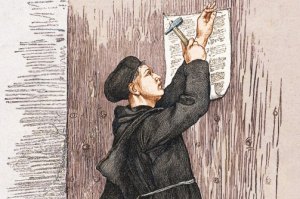
Today at worship, we remember the posting of Martin Luther’s 95 Theses on October 31, 1517. More important than that, we celebrate with thanksgiving that the Holy Spirit worked through Luther and other reformers to bring a renewal to Christ’s church – one still playing out today. Even during that difficult time of misunderstanding, false (and some valid) accusations and critiques against Luther and Protestants, regrettable divisions, and outright war, the Roman Catholic Church did reform itself in many areas through what they call their own Catholic Reformation. This was partly a direct response to true abuses identified by Protestant Reformers. Never expected when Luther hammered his 95 Theses on that church door in 1517, the entire church grew in its faith understanding as it argued about and searched for God anew. Even some alternative faith expressions have been born (such as the Anabaptist traditions, pietistic faiths and more). Although plenty of missteps have been made by human believers, this movement of the Spirit has enriched Christ’s church, and it indicates God is still speaking to us – still transforming us by grace through faith in his Word, Jesus Christ.
True, all remained imperfect in our fallen world. Mutual condemnations continued primarily until the aftermath of WWI and later WWII. Yet through the horrors of war and genocide, many Christian began to ask why we should hate one another. It could not please God. Within this spirit of repentance, the Holy Spirit worked to help heal and address divisions. Using ecumenists such a Dietrich Bonhoeffer, Brother Roger of Taize’, along with many others (some remembered and some not), and partly through the leadership of Pope John XXIII and the Second Vatican Council, another renewal of the Church began – not unrelated to Luther’s own actions in 1517 and later. In fact, many of his historic arguments were revisited with a new openness of heart. Resulting changes have proven so profound that the Roman Catholic Pope John XXIII and other Roman Catholics, along with Christians of other faith traditions are included in the Evangelical Lutheran Worship’s calendar of commemorations. The World Council of Churches, the Lutheran World Federation, full communion agreements between denominations, and ecumenical dialogues remain signs that we hope and actively seek to move that process forward.
Ecumenical discussions continue despite any mistakes arguably made at times and the reality that some Christians still reject any such talks and cooperation. One result has been the recent agreement of what it means to be justified through faith. Although some historic differences might remain in practice, Catholic and Lutheran reforms over the last century have resulted in denominations remarkably similar even amidst their differences. The current Pope Benedict often speaks well of Luther even if he doesn’t fully agree with everything Luther said or did. He agrees with Luther’s “burning question”, as Benedict puts it: “what is God’s position towards me, where do I stand before God?” As a Roman Catholic publication recently noted, this remains the central question of life today, even though many people don’t realize it. He also applauds Luther’s Christ-centered spirituality. Last echoing Vatican II, Pope Benedict remarks, “It was the error of the Reformation period that for the most part we could only see what divided us and we failed to grasp existentially what we have in common in terms of the great deposit of sacred Scripture and the early Christian creeds. For me, the great ecumenical step forward of recent decades is that we have become aware of all this common ground, that we acknowledge it as we pray and sing together, as we make our joint commitment to the Christian ethos in our dealings with the world, as we bear common witness to the God of Jesus Christ in this world as our inalienable, shared foundation.” (See Brumley, M. The Pope, Martin Luther, and our time. The Catholic World Report. Posted September 25, 2011 at catholicworldreport.com)
It is truly remarkable that the Roman Catholic, Lutheran and recently Methodist denominations have agreed on a Joint Declaration on the Doctrine of Justification over the last 10 or so years. This remains yet another sign that the Spirit is still at work, that God will make all things work for the good as scripture promises, and that Jesus’ prayer that we be one need not remain a dream forever.
As we remember Martin Luther and the Reformation and perhaps seek to celebrate all things Lutheran, let us also look kindly upon all of our brothers and sisters in Christ. I believe we must seek to actively and intentionally listen for God’s guidance together, living in Christ’s love and the hope of what is yet to come through the Spirit’s work in our midst.
To read this historic document, Joint Declaration on the Doctrine of Justification, visit the link below:
Husband, Pastor, Law Enforcement Chaplain, and member of the Clerical Errors (aka "The Three Priests"), I'm sharing my two cents with anyone who cares...
You can also find me on social media as Loudluthrn (Lou-d-Luthrn or Lou the Lutheran). It is a moniker given me while attending a Presbyterian Seminary, but I'm a loud and proud Lutheran too (just not too loud and proud, mind you).






 2pennyblog