
This sermon was preached on the Fourth Sunday in Easter (May 8, 2022) at Christ Lutheran Church in Fredericksburg, VA. Currently the worship video is not available due to a techincal issue. You can listen to the sermon on my companion podcast: S1,E15.
Grace and peace to you from God our Father and from the Lord Jesus Christ. Amen.
As the Book of Acts recounts the anecdotes of the early Church, we see Jesus’ teachings play out, become real, and even be expanded upon if not clarified within ordinary, everyday human lives. God works in history, yet these stories aren’t meant to be historical in the modern sense. In short, Acts is primarily a theological treatise hoping to spark and sustain faith.
Indeed, the author of Acts, St. Luke, writes that he set pen to paper to help provide the world with “an orderly account” of the promises that had been fulfilled among them as the early Church (see Luke 1:1). Starting in his gospel account of Jesus and extending into life amidst Christ’s earliest followers, Luke supplies us with a kind of “apologetic historiography” that helps establish and justify the origin and development of Christian peoples among the many faith traditions and cultures of his time.
Basically, as Professor Carl R. Holladay outlines in one of my favorite scholarly journals called Interpretation: A Journal of Bible and Theology[i], Luke seems to tell his story in such a way to help the hearers believe, but also he wishes to help us identify divine cause and effect. For example, Paul’s mission to eastern Asia Minor leads to the Jerusalem Conference (Acts 15) to discuss the future of Gentiles in what has primarily been a Jewish movement at that point. Then, the decisions made at that conference lead directly to Paul’s mission in the region of the Aegean Sea and eventually toward Rome. Indeed, in Luke’s understanding, just as the prophets’ life and testimony pointed to and connects with Jesus’ own glory, it is Jesus who animates and sends us out into the world. Our story is sewn into this larger, eternal story. Christ’s love at work in our lives leads to miracle upon miracle.
And in approaching history in this way, Luke understands that God’s ways are woven into all the tapestry of history, including individual lives and the smallest events. There’s both a personal intimacy and an overarching divine purpose being worked out among us…being fulfilled among us. We aren’t subjected to dumb luck or coldhearted fate; God has a loving plan for us…each and every one of us. And although bad things can happen to good people in a fallen world, or we can make bad choices hurting ourselves and others, it remains ok. God has the power and God wills to ultimately work things out for our welfare and to God’s glory. That’s partly why Luke doesn’t account for the Apostle Mark’s work establishing the Church in Egypt, or St. Thomas’ work in India, or other important Apostolic stories. It isn’t that these events weren’t significant or that miracles didn’t happen. No, Luke’s focus is on the grand design that wishes to spread faith from the center of the Jewish world, Jerusalem, into and throughout the gentile world as represented by Rome. Luke wants to clarify the Church’s role in the world in comparison to its two primary, contemporary accusers, Judaism and Roman religion and culture. So, his tale tends to follow Peter and Paul in their roller coaster ride toward Rome.
Certainly, Luke is not recounting some dull and dusty history. Luke is telling the story of Jesus Christ, Son of the Living God, who died and is risen from the dead…for you and for me. And Jesus’ power is still at work in, through, and around us. Luke sees a connection between what happened in “former times,” what is happening in his day, and right through our lives to “the last days” – the end of time. There’s a singular, loving purpose connecting all lives and moving us toward an ancient promise yet to be fulfilled – the resurrection of the dead and establishment of a new heaven and earth where we will live eternally with God in glory. As such, the Book of Acts incorporates the stories of many diverse individuals, and again, Luke assumes we play a part in this narrative too.
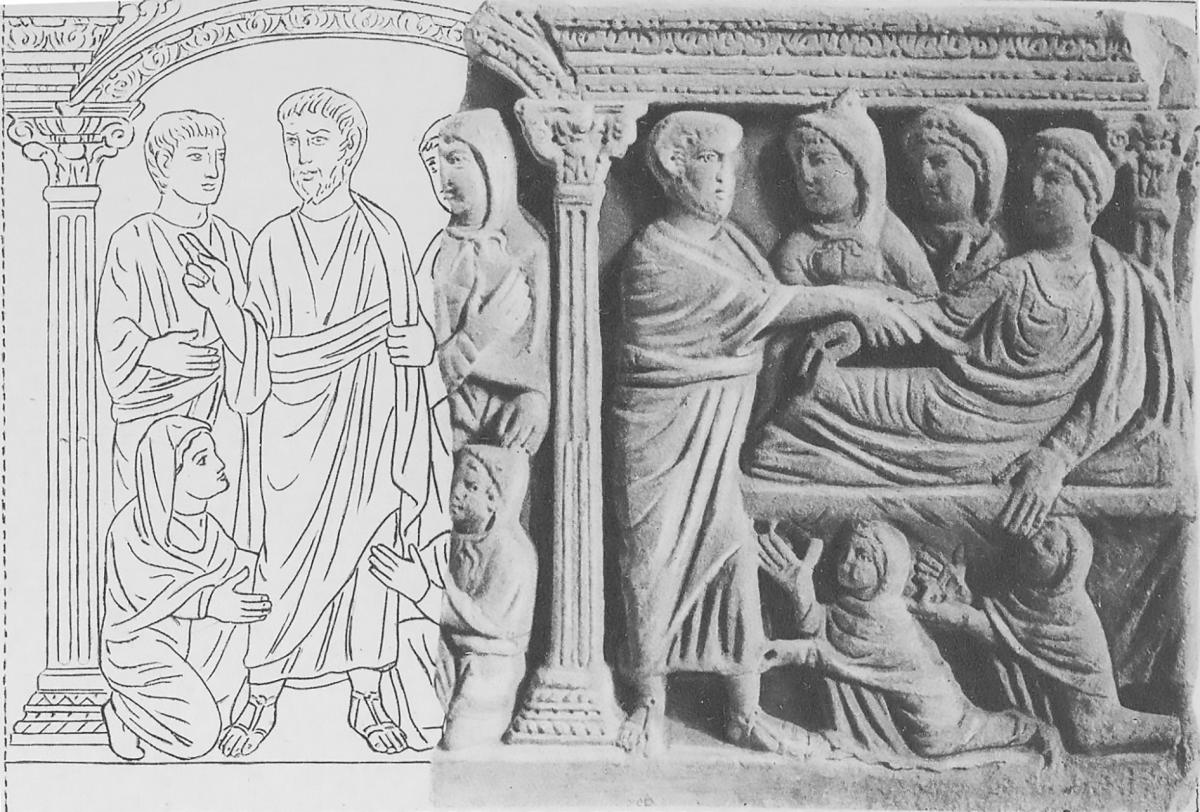
And so, we now come to the story of Tabitha – a life linked to the story of Jesus and our own. A fellow graduate student of mine, now a seminary professor, Dr. Raj Nadella, succinctly summarized the scene: “The story of Peter raising Tabitha from the dead parallels the story of Jairus’ daughter in Luke 8:40-56. While Jairus’ people advocated for his daughter in Luke 8, believers at Joppa advocate for Tabitha in this chapter. In both stories, the miracle occurs in a private setting. Just as Jesus sends everyone except Peter, James, and John out of the room prior to the miracle, Peter sends everyone out in this story. In both accounts, the deceased comes back to life after being ordered to get up. It is as if Peter, who was present when Jesus raised Jairus’ daughter from the dead, replicates a similar miracle at Joppa.”[ii] Do you hear the recurring, reverberating sound of God’s love at work as Luke tells it? God’s love echoes throughout time. As so many observe, Luke sees that history repeats itself. Yet, it is not exactly the same story, is it? Things have changed. Most importantly, Christ is risen! (Christ is risen indeed! Alleluia!) That Easter promise is still unfolding; the Kingdom of God birthing into our world through our lives. In this incident of resurrection, people with the help of the Spirit can understand that Christ’s authority has been truly shared with his followers. It is a hope-filled experience where Luke sees the victory of God and God’s people over the forces of death. Luke’s expectation and hope is that those who hear it for the first time or remember it in the future will come to an ever-deepening trust in Jesus as Lord.
Sadly, there are some who argue against the truth of such stories because they have never seen such things. Others in their enthusiasm or greed, sell videos on how you, too, can raise the dead. (It is true. As crazy as it might sound, I’ve seen them, and I know of someone who fell for this scam.) Yet even the Bible indicates raising from the dead is a rare thing. Surely, it wouldn’t be deemed such a big miracle if rising folks from death was a norm. It is important for us to recall that with the thousands of years covered, the Hebrew scriptures only preserves a handful of resurrection accounts enabled through the faith of prophets. Perhaps more surprisingly, Jesus himself is reported to have raised only three people from the dead during his earthly ministry (the widow’s son at Nain, Jairus’ daughter, and Lazarus). When someone is raised from the dead or miraculously healed…or not…one can always be sure that God has a very good and special reason for what God does or does not do. Somehow, God’s answer to our prayer – whether yes or no – will always be informed by God’s love for us and the world.
And so despite doubters, one can certainly find stories here and there of those risen from the dead or miraculously healed or helped if one looks. In my own life, there was a time when I served as a hospice chaplain to a person actively dying. (This means there were medical signs of impending death as judged by competent medical authorities). The family was Christian, but they had a hard time accepting his death and prayed for a miracle. As I prayed, they started to take over. They begged, pleaded and cajold hoping against hope that they could have even one more day with the one they loved. As I left that night, he was in a comatos-like state. When we were done praying, I said my goodbyes and went home. The next day, I received a call from a nurse. Somehow, someway, he was up and walking around, alert and talking, the next morning. The man’s doctor, nurse and hospice staff were rightly amazed. I was amazed. Science could not explain it. Yet the family that prayed so diligently, so passionately, with me that night saw this clearly as an affirmation of their own faith and hope. They gave thanks to God. All good things come from God, so who can say – however it happened – that they are wrong. I certainly will not! Strange things happen…miraculous and unusual things. Yet with all such miracle stories – whether Lazarus, Tabitha, or even the man I knew who was actively dying – the people involved eventually died. This incident wasn’t the End Times’ eternal, resurrected life with Jesus that we have in this passage. No, these miracles happen to call people into or affirm faith while we wait for that day. That’s what God uses miracles for. The love of God shows itself in a unique, concrete, if not intimate way for a particular and greater purpose. And so perhaps today’s account isn’t ultimately about Peter’s exemplary faith or Tabitha’s getting up from being dead after all? These details remain important, but I would like to suggest with others that Luke is pointing us toward something more. Again, this story is our story.
In Tabitha, we have a poor woman (a person at the margins of society likely due to her social and economic status and sex), and yet, our mighty God graciously, unexpectedly chooses to work miracles in her life. By that, I don’t mean God worked just through her resurrection (for that’s the low hanging fruit of the story). No, humble Tabitha, named Dorcas in Greek, was a seamstress who was known for her “good works and acts of mercy.” She echoed God’s love throughout her life. Her life and faith touched the lives of others and changed them for the better through relationships built on love. As Dr. Nadella also notes, “Her compassion and care allowed her to build a beloved community that became her family.”[iii] That’s the big and lasting miracle here – her legacy of love…ultimately Jesus’ legacy. Tabitha would experience death again, but in Christ, through her love shared and still being passed on through the Church, she lives on. And one day, Christ promises that we will all stand with him resurrected in his glory forever. Her story, our story, in no way ends with death.
For some, no matter what is said or how one tries to account for it, the story of Tabitha will remain an old wives’ tale. Yet, I believe with the early Church that the same divine love which raised her to life can be found at work in the lives of all those ordinary people who trust in Jesus – including yours and mine. That love was at work in Tabitha all along even before she or others perhaps recognized it, and it is still at work now. It is always at work even when we don’t see it or fully understand it. As a past seminary professor of mine attests, “God’s love creates, redeems and sustains without ceasing.”[iv] Through a faith, hope, and love lived out…echoing from and embodying Christ’s own life given for us…we become one with Christ’s story, power, and purpose…one with his love. We are transformed through that love into a resurrected people, walking in the world to change it, sharing in a legacy of love that will ripple throughout time without end. We can live generously like Tabitha, assured that death does not have the final word, because Jesus is the final word. And, it is he who has claimed us as his own forever. Amen.
[i] Holladay, C.R. (July 2012). “Interpreting Acts.” Interpretation: A Journal of Bible and Theology, 66(3), 245-258. Washington, DCs: Sage Publications
[ii] Nadella, R. (May 2022). Commentary on Acts 9:36-43 as downloaded from workingpreacher.org on May 5, 2022.
[iii] ibid
[iv] Stjerna, K.I. (2010). “Editors Introduction” in Two Kinds of Love: Martin Luther’s Religious World, by Mannermaa, T. p. XI.
Unless otherwise indicated, all scripture quotations for this post are from the New Revised Standard Version (NRSV) translation.
© 2022 The Rev. Louis Florio. All content not held under another’s copyright may not be used without permission of the author.

 2pennyblog