
Tag Archives: taize’

My “Pilgrimage of Trust” continues

Image: The Paris European Meeting (1994), (c) Taizé.

Thirty years ago (as of December 26, 2024 through January 1, 2025), I served at and attended my first European Meeting in Paris as “a permanent” (long-term volunteer) with the Brothers of Taizé. “100,000 Youths Invade Paris for Prayer” was the New York Times headline. “Spurred by an ideal that helped undermine communism in Eastern Europe, more than 100,000 young people have poured into Paris for a five-day prayer marathon.”

A number of volunteers had been working all year long helping to prepare the site (Porte de Versailles) and coordinating with local congregations and families to help receive the many young adult pilgrims. At these meetings, visitors live with local families or congregations to help deepen the relationships built and foster greater reconciliation and unity among the people of varied nations and denominations represented. The opening of the Iron Curtain after communism facilitated many coming from the East for the first time.

Just a couple of weeks before the meeting, a few thousand people still needed housing. I was invited to be with Brother Roger and the younger brothers for a song practice in their home when he spoke of the news. He shrugged his shoulders at this challenge and said in French, “God will provide.” It was among many of the lessons learned while I lived with them; challenging me to radically trust God. And of course, God did provide. As some friends from that time reminded when previously reminiscing, the provision was through the willing hearts and sweat of many – people risking the opening of their homes, and many volunteers and locals churches working long and hard to identify and prepare a welcome of young adults from across Europe primarily, but also the world. Hospitality remains a too often overlooked but important, ancient mark of the Church, but it can prove more difficult when at such a large scale.

At the event, I was assigned to work under Br. Ulrich (originally from Germany) distributing food. I helped oversee three of the large feeding stations which served lunch and dinner to these multitudes – more than 25k people at each area for each meal. (I was told that approximately 110,000 in total attended the event.) It was up early before dawn and in bed after midnight each day. My teams and I were outside in the elements for most of the day. I felt a bit like I was back in the Army, especially as among the food items many NATO surplus meals were served. Each food item had its place in multiple serving lines – bread, fruit, cheese, main course. As stockpiles grew smaller, they were replaced quickly. I became expert at driving a forklift. It wasn’t the Feeding of the 5,000, but it was miraculous in its own way. People cooperated well despite the use of varied languages. Volunteers and those served were for the most part patient and joyful.

The positive spirit of the event spread throughout our work, but it proved fatiguing nonetheless. With multiple languages and abilities, it could indeed be challenging. So, I along with other volunteers there from Taize’ tried to keep the pilgrims assigned to help us in brighter spirits. I taught many the poem Fuzzy Wuzzy was a Bear. Or as it rained, I shared the song, “It’s raining, it’s pouring, the old man is snoring,” along with other silly things – new to them, often as I said, people who knew little or no English. As young adults, many were keen to have fun but also learn or improve their English. Humor helped pass the time, and just as I survived many an Army field exercise with laughter, humor played well at the European Meeting too. I learned about 26 ways to say the word “cheese” as we served meals that week. Taizé is famous for its musical chants, and this ode to cheese almost became a chant on its own repeating the list in a sing-song voice: “cheese, fromage, formagio, queijo, queso, ost, ser, syr…”

True, I did get to see Paris a bit during the wonderful season of Christmas to include walking up the Eiffel Tower or visiting Notre Dame and the Champs de Lycee, but this trip was primarily about service. Yet, there was much joy and many new friendships made too. I became friends with a young woman from Germany who hated her “old fashioned” name, Cordelia. She liked American names, she said. So, I dubbed her Joe. I recall my friend, Petr, who spoke long and lovingly on a metro ride about the superior virtues of Czech chocolate, “the best chocolate in the world,” after tasting some French chocolate. Walking down the street one night with new friends from Lithuania and Poland, the Lithuanian man had to translate my English to the Polish woman in English because she could not understand my accent. She said it sounded like “waw waw waw.” I sounded a bit like Charlie Brown’s teacher if I comprehended correctly, but I understood them both! And what a splendid Feierabend, a phrase a German volunteer taught me for “quitting time,” as we watched New Year’s Eve fireworks explode over the Eiffel Tower from our warehouse rooftop as we closed up services. There are so many memories of wonderful people and conversations.

Unfortunately, the realities of the world were seen too. I noted a greatly increased police presence as the program neared completion. I learned later that a terrorist threat had come in, but – praise the Lord – nothing occurred and everyone had a safe time. If you know the more recent history of France, you know there have been significant, successful attacks since then. I’ve been told that since my time there, there’s a constant police presence on the hill of Taizé now because of increased threats. That saddens me even as I understand the need.

My week in Paris fell only a few weeks after my arrival in France, and it helped shape all that came after. It was a transformative experience for many including me. The managers of Porte de Versailles remarked with great amazement at how little trouble there had been, how friendly people were, and that the facilities and property were left cleaner than before we came. (Pilgrims had helped throughout including the cleanup.) Before the age of email, people left for home with new friends’ addresses and hope for the future. I learned more of what the Church could be, even amidst disagreements, and how peace could be made manifest most simply and beautifully between individuals.

Like most, I definitely left with deeper faith than I had come with, and I still ponder the miracles that are the European Meetings hosted by Taizé. This Paris encounter was the 17th annual meeting for young people organized by the community and was also at that time the biggest. As reported in the earlier cited article, “Organizers turned four austere halls at a Paris exhibition center into copies of the main church at Taizé, with saffron- colored drapes and icons glittering in the light of hundreds of candles.” Yet what makes the meeting is the people and the Holy Spirit, not the spaces.

Each year, the formal meeting is held in a different European city from December 28 through January 1. It’s not usually as big, but I suspect each one is profound in its own way. I’ve only been to one other meeting (Barcelona, 2000), but amidst the divisions of today’s world, I recognize the meetings’ sacredness. It’s import and the import of any efforts like it should not be underestimated. These meetings have the power to change your view of the world and your place in it.

As reported by the BBC, Brother Roger, the community’s founder, shared in Lisbon (2004) with the young people present, “If we are at present undertaking a pilgrimage of trust on earth with young people from every continent, it is because we are aware of how urgent peace is. We can contribute to peace to the extent that we try to respond to the following question by the life we live: Can I become a bearer of trust where I live? Am I ready to understand others better and better?”

As some governments expect war in the Pacific or a more expansive war in Europe within five years, such efforts nurturing trust in God and others, reconciliation, and peace remain beyond urgent. Perhaps beyond the importance of any treaty, I learned that peace must start with each one of us, today. We must seek to be reconciled with God and one another. For, Christ becomes more visibly present when we do. His joy and hope are experienced as real.

Yes, the importance of such a pilgrimage never ends. It continues through one’s life.

© 2025 The Rev. Louis Florio. All content not held under another’s copyright may not be used without permission of the author.
1 Comment

Filed under Uncategorized

My little springtime

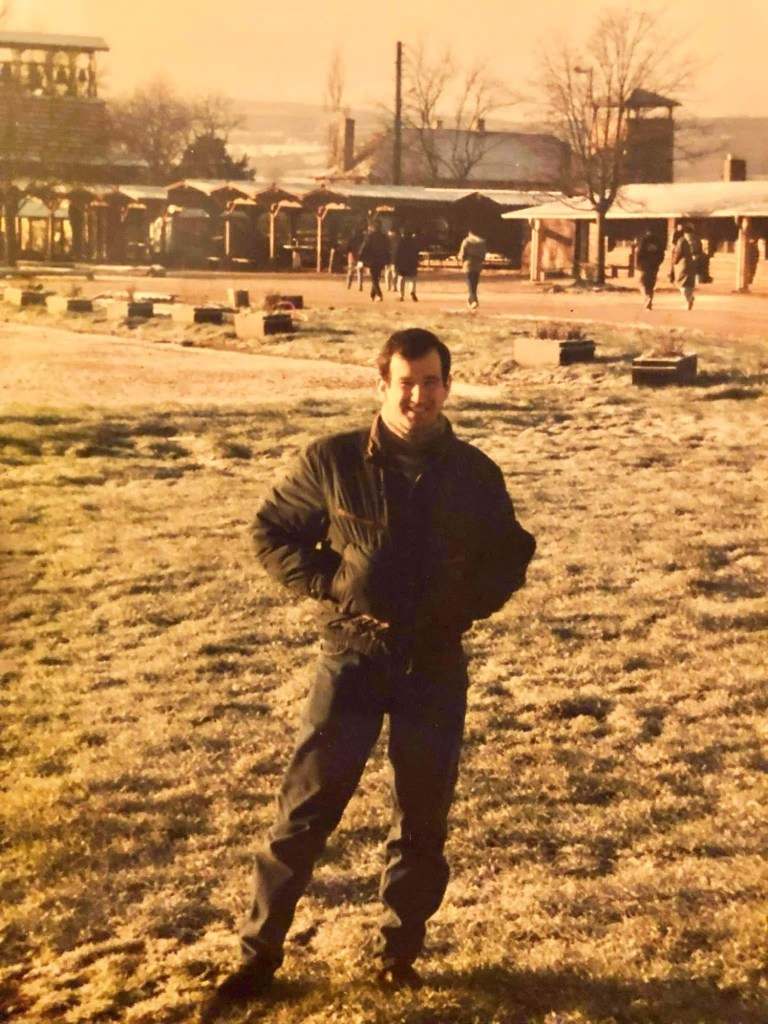
This is me in Taizé shortly after my arrival, perhaps January 1995. A new Lithuanian friend who was a former draftee in the Soviet Army took the photo for me. I finished my own US Army commitment in 1994. Enemies can become friends.

“Ah, Taizé, that little springtime,” remarked Pope John XXIII about the ecumenical monastic community nestled on a hill in Burgundy, France. Being there definitely was a springtime experience for me. I have recently been thinking about my time there a lot. For, I moved to Taize’ in France on December 5, 1994 – 30 years ago! 

I first met the brothers escorting Mary Washington College students to their first large meeting ever held in the US at Dayton University. Several thousand young adults from across the US gathered across denominational lines. As part of “the Pilgrimage of Trust,” we stayed with local families where conversations would continue. 

I had no idea how my heart would open when I first volunteered to go as a chaperone and participant. My experience changed the way I looked at life and the Church – how I understood myself as well. People sharing their faith, positive interactions with people who were previously “other” to me, and a more intimate prayer life energized me. 

I read much about the Ecumenical Community of Taizé and from Br. Roger, the founder, after that. I continued to pray with chants at home and with friends. I went to a few smaller regional meetings. It slowly became a part of me. I’d even catch myself singing their chants (ultimately prayers) as I drove to emergency calls or in quiet moments of my day. Like the prophet, Nehemiah, my prayer life and work life merged. I found myself praying all the time. As I found more peace, I became more patient and discerning when working with others or arresting people. I discovered peace even when amidst the thick of things. Even my sergeant noticed the change. He said during my review, “I don’t know what you are doing, but keep it up.” I think it was more what God was doing in my life, but his observations affirmed for me that I was in a better place and heading in the right direction. Whatever my future, God was with me.

All the while, I began to wonder if I was being called to become a brother. When younger, I had investigated becoming a priest while Roman Catholic. Yet like many young adults, with unaddressed trauma, grief and sin from the past, I had wondered far. I finally became open to radically trusting God after a crisis. Thanks to seeds planted in my past, faith-filled friends, and intentional spiritual, mental, and emotional work, I found my way back home. The Dayton meeting came when the time was right and catapulted me forward toward a new, radical trust in God. Now, I also understood the Church was more than my denomination. I came to believe my past errors need not hold me back. I was and remain forgiven and free. I became determined to address the issue of serving in the Church once and for all wherever God might lead me. For God had been faithful to me, and again, I trusted the Spirit would set me on the right path. 

During this time of growth, I had come to know Br. John. Br. John is one of the community’s American brothers, and he is often asked to go abroad. He had introduced me to a Croatian immigrant in Alexandria who hoped to have a meeting in the DC region where I then lived. Certainly, I would help! It proved such a special event. Only about 100 attended, but the impact was similar to my time in Dayton. As I spoke with Br. John during a break, I tentatively told him of my vocational search over the years – on and off. My friend Tony and I would be visiting Taizé in France for the first time, and I wondered – although I can’t sing well or speak French – maybe there was still an answer for me there? 

Brother John did not laugh at me as I feared. I was not rejected, but instead taken seriously in my search. Although I had not been before to the community, Br. John said that as I was in a different place than many in my search (I had done a lot of work regarding my repentance, healing, and discernment) perhaps I should spend a week in silence. I still would go to the three daily prayers. I would have moments of conversation. Yet mostly, I would spend time in silence or speaking with my future contact brother, Br. Francois, who would serve as a kind of spiritual director. (He was an early brother, and much later, I learned he was also a Lutheran pastor.) 

My contact brother, Brother Francois

Of course, most of my time was indeed spent meditating on scripture, praying, or going for walks. Yet, I was invited to eat with Br. Roger and the brothers once during this first visit as well. A brother who did not know me introduced himself and said, “You are in a week of silence aren’t you?” I said yes, but asked how he knew. He said that people experiencing a week of silence often had a glow about them. (Although I did not understand it at the time, I would later see that glow on other faces.) My growing trust and peace showed.

As my week closed, I told Br. Francois that I thought perhaps I should come for a longer time for more discernment. This would necessitate my resigning from the police department. My eyes and heart had opened wider, so I understood it was time to take a leap of faith. I felt pulled there. He said after a short time of discussion, “We cannot know yet what the answer will be, but we have similar hearts. You must come.” And so, long story very short, I resigned from the police department and came. I began my service as a long term volunteer, “a permanent” in Taize’ parlance, primarily working among the campsites and with meeting preparations. 

Upon arrival, I continued to meet with Br. Francois, and there were many, many more important friendships and memories made during my time there including at the Paris European Meeting with over 100,000 young adults! 

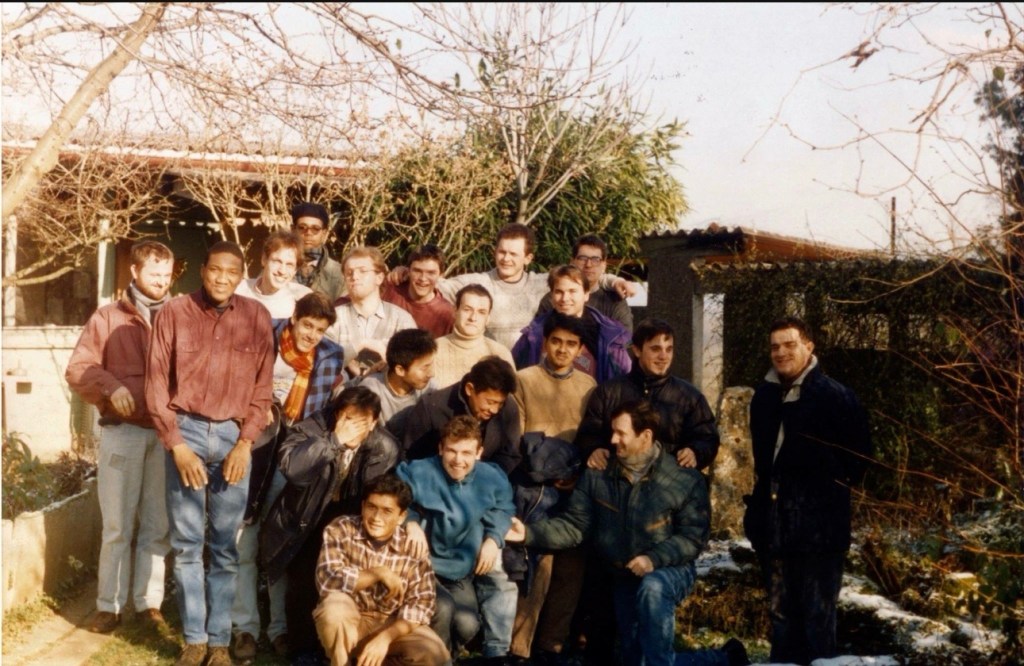
A group photo of the male Permanents at the time from all over the globe. Br. Mathew, a “young brother” in charge of caring for us, is now the Prior of the community (far right). Great memories!

Yet after about seven months, it became clear that I was not to stay, but I never doubted that I had been called there. I came to that little hill, and I saw Christ more clearly than ever before. I just now knew he was calling me to something else. Back to the valley for me! This led me to other people, and thus more new understandings of God’s love, but that’s for another time to share. 

I have not been back to what I still consider my spiritual home, but my wife, Kristine, and I did make it to a European Meeting in Barcelona. (It was the last time I saw Br. Francois. He died a few years ago.) I also was able to welcome Br. John and Br. Emile for a meeting at my church in the Richmond area in 2019. I hope our paths will cross again, but as I have written to my many dear fellow volunteers now across the globe, it’s ok if I don’t meet them again. I still sense the deep, living communion which we share any time I hear Taize’ chants, see a photo, or think of them. The Spirit works this way among the Church, a communion of saints. That communion spoken about in the creeds of the Church is tangible.

Yes, we are together still. It’s hard to explain, but it is true. I trust – thanks be to God – that it will be so forever.

“The Hill,” the village of Taizé in Burgundy, France.

Reflection expanded upon from a Facebook post shared on the 30th anniversary of my arrival to the Ecumenical Community of Taize’.

© 2025 The Rev. Louis Florio. All content not held under another’s copyright may not be used without permission of the author.
2 Comments

Filed under Memories

Amidst Our Mess

The Hub, Mar. 6, 2019

Some memorable items displayed in my new office.

Recently, I faced an ugly reality…my old office. After eleven years, it was time to pack up and move to Christ Lutheran. With the help of my wife, Kristine, we went to work. It took more than a day, but in the end, my things were packed, and the office clean again. I found there was plenty of dust and trash tucked away in unexpected places. Over time without really recognizing it, my workspace had become disordered. Yet, how pleasing it was to find amidst the dirt and grime small treasures that sparked many happy memories.

There are times in our lives that we need to set things straight. Liturgically, the Church offers us Lent. Many Christians give up certain foods or other pleasures as a discipline to help them recall the pain of sin and Christ’s own sacrifice. Others meet with their pastors to confess their struggle with sin and discern ways to make amends. Still others recommit to extra scripture studies, worship, or acts of mercy, charity and generosity. As the clutter clears, we might remember Jesus’ love more and see our lives in a new way.

Through the season of Lent, we reconnect to Gospel joy. Brother Roger of Taizé called Lent “forty days granted us in which to marvel at a love too great for words.” We participate in Lent not to become perfect, not to revel in our darkness with long faces, but to reconnect to a love longing to spark a springtime in our lives. Amidst our mess, we are offered new life through Jesus.

Originally published in The Hub, a weekly email of Christ Lutheran Church, Fredericksburg, VA.

© 2019 The Rev. Louis Florio. All content not held under another’s copyright may not be used without permission of the author.

Leave a comment

Filed under Uncategorized

A Resurrected People

“I shall not die, but I shall live, and recount the deeds of the Lord.” (Psalm 118:7)

Recently, I finally broke down and bought a smart phone. After eight years with my old phone, it was sadly necessary and overdue. One of its many features is the ability to play a musical alarm. Recalling my past joyful experiences with the Community of Taizé as well as the many prayers shared between All Souls Episcopal and Messiah Lutheran, I immediately thought to make a Taizé chant my alarm tone. Of all the many choices available, I selected Psalite Deo (Praise God), based on Psalm 118. [Listen below]

What a blessing it has proven to have my first conscious thoughts each day be of God’s love and the great things done and being done in my life. “This is the day the Lord has made” with all its opportunities. “Sing a new song to the Lord for all the wonders God has done.” It is another day for me to give thanks and praise with all the earth. “Sing out for joy!” No matter what happens in this day, “I shall not die but live!” “For God’s love endures forever.” “Alleluia! Alleluia!”

With such affirmations thrust upon my mind and heart, my day begins somehow differently than before. I recognize once again that God is always doing something new in my life. No matter the adversity laying before me in wait, I need not be afraid. It is truly time for me to awake from my slumber and witness to the new, joyful reality of the Risen Christ in my life.

In our Lenten class on grief, I mentioned that life can often seem like a number of “little deaths” with its many trials and losses. Yet as we might rightly grieve, we should never forget that through Jesus we have access to an abundant life. Our “little deaths” will be used by God to show love for us. Blessing will surely come, and so, we can live in hope. We are called as a resurrected people where we trust God is doing new and wonderful things in and through our lives. We need not get stuck in our doubts and darkness. We can instead embrace the resurrection dawning in our lives.

“In my distress, I called to the Lord. God heard my voice and set me free. God is my strength. God is my song.” How shall I proclaim this Good News? How can I not? It is humbling to think that our extraordinary God is breaking into our ordinary lives in such a joyful, intimate way.

Yes, we have access to God through the Risen Christ. The tomb is empty. Let us not linger there, but instead run and tell all we know through word and deed. Jesus is Risen! He is risen indeed! A new song and new life lie before us.

In thanksgiving, I want to live for him and those he entrusts to our care. I intend to lift my voice to the Lord for he is surely good, for his steadfast love endures forever (Psalm 118). I pray your life will join mine and the lives of all the saints in singing praises to God forever.

Happy and blessed Easter to you all!

Pastor Lou

Posted again (after an earlier, recent post on Psalm 118), here is Psalite Deo the Ecumenical Community of Taizé

This post originally appeared as a pastoral letter in Messiah Lutheran‘s newsletter, The Messenger (April 2015).

Unless otherwise indicated, all scripture quotations for this article are from the New Revised Standard Version (NRSV) translation.

© 2015 The Rev. Louis Florio. All content not held under another’s copyright may not be used without permission of the author.

Leave a comment

Filed under Pastoral Letter

“Today, you will be with me”

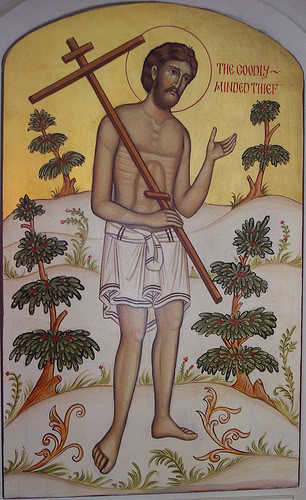
St. Dismas

St. Dismas

For those that have looked at my Heroes and Sheroes page, you might recognize that today is a special day for me. March 25th is the traditional commemoration date of Saint Dismas on a number of Christian liturgical calendars, and I bear his name.

Widely known as the “Good Thief” or the “Penitent Thief”, Dismas was crucified beside Jesus. The name Dismas was later adapted from a Greek word meaning “sunset” or “death.” His real name is unknown. Most likely, he was not a thief, but instead, some kind of rebel or raider deserving the death penalty under Roman law.

Dismas’ lesser feast day or commemoration derived from a tradition believing that March 25th was the actual calendar date of Christ’s crucifixion, although the Passover and Easter celebrations move due to their following a lunar calendar. The Feast of the Annunciation is the primary, modern celebration on our Lutheran calendars today (except when March 25th falls during Holy Week), but I still stop to remember St. Dismas annually on this day.

Although Dismas was never officially canonized by the Roman Catholic Church, he is declared so in scripture by Jesus himself. We hear in Luke that Dismas defended Jesus from the abuse of the other condemned man, commonly named Gestas (but also unknown). Hearing Jesus preach, teach and pray from the cross, Dismas began to look to Jesus with trust. He asked, “Jesus remember me when you come into your kingdom.” Jesus declared, “Truly I tell you, today you will be with me in Paradise.” (See Luke 23:39-43)

Years ago in a home with many challenges, I came to see the world in black and white terms. I secretly believed myself unlovable and defective even at a young age. As I write elsewhere, I am sure I heard the story of Dismas often in church growing up, but it first really impacted me while watching The Greatest Story Ever Told on television with my father in about eighth grade. At that time, I had been going through confirmation classes at St. Pius X Roman Catholic Church. Prior to confirmation (viewd as a sacrament in the Roman Catholic faith tradition), we were asked to think of a confirmation name, one to symbolize our coming to adulthood in faith and hopefully be a saint who inspired us.

In the Roman Catholic tradition, St. Dismas is the patron saint of condemned prisoners, reformed thieves, undertakers, funeral directors, penitent sinners, and prisoners. Indeed, some Lutheran and other prison ministries are named after him. When confirmed in the Catholic tradition, I decided to take his name. This seems ironic perhaps for one who would become a police officer, yet I always remembered how my heart was deeply touched by his story. In the depths of my being, I hoped I could be so loved.

Later as a young adult, I left active life in the church. I believed in God at some level, but I made bad choices at times, experienced losses that often come with life, and experienced much too much evil as a police officer. In short, I gave up on God. I became empty and cynical. I came to feel that not even Christ’s cross was enough to save me. I had much to repent over, for I was very wrong.

Yet when my life seemed darkest after another profound loss, two dear Christian friends from my past redirected my gaze toward the cross and its certain grace. On March 7, 1992, I had what I call my “re-conversion experience” – for I understand now that since my baptism and before, God has always been active in my life. My faith was small and deformed, but it made a difference in my life. God loved me before I ever realized it, even on Christ’s cross long ago. I truly experienced amazing grace, and my life changed.

Through this renewed experience with grace, I came to understand and more importantly finally trust that I was indeed loved and forgiven. I began to dig into scripture as never before. I hungered for the Word of life, and I found it alive in and through Christ’s church. With the church, I sought to share the grace I knew to be true with others in both word and deed. My police work became a sacred vocation. Later, God would invite me to take his love on the road through mission. Overtime, I discovered a home in the Lutheran family of faith. Still a sinner, I trust that I am also a saint. Christ declares this through his death and resurrection for our sake, and I do trust him for he never lies. His sacrifice atoned for our sin – past, present and future. His death remains enough to save us all.

Each year since my “re-conversion” and return to the church, I think of Dismas and rejoice. I celebrate the opportunities found in Lent and Christ’s forgiveness. I trust that with others who believe (and even those who don’t yet) I was, am and will be remembered. Dismas’ story is our own.

Yes, Jesus remembered us all as he died on that cross. He died, so that we could truly live…starting today.

Psalm 32 – The Joy of Forgiveness
1 Happy are those whose transgression is forgiven,
whose sin is covered.
2 Happy are those to whom the Lord imputes no iniquity,
and in whose spirit there is no deceit.
3 While I kept silence, my body wasted away
through my groaning all day long.
4 For day and night your hand was heavy upon me;
my strength was dried up as by the heat of summer.
Selah

5 Then I acknowledged my sin to you,
and I did not hide my iniquity;
I said, ‘I will confess my transgressions to the Lord’,
and you forgave the guilt of my sin.
Selah

6 Therefore let all who are faithful
offer prayer to you;
at a time of distress, the rush of mighty waters
shall not reach them.
7 You are a hiding-place for me;
you preserve me from trouble;
you surround me with glad cries of deliverance.
Selah

8 I will instruct you and teach you the way you should go;
I will counsel you with my eye upon you.
9 Do not be like a horse or a mule, without understanding,
whose temper must be curbed with bit and bridle,
else it will not stay near you.
10 Many are the torments of the wicked,
but steadfast love surrounds those who trust in the Lord.
11 Be glad in the Lord and rejoice, O righteous,
and shout for joy, all you upright in heart.

Prayer:

Gracious Lord, even as you died on your cross, you looked upon Dismas and saw our human need, shared suffering, and sin. You looked upon him with love before his repentence. His simple trust in you opened a way of communion with your heart’s mercy and forgiveness even as the centurion’s spear sought to tear your heart asunder. Your death and resurrection saves me. His trust in you inspires me. Bless your entire church; that together we remember your cross with confidence, persevere in faith through times of trial, and experience the resurrection of our lives today. Empower us to remember and serve the outcast, sinner, and all who suffer; sharing your grace, mercy and love, as you have so abundantly shared it with us. Amen.[i]


[i] This prayer is inspired by a Roman Catholic prayer.

Unless otherwise indicated, all scripture quotations for this article are from the New Revised Standard Version (NRSV) translation.

© 2013 The Rev. Louis Florio. All content not held under another’s copyright may not be used without permission of the author.
Leave a comment

Filed under Community Life, Grace, Law and Gospel, Liturgical Year, saints, Theology, worship

Jesus, Families…and Ground Hogs?

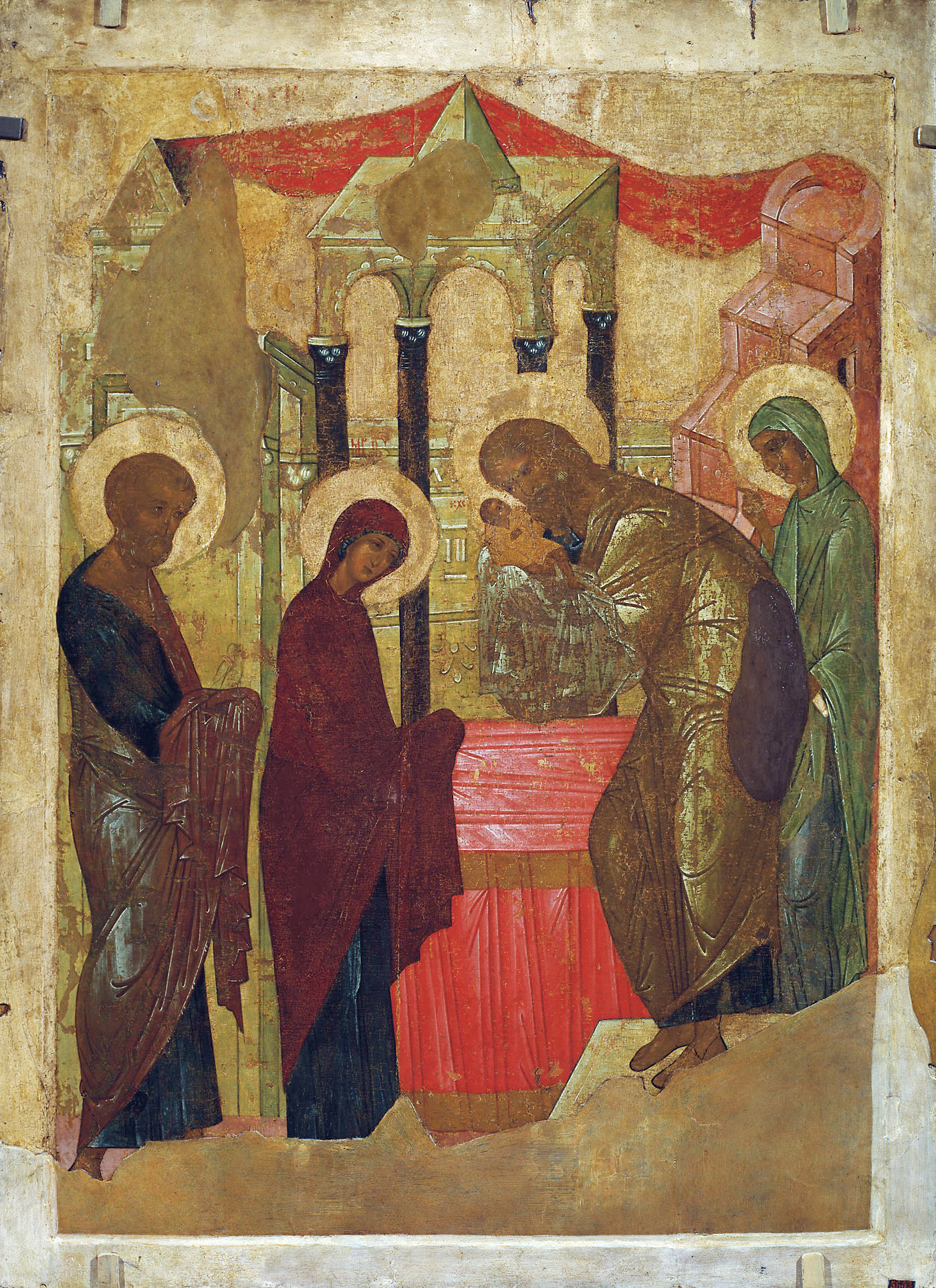
Presentation of Jesus at the Temple, Andrei RublevForty days after Christmas on February 2nd, Christians recall the Presentation of Jesus in the Temple. In a number of Christian denominations the season of Epiphany comes to an end.  According to scripture, Mary and Joseph took the baby Jesus to the Temple in Jerusalem forty days after his birth to complete Mary’s ritual purification after childbirth and to perform the redemption of the firstborn in obedience to the Law of Moses (Leviticus 12, Exodus 13:12-15).


As Mary and Joseph were poor, Mary was relieved of offering a lamb and a dove for her offering. Instead, she was to “take two turtle-doves or two pigeons, one for a burnt-offering and the other for a sin-offering; and the priest shall make atonement on her behalf, and she shall be clean” (Leviticus 12:8).

Around the globe, Christians will likely remember these early events as reported in Luke 2: 22-40. In fact, it is one of the most ancient feasts of the Christian church. With the traditional end of Epiphany, many remove any remaining Christmas greenery from their homes. If you are visiting the Taize’ Community in France, you will likely see a cage with two doves or pigeons in their Church of Reconcilliation. After the service, the birds are released. As the story reflects the light of Christ breaking into the world, it remains a common practice at many services throughout the world to bless candles for use during the year. To this day, some countries share special meals during family celebrations (i.e. crepes in France, or tamales in Mexico).

Pennsylvania Dutch folklore attached an ancient, pagan European practice of weather prognostication to this day. If the groundhog sees its shadow, superstition indicates winter weather will continue for six more weeks. (In ancient Europe, one might have heard of a badger or sacred bear serving this purpose.) Yet, such beliefs weren’t only held in Germanic nations. In England, one old English poem exclaims:

If Candlemas be fair and bright,
Winter has another flight.
If Candlemas brings clouds and rain,
Winter will not come again.

No matter the weather, I hope you and your family will develop your own ways of recalling the Presentation of Jesus. It reminds us of the Holy Family’s piety, and our family’s call as well. It displays a family united by love, as our own should be. The feast most importantly can remind us of how that young male child redeemed on that day came to redeem us through his cross and resurrection. We really should celebrate!

Unless otherwise indicated, all scripture quotations for this article are from the New Revised Standard Version (NRSV) translation.

© 2013 The Rev. Louis Florio. All content not held under another’s copyright may not be used without permission of the author.
Leave a comment

Filed under Church History, Liturgical Year