Tag Archives: theology

Called to decency, not consequentialism

As an ethicist from Grove City College, a conservative, evangelical institution, opined recently, a consequentialist “holds that good ends, however they might be defined, can justify the use of unethical means.” As he reflects on recent administration’s behaviors, he suggests that sort of thinking is a utilitarian approach, but not truly Christian. I agree, and I’ve been suggesting the same over the last few weeks. “I don’t agree with what’s happening (or all that’s being done or said), but…” isn’t a great approach to Christian ethics.

I’ve spoken or written to a number of Christians including pastors in favor of the administration’s ultimate goals about current events. I, too, want safety, prosperity, and justice. I am sensitive to how people long for a government that reflects their values, American traditional values included. I love and have served my country, making an oath to defend the Constitution. I have been injured doing so at times (as a police officer), and I have had several near death experiences. I say this as evidence that I love our nation, and I admit that I am supportive of some (not all) of the stated goals. Yet, I also know there is no justice without mercy (Micah 6:8). I remember that Jesus came to call all people to himself, not just Americans (John 12:32). We live in a political world where good people might not agree, but we don’t have to hate one another or demonize. Jesus calls us to be better than that.

I have come to understand from scripture that there is no “me first” sentiment overruling love of neighbor or enemy, but we are told to follow Jesus which means we must instead cary a cross (Matthew 16:24). Sacrifice is often necessary. I’ve sought to apply Christ’s Beatitudes to whatever I should do or not do, especially in difficult situations. I have of course failed at times, sometimes abysmally so, but I try to repent and make amends for my sin, turning to God so that I might live (Isaiah 45:22) – to live abundantly now as well as eternally as Jesus promises.

As Christians, we need to have our yes mean yes, and no mean no (Matthew 5:37). We should not explain away sin, rude behaviors or hurting people – intentionally or not – because we think the goals are “good.” We are to defeat evil with good (Romans 12:21) whether a liberal, a conservative, or an “anywhere in between” Christian. Humbly, we should listen and consider where we might be wrong, because no human is always right. We should repent and show others grace if they are willing to change. For as Jesus says in Mark 8:36, “For what does it profit a man to gain the whole world and forfeit his soul?”

This doesn’t mean we must go to war, culture war or otherwise, but we are called to decency – to be human in the best sense of the word, loved and changed by God. St. Peter himself argued, “but as he who called you is holy, you also be holy in all your conduct” (1 Peter 1:25). We are to love, not objectify, demean or abuse. Meekness was a word used to describe both Moses and Jesus, so I expect it does not mean what much of the world thinks. It takes courage, and it’s hard.

So perhaps like Sophie Scholl, Christian martyr of WW2, we must grow to understand that, “Just because so many things are in conflict does not mean that we ourselves should be divided” (as quoted in Seeking Peace: Notes and Conversations Along the Way, 1998, by Johann Christoph Arnold, p. 155). Or as with Dietrich Bonhoeffer, we can try to just be decent in the face of evil, as Victoria Barnett, a Bonhoeffer scholar, points out so well. Or even as Mother Teresa, Br. Roger of Taizé, and so many others who sought to live simply and at peace demonstrated through the simplicity of their lives, we can seek to do all things with great love. That’s often how the world experiences change; ultimately experiences Jesus.

A hero of mine, Jonathan Daniels, closed his valedictory address at VMI with this sentiment, one which I share, “I wish you the decency and nobility of which you are capable.” By God’s help, we are all capable of such a life no matter how impossible it might seem.

© 2025 The Rev. Louis Florio. All content not held under another’s copyright may not be used without permission of the author.

Leave a comment

Filed under Theology

Be at peace.

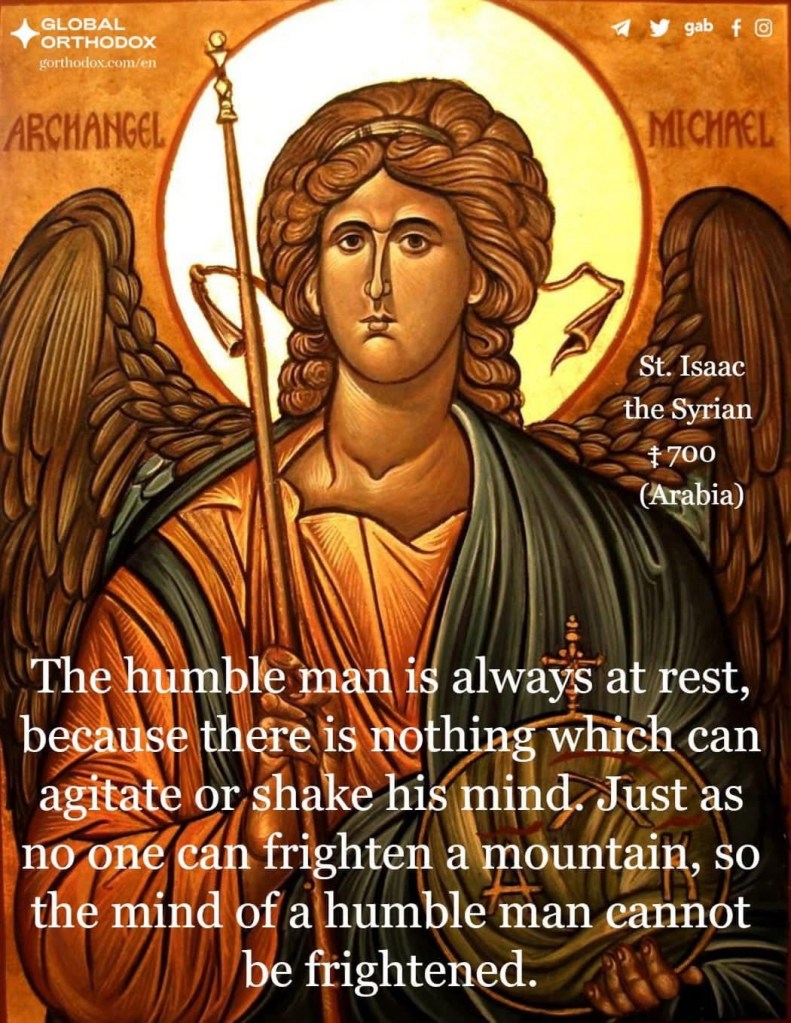
Image from Global Orthodox

St. Isaac the Syrian knew what he was talking about. For the Orthodox and many other Christians (sadly not all) humility isn’t docileness. It’s an understanding and deep trust that all we have comes from God. We are sinners in need of God’s mercy and direction. Yet because God is love and loves us, we can find peace. We can be nonanxious as others rage. We can rest in Jesus even as we work hard for justice, mercy and truth. We can be patient with those who don’t see the world as we do. We know who we are but also whose we are. This doesn’t mean we don’t struggle with fear at times or never fail or fall, but we find the strength in God’s Spirit to keep trying; to seek to love as God loves us; to keep moving forward knowing we don’t walk alone. Some people will see Christ in us and want the peace we have. Many more might reject us as they do Jesus and his message through word or deed, even as they might call themselves “Christians.” That matters not. Embraced by Christ, we can do no other than cling to Christ and our call nonetheless, even as we fight the interior whisper of demons telling us we aren’t good enough, don’t have the strength, must give up. Yet how can we give up when we have everything in Jesus who has already made us victorious? In that shared victory, we ought not judge or puff ourselves up. We must love the other. We should forgive. We should nurture peace. We do this from a God-given humility, not out of our willfulness. “What is hell as compared with the grace of resurrection?” St. Isaac once asked. Nothing. We can always choose to live in hope by God’s help. And through the power of his Spirit, God will.

© 2025 The Rev. Louis Florio. All content not held under another’s copyright may not be used without permission of the author.
Leave a comment

Filed under saints

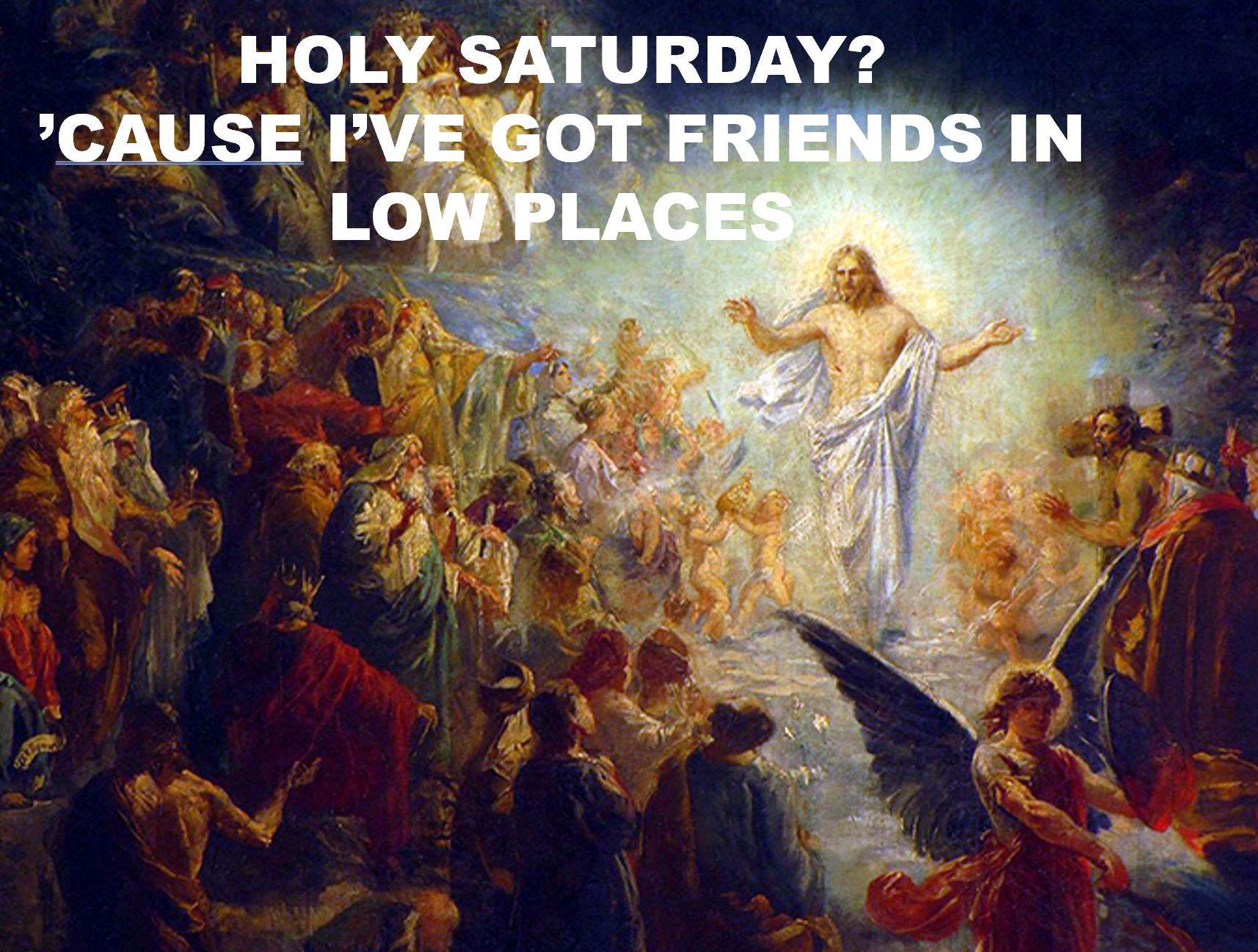
Holy Saturday?

Every year, I’m asked about where Jesus was or what he was doing on Holy Saturday. This meme pretty much sums it up even if in a humorous way. Jesus descended to sheol, the place of the dead out of love for others. The primary scriptural reference is from Peter 3:18-20:

“For Christ also suffered for sins once for all, the righteous for the unrighteous, in order to bring you to God. He was put to death in the flesh, but made alive in the spirit, in which also he went and made a proclamation to the spirits in prison, who in former times did not obey, when God waited patiently in the days of Noah, during the building of the ark, in which a few, that is, eight people, were saved through water” (NRSV Translation).

Christians debate what translated words to use. Did he descend into sheol, hell, or to the dead? That’s just a matter of translation. They also wonder about him coming victoriously or whether he still suffered? That is ultimately a holy mystery. What we do know is that Jesus experienced death fully, and even in death, he came to open heaven to those who trusted in God.

Leave a comment

Filed under Theology

The Door’s Open

“To preach Christ is to feed the soul, to justify it, to set it free, and to save it, if it believes the preaching.” – Martin Luther

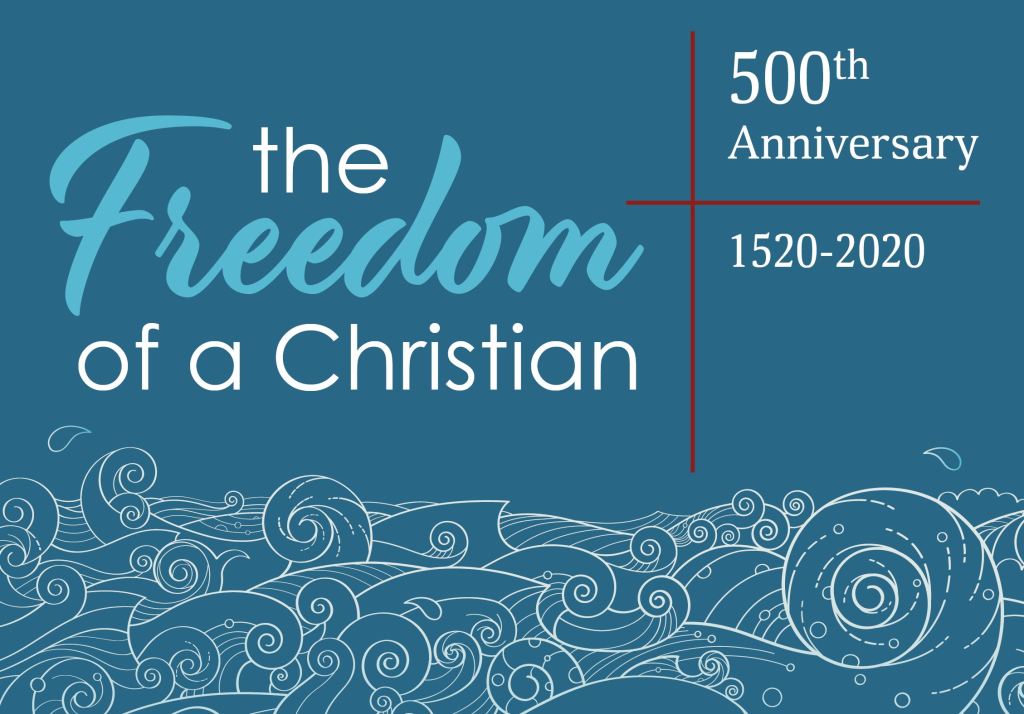
This fall, the ELCA marks the 500th anniversary of Martin Luther’s early important work, The Freedom of a Christian (also known as On Christian Liberty and other similar names), and we will remember it as well at Christ Lutheran. Why? Well, through this early work, Martin Luther decisively influenced the entire Protestant movement in all its forms. As the theologian Dietrich Oppen noted, “As such, it is one of the great documents of world history, a work which opened doors to the future, first in Luther’s time and still in our own.”

Starting on Thursday, September 10, at 10:00 am, join me as we journey through this important work anew or for the first time. Our sessions will help us better understand the mystery of Christ, especially Christ’s work in and through our daily lives. Participants will be provided a pdf copy of the text (which can be printed out or read electronically), but the text is also widely available for purchase if you prefer. A special anniversary study guide will also be provided. Recognizing both the importance of this work and busy schedules, sessions will be recorded and posted on our private Facebook group, but the sessions’ quality and impact will improve if you make an effort to attend together live – willing to share both your faith and questions about faith with others. Don’t worry if you can’t make every session, as always, just come as you can.

In these challenging times amidst much fear for the future, I cannot emphasize enough how important it is to trust in Christ’s saving, active love for each of us and our world. Like the earliest disciples, we are called to certainly watch and pray, but we are also asked to be Christ in the world. God has a purpose for you and I to fulfill in this time and this place as unlikely as that might seem to us. Doubts may grow strong, but they are never stronger than Christ’s love for us or his purpose.

My hope remains that – whether you find yourself out in the world or find yourself restricted to serving Christ’s Church from home – these sessions bless you to be a blessing. I also pray that they nurture a joyful, certain hope to be found in our shared future as children of God. You and I have been set free for a purpose, and so as my friend and spiritual mentor Br. Roger of Taizé once wrote, “Set out, forward, one step at a time, from doubt toward faith, not worrying about the impossible ahead.” The door has been opened by Christ alone. Let us walk through it together.

I remain in communion with you and love you,

Pastor Lou

For the ELCA’s curriculum and/or a free copy of Martin Luther’s “The Freedom of a Christian” visit elca500.org.

If you have interest in our congregation’s class, please contact me.

© 2020 The Rev. Louis Florio. All content not held under another’s copyright may not be used without permission of the author. This letter was first published in Christ Lutheran Church’s September 2020 newsletter.
Leave a comment

Filed under Pastoral Letter

Fili-ok or Fili-noway?

Image by Thomas B. on Pixaby, used by permission.

For those who attend our theology on tap meetings, Three Priests Walk in a Bar, you might recall that we originally created a special Facebook group so conversations could continue. Our producer and facilitator, Nick2, similarly invited folks to “pick apart” our gatherings conversation at a later date. Here’s a few items I shared after listening to the recent podcast of the live event held on “Can Christians Worship Together,” Episode 3.

Our producer and facilitator, Nick2, will likely address this later in a future podcast, but the word filioque is pronounced in classical Latin as “FIL-ee-oak” while ecclesiastical Latin is “FIL-ee-OH-kway.” (There was some discussion over this during the podcast.) What is Ecclesiastical Latin? It is Latin developed in Medieval times, particularly in the West according to some, that was a simpler form and reflects the Vulgate’s use of Latin. I confess that I don’t remember exactly how my seminary instructors said the word. They likely used the Ecclesiastical Latin, but the filioque isn’t a huge issue for modern Lutherans if not most modern Christians in general (day to day anyway). Also, Lutherans aren’t usually big “liturgical nerds” as many Episcopalians on social media self-identify, and if it weren’t for Fr. Adam, who is Orthodox, I don’t know if this specific theological split between East and West would even have come up explicitly again in my life after seminary.

Saying that the Holy Spirit proceeds from the Father and the Son (“and the son” is “filioque” in Latin) is considered one of the major causes of the schism between the Eastern and Western churches. Unfortunately, it remains a lasting, important theological issue in certain contexts. Fr. Adam, again an Orthodox priest, still argues, “FIL-ee-NO-way.” Fr. Nik, an Episcopal priest, argues primarily that it is “FIL-ee-OK.” As an ordained minister in the ELCA, I have options. In the Nicene Creed, the West added the “filioque” phrase unilaterally during the Middle Ages. The ELCA and Lutheran World Federation has agreed to recognize the unilateral nature of the addition and allows for it to be removed for ecumenical purposes. More about that later, but here is partly how we got to that decision:

In a half-joking way, I stated the Lutherans could do pretty much anything in worship as long as it isn’t explicitly prohibited in scripture. Yes, the Lutherans have rubrics (“a direction in a liturgical book as to how a church service should be conducted”), but we take them seriously, not rigidly. In general, good Anglicans I know would be horrified at changing any of the words of the Book of Common Prayer which guides and informs their worship. It can happen with prior approval of a bishop in extraordinary circumstances, but not often. They are in a way centered around and unified by the Book of Common Prayer as it reflects scripture. (Although Fr. Nik has joked scripture stole things from the Book of Common Prayer.) The majority of Orthodox and Roman Catholics I have known would be more than horrified to have words changed in the liturgy unless (at least in the West) there is explicit options offered. I know of a Roman Catholic priest disciplined for changing a small phrase in the communion prayers. Lutherans are a people with theological, formal confessions called the Book of Concord (meaning unity). Thus, scripture and theology (why we do things) tend to have more import than liturgical rigidity (the way we do things).

With the Reformation, Lutherans, Reformed and others were reconsidering worship in light of scripture. On the Reformed and “Radical” (Anabaptists and others) side of the house, there were arguments over what instruments to use. Some wanted only those mentioned in scripture. Others only wanted psalms as prayer during worship because they are in the Bible. Stained glass, icons, crosses and crucifixes were often condemned. Lutherans took a different track. Although valuing the liturgy, again we are not rigid about it. For pastoral concerns and other reasons, the pastor may choose changes beyond the approved options in the rubrics. We can adjust further if deemed necessary or helpful.

As I said previously, this is not to be done willy-nilly. We are accountable to our bishops, council and congregation, guided by scripture and liturgical catholic (universal) traditions. So if for good reason and complementary to if not grounded in scripture, we can introduce a wide variety of music, dance, art and icons, as well as alternative liturgical practices and rituals at the congregational level without approval from any “higher-ups” in our polity. We can wear or not wear certain traditional vestments and religious items. In some Lutheran communities, the pastor does not wear a collar for example. European Lutherans tend to be more like Roman Catholics, while American Lutherans tend to be lower church. In Europe, Lutherans can call our worship the mass (understanding that we don’t get extra credit for heaven nor is is a sacrifice) while Americans tend to call it “worship” or a “service” not wanting (historically) to sound too Papist and likely conforming to their low-church Protestant neighbors.

Thus, we do allow for variations in practice based on context and some times (to be honest) preference – which of course, can prove dicey. Pastors and worship committees can err. Still, I say all this because it reflects an agreement that we have with the Orthodox regarding the filioque.

In short, ELCA Lutheran are allowed to omit the filioque for ecumenical purposes. Episcopalians may as well if the context requires it, but they need approval of the bishop. I imagine many if not most Episcopal priests, including Fr. Nik, would hesitate to omit it as long as the Orthodox and Anglican Communion and/or Episcopal Church are not in full communion. Currently, I do not know of any other such accommodation in other denominations. (If you know of any, please let me know in the comments or contact me directly.) Here’s a link to the ELCA document which does a much better job than me in explaining the discussions and end result in detail:

https://bit.ly/38Tjxd9

Not wanting to copy Fr. Nik’s practice of being “real quick” before entering a nine-minute soliloquy, I will end briefly this way: I believe we are one Church even amidst our divisions and differences whether we like it or not. Our shared baptismal identity assures me of this. I trust in the end of time, God will make us fully one. In the meantime, we should strive to live in unity as much as possible. (I’m sorry, Fr. Adam, if this makes you shudder.)

2 Comments

Filed under Uncategorized

So many books

The Hub, August 13, 2019

“So many books, so little time.” Perhaps few know that as well as a pastor! We love and depend upon books even in this digital age for sound theology and ideas for better ministry. Come into any pastor’s office, and you will likely see books on shelves and tables, if not the floor. Today, this clutter has likely spread through electronic versions on their tablet or phone as well. Our lives seem fed by books.

Yet what would happen if the pastor attended to all these other books but moved away from reading scripture daily? As with anyone else, Bible stories will be conflated into cultural understandings rather than scriptural ones. Faith might become challenged if not weaker, and a hunger for meaning, understanding and hope would grow. As with satiating one’s thirst, we need to go back to the well often. We need to hear what scripture really says to us, for as an early Puritan pointed out, “God is still speaking.”

Now certainly, other books have value, as do our many commitments, but through scripture, we encounter our Living God who loves us anew in a special way. Scripture is the norm for teaching and our discernment over all daily matters in our lives. The Spirit can literally touch and reshape our hearts. Martin Luther argued the Word of God has the power to bring about repentance, faith, and salvation. “What pasture is to the beast…the nest for the birds, the stream for fish, the Scriptures are for believing souls,” Luther wrote.

As our community’s children return to their academic studies, let us also return as families and individuals to scripture. Take advantage of the free daily meditation guides in our welcome area. (Perhaps even take the extra step of reading each scriptural citation in full and in their original context.) Challenge yourself to a Bible reading plan based on themes for life or for reading the Bible throughout the year. It is easier than you think. Intentionally dig into scripture when facing decisions or problems, start or end your day. Listen for the Spirit through other’s interpretations that might affirm, challenge or shape your own. (Bible study with a spouse, family, or group is immensely helpful.) Also, engage Sunday’s sermons more deeply by taking notes or talking about the sermon or readings of the day with others afterward. You can also discuss scripture with our Christian tradition and the universal Church as you, just like a good pastor, attend ongoing classes and Bible studies to help you better understand historical and other contexts as well as hear what people of the very diverse past and present have to say.

If you need some direction, please ask Pastor Anne or me. We will be excited to open up the Bible with you. For each time we do, we encounter God’s love anew. And you with your faith (and questions) have something to teach us as well.

Originally published in The Hub, a weekly email of Christ Lutheran Church, Fredericksburg, VA.

© 2019 The Rev. Louis Florio. All content not held under another’s copyright may not be used without permission of the author.
Leave a comment

Filed under Pastoral Letter, Uncategorized

A difficult way…but true

baltimore 2As I write this, Baltimore is in flames. Pundits are spouting off. Peace seems a mirage; very much out of reach. Yet the peace Christ offers us isn’t of this world. It is both available to us here and now but also on its way.

If we say we want peace and justice, I found through the years that it isn’t achieved by pointing fingers of protest or in harsh judgments. It begins with a searching, fearless and ongoing look at my life and how I contribute to the injustices around me. Then, I make amends where I can.

It requires listening to the voices, pain, and problems of those I disagree with or who might not wish to listen to me. It comes from loving your enemies, and doing the good to those who hate you.

This is all difficult, but I think it is the only way for real and lasting change – Christ’s way.

We don’t offer such a love based upon people deserving it. We love because Jesus loved us even when we were his enemy. It is a conscious, heart centered choice. We make this offering even though we might be rejected, made fun of or worse.

This doesn’t mean we become doormats, for even the first disciples needed to dust off their sandals and walk away at times. Yet we might at other times be called to a form of martyrdom, where our pride, prejudice and preference are surrendered to the will of God despite the cost.

Our relationship with Christ calls us into relationship with others, even our enemies. That has to be our intentional goal. We need to seek them out. Again like the early disciples, we might have to return multiple times to try just once more to offer our faith and friendship. The person we seek to love might never get it. They may never understand and remain suspicious of us. Yet, change is possible.

If nothing else, you’ll witness the peace of Christ breaking into your heart and your world in a new way. Christ promised this. And maybe…just maybe…one who was your enemy might become your brother and sister, an unexpected gift in your life and to the world.

This is a difficult way, but it is true. Let’s seek to walk this way together, no matter what others might choose.

Christ’s peace,
Pastor Lou

This post originally appeared as a pastoral letter in Messiah Lutheran‘s newsletter, The Messenger (May 2015).

Unless otherwise indicated, all scripture quotations for this article are from the New Revised Standard Version (NRSV) translation.

© 2015 The Rev. Louis Florio. All content not held under another’s copyright may not be used without permission of the author.

Leave a comment

Filed under Pastoral Letter

In Christ’s “Defeat,” Our Victory: Meditation on Psalm 118

Psalm 118 is perhaps the consummate psalm for Palm Sunday, and as we enter Holy Week. Throughout the Gospel According to Matthew, the gospel writer has lifted up how Jesus was the fulfillment of all God’s promises in the Jewish scriptures. For example within the text, Matthew recounts five major lessons of Jesus’ teachings; much as there are five Books of Moses. When Jesus delivers his first recorded teaching in Matthew, Jesus gives his commands called the Beatitudes from a mountaintop; much like Moses was given the Decalogue on a mountain. Fourteen prophesies are explicitly connected to the actions of Jesus; fourteen being the traditional number of generations between Abraham and the establishment of the Davidic Dynasty, fourteen from David to the exile in Babylon, and fourteen from the exile to Jesus’ birth. It isn’t much different with Psalm 118. As with many, this psalm reflects aspects of the life and death of Jesus.

Psalm 118 is often recited as part of the Hallel, a Jewish prayer consisting of a verbatim recitation of Psalms 113 through 118. The Hallel is used for praise and thanksgiving on holidays such as the Passover, when the Jews recall the Angel of death passed over Jewish homes in Moses’ time leading to their freedom from Egyptian slavery. As Jesus enters Jerusalem for the Passover celebration, he deliberately enters “mounted on a donkey, and on a colt, the foal of a donkey.” This fulfills the apocalyptic prophesy of Zechariah 9 regarding the coming ruler of God’s people and the judgement of Israel’s enemies.

To an oppressed people under Rome’s authority, Jesus was considered by many a messianic figure in the political sense. They quote Psalm 118 (verses 25-26), “Hosanna to the Son of David! Blessed is the one who comes in the name of the Lord! Hosanna in the highest heaven!” Many likely expect Jesus to precipitate their freedom as Moses did long ago and reinitiate a Davidic kingship. In celebration, they will “Bind the festal procession with branches, up to the horns of the altar” – the way to the Temple where Jesus will come into his final conflict with his adversaries.

Yet, Jesus hasn’t come to be king in that sense. “It is better to take refuge in the Lord than to put confidence in mortals. It is better to take refuge in the Lord than to put confidence in princes.” (v. 8-9). Like the ritual sacrifices in the Temple, Jesus will become a bloody, final sacrifice for our sake. Throughout the week, Jesus will remain in conflict until he is finally betrayed. He will be surrounded by adversaries like bees, pushed hard, and find himself crowned with thorns (v. 12).  He will die on a cross like a rebel, falsely accused of proclaiming himself king. It seems that he is defeated. “The stone that the builders rejected has become the chief cornerstone. This is the Lord’s doing; it is marvelous in our eyes.” The Temple, too, will be destroyed in 70 CE, but the church, Christ’s body, will rise in its stead.

Thanks to God’s steadfast love, we will never be rejected. Through Jesus’ cross and resurrection, we have access to our Father in Heaven and forgiveness for our rebellion in sin. With Jesus, our lips and hearts can pray with confidence, “I shall not die, but I shall live, and recount the deeds of the Lord.” Through the events of this upcoming week, we become conquerors with Christ (see Romans 8). We can rightly sing a song of victory – the victory of Jesus for our sake.

Christ’s peace be with you as we enter Holy Week together, Pastor Lou


Please enjoy a musical meditation on Psalm 118 from the Ecumenical Community of Taizé

Unless otherwise indicated, all scripture quotations for this article are from the New Revised Standard Version (NRSV) translation.

© 2015 The Rev. Louis Florio. All content not held under another’s copyright may not be used without permission of the author.

Leave a comment

Filed under Liturgical Year

Be born in me, again and again

Angels appearing before the shepherds, by Henry Ossawa Tanner

Angels appearing before the shepherds,                                     by Henry Ossawa Tanner

And suddenly there was with the angel a multitude of the heavenly host, praising God and saying, “Glory to God in the highest heaven, and on earth peace among those whom he favors!”(Luke 2:13-14)

What a powerful, enduring image – an angelic multitude proclaiming the birth of Jesus to poor shepherds in a field! In great works of art or on more humble Christmas cards or creches, even in our favorite carols, we imagine them in song with the shepherds below basking in the glory and love of our God. How much more should we let our lives sing a song of gladness? For Jesus came not to remain in that stable, but instead plans to come to us where we are. He desires to reside in our hearts.

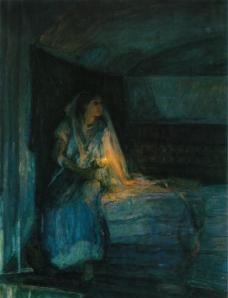
Mary (1914), by Henry Ossawa Tanner

Mary (1914), by Henry Ossawa Tanner

Yes, through our faith and baptism, we share a more similar experience to Mary’s own. She was a poor, relatively uneducated young lady; likely 13 to 15 years old. She had lots of questions, doubts and fears to wrestle with, yet when the angel announced she would become the mother of the one true God, she submitted. Her magnificat (a song of praise captured in Luke 1) declares with certainty, “My soul magnifies the Lord, and my spirit rejoices in God my Savior.”

Mary was God’s favored one, and we share in that favor. Truly, Jesus waits to be born in each of us and reborn each day. No matter how we perceive ourselves with our varied gifts and struggles, God has come to us declaring each of us beloved child. Prophets in the Jewish scriptures predicted a time when the Temple would be no more, for our bodies would become the place where the yet unknown Christ resides. The Angels in the field proclaimed that Jesus came for all of us who are poor, imperfect and in need of love.

In Jewish theology, our heart represents more than an organ or emotional passion, it reflects our utmost being – the depths and totality of who we are. That’s where Jesus wishes to reside. So, Jesus prayed that we be one as he and the Trinity are one. It is Jesus who chose and called each of us to follow him. It is he who wants to live inside us and through us so intimately in every moment that he names us as his body. This good fortune is offered as a certain gift to all who dare trust in his promises.

Surely, Christ’s presence will upset our lives. It might even make us the objects of scorn or worse. Yet, “Do not be afraid!” God’s favor will never disappoint. Walk on so that your life becomes his song. Walk on trusting that Christ walks with you and that many more miracles shall surely come. His presence will bless us beyond our expectations.

The Christian singer Francessca Battistelli in a recent song imagines these words coming from the heart of Mary and her own, “I am not brave. I’ll never be. The only thing my heart can offer is a vacancy. I’m just a girl. Nothing more. But I am willing, I am Yours. Be born in me.”

Do not doubt any longer, but believe. Open your heart and welcome Christ at each new sunrise or whenever darkness falls. The promises of God are fulfilled in your hearing. Blessed are you! Holy are you! Sing to the glory of God, so that all might believe!

Be born in me (Mary), Francesca Battistelli 

This post was originally published in Messiah Lutheran Church and School’s newsletter, The Messenger (December 2014/January 2015).

Unless otherwise indicated, all scripture quotations for this article are from the New Revised Standard Version (NRSV) translation.

© 2014 The Rev. Louis Florio. All content not held under another’s copyright may not be used without permission of the author.

1 Comment

Filed under Advent, Christmas, Grace

My Heart Remains in Wonder

stained glass nativity with sunOn coming to the house, they saw the child with his mother Mary, and they bowed down and worshiped him. Then they opened their treasures and presented him with gifts of gold, frankincense and myrrh.” (Matthew 2:11)

Have you ever taken a good look around our sanctuary? Our stained glass windows are beautiful and educational. Long before the average person could read, people attempted to capture and share the wonder of God’s love for us through the art of stained glass.

At this time of year, my thoughts are always drawn to meditate upon the meaning behind our nativity window. It shows the star of Bethlehem shining above a manger. In the manger is the ancient “Chi Rho” symbol. This symbol is the first two letters of “Christ” in Greek joined together. Early Christians used this mark to represent Jesus. The window reminds us that Jesus, the Christ, came to us in human form at Christmas. Such news becomes even more wondrous when one considers that he comes to us throughout time. He is the Alpha and Omega, the beginning and the end – present before history began and will be after it ends – because Jesus always was, is and will be our God who is with us and for us.

Luther once wrote that the Bible is like the manger where we can meet, know and worship Jesus the Christ over and over again. This, too, is true, but it also doesn’t quite capture this special relationship – the intimacy spoken of goes well beyond “knowing” Jesus with only our intellect. Our holy texts assure us that Jesus has come to live with us in our hearts. Jesus wants to abide in us. He longs to be an intimate part of every aspect of our lives. This joyful mystery cannot be captured fully in written word or by any other human art, yet my thoughts came back to an old 18th Century Danish hymn which focuses upon the joining of our human hearts with the divine heart though the incarnation and gift of faith. It is one of my favorite pieces of Christmas music.

BrorsonWritten by a Danish Lutheran pastor and later bishop, Hans Adolph Brorson, Mitt Hjerte Alltid Vanker (in English, sometimes entitled “My Heart Always Wanders” or “My Heart Remains in Wonder”) movingly grasps at the surprise and mystery of the incarnation. Soundly pietist,  the reflection remains more oriented toward his feelings and heart rather than any intellectual exploration. The lyrics reflect relationship and intimacy, as well as grace and gratitude. Contemplating this miracle, God coming to us as a vulnerable newborn in a stable, Brorson’s own mind and heart wanders and enters a blissful wonderment as he thinks about his current saving, relationship with Christ.

O come, my Lord, I pray Thee!
And be my honour’d guest,
I will in love array Thee
A home within my breast.
That home can be no stranger
You bought it all yourself.
Thou will surely stay here
Swaddled in my heart.

We will never be able to fully appreciate, capture, or understand the miracle of love offered to us through Jesus Christ. Yet because it is not just an historical event, each and every day we may strive to cooperate with grace and make room for the Christ child in our hearts above all other things. His birth should move us to reflect upon the ultimate, ongoing Christmas miracle which comes to us through Christian faith, worship, fellowship and service. Christ’s Spirit continues to shape us and sanctify us into the gift God first intended with our own creation. We become part of God’s greatest gift to the world, where in Jesus’ name, we will love others. Through grace, we concretely become the Christ’s body, here and now.

Throughout your holiday wanderings and celebrations, I pray that you, your family and friends stop and ponder the nativity. Continue to wonder about and experience this joyful mystery and invitation in your life. Rejoice, for a child has been born for us! His name is Jesus, and we will never be alone or unloved. In response, let us seek to rightly worship him, opening our hearts and offering all that we are to him in thanksgiving.

—————————–

Many variants of the song exist in English due to the difficulty of translation. Along with the above video, here are English lyrics for this wonderful Christmas song:

My Heart Remains in Wonder/My Heart Always Wanders

My heart remains in wonder (or better translation: My heart always wanders)
Before that lowly bed
Within the stable yonder
Where Christ, my Lord, was laid. (or: was born)
My faith finds there its treasure,
My soul its pure delight,
Its joy beyond all measure,
The Lord of Christmas night.

But Oh! my heart is riven
With grief and sore dismay
To see the Lord of heaven
Must rest on straw and hay,
That He whom angels offer
Their worship and acclaim
From sinful man must suffer
Such scorn, neglect and shame.

Why should not castles royal
Before Him open stand,
And kings, as servants loyal,
Obey His least command?
Why came He not in splendor
Arrayed in robes of light
And called the world to render
Its homage to His might?

The sparrow finds a gable
Where it may build its nest,
The oxen know a stable
For shelter, food and rest;
Must then my Lord and Savior
A homeless stranger be,
Denied the simplest favor
His lowly creatures see.

O come, my Lord, I pray Thee,
And be my honored guest.
I will in love array Thee
A home within my breast.
It cannot be a stranger
To Thee, who made it free.
Thou shalt find there a manger (or: Thou will surely stay there)
Warmed by my love to Thee.[i] (or: swaddled in my heart)

In English, it is difficult to find a flowing, direct translation of the traditional final stanza in Danish or Norwegian, but it means roughly:

I’ll willingly spread branches
Of palms around your bed.
For you and you alone
I will live and I will die.
Come, let my soul find bliss
In this moment of delight:
To see you born right here,
Deep inside my heart’s abyss. (or: loving heart)[ii]


[i] English version on Hymnary.org

[ii] Translation merging multiple sources, primarily the above video and pust.org

The above piece was adapted from one shared in Messiah’s newsletter, The Messenger, in November 2009. Unless otherwise indicated, all scripture quotations for this article are from the New Revised Standard Version (NRSV) translation.

© 2013 The Rev. Louis Florio. All content not held under another’s copyright may not be used without permission of the author.
Leave a comment

Filed under Christmas, Liturgical Year, Uncategorized