
This sermon was preached on Trinity Sunday (June 12, 2022) at Christ Lutheran Church in Fredericksburg, VA. You can listen to the sermon on my companion podcast: S1, Ep18, or watch it on our congregational YouTube channel.

Grace and peace to you from God our Father and from the Lord Jesus Christ. Amen.
On this Trinity Sunday, I was reminded of a brief but illuminating story shared elsewhere. An elder member of a congregation was feeling lonely in a nursing home when members of his congregation stopped in for a visit. While there, one read some scripture, another offered prayer, and together they all shared memories of their past along with the joys and sorrows of their present. As the visit concluded and the visitors prepared to depart, the older man said, “How did you know this is what I needed today? This was awesome!”
There had been no visions or prophesy shared. There were no miraculous healings visible. Yet, the man and his visitors both knew they had shared something sacred – something awesome and holy had been experienced. The man felt strengthened and encouraged for whatever lay ahead. He felt connected to these people, his congregation, and God once again. He was reminded that he was not alone…was never alone…and remained loved. That’s no small thing. And so, the man expressed his amazement and wonder the best way he knew how. He named what he had experienced with one, imperfect word, “Awesome!”[i]
When we sense that we have experienced the sacred, our human words often fall short. Poets and artists might try. Scientists of faith (such as Isaac Newton, Robert Boyle, George Washington Carver, or even Florence Nightingale in her work to create safer and more sanitary medical care)…so many scientists including many modern ones…have experienced awe inspiring, faith affirming events through their work. Yet whoever they were or are, they could never fully explain their experience. There was always something more to know. Yet this shouldn’t surprise us. How can a limitless, infinite, omnipresent and omniscient God be captured by any human means of communication, art, or even science? With our limited abilities and brain space, as created beings, we cannot fully understand God, or we would be God.
So, we try as best we can to make sense of it all and express the mysteries of God. We use allegories, allusions, similes, and more to capture bits and pieces of who God is and how God interacts with us. Theologians write and write and write trying to identify God and our relationship with God. In Martin Luther’s case over fifty-five very thick volumes of his writings have been collected and translated into English (just those in English!). Still, these millions of words fall short. God’s works are so wonderous and so many that the psalmist writes, “Were I to proclaim and tell of them, they would be more than can be counted” (Psalm 40:5).
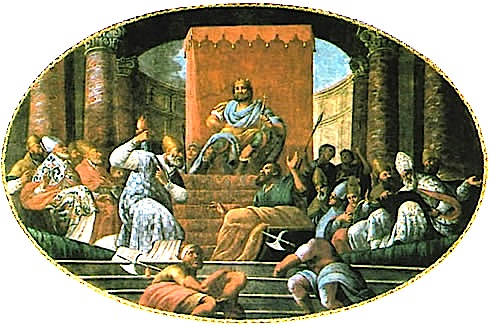
This holy conundrum represents the issues we might experience with our theological understanding of God as a Trinity. We cannot fully explain the relationship between Father, Son, and Holy Spirit. We cannot fully describe our encounters with God. Indeed, from the earliest times of the Church, some people have rejected this Trinitarian construct. Early radicals and nonconformists of the Church tried, but their teachings were deemed heretical and rejected. Later, Christianized barbarians and still other believers rejected the Trinity, and the Church answered them all with creeds – imperfect yet concise statements of our belief (credo means “I believe” in Latin”). Indeed, even today’s Feast of the Holy Trinity was addred to the Church Year to help combat the rejections of and misunderstandings related to the Holy Trinity or Godhead – Father, Son, and Holy Spirit.
The Apostles’ Creed, the Nicene Creed, and the Athanasian Creed all speak of God in terms of Father who is the Creator, Son who is Savior, and the Holy Spirit which prays for us, guides, protects and nurtures us, and draws us into belief of and communion with our Triune God and Christ’s Church. The Athanasian Creed (the last creed created as agreed to by east and west) proclaims as it begins, “Now this is the catholic (universal) faith: We worship one God in trinity and the Trinity in unity, neither confusing the persons nor dividing the divine being. For the Father is one person, the Son is another, and the Spirit is still another. But the deity of the Father, Son, and Holy Spirit is one, equal in glory, coeternal in majesty. What the Father is, the Son is, and so is the Holy Spirit.” The creed goes on and on (it’s the longest of our three Ecumenical Creeds), but in short, it identifies that the Godhead or Trinity has varied attributes or characteristics, different functions that we might see or recognize, but somehow, some way, remains always one. Again, the creed reminds us, “What the Father is, the Son is, and so is the Holy Spirit.” At some level, the Church knows it (the Trinity) when we see it, but we see it only when and as God reveals itself to us. Thus, we cannot exactly put our finger on it, but with God’s help, we know it is there. (Whew! Does your head hurt yet? Now, you know a bit of what it feels like to be in seminary.)
In our first reading, we meet a personification of Holy Wisdom as a female. When God made the heavens and created all things, it was there. So, many see this passage as a reference to the Holy Spirit. Jesus, himself is called the Alpha and Omega in scripture (the first and last letters of the Greek alphabet) to help us understand that Jesus always was, is, and will be. God, who is called Father in one popular prayer gifted to us by Jesus, is also alluded to as being like a Mother Hen, or like a mom nursing a child, as well as described with other feminine imagery. We are told that God, our Creator, spoke everything that is into being out of nothing. Father, Son, and Holy Spirit are one…of spirit…existing in and outside of time simultaneously …working within and yet not subject too all the physical and metaphysical laws and constructs one might be able to identify. Father, Son, and Holy Spirit were one at creation. And with the many male and female attributes of God, it has been revealed that God is neither male or female but ultimately spirit, and we are told that male and female alike are created in God’s image.
Yet, humans meet God over linear time. We came to understand God better as we met God throughout history…much like a deepening relationship. And so, we are tempted to think that God the Creator came first, then Jesus was born, and then the Holy Spirit came on Pentecost. That make sense to us because we live in time, yet…ehhhh (making a buzzer sound)…that’s wrong…totally wrong. As some hymns try to convey (“Lord of the Dance” or “Come to the Dance of the Trinity” for example), it is as if the three persons of the Trinity eternally dance together throughout time, outside of time, and in our lives. God is Lord of the Dance, and we created creatures are invited to dance amidst the Trinity. It is in dancing that God reveals God’s self, and we come to know God, but God always was, is, and will remain more than what we experience or understand.
In today’s Gospel from John, we hear Jesus definitively make such connections without using any pure and pat Trinitarian formula. What belongs to God belongs to Jesus. What the Spirit shares comes from (belongs to) Jesus and thus also God the Creator. They are one, unified in purpose, essence, in all things. And yet, curiously, Jesus doesn’t go into any long explanation. Who God is gets revealed to us, and at best, it remains a matter of trust (of faith) because we cannot know all there is to know. Would Jesus lie about such things? I don’t think so. And yet, I must confess, I cannot fully understand the Trinity either. No human can.
As humans, it can be hard to accept that we can never fully obtain knowledge of God in this life. We like being in control, and knowledge gives us such power to contain and organize our lives that we might think that we are in control. Yet, life is never fully controllable. Good things happen to bad people at times, and bad things happen to the good among us at times. And yet, as we hear scripture where new meanings are discovered that seem to speak directly to us and our situation, when we fall in love with someone who just seems to get us, when someone calls at just the right moment, when the door that helps us escape an unpleasant situation opens toward a new future filled with hope, when we witness a new birth in creation or our family…ah, we know it (the Trinity) when we see it. A spark within us helps open us to the sacred at work right in front of us, and we perhaps come to believe just a little bit more. Maybe there is a meaning to life after all? Maybe there is a God who loves us?
And perhaps when all the words are spoken, when there are no more scientific theories to be conjectured, and when artist’s imaginations run dry…perhaps then, we will see God as God truly is….as John elsewhere writes, “God is love.” Maybe that’s enough for us to know. God created the world out of love. Jesus offered his own life for us out of love. The Spirit resides with us, guides us, and connects us out of love. We are told that God loved us in our mother’s womb, down to each hair on our head. God loves us even when we run away like Adam and Eve or any of the Prodigal Sons and Daughters among us, or even as we fail. God love us enough to share in our death, so that we can be free from the power of death. God loved us before we ever knew of God, and our Triune God promises to actively, presently, always and forever love us. I don’t know about you, but I would say that God is awesome. Maybe like the man in the nursing home, that’s all one can really say. Amen.
[i] Story adapted from “Daily Discipleship” (June 3, 2007) by the Evangelical Lutheran Church in America.
Unless otherwise indicated, all scripture quotations for this post are from the New Revised Standard Version (NRSV) translation.
© 2022 The Rev. Louis Florio. All content not held under another’s copyright may not be used without permission of the author.


 2pennyblog