
As Easter approached, a very problematic, allegedly Evangelical pastor was waxing eloquent on social media. Joel Webbon wrote, “The young men are waking up. Women will learn to have a quiet and gentle spirit. Deus vult [God wills it]” (Joel Webbon on X, April 7, 2025). He was likely referencing 1 Timothy 2:11-15 – out of its original context, of course – where women (likely in the Greek most particularly wives) were supposed to publicly follow the lead of the husband during instruction and worship within a Greco-Roman patriarchy of the day. The post is being accepted as sound advise by some, including some I know. That concerns me greatly, and I’d like to publicly challenge that.
Yes, the Bible speaks of submission, but what is that and how does it apply? Paul and his contemporaries were trying to fit in, being all things to all people (1 Corinthians 9:19-23), including those influenced or under the dominion of Roman culture and laws. In that culture, respectable faiths should not be too loud and crazy at worship. So, Paul asked that all things be done in an orderly way (1 Corinthians 14:40). Women should have head coverings and men should have short, uncovered hair while at worship like other contemporaries. It was improper and shameful in that world to do otherwise…but he never explicitly calls it a sin. Thus, later Christians have allowed all kinds of practices regarding length of hair and head coverings. Cultural expectations plays a part in what Paul writes, as he never wants such things to discredit Christianity or become a stumbling block to faith. They play a part in our lives now. Would a church allow men in shorts at worship in the 1950s? A women’s bare shoulder? What is “right” is often impacted by what culture sees as acceptable.
Paul also continually connected the Christian faith to the ancient Jewish faith. Why? The Romans expected a “real” religion to be orderly, reflecting Roman social structures as above, but also connected to an ancient faith. “Real religions” were ancient ones to the Romans. New faiths were looked upon with suspicion if not derision as cults. So, the Romans respected and allowed Judaism, and Paul regularly tried to ensure the Roman world knew that Christianity was not new. It was a the fulfillment of ancient promises. Jesus was the New Adam (see Romans 5). And Christians, whether originally Gentile or Jew, were all the Children of Abraham (see Romans 9).
Yes, the early Church lived in a Greco-Roman world under suspicion and threat from many sides. The execution of Jesus was just the start. That context matters. Ironically, Webbon made his comment about women just before Easter, when the entire Church worships Jesus, Son of the Living God, risen from the dead. Among the Gospel stories read at worship, one most often hears of a woman who would not be quiet, Mary Magdalene. (She is also known as Mary of Magdala, a small town on the Sea of Galilee where she was likely from.) Out of the norm of her day, she followed Jesus. She seems to not have been under the authority of any household male. Yet, she helped sustain his mission with money, and she seems to have been looked upon with respect within the Christian community.
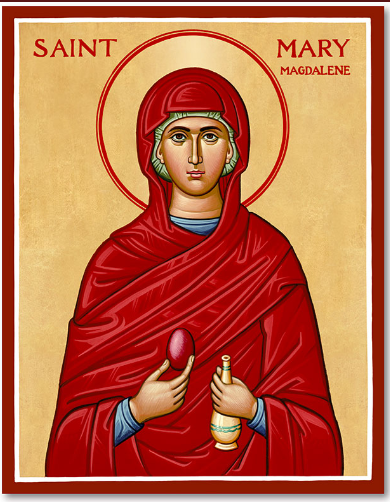
The day after the sabbath had ended, three days after Christ’s resurrection, women went to the tomb carrying myrrh and other spices to anoint and clean the body of Jesus. They hoped to finish the burial possess cut short by the start of Passover. These women are called with respect, the Myrrhbearers. (The list includes Nicodemus and nine named women including Mary Magdalene. (Some suspect there were more than those named.) As a result, Mary Magdalene is often pictured with an urn of myrrh ointment, a spice used for healing, blessing, and burials, and an egg, meant to remind Christians of the Resurrected Christ coming out of the tomb.) In Matthew 28, as they came to the tomb, Mary and another Mary, the mother of James the Less and Joses, are told of the resurrection by an angel. Jesus soon appears to them both, instructing them to share the Good News with his other disciples. In the oldest Gospel account, Mark 16, Mary Magdalene and Mary the mother of James and Salome go to the tomb. An angel appears, and they are told to tell others, but fear keeps them quiet…at least for a time. For Luke 24 reports, “Now it was Mary Magdalene, Joanna, Mary the mother of James, and the other women with them who told this [of Jesus’ resurrection] to the apostles. But these words seemed to them an idle tale, and they [the Apostles] did not believe them.” Despite disbelief, and likely being told to be quiet, they spoke until Peter ran to confirm it. And in John 20, Jesus appears to Mary first of all, asking her to tell the others. In all the Gospels, Mary Magdalene plays a significant role particularly after the resurrection.
As a witness to the Resurrected Christ, she brings the Good News to others. She eventually becomes called the Apostle to the Apostles, most likely first called this by Thomas Aquinas, a Doctor of the Church. Yet who was she to deserve this? All the Bible says is that she was a woman of means who supported and traveled with Jesus. She had seven demons exercised out of her according to Luke, but it is only later in the Middle Ages that people start to assume she is a prostitute or adulteress. (One of the common excuses for besmirching her reputation is that she had money to share, when Greco-Roman women could actually have money under certain circumstances. They could even run businesses and farms.) Ultimately, it was grace. She was chosen by Jesus to be the first to see him. He thought her important apparently. She’s called an Apostle as a first hand witness to Christ’s Resurrection and commissioned by him to tell others.
Contrary to this story, Webbon doesn’t apparently trust or keep women in such high esteem. Along with following the husband’s lead and staying in the home, women should not vote. He claims the 19th Amendment has stolen half of his vote from him. He only “allows” his wife to vote as a form of restitution. She votes his way. (Listen here.) Sure, 1 Timothy 2 was particularly in the context of worship, but I see that scripture is usually fitted into his preconceived political and social notions. He appears to want women not just submissive but subjugated. (This effort to make scripture fit one’s argument is called prooftexting.) He’s not a fan of using scholarship of any kind to help us understand what the original voices were really saying in their time and place and why.
And so, he has also suggested women who falsely accuse men of sexual assault could be publicly executed to stop the #metoo movement. That might have been good for some leaders of ancient Israel – if a lie. Death could indeed be the sentence if someone lied under oath. Yet Webbon’s way is not the way of Jesus. He seems to call for death in light of his politics, bias, and desire for control. I have not yet seen him call for justice for men who do sexually assault women as in Deuteronomy. Nor can I find where he ever considers the many accusations and findings against the current President’s sexual improprieties, if not crimes, seriously. Webbon appears to start with doubting any woman’s claims. In fact, if one wants to be “biblical,” the ancient Israelites were meant to consider a women’s accusation, but the repercussions were like many other tribal people’s of the time. If a man committed sexual violence against an unmarried woman, he might have to marry her. If she was engaged or married, this might lead to his death. Still in that patriarchal society, the woman’s well being was not always of prime concern. Keeping some kind of peace within the family, tribe, and people would be.
In contrast to Jewish scriptural laws and Webbon’s corruption of them, Jesus lifts up repentance and forgiveness as his way. Justice is offered to all people, and justice includes mercy. In John 8:1-11, Jesus famously stops a woman caught in adultery from being stoned according to Deuteronomy 22:21. Paul writes in Galatians 3:23-28, the Children of God are no longer male or female, even though he recognizes social structures and their realities. So, you can find Christian societies allowing women to exercise varied levels of female emancipation throughout time. For example, women likely had more freedom and power under the Roman Empire than in Europe under the Middle Ages. And over time, women in modernizing, democratic countries have allowed women self agency and the ability to protect themselves or seek justice.
In the original statement sparking this post, Webbon was responding to Fox News’ Megyn Kelly’s concern that educated, working, conservative women were running into trouble. On the right, more young men do not want to marry a woman who works. This might be true. There are some polls and studies that suggest young men are looking toward the ancient Orthodox faith more with its claimed clear certainty, religious rigor, and high church spiritual practices including long-term, prayerful fasting. While other Christian churches are shrinking (both liberal and conservative congregations and denominations), Orthodoxy has grown in the United States by as much as 78% – or so it is claimed. Articles and Orthodox friends I know gleefully suggest it is due to the feminization of the Church. (Indeed, women make up the majority of most religious bodies in the United States.) Yet, multiple studies indicate a number of factors leading to attendance changes including the growth of what is called the “nones.“
One conservative, Reformed person that I know from my past simply suggested that Webbon was right. “The Bible opposes feminism and egalitarianism. And has high callings for husbands and wives,” the person said. (I doubt he knew Webbon’s reputation, he just heard a statement he agreed with.) Unfortunately, too often, that high calling becomes staying at home and losing oneself. It can lead to abusive relationship. Webbon’s (and my Reformed friend’s) is not a clear reading of scripture but a simplistic one. Yes, being a spouse and mother can be a wonderful calling. Yet, God can call women to other pursuits alongside or in place of marriage. Even the earliest Reformers understood that. Each person has their unique call from God. Indeed, people might have multiple calls in their lifetime – one after another, or more than one at once. We need to allow people to answer their call. If called to marriage, men, too, are to be helpmates, not task overseers. God created Eve as Adam’s helper before the Fall. There is no biblical implication that she was to be subject to his whims. “So God created humans in his image, in the image of God he created them; male and female he created them” (Genesis 1:26-28).
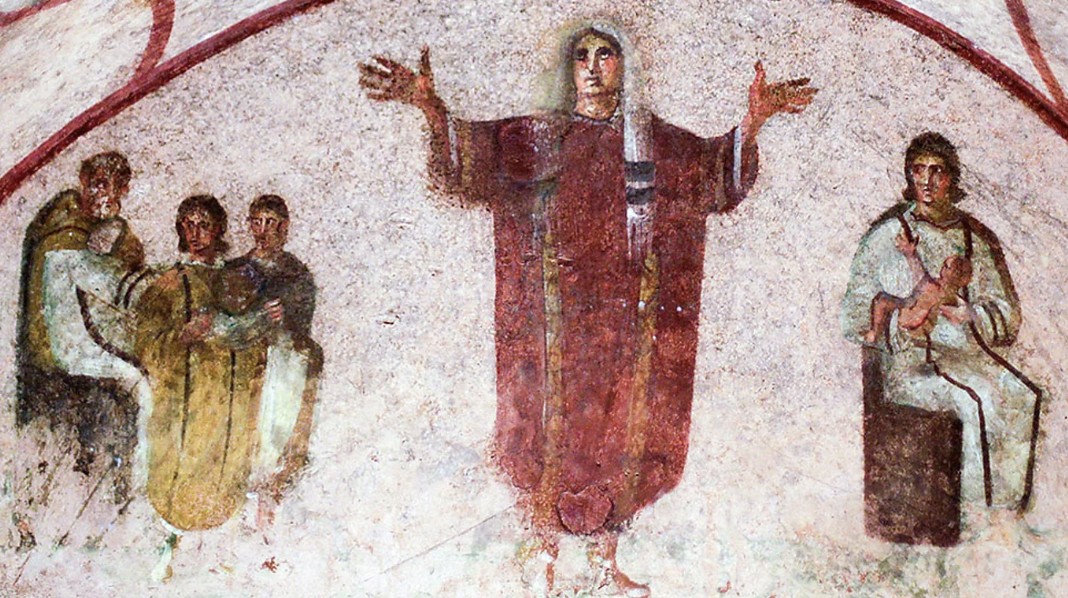
Further, there is evidence in and out of scripture that women took some leadership rolls in the early Church. Lydia’s home church, started by Paul with her willingness and generosity as a business owner, was critical to Paul’s success in Philippi (Acts 16:11-15). We hear accounts of widows ministering to others, but we also learn on the office of deaconess. Deaconesses likely existed as an office into the 4th Century, then the office began to decline as culture changed and faced worldly pressures. (The Roman Empire split in 395 AD into East and West. It ended in 476 AD.) Some archeological evidence might exist that they served as pastors/priests at communion, such as a famous fresco (see below) in the Santa Priscilla Catacombs, although it is hotly debated. There is no indication it was common practice as of yet, even if exceptions might have existed for female pastors/priests. (The figure referenced could have been a deaconess as some suggest, but hand gestures shown make them think of the Eucharistic prayers.) Then in the closing of Paul’s Letter to the Romans, he gives thanks for many people to include women for their faithful leadership within the Church and for helping him. One who is named Junia (in most translations) might have really been named Julia according to five thus far discovered early versions of the letter. It remains an unsettled mystery. Still, there were much later women under oppression from communists behind the Iron Curtain who took on the role of Roman Catholic priests. Ludmila Javorova was one such known person, along with others. (The religious validity of this ordination was suspect according to the Vatican who never recognized it. Yet, she and others seem to have served as priests in the underground church to help the Church survive oppression.) Perhaps a similar thing happened in the early times of the earliest Church?
I would have loved to ask Martin Luther his thoughts. In a desert island scenario, he suggested the stranded group might consider anyone from the group to serve as pastor in order to preside at communion, as Lutherans believe in the priesthood of all believers. Would he have included women as candidates? Even within his own cultural context, I suspect that he likely would have said ok if no men were present. His wife, Katie, might have been much more in favor of this. After all, there is much evidence that she was a major part of Martin Luther’s ministry behind the scenes. She was a theologically educated nun in her own right, one who had found freedom through the Reformation and escaped her convent. Based on letters and outside sources, she seems to have deeply influenced his life and theology.
By the 9th Century, only nuns could be deaconesses in the West. By the Middle Ages, the role had pretty much disappeared for woman. Lutherans of the 19th Century led the way to restore this office for women. “In 1836, in Germany Pastor Theodor Fliedner and his wife Friedericke Műnster, using the story of New Testament Phoebe (Romans 16:1), the example of Mennonite deaconesses in Holland, the work of the Daughters of Charity of Saint Vincent de Paul and the work of Wichern and his brotherhoods of deacons, called women to serve as deaconesses in a small pastoral charge in Kaiserswerth.” (Read more at the ELCA Deaconess website.) The first female pastor recognized in modern times seems to be Antoinette Brown Blackwell. She was given a license to preach by the Congregational Church in 1851 and then offered a position as Minister of a Congregationalist church in South Butler, New York in 1852. She ultimately became Unitarian though.
Yet, this blog post isn’t about women’s ordination. It is not ultimately just about the treatment of women in society or families. This problematic pastor’s writings, sermons, and public statements ripple into other spheres. He has influenced (along with others) national discourse and attitudes in an unhealthy way. This is also about who is a Christian or not. It is about Christian nationalism, too. It’s about dangerous teaching, a threat to life and liberty to include the expression of one’s faith. I’m sharing this post because members of my congregation had concerns and questions about his post, so maybe others do too. They are right to be concerned!
Unfortunately, some others on social media thought his quote seemed like a welcome vision of the family without looking at the darkness behind the words. The first thing to remember is that a Christian is not a Christian is not a Christian. Even Jesus says some who cry out, “Lord! Lord!” won’t be recognized by him (Matthew 7:21-23). Being a Christian isn’t just being one in name. It is a life that is meant to reflect Christ’s own. Yet in practice, Christianity is a huge umbrella of beliefs. Some are closer to Jesus’ teaching while others miss the mark, still others manipulate, offend, or violate laws under the name Christian for prophet, sexual gain, or other worldly power. Yet no group of individual reflects Christ perfectly (including my own understanding and practices) because we are human.
In fact, not all Christians or denominations are humble enough to recognize they could be wrong on some things if not many things. Christians can echo worldly politics more than the Holy Sprit. This happens among both those labeled liberal or conservative politically. Meanwhile we as Christians are supposed reflect and hope in Christ first – to embody him in the world. We are in the world, but not supposed to be of it (see John 17). Or as Paul writes in Romans 12:2, “Do not be conformed to this age, but be transformed by the renewing of the mind, so that you may discern what is the will of God—what is good and acceptable and perfect.” Then theologically, some might be incredibly rigid and unhealthy, while others become so open, it’s hard to see Christ amidst the syncretism. So when we see such posts, I suggest we consider the source – the spiritual leader’s judicatory if any, as well as the person speaking. It might sound like a reasoned statement but prove anything but. It can be helpful to dig deeper to better understand the argument being made.
Take for example this particular pastor who is listed publicly as simply “Evangelical.” Again, no one size fits under this label. In his case, his congregation is part of The Evangelical Covenant Church (ECC). It was founded by immigrants who broke away from Swedish Lutheranism in favor of a radical pietism, emphasizing certain teachings regarding holy living over grace. As it’s base, pietism has some merit. Faith should have a heart centered component. Yet with radical pietism, if faith is not in your heart (at an emotional and personal level), and you don’t overtly, rigidly witness to your faith in your actions, you might be told that you are not a “real Christian.” Those who believe but struggle with sin are out. You might say you are a Christian and go to church and serve others, but that might not be good enough for radical pietists despite whatever might be said about heart and grace. His denomination focuses a great deal on perfectionism and legalism in practice. They tend to be politically very conservative and quickly judge others. Radical Pietists in general tend to distinguish between “true” and “false” Christianity based on their assessment of works and a rigid theology and biblical fundamentalism.
This pastor who wants women to “submit” is in a very small denomination, yet it teams up politically with likeminded people. In our modern age, he can have a big influence. In this season of Easter, it’s good to remember that Mary Magdalene and other women refused to be quiet. Again, she’s the “Apostle to the Apostles,” first sharing news of Jesus. She traveled with him before his death and watched as he died. She was going to care for his body when men were still hiding out of fear. There have always been women leaders. Moses’ sister, Miriam, was a prophet for example. Deborah was a Judge of Israel, a tribal leader, and prophesied as well. Many women helped the Apostles and first disciples succeed and even start churches. Paul was helped in his ministry by a married couple. “Greet Prisca and Aquila, my coworkers in Christ,” he writes in Romans 16:3. On the other hand, Webbon seems to deny women a place not just in the pulpit or voting booth, but perhaps even at the feet or Jesus or at his table. He seems to not truly like and respect women. He has said he would prefer his wife never votes.
Perhaps most dangerously, Webbon is also a Christian Nationalist who aggressively supports the current administration. His Christian beliefs are bound as one to national ones. His wants to control more than women. He has wrongly and explicitly claimed that the United States belongs exclusively to Christians, and that means non-Christians shouldn’t hold public office. He’s overtly anti-semetic. He has wrongly said that God is done with Jews. He has suggested illegal immigrants be shot crossing the border. This rigid thinking all loops us back to his extreme pietistic roots. Who’s going to be considered a real Christian and who a false Christian? It’s not going to be Roman Catholics, the Orthodox, Methodists, Lutherans, Presbyterians, and members from other established denominations out of sink with his rigid worldview who have power, a vote, or even a say. It will be a small group of unhealthy Christians lording their ways over others – including Christians and non-Christians alike. It’s dangerous and unlike Christ. It most certainly does not reflect the Constitution.
Certainly, his desire to subjugate goes well beyond women. His teachings are far from Jesus who says, “Take my yoke upon you, and learn from me, for I am gentle and humble in heart, and you will find rest for your souls. For my yoke is easy, and my burden is light.” When you have executive orders that might inadvertently (or perhaps intentionally) disenfranchise women by creating more hoops to jump through, it is people like Webbon who is applauding if not urging this on. We discover it becomes a bigger issue that potentially impact all of us in many varied ways, crossing from family, into religious freedom, and Constitutional values. Formally of the New Apostolic Reformation, now denouncing them, Webbon still shares their goal – a Christian nation in the worst and most un-Christian sense.
The ripples of injustice can have a long reach. So, I encourage everyone to stay informed, and please don’t take memes or social media quotes at face value. Sharing them might connect you to some very bad theology, politics, and people. When considering hot button social and political issues of the day, especially when someone uses scripture (including when you read anything from me), test what you read. Look deeper. Listen to other voices of the past and the present. We don’t want freedom to be drowned by ignorance, nor our true faith and baptism, amidst its many differences being worked out peacefully, to be denied by a wolf in sheep’s clothing (Matthew 7:15). Just because someone claims the title of pastor, it does not mean they should be one.
Jesus wants streams of justice and a baptismal people who live and love others like he does. He calls all people to follow him together as one. For he alone is the Living Water, the Good Shepherd of his sheep. Don’t settle for the political poison, the gall of the world. Gall, which contained myrrh in it, was not for healing, honor, or blessing. Gall was offered to Jesus to numb his pain. Worldly control and domination might seem to numb our fear and pain for awhile, make one think they are in control, but it leads to death. Jesus refused it. Out of love, he was willing to fully willing to experience the pain of death.
We, too, are asked to risk feeling the pain that can come when following Jesus in love. He invites us to accept our crosses and bear them with his help. It is hard to live in relationship with others. Yet, we are told to die to oneself for the good of others. Yes, even marriage is a form of martyrdom to the Orthodox. We are meant to give of ourselves fully and freely in love of our spouse, answering Jesus’ call.
The Christian life exemplified by Jesus is hard, but it leads to life for you and others. It is meant to be walked in communion together, no longer slaves but children of God, siblings, family. Thank heavens Mary Magdalen and other women of the early Church did not shut up because culture told them too. In a time such as this, they have more to teach us.
Revised for clarity on October 7, 2025.
© 2025 The Rev. Louis Florio. All content not held under another’s copyright may not be used without permission of the author. Scripture quotes are using the NRSVue translation.

 2pennyblog
Dear Pastor Lou,
Thank you for sharing your recent blog post and for your thoughtful engagement with the questions surrounding women’s roles in the church. I appreciate your pastoral concern for how Scripture is interpreted and applied in our contemporary context, and your desire for respectful and informed dialogue.
From the perspective of Orthodox Lutheran theology, the discussion about ordination and church order is always rooted in Scripture and the Lutheran Confessions. As I mentioned previously, Orthodox Lutherans maintain that the pastoral office is reserved for qualified men, following the apostolic pattern and biblical witness, not out of a sense of superiority or inferiority, but as a matter of faithfulness to what we believe Scripture teaches. In light of this, it is important to affirm that we view Paul’s words as the inspired Word of God, relevant across time and not to be dismissed or edited based on modern conventions. As 2 Timothy 3:16 states, “All Scripture is God-breathed and is useful for teaching, rebuking, correcting and training in righteousness.” Furthermore, 2 Peter 1:20-21 reminds us that “no prophecy of Scripture comes from someone’s own interpretation, because no prophecy was ever produced by the will of man, but men spoke from God as they were carried along by the Holy Spirit.” We find these texts to be foundational in understanding how we treat the Word of God.
I would also like to clarify that Orthodox Lutheran theology should not be identified with, or assumed to align with, modern Christian fundamentalism. While both traditions affirm the authority of Scripture and the core doctrines of the Christian faith, there are important distinctions. Orthodox Lutheranism is grounded in the universal doctrines (dogmas) of Christianity, as confessed by the church fathers and Reformers, focusing on essentials such as the Trinity, the incarnation, and salvation by grace through faith. In contrast, Christian fundamentalism often adds secondary or tertiary beliefs—such as specific end-times views or particular stances on creation—as necessary for authentic Christian identity, and tends toward a separatist approach to fellowship. Further, Orthodox Lutheran perspectives differ significantly from statements such as those made by Joel Webbon on X on April 7th, 2025, regarding the roles of women in society, politics, and the church. Webbon’s views do not align with the nuanced and historically grounded approach of Orthodox Lutheranism. To suggest, as Webbon does, that women should be subjugated or denied a voice in society contradicts the spirit of Galatians 3:28, “There is neither Jew nor Gentile, neither slave nor free, nor is there male and female, for you are all one in Christ Jesus.” We also look to texts such as Proverbs 31:10-31, which highlights the virtues and capabilities of a wise and industrious woman. Orthodox Lutheranism recognizes that both men and women are created in God’s image (Genesis 1:27) and are called to use their gifts and talents for the good of the church and the world.
Lutheran theology, shaped by its confessional heritage, also differs significantly from the Reformed and revivalist traditions that have influenced much of modern fundamentalism. Our approach to doctrines such as justification, the means of grace, and the distinction between law and gospel is distinctively Lutheran and not always shared by fundamentalist or evangelical groups.
Thank you again for opening this conversation. I value your commitment to thoughtful engagement and your pastoral heart for the unity and witness of the church.
In Christ,
Paul
Certainly, you are correct. I did not go down that road fully on purpose, just opened the gate. That’s a very deep, involved discussion as you well know. So, if I gave the impression there’s no room for disagreement between Christians, that was not my intent, and I apologize. My main concern for posting this piece was NOT the role of women in the Church. It was the man’s view of submission and the role of women in the world as a whole. He’s supposed interpretation of scripture leads to something other than grace. I think his attitude reflects sin and anti-Constitutional attitudes. He’s a dangerous character with the title of “Evangelical Pastor.” This can help mislead people into grave error. I personally do not consider traditions that are against women ordination automatically evil or my enemy, even as I personally recognize female ordination based on what I view to be biblically supportable reasons. Being wrong can just be that, not necessarily a sin or heresy. I would point out though that *some* Lutheran denominations go beyond prohibition of ordination based on the Confessions as they understand them. These usually smaller bodies tend to lean toward fundamentalist behaviors and legalism. They can prohibit: women standing on the altar to speak; women voting at congregational meetings; and even in one case I’m personally aware of, excommunication of a physically abused women for getting a divorce to escape her husband when the Lutheran Confessions speak out against divorce. Meanwhile, her husband remained a member of that congregation. Just because someone claims confessional beliefs, I always suggest one doesn’t just assume they are correct beliefs. Even Confessional Lutherans vehemently disagree at times. Ask questions. Why one argues against female, ordained leadership, and how one treats women in love or not makes all the difference. Obviously, both views on ordaining women cannot be right, but I think God can forgive one who tries to be faithful but errs. Thanks for your thoughtful response. I hope people do read your comment too to add to their discernment and understanding. Peace+