Category Archives: Church History

Why didn’t Lutherans reform back to Orthodoxy?

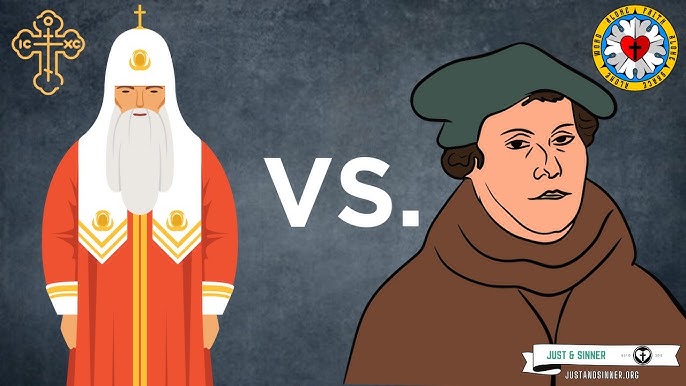
Image: from Just & Sinner, Rev. Dr. Jordan Cooper (See link below.)

The following is a much expanded essay on “Why didn’t Lutherans reform back to Orthodoxy?” When I first posted this blog in 2021 on Lutherans and Orthodoxy (the Eastern tradition of Christianity), I had no idea that an off the cuff post would become consistently my most popular. I suspect there are many reasons for this, but here are a few.

First, The Moscow-Constantinople Schism of 2018 has continued to rear its ugly head in news thanks to the invasion of Ukraine by Russia. In Ukraine, the two main Orthodox churches are the Ukrainian Orthodox Church of the Moscow Patriarchate (UOC-MP) and the Ukrainian Autocephalous Orthodox Church (UAOC), which later merged with the Kyiv Patriarchate to form the Orthodox Church of Ukraine (OCU). The OCU, no surprise, has no real interest to be under the care of the Russian Patriarch, someone whom is largely believed to have served with the KGB as an informant while a priest in the 1970s and a spy in Switzerland, whom has declared that those that are fighting for Russia and are killed in Ukraine will be martyrs gaining access to heaven (partly to help with Army recruitment), and whom is pals with Vladimir Putin. The native Ukrainians also have an historic but disputed by Moscow claim to religious independence. Yes, as Ukraine fights for its existence, some holy places have been forcibly reclaimed from the Russian-friendly Orthodox, and some priests suspected of cooperating with the Russians arrested or deported. This is often the undercurrent for the claim that the Ukrainian government is anti-Christian. It is likely more specifically anti-Russian. Let’s just say that wherever you fall on this international disagreement, it has attracted attention to Orthodoxy.

Numerous surveys also indicate that while many other denominations in the United States have faced losses, the Orthodox Church in America (OCA) has experienced some growth. Of course, it remains a small entity domestically, so when throwing around percentages, one needs to keep things in context. When an article states that young men are joining Orthodoxy in “droves,” understand that droves is a relative term. Such articles often suggest this growth is particularly due to young adult males seeking peace and more certainty in their lives. Less complimentary, others think some of those moving toward Orthodoxy are from the far-right, attracted by its connection to what they read about Russia and Putin.

Then, this year is the 1700th anniversary of the Nicaean (or Nicene) Creed. As people fought over who Jesus was, this creed became a seminal, theological lens to help us interpret and confess our shared faith as Christians. It holds much significance as it came from a council before the Great Schism of Eastern and Western Christianity. People, at least some people, want to understand why the Church fractured and what is all the hubbub about the filioque. (In our podcast, we jokingly say the west is Fili-ok, and the East is Fili-no way.)

Adding to confusion is the Orthodox world itself. They often say they never change, but they certainly fight among themselves. Yes, there are issues between Eastern Orthodoxy and Oriental Orthodoxy. Yet, jurisdictions (patriarchates) can get mad at one another thanks to theological differences often couched in deeper cultural or nationalistic issues. At such times, they may condemn one another as heretics (such as with the Moscow-Constantinople Schism mentioned above) or simply not recognize one another. The Orthodox Church in America (OCA) is itself in such a dilemma. In 1970, the Russian Orthodox Patriarchy approved the OCA’s request to become autocephalous. Constantinople felt the Russians overstepped their bounds due to lack of consultation. To this day, some Orthodox jurisdictions recognize the OCA as autocephalous while others don’t. The Orthodox world tends to not like being called denominations as they see themselves as the one and only Church, but they sure can treat one another roughly as if varied denominations. The unity of Orthodoxy proves to be on shaky ground historically.  

Let me be clear, there’s no doubt in my mind or heart that Orthodoxy is a beautiful expression of Christianity with a rich theological heritage incorporating wonderful art, music, and ultimately worship into community life. God is at work. I have been to their worship several times, and as my friend Fr. Adam, an OCA priest, gleefully, playfully reminds me, a godson of mine converted to Orthodoxy not too long ago. Orthodoxy is too often ignored in the West when we should listen to them. We might not ever fully agree, but we should listen. As a valid member within the body of Christ, they have much to teach us!

So yes, I understand the attraction and positive aspects of Orthodoxy even if it is still not the place for me. And although the Orthodox might assess me as a Lutheran or Western Christian to be deficient – at risk of damnation for not being part of “the Church” as they define it – I look at them perhaps as Martin Luther did with some esteem and love. They are Christians, even if I profoundly disagree with them at times. Indeed, I have learned a lot from them particularly about the early Church voices and practices. If you ever listened to our Three Priests Walk in a Bar Podcast, you have heard some wise and gentle words from Fr. Adam. (I know…surprising, right?!) He says, “We know where Christ is [in his mind, Orthodoxy], but not where Christ is not [that Christ might be active somehow in the other Christian expressions, but yes, they are outside the Church].” Our podcast is on an undefined hiatus, but I have continued to try to learn about Orthodoxy to hopefully affirm, stretch, or even correct my faith beliefs. If one seeks to be humble, one should recognize that there’s always something to learn.

This leads us to my previous blog (2021) on this issue. Immediately below, I am sharing part of a Facebook discussion that occurred between my dear friend, Fr. Adam, me, and others regarding a famous Martin Luther quote cited often by the Orthodox or incorporated into a meme around Reformation Day each year:

“The Greeks [Orthodox] . . . are not heretics or schismatics but the most Christian people and the best followers of the Gospel on earth.” Martin Luther (1999). Vol. 32: Luther’s Works, vol. 32: Career of the Reformer II (J. J. Pelikan, H. C. Oswald & H. T. Lehmann, Ed.) (59). Philadelphia: Fortress Press.)”

A most common version of the meme often simply quotes, “The truth lies with the Greeks.”

That proves somewhat ironic when it comes from a person who is Russian Orthodox or participates in another jurisdiction in schism with the Greek Orthodox. It certainly does not reflect the whole story. Their use of the quote proves too simplistic if not misleading.

So, one Orthodox person in our past podcast’s Facebook group asked in response:

“Why didn’t they [Lutherans] reform back to Orthodoxy?” That’s a most excellent and complicated question. There are many people and groups trying to address this troubled history theologically and through formal and informal conversation. Many Christians long for the unity Christ prayed for, but it is never easy.

My immediate response (with some current edits and updates) was basically as follows:

The short, quick (?) answer, since [name withheld] asked: Lutherans who saw themselves as reforming back to earlier roots of the universal Church assumed (always a bad thing) that the cultural and religious differences between the East and West would not be too hard to work through. What they found instead was that the Orthodox in some areas were (in their view) too much like the Papists, and the Orthodox found the Lutherans in some areas too much like the Papists. So, you had a theological, religious and cultural divide much larger than first anticipated.

The quote is best understood in this context. Luther seems to have hoped to be reconciled with the Orthodox and earn their support, but even perhaps more so, he wanted to win his arguments with those that supported Rome’s supremacy. The above, “often-cited-by-the-Orthodox” quote seems to be shared in order to assert a sort of superiority (Orthodoxy over other Christians) sometimes for humor and sometimes not so graciously. This proves especially so around the time of Reformation Day. (So much for humility, Fr. Adam Sexton, but you know I love you anyway.)

Instead, the statement by Martin Luther was offered within a debate with Johann Eck, a Roman papal representative. Eck argued that the fullness of the Christian Church lay only in Rome under the authority of the Pope. Martin Luther’s complement seems intended to push back such claims and reinforce the universality of Christendom and the Lutheran right to descent.

The complete history of actual early dialogue and interaction between Orthodoxy and Lutherans appears largely lacking from what I can immediately see. For example, one Orthodox resource on the web suggested the East really didn’t interact with Lutheranism in any intentional manner until about 50 years after Luther’s death. (I can’t validate this as of yet.) Orthodox-Lutheran dialogue was picked up again in later years and is ongoing.

For the 90+% of all world Lutherans represented by the Lutheran World Federation (LWF), a communion of Lutheran religious bodies, it is primarily conducted through the LWF. These church bodies understand that scripture has primacy over the Lutheran confessional documents. They only hold true as far as they agree with scripture. Thus, although our disagreements might be important, the church bodies see no issue entering conversations with the Orthodox, and if shown to be wrong, changing the accepted understanding of theology and practice.

“Confessional Lutherans” (about 10% of Lutheranism) would see Orthodoxy as in error as with anyone else that doesn’t fully agree with the Lutheran Confessions, the Book of Concord. They see the Lutheran Confessions as a true reflection of scripture. Thus, their approach to the confessions is almost fundamentalist. (This might be an oversimplification, but if you disagree with the Lutheran confessions, you aren’t fully in the Christian club.) They tend to loathe to disagree with any point, change, or expand upon the wording of the confessions.

The World Council of Churches, which many Lutheran bodies belong to, has some ongoing discussions with Orthodoxy, but there are also some conversations held directly between the Evangelical Lutheran Church in America (ELCA) and Orthodoxy (including the Orthodox Church in America). Although shrinking, the ELCA remains the largest Lutheran church body in the United States. (In Virginia, it has been growing smaller in membership at about the same rate as Evangelical and Baptist communities according to a PEW study, so it might not just be “liberal” theology and behaviors that are the root cause of decline. Even as the ELCA might prove unsustainable by some of its own estimations, I don’t think Lutheran theology – whether more liberal or orthodox – will disappear. It remains an important witness of the Church.)

If you do a search, you can also easily find many Orthodox blogs on Lutheranism and Orthodoxy, but I find many of these authors honestly misunderstand (or perhaps intentionally remain ignorant toward) Lutheran theology and practice. Yet, be aware these authors might also often conflate variations of “Protestants” as if sharing one theology. They lack understanding if not education on what “Protestants” are or believe. The Orthodox tend not to play well with others theologically and cut off from interfaith dialogue. The word ecumenism to the Orthodox only applies to those within the Orthodox world, so errors are likely.

In Luther’s time, those called Evangelicals (not in the modern US sense, but as a people trying to live according to scripture) and Protestants (those protesting Roman Catholic errors in theology and practice in the West) were first and foremost early Lutherans. The term “Lutheran” was eventually projected on to them as the Reformation progressed. Over time, some of these early Luther-friendly Christians began to wear the name Protestant and Lutheran with pride, although “Evangelical” often remains part of denominational and congregational names. Interesting to note, Martin Luther argued against using his name to represent any church body, and so one can still run into “Lutheran” denominations bearing other words or phrases as part of their names such as churches “of the Augsburg Confession.” (The Augsburg Confession is the primary confessional document of faith for the Lutheran Church, presented to the Holy Roman Emperor Charles V at the Diet of Augsburg on June 25, 1530.)

Over time, Protestant became a big umbrella term for all those protesting Rome’s church and resulting break off groups – including Anabaptist traditions, English separatist movements, and the bodies leading toward and including modern American Evangelicals and Pentecostalism. In the time of the Reformation, people generally identified branches of Christendom as Papists/Roman, Evangelicals/Protestants/Lutherans, Calvinist/Reformed, and Radicals/Anabaptists, and of course Orthodox.

The modern, US understanding of “evangelicalism” tends to be anabaptist or separatist in theology and often very conservative politically. It is often a far cry from Lutheran theology in many areas, including the more conservative Lutheran bodies. Some who claim the title Protestant are not so in the traditional sense any more than some Anglicans claiming to be Catholic are a perfect fit. See for example, my recent blog post on the New Apostolic Reformation. The many western branches of Christendom often have some touchstones of faith and practice – thus the umbrella use of the term – but perhaps this is in a similar way that varied Orthodox bodies cross-condemn one another although sharing some beliefs.

Convince a Lutheran by both scripture and reason, and you might yet see a Reform back to Orthodoxy. Yet with much of Orthodoxy often fighting among themselves throughout history, and with ongoing cultural differences and approaches to scholarship, I don’t think that could be easily done. (Fr. Adam, I again assert that this is where I duck for incoming abuse and scorn from your friends…if so, you owe me a beer.)

My wrestling with Orthodoxy continues, because I think they have some things to teach me, and perhaps I have something to teach them. When quoting the Lutheran confessions, I often have Orthodox folks say, “That sounds very Orthodox.” In return, I might at times say, “That’s very Lutheran of you.” Despite differences, we should not be surprised of any overlapping theology. Jesus’ prayer for unity will be fulfilled in perhaps some surprising ways. Indeed, there was actually a reported movement of many LCMS toward the Orthodox in the 1990s according to Dr. Jordan B. Cooper. (Lutherans tend not to move toward Roman practice, but some do.) Anything is possible when the Spirit is involved.

The filioque debate (in Ecclesiastical Latin pronounced filiˈokwe; meaning “from the Son” as used by the West in the later Nicene Creed without Eastern agreement) remains a huge issue, even as the LWF and ELCA have shown some willingness to lean into or accommodate the Orthodox take. Ongoing cultural differences, respected Western voices like Augustine of Hippo (who used the Latin Vulgate as opposed to the Greek scriptures causing some interpretive issues for the Orthodox), and many other interpretive issues remain serious hurdles.

Yet, there are similarities too. As widely noted, there is a tendency of both Lutherans and Orthodox to hold Thomistic scholasticism in disdain. I think I have made that clear in our podcast particularly when conversing with Fr. Nik who loves Thomas. While I appreciate Thomas Aquinas’ intellect, I think he goes too far at times in his attempts to define “mystery.” One cannot clearly see them as explicitly biblical, therefore once can disagree. Lutherans, including Martin Luther himself, have traditionally understood and valued the mystical nature of the Spirit’s work among us and in us. (See the book, Theology of the Heart or Luther and the Mystics by Bengt R. Hoffman to learn more.) Yet, we historically hesitated to go into any specificity. Traditional Lutherans might still use or appreciate scholasticism at times, but as a whole, Lutherans have been suspicious of overuse of our reason. This is all not unlike many Orthodox believers. And like the Orthodox, Martin Luther never intended biblical interpretation to be done in isolation. We listen to the voices of the past such as the Church Patriarchs, the voices of Christians around us (Lutherans would look to a more diverse group, of course), and then form and share our own opinions as we listen for the Spirit’s guidance to truth. In cooperation with God and one another, we discern truth.

If you wish to dig into this topic further, I highly recommend the following:

Although he falls theologically to my right, I very much admire and give thanks for the scholarship of Dr. Jordan B. Cooper. He is a pastor in the American Association of Lutheran Churches, a small (16,000 member) confessional, Lutheran body. He draws upon, compares and contrasts many sources quite fairly in my view. Watching his video, A Lutheran Response to Eastern Orthodox Theology, will likely be a fruitful use of your time. The image used for this blog post is from that video.

You can find news and joint statements between Lutherans of the LWF and Orthodoxy (primarily Greeks) on their page about Lutheran-Orthodox Dialogue. This includes a recent important document, Lutheran-Orthodox Common Statement on the Filioque (July 2024), where in regards to the Nicene Creed they “suggest that the translation of the Greek original (without the Filioque) be used in the hope that this will contribute to the healing of age-old divisions between our communities and enable us to confess together the faith of the Ecumenical Councils of Nicaea (325) and Constantinople (381).”

For the Orthodox bilateral conversations with the ELCA and/or their representatives, you can visit their website’s page on “bilateral conversations.”

As we discern together, I think we must be mindful of Paul’s heartfelt request from Ephesians 4:1-6: I, therefore, the prisoner in the Lord, beg you to walk in a manner worthy of the calling to which you have been called, with all humility and gentleness, with patience, bearing with one another in love, making every effort to maintain the unity of the Spirit in the bond of peace: there is one body and one Spirit, just as you were called to the one hope of your calling, one Lord, one faith, one baptism, one God and Father of all, who is above all and through all and in all.

© 2025 The Rev. Louis Florio. All content not held under another’s copyright may not be used without permission of the author.

2 Comments

Filed under Church History

Light, light brief candle

Photo by Annie Spratt on Unsplash. Used by permission.

As his official biography reveals, “Hendro Munsterman is a Religion journalist and Vatican correspondent in Italy, The Netherlands, and France. After having studied and taught theology and religious studies at universities in The Netherlands, Switzerland and France, he became a full-time religious journalist and analyst for the national Dutch daily, Nederlands Dagblad.” Yes, he’s a smart cookie, as we might say in the United States, with a heart for God and others. I am also blessed that he is a friend. We served together in France as volunteers with the Ecumenical Community of Taizé in our young adult years.

I’ve enjoyed listening to or reading his reports and ponderings over the years. Yesterday, I came across his Facebook post about a recent television panel he was invited to join. As a “Vatican Watcher,” Hendro was asked to comment on the current Pope’s legacy as his health has recently declined. (For those that have not heard, Pope Francis suffered a polymicrobial infection with subsequent pneumonia in both lungs which forced him to remain in the hospital.) The short clip from the panel discussion got me thinking.

In the clip, Hendro provided some helpful analysis of the current Pope Francis’ legacy. Hendro mentioned how Pope Francis sought to turn the Vatican’s face outward. He is one who wants the Church to go to the people where they are, not wait for others to come to the Church. Pope Francis is a “pope of proximity” where people want to touch him in his approachability, yet he exemplifies the desire for the Church to go into the world and to touch human realities and consider those on the peripheries. This is at its heart all a great witness for a Savior who asked us go and make disciples of all nations, baptizing them in the name of the Father and of the Son and of the Holy Spirit (Matthew28:19) – even if the Devil can be in the details of political policies and realities.

In listening to him speak, I thought of the many conservative Roman Catholics whom I know personally that hate (yes, hate) this Pope. I have seen them post about it, and in some cases, I somehow ended up on an email chain with argumentative, unfriendly articles attached. Sometimes, the complaints surrounded his openness to relationships with Protestants or the fearful perception that Pope Francis was reinterpreting dogma or traditional practices. His restrictions on the Latin Mass is also unpopular in that camp, as is his Franciscan, Argentinian approach to liberation theology, which they claim has created confusion. They often claim he is too political, sometimes as if the Church should never interact with business or the world. Speaking of business, Pope Francis has sought to reform the Vatican bank, the Institute for Works of Religion (IOR), to make it more transparent and accountable. This was not always popular with movers and shakers in the Vatican. The list can go on much further, but whatever he has done or failed to do, the posts, articles and emails are often very ungenerous. In fact, some can demonize him as if he is an antipope or antichrist of some sort seeking to kill the Roman Catholic Church.

This is all in the face of a broad popularity – 75% of United States Catholics see Pope Francis in a positive light. (It is much harder to gage any sure Protestant view of the Pope due to historic differences and in some traditions animosity, yet a Barna study found that 35% of respondents thought Pope Francis actually improved their view of the Roman Catholic Church.)

Yet as with all of us who believe in Jesus, imperfect as we are, God can still always use our humble, sin tainted witness for good (Romans 8:28). Martin Luther’s caution regarding the commandment not to give false testimony – number eight as Lutherans count them – comes first to my mind: “We should fear and love God so that we do not tell lies about our neighbor, betray him, slander him, or hurt his reputation, but defend him, speak well of him, and explain everything in the kindest way” (from his Small Catechism). Then in the case of Pope Francis, I must say that his hoping to turn the Vatican’s face outward, having the Church go to the people outside the walls, is admirable. All Christians should agree that this is needed in a world with so much pain, suffering, and often times ignorance.

Sure, Martin Luther was no fan of Popes. (He called his contemporary Pope the Antichrist in 1520.) Yet, he, too, would likely agree that this is the way the Church should seek to live out the Gospel. He once argued, “Anyone who is to find Christ must first find the Church.” He goes on to say the Church is not a building but us in the flesh! Luther wrote extensively on vocation, God’s call in our ordinary, day to day lives. Our vocation is ultimately for the glory of God and the service of others. To Luther, even a father changing a dirty diaper becomes holy when done in love. Yet, this is never about earning merit for heaven. “God does not need our good works, but our neighbor does,” quipped Luther. The Church, you and me and all who believe, need to be active in the world to meet people, love them, and share our love of God with them through word and example.

Then, Martin Luther taught a great deal about what we call the Theology of the Cross. Yes, this understanding holds that we can never save ourselves. Only Jesus through his cross and resurrection can do that. Yet, it also reminds us that God often shows up not in and through power but in places of weakness and suffering. We remember that we were saved for a purpose. As Jesus told his disciples, “If any wish to come after me, let them deny themselves and take up their cross and follow me. For those who want to save their life will lose it, and those who lose their life for my sake will find it” (Matthew 16:24-25). Our lives are not just about us; our security and happiness. We are sent to this time and this place to love as Jesus loved. This often infers sacrifice and suffering alongside or for the benefit of “the least of these” (Matthew 25:45).

Finally, Martin Luther thought of sin as ultimately our being “curved inward on ourselves” (incurvatus in se). Looking out for ourselves first can keep us from caring for the neighbors and world around us. It can lead to greed. It might encourage indifference to the suffering of those around us. We might abuse employees or others close to us. We might hear ourselves saying, “That’s not my problem” when Jesus says, “Love one another as I have loved you” (John 13:34). When our eyes are on ourselves, we can’t accurately see the world as it is, nor our place in it. We tend to take our eyes off of Jesus and lose our way, hurting ourselves, others, and our world – intentionally or not. So despite some profound theological, polity, and worship differences, I think Pope Francis is taking his stand not too distant from us Lutherans. We are indeed asked to be Light bearers to the people of this world.

When Lutherans are baptized, they are often presented a small candle lit from the Paschal candle (a much larger candle in the sanctuary representing Christ’s own light). The lay leader giving the candle to the newly baptized quotes Jesus telling them, “Let your light shine before others, so that they may see your good works and give glory to your Father in heaven.” (Matthew 5:16). We have to fight by God’s help our human tendency to be curved inward on ourselves. Look to Christ in his examples, teachings and promises. He’s the Light of the World (John 8:12). We can ask for his Spirit to guide us and correct our course when we are wrong (John 14:16 and John 16:7).

As old Marty would repeatedly say in his catechism, “This is most certainly true.” We were created and called to cooperate with the grace offered us to help fulfill God’s will for the world. Yet if we are in the habit of not doing so, our lives will likely become similar to an old, ill-used wick bent inward and broken. Our light, really Christ’s light, can appear as if snuffed out. At the very least, we won’t shine with the abundant life Jesus promised and intended for us (John 10:10 and Romans 5:17). What a loss for us and our world!

If you wish to see the video of the full panel conversation at France24 in English, click here – “Which direction for the Church? Pope’s hospitalisation puts prelates on stand-by.”

This detailed post evolved from a simple Facebook exchange on February 26, 2025. I want to thank Hendro Munsterman again for sharing about his panel discussion.

© 2025 The Rev. Louis Florio. All content not held under another’s copyright may not be used without permission of the author.

Leave a comment

Filed under Church History, Theology

Maybe we should be an ass

Mosaic in El Moallaqah Coptic Orthodox Church: The Flight to Egypt, Cairo, Egypt by Unknown. c. 9th Century AD.

Whoever said the Middle Ages weren’t fun? I bring you glad tidings and happy greetings on this Feast of the Ass.

Yes, according to a blog post by Fr. John Zuhlsdorf: “The feast which became popular in France, could have stemmed from the so-called ‘feast of fools.’ It may tendrils into biblical donkeys, or the integration of the ass into the nativity narrative. It could have been in part inspired by a sermon of pseudo-Augustine. The day included the tradition of a parading a couple of kids (not goats) on an ass (not a Jesuit) right into the church, next to the pulpit during the sermon. The congregation would respond with loud ‘hee haws.’”[i]

This sounds a bit like an early version of Vacation Bible School or maybe fiction, but nope, this liturgical feast was the real deal. It was meant to commemorate the Holy Family’s flight into Egypt. So, on and near the day appointed, congregations would hear donkey-related stories in the Bible including the escape into Egypt (Matthew 2:13–23). Problematically, scripture never explicitly mentions a donkey in the narrative of Christ’s birth or the flight, but that’s firmly in the cultural memory. Why?

Well, donkeys were a symbol of humility and peace while horses were symbols of earthly power and war. Also, through many prophetic texts speaking to ancient Israel, we learn that God did not desire the Holy People of Israel to trust in horses and chariots, as Egypt did, but in the Lord (i.e. Psalm 20:7). Instead, they commonly utilized donkeys also known as asses. Donkeys are also one of the earliest and most frequently mentioned animals in the Bible through multiple texts. In the book of Job, the donkey is one of the fourteen animals that the Lord uses to illustrate God’s own power and creativity to Job (Job 39). Then, Balaam’s donkey actually speaks (Numbers 22:23). The only other animal ever to speak is the serpent of Genesis. Indeed, many verses urge people to be good to their beasts including their donkeys (i.e. Exodus 20:10, Deuteronomy 5:14, Proverbs 12:10).

Yet perhaps most importantly, the donkey was connected to the Messiah as a sign: “Rejoice greatly, O daughter of Zion; shout, O daughter of Jerusalem: behold, thy King cometh unto thee: he is just, and having salvation; lowly, and riding upon an ass, and upon a colt the foal of an ass” (Zechariah 9:9). Jesus embodies this as he rode into Jerusalem for his final Passover. If Jesus ends his life with a ride on a donkey, it does not take a great deal of creativity to imagine Jesus (through his expectant mother, Mary) rode one as he entered into our world incarnate. (It is likely one was not only available but used.)

So, if anyone ever says you are acting like an ass, or you feel like one, don’t be too quick to take offense or lose heart. Think of the humble donkey and give God thanks. For all their drawbacks, the ass remains a valuable animal, born with a purpose, and dearly loved by God. If God can use an ass, God can surely use you or me. The Bible tells us so.

Yes, this feast might no longer be on the liturgical calendar, but blessed Festum Asinorum, Feast of the Ass Day, to one and all!

Epilogue:

Hear is a song from Italian history with the feast to help brighten your celebration.[ii] As the feast was seemingly associated with the Feast of Fools, it is quite jolly unlike other liturgical music of the day. An Italian troubadour version of ‘Orientis Partibus’ with braying chorus.[iii]

Translation:

From the country of the East,
Came this strong and handsome beast:
This able ass, beyond compare,
Heavy loads and packs to bear.

Chorus:
Now, seignor ass, a noble bray,
Thy beauteous mouth at large display;
Abundant food our hay-lofts yield,
And oats abundant load the field.
Hee-haw! He-haw! He-haw!

True it is, his pace is slow,
Till he feels the quickening blow;
Till he feel the urging goad,
On his hinder part bestowed.

Chorus: Now, seignor ass, &c.

He was born on Shechem’s hill;
In Reuben’s vales he fed his fill;
He drank of Jordan’s sacred stream,
And gambolled in Bethlehem.

Chorus: Now, seignor ass, &c.

See that broad majestic ear!
Born he is the yoke to wear:
All his fellows he surpasses!
He’s the very lord of asses!

Chorus: Now, seignor ass, &c.

In leaping he excels the fawn,
The deer, the colts upon the lawn;
Less swift the dromedaries ran,
Boasted of in Midian.

Chorus: Now, seignor ass, &c.

Gold from Araby the blest,
Seba myrrh, of myrrh the best,
To the church this ass did bring;
We his sturdy labours sing.

Chorus: Now, seignor ass, &c.

While he draws the loaded wain,
Or many a pack, he don’t complain.
With his jaws, a noble pair,
He doth craunch his homely fare.

Chorus: Now, seignor ass, &c.

The bearded barley and its stem,
And thistles, yield his fill of them:
He assists to separate,
When it ‘s threshed, the chaff from wheat.

Chorus: Now, seignor ass, &c.

With your belly full of grain,
Bray, most honoured ass, Amen!
Bray out loudly, bray again,
Never mind the old Amen;
Without ceasing, bray again,
Amen! Amen! Amen! Amen!
Hee-haw! He-haw! He-haw!’[iv]

© 2025 The Rev. Louis Florio. All content not held under another’s copyright may not be used without permission of the author.


[i] Zuhlsorf, J. (January 14, 2020). “14 January – Festum Asinorum #FeastoftheAss Day! (No, it’s not a special Jesuit holiday.)” The American Catholic. Downloaded January 14, 2025 from https://the-american-catholic.com/2020/01/14/feast-of-the-ass/.

[ii] Faber Teatro. Orientis Partibus (con asino), a Bracciano, 12 Luglio 2009 at cristinadelmastro.

[iii] Thanks to the Equus Asinus blog for sharing this song among its several great blog posts on the Feast of the Ass. Thomas, G. (January 14, 2023). “Feast of the Ass, 14 January.” As downloaded at https://equusasinus.net/2023/01/14/feast-of-the-ass-14-january/.

[iv] Ibid.

Leave a comment

Filed under Church History, Liturgical Year, worship

Burn brightly

St. Blaise (1740), Maria-Trost Church, Berg bei Rohrbach

Today, not on our Lutheran calendar but celebrated by many other Christians, is yet another feast day connected to spring and growing light, the Feast of Saint Blaise (pronounced blayz).

Blaise is considered to be an historic figure, but there has grown a great deal of myth around his life. A physician and bishop of Sebastea in historical Armenia, he died as a martyr on February 3 sometime around 316 AD. He is remembered for many miraculous (if perhaps mythic) healing stories to include saving a child from chocking on a chicken bone while on his way to his own judgement and death. He is said to have died by beheading.

And so being the day after Candlemas and with his being associated with stories about the throat, some early Christians through to this day often have their own throats blessed, sometimes while two candles blessed on Candlemas are layed in a crosslike shape upon their throat. Indeed in the Middle Ages, Blaise was considered one of “the Fourteen Holy Helpers” who during the time of the plague became popular for intercession for everything from a headache to an unexpected death.

Photo credit: Figurines of the Fourteen Holy Helpers by an unknown artist, Chapel on the Michaelsberg, Untergrombach, Germany, by H. Zell, CC BY-SA 3.0 <https://creativecommons.org/licenses/by-sa/3.0>, via Wikimedia Commons

These kind of practices – and the sometimes mythic aspect of these fourteen saints themselves – often caused them to diminish in stature following the Protestant Reformation. Our Augsburg Confession, Article XX1 teaches us: “Of the Worship of Saints they teach that the memory of saints may be set before us, that we may follow their faith and good works, according to our calling, as the Emperor may follow the example of David in making war to drive away the Turk from his country. For both are kings. But the Scripture teaches not the invocation of saints or to ask help of saints, since it sets before us the one Christ as the Mediator, Propitiation, High Priest, and Intercessor.” We remember and give thanks for the example of all the saints whether on a list for recognition or not, including Blaise, but even as we might venerate and honor them, we seek to reject superstition and, as Lutherans, we do not invoke them.

For his part, Martin Luther, seeing many abuses and evidence of magical thinking and idolotry in some cases, argued, “No one can deny that by such saint worship we have now come to the point where we have actually made utter idols of the Mother of God and the saints, and that because of the service we have rendered and the works we have performed in their honor we have sought comfort more with them than with Christ Himself. Thereby faith in Christ has been destroyed. [E 28:415; quoted in MartinLuther, What Luther Says, Vol. III, ed. Ewald Martin Plass (St Louis: Concordia Publishing House, 1959), 1254; cf. LW 36:299-300]. There is no explicit biblical citation supporting invocation of the saints (so Christians might disagree), but a larger concern for Martin and the earliest Reformers remained our human tendency for magical thinking.

Many great saints and martyrs have long been forgotten by the world, but they are never forgotten by God. Not everyone makes a liturgical list. Some through no fault of their own have become wrapped in myth. Yet, through the gift of faith, the legacy of any saint can instruct or inspire us in some way. They can serve as great examples for us. So, rest in peace, Blaise. Your efforts still burn brightly…not because of what you did or failed to do, but because the light of Christ chose to shine brightly through you love.

Through remembering the saints and martyrs, Jesus reminds us, “In the same way, let your light shine before others, so that they may see your good works and give glory to your Father in heaven.” With God’s help, may our lives burn brightly, too.

Unless otherwise indicated, all scripture quotations for this post are from the New Revised Standard Version Updated Edition (NRSVue) translation.

© 2023 The Rev. Louis Florio. All content not held under another’s copyright may not be used without permission of the author.

Leave a comment

Filed under Church History, saints

Shedding a Light on Candlemas

An audio version of this post can be found here.

There’s definitely some confusion when it comes to Candlemas each February 2. Not only is it overshadowed by Groundhog Day, but it also remains rather obscure to many modern Christians and most certainly non-Christians. Candlemas is perhaps most properly or commonly called the Feast of the Presentation of Jesus. The Church remembers Mary and Joseph taking Jesus to the Temple forty days after his birth to complete Mary’s ritual purification after childbirth and to perform the redemption of the firstborn son as reported in Luke 2:22-40.

Photo by Sixteen Miles Out on Unsplash; licensed under CC0.

Candlemas is an old feast of the Church, a kind of holiday or holy day one might say. Normally, a feast day commemorates a person or event. Unfortunately, with Candlemas, it appears multiple, closely related meanings have been attached to it over the centuries and events perhaps merged. In a web search, you will quickly learn that Candlemas can not only be called Feast of the Presentation of Jesus, but it can also be known as the Feast of the Purification of the Blessed Virgin Mary, or the Feast of the Holy Encounter.

In Leviticus 12:2-8, we learn “A woman who becomes pregnant and gives birth to a son will be ceremonially unclean for seven days, just as she is unclean during her monthly period. On the eighth day the boy is to be circumcised. Then the woman must wait thirty-three days to be purified from her bleeding. She must not touch anything sacred or go to the sanctuary until the days of her purification are over.” (There are separate requirements for the birth of a girl child.) For the male, a year-old lamb was to be offered for a burnt offering and a young pigeon or a dove for a sin offering. If the mother and her family could not afford a lamb, she was to bring two doves or two young pigeons, one for a burnt offering and the other for a sin offering. God was thought to be a God of life. Things that smacked of death and illness such as blood were deemed unclean. In sacrificing the offering as part of the ritual in faith with prayer, the priest was thought to be atoning for any of her sins. A person was being made fit to be in the presence of God and among God’s Holy People.

The first male child held special significance to the early Hebrews. With their cultic life and practice centered around priestly activities and offerings relating to the Ark of the Covenant and Ten Commandments, members of the twelve tribes were expected to support the work of the Tent of Meeting and later the Temple in Jerusalem. As the people became more numerous and the cultic practices more established, it was recognized that not every first male child need to serve with the priests. Indeed, sometimes families making a subsistence living might need him more just to survive.

Exodus 13:2-15 describes another ordinance. Through Moses, God was believed to have commanded, “Consecrate to me every firstborn male. The first offspring of every womb among the Israelites belongs to me, whether human or animal.” All the firstborn males of their livestock were also to belong to the Lord. When people asked why, they were to explain, “Pharaoh stubbornly refused to let us go, the Lord killed the firstborn of both people and animals in Egypt. This is why I sacrifice to the Lord the first male offspring of every womb and redeem each of my firstborn sons.”

In Numbers 18:15-16, it says, “The redemption price for firstborn non-Levites was set at 5 shekels.” Today, this practice is known as the pidyon haben, the redemption of the first-born son, and silver coins are used. It is only conducted for male babies but not if the baby was delivered by cesarian section. In effect, the father “buys” or “redeems” his son from the priest and the expected, traditional service. (The Temple no longer exists, so it is more symbolic than in the past.) At least under rabbinical practice today (if not earlier), this obligation only exists if the parents are not Levites or part of the priestly class.  In a quick review of scripture, I see no date for this to be held in scripture, but today the obligation begins when the baby is 30 days old, and so the ceremony often occurs on the thirty-first day after birth. If included parents do not redeem the child for whatever the child becomes responsible for his own redemption at thirteen years of age. (See the article Redeeming firstborn sons for more details.)

Certainly, Luke seems to confuse these two practices – the redemption of the first male child and the purification of the mother forty days after birth. In fact, Luke has the fee for the purification of the mother become the redemption price for the son. Remember, Luke did not observe these events. He was a Greek doctor who had come to believe in Jesus and served with Paul for a time. To me, it certainly seems reasonable that he didn’t fully understand Levitical codes. I’ve read some articles suggesting that there was no such custom of presenting a Jewish male child in the Temple back in the first Century, but with the redemption needing to be made to a priest, perhaps a child need not be there, but I would certainly not be surprised if a family did. I see no reason to doubt the ultimate truth of the passage. Jesus was presented in the Temple. Simeon and the prophet Anna could have certainly encountered Jesus and through the Spirit’s revelation understood his import. (Hence, Candlemas can also be known as the Feast of the Holy Encounter.)

Whether we focus on some kind of presentation of Jesus including most likely the story of his redemption, the purification right of Mary, or Jesus being revealed as the Messiah to Simeon and Anna, I hope we remember all these early stories and practices amidst their variations. They help make Jesus and his family come alive in context of their time. February 2 being forty days Christmas remains the perfect day to do so. Indeed, as I have written elsewhere, the date was once was considered the end of what was called the Season of Epiphany, and any remaining Christmas greens were taken down. (Today, most denominations don’t have a season of Epiphany but have January 6 as the Feast of Epiphany and what is now called the start of the Season after Epiphany.)

So that all said, with all those names and remembrances possibly now making more sense, why is the day also called Candlemas? Well, in past days, Christian families would commonly bring candles to the church as we remembered Jesus as “a light for revelation to the Gentiles, and the glory of [God’s] people Israel.” Much as we bless food to our use or dedicate worship items through prayer, families would ask that the candles used in the home for light be blessed.

Happy Candlemas everyone! As Jesus urged, “let your light shine before others, so that they may see your good works and give glory to your Father in heaven.”

Unless otherwise indicated, all scripture quotations for this post are from the New Revised Standard Version (NRSV) translation.

© 2022 The Rev. Louis Florio. All content not held under another’s copyright may not be used without permission of the author.

Leave a comment

Filed under Church History, Lectionary, scripture, worship

Is this a season of spooks or saints? The historic relationship between Halloween, Reformation Day & All Saints Day

Luther schlägt die 95 Thesen an (Painting of Luther nailing 95 theses), by Julius Hübner (1878), Public Domain

All Hallows’ Eve, more commonly known as Halloween, is an important time for us Lutherans (and the entire Church, I might add). Yes, on October 31, 1517, good old Martin Luther posted his 95 Theses critiquing practices and teachings related to indulgences.(1) It was good – and likely not coincidental – timing. The Church was thinking about matters of death and resurrection.

Indeed, the harvest was ending. Plants were dying or growing dormant. Hunting became harder as animals became scarce due to migration or the movement into hibernation. The season was growing darker and days shorter. People’s minds in these more superstitious days could turn to some very dark things. As a television show popularized, they would sense, “Winter is coming” in the worst sense. Death seemed afoot with demons, goblins, and ghosts to boot.

Pagan cultures for centuries had used this time of year to remember the dead and dark things, especially those who might still be walking or floating around them.  As Christianity supplanted paganism, people did not really change. Many of the fears remained the same. Not everyone trusted that Jesus had fully defeated death, at least where they were concerned. It seemed reasonable and likely that more suffering was to come as people they loved transitioned into the afterlife.

In this context, people strained to make sense of it all. Drawing from some dubious scriptural citations and some very creative thinking, people expected they would never be good enough to merit heaven. The idea of limbo and purgatory – places where those not ready or quite good enough for heaven could be purged of sin and maybe one day enter heaven after much suffering – came into the fore. Hell caught more and more of the common folk’s attention, as heaven seemed more and more unattainable. They feared God’s judgement in a world where many died before thirty years of age. The world was a frightening place, and God seemed distant, angry and terrifying.

So, the Church tried as it could in those times to respond to (and within) that worldview. Although there certainly were early practices honoring saints and imploring divine help and mercy for the dead, one can trace a more significant line toward today’s practices. On 13 May 609 or 610, Pope Boniface IV consecrated the former Pantheon at Rome to become a Christian shrine, Our Lady and the Martyrs. He is believed to have chosen this date to witness against and supplant the ancient, Italian pagan feast of the Lemuria. The Lemuria was celebrated on three days — May 9, 11, and 13. Even days were considered unlucky by the Romans. The day honored the dead and particularly the lemures, the unfriendly if not dangerous spirits of people who died violent or untimely deaths. Pope Boniface IV ordered a celebration should be held every year.

In a similar fashion, sources indicated that Pope Gregory III dedicated a worship space in Old St. Peter’s Cathedral to venerate relics of saints, martyrs, and the Apostles of the Church on November 1, 731. This, too, was to be remembered each year with festival worship. By the late 8th Century, a practice to remember the saints and martyrs also grew seperately in what is now the British Isles and Ireland as the Church fought back popular Celtic pagan practices related to remembering the dead. A Northumbrian abbot, Alcuin, whether reflecting upon events in Rome or perhaps something else, argued alongside others that an annual remembrance and celebration should occur every November 1. At the insistence of Pope Gregory IV and other religious leaders, the Holy Roman Emperor, Louis the Pious, finally decreed November 1 would become a “day of obligation” in 835.(2) Failure to attend worship would risk one’s salvation and perhaps result in fines or punishment. By the 12th Century, the 13 May celebration had been supplanted by the November 1 saintly celebration and its accompanying October 31 vigil services.

It was easy in those days to assume the “perfect” and holy saints might be with God, but what about our family members who, well, we knew not to be so perfect or even “bad”? In the 13th Century, All Souls’ Day became a companion observance on Novmber 2 to remember all those still in pergatory. All Saints’ Day remained a day to recognize the exulted few. Also known as the Commemoration of All the Faithful Departed and the Day of the Dead, All Souls’ Day is specifically meant to be about prayer and remembrance for the souls of these still suffering, baptized members of the Church. (3)

All the while as these litrugical practices developed, amidst the ravages of the plague and on and off again wars in Europe, things became more frightening. Coffers became emptier. The Church began to seek funds through the selling of indulgences. Indulgences were like a “get out of Purgatory free card,” a way to reduce the amount of punishment one had to undergo for their sins.(4) In other words, one could pay for oneself or one’s family members (even those already dead) to be released earlier from purgatory, and you received a paper that said so. Looking upon the mass as a sacrifice, people could also pay for masses to be said to help their dearly beloved departed. Each mass paid for meant less time suffering. Under the auspices of “the keys” (Matthew 16:19), believed to be a hereditary power gifted to those succeeding St. Peter as bishop of Rome, Popes began to use that power to their advantage and disgrace. The money would build a new cathedral in Rome, but it also fueled a growing corruption in the western Church.

On October 31, 1517, in walked a college professor, a Bible scholar, theologian, and Augustinian Monk, named Martin Luther. He posted his 95 Theses, or Disputation on the Power and Efficacy of Indulgences, against these abuses in the hope of sparking discussion and reforms. The day he chose to do this was the Vigil of All Hallows (or now, All Saints’) Day, also originally called All Hallows’ Eve (now Halloween to most people). The Church was remembering Christ’s victory over sin, death, and the Devil. It was celebrating the freedom his faithful followers had been gifted. What a perfect time to assert, “When our Lord and Master Jesus Christ said, ‘Repent’ (Mt 4:17), he willed the entire life of believers to be one of repentance.” He went on to argue ninety-five theological points that the process of repentance (a turning back toward God) and frogiveness of sin should not be about money or based on fear. Martin Luther had come to believe our loving God has already freed us in love through what Jesus had done and promised. If the Papal authorities really had the power to forgive sin, why not do so out of love? In response to Christ’s sure promises, we are invited to trust and reorient our life toward God and others in love – in thanksgiving not fear. We can run back to God for foregivenss over and over agains without fear. We can walk on through tribulations, punishments and even hell itself with confidence. Our battle is already won by Jesus, and death has lost its sting. This good news turned into what we know today as the Reformation.

Foot notes:

(1) Some scholars suggest that Martin Luther did not nail his 95 Theses to any door, but instead, they argue he only mailed (“posted”) it. Yet, I would argue to accept that he mailed something does not necessarily exclude the possibility that he also (or only) posted/nailed/tacked something on to the door of the university church. He we are in the 21st century, and I still see occasional missives posted on or near the nearby university – much as I did in the 2000s and 90s. I’ve seen this behavior in other countries as well. I’m not so fast to give up on pervasive social memory. I’ve seen “stories” discarded as myth as told by Native Americans and others, and then someone goes and discovers something proving the story holds some truth. Anything is possible. Indeed, in the early 1600s, he was depicted writing them on the door with a quill. Here’s an article from the Washington Post (2017) that might help explain this still unsettled debate – to often presented as fact: https://www.washingtonpost.com/news/retropolis/wp/2017/10/31/martin-luther-shook-the-world-500-years-ago-but-did-he-nail-anything-to-a-church-door/

(2) For Roman Catholics, All Saints’ Day remains a “holy day of obligation.” All Souls’ Day is not. Yet, the Code of Canon Law (1246 § 2) declares that an Episcopal Conference “can suppress some of the holy days of obligation or transfer them to a Sunday” with the required approval of the Apostolic See. The United States Conference of Catholic Bishops decided to eliminate the obligation to attend Mass when the solemnities of January 1 (Mary, Mother of God), August 15 (The Assumption) and November 1 (All Saints’ Day) fell on Saturday or Monday. The Holy See approved this decree on July 4, 1992. Thus, All Saints’ Day will not be a day of obligation for Roman Catholics in 2021.

(3) Later with the Reformation’s influence affirming the unbiblical nature of beliefs in pergatory and Martin Luther’s and other Reformers’ contentions that at our best we can be only imperfect sinner-saints, All Souls Day became primarily a Roman Catholic observance. Most Protestants remember and give thanks for the Christian life and witness of all our dearly departed on All Saints’ Day along with all the more famous saints of the Church. After all, we are all saints through our faith and baptism, even as we struggle with sin. We don’t believe the blessed dead need our prayers when they already have Jesus. We are all considered saints through the power and promise of our faith and baptism – by grace through faith in Jesus Christ. That said, some Protestants in the Anglican Communion and elsewhere still have liturgies for that similar purpose on November 2, although individuals might or might not fully reject the concept of pergatory.

(4) Indulgences could also be earned for praying certain prayers, wearing certain medals or scapulas, or making a pilgrimage.

The 504th anniversary of the Reformation will fall on October 31 in 2021. Modern Lutherans tend to mark it in worship on the Sunday closest to or on Ocvtober 31. All Saints’ Day, still on November 1, will be marked most years on the following Sunday (if November 1 is not a Sunday) by most Lutherans and many others in Christ’s one, holy, and apostolic Church – and by that, I mean many across the ecumenical Church. Roman Catholics still observe All Saints’ Day on November 1 along with All Souls’ Day on November 2.

Originally published in the October 26, 2021 edition of Christ Lutheran Church’s (Fredericksburg, VA) weekly newsletter, the Hub.

© 2021 The Rev. Louis Florio. All content not held under another’s copyright may not be used without permission of the author.

Leave a comment

Filed under Church History, Pastoral Letter, saints

Rethinking the Civil War, It’s Legacy, & Me

Click this image to read the article alluded to below in my blog, “Why Do Confederate Lies Live On” in The Atlantic.

“When I was a child, I spoke like a child, I thought like a child, I reasoned like a child; when I became an adult, I put an end to childish ways” (1 Corinthians 13:11).

Recently, I came across an excellent article in The Atlantic called “Why Do Confederate Lies Live On.” It was written by Clint Smith, an African American staff writer with the magazine. Focused on his experience with the chapel at Blandford Cemetery, it gave me reason to pause and reflect about my own life.

VMI Cadet Hartsfield of the Battle of New Market is buried somewhere in the Blanford Cemetery in a grave lost to history. In 2014, Petersburg’s VMI alumni group asked me to offer an invocation and benediction for their recognition of the 150th anniversary of the Battle of New Market on May 15th. I was serving as a pastor in Richmond at the time. I naively expected a small, outside event from what I was told. It ended up being a larger event in this cemetery chapel. (I had never heard of this chapel before my visit.)

I was told a World War 2 veteran who survived landing just a day or so after D-Day and fought through the war would speak about his experiences. He did, and that was positive. I did not expect a local SCV color guard with the Stars and Bars battle flag or the explicitly Confederate windows. It was sort of creepy and fascinating at the same time.

My previously prepared prayer alluded to the errors and evils of the Civil War. Yet now, I wish that I had explicitly and strongly refuted slavery and racism as part of it. I mentioned how the cadets’ actions under fire likely helped lead to the preservation and restoration of VMI after the war and perhaps indirectly helped shape or inspire folks like George C. Marshall and Civil Rights Martyr, Jonathan Daniels, and others to bravery or to do their duty. (At some level, I think that remains true for me.) I realize that God can make good come from anything, even our sin. I prayed VMI and our nation would become ever better, more just, and reconciled.

On one hand, I was honored to be asked by fellow alumni, especially for this momentous 150th anniversary year of the Civil War. My fellow alumni were hospitable, and like many alumni including myself, love VMI. On the other hand, I wish I went further and spoke more clearly about the sins of racism, slavery and treason. I value history, but we need to tell the whole story – even the ugliest parts.

Even though I’m from the north, even though some of my ancestors fought for the United States during the rebellion, even though my First Class dykes (senior mentors are called dykes after the cross-belts or dykes worn as part of the uniform) used to have me answer, “The United States of America, Sir,” to the question at VMI about who won the Civil War, the Lost Cause Myth can insidiously take hold of a person if we aren’t wary. It can obscure our vision and understanding, as well as stir division or wound others unintentionally. The myth dresses up and softens what’s ugly. After all, that myth and racism in all forms are just more signs of sin at work in our lives and world. And, sin often traps us subtly over time.

I’m not the person I was in 2014. My attitudes have hopefully continued to evolve, and I pray I continue to grow in understanding and empathy. Wherever needed, I desire the wisdom to repent of my sin including any sin related to racism. I want the courage to challenge racism wherever it is encountered. I’m not looking to erase history. I understand all of us, even the best of us, can only be simultaneously sinner and saint and never perfect. It can be helpful to remember the past. Yet as Christians, we understand we are always reforming. We need to separate ourselves from rigid, dualistic (that everything is all good or all bad), or simplistic thinking and bravely embrace the truth of our past and our present whatever we might see. We can love and respect our enemies, even those of the past, even as we seek to see them and their failures as they truly are.

Want to learn more? I would highly recommend this additional text: Robert E. Lee and Me: A Southerner’s Reckoning with the Myth of the Lost Cause.

Unless otherwise indicated, all scripture quotations for this post are from the New Revised Standard Version (NRSV) translation.

© 2021 The Rev. Louis Florio. All content not held under another’s copyright may not be used without permission of the author.

Leave a comment

Filed under Church History

The Lost Valentine (Not the movie on Hallmark)

Read an article about what Valentine might have looked like here.

Much like Charlie Brown waiting to be noticed by the little red-haired girl, it seems we have come to overlook and ignore the very source of “Valentine’s Day.” Yes, the living, breathing follower of Christ who died as a martyr seems to have been forgotten. Even his title of “Saint” has most often disappeared from February 14th. Somehow, his historic contribution to our shared faith has been transfigured into candy sales, cards, and romantic movies. Good grief!

Valentine of Rome, known as Valentinus in Latin, was a well-known saint at one time with a popular devotion dating back to the late 3rd Century. There exist several Valentines on liturgical calendars, but much of the details of his life are lost to us. As questions exist about the veracity and scope of what we know, Roman Catholics took him off their liturgical calendar in 1969 as part of their process of liturgical renewal and modernization. Some other denominations – including the ELCA – followed suit. (He is still considered a saint, but he does not have a dedicated feast day celebrated at worship; excepting any local commemorations.)

Despite some doubts, a consensus about THE Valentine’s life exists. Some argue the famed Valentine was a Roman priest and physician or healer of some kind. He died during a general persecution of Christianity led by Emperor Claudius II Gothicus in about 269 AD. His day of martyrdom, February 14th, became his feast day. (The Church tends to recognize the day of death as a day of new birth in Christ, so the day of death most often becomes the feast day.) Other candidates include a bishop killed during a similar persecution under Emperor Aurelian in 273 and a person only known by this name martyred with other Christians in Africa during an unspecified date that same century. Both later Valentines allegedly also died on February 14th, and some argue the bishop may even be the priest (just two versions of the same life). Valentine was a common name back in those imperial days, and there are about one dozen other saints with that name, as well as a Pope (reigning for two months in 827 AD). So with limited documentation, one can understand the confusion.

Mythic stories have been shared about the primary Valentine’s marrying people in secret, sharing a card with his jailer’s daughter signed “your Valentine,” healing a judges blind daughter (inspiring the judge to convert to Christianity), and other such things, but they do not seem strongly supported by evidence. Valentine’s life and death probably had little to do with romance, but more likely a love for God and neighbor; a love that always heals and brings new life. Valentine appears to have been beheaded for his faith, and his flower crowned skull is now venerated in a Roman Catholic cathedral. That is not a very romantic ending, but it did inspire many others toward faith in Jesus.

So, how might we best put the saint back into the day? Perhaps, we could strive to serve our neighbors somehow? How could we help heal others – in mind, body, or spirit? Families might seek to take the focus from romantic love and refocus on the mutual love that builds others up. It has become the practice of some to draw names and seek to do something nice for the person chosen. We might take some time to tell one another how we see God at work in them. We could do something nice for those in the healing profession or serving as first responders. We could even pray for the Church, especially the persecuted Church. No, I am not suggesting we need to avoid fancy dinners and chocolates entirely, but maybe there could be more to the day than some would have us believe.

Originally published in The Hub, a weekly email of Christ Lutheran Church, Fredericksburg, VA.

© 2021 The Rev. Louis Florio. All content not held under another’s copyright may not be used without permission of the author.

Leave a comment

Filed under Church History

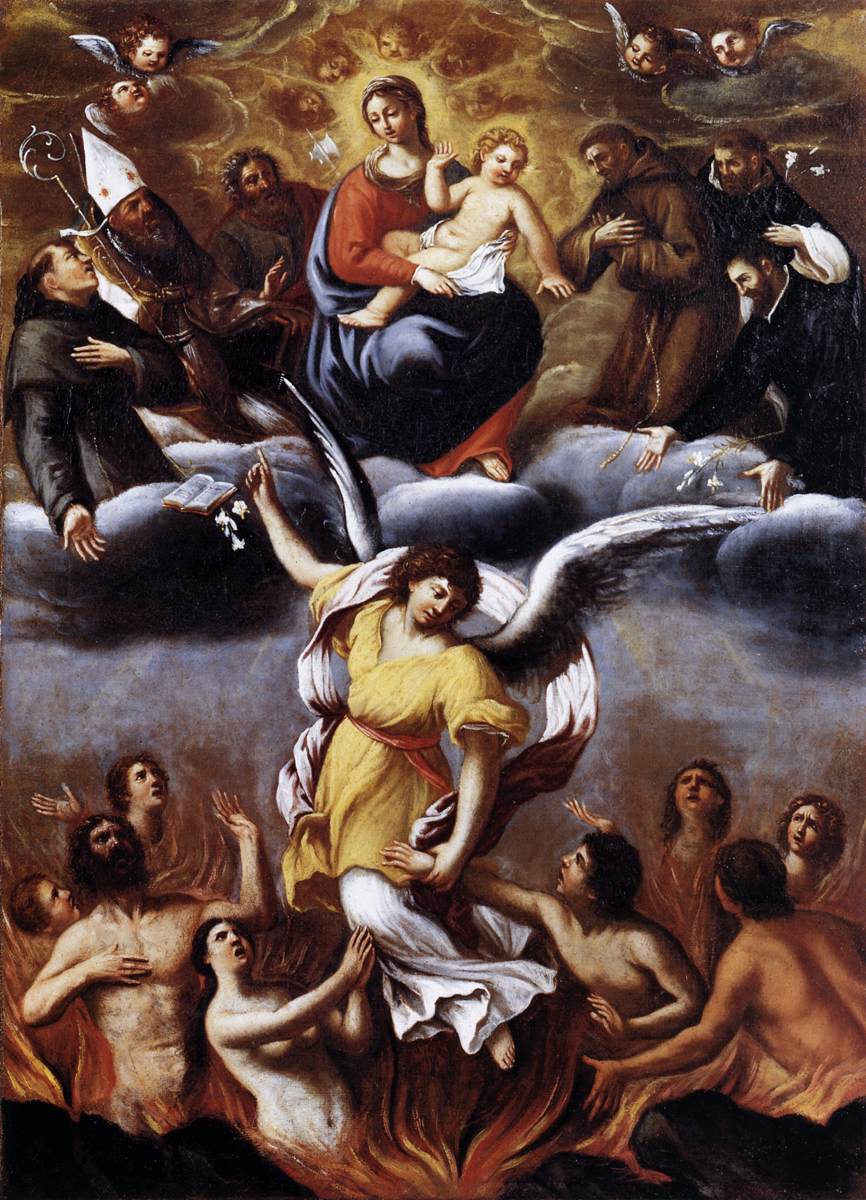
Masses for the dead, or no? Purging common ideas related to purgatory

A fiery image of purgatory by Ludovico Carracci

Recently, a congregant received a mass card from Roman Catholic friends after her mother died. A certain number of masses are going to be said at a church community or through a religious community on behalf of the beloved departed. I often get the question in such circumstances, “What is this all about?”

That’s a great and common question. It is all related to the idea of purgatory. From several verses in the Bible and the Apocrypha (Old Testament books not recognized at the level of scripture by Lutherans, but respected), Roman Catholics had developed the idea of purgatory – a place where our sins would be purged after death in order to make us worthy of living with God. More sin meant a longer time in purgatory perhaps hundreds or thousands of human years.

Thought to be a painful process or place, Roman Catholics discerned those languishing in purgatory might be helped with prayers offered for their sake. (Again, they did so using some scripture and Apocryphal sources, but also some questionable human mythic ideas that popped up over time.) In short, they began to think people could make sacrifices, pilgrimages, etc. to help the dearly departed or themselves. This eventually came to include paying money to satisfy any debt for sin. That’s where paid indulgences came into popularity and eventually Luther’s 95 Theses in opposition.

Although paid indulgences don’t exist as they did in the 16th Century, the Roman Catholic Church still holds onto the idea of purgatory and the need for additional satisfaction for sin. Although some modern Roman Catholic theologians now focus on purgatory being more of a process than a place, you still find literature and devotions allowing for a certain number of years off any time in purgatory based on prayers (rosaries said or novenas for example), masses said where the souls of those in purgatory are prayed for (usually for a donation), or specified approved service or pilgrimages (for example, some pilgrimage completed and 0 or 500 years off). At other times no such benefit is promised. The benefit is discerned by the Church leadership under the Pope, not locally. Despite some changes in or diversity amidst explanations offered, old ways die hard.

Although Lutheran’s often pray at the time of death, funerals, and committals that Christ accept the soul of the departed into his care and keeping, we don’t agree with the idea of purgatory per se. We don’t feel there is firm scriptural proof for it. Luther did for a time seem to hold onto the idea that some kind of purging would happen, but this did not necessarily mean a place existed nor was it anything faith in the death and resurrection of Jesus couldn’t cover. If there is any “purging” (or in effect “purifying”) this isn’t something we worry about or seek to describe. We are saved by grace through faith in Jesus. That’s all we know clearly from scripture. That’s what we trust in. Luther used to argue, “Remember you are baptized,” and “Jesus doesn’t lie.” If you are Jesus’ through faith and baptism, you are saved. Yet, Lutherans and other Protestants (particularly the Reformed) sometimes still talk in terms of “glorification” after death which might echo the Roman Catholic view somewhat. Yet again, we all basically reject the Roman Catholic construct of purgatory.

That said, when someone Roman Catholic has paid for masses to be said for the soul of someone who has died, a “mass card” is often sent to let the bereaved family members know. The mass is said as an offering for the person to be acceptable before God. (There might be other names prayed for at the same time.) It is meant to honor and help the departed and comfort the grieving, so I just say thank you instead of entering any theological debate. It was a gift offered in love and their faith. If they ask about our faith in regards to this practice, I’m honest. In my heart, I trust my loved one is already covered by grace through faith. On the negative side, some Roman Catholic agencies and parishes (not all) can use paid for masses as a form of fundraising – not so unlike Luther’s hated indulgences. Its problematic on many levels even among the Roman Catholic faithful, but sadly, it does happen.

Leave a comment

Filed under Church History, Grace, Theology

To commune or not to commune, that is the question.

For those who attend our theology on tap meetings, Three Priests Walk in a Bar, you might recall that we originally created a special Facebook group so conversations could continue. Our producer and facilitator, Nick2, similarly invited folks to “pick apart” our gatherings conversation at a later date. Here’s a few more items I wish to share after listening to the recent podcast of the live event held on “Can Christians Worship Together or Not?,” Episode 3.

Source: Pixaby. Used by Permission

During our recent discussions, I told a story of a young man in high school who came forward to the altar in order to commune. As I provided him the body of Christ, he said, “Amen,” consumed it, and added excitedly, “This was my first time!” I did not know this young man or his mother kneeling beside him at the time, but she appeared visibly dismayed. Traditionally, Lutherans prepare young people and new adult members for sharing in the Lord’s Supper. Her body language and facial expression indicated she and her son had done something wrong. In response, I simply said, “Welcome to the Lord’s Table.” Then, I continued to commune others and preside over the closing of our worship together.

Normally, I try to be in the narthex (the entrance area of the church building) to greet both visitors and returning church members to our Sunday service. This mother and son were visitors, but they came in as the service began. In our bulletin, we had an invitation to commune which outlined not only how to commune but also who can commune. (It specifically invited all baptized, communing members of any Christian church to do so.) I approached the mother and son after the service, not only to greet them formally, but to invite the mother and son into deeper relationship with our congregation. I didn’t overtly accuse or correct. I didn’t lecture. I just met them where they were in order that we could walk forward together with Jesus Christ.

It turned out that the family had fallen away from church attendance after moving to our area, but they desired to be one with the church again. How wonderful! Why would I put additional stumbling blocks before them to hinder them from coming to Jesus? Instead, I conversed with them, properly instructed them (especially the son regarding the Lord’s Supper), and we welcomed them into our congregation. The previously baptized young man went on to not only commune regularly but also to become a young adult leader in the congregation – one who continued in relationship with the Church through the rite of confirmation and beyond.

If he had not been baptized, it might have been a mistake or a shame, certainly improper by our polity, but I argue it would not necessarily be a sin for him to commune. A sin and a human mistake are not always the same thing. No evil or affront was intended. In 1 Corinthians 11, Paul does indeed argue against receiving the sacrament unworthily (as Fr. Nik noted), but it seems Paul is primarily addressing disunity in the community and not baptism or knowledge of the Sacrament. He never indicates how often the community should commune, but he expresses concern that some have privatized a communal act. Paul appears most concerned with how our lives relate to Jesus’ own and how love ties us in one body together.

As a result, he encourages self-reflection and examination more than present some theological argument over the form and substance of the elements or whom should be admitted to the supper. (Although some of that might have been assumed by Paul, it isn’t his main point nor preserved in writing.) The good news is that we can repent and be renewed even when facing judgement for our lack of discernment regarding love and unity. “Paul’s counsels are driven not by a veneration of the supper properly observed, but by the Corinthians’ failure to have the supper function among them as it should, namely as a beacon by which to keep their lives on the proper path of faith” (The New Interpreter’s Bible Commentary, Abingdon Press, 2002, p. 938). In Paul’s mind the illness and death in the community is a sign of eschatological judgement for disunity, not some sudden, wrath of God, superstitious punishment for lack of understanding while consuming the Eucharist. He seems to believe it is better not to participate in the meal than to dishonor it with disunity. To receive it improperly (in disunity) profanes the life and death of our Lord (Harper Collins Bible Commentary, Harper San Francisco, 2000, p. 1088).

Perhaps this is why “the kiss of peace” and confession were deemed critical to the Lord’s Supper and reserved only for the baptized in some early communities according to some Roman Catholic sources I’ve read in the past. Yet, this particular passage might not prove a great argument against who should commune or changes in practice. It isn’t really about that. Indeed, Christian communities including the Orthodox have changed some practices regarding the Lord’s Supper over time. For example, even when catechumens are dismissed in certain Orthodox liturgies, they actually don’t leave any more. (Listen to our podcast for more on this.) Reserving reception of the Lord’s Supper to those whom are baptized is primarily based upon the earliest known church practices as observed in and interpreted from scripture. It is a tradition handed down to us. Yet just as the “kiss of peace” (now “the sign of peace”) is now open to all, and catechumens are not actually dismissed any longer, perhaps other changes might be discerned by the Church in who should receive the Eucharist. (I’m not saying we should change, as I value the voices of the past, but people aren’t necessarily evil for raising the question.)

In rebuttal to my personal example above, our Orthodox friend, Fr. Adam, spoke about the necessity of knowing whom you commune and protecting the sanctity of the eucharist by overseeing (if not controlling) who participates. In ordination, the Orthodox priest promises “unto death” to protect the Sacrament. They are thought stewards of this mighty, miraculous gift. Those outside of the Orthodox Church, the only true expression of Church in their understanding, cannot and must not commune. He argued this is not exclusionary but a sign of hope that in the future we may all commune. To have someone unprepared or unworthy to commune is anathema, a grave sin in his tradition. Therefore, he must seek to welcome unfamiliar persons, and it is the responsibility of visiting Orthodox to present themselves to him. The expectation remains that only those properly baptized, confirmed and confessed, free of grave sin, participate. Thus, he inferred that the error in this case was not ultimately the young man’s but the priest’s (mine). In the Orthodox view, I should have stopped him from communing. In fact, he never should have even had the opportunity.

Meanwhile the Evangelical Church in America (ELCA), our pastors when ordained or installed promise to love, serve, and pray for God’s people, nourishing them with the word and sacraments. While respecting the sanctity of the Sacrament and the need to preside in a meet and right way, there is no explicitly, strong guardian language as with the Orthodox, although we understand that we are stewards. We recognize that the Sacraments are a means of grace, not an end in themselves. We understand that we share this responsibility with the congregational council and the people of the congregation as well. The sacrament belongs ultimately to Jesus and is our gift and honor to share.

Among those who commune, Martin Luther and our confessions condemn any requirement for preparatory acts such as confessing or fasting in order to do so. We can perform such practices as a personal spiritual discipline, but they aren’t required, and we receive no merit for salvation with any of our efforts. No one is worthy on their own or by their own efforts of receiving the Lord’s Supper – ever. No one can properly prepare to receive what is this pure gift of grace. At some level the sacrament as a means of grace always remains a mystery. It doesn’t truly belong to any bishop’s office or any pastor, but it remains a gift from Christ left in the care of the priesthood of all believers, administered in accordance with scripture, our confessions and polity. In that sense, we all are stewards of it.

Again, following Apostolic tradition, only those baptized commune. (Although, this is now being debated by some.) We instruct those baptized about to commune for the first time in scripture, our confessional beliefs, and our practices, so that they might better participate and value what they are receiving. The methodology and scope of this training varies widely by community. Hopefully, faith will increase through the training and education (by cooperating with the grace being offered), but no specific training is explicitly mandated or outlined by scripture. Though, it appears to have been a practice to educate new members of the community. Our modern model for it based on early Christian communities, early writings and traditions, but again, they vary widely within our denomination and the wider Church.

Traditionally, many if not most Lutherans appear to have communed upon confirmation. Yet with changes in the Roman Catholic Church under Pope Pius X in the 1920s regarding the age for communing and growing ecumenism, it appears discernment over these issues continued. A pan-Lutheran meeting in the 1960s settled on fifth grade as an appropriate age to commune, or nearly settled, for this wasn’t a mandate. Lutherans began to commune youth members at earlier ages as time passed, fifth grade, and still at confirmation. Today, you still find a wide variety of practices with children communing even younger than second grade at times. Even in some Confessional Lutheran bodies, it is left up to pastoral discretion. As for my practice, I enter conversations with parents to discern what might be best for the Church and the individual child. We remember that the age requirement isn’t scriptural but a practice discerned, developed even changed over time. Through our baptism, we are “qualified” in a sense or made worthy by the Holy Spirit’s presence and claim upon us (received through baptism) to be welcomed at the table. We are saved in Baptism and receiving the Eucharist through grace by faith alone. These Sacraments are deemed special means of grace.

Although requiring preparation and sacrifice for communing is condemned, I have actually heard of some American Lutheran pastors (especially in the 1940/50s) requiring confession before communing. This appears contrary to our common understanding of our confessions, the Book of Concord. We do have a rite to offer private confession, and we most often include confession as part of our Sunday liturgy or other times we share in the Lord’s Supper, but it isn’t required. Like the Orthodox, some Lutherans do require visitors present themselves before communing, and I have even been told of congregations expecting some form or written confirmation of denominational participation before one can commune. Still other Lutheran bodies will not let anyone outside of their denomination participate and refuse altar fellowship between Christian bodies if they don’t accept our Confessions fully. These more restrictive measures prove often to be taken by Confessional Lutheran congregations in my experience and the testimonies I have heard, not members of the Lutheran World Federation and ELCA (90+% of all Lutherans globally.)

In contrast, most congregations seem to just include requirements for communing in the Sunday bulletin or make announcements, and we hope and trust visitors will comply. Some of the common wording will invite any baptized communing Christians to participate. Others add that participants must also affirm the real presence of Christ in the Sacrament. We often explicitly explain our understanding of the Sacrament and mention our expectations for communing before weddings, funerals and community worship services where we sometimes celebrate the Eucharist and know many from other traditions might be present. Like the Orthodox, offering the Lord’s Supper at weddings and funerals remains rare, but it is allowed.

Whatever our policy, the majority of Lutherans do not usually challenge people at the altar rail from what I have seen and heard, although perhaps some Confessional Lutherans might. In practical terms, we do not always have the capacity (especially in a 200+ person church) to engage everyone before the service. So, again, trust might be required that people will accept our training, requests and guidance. Ushers, greeters and people in the pews are also asked to help with the welcome and orientation to the service. If people come to the rail, we usually commune them. If they did so in error and we come to know this, pastors tend to meet them later to offer future guidance and instruction. It might be deemed sloppy if not wrong by Fr. Adam and our Orthodox brothers and sisters, but I suspect God has a way of “protecting” the Eucharist better than we do. Here, my supposed “error” providentially led the young man and his family into deeper faith and rootedness in the Church likely because I responded pastorally; taking our theological and scriptural stances seriously while seeking to meet people where they are.

As much as I hear our Orthodox, Roman Catholic and Confessional Lutheran friends framing the need for theological, denominational compliance prior to communing as a hopeful thing, I struggle to accept that. It focuses on division more than welcome. It puts into question the power of our shared baptism. I accept the historic teaching and guidance that only baptized, believing Christians should commune, but if we worship the same Lord and share in baptism, why not commune together? No one properly and fully understands this mystery. I agree with John XXIII that there is more that unites us than divides us. I have witnessed grace in the way pastors and communities welcomed outsiders to the table – sometimes making pastoral exceptions to the common rules. Some communities such as Taizé seem particularly creative in their welcome. Therefore, I accept the benefit of communal standards while arguing for sensitivity and grace.

It brings to mind a story shared by Jean Vanier, founder of L’Arche:

“A young girl with a mental disability made her First Communion during a beautiful celebration of the Eucharist. After the ceremony her uncle said to her mother: ‘What a beautiful liturgy! The sad thing is that she did not understand anything.’ The young girl overheard this remark and said to her mother: ‘Don’t worry, Mommy, Jesus loves me as I am.’”

Perhaps, just perhaps, we self-assured bishops, pastors and lay leaders could learn something about the Eucharist from her?

Leave a comment

Filed under Church History, Uncategorized