Tag Archives: vmi

Being like Marshall

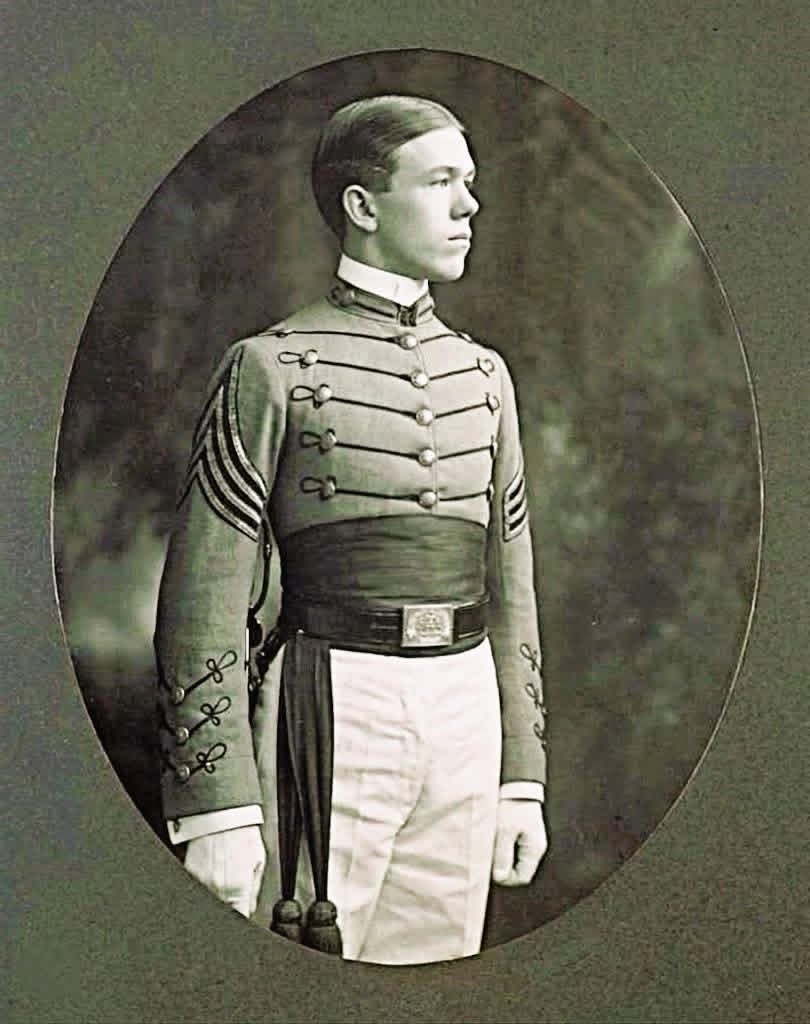
First Captain, George C. Marshall

My “Being Like…” blog posts profile the moral, ethical, and spiritual life of persons that I feel kinship too and most often am inspired by.

A recent post by History Uncovered on Facebook reported on the life of General George C. Marshall. If you don’t know him, you should. He led a remarkable life.

George C. Marshall rose from relatively humble beginnings in Uniontown, Pennsylvania. It was reportedly a stable family and one with some wonderfully historic roots. He was a first cousin, three times removed, of former but still renowned Chief Justice of the Supreme Court John Marshall. (John Marshall is definitely regarded as one of the most influential justices ever to serve, and he often came up in classes on legal procedure as I pursued my Masters in Criminal Justice.) With deep family roots in Virginia and an interest in pursuing a military career, George Marshall entered the Virginia Military Institute, my alma mater.

While there, Marshall was a solid cadet. He finished academically in the middle of his class. Yet, his overall performance, dependability, and character garnered attention and promotion. By his First Class Year (Senior), he was First Captain of the Corps serving in Company A.

As a cadet myself, he grew in my esteem with almost daily reminders as I was assigned to Alpha Company eventually becoming its commander as a Cadet Captain. By then, the top rank in the Corps of Cadets was Regimental Commander. I was told that I was one of six considered as finalist for that role, but was assigned to the company level due to my abilities working with others and positive cadet surveys. Yet, to be Alpha Company Commander as he was felt in my young mind like a connection of import and an honor of sorts.

There were other less personal reminders of his legacy thanks to a statue and arch commemorating him, but we also had access to the wonderful George C. Marshall Foundation and Museum on post. (Unfortunately, in my mind, it is more of a library for research today discontinuing some of its displays.) I spent much time there.

Thanks to the foundation’s presence, we had relatively regular access to presentations and writings about Marshall. I recall several that I attended were offered by the eminent, definitive Marshall biographer, Forrest Pogue. Yearly, VMI also served as host to the Marshall Awards where top military cadets of Army ROTC units came for an annual conference in the spring. As a cadet branching with the Army, I often escorted Generals attending the event and was able to listen in to many fabulous scholars and leaders as they shared their wisdom.

Although I changed directions from my initial desire for a military career (God had other ideas), thankfully for the world, Marshall did not. He eventually became Chief of Staff of the U.S. Army under presidents Franklin D. Roosevelt and Harry S. Truman. He’s largely credited for the Allied victory by Winston Churchill and others, although Eisenhower is more commonly known today.

After World War 2, he served as Secretary of State and Secretary of Defense under Truman. He also had the vision behind what became known as the Marshall Plan. (My grandfather graduated at the Harvard Commencement where Marshall first announced the plan on June 5, 1947. My mother was there too, as at the time, my grandfather was the oldest graduating senior that Harvard ever had to that point. He had gone directly into business, and after some success, sought more education.)

Following all his sacrifices, President Truman knew that Marshall was still not truly ready to retire. He asked Marshall to consider becoming head of the American Red Cross. Marshall consented by letter on March 15, 1949. Yet as busy as he was, he still found time to serve in the church as a leader on his local Episcopal vestry. He was a person dedicated to loving his neighbor, serving his nation but also the world. His faith and VMI seems to have greatly influenced him in this direction.

The History Uncovered post observed, “VMI was not simply an academic institution—it was a training ground for responsibility, where leadership had to be earned through conduct, consistency, and example. By absorbing these values, he gradually transformed from an ordinary student into a dependable presence within the Corps of Cadets. His performance at VMI revealed a pattern that would follow him throughout his career: he did not seek attention, but he consistently delivered structure, planning, and accountability.”

There are many great leaders from VMI, but of them all, I’ve come to be most inspired by Jonathan Daniels and George Marshall. As I’ve written before, I admire Jonathan Daniels’ clear sense of justice, willingness to serve others, and his desire to love and help free others from darkness including those who saw him as an enemy. He died doing so, saving a young African American girl’s life, thus he’s on the calendar of saints for the Episcopal Church.

As I learned more about George Marshall beyond VMI, I continued to be inspired by his humble service which I suggest also shaped by his Christian faith and loving family life along with his experience at VMI. He truly spoke truth to superiors even if likely unwelcome. A famous example is when he boldly spoke plainly to General Pershing as a Major in World War 1. While others hedged bets, Marshall told the truth. As a result, many thought his career was done for. One article reports, “Marshall shrugged off his friends’ condolences, saying: ‘All I can see is that I may get troop duty instead of staff duty, and certainly that would be a great success.” Rather than ending his career, Pershing was impressed. Marshall became a favored, trusted advisor of Pershing.

Marshall was the consummate team player, yet his morals and ethics kept him from conforming to group think or accept that which was wrong. Even at the risk to his career, he always strove to do the right thing. Although he advanced in rank, he did not seem to seek that out. He just tried to serve his nation and others.

Jonathan Daniels and George Marshall are two excellent role models, and I hope and pray my experiences at VMI and beyond along with their faithful witness will increasingly help shape my own life. Part of this influence is seen in my resume. I’ve served in a military staff position (battalion level in the National Guard) and on interdisciplinary teams as a missioner at St. Joseph’s Indian School, a hospice and hospital chaplain, as a board member on one of the largest nonprofits in Virginia, helping community groups and serving local congregations. I feel that Marshall’s example has always been before me challenging me to always do better when it comes to being a team player and to not worry about credit. (Who else rightly judges us other than God anyway?)

Yes, it’s nice getting awards or being promoted. It’s appropriate to thank people for their efforts. Yet all I really want to do is love my neighbor in thanksgiving for how Jesus changed the direction of my life. He’s still changing it, and I’m still learning, but that’s my daily hope and prayer. I think in their own unique way, both Daniels and Marshall echoed Christ’s own life and have something to teach all of us. Maybe George C. Marshall should be on a calendar of saints somewhere, but I don’t think he’d ever have cared. For in the end, whatever our vocation, we who believe are called to be saints too.

© 2026 The Rev. Louis Florio. All content not held under another’s copyright may not be used without permission of the author unless under terms of fair use and properly attributed. Scripture passages when used are from the NRSVue translation unless otherwise indicated.

Leave a comment

Filed under Uncategorized

Trying to live with decency and nobility: Why I signed the open letter to VMI’s Board of Visitors

Jonathan Daniels while a cadet at
the Virginia Military Institute, Lexington, VA

Jonathan Myrick Daniels, Virginia Military Institute (VMI) Class of 1961, was born on March 20, 1939 in Keene, New Hampshire – eighty-six years ago today. He was the valedictorian of his graduating class. In his valedictorian speech, he ended by saying, “I wish you the decency and nobility of which you are capable.” This ultimately remains a challenge to us all no matter our faith, school, or political party. We need more decency and nobility right now in our nation.

Living this ideal out, Jonathan ultimately joined the ranks of those fighting for Civil Rights while an Episcopal seminarian. He was subsequently killed sacrificing his own life to protect Ruby Sales, an African American teen at the time. He was shot by an off duty, part time sheriff’s deputy, a member of the KKK, in Hayneville, Alabama (“Bloody Lowndes County”) on August 20, 1965. Upon learning of Daniels’ murder, Martin Luther King Jr. stated that “one of the most heroic Christian deeds of which I have heard in my entire ministry was performed by Jonathan Daniels.” In 1991, Jonathan was also designated as a martyr on the Episcopal Church’s liturgical calendar.

Recently, the first African American Superintendent of VMI, Major General Cedric T. Wins, did not have his contract renewed. He and many others think it is ultimately related to bias and racism, a hatred of DEI, and other political factors rather than his job performance as evident across multiple measures. Some concerned alumni started an online open letter to the VMI Board of Visitors demanding some transparency and accountability.

The letter can be signed by VMI alumni and any friends of (persons concerned about) VMI. If you’d like to sign it or read more about this effort, visit In Alma Mater’ Name. In Alma Mater’s Name is a nonpartisan, non-political community dedicated to preserving the traditions, values, and excellence of the Virginia Military Institute. At their site, one can read the open letter, see the signers, sign it yourself, and learn about or track this issue through their page. As of now, there are over 1000 signatories to the open letter. In a sense, the letter questions the decency and nobility of the board’s decision.

I first learned of Jonathan Daniels when a cadet at VMI (1982-1986). I would occasionally study in the English majors library, “the Daniels’ Den,” in Scott Shipp Hall (the liberal arts building). He would in time become an inspiration for my own path. I have reason to suspect what happened to General Wins was not ultimately the “decent” thing to do. I, too, believe his tenure was likely conflated with hatred of the reported excesses that can come with DEI or any modern political agenda – at least in some people’s minds. For example, I saw that one alumnus posted on social media that General Wins himself was a DEI hire. Others joked openly of his tenure’s demise. I find this kind of talk an insult to his reputation, honor, and all that he accomplished in the United States Army. I admire the many challenges he overcame while serving at VMI. I suspect but cannot know that he faced harsher words in his tenure from some alumni or citizens of Virginia upset over DEI, Confederate iconography being removed, and pandemic policies, all a reflection of our brokenness in society today.

I know of General Wins from my time at VMI as a fellow cadet. He seems a decent, capable, intelligent human being deserving more respect even if one disagrees with any policies or actions. I recall that alumni widely posted their pride and high hopes as he was appointed. The General did what he was asked by the Governor (a Democrat at the time and an alumnus), and the General performed well despite the pandemic and lots of anger generated as he sought to make VMI more welcoming to all. Some vocal alumni seemed to argue nothing was amiss. They grew angrier with every change. Acclaim from some turned to open derision. Sadly, this politicization of education, stated General Wins in a recent Roanoke Times article, has pitted cadets, staff, and alumni against one another “creating a toxic organizational culture.” This hurts everyone.

The Board of Visitors’ vote to decline offering a contract reportedly reflected the preponderance of board members appointed by Governor Youngkin (R), some added just before the vote. (I’ve read that two of his appointees voted in favor of extending a contract.) That the vote occurred as Black History Month ended seems a bit tone deaf and insensitive on its face. As already considered among the most expensive colleges per student in Virginia, one can probably expect Democrats in the House of Delegates to respond negatively as others suggest. I’d suspect some young women and minority prospects might opt to apply elsewhere in this uncertain and contentious environment. Certainly, if anecdotally, it seems many outside of the VMI community are judging VMI harshly for this move from what I see on social media and in news reports. Based on what I know from my relationship with VMI, a response is likely warranted especially if more positive change is to come. Yet, don’t be surprised if some argue to close the school. That’s come up in the past as far back as the 1920s for varied reasons.

Supporters of VMI often claim, “VMI is good.” Certainly, it was very good for me. I still recommend the school almost forty years after graduation. There are many great, generous and loving leaders that were molded at VMI now serving in all walks of life. Yet as a First Class Cadet (Senior), I had to stop a Third Class Cadet (Sophomore) from passing around virulent anti-Roman Catholic tracks and comic books. (I was Roman Catholic at the time and President of the Newman Club as well as President of the interfaith Religious Council.) It was out of ignorance, and he repented. I forgave him, and we moved on.

In town, the KKK posted flyers against minorities while I was a cadet. Their wild accusations against others included Roman Catholics. (Among the more ludicrous claims was that the Pope was plotting to take over the post office.) I also overheard upperclassmen jokingly talking about Roman Catholics as “Fish Eaters” while a cadet. I never heard that before or since, but I interpreted it as idiotic bias. I heard people openly and often say Roman Catholics were not Christians. I had Jewish cadets share similar frustrations. They felt uncomfortable and misunderstood in the very overtly Evangelical and often pushy conservative Christian culture present at VMI at the time. Intentionally or not, the welcome mat didn’t always seem out. I have other stories too from my time as a cadet. (As a graduate, I have heard other more recent concerns, but only second hand. These Jewish cadets – now alumni – would have to come forward to share their stories, but I was told that they hesitated out of fear of repercussions.)

I want to note that the chaplain at the time, Col, Charles Caudill, worked hard to address such issues – to build both understanding and community. The chaplain office’s Religious Council actively sought out diverse membership under his watch. I always trusted I could go to him to talk honestly about life in the Corps, even when we disagreed over things at times, and the Religious Council ultimately brought cadets of diverse faith together to help facilitate all religious life. Many members also became my friends.

Unfortunately outside of religious bias, I’m also aware of a few felonies (properly adjudicated thankfully) being committed by cadets on occasion – some very serious. I know some later female graduates who have claimed to experience bias and overt abuse. And, also since my cadetship, I’ve heard alumni concerned at times that the Honor Court might be unfairly targeting people – often athletes and thus often minorities. A report suggested just that in 2021. Then within its adversative system, one which helped me grow as a leader, there’s always a tension over what is placing pressure on cadets to push to their limits often while under great stress and what is hazing. It was debated then, and I expect it is debated now. Even the modern US military struggles with this issue, so I don’t think that’s a surprise. Although, I hear there are many more controls, limitations, and safety protocols in place today at VMI to make what’s called the Rat Line safer. (It’s also a shorter duration than when I was a cadet.)

My African American peers never spoke to me about racism and bias when I was a cadet at VMI (no real surprise considering the culture of the time), but some have been more willing to talk in recent years. If they say they faced discomfort, a lack of welcoming, or more overt negative treatment, I’m going to listen to them; not deny everything off the cuff. These are people I respect and trust. I have no reason to doubt them. I’d encourage other alumni to speak to past minority and female cadets that they know. I suspect some people might now share stories.

Certainly, most minority cadets of my time were not keen on saluting Jackson’s statue, a requirement for new cadets at the time. Many likely bristled to answer the common question asked of first year students called Rats, “Who won the Civil War?” The demanded answer was, “VMI with the help of the South.” My First Class mentor when I was a Rat, also from Massachusetts, insisted instead that I answer, “The United States of America, Sir.” That earned me a lot of push ups, but I wouldn’t call my treatment abusive. It was annoying though. How much more annoying for my minority classmates? Only they can say or truly know. I never shared that experience or context as a white cadet.

So, although I usually prefer writing my own advocacy letters, and I’ve only signed one other group letter before (with other Richmond pastors against racism as self-identified KKK, Proud Boys, and Neo-Confederate members began to make appearances as the Robert E. Lee statue’s future was debated), I’ve signed the letter mentioned above. I expect some of my classmates and VMI contemporaries might not fully understand why.

Yes, VMI is much more good than bad. It’s the same school that nurtured George C. Marshall and Jonathan Daniels for a start. (I’ve not sought to share that much longer, more comprehensive, positive history here. There are many sources you can find for yourself if interested.) Yet, it’s always been a school comprised of imperfect humans – some very imperfect. There have been bad things that have happened and still likely could happen as on any campus. Yet this all leads me to say, “VMI is good, but it always can be better. So can I. So can we all.” Recognizing VMI has growing edges is not a betrayal of the school or its alumni. In fact, I am writing this blog post because I care about its cadets, faculty and staff, and all its alumni, along with its ongoing legacy.

If I had more influence, I’d like to see more interpretive signage across campus and cadet led history projects (perhaps even a podcast) on the past wrongs at VMI just like Mount Vernon has done – particularly on slavery, the context and VMI’s part defending that horror. I’d like to see more focus on women’s rights and other hot button issues, not to indoctrinate, but so that cadets can learn to agree or disagree on sound principles rather than assumptions or feelings. I’d like more history and ethics courses wrestling with these issues and to provide cadets with the broadest experiences possible across genders, cultures, and religions affiliations, and yes, that means humanist secularism too. They would be better able to engage with the world with more decency, empathy, and compassion. I suspect they would prove wiser too. One can be book smart yet very unwise.

The Institute seems much better in academics, military training, studying abroad, and in addressing such tender subjects as above than when I was there. Our culture as a whole in the US has improved in its treatment of racial, ethnic or religious minorities, women, and others, although it might not always feel like it. (This is supported by many research markers, but sadly, this, too could be regressing.) Yet many of the recent improvements at VMI have been because of the influence of General Wins along with dedicated faculty and staff who want cadets ready for a multicultural world. I’d hate to see VMI move backwards. So, if not DEI, what other efforts can be made? We shouldn’t be afraid to say that it’s not a perfect place.

My signature on the open letter only represents me, no other organization, nonprofit, or my congregation. Yet, I think transparency and accountability is not a big or controversial ask. I remain hopeful VMI will continue to evolve and excel. Even with all I’ve shared above, again, I know there’s much more good. I can honestly sing with other alumni the old school song ending, “God bless our team and VMI.” I’m hoping and praying that we all are always capable of greater decency and nobility by God’s help.

© 2025 The Rev. Louis Florio. All content not held under another’s copyright may not be used without permission of the author.

4 Comments

Filed under social justice

Rethinking the Civil War, It’s Legacy, & Me

Click this image to read the article alluded to below in my blog, “Why Do Confederate Lies Live On” in The Atlantic.

“When I was a child, I spoke like a child, I thought like a child, I reasoned like a child; when I became an adult, I put an end to childish ways” (1 Corinthians 13:11).

Recently, I came across an excellent article in The Atlantic called “Why Do Confederate Lies Live On.” It was written by Clint Smith, an African American staff writer with the magazine. Focused on his experience with the chapel at Blandford Cemetery, it gave me reason to pause and reflect about my own life.

VMI Cadet Hartsfield of the Battle of New Market is buried somewhere in the Blanford Cemetery in a grave lost to history. In 2014, Petersburg’s VMI alumni group asked me to offer an invocation and benediction for their recognition of the 150th anniversary of the Battle of New Market on May 15th. I was serving as a pastor in Richmond at the time. I naively expected a small, outside event from what I was told. It ended up being a larger event in this cemetery chapel. (I had never heard of this chapel before my visit.)

I was told a World War 2 veteran who survived landing just a day or so after D-Day and fought through the war would speak about his experiences. He did, and that was positive. I did not expect a local SCV color guard with the Stars and Bars battle flag or the explicitly Confederate windows. It was sort of creepy and fascinating at the same time.

My previously prepared prayer alluded to the errors and evils of the Civil War. Yet now, I wish that I had explicitly and strongly refuted slavery and racism as part of it. I mentioned how the cadets’ actions under fire likely helped lead to the preservation and restoration of VMI after the war and perhaps indirectly helped shape or inspire folks like George C. Marshall and Civil Rights Martyr, Jonathan Daniels, and others to bravery or to do their duty. (At some level, I think that remains true for me.) I realize that God can make good come from anything, even our sin. I prayed VMI and our nation would become ever better, more just, and reconciled.

On one hand, I was honored to be asked by fellow alumni, especially for this momentous 150th anniversary year of the Civil War. My fellow alumni were hospitable, and like many alumni including myself, love VMI. On the other hand, I wish I went further and spoke more clearly about the sins of racism, slavery and treason. I value history, but we need to tell the whole story – even the ugliest parts.

Even though I’m from the north, even though some of my ancestors fought for the United States during the rebellion, even though my First Class dykes (senior mentors are called dykes after the cross-belts or dykes worn as part of the uniform) used to have me answer, “The United States of America, Sir,” to the question at VMI about who won the Civil War, the Lost Cause Myth can insidiously take hold of a person if we aren’t wary. It can obscure our vision and understanding, as well as stir division or wound others unintentionally. The myth dresses up and softens what’s ugly. After all, that myth and racism in all forms are just more signs of sin at work in our lives and world. And, sin often traps us subtly over time.

I’m not the person I was in 2014. My attitudes have hopefully continued to evolve, and I pray I continue to grow in understanding and empathy. Wherever needed, I desire the wisdom to repent of my sin including any sin related to racism. I want the courage to challenge racism wherever it is encountered. I’m not looking to erase history. I understand all of us, even the best of us, can only be simultaneously sinner and saint and never perfect. It can be helpful to remember the past. Yet as Christians, we understand we are always reforming. We need to separate ourselves from rigid, dualistic (that everything is all good or all bad), or simplistic thinking and bravely embrace the truth of our past and our present whatever we might see. We can love and respect our enemies, even those of the past, even as we seek to see them and their failures as they truly are.

Want to learn more? I would highly recommend this additional text: Robert E. Lee and Me: A Southerner’s Reckoning with the Myth of the Lost Cause.

Unless otherwise indicated, all scripture quotations for this post are from the New Revised Standard Version (NRSV) translation.

© 2021 The Rev. Louis Florio. All content not held under another’s copyright may not be used without permission of the author.

Leave a comment

Filed under Church History

Love & Resurrection

I lost fear in the black belt when I began to know in my bones and sinews that I had been truly baptized into the Lord’s death and Resurrection, that in the only sense that really matters I am already dead, and my life is hid with Christ in God. – Jonathan Daniels

Jonathan Daniels was a graduate of the Virginia Military Institute. He went on to become an Episcopal seminarian at the Harvard Divinity School, and from there, became a martyr in the deep south on August 20, 1965.

Jonathan Daniels was a graduate of the Virginia Military Institute. He went on to become an Episcopal seminarian at the Harvard Divinity School, and from there, became a martyr in the deep south on August 20, 1965. To learn more, click this image.

Jonathan Daniels was a white seminarian who felt called to help Dr. Martin Luther King, Jr. with civil rights work in the Deep South. Shortly before his martyrdom, he penned the words above. In his work, he had stared down violent threats and intimidation. His freedom in Christ helped him love with great abandon. Indeed, he loved unto death.

On Friday, August 20, 1965, he was heading to a general store in Hayneville, Alabama to get drinks with three friends. A local man, Tom Coleman, met them as they approached. He threatened them and leveled his gun at seventeen-year-old Ruby Sales who was African American. Daniels pushed Sales down to the ground and caught the full blast of the discharge. He died a martyr living out Jesus’ teaching, “No one has greater love than this, to lay down one’s life for one’s friends.” Martin Luther King, Jr. said Jonathan Daniel’s martyrdom was “one of the most heroic deeds of which I have heard in my entire ministry and career for civil rights.”

We might never be called to martyrdom, but we are called to love with abandon like Jonathan Daniels and so many of our Christian brothers and sisters before us. Ordinary people in so many ways, many of the greatest saints were quite fallible. Yet, they experienced the love of Christ in a way that changed them. They came to understand resurrection was not just an event only involving Christ in the distant past or one far in the future at the end of time. We can live a resurrected life starting now when we trust Jesus with our lives. It is that trust that frees us from sin, death, and the Devil. It frees us to love in miraculous ways, whether the world recognizes it or not.

I pray that as we approach another Easter, we don’t seek Christ in any old, dusty tomb. Let us seek him in our hearts and the relationships God leads us into. Find him in his holy word, studying it alone or with others. Encounter a foretaste of the feast to come in corporate worship at church or in the home. Serve the Risen Christ in the one’s he has entrusted to your care, perhaps even those whom you resent or whom are your enemies.

Yes, Jesus is risen. He is risen indeed! It is amidst our ordinary life and among our average neighbors that we will find him and begin to experience the new life he promises. He has gone ahead of us, waiting for us in our future. Do not be afraid. Rejoice, for “there you will see him,” much as the disciples were told in Matthew 28:7.

Christ’s peace to you, and happy Easter!

Pastor Lou

The above pastoral letter was originally published in Messiah Lutheran Church and School’s newsletter, The Messenger (March 2013 edition). To view the entire issue of The Messenger or to see the full calendar of events, visit: http://www.mlcas.org

Unless otherwise indicated, all scripture quotations for this article are from the New Revised Standard Version (NRSV) translation.

© 2013 The Rev. Louis Florio. All content not held under another’s copyright may not be used without permission of the author.

2 Comments

Filed under Church History, Community Life, saints, social justice, Uncategorized