Category Archives: Church History

Crime Log: Nicholas of Myra

Mugshot of Suspect: Bishop Nicholas of Myra


Mugshot of Suspect: Bishop Nicholas of Myra.
Used under fair use guidlines – (c) Anand Kapoor, 2004
(Click the photo for more images from stnicholascenter.org)

Ladies and gentlemen, the report you are about to read is true. Only some names have been changed to protect the innocent…

Nicea Police Department – Crime Report

Date: On or about May 20, 325 AD

Offense: Assualt & Battery                                                       Case Number: 1225

1. Victim: Arius, Presbyter of Alexandria, Egypt

DOB: UD, 250 AD or 256 AD     National Origin: Central-North African

S: Male     Ht.: UK     Wt.: UK  Skin: Dark to Olive color

Other: Facial Hair – full beard; described as “tall and lean, of distinguished appearance and polished address.”

Previous Arrests & Torture: N/A

2. Suspect: Nicholas, Bishop of Myrna, Region of Lycia

DOB: UD, 270 AD     National Origin: Greece

S: Male      Ht.: 5′ 6″      Wt: 160 – 200 lbs.  Skin: Olive

Other: Facial hair – full beard; previously broken nose

Previous Arrests & Torture: During the persecution of Christians under Roman Emperor Diocletian

3. Disposition: Arrest

4. Incident Summary:

Presbyter Arius of Alexandria, Egypt reported that Bishop Nicholas of Myra (aka Nikolaos of Myra) did intentionally assault and batter him in the presence of multiple witnesses on or about the start of the Emperor’s church council in 325 AD. Witnesses included his royal highness, Flavius Valerius Aurelius Constantinus Augustus (aka Constantine I), Emperor of Rome, along with over 300 bishops, other clergy, scribes, servants, and attendees.

Presbyter Arius stated to officers that he was attending the First Ecumenical Council of Nicea to defend his position on the Trinitarian controversy over the nature of The Son, Jesus Christ, and his relationship to God the Father. Arius contended that Jesus as the Son of God was not the eternal God, but rather was created by God the Father – a denial of the more widely accepted concept of the Trinity.

Bishop Nicholas took issue with Arius’ position. He rejected the view of Arius and his followers that “there was once that when he was not” and was of the attendees arguing for the co-eternity of the Son with the Father. Also rejected was the position that Jesus was  “mutable or subject to change” in his essence. Bishop Nicholas agreed with those who maintained that the Son just like the Father was beyond any form of weakness or corruptibility, and most importantly that he could not fall away from absolute moral perfection.

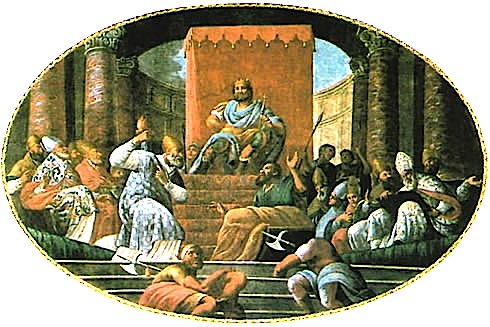
At some unspecified point, the scholarly debate turned into an argument, and the victim along with mutiple witnesses from the assembled council (see supplement to this report to be filed later) stated that Bishop Nicholas did use his right hand or fist to punch or slap Arius, causing the victim to fall to the floor. Seeing the alleged offence, the Emperor and assembled bishops had Bishop Nicholas taken into custody, stripped of his bishop’s garments,  and thrown in prison to cool off.

Upon interview of the prisoner by this reporting officer, Bishop Nicholas admitted the offense done “out of love for Jesus Christ.” He stated he had grown tired of Arius’ insults to Christ’s full divinity. Further legal action is pending, but Bishop Myra is expected to return to his duties upon the request of Emperor Constantine in his role as Pontifex Maximus,  the high priest of the College of Pontiffs of Rome.

It should be noted that the suspect has reportedly been involved in previous altercations and incidents of public controversy, including but not limited to: saving young women from slavery, protecting sailors, sparing innocents from excecution, providing grain in a famine, and the rescue of a kidnaped boy.

Artist rendition of the alleged offense.

Artist rendition of the alleged offense.

Form NPD-CR1                           Reporting Officer: Centurion A. Brutus 

Happy Feast of St. Nicholas, December 6th!

© 2012 The Rev. Louis Florio. All content not held under another’s copyright may not be used without permission of the author.

Leave a comment

Filed under Church History, Liturgical Year, Uncategorized

Put the Chi back in Christmas

For all the hubbub about using “Xmas” instead of “Christmas” as shorthand (and in some cases where people intentionally desire to erase any reference of Christ from Christmas by using Xmas), the ironic, historic truth remains that ancient Christians utilized the Greek letter Chi and letter symbol Chi-Rho as a means to represent Jesus Christ. Such symbols are called christograms.

You see, the name Jesus Christ in Greek, the language of the New Testament texts, is Ἰησοῦς Χριστός. The first letter of the title Christ (signifying Jesus as the anointed one, the Messiah) looks like our English X and became a convenient, somewhat obscure way for early Christians in the catacombs and elsewhere to identify artistic representations of Jesus and Christian markings, signs, or art – similar to use of the Christian fish symbol.

Later, the Emperor Constantine I had a dream that he should put the “heavenly divine” symbol of Chi-Rho on his army’s shield before the Battle of the Milvian Bridge to guarantee victory. He did just that, won the battle, and turned the formerly pagan empire into a Christian one. The Chi-Rho symbol became and remains one of the most common christograms used in sacred and liturgical settings. In fact, it is often used as part of the modern Christmas tradition of the Chrismon Tree. Invented by a Lutheran in Danville,  Virginia in 1957, this practice is now popular in many congregations throughout the United States and across denominational lines.

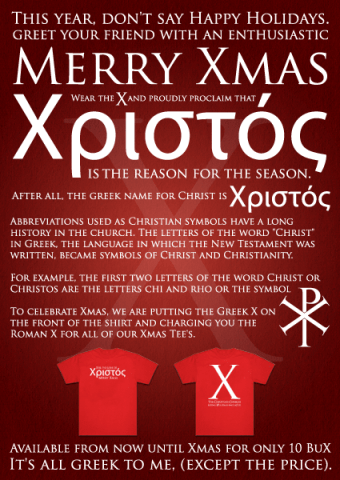
As I find the debate over the use of Xmas somewhat distracting if not tedious and dislike the rush toward Christmas only to hide it away from the public eye as soon as December 25th passes, I try to experience Advent as a true time of expectant waiting and preparation. I also make an effort to enjoy the traditional Christmas period lasting twelve days through Epiphany on January 6th. So last year as Christmas approached, I posted an image I had found by Orthodox iconographer Raymond J. Mastroberte on Facebook saying, “Keep Chi in Christmas…Because early Christians used Greek abbreviations!” The illustrator’s image struck my sometimes questionable funny bone, and I playfully proclaimed that I would be putting the Chi in Christmas all twelve days.

Image and copyright by Orthodox iconographer Raymond J. Mastroberte. Image used here for teaching and not for profit under the terms of fair use.

Image and copyright by Orthodox iconographer Raymond J. Mastroberte. Image used here for teaching and not for profit under the terms of fair use.

In the context of our modern conundrum over Xmas, it wasn’t long until someone missed my attempt at humor. They argued that surely since Jesus Christ had done so much, suffered and died for our sake, we could most certainly take the time to spell out his name in full. It was as if the ancient Christian signs and symbols were suddenly disrespecting our Lord. And so, my attempt at lighthearted banter fell as another victim of this modern culture war.

As the past few years attest, an annual argument has indeed arisen about the secularization and explicit anti-Christian elements of our Christmas celebration. It should be expected, for in school gatherings and shopping malls, on public plazas and in our homes, religious symbols for Christ and his birth have come to be often replaced by winter scenes, Santa and his reindeer, snowmen, cute penguins or polar bears…the list goes on and on. In fact, some suggest that many Americans can’t specify what the Christmas holiday commemorates.

In opposition to Christmas, one atheist author argues that there is historically no proof that “Christ is the reason for the season.”[i] They suggest that winter celebrations have always existed, and such a modern mantra is only a Christian attempt to assert their cultural superiority over everyone else. Sadly in the name of multiculturalism, echoing choruses of Merry Christmas can be explicitly prohibited in some environs. Yes, just as there was no room at the inn on the original Christmas Eve, there seems to be no room in our public lives for Jesus today.

Yet, let’s not be too quick about things, as there are other signs to look for. Gallop found, “Ninety-five percent of Americans celebrate Christmas, and of these, 51% describe the holiday as ‘strongly religious’ for them, continuing an upward trend seen since 1989.” This 2010 poll also found a majority of Americans self-reported “incorporating specific religious activities or symbols into their holiday celebrations. This includes 62% who attend religious services on Christmas Eve or Christmas Day, 65% who display decorations with a religious meaning, and 78% who take time to reflect on the birth of Christ.”[ii] Self-reporting surveys can prove inflated, but we can see signs of hope for our beloved holiday.

Nevertheless, further confusing this debate, this same Gallop study found many more Americans were likely to practice secular traditions (in the ninetieth percentile range, depending upon the activity) than religious. Sadly, a recent poll by Think Finance claimed that 45% would rather skip Christmas due to the debt accumulated from gift giving.[iii] Others seasonally face bouts of depression or other mental illnesses magnified by their isolation or sense of loss during the holiday season, and thus they dread Christmas’ arrival.[iv]

Amidst debates and arguments, blinded by bobbles, decorations, and good deals, we can forget that our redemption is drawing near. Our time on earth is short, and we should live with hopeful and loving expectation as if Christ will indeed come soon. Signs of trouble and even outright persecution are nothing new. Jesus promised us such as these in his prophesies, comparing them to birth pangs.[v]

Should we then be so surprised that people are confused, lost, and hurting when it comes to Christmas and more importantly Jesus Christ? Should we let this distract us from our call as a holy people living together in Jesus’ holy name? Intentionally seeking the newborn Christ in our own hearts, we can repent of our own errors and grow in faith. Living as part of his body through our shared ministry of preaching, teaching and baptizing, or accepting and loving others (even our enemies) as they are, we can be used by God to bear Jesus into the world.

The devil’s in the details, and so it appears with our modern Christmas. Let’s not get anxious about the holiday – lost in empty debates or the holiday wrapping of materialism. As Christians, we are called to celebrate!

Look to the true heart of Christmas toward Jesus Christ himself, the final Word on this argument, come to save us. Whatever we choose to do and however we choose to say it, let’s seek to make Christ known every day. Look past the veneer of our time and see those suffering and alone around us. Enter relationship with them, help them, or guide them toward people who can. Celebrate the truth of Christ’s coming within every aspect of our lives – for the love of Χριστός, ourselves, and our neighbors.

There are more than enough signs of trouble and discord. Let’s not waste time dwelling upon them or pointing them out. Instead, let’s seek to be living, joyful signs that Jesus is near. That’s probably the best way for any of us to wish the world a meaningful Merry Christmas and eternity.

My wife, Kristine, and I wish you a holiday filled with blessings. May those same blessings flow through you to help transform the lives of others.

Pastor Lou

For those interested, visit OldLuteran.com for their comical take on this debate. Access their site through the image below:


[i] Cline, C. Putting Christ Back in Christmas: Is Jesus the Reason for the Season? as downloaded from http://atheism.about.com/od/christmasholidayseason/p/JesusReason.htm on November 30, 2012.

[ii] Jones, J.M. Christmas Strongly Religious for Half in U.S. Who Celebrate It: Secular traditions more common among Americans than religious traditions.  December 24, 2010 as downloaded from http://www.gallup.com/poll/145367/Christmas-Strongly-Religious-Half-Celebrate.aspx on November 30, 2012.

[iii] Berk, C.C. Why One Poll Says 45% Would Rather Skip Christmas. November 19, 2012 as downloaded from http://www.cnbc.com/id/49880517/Why_One_Poll_Says_45_Would_Rather_Skip_Christmas on November 30, 2012.

[iv] See for example Mayo Clinic’s Stress, depression and the holidays: Tips for coping at http://www.mayoclinic.com/health/stress/MH00030

[v] See for example Luke 21: 25-36 or Mark 13:8.

The above pastoral letter was originally published in Messiah Lutheran Church and School’s newsletter, The Messenger (December/January 2012 edition) in an abridged version. To view the entire issue of The Messenger or to see the full calendar of events, visit: http://www.mlcas.org

Unless otherwise indicated, all scripture quotations for this article are from the New Revised Standard Version (NRSV) translation.

© 2012 The Rev. Louis Florio. All content not held under another’s copyright may not be used without permission of the author.

Leave a comment

Filed under Church History, Community Life, Lectionary, Liturgical Year, Pastoral Letter, Uncategorized

Doom but not gloom

Christ the King

Today, too many fear the promised return of our Lord Jesus. In movies and other works of fiction, many can only imagine a terrible time of horror, suffering and judgment. Indeed, we are told in scripture that the end of time promises some form of Judgment Day will occur, but all is not a future full of darkness alone. With the symbolic language and prophetic texts used to speak of such a time, people tend to actively speculate about what such a time could be like. Many let their imaginations run wild for profit, the intimidation of others, or perhaps just out of ignorance. Yet in truth, to try to discern the mechanisms and mechanics of Judgment Day puts us at risk of being unbiblical. Such an exercise always proves futile for we lack God’s vision and understanding.

Instead of speculating about suffering or damnation, perhaps we should hold fast to Christ’s promise that he returns out of love for us. For rather than inspiring fear or proving a map to a terror-filled future, texts such as Revelation were written as much for (if not more for) Christians suffering in the present time to find hope and encouragement amidst persecution. In it, we are assured Jesus will most certainly come to complete what his life, death, and resurrection started. Jesus will come for us and our sake, to set the world right and bring new life. Thus rather than fearing the End of Time, the earliest Christians prayed that Jesus would come soon. The Second Coming is Christ’s answer to all that terrorizes our present lives, and we modern folk should rightfully celebrate along with those Christians who came before us.

Much after the first Christians, during a time when nationalism and secularism was taking a toll on the world through wars, greed, and political dysfunction, the feast of Christ the King was first introduced by Pope Pius XI in 1926. By 1969, the date was changed from the last Sunday in October to the last Sunday of the liturgical calendar year. Today, it is celebrated by the Roman Catholic Church along with many Anglicans, Lutherans, other Mainline Protestants, as well as parts of the of the Orthodox Church.

This ecumenical feast day is a celebration of hope while the universal church awaits Christ’s return. It serves to remind us that we should seek to live as one under our one Lord, Jesus Christ, loving God and our neighbor as ourself. Like the Christians before us, we remember and trust that Christ will come again – praying with hope that he comes soon. For only then will we experience the fullness of our promised life with him where “he will wipe every tear from their eyes. death will be no more; mourning and crying and pain will be no more, for the first things have passed away” (Revelation 21:4).

In the Evangelical Lutheran Church in Sweden, this feast day has been referred to as the Sunday of Doom. This name is somewhat ironic. There is doom in a sense, but we should never be overcome with doubts and sorrow as Christians. There is much more in store. The old world will pass away, and a new heaven and earth will be shared with us. Those who believe will be fully saved  and judged as if righteous; not based upon what they have done, but solely by grace through faith – trusting in what Jesus has already done for us through the power of his cross and resurrection. This Christ proclaimed, and it will be fulfilled.

Our true King will indeed return, but whatever trouble must come in the meantime, we should worship him, rejoice and be glad while we wait. We should set our hands and hearts to the work of making ourselves and our world ready for his return. For as much as we expect Christ, he asks and expects this of his faithful church.

Yes, the best is yet to come, and as Christians, we are promised that End of Time will mean a new beginning with our loving Savior and King. Our future (in the end) is nothing but bright.

Happy Christ the King Sunday!


Unless otherwise indicated, all scripture quotations for this article are from the New Revised Standard Version (NRSV) translation.

© 2012 The Rev. Louis Florio. All content not held under another’s copyright may not be used without permission of the author.
Leave a comment

Filed under Church History, Law and Gospel, Lectionary, Liturgical Year

The Reformation: It isn’t just for Lutherans anymore. (It never really was.)

Today at worship, we remember the posting of Martin Luther’s 95 Theses on October 31, 1517. More important than that, we celebrate with thanksgiving that the Holy Spirit worked through Luther and other reformers to bring a renewal to Christ’s church – one still playing out today. Even during that difficult time of misunderstanding, false (and some valid) accusations and critiques against Luther and Protestants, regrettable divisions, and outright war, the Roman Catholic Church did reform itself in many areas through what they call their own Catholic Reformation. This was partly a direct response to true abuses identified by Protestant Reformers. Never expected when Luther hammered his 95 Theses on that church door in 1517, the entire church grew in its faith understanding as it argued about and searched for God anew. Even some alternative faith expressions have been born (such as the Anabaptist traditions, pietistic faiths and more). Although plenty of missteps have been made by human believers, this movement of the Spirit has enriched Christ’s church, and it indicates God is still speaking to us – still transforming us by grace through faith in his Word, Jesus Christ.

True, all remained imperfect in our fallen world. Mutual condemnations continued primarily until the aftermath of WWI and later WWII. Yet through the horrors of war and genocide, many Christian began to ask why we should hate one another. It could not please God. Within this spirit of repentance, the Holy Spirit worked to help heal and address divisions. Using ecumenists such a Dietrich Bonhoeffer, Brother Roger of Taize’, along with many others (some remembered and some not), and partly through the leadership of Pope John XXIII and the Second Vatican Council, another renewal of the Church began – not unrelated to Luther’s own actions in 1517 and later. In fact, many of his historic arguments were revisited with a new openness of heart. Resulting changes have proven so profound that the Roman Catholic Pope John XXIII and other Roman Catholics, along with Christians of other faith traditions are included in the Evangelical Lutheran Worship’s calendar of commemorations. The World Council of Churches, the Lutheran World Federation, full communion agreements between denominations, and ecumenical dialogues remain signs that we hope and actively seek to move that process forward.

Ecumenical discussions continue despite any mistakes arguably made at times and the reality that some Christians still reject any such talks and cooperation. One result has been the recent agreement of what it means to be justified through faith. Although some historic differences might remain in practice, Catholic and Lutheran reforms over the last century have resulted in denominations remarkably similar even amidst their differences. The current Pope Benedict often speaks well of Luther even if he doesn’t fully agree with everything Luther said or did. He agrees with Luther’s “burning question”, as Benedict puts it: “what is God’s position towards me, where do I stand before God?” As a Roman Catholic publication recently noted, this remains the central question of life today, even though many people don’t realize it. He also applauds Luther’s Christ-centered spirituality. Last echoing Vatican II, Pope Benedict remarks, “It was the error of the Reformation period that for the most part we could only see what divided us and we failed to grasp existentially what we have in common in terms of the great deposit of sacred Scripture and the early Christian creeds. For me, the great ecumenical step forward of recent decades is that we have become aware of all this common ground, that we acknowledge it as we pray and sing together, as we make our joint commitment to the Christian ethos in our dealings with the world, as we bear common witness to the God of Jesus Christ in this world as our inalienable, shared foundation.” (See Brumley, M. The Pope, Martin Luther, and our time. The Catholic World Report. Posted September 25, 2011 at catholicworldreport.com)

It is truly remarkable that the Roman Catholic, Lutheran and recently Methodist denominations have agreed on a Joint Declaration on the Doctrine of Justification over the last 10 or so years. This remains yet another sign that the Spirit is still at work, that God will make all things work for the good as scripture promises, and that Jesus’ prayer that we be one need not remain a dream forever.

As we remember Martin Luther and the Reformation and perhaps seek to celebrate all things Lutheran, let us also look kindly upon all of our brothers and sisters in Christ. I believe we must seek to actively and intentionally listen for God’s guidance together, living in Christ’s love and the hope of what is yet to come through the Spirit’s work in our midst.

To read this historic document, Joint Declaration on the Doctrine of Justification, visit the link below:

http://archive.elca.org/ecumenical/ecumenicaldialogue/romancatholic/jddj/index.html


© 2012 The Rev. Louis Florio. All contents not held under another’s copyright may not be used without permission of the author.
Leave a comment

Filed under Church History, Law and Gospel, Liturgical Year

New Worship Times for Messiah Lutheran!

As a prisoner for the Lord, then, I urge you to live a life worthy of the calling you have received. Be completely humble and gentle; be patient, bearing with one another in love. Make every effort to keep the unity of the Spirit through the bond of peace. There is one body and one Spirit, just as you were called to one hope when you were called; one Lord, one faith, one baptism; one God and Father of all, who is over all and through all and in all. (Ephesians 4:1-6)

[Jesus said,] I will remain in the world no longer, but they are still in the world, and I am coming to you. Holy Father, protect them by the power ofyour name, the name you gave me, so that they may be one as we are one. (John 17:11)

Dear members and friends of Messiah Lutheran:

As announced in our newsletter and at worship, we have the great opportunity to concretely live out Paul’s hope for unity among believers and Christ’s prayer that we live as one. Our brothers and sisters of All Souls Episcopal (a mission congregation) will begin worshiping at 9:30 AM on most Sundays as our regular guest while they work toward establishing their own facility. This required we set new worship times of 8:00 AM and 11:00 AM starting this Sunday, August 12th.

Please join me in welcoming them, as I am confident they will welcome you, as one family in Christ. Along with our worship space, we will be sharing in some ministries to build up the body of Christ and share Christ’s love within our community. We hope this sets a firm foundation for when they have their own building; that this cooperative relationship continues to the glory of God.

The early Lutheran Reformers did not see themselves as fracturing the church, but rather hoped to repair divisions while living consistent with their individual understandings of scripture. Thus, the vast majority of Lutheran bodies throughout the world have been open to ecumenical efforts from the beginning. To learn more about the special cooperative relationship of the ELCA and Episcopal Church as well as with five other denominations in the United States, follow this link:

http://www.elca.org/Who-We-Are/Our-Three-Expressions/Churchwide-Organization/Office-of-the-Presiding-Bishop/Ecumenical-and-Inter-Religious-Relations/Full-Communion-Partners.aspx

A “full communion” relationship does not indicate a merging of these denominations with the ELCA, but it instead declares our intention to live as one as much as possible (repairing historic wounds while helping one another through the sharing of pastors, ministries and assets whenever deemed appropriate).

Thank you for your willingness to try to live out this unity in Christ. If you note any problems or concerns, or you have ideas of how to do something better while the All Souls community remains our guest, please be sure to speak with me or a council representative. See you Sunday!

Peace,

Pastor Lou

3 Comments

Filed under Church History, Pastoral Letter, Uncategorized, worship

An Historic Day

I love history. It doesn’t matter if it is church or secular history, about peacemakers or warriors, I always seem to learn something helpful for my modern life when I look back in time. Beyond the many books I read and the movies and television shows I watch (often to my wife’s chagrin), I even enjoy those quick notes found in the “This Day in History” articles of my local newspaper. So sometimes (just for fun), I will look toward history when a significant day in my life occurs. For example, I was born on December 10. On that day in 1520, Martin Luther burned the papal bull (edict) demanding he recant from his critique of the Roman Catholic Church or be excommunicated. This would have been a death sentence back in his day. On June 1, the first written record of Scotch whiskey appears in the Exchequer Rolls of Scotland, certainly a day of celebration. Ironically, it also serves as the anniversary of another wonderful celebration for me – the day I married my wife. (Cheers to that!) On October 28, 2007, the congregation of Messiah Lutheran Church voted to call me as pastor. It was Reformation Sunday. (The Reformation actually began on October 31, 1517 when Luther posted his 95 Theses, but our denomination tends to recognize the anniversary on the Sunday before that date when October 31 isn’t itself a Sunday.) Now to be clear, I don’t plan events based upon historic dates. I enjoy looking backward after the fact; just to see if I learn any fun tidbit or maybe even something helpful. So by now, you get the idea. I am a bit of a nerd when it comes to history. I confess it to you freely.

Consequently, you probably won’t be too surprised to learn that I looked toward history after opening this blog on January 14, 2011. (Hopefully, my decision to write a blog will not become a day to live on in infamy.) In our denomination, we have days where we commemorate special witnesses to God’s love at work in our midst. We recall the Christian lives and witness of fellow saints. These saints aren’t perfect, for no human ever was, is, or can be perfect. As Luther pointed out, we are at best sinner-saints, truly saved but in constant need of our Savior’s grace. I often find people listed who I hadn’t previously known; at least not well. This was such an occasion, for by looking at our liturgical calendar, I made the acquaintance of Eivind Josef Berggrav (1884-1959), deceased Primate of the Church of Norway. Examining the life of Bishop Berggrav, we find the classic case of the right person being at the right place at the right time. Although special in many ways by most accounts, he perhaps wouldn’t have been more than a footnote to history if he hadn’t been the presiding bishop in Norway at the time of the Nazi occupation.

Personally, I found Bishop Berggrav interesting on several levels. First, he was a man of courage; a courage that appears to stem from his simple trust in God. Despite the threat of execution, his imprisonment in isolation, and the darkness of the times surrounding him, he remained prophetic in word and deed. He did his best to do what he felt called to do by God. He strived to act in love rather than react out of fear. This admirable quality was nurtured by his interaction with and his understanding of the catholic church (read “universal church,” note the small “c”). Despite differences in theologies, Berggrav believed there was only one church, and we should all strive together to answer Christ’s call to be the reflection of his light in a dark world. Like Nobel winner Nathan Söderblom after World War I, Berggrav believed that doctrinal agreement wasn’t crucial for Christians to live out this shared call. From his prior work to unify the church, his ecumenical contacts became an inspiration and support for him during World War II. The Confessing Church in Germany served as a model for his own leadership and action when the Nazi supported government attempted to take over the Church of Norway. Messages of support and news of public prayer on his behalf at Canterbury and other places helped sustain him during his imprisonment. Even in Norway, this attitude of openness and acceptance helped draw religious minorities (such as independent pietistic Lutheran churches and Roman Catholics) closer together in opposition of the fascist regime. Despite the oppression and challenges he faced, he learned to trust that he was never alone.

According to D.M. Yeager, he apparently was blessed with a charism of grace. Humble in his own self-assessment as sinner-saint, Berggrav tried to find the good in others. This was partly shaped by his past prison ministry. While not being blind to the realities of who he dealt with, he saw in them ordinary, fallible people where the goodness of God was still at work. In relating with others, people recognized his knack to be a compassionate, empathetic, bridge builder. After first taking on the role of bishop, he wrote in a letter, “My first objectives is to find something good, partly because I know there is always some good everywhere, and partly because I have to feel kindly toward a group before I can speak any words of admonition to them.”[i] Yet, such relationships were not to be maintained if they enabled or encouraged evil. When it was clear that the occupation government was committing atrocities and would not be true to its promises, he took actions against it.

Despite the personal costs, Bishop Berggrav found he had a Christian duty to disobey. He began to lead the institution of the church in its peaceful resistance. The church would seek to become a protective barrier between the illegitimate government and the citizenry. On Easter Sunday 1942, all but 64 of the 861 pastors of the Church of Norway read at worship The Foundation of the Church, a document primarily prepared by Berggrav explicitly stating that “the requirements of religious faith now made it impossible for Christians to cooperate with many of the laws and policies of the civil authorities.”[ii] The pastors then resigned simultaneously from the state church. Congregants responded as well, sheltering the pastors and refusing to participate in the state church. Reminiscent of the two kingdoms theology of Luther, he recognized that both church and state had parts in God’s ultimate plan. So while he argued that the church’s opposition should be and must remain peaceful, he remained a realist. He believed that when a government began to perform as a murderer, citizens must act in the government’s stead to protect themselves and fulfill God’s call for justice. Thus, some may indeed be called to take up arms for that purpose. This armed opposition isn’t purely political, nor is it to be self-serving. Violence is only entered into for the purpose of restoring a proper, just government, protecting the defenseless, and for calling others to repentance. Reconciliation must remain the goal.

There is much, much more to be said about Eivind Josef Berggrav, more than I could ever say here. For those interested in learning more, I would commend to you D.M. Yeager’s article, God, Church, and Country: Berggrav’s Leadership in the Norwegian Resistance in the Journal of Lutheran Ethics (available through elca.org). As for me, I recognize a bit better how his life has somehow touched my own through the communion of saints. I will be challenged to live up to his legacy as I think of him. For certainly all of us will face opposition in this fallen, imperfect world. Recalling of Baggrav’s own response in troubled times, we might be encouraged to look for the good in our enemies and to seek reconciliation where possible. We might find the courage to apply our faith as best we can to the troubles of our day. In all things, maintaining a simple trust in the eternal providence of God, we might see past our own immediate fears or suffering to realize that we just might be the right people at the right time and right place, sent by God, for these troubled days that surround us. We could even find ourselves inspired enough in our daily lives to risk acting in love no matter the cost. With such grace active in our lives, the course of history will certainly change for the better. Each day will prove historic and a blessing.


[i] Yeager, D.M. God, Church, and Country: Berggrav’s Leadership in the Norwegian Resistance. Journal of Lutheran Ethics, Vol. 6, Issue 5 [on-line edition via elca.org]. May 2006.

[ii] Yeager (on-line, ¶42) As noted by the author, the figures are according to a work by Odd Godal. In some documents, the number of pastors reported as resigning varies slightly.

Bibliography


Anonymous. (n.d.) Eivind Berggrav. Wikipedia.org as downloaded on January 15, 2011.

Evangelical Lutheran Church in America. Evangelical Lutheran Worship: Pew Edition. Minneapolis, MN: Augsburg Fortress.


Yeager, D.M. God, Church, and Country: Berggrav’s Leadership in the Norwegian Resistance. Journal of Lutheran Ethics, Vol. 6, Issue 5 [on-line edition via elca.org]. May 2006.

© 2011 The Rev. Louis Florio. All text and images not held under copyright by Word Press or another entity may not be used without permission of the author.

Leave a comment

Filed under Church History