As the Passion ends, we leave with Jesus laid in the tomb. Was he asleep? No, scripture clearly strives to prove and proclaim that Jesus truly died on that cross. Did he go to heaven? Actually, scripture leads us to believe that Jesus was somehow still miraculously at work but not in heaven.
Our Lutheran confessions state that “we believe simply that the entire person, God and human being, descended to Hell after his burial, conquered the devil, destroyed the power of Hell, and took from the devil all his power.” (See Solid Declaration, Art. IX.) Luther seems to have believed it an ultimate mystery that Jesus descended. Nothing tells us if he did so in “humiliation” or in glory, but we should just believe the faith in which we baptize (see the Apotles’ Creed: Jesus descended into sheol – in Hebrew the place of the dead, sometimes called hades).
Early Christianity believed this and scripture alludes to it in such passages as 1 Peter 3:18-20: For Christ also suffered for sins once for all, the righteous for the unrighteous, in order to bring you to God. He was put to death in the flesh, but made alive in the spirit, in which also he went and made a proclamation to the spirits in prison, who in former times did not obey, when God waited patiently in the days of Noah, during the building of the ark, in which a few, that is, eight people, were saved through water.”
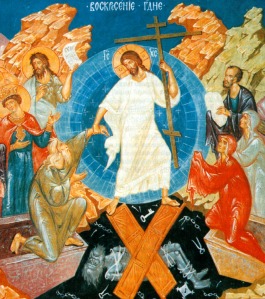
In the Old English, harrowing was the term used to describe Christ’s descent. Ancient icons often show Jesus amidst previous saints of the Jewish Testament, standing on the gates of sheol now opened. The gates are often an “X” or Chi in Greek, reminding us that Jesus is Χριστός, or Christ – the Annointed One and our Messiah come to save us from sin, death and the Devil.
Christians may debate whether Jesus entered triumphantly or suffered more indignities, but mainstream Christianity looks to both scriptures and the faith handed down to us. Jesus’ entrance into the grave was not the last of his journies for us. With sundown, his burial was complete. The Jewish sabbath had begun, and Jesus went to work. The Saturday of our Holy Week is indeed good (holy), and we rightly rejoice even as we wait for the Day of Resurrection. Jesus has come to save all his people.
Unless otherwise indicated, all scripture quotations for this article are from the New Revised Standard Version (NRSV) translation.
Within an ancient culture that didn’t count women during the government census or necessarily notice or respect them in the home, it is not a real shocker the bible doesn’t often mention women.
Despite this, it remains most probable that women were an important part of Jesus immediate community and present at his final Passover Feast. Matthew reports that at the feeding of the 5,000, the count did not include women and children.[i] Or later, Matthew shares that women who “had followed Jesus from Galilee to care for his needs” watched as he died.[ii] (Was this perhaps after preparing and sharing in his last Passover Feast?). There are other attestations from other Gospel writers as well which some see as supporting that women were among his disciples and active in his ministry.
Whether you agree or not, or think women had their feet washed by Jesus or not, Jesus’ greatest intention on Maundy Thursday was to teach us to love and serve everyone (“one another”) as he had us. After all, Maundy comes from the Latin word mandatum (meaning “commandment”), and it was used in the early Latin Vulgate translation of John 13:34: “I give you a new commandment, that you love one another. Just as I have loved you, you also should love one another.” Using scripture to interpret scripture and seeing Christ’s own example, it is hard to argue that this command to love only covered Christians. Christ longs for his family to grow.
Yes, this final teaching echoed Jesus’ earlier ones. What’s the greatest commandment?[iii] Who is our neighbor?[iv] Jesus reached out to all those marginalized by society whether Jewish or not. We are not to become their stumbling block.[v] We are to let “the children” come to Jesus.[vi] Indeed, we are to love whoever might be thought as “the least of these” – perhaps children, inmates, the poor, women (in many cultures still), anyone we tend to label as “sinners”, and non-Christians. Matthew is said to have been the most Jewish of the Gospel writers; at least his writings reflected many Jewish teachings and responded to many Jewish biases about their being the chosen ones of God. Yet, he shows Jesus to be incredibly open and loving to all. Jesus longs for relationship!
Despite this, some traditionalist Roman Catholics have become more and more vexed by Pope Francis’ election and recent behaviors. He has cast aside signs of regalism. He has acted in ways lifting up the priesthood of all believers. He has expressed openness to Protestants, Orthodox Christians, and people of other faiths entirely. As in Argentina when a Cardinal, Pope Francis seeks simplicity, and he lives that way. Not the least of their issues with him, many traditionalist have expressed “the horror” (not my word, but often found in their tweets and posts) that the Pope would wash not only the feet of a juvenile women who happened also to be a prisoner, but in one case was Islamic. “He cultivates a militant humility, but can prove humiliating for the church,”[vii] Fr. Bouchacourt, head of the traditionalist, schismatic St. Pius X Society, said. I have seen similar less than charitable comments by other traditionalists, even from some of those who haven’t broken from the Roman Catholic hierarchy but instead claim to love and obey it. Some even suggest Pope Francis’ behaviors are just a show in violation of scripture.[viii]
If signs of humility are embarrassing to the Roman Catholic Church, then I bluntly but in love suggest these folks take a look at Jesus’ own behavior. Jesus often intentionally exemplified his teachings through public behaviors. That’s what teachers and leaders need to do. Jesus prayed in public at times not for his own sake and not for a show, but so that others could be comforted and learn of God’s love.[ix] He purposefully embodied earlier prophesies to help reveal his identity, such as by riding a young donkey into Jerusalem.[x] (Certainly, Palm Sunday was quite a spectacle.) Some of the same conservatives – those who were so protective in promoting the sanctity of the conclave and agressively argued that the election process was in the Spirit’s presence and following God’s will – turned on Pope Francis that first night.
Even as a Lutheran, I would agree that the Spirit is involved in leading the Roman Catholic Church, but I would also argue the Spirit seeks to guide all other denominations as well. Institutions made of fallible humans can err (a very Lutheran attitude to be sure), but we still remain Christ’s church. Despite the historic divisions of the universal church, Pope Francis holds one of (if not the most) prominent positions of Christianity. To be ashamed of such humble, public actions that so many “of the least” will take notice of seems the real shame to me.
This Lutheran says, “Good for Pope Francis!” Perhaps I shouldn’t care so much, but I (like countless other Christians) hope and pray for the coming reality of Christ’s own prayer that we live as one.[xi] We are the church together, not our denominations, through the grace of our shared faith and baptism. I humbly support my brother Francis in his efforts to make Christ’s love known in the entire world.
After all, Jesus asked us to love and support one another. He never said with our human minds, hearts and ways that we always would agree on everything.
According to one commentating participant of Lent Madness 2013, “For the people who comprise the parish of St. Monica and St. James Episcopal, Frances Perkins is not just a New Deal bureaucrat, but is a living, breathing saint who worshipped with their predecessors and put the incarnational theology of their Anglo-Catholic liturgy into concrete social action.”[i]
Yes, it was often in their rooms and sanctuary that she stayed, prayed and made plans to champion a social safety net for the elderly, eliminate child labor, fix a minimum wage, create the Civilian Conservation Corps (CCC), provide disability for those hurt on the job, create unemployment insurance, a shorter work week, and worker safety regulations. She was an important person of her time, and her actions still help shape our nation. For some, these programs remain a lifeline.
Frances believed faith “served as a bedrock and a way to seek meaning in life when so much seemed inexplicable.”[ii] In her young adult life, she attended Mount Holyoke College, whose founder, Mary Lyon said, “Mount Holyoke women should live for God and do something.” A Baptist turned Congregationalist, she also is known to have advised, “When you choose your fields of labor go where nobody else is willing to go.” She knew the needs of the world.
Within that legacy, one of Frances’ teachers took her to look at the hard realities found in the nearby textile mills and factories.[iii] From affluence herself, Frances discovered a vocation to do something for the poor, the immigrant, and all others in need. Like today, many young women had come to the United States for promised jobs, but instead, they were forced into prostitution. Working with police and other institutions, Frances fought against this plight, the frequent drug and alcohol addiction, and the abusers of others.
Having been a cop in such communities, I know this to be no small task. Indeed, it is frightening in our seeming powerlessness over such issues as well as to stand in the face of real and potential violence. Thanks to her faith, Frances wasn’t afraid to enter relationship with the poor or anyone in need. She went where too few are willing to go.
Nominated as the first woman cabinet member as Secretary of Labor under Franklin D. Roosevelt, she continued to care about “the least of these”[iv] among us. She actively sought to protect Jewish and other refugees facing persecution in Europe under the Nazis. Until 1940, the Labor Department controlled the Immigration Service. She never got the quotas she desired, but a number of our Jewish neighbors owe their lives partly to her efforts, as do the famous Von Trapp family of Sound of Music fame.[v]
Writing this during this Passover holiday, I am reminded how Frances sought to echo God’s own love as reported in Deuteronomy 10, “For the Lord your God is God of gods and Lord of lords, the great God, mighty and awesome, who is not partial and takes no bribe, who executes justice for the orphan and the widow, and who loves the strangers, providing them food and clothing. You shall also love the stranger, for you were strangers in the land of Egypt.”[vi] Reflecting previous teachings of the prophets, Jesus, the Son of God, called us to concretely live out Deuteronomy 6, to love God with all that we our and our neighbor as ourselves.[vii] Frances heard and understood rightly that our neighbor includes all those around us. We are created and called to be God’s ambassadors to the world.[viii]
Most certainly, Frances Perkins lived within the concrete reality of amazing grace. Once when asked “Don’t you think it’s wrong for people to get things they don’t pay for?” “Why no,” Frances Perkins responded. “I find I get so much more than I pay for. Don’t you?”[ix] She understood that assisting the poor wasn’t just the work of government, and so she enlisted the help of church communities from across the United States to help respond to the upheavals of the Great Depression. She served the poor and needy directly as well, despite her station, throughout her life.
In a fallen world with fallen people, some today take advantage of such “grace,” do not appreciate it, or even intentionally abuse it. As humans, that’s the way it has always been. Even though the poor and undeserving will always be with us, we are to feed, clothe, train, and love them anyway. People will die, but we are to seek their healing and comfort. We are a people of hope and grace, and not ultimately one of reason. In fact, as Philp Yancey professes in his book What’s so amazing about grace (2002), life isn’t fair but neither is grace. God utilizes a totally different scale of justice than we do where love overflows.
Still, some might have very sound political and economic reasons to disagree with how Florence concretely tried to share God’s love, the system that has came about in more recent time, or even aspects of her theology. Yet speaking from a Lutheran perspective, we don’t expect perfection in God’s saints or require mystical miracles. Among the greatest mystery is that love can be found at all in a world that rejected the love of Christ and often still does. Even more so, we imperfect people are the means God has chosen to make love known since Jesus ascended.[x]
With Frances’ win of the Golden Halo, some will likely gnash their teeth at the “political correctness” of it all. If her last competitor, the evangelist Luke, had won, some others would have likely bristled at the patriarchal or mythical aspects of his victory. (I was happy either way for this matchup is at its corps just a silly way to promote Christian formation, and all saints share in the most import thing – Christ’s victory.) The truth remains that both saints remind us of our own call to be saints in our own context. We are to use the gifts that God gave us to the best of our ability – for God’s glory and not our own.
Some may never know our doubts and darkness, seeing only our public “mythic” face. Some may disagree with our attempts to love or even aspects of our faith and theology. Most of us will never be recognized or lauded for loving others. Still, I firmly believe that we are saints nonetheless; part of a great cloud of witnesses[xi], and God will make our love matter.
If we are indeed Christ’s saints (and we are through faith), we can’t just sit here as if faith without works is ok. A living faith infers we need to love – always imperfect even at our best, but love nonetheless; prudently certainly, but not with so much prudence that we are frozen to inaction from fear of error or consequences.
As Jesus said approaching his own suffering and death, the poor will be with us always, but in saying this, he alluded to Deuteronomy 15, “Give generously to [those in need] and do so without a grudging heart; then because of this the Lord your God will bless you in all your work and in everything you put your hand to. There will always be poor people in the land. Therefore I command you to be openhanded toward your fellow Israelites who are poor and needy in your land.”
Br. Roger of Taizé used to remind those of us in discernment for vocations there or in other parts of the church that Jesus is awaiting us in that dark chasm of our future. We must go forward to him with trust. We must seek to love, for Christ will meet us then and there. You see, God will use all things (even our failures and sin) for the good of those who love him.[xii]
As a theological descendent of Martin Luther’s Doctrine of the Two Kingdoms, I do indeed trust, understand, and demand that government has to be part of the solution to address poverty and other social ills. Yet, I acknowledge that we have to be smarter and demand more accountability and care. Government is a bureaucracy after all. People are imperfect. I also sometimes wonder if some of us rely on government as a solution to social ills way too much or (worse?) would rather pay taxes to support such programs than be in relationship with the poor. (As I often teach, a personal relationship with Jesus infers a relationship with others, including those in his church and without; those who have plenty and those who lack.) Too often, we attack one another rather than wrestle with the problem at hand. We get angry at the possibility of change or what we percieve as an attack on our precious viewpoints.
Now is the acceptable time…a time to be truly charitable – seeking to serve all those suffering, listening with respect and patience to one another, forging new relationships to seek God’s will and do it, forgiving error when it occurs. (And it certainly will come!) In humility, we must also remain aware that the worst error might prove to be our own, known or unknown.
True, Frances Perkins isn’t yet on our Lutheran (ELCA) Liturgical Calendar, but perhaps she should be – and not just because the ELCA has a full communion agreement with the Episcopal Church. We believe we are saved by grace through faith in Jesus Christ (by trusting in what he has done for our sake) – not our own works. In Frances’ historic context, she was remarkable and helped shaped our modern nation. More importantly, her witness was a faithful one. She has inspired many others to loving service at Mount Holyoke and elsewhere, yet she was never perfect nor are we. She could yet serve to inspire others to serve and hold discussions to evaluate how we could love our neighbor most effectively through government, church, and as individuals.
Maybe that’s a great miracle we should always trust in and act upon. We are truly Christ’s saints – all of us who believe even if with doubts – and we need to seek to live as his saints, his body in the world. Perhaps it is a happy coincidence that Frances Perkins won the Golden Halo on this Maundy Thursday (from the Latin mandatum, meaning command). Her imperfect but faithful life reminds us of the command Jesus left us as our inheritance during his Last Supper. The Gospel of John (13:34) reports that Jesus said, “A new commandment I give unto you, that we love one another; as I have loved you.”
Without fear, without hesitation, without our preconceived political notions or human expectations, may we heed Christ’s great command to love God and one another. Whether we view ourselves more left or right or anywhere in the middle, we shaare the family name of Christian. May Christ help us live as his saints each day in our own context – using our time, treasure and talent to the best of our ability.
Heaven knows, this real world needs all the saints it can get. We will never love perfectly. Our work will seem to never end, but do not be afraid. As Frances believed and scripture promises, Christ “will wipe every tear from their eyes. Death will be no more; mourning and crying and pain will be no more…”[xiii] Thanks to Jesus, inspite of and because of our sin, we will share in a victory beyond our hopes and dreams.
Jesus will do what we cannot. All things will be made perfect and new. His justice and love will reign fully at last.
To read of Lent Madness and the awarding of the 2013 Lent Madness Golden Halo visit: http://www.lentmadness.org
This year, Mount Holyoke, a women’s college in Massachusetts and alma Marta of Frances Perkins, celebrates its 175th anniversary. (There alumni, staff and students caused a large spike in turnout for Frances each round, thanks to use of social media.) Congrats to them! (If only VMI had done the same for Jonathan Daniels!) You might like to visit their special anniversary website celebrating women of influence: https://www.mtholyoke.edu/175/celebrating-175-years-women-influence
The United States Labor Department is also celebrating their 100th anniversary. Learn more here: http://www.dol.gov/100/
You can learn more of Francies Perkins by visiting the Frances Perkins Center on the internet or in person: http://francesperkinscenter.org/
Watch this short excerpt of “You may call me her Madam Secretary”
From the Washington Post, March 28, 2013 edition, you can read about Frances’ win and the reaction in the Labor Department. I hope and pray all government employees view their service as a sacred vocation, loving their neighbor, as she did: http://wapo.st/165chTZ
For those that have looked at my Heroes and Sheroes page, you might recognize that today is a special day for me. March 25th is the traditional commemoration date of Saint Dismas on a number of Christian liturgical calendars, and I bear his name.
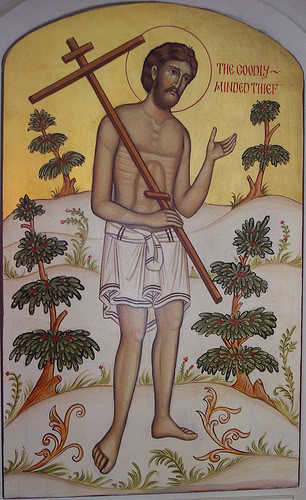
Widely known as the “Good Thief” or the “Penitent Thief”, Dismas was crucified beside Jesus. The name Dismas was later adapted from a Greek word meaning “sunset” or “death.” His real name is unknown. Most likely, he was not a thief, but instead, some kind of rebel or raider deserving the death penalty under Roman law.
Dismas’ lesser feast day or commemoration derived from a tradition believing that March 25th was the actual calendar date of Christ’s crucifixion, although the Passover and Easter celebrations move due to their following a lunar calendar. The Feast of the Annunciation is the primary, modern celebration on our Lutheran calendars today (except when March 25th falls during Holy Week), but I still stop to remember St. Dismas annually on this day.
Although Dismas was never officially canonized by the Roman Catholic Church, he is declared so in scripture by Jesus himself. We hear in Luke that Dismas defended Jesus from the abuse of the other condemned man, commonly named Gestas (but also unknown). Hearing Jesus preach, teach and pray from the cross, Dismas began to look to Jesus with trust. He asked, “Jesus remember me when you come into your kingdom.” Jesus declared, “Truly I tell you, today you will be with me in Paradise.” (See Luke 23:39-43)
Years ago in a home with many challenges, I came to see the world in black and white terms. I secretly believed myself unlovable and defective even at a young age. As I write elsewhere, I am sure I heard the story of Dismas often in church growing up, but it first really impacted me while watching The Greatest Story Ever Told on television with my father in about eighth grade. At that time, I had been going through confirmation classes at St. Pius X Roman Catholic Church. Prior to confirmation (viewd as a sacrament in the Roman Catholic faith tradition), we were asked to think of a confirmation name, one to symbolize our coming to adulthood in faith and hopefully be a saint who inspired us.
In the Roman Catholic tradition, St. Dismas is the patron saint of condemned prisoners, reformed thieves, undertakers, funeral directors, penitent sinners, and prisoners. Indeed, some Lutheran and other prison ministries are named after him. When confirmed in the Catholic tradition, I decided to take his name. This seems ironic perhaps for one who would become a police officer, yet I always remembered how my heart was deeply touched by his story. In the depths of my being, I hoped I could be so loved.
Later as a young adult, I left active life in the church. I believed in God at some level, but I made bad choices at times, experienced losses that often come with life, and experienced much too much evil as a police officer. In short, I gave up on God. I became empty and cynical. I came to feel that not even Christ’s cross was enough to save me. I had much to repent over, for I was very wrong.
Yet when my life seemed darkest after another profound loss, two dear Christian friends from my past redirected my gaze toward the cross and its certain grace. On March 7, 1992, I had what I call my “re-conversion experience” – for I understand now that since my baptism and before, God has always been active in my life. My faith was small and deformed, but it made a difference in my life. God loved me before I ever realized it, even on Christ’s cross long ago. I truly experienced amazing grace, and my life changed.
Through this renewed experience with grace, I came to understand and more importantly finally trust that I was indeed loved and forgiven. I began to dig into scripture as never before. I hungered for the Word of life, and I found it alive in and through Christ’s church. With the church, I sought to share the grace I knew to be true with others in both word and deed. My police work became a sacred vocation. Later, God would invite me to take his love on the road through mission. Overtime, I discovered a home in the Lutheran family of faith. Still a sinner, I trust that I am also a saint. Christ declares this through his death and resurrection for our sake, and I do trust him for he never lies. His sacrifice atoned for our sin – past, present and future. His death remains enough to save us all.
Each year since my “re-conversion” and return to the church, I think of Dismas and rejoice. I celebrate the opportunities found in Lent and Christ’s forgiveness. I trust that with others who believe (and even those who don’t yet) I was, am and will be remembered. Dismas’ story is our own.
Yes, Jesus remembered us all as he died on that cross. He died, so that we could truly live…starting today.
Psalm 32 – The Joy of Forgiveness 1 Happy are those whose transgression is forgiven,
whose sin is covered. 2 Happy are those to whom the Lord imputes no iniquity,
and in whose spirit there is no deceit. 3 While I kept silence, my body wasted away
through my groaning all day long. 4 For day and night your hand was heavy upon me;
my strength was dried up as by the heat of summer. Selah
5 Then I acknowledged my sin to you,
and I did not hide my iniquity;
I said, ‘I will confess my transgressions to the Lord’,
and you forgave the guilt of my sin. Selah
6 Therefore let all who are faithful
offer prayer to you;
at a time of distress, the rush of mighty waters
shall not reach them. 7 You are a hiding-place for me;
you preserve me from trouble;
you surround me with glad cries of deliverance. Selah
8 I will instruct you and teach you the way you should go;
I will counsel you with my eye upon you. 9 Do not be like a horse or a mule, without understanding,
whose temper must be curbed with bit and bridle,
else it will not stay near you. 10 Many are the torments of the wicked,
but steadfast love surrounds those who trust in the Lord. 11 Be glad in the Lord and rejoice, O righteous,
and shout for joy, all you upright in heart.
Prayer:
Gracious Lord, even as you died on your cross, you looked upon Dismas and saw our human need, shared suffering, and sin. You looked upon him with love before his repentence. His simple trust in you opened a way of communion with your heart’s mercy and forgiveness even as the centurion’s spear sought to tear your heart asunder. Your death and resurrection saves me. His trust in you inspires me. Bless your entire church; that together we remember your cross with confidence, persevere in faith through times of trial, and experience the resurrection of our lives today. Empower us to remember and serve the outcast, sinner, and all who suffer; sharing your grace, mercy and love, as you have so abundantly shared it with us. Amen.[i]
[i] This prayer is inspired by a Roman Catholic prayer.
Unless otherwise indicated, all scripture quotations for this article are from the New Revised Standard Version (NRSV) translation.
Grace and peace to you from God our Father and from the Lord Jesus Christ. Amen.
Every year as we approach Lent, I am surprised at how many comments I hear or read about indicating that “Lent is not biblical.” When I come across such comments, I bristle a bit. I feel disappointment and frustration, and yes, sometimes even some anger when the person is particularly snarky about it. Of course, it isn’t biblical! No one is claiming that the season of Lent is biblical. It is no more biblical than Christians arbitrarily deciding upon December 25th as a good day to remember Jesus’ birth is biblical – not in the strictest sense anyway.
Yet, I fear these folks are missing the forest for the trees. They are sadly missing an opportunity to be blessed. There is no specific call for Lent in the Bible (no one is arguing that), and still, isn’t it remarkable that the earliest Christians found designating such a season spiritually helpful? During these forty days (not counting Sundays which are remembered as days of Resurrection), special disciplines are encouraged as they serve to nurture faith in the individual even as they might serve to witness to our faith and grow Christ’s Church. This season…a season designated by the community of faith for the good of all and to honor God…was found to be a meaningful, beautiful time of preparation for Easter. So, it became a yearly practice and was given a suitable name. The season became known as Lent, an old English word meaning spring.
Yes as with spring, we may witness new growth and new life during Lent. This is what we hope for during these forty days, but we may prevail upon its disciplines at any time of year. Such disciplines don’t lead to a reward for our goodness. They aren’t something we do to become holy, for we cannot become holy by our own power. Instead, such practices become our opportunity to “live in Christ” – to live out our faith concretely nurturing our love for God and others and thereby offering us a chance dwell in God’s grace and love for us. It is for that reason that we find such disciplines commended in the Law and the Prophets, and even by Jesus himself.
The Psalms[1] are filled with such spring-like imagery as are the prophetic texts[2], and some of Jesus’ own parables[3]. Our life with God is always filled with bounty and blessing, often symbolized by natural things: the streams that refresh us; or the trees that serve as protection or a home for God’s beloved creatures. For the many disciplines of Lent – reflection upon one’s life and repentance, fasting, prayer, and most certainly almsgiving and acts of mercy – they can become like the tall cedars of our faith providing us a safe dwelling place in this world of trouble…a place of comfort and shade, strength and renewal. Amidst their many branches, God embraces us. God can even transform us. This Lenten invitation to take actions rooted in our faith in Christ serves only as a reminder of what Paul said in his letter to the Romans, “God’s kindness is meant to lead us to repentance.”[4] It leads us toward a deepening unity with Jesus, both his life and in his church.
Indeed as someone said recently, “Ashes don’t say we’re holy. They say we’re sinners.” They are to reflect the ongoing prayers of our hearts, “I’ll try to be better. I’ll do what Lent asks: more prayer, more sacrifice, more almsgiving.”[5] Western Christians whether Roman Catholic or Protestant desire to remember their total reliance upon God’s grace. “Remember you are dust, and unto dust you shall return,” we are told. This life is fleeting, sometimes dangerous, and we at our best are only sinner-saints.[6] We need the grace of Jesus Christ to help us make it through. The church as a community, as the body of Christ, commends these practices to us. Through them, we may be built up by God and encouraged to build up one another.
Using varied words throughout Christ’s diverse and universal Church, we hear as much during community worship on Ash Wednesday. For example, the Episcopal Book of Common prayer (not too unlike our Lutheran commendation to a holy Lent heard earlier tonight) rightly proclaims, “The first Christians observed with great devotion the days of our Lord’s passion and resurrection, and it became the custom of the Church to prepare for them by a season of penitence and fasting. This season of Lent provided a time in which converts to the faith were prepared for Holy Baptism. It was also a time when those who, because of notorious sins, had been separated from the body of the faithful were reconciled by penitence and forgiveness, and restored to the fellowship of the Church. Thereby, the whole congregation was put in mind of the message of pardon and absolution set forth in the Gospel of our Savior, and of the need which all Christians continually have to renew their repentance and faith.”[7]
So, we begin this season of Lent with ashes – a broken, struggling people – but also gathered together as one holy people of God. Our sin is systemic, shared and individual, but we are also chosen and loved. God plans for our redemption. In a time of trial for the nation of Israel, Joel commended these same types of behaviors.[8] By their apathetic faith, unholy alliances with powers of this world, and acts of selfishness and sin, the people of God were at risk in those days. They were weakened as a nation by such behaviors, and a terrible plague of locusts put them further at risk – at risk of invasion, starvation, and suffering. Joel hoped that by immediate repentance the advancing threat would be turned aside by God.
Well, hear the Good News! Thanks be to Jesus Christ, we need not just hope. Salvation is ours. Forgiveness is possible, and it isn’t too late. No matter who we are, what we have done or failed to do, the grace of Jesus Christ invites us into his loving arms. These are days not of gloom and doom but of growing light. They are days to be celebrated. Through Christ’s cross, the sin of all who trust in him has been redeemed. His cross previously an instrument of torture and death became for us a forgiving place of shade where we can invite our friends and neighbors to also find rest. Through our baptism, we are clothed in Christ, the finest of garments, given new life and a new family of God. This is much as Zachariah and other prophets have promised throughout the ages.[9] It is a new day, a final age where Jesus is coming back to complete his work, and we are invited. In our hearing, all God’s promises have been fulfilled in Jesus Christ.[10]
As unworthy as we all might be, we are still loved by Jesus! And since we are so loved – loved unto his own death, Jesus invites us to gather, remember, and experience new life: remember our need for God; remember our failings and all the ways we turn away from God; and not least of all, remember all the grace-filled ways Jesus reaches out to us, drawing us back.[11] We have this shared forty-day journey to re-experience Jesus’ parable of the vine and the branches.[12] In this season, we will bear fruit by intentionally striving to remain in the vine which is Jesus. We admit openly that without Jesus we can produce no fruit, and so we turn to him all the more and hold on in faith. We will seek intentionally to better love God and our neighbor. We desire that this dedication and fruitfulness will not fade after forty days but instead last a lifetime. It will be Jesus who will use this time to prune us and bring new life. His light will overcome our darkness, and it will shine more and more brightly.
This is our Lent, our springtime given us as a gift in the present even as we await the eternal Easter of our future. Lent is more than a season of time. It is a call to a way of life, Christ’s way. It goes well beyond the Bible even as it is rooted in it, because together on this journey, we have the opportunity to personally encounter anew the living Word of God, Jesus Christ, our Lord and Savior. Amen.
The above pastoral letter was originally published in Messiah Lutheran Church and School’s newsletter, The Messenger (June 2013 edition). To view the entire issue of The Messenger or to see the full calendar of events, visit: http://www.mlcas.org
Unless otherwise indicated, all scripture quotations for this article are from the New Revised Standard Version (NRSV) translation.
“From silly devotions and fromsour-faced saints, good Lord, deliver us.” – St. Teresa of Ávila
Much too often, I come across people dreading Lent. Perhaps these folks might not like to remember that we are all sinners. Perhaps they feel threatened by the scriptural reminders of condemnation and death found in the texts so often used at our worship. They might be filled with dread as they overly focus on sacrifices and rituals. In doing so, we risk minimizing the power of Christ’s cross and resurrection; forgetting God’s grace reaching out to each of us. We tend to forget to live out and share our faith in daily life, and thus fail to fully experience the joy that it can bring to us and others today (not just in heaven). Lent in its Old English root means “spring,” and today, I have trouble viewing Lent as anything but a beautiful experience of growth and new life.
As I have shared with others, I become remarkably joyful during Lent. Even as I might confess my sins anew with ashes on my head, I can’t keep from smiling. You see, Lent was coincidentally the time of my rapproachement to the Church after many years away. Much like the prodigal son, I had spent my early adult years squandering the grace offered to me in my baptism. A difficult family life and things I saw as a police officer had hardened my heart against God and others. Eventually, I had come up empty. (No surprise there, I suppose.)
It was at this time of crisis – as Lent began in 1992 – faith-filled friends reminded me of the reality of God’s grace. With their loving witness, invitation and guidance, I discovered the compassion that God had for me all along. Much like Zaccheus in his tree, I became excited to hear Christ’s invitation to join with him in celebration within his Church. God was love indeed, and God could even love me! (This was indeed a great surprise to me at the time, for I had suspected wrongfully that my sins were too great even for Christ’s cross.)
Lent that year became a gift for me to be excitedly opened and treasured; a period of renewal and celebration. It was a joyful time of being embraced by Christ and by his Church. It proved to be my “re-conversion” experience, where I discovered the beauty of our baptismal promises and shared faith. It wasn’t a perfect time, and I still struggle with sin, but Jesus used this time of shared disciplines, fellowship, and service to restore me to wholeness. By Easter, I understood more about the Resurrection than I ever dreamed possible. I had begun to experience its reality in my own life. Thus affirmed, I trust I have much more to learn and experience in the years ahead.
Despite our sin and unworthiness, I don’t believe sour-faces or dread are necessarily very appropriate as we go about our Lent. Instead, I echo Paul proclaiming, “Rejoice in the Lord always; again I will say, Rejoice!” For with Jesus, all things are possible – even our new life in him. I pray this Lent prove a time of “re-conversion” for us all and a very real celebration. I am sure God’s grace will surprise us once again. [1]
For even more Joy this Lent…
As I reentered the Church, I found listening to other people’s stories helped me on my own walk with Jesus. Both historic persons – biblical personas such as the Prodigal Son, or real people such as Zaccheus and later saints – as well as people around me became a testimony about the grace God offers us through a beautifully diverse “great cloud of witnesses.”[2] These people of faith speak to me, not of perfection, but of God’s grace at work in our everyday lives. They remain concrete signs of God’s love active in the world as we ourselves strive to love God and neighbor.
Even as Lent is meant to be a time of self-examination and repentance, it is also certainly a time of joy. Fun need not be outlawed. Therefore, I am very grateful to the two Episcopal priests who created the interactive fun known as Lent Madness, and I happily recommend it to you as part of your own Lenten devotions.
Lent Madness is basically 32 saints (those primarily included in liturgical commemorations by the Church) matched up in a tournament-like single elimination bracket. By participating in Lent Madness, you will likely learn and laugh, because the bloggers responsible also seek to reveal the sometime laughable nature of Christ’s saints – a nature we all share.
So, I strongly urge you join other saints of our time at the website daily. We’ll read about some very special, faithful people and have the chance to vote for our favorites. Jesus offers salvation to us all, but your vote helps determine who “wins” the Golden Halo.
[1] The above portion of this post was written for use in the Lenten reflections to be shared by FaithInRichmond.org during Lent 2013. It was published under the title, Surprised by God’s Love.
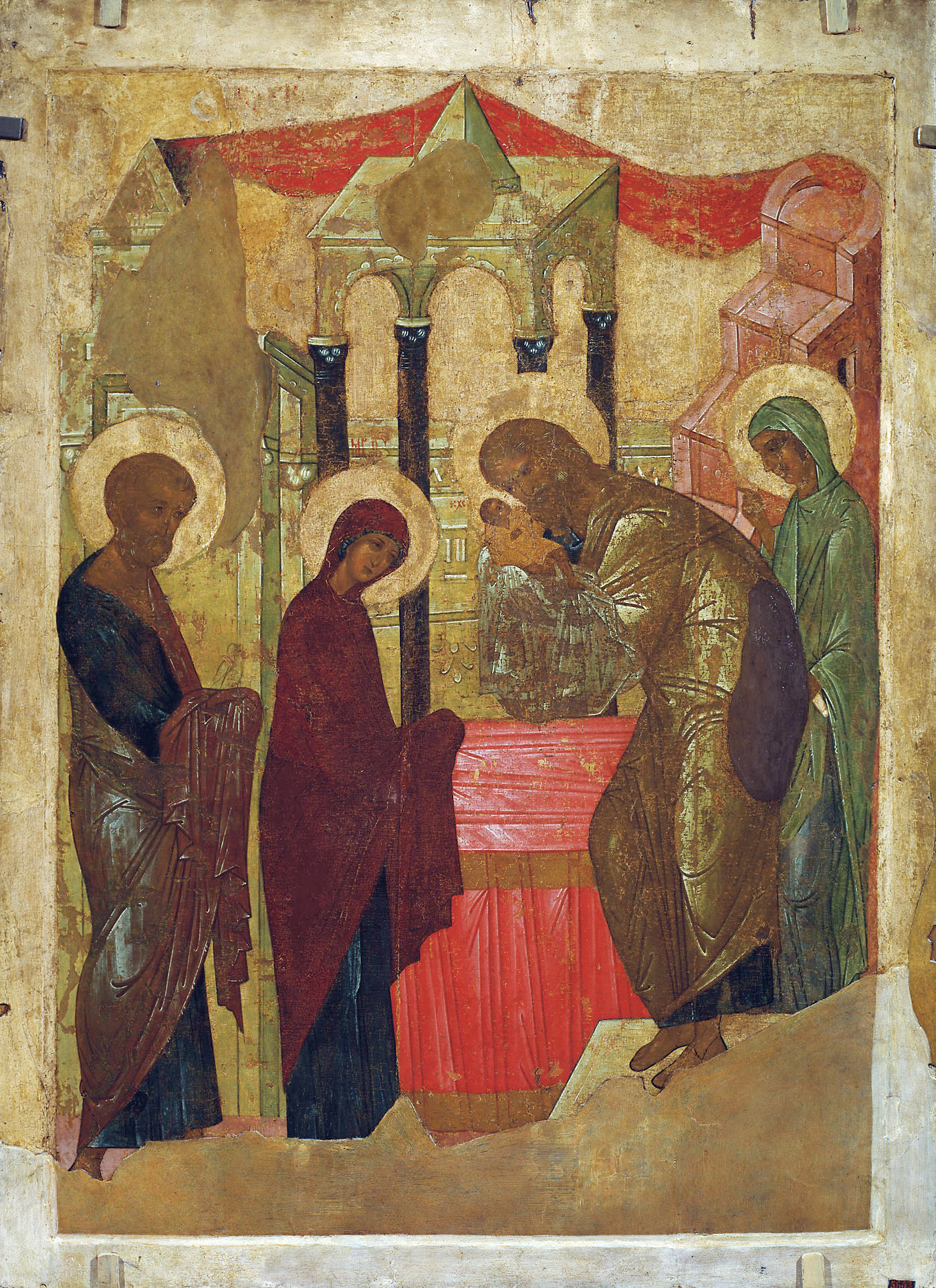
Forty days after Christmas on February 2nd, Christians recall the Presentation of Jesus in the Temple. In a number of Christian denominations the season of Epiphany comes to an end. According to scripture, Mary and Joseph took the baby Jesus to the Temple in Jerusalem forty days after his birth to complete Mary’s ritual purification after childbirth and to perform the redemption of the firstborn in obedience to the Law of Moses (Leviticus 12, Exodus 13:12-15).
As Mary and Joseph were poor, Mary was relieved of offering a lamb and a dove for her offering. Instead, she was to “take two turtle-doves or two pigeons, one for a burnt-offering and the other for a sin-offering; and the priest shall make atonement on her behalf, and she shall be clean” (Leviticus 12:8).
Around the globe, Christians will likely remember these early events as reported in Luke 2: 22-40. In fact, it is one of the most ancient feasts of the Christian church. With the traditional end of Epiphany, many remove any remaining Christmas greenery from their homes. If you are visiting the Taize’ Community in France, you will likely see a cage with two doves or pigeons in their Church of Reconcilliation. After the service, the birds are released. As the story reflects the light of Christ breaking into the world, it remains a common practice at many services throughout the world to bless candles for use during the year. To this day, some countries share special meals during family celebrations (i.e. crepes in France, or tamales in Mexico).
Pennsylvania Dutch folklore attached an ancient, pagan European practice of weather prognostication to this day. If the groundhog sees its shadow, superstition indicates winter weather will continue for six more weeks. (In ancient Europe, one might have heard of a badger or sacred bear serving this purpose.) Yet, such beliefs weren’t only held in Germanic nations. In England, one old English poem exclaims:
If Candlemas be fair and bright,
Winter has another flight.
If Candlemas brings clouds and rain,
Winter will not come again.
No matter the weather, I hope you and your family will develop your own ways of recalling the Presentation of Jesus. It reminds us of the Holy Family’s piety, and our family’s call as well. It displays a family united by love, as our own should be. The feast most importantly can remind us of how that young male child redeemed on that day came to redeem us through his cross and resurrection. We really should celebrate!
Unless otherwise indicated, all scripture quotations for this article are from the New Revised Standard Version (NRSV) translation.
The following are the three meditations I shared during our Family Christmas Eve Service at Messiah Lutheran Church and School in 2012. Our theme was “Sent into the World.” We remembered both how Jesus was sent into our world to save us as a newborn babe and how we are sent as his church out into the world. Thus, the service included many hymns and carols from all over the world. The three below were part of the meditation portion of the program, but it was a night filled with music and fun.
The Gift of Jesus
Reading: Isaiah 9:2-7
Prop: small Christmas tree ornament of the globe
“The people who walked in darkness have seen a great light; those who lived in a land of deep darkness—on them light has shined” (Isaiah 9:2).
Consider the world [holding up ornament]….Ok, it’s a bit larger than this ornament, but it’s a relatively small place in the vast, extensive darkness of space. Proportionally, this ornament in comparison to your own size is much, much larger – infinitesimally so – than what we would find with a God’s eye view of our planet. Our world is only a small rock in a vast galaxy that itself is only one of millions of galaxies. Our universe was created from a black void – both the Bible and science think so – and this poor little sphere spends much of its time suspended amidst that darkness; hidden by larger heavenly bodies, and threatened by them as well. Yes, our fallen world is filled with threats and horrors and many terrible unknowns, and it always has been. Yet, light breaks in to give warmth, nurture life, and bring joy. Amidst a cosmic battle, God doesn’t leave us unloved or alone in the dark. Instead, he chose to dwell among us…even became one of us on this tiny, out of the way planet we call home.
Long ago, the great prophet Isaiah lived in the 8th Century BC. It was a time of much darkness. Certainly, they didn’t have our modern conveniences or scientific knowledge, but they shared in our troubled humanity. Throughout Isaiah’s life, the nation of Israel faced wars and rumors of war. At least three times, the existence of Israel was at risk of obliteration and exile. It was a time of early death due to violence, famine and disease. There was seemingly too little joy and never enough peace. Yet, a son was born to a young maiden, wife of the king, and the prophet saw in this somewhat ordinary experience the promise that lay within. God would be faithful no matter how dark the days got. God’s plan to rescue his Holy people would never go unfulfilled. Later Christians would understand this same passage to testify to the coming of Jesus Christ.
Over the last few weeks, we have seen too much darkness. Many are still homeless in the northeast after Hurricane Sandy. Diplomats in Benghazi were horrifically killed. In Connecticut, we hear the cries of modern “Rachels” weeping as foretold by the prophet Jeremiah. (See Jeremiah 31:15-17 and Matthew 2) They cry over too many innocents and our own innocence lost in the safety of their small town school. Closer to home and only in these past few weeks, members of our community have suffered new joblessness, accidents and serious illness, and our beloved Assistant to the Bishop, Pastor Chip Gunsten, died unexpectedly. More tears. More death. Darkness. We might be tempted to echo the writer of Lamentations wondering, “Why God would allow such things? Why would he punish us so?” as we groan anew:
5 [God] has besieged and enveloped me
with bitterness and tribulation; 6 he has made me sit in darkness
like the dead of long ago. (See Lamentations 3)
Yet in these times of trouble, hear the promises that come to us through Isaiah. Much like that time long ago, there is a sign to remember and hope to be found amidst our darkness. When the time was right, a virgin did conceive, and a very different child was born…one like no one before or since…perhaps beyond Isaiah’s own understanding. He would be a miracle of light, giving hope, joy and love to all the nations. This king would not be a king in our political sense. Instead, he would suffer under the political forces of our world as we might. He would live amongst the ill and dying. His life would be continually threatened from the slaughter of the innocents in Bethlehem until his own death on a cross. God had come, not to punish us, but to share our lot and change it; to end suffering and bring everlasting peace. All authority rested on Jesus’ shoulders, and yet out of love, he took upon those same shoulders the weight of sin, death and the Devil to defeat them all and save us.
Like that original Christmas night long ago, Jesus comes to our tiny planet to touch our tiny lives and hearts today. He wishes to be God with Us, Emmanuel, and so none of the political chaos, evil or darkness is powerful enough to stop him. Although it might be hard for us to recognize him with our human senses at times, our faith hears his voice and trusts he is near. Together as church, we gather as one, holding on in the darkness and never alone. God does not will such suffering. God is only love. Jesus remains our proof, and the fullness of God’s Kingdom will banish our darkness forever when the time is right.
Until then, we testify to the light and hold on to one another – teaching, serving, worshipping, loving God and neighbor. For, “What has come into being in [that baby] was life, and the life was the light of all people. The light shines in the darkness, and the darkness did not overcome it (See John 1).”
Although we remain in this land of darkness, the light shines on us and through us still, and our Lord Jesus promises that it always will. No matter what worries us or threatens us…no matter the darkness we sense around us or in us, rejoice! Rejoice with the choirs of angels and all God’s saints for the promise of Christmas has come to us, and we will never again be separated from his love. Amen.
Carol, “Angels We have Heard on High,” Red, 289
The Gift of Grace
Reading: Titus 2:11-14
Prop: Wrapped package or gift bag – empty inside
One of my favorite traditions each Christmas Eve is to gather with my extended family and friends, share a special meal and open gifts. It is such a great joy to see the look of expectation through the eyes of my young nieces and nephews gathered together. Unfortunately sometimes…and I’m afraid it was the same when I was young too…the package comes all wrapped and beautifully bowed…it gets opened frantically, quickly…only to have the child move on just as rapidly to the next gift. The gift delights for a moment, but then the child moves on perhaps as if that beautiful gift box or bag was filled with nothing. [Emptying and examining package]
We, the children of God, spend much of our lives in a similar fashion. We chase after the next bobble or possession, seek positions of power that don’t last, and spend too much time in activities that can’t love us – costly time away from our family and friends. I often hear when someone has a near death experience or approaches the end of their life, “I wish things were different. I have wasted my life.” Yes, as children, we can easily lose our way.
Yet through Christ, a different gift lies before us; one that is eternal and can fill all our life’s empty places. We sense that something is missing, and that perhaps, we could do better. We somehow in our hearts expect more from this life. And so, Jesus calls us buy name, offering us the ultimate gift of his love and friendship.
The theologian Dietrich Bonhoeffer compared us to miners trapped underground. We might feel that we are without hope – waiting for death – until suddenly a voice is heard, calling from seemingly nowhere, yet calling in our darkness. “Where are you? Help is coming!” The helpless miner stands up, mustering strength to cry out in return, “Here I am! Come through to me and rescue me!” Faced with the inability to save himself, the miner admits his neediness, “I cannot come through. I cannot help myself. But I wait. I wait and will hold on until you come. Only come quickly.” The miner sees nothing, nothing at all to give him hope. He only hears the promise of the savior, “I am coming for you!” Blow after blow, the sound comes nearer. There is a last crashing, seemingly thunderous blow of the hammer…light breaks in…at first just a hope or glimmer of light…but yes, more…certainly more! One strike and he will be free. New life will be his.[i]
This story is a metaphor for the giftedness of our present life. Jesus has come to save us, he is with us, and he will come again. That saving work began in a small stable. It continued on a cross. It proceeded from a tomb. Yet this is only the first breaking in of his light and love. His saving work continues to dawn in our daily lives today. He calls us to wait…listen for his voice, hold on for his help, and live in his hope. Look up, raise your heads, and expect salvation…a salvation that not even the power of death can keep from us.
In return, we are only asked in the present age to seek lives that are self-controlled, upright, and godly, 13while we wait for the blessed hope and the manifestation of the glory of our great God and Savior,* Jesus Christ (see Titus 2:11-14). He will do all the heavy work, so that through faith, we receive a gift beyond price – a saving grace, a living grace…a grace that must be shared with others, so that we may one day taste our freedom fully together. With such a life reborn of faith, we’ll sense the light of Christ is near us even amidst our darkness. Amen.
Carol, “I Am So Glad Each Christmas Eve,” Red, 271
The Gift of Church
Reading: Luke 2:1-20
“Props”: the people of God!
In these modern times, skeptics demand proof. “Prove that the reason for the season is Jesus! Prove to me that God is love!” What signs can we give them?
Long ago, some less modern skeptics gathered in a field. They were of lowly status, shepherds of sheep. They were known for dirty bodies and dirty lives filled with drinking, lies, and even theft. They were a hard people shaped by the hardness of life, and they expected little.
“Then an angel of the Lord stood before them, and the glory of the Lord shone around them, and they were terrified. But the angel said to them, “Do not be afraid; for see—I am bringing you good news of great joy for all the people: to you is born this day in the city of David a Savior, who is the Messiah, the Lord. This will be a sign for you: you will find a child wrapped in bands of cloth and lying in a manger.” (see Luke 2)
The long expected sign for the King of Kings, the Messiah, our Savior…the one who would change all the world…was a baby! It was a poor infant from a poor family in poor circumstances. A child swaddled in simple, torn strips of cloth. That was the great sign of God’s love. God had come to share in the hardness of life and free us from it.
That child would grow to be a boy wise beyond his years. Then, he would become a man who preached and taught not as the scribes and priests did but as one with the authority of God. This great rabbi would travel the land by foot. He would walk far and wide reaching out not only to the expected Chosen Ones of God, but all people: the lepers, the wounded, and the greatest of sinners. Even on his cross, that man would share comforting words of God from scripture, pray for his persecutors, offer forgiveness to someone crucified beside him, care for his mother, and give up his own life so that others might live. Jesus’ life and being was and remains that greatest of signs of God’s love for us.
And so here we are, gathered as millions and millions of Christians have done over the millennia and do so tonight. We would not be here if Jesus hadn’t been born as one of us and risen from the dead…if people like us hadn’t been touched by the light of his life and past that light on to us through the ages (as we will symbolically do with candlelight later this evening). The incarnate Christ is who we worship…the ever so real and yet divine Jesus…and he is present in our world through the incarnate church, the embodiment of his teachings, life and love.
We can be a hard people with a hard life, and yet the angels speak to us…call us to become Christ’s messengers. “Do not be afraid! To you is born a Savior”…for you a Savior. He is a gift come to you, so that you with others might share one communal, eternal, joyful life with him. Through faith, we are to be his body, a sign of good news and great joy for all people.
As his body, we are asked to share in his life, suffering, death, and resurrection out of love. It is his Spirit that washes over us in our baptism, and his flesh and blood that touches our own in our sacred meal. Just as Jesus’ life is the final answer to sin, death and the Devil, he has spoken us into being for this time and this place with all its unique challenges. Look to your right and left…see yourself in a mirror. We are the church! We are to be Christ in the world!
We are called to be Christ’s church together, a gift to the world as Jesus was God’s loving gift to us. As the Spirit was a gift to the first disciples that same Holy Spirit seeks to empower us now. Therefore go and make disciples of all nations (see Matthew 28:16-20)…be zealous in good deeds (Titus 2:14)…walk in his light (Isaiah 9:2)…For God so loved the world that he sent his only Son into our world to rescue us and dwell in our hearts (John 3:16-17). Out of that same love, God sends us back out into that hard, dark world – strengthened and never alone – to share his light not just on this holy night, but always.
May we like those shepherds, praise God and share with one and all what we have seen and heard. Amen.
Carol, “Infant Holy, Infant Lowly,” Red, 276
[i] Paraphrase of a portion of a sermon by Dietrich Bonhoeffer as translated in Robertson, E. (trans. And ed.) (2005) Dietrich Bonhoeffer’s Christmas Sermons. “How a prisoner awaits for his release.” December 3, 1933. pp. 88-90.
Unless otherwise indicated, all scripture quotations for this article are from the New Revised Standard Version (NRSV) translation.
The following is a short sermon I preached to my congregation at Messiah Lutheran Church and School, on the Third Sunday of Advent, often called Gaudete (Rejoice) Sunday. Although our preschool students and elementary-agers were present to perform a joyous Christmas musical, the death and sadness of the last week, especially in Newtown, CT, could not be ignored.
As our last hymn [O come, O come, Emmanuel] reminds us[i], the Advent season is a time of waiting and expectation. The song is much like many others among our Advent hymns and even some of our more traditional Christmas carols. Many project a sense of sadness and longing. They can prove almost melancholy. Our hymn writers and liturgists – just like us – know the imperfections and pain of this world, and so we look toward Christ to deliver us. Our music, images, and prayers can reflect that sense of loss, waiting and hope. Being a Christian, I heard someone once say, is like being a person separated from their greatest love; something is missing, and not quite right. We hunger and thirst for that love to be one with us again, so that our lives can feel whole.
This week, we have been unhappily reminded of that truth. We lost our assistant to the bishop, Pastor “Chip” Gunsten, a dear friend of mine and many here at Messiah as well as throughout our synod, who died suddenly while undergoing treatment for cancer. We are not the only ones mourning, for our Catholic brothers and sisters lost their former beloved bishop, Walter Sullivan on the same day. He was someone I knew well, and he proved influential to my own discernment of service within the church. Our Presbyterian friends in Virginia lost one of their own leaders as well, Cynthia Bolboch, Moderator of the 219th General Assembly of the Presbyterian Church (U.S.A.) on December 12th. Having many Presbyterian friends after attending a Presbyterian seminary, I shared in their own grief and sadness. As the week closed, I was tired and worn down from dealing with death and the many emotions that always accompany it. Then, we received the horrific, numbing news of Newtown, CT. People thousands of miles away shared in that community’s dread and grief and fearfully held their own loved ones closer.
How can we make sense of such things? I’m not sure that we can. Oh, as a Christian, I trust that God can use them – turn them on their head and make all things work for our good. I know blessings and signs of love can be found even amidst tragedy – perhaps especially at times of tragedy – through the heroes and servants shining in those times of darkness, or through the love that is shared with us to help us make it through. Yet, maybe we are never supposed to make sense of these things at all. It isn’t within our capabilities to make sense of the nonsensicle. The issues can be too involved for us to handle or beyond us. Maybe they just can’t ever make sense, because they are counter to what God wants for us. God’s will is to save us for a future full of hope, not to condemn us to an eternity of woe[ii]. God’s plan from the time of Adam and Eve was to redeem and save us out of love.[iii]
These sufferings are symptoms of that earlier wound. They are parts of our life as a fallen, imperfect people in a fallen, imperfect world. People sin. People suffer. People die. Uncontrollable evil and sadness do exist. Perhaps instead of looking back for answers as to why things happened, we should look forward. Our time is better spent in the face of such evil asking, “What would you have us do, Lord?”
Certainly, God never abandons us to this sorrow. God has a purpose and a plan which includes us. Jesus was sent into our world as a little child to share our life and lot; even our suffering unto death. God doesn’t rejoice at our destruction, but rather wants us to live abundantly through his only son.[iv] Jesus would become God’s final word on evil, sin and death. They have been defeated through his cross and resurrection, and we are saved here and now. Yet, sin and death are enjoying their final death throws at our expense. Jesus declares we are free from their power; saved even as we and creation might groan at times.[v]
In this present age, Jesus promises to come again to complete the work which he started and banish sin and death forever. There will be a new heaven and earth where suffering will be no more.[vi] In the meantime amidst our lingering troubles, he asks us to look up and be ready, not as a sullen or defeated people, but as his beloved people. Be ready, he says, so that our hearts are not weighed down with dissipation and drunkenness and the worries of this life, so that the day doesn’t catch us unexpectedly, like a trap.[vii]
No, we who are saved have a purposeful, divine work to do. We are left here – called to this time and this place – as his messengers speaking his words of love, healing and forgiveness; words so sorely needed in this wounded, combative world. Like the law and the prophets before him including John the Baptizer[viii], Jesus taught us what we need to do – love God with all we are and our neighbors as ourselves.[ix]
Today both despite our suffering and because of it, we are to speak these words and embody them. God uses us with all our weakness and imperfection to give them form and substance, flesh and bone, to make them real. We are echoes of Jesus crossing all the earth shouting, “Do not be afraid! Jesus has come! He is risen and will come again!” We are called to lovingly and boldly put these words into actions together as church…Christ’s church…his body…his hands reaching out and touching broken lives through our own.[x]
Today, we have also heard words that Paul spoke to Christians in Philippi when they were persecuted, broken and felt alone. These same words were shared with us yesterday at Pastor Gunsten’s funeral. Perhaps it is providential that the lectionary had them as one of our assigned texts considering recent events:
Rejoice in the Lord always. I will say it again: Rejoice! Let your gentleness be evident to all. The Lord is near. Do not be anxious about anything, but in every situation, by prayer and petition, with thanksgiving, present your requests to God.And the peace of God, which transcends all understanding, will guard your hearts and your minds in Christ Jesus. (Philippians 4: 4-7)
Rightly, Jesus is called Emmanuel, God with Us. We need not get stuck in our fear, hurt or anger. Look up! Raise your head! Do not be afraid! These are the words Jesus speaks to us in the face of our most unimaginable threats or losses. When the world and its realities rage, when struck by great sorrow, or when we cannot find reconciliation with others we so deeply long for, Jesus speaks to us as he did similarly to that storm long ago, “Peace I leave with you; my peace I give you. I do not give to you as the world gives. Do not let your hearts be troubled and do not be afraid.”[xi]
This world can be a frightful, sad and lonely place, but we need not grieve as people without faith.[xii] We need not live as a people without love.[xiii] Despite any of our doubts, Christ’s peace and love are with us always[xiv], and we have a shared ministry to do in his holy name.[xv] His light is in our midst and shining through our hearts, and the darkness shall not overcome it.[xvi] Remember always that we are baptized – claimed and called, to be Christ and to serve Christ in the world.[xvii] We must never try to hide ourselves from the pain of this life and thus not truly live.[xviii]
We are Christ’s church, together with Jesus and thus never alone. He has come for us and will come again. Our longing will be vindicated. This truth is rightly celebrated at every moment and forever, but especially during Advent. We celebrate it this morning through our young people attending Messiah Lutheran School who have come to proclaim the story of Christ’s birth with us anew today.[xix] Amen.
Readings for the Third Sunday of Advent – December 16, 2012
Zephaniah 3:14-20
Isaiah 12:2-6
Philippians 4:4-7
Luke 3:7-18
[i] “O come, O come, Emmanuel, and ransom captive Israel, that mourns in lonely exile here until the Son of God appear. Rejoice! Rejoice! Emmanuel shall come to you, O Israel. (Evangelical Lutheran Worship, Hymn 257, verse 1)
[xiv] In Mother Teresa and Brother Roger’s book called Seeking the Heart of God (1993), Brother Roger writes: “Four hundred years after Christ, a believer names Augustine lived in North Africa. He had experienced misfortunes, the death of his loved one. One day he was able to say to Christ: ‘Light of my heart, do not let me darkness speak to me.’ In his trials, St. Augustine realized that the presence of the Risen Christ had never left him; it was the light in the midst of his darkness.”
[xvii] At times of fear or doubt, Martin Luther is said to have reminded himself, “I am baptized”; a reminder that he was Christ’s called, claimed and sent child. His writings also indicate that we act as Jesus in the world, but also encounter Jesus in the least of these, those suffering and alone. Through their lives Jesus cries out to us for compassion.
Throughout Scandinavia and especially Sweden, the feast of St. Lucy on December 13th holds a special place on the liturgical calendar. Associated today with the lights and laughter of Christmas, the roots of this holy day are much darker.
Before science proved otherwise, December 13th was commonly considered the darkest point of the year. In nations where darkness reigns at wintertime due to their extreme northern location, a celebration developed to mark the transition from darkness to light. The pre-Christian season of Yule honored the winter solstice and the return of the sun through feasting, gift giving, and other gatherings. Such activities would hopefully keep one safe from the evil forces that lurked as an ever present danger.
One such danger was Lussi, a female demon who was thought to actively roam on December 13th. She would ride through the air with her followers, the Lussiferda. It would be dangerous to walk alone in the darkness. People feared falling asleep and becoming her victim. In some traditions, she might even come down the chimney to snatch away misbehaving children. Throwing all night parties seemed to remedy her threat.
Much later and far away in Italy, Lucy (sharing the Latin root for light, lux) was born in 283 CE. In Italian, she is known as Santa Lucia. Details of her life are sketchy and often tinged with myth, but she seems to have been a devoted Christian woman known for her generosity and faithfulness. The core of the story indicates she was pledged to a pagan for marriage. Lucy’s heart was elsewhere. She wanted to devote her life to Jesus Christ. Instead of using her dowry for marriage, she gave it to the poor. One story accounts that she wore a wreath with candles atop it to keep her hands free in order to deliver more assistance to her fellow Christians in the catacombs. Word came to her betrothed that she had found a more suitable bridegroom. In anger, he turned Lucy over to the local Roman authority, the magistrate Paschasius.
Here the stories vary, but what seems certain is that Lucy refused to marry her intended husband or reject Christ even under torture. She was perhaps blinded, thus hagiographic images of Lucy often show her eyes on a plate of some kind. Yet, this part of the story didn’t appear until the 15th Century in any known writings. However she met her end, it is uniformly reported she did so with faith in Christ even unto death in 304 CE. She is remembered as a martyr, thus her feast day’s liturgical color is red.
Lucy’s legacy is not that of Lussi, yet in the northern European lands, there stories somewhat merged. The light of Christ which shined so brightly through this young virgin’s life now became associated with the winter solstice. She doesn’t break into the home through the chimney. No one hides in fear. Instead a young girl is often selected to represent her and bear gifts (usually foods such as Lussekatt – a “St. Lucia Bun” – made with saffron) to her family, singing songs and wearing a wreath with lit candles around it. The song lyrics vary, but they have the Italian tune Santa Lucia. Today, many cities in Northern Europe have public processions to remember Lucy.
This is the English translation to one version called “Night Walks with a Heavy Step”[i]:
Night walks with a heavy step
Round yard and hearth,
As the sun departs from earth,
Shadows are brooding.
There in our dark house,
Walking with lit candles,
Santa Lucia, Santa Lucia!
Night walks grand, yet silent,
Now hear its gentle wings,
In every room so hushed,
Whispering like wings.
Look, at our threshold stands,
White-clad with light in her hair,
Santa Lucia, Santa Lucia!
Darkness shall take flight soon,
From earth’s valleys.
So she speaks a Wonderful Word to us:
A new day will rise again From the rosy sky…
Santa Lucia, Santa Lucia!
So whether in Italian (Santa Lucia), Swedish (Sankta Lucia), or English (Saint Lucy), this woman shouldn’t be confused with the burglarizing evil spirit or witch of old legends. Lucy is her own woman, not just a remake from paganism. She deserves to be remembered for her Christian witness through her ordinary life. She can serve as an inspiration for us to let the light of Christ shine through us. She is just one of a great cloud of witnesses God has used to break into the darkness of our world.
Like Lucy, we are children of that same light. We are innocent of all charges against us, real or imagined, through faith in the Son of God who came as a child in Bethlehem long ago. All powers of evil, sin and death raged against him then, but “The light shines in the darkness, and the darkness did not overcome it” (John 1:5). We are asked to serve as his living symbols, an assurance that he once came that Christmas long ago, but also proof that he is risen. We remain signs pointing to the truth that he will come again. We do this through boldly loving in his name, even unto death, for we know we shall share in his final victory. “Whoever loves a brother or sister lives in the light, and in such a person there is no cause for stumbling” (1 John 2:10). In Christ, we shall find forgiveness, new life, and a love we never dared hope for.
When Jesus finally does come at the end of the age, a new everlasting day shall rise. Darkness will forever take flight. “And there will be no more night; [those who trusted in him] need no light of lamp or sun, for the Lord God will be their light, and they will reign for ever and ever” (Revelation 22:5). With Lucy and all the communion of saints, we await and announce his coming.
Let us pray: Lord God, Saint Lucy did not hide her light under a bushel, but let your light shine for the whole world, for all the centuries, to see. We may not suffer torture the way she did, but we are still called to let the light of our faith illumine our daily lives and the lives of others. Help us to have the courage to bring our faith into our work, our recreation, our relationships, our conversations, and every corner of this day. Amen[i]
Merry Christmas! Buon Natele! God Jul!
Pastor Lou
[i] Variation of a Roman Catholic prayer and one seen in a devotion by Bishop Kanouse of the Northern Texas-Northern Louisiana Synod, ELCA)
Husband, Pastor, Law Enforcement Chaplain, and member of the Clerical Errors (aka "The Three Priests"), I'm sharing my two cents with anyone who cares...
You can also find me on social media as Loudluthrn (Lou-d-Luthrn or Lou the Lutheran). It is a moniker given me while attending a Presbyterian Seminary, but I'm a loud and proud Lutheran too (just not too loud and proud, mind you).









 2pennyblog