Category Archives: Liturgical Year

Crime Log: Nicholas of Myra

Mugshot of Suspect: Bishop Nicholas of Myra


Mugshot of Suspect: Bishop Nicholas of Myra.
Used under fair use guidlines – (c) Anand Kapoor, 2004
(Click the photo for more images from stnicholascenter.org)

Ladies and gentlemen, the report you are about to read is true. Only some names have been changed to protect the innocent…

Nicea Police Department – Crime Report

Date: On or about May 20, 325 AD

Offense: Assualt & Battery                                                       Case Number: 1225

1. Victim: Arius, Presbyter of Alexandria, Egypt

DOB: UD, 250 AD or 256 AD     National Origin: Central-North African

S: Male     Ht.: UK     Wt.: UK  Skin: Dark to Olive color

Other: Facial Hair – full beard; described as “tall and lean, of distinguished appearance and polished address.”

Previous Arrests & Torture: N/A

2. Suspect: Nicholas, Bishop of Myrna, Region of Lycia

DOB: UD, 270 AD     National Origin: Greece

S: Male      Ht.: 5′ 6″      Wt: 160 – 200 lbs.  Skin: Olive

Other: Facial hair – full beard; previously broken nose

Previous Arrests & Torture: During the persecution of Christians under Roman Emperor Diocletian

3. Disposition: Arrest

4. Incident Summary:

Presbyter Arius of Alexandria, Egypt reported that Bishop Nicholas of Myra (aka Nikolaos of Myra) did intentionally assault and batter him in the presence of multiple witnesses on or about the start of the Emperor’s church council in 325 AD. Witnesses included his royal highness, Flavius Valerius Aurelius Constantinus Augustus (aka Constantine I), Emperor of Rome, along with over 300 bishops, other clergy, scribes, servants, and attendees.

Presbyter Arius stated to officers that he was attending the First Ecumenical Council of Nicea to defend his position on the Trinitarian controversy over the nature of The Son, Jesus Christ, and his relationship to God the Father. Arius contended that Jesus as the Son of God was not the eternal God, but rather was created by God the Father – a denial of the more widely accepted concept of the Trinity.

Bishop Nicholas took issue with Arius’ position. He rejected the view of Arius and his followers that “there was once that when he was not” and was of the attendees arguing for the co-eternity of the Son with the Father. Also rejected was the position that Jesus was  “mutable or subject to change” in his essence. Bishop Nicholas agreed with those who maintained that the Son just like the Father was beyond any form of weakness or corruptibility, and most importantly that he could not fall away from absolute moral perfection.

At some unspecified point, the scholarly debate turned into an argument, and the victim along with mutiple witnesses from the assembled council (see supplement to this report to be filed later) stated that Bishop Nicholas did use his right hand or fist to punch or slap Arius, causing the victim to fall to the floor. Seeing the alleged offence, the Emperor and assembled bishops had Bishop Nicholas taken into custody, stripped of his bishop’s garments,  and thrown in prison to cool off.

Upon interview of the prisoner by this reporting officer, Bishop Nicholas admitted the offense done “out of love for Jesus Christ.” He stated he had grown tired of Arius’ insults to Christ’s full divinity. Further legal action is pending, but Bishop Myra is expected to return to his duties upon the request of Emperor Constantine in his role as Pontifex Maximus,  the high priest of the College of Pontiffs of Rome.

It should be noted that the suspect has reportedly been involved in previous altercations and incidents of public controversy, including but not limited to: saving young women from slavery, protecting sailors, sparing innocents from excecution, providing grain in a famine, and the rescue of a kidnaped boy.

Artist rendition of the alleged offense.

Artist rendition of the alleged offense.

Form NPD-CR1                           Reporting Officer: Centurion A. Brutus 

Happy Feast of St. Nicholas, December 6th!

© 2012 The Rev. Louis Florio. All content not held under another’s copyright may not be used without permission of the author.

Leave a comment

Filed under Church History, Liturgical Year, Uncategorized

Put the Chi back in Christmas

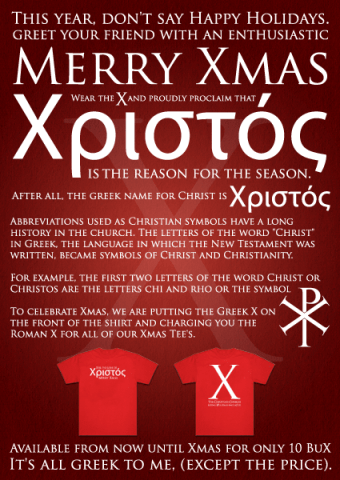
For all the hubbub about using “Xmas” instead of “Christmas” as shorthand (and in some cases where people intentionally desire to erase any reference of Christ from Christmas by using Xmas), the ironic, historic truth remains that ancient Christians utilized the Greek letter Chi and letter symbol Chi-Rho as a means to represent Jesus Christ. Such symbols are called christograms.

You see, the name Jesus Christ in Greek, the language of the New Testament texts, is Ἰησοῦς Χριστός. The first letter of the title Christ (signifying Jesus as the anointed one, the Messiah) looks like our English X and became a convenient, somewhat obscure way for early Christians in the catacombs and elsewhere to identify artistic representations of Jesus and Christian markings, signs, or art – similar to use of the Christian fish symbol.

Later, the Emperor Constantine I had a dream that he should put the “heavenly divine” symbol of Chi-Rho on his army’s shield before the Battle of the Milvian Bridge to guarantee victory. He did just that, won the battle, and turned the formerly pagan empire into a Christian one. The Chi-Rho symbol became and remains one of the most common christograms used in sacred and liturgical settings. In fact, it is often used as part of the modern Christmas tradition of the Chrismon Tree. Invented by a Lutheran in Danville,  Virginia in 1957, this practice is now popular in many congregations throughout the United States and across denominational lines.

As I find the debate over the use of Xmas somewhat distracting if not tedious and dislike the rush toward Christmas only to hide it away from the public eye as soon as December 25th passes, I try to experience Advent as a true time of expectant waiting and preparation. I also make an effort to enjoy the traditional Christmas period lasting twelve days through Epiphany on January 6th. So last year as Christmas approached, I posted an image I had found by Orthodox iconographer Raymond J. Mastroberte on Facebook saying, “Keep Chi in Christmas…Because early Christians used Greek abbreviations!” The illustrator’s image struck my sometimes questionable funny bone, and I playfully proclaimed that I would be putting the Chi in Christmas all twelve days.

Image and copyright by Orthodox iconographer Raymond J. Mastroberte. Image used here for teaching and not for profit under the terms of fair use.

Image and copyright by Orthodox iconographer Raymond J. Mastroberte. Image used here for teaching and not for profit under the terms of fair use.

In the context of our modern conundrum over Xmas, it wasn’t long until someone missed my attempt at humor. They argued that surely since Jesus Christ had done so much, suffered and died for our sake, we could most certainly take the time to spell out his name in full. It was as if the ancient Christian signs and symbols were suddenly disrespecting our Lord. And so, my attempt at lighthearted banter fell as another victim of this modern culture war.

As the past few years attest, an annual argument has indeed arisen about the secularization and explicit anti-Christian elements of our Christmas celebration. It should be expected, for in school gatherings and shopping malls, on public plazas and in our homes, religious symbols for Christ and his birth have come to be often replaced by winter scenes, Santa and his reindeer, snowmen, cute penguins or polar bears…the list goes on and on. In fact, some suggest that many Americans can’t specify what the Christmas holiday commemorates.

In opposition to Christmas, one atheist author argues that there is historically no proof that “Christ is the reason for the season.”[i] They suggest that winter celebrations have always existed, and such a modern mantra is only a Christian attempt to assert their cultural superiority over everyone else. Sadly in the name of multiculturalism, echoing choruses of Merry Christmas can be explicitly prohibited in some environs. Yes, just as there was no room at the inn on the original Christmas Eve, there seems to be no room in our public lives for Jesus today.

Yet, let’s not be too quick about things, as there are other signs to look for. Gallop found, “Ninety-five percent of Americans celebrate Christmas, and of these, 51% describe the holiday as ‘strongly religious’ for them, continuing an upward trend seen since 1989.” This 2010 poll also found a majority of Americans self-reported “incorporating specific religious activities or symbols into their holiday celebrations. This includes 62% who attend religious services on Christmas Eve or Christmas Day, 65% who display decorations with a religious meaning, and 78% who take time to reflect on the birth of Christ.”[ii] Self-reporting surveys can prove inflated, but we can see signs of hope for our beloved holiday.

Nevertheless, further confusing this debate, this same Gallop study found many more Americans were likely to practice secular traditions (in the ninetieth percentile range, depending upon the activity) than religious. Sadly, a recent poll by Think Finance claimed that 45% would rather skip Christmas due to the debt accumulated from gift giving.[iii] Others seasonally face bouts of depression or other mental illnesses magnified by their isolation or sense of loss during the holiday season, and thus they dread Christmas’ arrival.[iv]

Amidst debates and arguments, blinded by bobbles, decorations, and good deals, we can forget that our redemption is drawing near. Our time on earth is short, and we should live with hopeful and loving expectation as if Christ will indeed come soon. Signs of trouble and even outright persecution are nothing new. Jesus promised us such as these in his prophesies, comparing them to birth pangs.[v]

Should we then be so surprised that people are confused, lost, and hurting when it comes to Christmas and more importantly Jesus Christ? Should we let this distract us from our call as a holy people living together in Jesus’ holy name? Intentionally seeking the newborn Christ in our own hearts, we can repent of our own errors and grow in faith. Living as part of his body through our shared ministry of preaching, teaching and baptizing, or accepting and loving others (even our enemies) as they are, we can be used by God to bear Jesus into the world.

The devil’s in the details, and so it appears with our modern Christmas. Let’s not get anxious about the holiday – lost in empty debates or the holiday wrapping of materialism. As Christians, we are called to celebrate!

Look to the true heart of Christmas toward Jesus Christ himself, the final Word on this argument, come to save us. Whatever we choose to do and however we choose to say it, let’s seek to make Christ known every day. Look past the veneer of our time and see those suffering and alone around us. Enter relationship with them, help them, or guide them toward people who can. Celebrate the truth of Christ’s coming within every aspect of our lives – for the love of Χριστός, ourselves, and our neighbors.

There are more than enough signs of trouble and discord. Let’s not waste time dwelling upon them or pointing them out. Instead, let’s seek to be living, joyful signs that Jesus is near. That’s probably the best way for any of us to wish the world a meaningful Merry Christmas and eternity.

My wife, Kristine, and I wish you a holiday filled with blessings. May those same blessings flow through you to help transform the lives of others.

Pastor Lou

For those interested, visit OldLuteran.com for their comical take on this debate. Access their site through the image below:


[i] Cline, C. Putting Christ Back in Christmas: Is Jesus the Reason for the Season? as downloaded from http://atheism.about.com/od/christmasholidayseason/p/JesusReason.htm on November 30, 2012.

[ii] Jones, J.M. Christmas Strongly Religious for Half in U.S. Who Celebrate It: Secular traditions more common among Americans than religious traditions.  December 24, 2010 as downloaded from http://www.gallup.com/poll/145367/Christmas-Strongly-Religious-Half-Celebrate.aspx on November 30, 2012.

[iii] Berk, C.C. Why One Poll Says 45% Would Rather Skip Christmas. November 19, 2012 as downloaded from http://www.cnbc.com/id/49880517/Why_One_Poll_Says_45_Would_Rather_Skip_Christmas on November 30, 2012.

[iv] See for example Mayo Clinic’s Stress, depression and the holidays: Tips for coping at http://www.mayoclinic.com/health/stress/MH00030

[v] See for example Luke 21: 25-36 or Mark 13:8.

The above pastoral letter was originally published in Messiah Lutheran Church and School’s newsletter, The Messenger (December/January 2012 edition) in an abridged version. To view the entire issue of The Messenger or to see the full calendar of events, visit: http://www.mlcas.org

Unless otherwise indicated, all scripture quotations for this article are from the New Revised Standard Version (NRSV) translation.

© 2012 The Rev. Louis Florio. All content not held under another’s copyright may not be used without permission of the author.

Leave a comment

Filed under Church History, Community Life, Lectionary, Liturgical Year, Pastoral Letter, Uncategorized

Doom but not gloom

Christ the King

Today, too many fear the promised return of our Lord Jesus. In movies and other works of fiction, many can only imagine a terrible time of horror, suffering and judgment. Indeed, we are told in scripture that the end of time promises some form of Judgment Day will occur, but all is not a future full of darkness alone. With the symbolic language and prophetic texts used to speak of such a time, people tend to actively speculate about what such a time could be like. Many let their imaginations run wild for profit, the intimidation of others, or perhaps just out of ignorance. Yet in truth, to try to discern the mechanisms and mechanics of Judgment Day puts us at risk of being unbiblical. Such an exercise always proves futile for we lack God’s vision and understanding.

Instead of speculating about suffering or damnation, perhaps we should hold fast to Christ’s promise that he returns out of love for us. For rather than inspiring fear or proving a map to a terror-filled future, texts such as Revelation were written as much for (if not more for) Christians suffering in the present time to find hope and encouragement amidst persecution. In it, we are assured Jesus will most certainly come to complete what his life, death, and resurrection started. Jesus will come for us and our sake, to set the world right and bring new life. Thus rather than fearing the End of Time, the earliest Christians prayed that Jesus would come soon. The Second Coming is Christ’s answer to all that terrorizes our present lives, and we modern folk should rightfully celebrate along with those Christians who came before us.

Much after the first Christians, during a time when nationalism and secularism was taking a toll on the world through wars, greed, and political dysfunction, the feast of Christ the King was first introduced by Pope Pius XI in 1926. By 1969, the date was changed from the last Sunday in October to the last Sunday of the liturgical calendar year. Today, it is celebrated by the Roman Catholic Church along with many Anglicans, Lutherans, other Mainline Protestants, as well as parts of the of the Orthodox Church.

This ecumenical feast day is a celebration of hope while the universal church awaits Christ’s return. It serves to remind us that we should seek to live as one under our one Lord, Jesus Christ, loving God and our neighbor as ourself. Like the Christians before us, we remember and trust that Christ will come again – praying with hope that he comes soon. For only then will we experience the fullness of our promised life with him where “he will wipe every tear from their eyes. death will be no more; mourning and crying and pain will be no more, for the first things have passed away” (Revelation 21:4).

In the Evangelical Lutheran Church in Sweden, this feast day has been referred to as the Sunday of Doom. This name is somewhat ironic. There is doom in a sense, but we should never be overcome with doubts and sorrow as Christians. There is much more in store. The old world will pass away, and a new heaven and earth will be shared with us. Those who believe will be fully saved  and judged as if righteous; not based upon what they have done, but solely by grace through faith – trusting in what Jesus has already done for us through the power of his cross and resurrection. This Christ proclaimed, and it will be fulfilled.

Our true King will indeed return, but whatever trouble must come in the meantime, we should worship him, rejoice and be glad while we wait. We should set our hands and hearts to the work of making ourselves and our world ready for his return. For as much as we expect Christ, he asks and expects this of his faithful church.

Yes, the best is yet to come, and as Christians, we are promised that End of Time will mean a new beginning with our loving Savior and King. Our future (in the end) is nothing but bright.

Happy Christ the King Sunday!


Unless otherwise indicated, all scripture quotations for this article are from the New Revised Standard Version (NRSV) translation.

© 2012 The Rev. Louis Florio. All content not held under another’s copyright may not be used without permission of the author.

Leave a comment

Filed under Church History, Law and Gospel, Lectionary, Liturgical Year

One fish. Two fish. Lutherans catch fish…and people too.

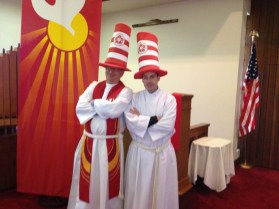
by Pastor Lou Florio with lots of help and inspiration from Dr. Seuss’ Cat in the Hat and OldLutheran.com

Due to continued requests, I am sharing the following Seuss-like poem about the Reformation. Inspired by Old Lutheran’s 2012 Reformation Party Kit theme (Luther in the hat), our intern, Vicar Nathan Huffman, and I participated in a short skit and then recited this poem. It was all part of our children’s sermon at Messiah Lutheran (Mechanicsville, VA) on Reformation Sunday, October 28, 2012.

The sun did not shine.
It was too wet to play.
The church was adrift.
The pope lost his way.

Though many saw problems,
Others did not.
Forgiveness was sold.
Salvation bought.

So the people in their houses did nothing at all.
They assumed it was just life,
at least since the Fall.

“Oh, how could this be?”
The people did say.
“It seems oh so wrong…
But in the church we must stay.”

So all they could do was
Sit sit sit sit.
But God did not like it;
not one little bit.

And then something went bump.
How that bump made us jump.
We looked and we saw him
step on the church mat!
We looked and we saw him
– Luther in his old monkish hat!

Knock knock went his hammer
on that old church door
He posted 95 theses
and then wrote much more.
He wrote and he wrote.
Oh what was Luther to do?
The church was so sick. It had spiritual flu.

Luther sat there and pondered, “How can one be saved?
…oh how, how, how, how?”
He studied and read, then it came to his mind
“Grace alone, faith alone, word alone – That’s a new find!”

Well, not really new.
It was as old as the bible.
Jesus called us to be one
And not at all tribal.

We should love with our hearts
And serve with our hands
We should teach about Jesus
And catch fellow-man.

It’s never for credit.
It’s never for pay.
It’s just out of love.
That’s Jesus’ way.

Yes, a Reformation of sorts had truly begun.
Led by God’s Spirit, honoring God’s Son.
But the pope and his friends said,
“No, no, no, make that cat go away.
Tell that Luther in his hat you do not want to play.
He should not be here. He should not be about.
He should not be around while indulgences cast out.”

Yet, it was just far too late.
A new day begun.
The people excited.
To be Lutheran found fun.

Yes, long, long ago
In a place far away
The Reformation did come and decided to stay.

There is no need to bribe God.
No need to hide.
Christ’s cross is enough
and the bible our guide.

Some call us Lutheran, together we’re church,
Sinner-saints all, yet in baptism, given new birth.
“We study and learn, it’s most certainly true!
Together as Lutheran’s we have some fun too.”*

“It’s Fun to be Lutheran, this much we know now.
It’s fun to be Lutheran and I’ll show you how.
Follow me, follow me we’ll have all kinds of fun.
Sing songs and tell stories and dance in the sun.
Follow me, follow me said a cat from the steeple.
We’ll teach and we’ll preach”*
and catch lots of people.

“Look at us! Look at us! Look at us now!
It’s fun to be Lutheran
You just have to know how.” *

Grace, word and faith, we need nothing more.
It’s just such as these that sends us out the church doors.

“It’s fun to be Lutheran
so let others know.
Wear this red and white button
The message will show!”*
(Holding up the OldLutheran.com “Fun to be Lutheran” button. These were shared with those present.)

There is plenty of fun. We won’t use it up.
Love God,
love your neighbor,
and share in Christ’s cup.

Together, be Christ
Together, we’ll serve.
Stick to Christ in faith,
and try never to swerve.

The Reformation ain’t over.
The church…it is we.
This is most certainly true,
because Christ set us free.

* Indicates quotes from OldLutheran.com

To get your fix of Lutheran fun, be sure to visit http://www.oldlutheran.com  –  Its “the Center for Lutheran Pride (but not too proud).”

© 2012 The Rev. Louis Florio. All contents not held under another’s copyright may not be used without permission of the author.
1 Comment

Filed under Liturgical Year, Uncategorized

The Christian’s great lie: “I’m no saint.”

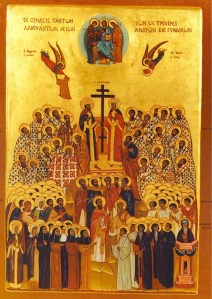
Can you see yourself here?

Do you struggle believing yourself to be a saint? Well, we probably don’t look much like the popular artwork depicting saints. Our lives often lack color amidst our many mundane affairs, and they certainly can prove messy at times.

Yes, Christians are fully human living in a real world. They experience real problems and pain, temptation and torment. In a fallen world, we tend to make fallen choices. We are “bent inward upon ourselves” as Martin Luther used to say; tending to care for ourselves more than God or our neighbour. Our lives are far from picture perfect.

Yet by grace through faith in Jesus Christ, we are forgiven, looked upon and declared as righteous, fully and savingly loved. We are simultaneously sinner and saint, one of Christ’s sheep who will never be truly lost. If you trust in Jesus and his promises, you are indeed a saint – called and chosen for a particular purpose. He declares it is so, no matter what you might believe, no matter how lost you might feel, no matter what your doubts and darkness might say. You and I are part of “a holy little flock and community of pure saints under one head, Christ” (Martin Luther, Large Catechism). Jesus is calling us now and waits to lead us.

Today, All Saints Day, isn’t about some musty artwork. Saints aren’t really those stoic statues and stained glass figures we see so often in churches. No, this day is about people like you and me; as well as people before us, around us and yet to come. We are an imperfect people, yet a people assembled (a church) and called (ambassadors) to risk living a bold trust in God’s grace. This is otherwise known as a life of faith. Through grace alone, we are the communion of saints. We are and remain Christ’s, never out of his loving reach.

So saints, enjoy your day and celebrate the love of God active in your life, even as you might remember with thanksgiving the saints Christ used in the past to make his love known to you. Your life will never be picture perfect, but it remains framed by the love of Jesus Christ. That’s what truly makes it beautiful and gives it meaning.

Happy All Saints Day!


© 2012 The Rev. Louis Florio. All contents not held under another’s copyright may not be used without permission of the author.

2 Comments

Filed under Liturgical Year

The Reformation: It isn’t just for Lutherans anymore. (It never really was.)

Today at worship, we remember the posting of Martin Luther’s 95 Theses on October 31, 1517. More important than that, we celebrate with thanksgiving that the Holy Spirit worked through Luther and other reformers to bring a renewal to Christ’s church – one still playing out today. Even during that difficult time of misunderstanding, false (and some valid) accusations and critiques against Luther and Protestants, regrettable divisions, and outright war, the Roman Catholic Church did reform itself in many areas through what they call their own Catholic Reformation. This was partly a direct response to true abuses identified by Protestant Reformers. Never expected when Luther hammered his 95 Theses on that church door in 1517, the entire church grew in its faith understanding as it argued about and searched for God anew. Even some alternative faith expressions have been born (such as the Anabaptist traditions, pietistic faiths and more). Although plenty of missteps have been made by human believers, this movement of the Spirit has enriched Christ’s church, and it indicates God is still speaking to us – still transforming us by grace through faith in his Word, Jesus Christ.

True, all remained imperfect in our fallen world. Mutual condemnations continued primarily until the aftermath of WWI and later WWII. Yet through the horrors of war and genocide, many Christian began to ask why we should hate one another. It could not please God. Within this spirit of repentance, the Holy Spirit worked to help heal and address divisions. Using ecumenists such a Dietrich Bonhoeffer, Brother Roger of Taize’, along with many others (some remembered and some not), and partly through the leadership of Pope John XXIII and the Second Vatican Council, another renewal of the Church began – not unrelated to Luther’s own actions in 1517 and later. In fact, many of his historic arguments were revisited with a new openness of heart. Resulting changes have proven so profound that the Roman Catholic Pope John XXIII and other Roman Catholics, along with Christians of other faith traditions are included in the Evangelical Lutheran Worship’s calendar of commemorations. The World Council of Churches, the Lutheran World Federation, full communion agreements between denominations, and ecumenical dialogues remain signs that we hope and actively seek to move that process forward.

Ecumenical discussions continue despite any mistakes arguably made at times and the reality that some Christians still reject any such talks and cooperation. One result has been the recent agreement of what it means to be justified through faith. Although some historic differences might remain in practice, Catholic and Lutheran reforms over the last century have resulted in denominations remarkably similar even amidst their differences. The current Pope Benedict often speaks well of Luther even if he doesn’t fully agree with everything Luther said or did. He agrees with Luther’s “burning question”, as Benedict puts it: “what is God’s position towards me, where do I stand before God?” As a Roman Catholic publication recently noted, this remains the central question of life today, even though many people don’t realize it. He also applauds Luther’s Christ-centered spirituality. Last echoing Vatican II, Pope Benedict remarks, “It was the error of the Reformation period that for the most part we could only see what divided us and we failed to grasp existentially what we have in common in terms of the great deposit of sacred Scripture and the early Christian creeds. For me, the great ecumenical step forward of recent decades is that we have become aware of all this common ground, that we acknowledge it as we pray and sing together, as we make our joint commitment to the Christian ethos in our dealings with the world, as we bear common witness to the God of Jesus Christ in this world as our inalienable, shared foundation.” (See Brumley, M. The Pope, Martin Luther, and our time. The Catholic World Report. Posted September 25, 2011 at catholicworldreport.com)

It is truly remarkable that the Roman Catholic, Lutheran and recently Methodist denominations have agreed on a Joint Declaration on the Doctrine of Justification over the last 10 or so years. This remains yet another sign that the Spirit is still at work, that God will make all things work for the good as scripture promises, and that Jesus’ prayer that we be one need not remain a dream forever.

As we remember Martin Luther and the Reformation and perhaps seek to celebrate all things Lutheran, let us also look kindly upon all of our brothers and sisters in Christ. I believe we must seek to actively and intentionally listen for God’s guidance together, living in Christ’s love and the hope of what is yet to come through the Spirit’s work in our midst.

To read this historic document, Joint Declaration on the Doctrine of Justification, visit the link below:

http://archive.elca.org/ecumenical/ecumenicaldialogue/romancatholic/jddj/index.html


© 2012 The Rev. Louis Florio. All contents not held under another’s copyright may not be used without permission of the author.
Leave a comment

Filed under Church History, Law and Gospel, Liturgical Year

Three Hours Changed My Life

Lord, as I contemplate your suffering on that cross so long ago, my heart grieves. I mourn your sacrifice for my sake. I regret the wounds that my sin has caused. In the days of my youth, I was quick to forget your saving act of love. I doubted that you died for me, and even if you had, I believed my sin too great to be forgiven. Through my lack of trust – embodied in so many of my words and deeds – I mocked you with my life. I scourged you with my poor choices. I made idols to lift up and worship rather than seek comfort in your holy cross. Although standing amidst the living, I had descended down into the Pit.

I confess that I remain a sinner, and yet, you have chosen me to live among your saints. In my distress, your arms reached out to me from that same cross I scorned. Your love crossed time to declare for me a new life of jubilee. Through people, places and events, you helped me recognize the truth and glory of your cross: you died for me, and my sin is never greater than your grace. I am not who I once was, and I have found hope in whom you will help me become. You will never forsake me, for you have paid too high a price. I have been made new through your love.

Lord, I know you will prove faithful to me and all of your promises. You have always been faithful even before I knew you. Your death remains a sign that you will always remember me. Purify my heart, O Christ, so that I never forget you. Still standing amidst the living, help me share this resurrected life with others. Amen.

The above text was composed after sharing Three Hours watching, waiting, and worshiping with some of my brothers and sisters in Christ from Messiah Lutheran Church. Each Good Friday, we gather from noon to three o’clock to hear the synoptic gospel accounts of the crucifixion, pray psalms, listen to meditative music, and hear reflections about the cross in our lives from Martin Luther, Dietrich Bonhoeffer, Brother Roger of Taizé, Jean Vanier and more.  At 7 pm, we reconvene for a special Good Friday worship service.

Leave a comment

Filed under Liturgical Year, Uncategorized

Why L’Arche for Lent?

Logo of L'Arche ("The Ark") Communities, downloaded from larche.org

Despite the heated language in our polarized world, justice and peace are Gospel values. People too often use such words like a weapon for their political agenda (conservative or liberal, believer or non-believer) rather than listen to them with a holy fear. These words are powerful, spoken from the mouth of God to our hearts. Lived out, they change us and the world. We are to love the poor, the oppressed, the widow and the orphan. We are even to love or enemy. We should never let ourselves be led away from these words and who first spoke them just because they are sometimes misused. Instead, we should seek their depths in the wellspring which is Christ and his community, the church. We should strive to live them out every day, so we and the world can be transformed by love.

One of the most powerful ways to grow into love is to experience it in the real world. Recognizing our own need for love, we must allow ourselves to be rooted into the gospel message as the Spirit moves. Through situations, people, and places, as well as our own weakness, the Spirit intends to drive us into the wilderness. The Spirit calls us to experience new life there. I believe Gospel stories become Gospel realities as we seek to live them out concretely in our lives; sometimes in places where we are not so comfortable. Through sacred but small moments, our relationship to the world and each other will be transformed.

As a community of faith over the last few seasons of Lent, Messiah has been examining the Christian life and witness of well known figures of the last century. We do so hoping to grow as individuals and a community. As pastor, I have tried to identify people who shared different yet compatible visions of community: Dietrich Bonheoffer, Brother Roger of Taizé, and this year, Jean Vanier and the community members of L’Arche. Each has been given a vision by God of what community can be. Through their lives, they exemplified what Br. Roger so often described as a “parable of community” that teaches us and the world new possibilities.

L’Arche literature and websites proclaim that community isn’t an ideal but you and I. Despite our differences in politics, theology, or ability; we are called to be one with each other and with God. A local L’Arche community describes their shared life in this way:

L’Arche Blue Ridge Mountains mission is to create fully-accessible homes where people with and without disabilities share life in a spiritually based community. We strive to make these homes places of caring and faith, where individuals’ unique callings and abilities are brought out.[1]

Through their words, I can hear an invitation of what “church” can become in a real and too often difficult world. I first became fully aware of L’Arche while volunteering with the Community of Taizé. (I had heard of them and a famous member of their community, Henri Nouwen, but I hadn’t gotten to know them well.) A group from the original home at Trosly-Breuil came to visit, and a young man proudly and joyfully told me about his life there. Pasquel (I still remember his name, a name which means Easter) ended his witness by offering me a new beginning. He invited me to live with them. I was unable to accept the invitation at the time, but I remain deeply touched by his testimony and openness. Somehow, I still feel in communion with him and his hope and vision for tomorrow, even as I feel called in the here and now to be at Messiah Lutheran in Mechanicsville. Who knows what tomorrow might bring? Yet, I believe we all can live that hope out no matter where we are.

Personally, I know his vision can be a reality. Long before I knew Pasquel, I knew the love of my grandmother. Her firstborn, my aunt, was born with a serious mental disability. At the time (the 1930s), people encouraged her to put my Aunt Theresa into an institution. She wouldn’t hear of it. Instead, she chose to respond to her call to love. With time, patience and effort, Aunt Theresa grew to be a beautiful lady with much love to share. She held a job, learned to drive, and even helped care for my grandparents as they grew older. I believe my grandmother, my aunt, and my family were transformed by grace; a grace that saw past the dark realities and allowed us to live in the light of hope. I never saw my aunt as disabled although I couldn’t avoid her disability. Only love stands out when she comes to mind.

With these varied experiences now part of me, I hope to nurture that similar love which is already active at Messiah by sharing in an exploration of the Christian life and witness of Jean Vanier and L’Arche. During Lent, we’ll read Jean Vanier’s writings, watch some videos, discuss our impressions, but most importantly (if things go as planed), we will worship and fellowship with members of L’Arche Blue Ridge Mountains to help celebrate the season of Easter. Both communities have much love to share and much more to learn about love. Together, I think our Lenten journey will be a true adventure; an adventure more deeply into the love which is Christ. We will be blessed to share in the resurrection more concretely through a new life with God and each other.

To learn more about L’Arche, visit:

L’Arche International                            http://www.larche.org/

L’Arche USA                                                http://www.larcheusa.org

L’Arche Blue Ridge Mountains           http://www.larchebrm.com

Or, listen to “Jean Vanier: The wisdom of tenderness” (radio interview, American Public Media): http://being.publicradio.org/programs/wisdomoftenderness/

© 2011 The Rev. Louis Florio. All contents not held under another’s copyright may not be used without permission of the author.

[1] L’Arche Blue Ridge website at http://www.larchebrm.com . Downloaded on March 12, 2011.

Leave a comment

Filed under Liturgical Year

Repent & Rejoice – This Lent and Every Day

This is what the Sovereign LORD, the Holy One of Israel, says: “In repentance and rest is your salvation, in quietness and trust is your strength, but you would have none of it.” (Isaiah 30:15) 

Repentance is good for the soul, or so the Lord teaches. Yet, we often resist. It is hard to admit our frailty. It is hard to sometimes see it. Like sour medicine, our hearts tend to resist surrendering our individual sovereignty to the sovereignty of God. So, the season of Lent proves a reminder of and exercise in repentance.

Serious business, repentance need not always be a somber act, but it is necessary each and every day. We are getting right in our relationship with God after all: a Lord who created us, a Savior who died for us, and Spirit who comforts us. We are asked to pay more attention to our relationships and a world entrusted to our care. God is love, and we should rejoice at the opportunity to become more loving. Repentance always seeks out forgiveness and reconciliation, and our hearts should rightfully celebrate.

And so, I join Teresa of Avila in praying, “From silly devotions and from sour-faced saints, good Lord, deliver us.” Instead, I invite you with a smile on my face to join us for our many life affirming (and yes, sometimes even fun) events this Lent. I encourage us all to seek out deeper worship, meaningful service opportunities, and other appropriate Lenten disciplines. As individuals and as a family of faith, we might come to better understand what it truly means to rejoice and be glad.

Many blessings be upon you and your Lenten journey,

Pastor Lou


This piece was originally published in Messiah Lutheran Church and School’s monthly newsletter, The Messenger. You can view current and recent issues of The Messenger at: http://www.mlcas.org.

Photo in public domain: Balaska, J. (February 25, 2009) Ashes imposed on the forehead of a Christian on Ash Wednesday.

© 2011 The Rev. Louis Florio. All contents not held under another’s copyright may not be used without permission of the author.

Leave a comment

Filed under Liturgical Year