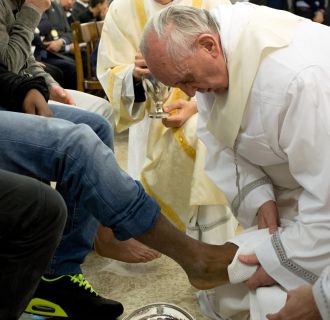
 A response to “Pope’s foot-wash a final straw for traditionalists” as reported by the AP
Within an ancient culture that didn’t count women during the government census or necessarily notice or respect them in the home, it is not a real shocker the bible doesn’t often mention women.
Despite this, it remains most probable that women were an important part of Jesus immediate community and present at his final Passover Feast. Matthew reports that at the feeding of the 5,000, the count did not include women and children.[i] Or later, Matthew shares that women who “had followed Jesus from Galilee to care for his needs” watched as he died.[ii] (Was this perhaps after preparing and sharing in his last Passover Feast?). There are other attestations from other Gospel writers as well which some see as supporting that women were among his disciples and active in his ministry.
Whether you agree or not, or think women had their feet washed by Jesus or not, Jesus’ greatest intention on Maundy Thursday was to teach us to love and serve everyone (“one another”) as he had us. After all, Maundy comes from the Latin word mandatum (meaning “commandment”), and it was used in the early Latin Vulgate translation of John 13:34: “I give you a new commandment, that you love one another. Just as I have loved you, you also should love one another.” Using scripture to interpret scripture and seeing Christ’s own example, it is hard to argue that this command to love only covered Christians. Christ longs for his family to grow.
Yes, this final teaching echoed Jesus’ earlier ones. What’s the greatest commandment?[iii] Who is our neighbor?[iv] Jesus reached out to all those marginalized by society whether Jewish or not. We are not to become their stumbling block.[v] We are to let “the children” come to Jesus.[vi] Indeed, we are to love whoever might be thought as “the least of these” – perhaps children, inmates, the poor, women (in many cultures still), anyone we tend to label as “sinners”, and non-Christians. Matthew is said to have been the most Jewish of the Gospel writers; at least his writings reflected many Jewish teachings and responded to many Jewish biases about their being the chosen ones of God. Yet, he shows Jesus to be incredibly open and loving to all. Jesus longs for relationship!
Despite this, some traditionalist Roman Catholics have become more and more vexed by Pope Francis’ election and recent behaviors. He has cast aside signs of regalism. He has acted in ways lifting up the priesthood of all believers. He has expressed openness to Protestants, Orthodox Christians, and people of other faiths entirely. As in Argentina when a Cardinal, Pope Francis seeks simplicity, and he lives that way. Not the least of their issues with him, many traditionalist have expressed “the horror” (not my word, but often found in their tweets and posts) that the Pope would wash not only the feet of a juvenile women who happened also to be a prisoner, but in one case was Islamic. “He cultivates a militant humility, but can prove humiliating for the church,”[vii] Fr. Bouchacourt, head of the traditionalist, schismatic St. Pius X Society, said. I have seen similar less than charitable comments by other traditionalists, even from some of those who haven’t broken from the Roman Catholic hierarchy but instead claim to love and obey it. Some even suggest Pope Francis’ behaviors are just a show in violation of scripture.[viii]
If signs of humility are embarrassing to the Roman Catholic Church, then I bluntly but in love suggest these folks take a look at Jesus’ own behavior. Jesus often intentionally exemplified his teachings through public behaviors. That’s what teachers and leaders need to do. Jesus prayed in public at times not for his own sake and not for a show, but so that others could be comforted and learn of God’s love.[ix] He purposefully embodied earlier prophesies to help reveal his identity, such as by riding a young donkey into Jerusalem.[x] (Certainly, Palm Sunday was quite a spectacle.) Some of the same conservatives – those who were so protective in promoting the sanctity of the conclave and agressively argued that the election process was in the Spirit’s presence and following God’s will – turned on Pope Francis that first night.
Even as a Lutheran, I would agree that the Spirit is involved in leading the Roman Catholic Church, but I would also argue the Spirit seeks to guide all other denominations as well. Institutions made of fallible humans can err (a very Lutheran attitude to be sure), but we still remain Christ’s church. Despite the historic divisions of the universal church, Pope Francis holds one of (if not the most) prominent positions of Christianity. To be ashamed of such humble, public actions that so many “of the least” will take notice of seems the real shame to me.
This Lutheran says, “Good for Pope Francis!” Perhaps I shouldn’t care so much, but I (like countless other Christians) hope and pray for the coming reality of Christ’s own prayer that we live as one.[xi] We are the church together, not our denominations, through the grace of our shared faith and baptism. I humbly support my brother Francis in his efforts to make Christ’s love known in the entire world.
After all, Jesus asked us to love and support one another. He never said with our human minds, hearts and ways that we always would agree on everything.
Postscript: Vatican responds to complaints: http://bit.ly/Z02evs
[xi] See John 17.
Unless otherwise indicated, all scripture quotations for this article are from the New Revised Standard Version (NRSV) translation.
© 2013 The Rev. Louis Florio. All content not held under another’s copyright may not be used without permission of the author.


 2pennyblog