Everyone has a unique call from God. Ultimately, we are to glorify God by
loving God with all that we are and through loving others as ourselves – no
matter what we do or where we find ourselves. Yet, the Devil is often in the
details! How do we know which way to go?
Interests, hobbies, varied experiences and talents all come together to
help clarify our way. Some of us end up in overt care, teaching or service
professions. Others might find their primary place is in the home building
family life. Still others might find themselves placed in jobs which seem far
removed from faith. Indeed, our call may even change over time as we learn more,
encounter new people and experiences, or our abilities change.
Yet not surprisingly, if love for God and our neighbor is present in
the way we fulfill our duties, we will discover sacred moments in ANY
job. If faith shapes how we treat others in business, Christ will be there with
us. God wants sacred light to shine throughout the world, even where we work or
study. Our intended vocation (at its root meaning “sacred call”) often will be discovered
where our passions and God’s purpose for us cross.
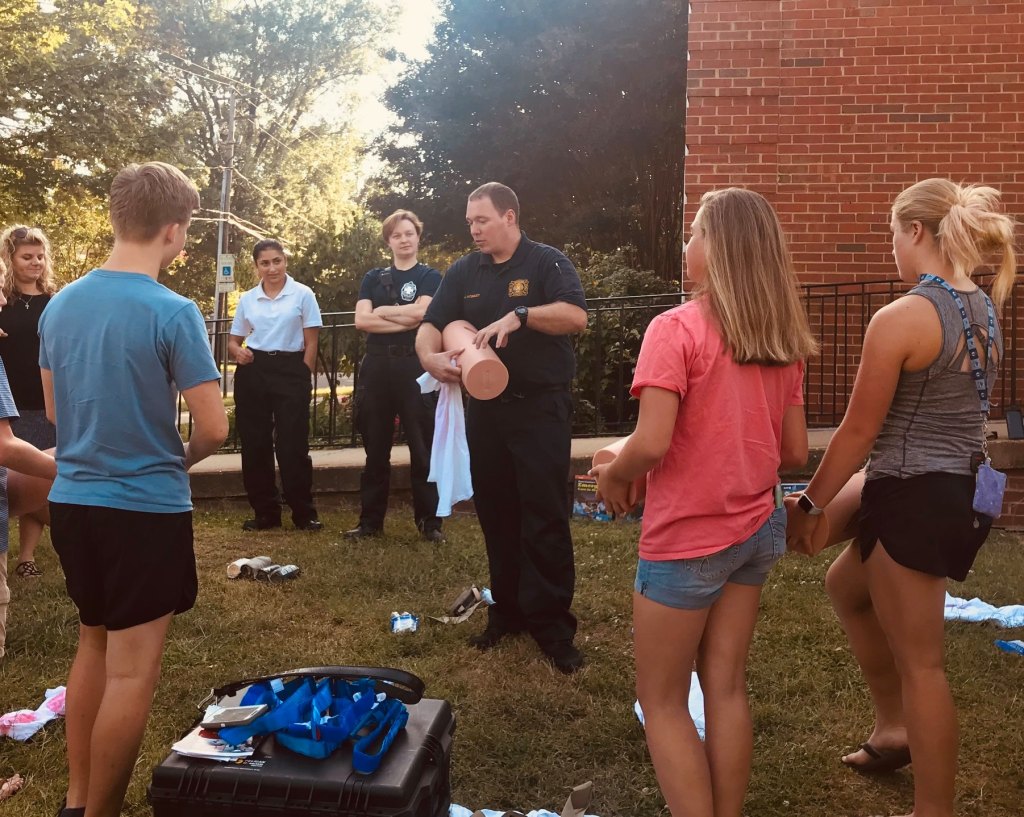
Last Sunday, we exposed our youth to a “Wheel of Service.” In one
station, a Fredericksburg medic taught them about emergency medical care for
serious, bleeding wounds. He also shared about volunteer opportunities for
teens with his department and the joys of his career. In a second station, our
youth group served other youth by packing “Feed the Children” bags. These bags
help food insecure students in our region. They also learned about the
operations of our Food Pantry and how it helped our neighbors. Finally, Pastor
David Casey, our Campus and Young Adult Missioner, led us in a discussion about
campus ministry. Not only are such ministries an opportunity for food,
fellowship and relaxation, such programs can help one grow in faith and find
one’s way forward to the place Jesus is trying to lead us. Retreats, spiritual
direction, volunteering (such as with Young Adults in Global Mission or the
Lutheran Volunteer Corps), service projects, presentations about other people’s
calls and our shared ministries, and yes, even attendance at Sunday worship can
all come together to plant seeds for tomorrow.
However, don’t think such discernment is only for the young. Each and every day, we have a new adventure instore when following Jesus. No matter how old we are, our perceived abilities or disabilities, our assets or struggles, Jesus is calling us. Jesus is calling you. Seek to intentionally discern that call and follow Jesus. There might be a time of waiting. Perhaps we will only understand looking backward. Yet, Christ will get us to where we each need to be for the sake of his Church and the world.
Originally published in The Hub, a weekly email of Christ Lutheran Church, Fredericksburg, VA.
Knock, knock, knock…Below is my response to “Protestantism is Not United, Not Catholic, and Not a Church,” by Fr. Andrew Stephen Damick (2017).
The argument that Protestants are not united, not Catholic, and not a Church doesn’t upset me much as a Lutheran. The Great Schism (1054) and the start of the Protestant Reformation (1517) left the Christian world divided with the Orthodox, Roman Catholics (or Papists), Evangelicals (the first called Protestants and eventually Lutherans), and what were often at first named Radicals (Anabaptists and others pushing the traditional theological envelope). The Augsburg Confession was written with the hope for unity even amidst some practical, concrete theological differences.
As regional and theological breaks continued to occur, “Protestant” became an umbrella term for many disparate groups, and Evangelicalism more recently became connected to believer-baptism, “Bible based” traditions. The term, Protestant, is now sometimes used to indicate mainline denominations, but in general, the term covers a disparate group in common usage – often Mainline Protestant, Evangelical, Pentecostal and others. Although, it is important to note that some high church Episcopalians/Anglicans don’t like to be thought of as Protestant at all. Still, most everyone else considers them so (whether fair or not).
I would argue that some Protestants are more attached to the “Catholic” (universal) heart of the church than others. Determining what that heart is remains the rub. For my part, I put my trust in Jesus, Son of the Living God, risen from the dead. Beyond that, I’m open to arguments and even ultimately being proved wrong. Despite our hardheartedness, I find continually that the Holy Spirit makes us one Church out of many denominations (or “church bodies” if you prefer) whether we like it or not. There are many commonalities. There is an ecumenical movement affirming catholicity over division. Yes, we find these are muddied, sinful waters, but I expect the Baptismal waters will win out yet.
So, I believe the author fails to adequately or even fairly differentiate between varied beliefs of Protestantism. Echoing his own argument, must of us confess that we are not one! We understand that the Church is fractured, but we don’t have to look far to identify fractures in the Orthodox edifice as well. Just look at what’s going on in orthodoxy over in the Ukraine. Closer to home, in my own county, I know of Orthodox Christians that mutually condemn one another. Certainly, we know Orthodox folks in the Richmond area who are viewed with suspicion if not distaste by other Orthodox folks. The catholicity of the Church is broken, and so, many Christians are working toward repairing the breach when and where they can. There’s a hunger for unity with God and one another.
In my view, the author makes a mistake by conflating Protestant
traditions. He focuses on the “Reforming Catholic Confession” as if it is a
seminal Protestant document. It is actually a document initiated (as I
understand it) by Kevin Vanhoozer, a seminary instructor at Trinity Evangelical
Divinity School (Deerfield, IL). Interestingly, the seminary is affiliated with
the Evangelical Free Church of America. This denomination is Evangelical in the
modern sense (believer-baptism, “bible based,” etc.) not the Lutheran sense (“of
or according to the teaching of scripture”). The Evangelical Free Church of
America’s deepest roots are indeed found among Swedish, Danish, and Norwegian
Lutheranism, but they are ultimately a break-off sect in the United States – former
Lutherans influenced by Baptist and Evangelical neighbors. Ironically, they
were originally considered “liberal” by some, as the predecessor bodies were
trying to cast off the cloak of the “Old World” religion and hungered to be a “free”
(not state supported) church. Today, Evangelicalism is in fact often closely
connected to conservative politics and traditions, but not always.
I would argue we all fall short of the “Catholic” standard. Orthodox, Roman Catholics, Mainline Protestants, Evangelicals, Pentecostals, and all others have plenty of repenting to do rather than casting stones. I’m thankful to be part of a Protestant denomination that is trying to live out the Augsburg Confession’s hope of our being one, and most importantly, Jesus’ own prayer for us to be one (John 17:20-23).
I don’t fault the authors of “The Reforming Catholic Confession” for arguing for the catholicity of their faith (as they see it), even though, I do often disagree with their theological claims. Thanks to the Holy Spirit, I trust we are one even as we disagree. Thus, perhaps we as Church would find it more productive (and in line with God’s will) to focus on what unites us rather than divides us as Pope John XXIII suggested; even if we need good beer and conversation as the starting course.
Amidst our Christian brokenness and sin, I trust the fullness of the promised feast is yet to come. Someday, Jesus’ prayer will be completely fulfilled. Yes, we are one Church, just not quite yet.
Pastor Lou is a member of “the Three Priests.” Join him (an ELCA pastor), Fr. Adam (an Orthodox Church in Americapriest), and Fr. Nic for a Three Priests Walk in a Bar event in Ashland, Virginia, or through their (hopefully) upcoming podcast series.
This post was created in response to an article shared by an Orthodox friend, Fr. Adam, on Facebook, “Protestantism is Not United, Not Catholic, and Not a Church – Orthodoxy and Heterodoxy,” by Fr. Andrew Stephen Damick, on Reformation Day 2019. Find it here: https://bit.ly/36o4XtI
As August ends, I am participating in a community worship service and national
ringing of church bells. Sunday, August 25, will mark four hundred years since
the first Africans arrived by force at Fort Monroe, Virginia. Slavery is a
tough subject to address, and when you add the many ongoing sins related to
slavery, Jim Crow Laws, segregated communities, and other signs of personal and
systemic racism, it becomes even more difficult.
Whether racism or any other hot button issue, it is helpful to remember
that forgiveness is already ours. We need not get stuck in shame whether it is
our sin, the sin of others or of the world. Nor should we fear acknowledging
guilt. Instead, humility calls us forward into a future together with Christ. We
who have been reconciled to God through Christ have also been entrusted with a
ministry of reconciliation (see 2 Cor. 5: 11-21). We can indeed address
hurtful, “hot button” issues without defensiveness or unholy anger.
As election fever rises again and troubles of the world present
themselves, I find it helpful to listen more than talk. What is really being
said and why? Is my momentary adversary speaking from their own woundedness and
therefore wounding me? Sometimes angry people facing compassion and gentleness
can be moved toward compassion and gentleness themselves. In speaking, I try to
avoid blanket statements, as hot button issues are often multilayered, nuanced
and intersect with others. As a flawed human, I might even be wrong, so I try
to consider both what I might need to learn and where we might be able to find
areas of agreement. Although Lutheran Christians have always been encouraged to
engage the world and call authorities to account when necessary, regarding the Eighth
Commandment (as Lutheran’s count them, the admonition to avoid bearing false
witness), Martin Luther cautions, “We are to fear and love God, so that we do
not tell lies about our neighbors, betray or slander them, or destroy their
reputations. Instead we are to come to their defense, speak well of them, and
interpret everything they do in the best possible light” (Small Catechism).
And then, of course, we have Christ’s own teaching and example, “You
have heard that it was said, ‘Love your neighbor and hate your enemy.’ But I
tell you, love your enemies and pray for those who persecute you, that you may
be children of your Father in heaven.” Praying for those we oppose might not
always result in an observed change in their behaviors, but I always find it
brings a change in me – in attitude toward them and the world, in my own
general peace, or sometimes in my own repentance. Consider praying before you
hit that post button or begin a difficult conversation. Or, just step away, and
then come back to address things after some prayer and reflection. It is
amazing how the Spirit can give us just the right words.
Like the Psalmist in Psalm 27, “I believe that I shall see the goodness of the Lord in the land of the living.” Sometimes that goodness will enter the world through us.
Originally published in the June 2019 newsletter of Christ Lutheran Church, Fredericksburg, VA.
Unless otherwise indicated, all scripture quotations for this article are from the New Revised Standard Version (NRSV) translation.
Picture credit: Gerard Seghers (attr) – The Four Doctors of the Western Church, Saint Augustine of Hippo (354–430); or as I would call it, “Let me think, think, think…”
At a recent “Three Priests” theology discussion, one sticking point remained as we closed our talk on the Word of God: Is the biblical canon closed? Well, I argue that depends on how you look at it.
Due to some modern fictional books and movies, the Emperor Constantine is sometimes wrongly given credit for the canon inherited in Western Christendom. Constantine did call the Council of Nicea (325), which was the first general conference or “ecumenical Council” of the Christian church, but this first gathering is not reported to have addressed the canon. In 330 CE, Constantine did finance the copying of fifty Christian “bibles,” comprised of commonly accepted books, but he, too, does not seem to have officially influenced the cannon.
So, did any council approve what we know as the cannon? That in itself is a tricky question. There *was* a “council” (small “c”) to help establish the Roman Catholic/Western cannon and later councils affirmed it, but these were not any of the seven great “Ecumenical Councils” which occurred before the split of Eastern and Western Christendom.
The Synod of Hippo of 393 is one of several gatherings of bishops sharing this name. (Synods of Hippo were also held in 394, 397, 401 and 426.) This specific gathering is commonly held by Roman Catholics as the first time any council of bishops (again, not to be confused with one of the seven “Ecumenical Councils”) listed and approved a Christian biblical canon. This list corresponds closely to the modern canon in the West. This canon included the six later books classed as deuterocanonical/apocryphal as well as First Ezra/Esdras and Second Ezra/Esdra. Also included among these apocryphal texts: Tobit, Judith, 1 and 2 Maccabees, Wisdom, Sirach, Baruch, parts of Esther and parts of Daniel. It left out some apocryphal books recognized by the Orthodox.
This canon list was later approved at
the Council of Carthage (again a series of synods and not listed as one of the seven
ecumenical councils) pending ratification by the “Church across the
sea”, that is, the See of Rome. This Council of Carthage (the third of
several synods in the 3rd, 4th and 5th
Centuries sharing this name) affirmed the canon established in Hippo on 28
August 397 (and again in 419).
The councils held at Hippo were held under the authority of Augustine, and I’ve read he considered the cannon closed. In reality, others (both saints and heretics) continued to propose varied lists. Indeed, First Ezra/Esdras was excluded in the Vulgate Bible (late fourth century) and ceased to be considered canonical in the West. The modern Book of Ezra formerly included the Book of Nehemiah in a single book, but it is now commonly split since the 9th century onwards. It was not until 1516/17, in the first printed Rabbinic Bible of Daniel Bomberg that the separation was introduced generally in Hebrew Bibles.
The cannon solidified over time in the West, but Luther stirred the pot again with his Reformation review when he asked, “What is truly scripture?” He evaluated opinions and judgments of the past, but he wasn’t afraid to challenge them. He ultimately rejected the Apocrypha. Jewish religious leaders of Germany tended to reject them, so why shouldn’t Christians? He also attempted to remove the books of Hebrews, James, Jude and Revelation from the canon. To him, they were out of whack with “grace alone” and “faith alone” doctrine. Other Reformers disagreed. In the end, he kept these New Testament books, but these books are still to be found toward the end of the German Language “Luther Bible.”
The Council of Trent (1545-1563), the 19th “ecumenical council” of the Roman Catholic Church, was called in response to the Reformation. Indeed, my old priest and Sunday school teacher (from pre-Lutheran days), Father Foley, considered this council the start of the “Catholic Reformation” in response to the “Protestant Revolt.” (These terms were common among Catholics, and remains so among some hard-corps, conservative Roman Catholics.) This council was not truly ecumenical, as it did not include anyone from the Orthodox Church. In response to the Reformation, it approved the Catholic Cannon we know today. This includes apocryphal books.
The Lutheran/Protestant cannon continued
to exclude the Apocrypha as scripture. Although not viewed as being the
standard of scripture, these works remained valued even by Martin Luther. They
are often included in modern editions of scripture, but you will find them
clearly designated as apocryphal or deuterocanonical texts.
So, is the cannon closed? Theoretically, it closed in the 300s, but one can see there have been and remain variations. The Church (East and West; Catholic, Protestant and Orthodox) could work toward more unity someday, as unlikely as that sounds. Or, maybe the West might accept just as my Orthodox friend, Father Adam Sexton, proposes, “The Orthodox Church is right. We have received what we were meant to receive.” Then, in that sense, the West could accept the East’s ruling and “go back” to that. Yet many of those Christians who are orthodox (small “o” meaning more traditional) would say, the canon is absolutely closed as is. Some suggest the canon was closed with the death of the last Apostle. Others say that scripture points to the revelation in the Christ which has fully come in Jesus.
Yet some scholars and others do indeed argue about the closing of scripture. Usually, they suggest better, more complete surviving texts might someday be found calling for an amendment to the canon. Or, they suggest texts formally rejected for theological or political reasons might need to be reevaluated. Or, they argue that there is nothing in scripture that defines the canon, only councils of men did. Yet again, most of the catholic (small c meaning universal), orthodox (small o, meaning more traditional) Church deems the canon closed by the Spirit. To do otherwise can be viewed heretical and certainly false prophets and revelation could mislead us.
In practice, some argue that the canon was closed with early gatherings of bishops (in the 300s), as well as with the East-West break, or even with the Reformation and/or Council of Trent (1500s). Yet even after choosing any of these historic markers, disputes remain between Christians over exactly which books belong. Is it really closed if the entire church can’t reach a consensus? Some past and present Protestants believe that the Church recognizes the canon, but it does not have the authority to close it.
Looking at history, Karl Barth, a Reformed theologian of the 20th Century, put it this way, “The insight that the concrete form of the Canon is not closed absolutely, but only very relatively, cannot be denied even with a view to the future” (Karl Barth, Church Dogmatics: The Doctrine of the Word of God, Vol. I/2, trans. Bromiley, G. W., & Torrance, T. F. London; New York: T&T Clark. 2004. Print. p. 476). Another major shaking of the Church could yet cause the books to be reevaluated, shuffled, or who knows what. Well, as I said last night, only God knows, and we will find out. Until then, we seem to be left with a general, human consensus – we trust guided by the Holy Spirit – and thus could be in error or not done discerning, “What is scripture?”
*As this was just for fun and general edification, I’m not listing all my resources, but they included the Catholic Encyclopedia, US Catholic Bishops Conference website, multiple Wikipedia articles (yeah, I know, not always authoritative), multiple blogs (some kind of out there), and classes by Father James Foley, SJ (may he rest in peace).
“So many books, so little time.” Perhaps few know that as well as
a pastor! We love and depend upon books even in this digital age for sound
theology and ideas for better ministry. Come into any pastor’s office, and you
will likely see books on shelves and tables, if not the floor. Today, this
clutter has likely spread through electronic versions on their tablet or phone
as well. Our lives seem fed by books.
Yet what would happen if the pastor attended to all these other books but moved away from reading scripture daily? As with anyone else, Bible stories will be conflated into cultural understandings rather than scriptural ones. Faith might become challenged if not weaker, and a hunger for meaning, understanding and hope would grow. As with satiating one’s thirst, we need to go back to the well often. We need to hear what scripture really says to us, for as an early Puritan pointed out, “God is still speaking.”
Now certainly, other books have value, as do our many commitments,
but through scripture, we encounter our Living God who loves us anew in a
special way. Scripture is the norm for teaching and our discernment over all
daily matters in our lives. The Spirit can literally touch and reshape our
hearts. Martin Luther argued the Word of God has the power to bring about repentance,
faith, and salvation. “What pasture is to the beast…the nest for the birds, the
stream for fish, the Scriptures are for believing souls,” Luther wrote.
As our community’s children return to their academic studies, let
us also return as families and individuals to scripture. Take advantage of the
free daily meditation guides in our welcome area. (Perhaps even take the extra
step of reading each scriptural citation in full and in their original context.)
Challenge yourself to a Bible reading plan based on themes for life or for
reading the Bible throughout the year. It is easier than you think. Intentionally
dig into scripture when facing decisions or problems, start or end your day.
Listen for the Spirit through other’s interpretations that might affirm,
challenge or shape your own. (Bible study with a spouse, family, or group is
immensely helpful.) Also, engage Sunday’s sermons more deeply by taking notes
or talking about the sermon or readings of the day with others afterward. You
can also discuss scripture with our Christian tradition and the universal
Church as you, just like a good pastor, attend ongoing classes and Bible
studies to help you better understand historical and other contexts as well as
hear what people of the very diverse past and present have to say.
If you need some direction, please ask Pastor Anne or me. We will
be excited to open up the Bible with you. For each time we do, we encounter
God’s love anew. And you with your faith (and questions) have something to
teach us as well.
Originally published in The Hub, a weekly email of Christ Lutheran Church, Fredericksburg, VA.
Last week, I was fortunate to complete my Virginia Synod’s continuing education requirement through the International Conference of Police Chaplains’ Annual Training Seminar in Wichita, KS. This conference brought together approximately 500 law enforcement chaplains from across the United States and five other countries.
Chaplaincy
programs in the United States must pass the “Lemon Test” established by the
Supreme Court (Lemon v. Kurtzman, 1971). Chaplains must have a secular purpose,
must not excessively entangle the government with religion, and neither proselytize
nor inhibit religion.
In effect,
chaplains are to serve everyone. They can provide counseling and referrals.
They can serve in support roles for crisis situations. Most often, they tend to
serve through a ministry of presence; responding to emotional, mental or spiritual
needs as they arise. Chaplains can pray and provide overtly spiritual
counseling if requested, but religion is never to be pushed. Most often, chaplains
help connect law enforcement, staff and citizens in need to spiritual or psychological
resources of their choice – both secular and religious, quite often facilitating
previously established relationships.
Duties
vary but for the agencies I serve, chaplains often assist officers with death
notifications, crime victim support, and homeless outreach. They go on regular “ride-alongs”
with police where they get to know officers and their work better, but informal,
confidential counseling might also occur. “Ride-alongs” might also help connect
them with victims of crime, accidents or deaths. Chaplains also help facilitate
community policing efforts, emergency relief, and law enforcement response to major
crises. Chaplaincy is only one option to help with the general health,
resiliency and retention of officers. They regularly help provide voluntary emotional,
mental and spiritual care to law enforcement officers and their families serving
alongside employee assistance programs, staff psychiatrists or psychologists,
and peer support offerings.
Thus, the courses I took often overlapped with ministry needs of our congregation. This year, I received training in stress reduction, suicide interdiction and support, counseling techniques specific for varied generations, coping with death, building resiliency, funeral protocols, and more. I hope my continuing education helps me serve your needs better but also our neighbors in the greater community. Thanks to you and our council for supporting my attendance. With your support, I am better able to make a loving difference in our faith community and beyond.
Originally published in The Hub, a weekly email of Christ Lutheran Church, Fredericksburg, VA.
[God] determines the number of the stars; [God] gives to all of them their names. (Psalm 147:8)
What a wonderful time of year! Our congregation overflows with song and
laughter as younger church members and friends join us for Vacation Bible School
(VBS). Yes, we offer all the usual Bible-related activities, but this isn’t
just kid-stuff. God uses ordinary things to perform an extraordinary work in
and through us and our shared ministry.
While with these children, we hope to embody the faith God gives us –
to experience it through community – and make these ancient stories come alive.
To do this, the interactions of play and fellowship become holy times where the
love of God becomes manifest.
As biblical witness attests again and again, God’s love is a fire. How
exciting it always proves to see light shine from a child’s face as they
realize that God isn’t some far off, cold being but relational, loving and
always close to them. (Perhaps their faces become a bit like Moses’ own, filled
with light as he encountered the Lord.) For some, it might be the first time or
one of the few times they hear the words, “God loves you.”
We are intended to be children of the light which is God. We sometimes
falter. Faith can begin to flicker and even seem to fade as the cosmic winds of
life blow or we make bad choices. Yet, our Lord who is light doesn’t want to
leave us in the dark. Love always comes to us through Jesus, his Word, and his Church.
Thus through “fun and games,” the Spirit is calling these children and
our volunteers closer to the heart which is our God. Much like the spacecraft
project pictured above, the scripture stories are binding lives piece by piece
to make a more beautiful whole through faith.
Our “To Mars and Beyond” VBS reminds me of an ancient promise made to Abraham. One of those stars above us has been placed there to represent you and me. It is true. God really loves us.
Originally published in The Hub, a weekly email of Christ Lutheran Church, Fredericksburg, VA.
Scripture text from the New Revised Standard Version (NRSV)
Annette Pfohl, a dear friend (who became
family to Kristine and I over the years), had an aggressive form of breast
cancer. It was a long, hard fight, and both her family of blood and large family
connected through love alone wanted to support her. They became known as Team
Annette.
Still young, her son, Kyle was an active
part. At Riverbend High School, he and other students were challenged to do
some sort of community service. Rather than give into anger, he remembered his
mother’s words about how to battle cancer: “It means never giving up hope and
supporting each other!”
His passion was running, and he had
become incredibly good at it. Finally, that passion and promise intersected
with holy purpose. That senior project became much more than he first imagined.
After its eighth year this past Sunday, the Battling Cancer Race has raised
approximately $120,000 to help cancer patients in the Fredericksburg region.
Annette died in 2016, but the love and
hope she shared reflected the Christian love and hope she held on to. As I led
the opening prayer this year for the event, it struck me that the hope that
helped Annette remains alive and well through the runners and walkers
assembled. Through their desire to love their neighbor or perhaps honor family
or friends fighting cancer – while doing
what they love – they are no longer just “runners” or “competitors.” They have
become living signs of hope among us.
What is your passion? Where do your interests and skills lie? Most likely, these will cross with your holy purpose so that the faith, hope and love of God can be magnified. We each have a different race to run perhaps, but we share the same goal. So, “let us run with perseverance the race marked out for us, fixing our eyes on Jesus…” (see Hebrews 12:1-3). It’s this kind of hope that will change us and the world one step at a time. It’s the kind of hope that has led Kyle to become a new member of Christ Lutheran and the faith which we share.
Originally published in The Hub, a weekly email of Christ Lutheran Church, Fredericksburg, VA.
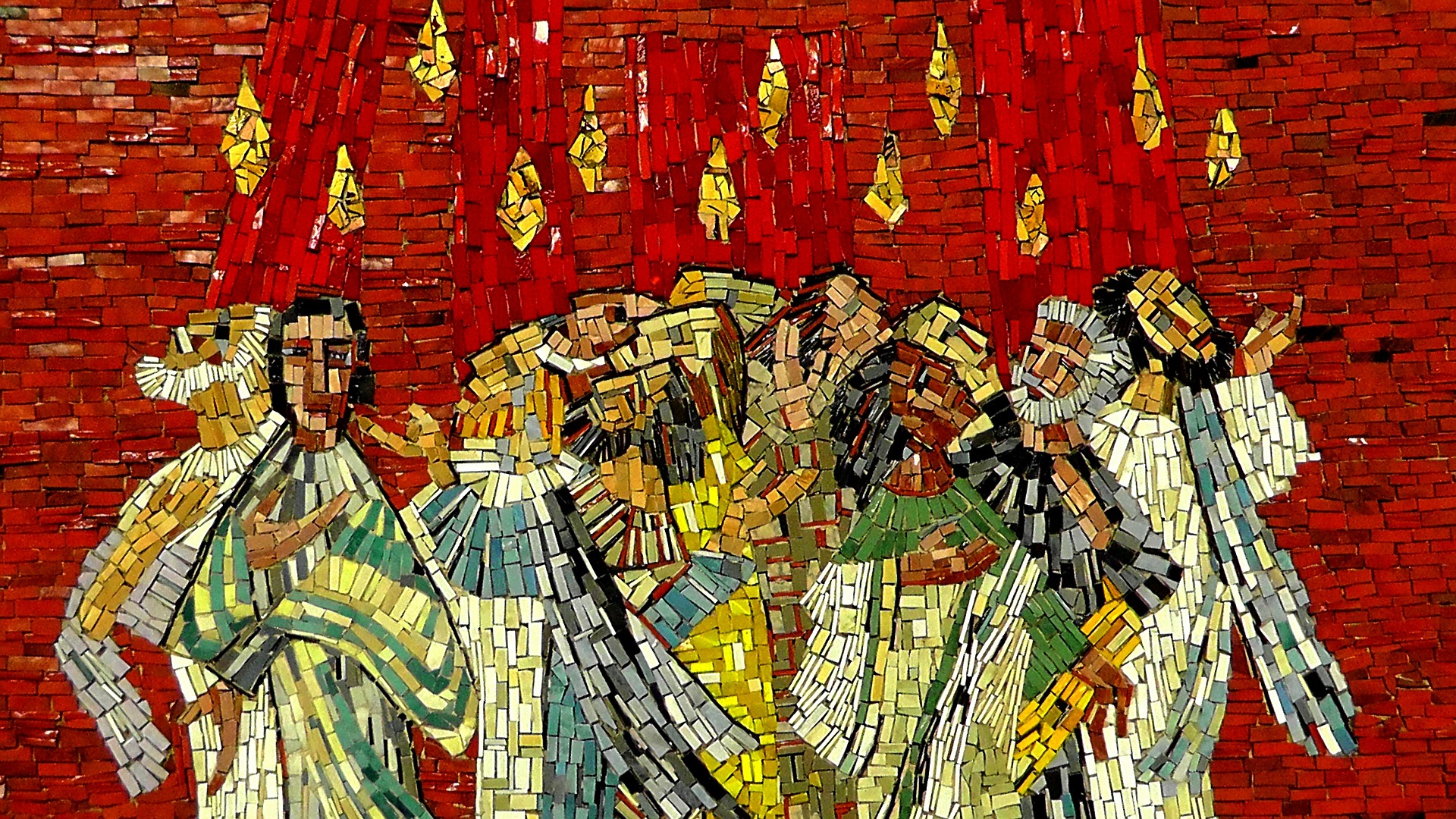
Pentecost Sermon, Year C
Texts: Genesis 11:1-9; Acts 2:1-21; John 14:8-17
Christ Lutheran Church, Fredericksburg, VA
June 19, 2019
The great St. Paul, surprising Apostle to the Gentiles, once confessed, “When I was a child, I spoke like a child, I thought like a child, I reasoned like a child; when I became an adult, I put an end to childish ways” (1 Corinthians 13:11). Thanks to the Holy Spirit, his faith and understanding evolved, deepened and grew as he journeyed through life – as it intends to do during all of our lives.
As I turned to the Holy Spirit in prayer this week, I asked for help with today’s message. That’s always a good place to begin, and after some time, this particular passage came to my mind and just wouldn’t go away. It just seemed so appropriate in light of our reading on the Tower of Babel, as well as our having nine of our youth recognized as adults though the ritual of confirmation, and one adult choosing to affirm their faith this day as well. You’ve probably heard it before at a wedding or other community focused worship event, as Paul seeks to address the importance of the faith, hope and love we all share as Christians.
As I said, this quote came to my mind as I reflected on the Tower of Babel. I was fascinated by this story as a child with its dynamic images of a tall tower reaching towards heaven. I thought it was so cool. And then, we get to hear of punishment…or at least, that what it sounded like to me. In my juvenile mind, I saw the tower come crashing down in God’s anger with fire and brimstone or perhaps a mighty wind – much like I might have torn down my Lego towers while playing. I pictured this destruction even though scripture tells us no such thing. Scripture reveals that the tower survived unfinished, and the people were only scattered throughout the earth, never destroyed or abandoned. This was just as God intended when Adam and Eve were told to go forth and multiply and inhabit all the earth. The people of Babel would spread over time with new languages and eventually dynamic, beautiful new cultures. Each of these cultures conribute to a remarkable tapestry that makes our world a better place and helps glorify God. My childhood brain could certainly understand consequences for wrong behavior…but the wideness of grace and mercy? Apparently, I wasn’t quite ready to understand that.
This sacred story often shared even in preschools is at its depths no kid’s story. It is a mythic tale, and by that I don’t mean false, but a teaching story rooted in the past and revealing ultimate truths about ancient peoples, ourselves, and the sacred activity of God woven through it all. If you listened closely, you heard that the people of God, yet once again, have sought to be like God. They are chasing after the power, wealth and glory of this world and losing touch with who they were meant to become in the process. Much like Adam and Eve, they’ve reached for that unattainable fruit, and now, they face separation from God and one another. That’s always the way when we do such things, even today.
Like Adam and Eve, these people were sent out into the world, but just as Adam and Eve wouldn’t leave Eden without God’s grace and a plan for restoration, neither will the people of Babel. Adam and Eve would be provided clothing, protection and family. The people of the tower will receive something even better. God will make eternal good come from bad. Among all these new peoples, one people would be set apart. Remember the “children of Abraham?” Abraham would be given a trust in God that would rush and wind its way down through a very troubled, often sinful family line. This was often a family that fought amongst themselves, who were selfish and lazy, or sometimes meanspirited and lacking faith. They struggled with faith and often sinned. Yet, they spread out into the world and became what we know as the people of Israel. The Jewish people, a small, enslaved and often conquered people, would be used to fulfill promises delivered by the prophets. Through the Jewish people, all nations would become blessed. It was the Jewish people who lead us to Jesus, and some from this people will number among his first followers. Today, our confirmands claim their share in that sacred inheritance.
Yes soon, moments from now, our confirmands will be welcomed as adults in the church. They have been offered a choice to affirm the promises of their baptism…to seek to love Jesus by following his commands. Yet as they have hopefully learned (and all we Christians should understand), we can topple as easy as the people on that tower of Babel. We are they, and they are us…flawed, sinful, never able to be perfect on our own…people. We are just people. And so as we set off in the world with good intentions, Jesus offers us hope, help and a way forward. An Advocate was sent to live with us and in us. It came to us through the promises of our Baptism whether we feel it or not; understand it or not. For, it is God’s promise to us!
Now, as a child (even into my young adult years), I understood this wrongly. Yes, people promise (or have sponsors promise on their behalf when too young to do so themselves) to seek to follow Christ. Publicly proclaiming and affirming our faith is a great and appropriate thing to do each and every day, but if we are honest, we know our promises will break now and again. Fortunately, baptism is not ultimately about us. It is more about God’s reaching out to us. And so daily through our lives, the Holy Spirit…the One who came upon us at our baptism…who claimed us as God’s own at our baptism…who set us apart to bless nations…that very same Spirit will seek to affirm and fulfill a godly, perfect promise again, and again and again…even when we goof up… even when we don’t deserve it. With that Spirit’s first coming to dwell in the hearts of the Apostles, we were given a sign to help us believe. Recall, “All of [the disciples] were filled with the Holy Spirit and began to speak in other languages as the Spirit enabled them (Acts 2:4).” What had seemed a curse for the people of Babel had now become blessing in the hands of our God…a gift meant to unify and call people of all nations home. They would be called through the voices of ordinary people.
Yes, it is true that through the ages we have inherited a sometimes fractured, imperfect faith skewed by human sin, but the Spirit makes even faith much smaller than a mustard seed “count,” or in other words have a powerful affect. Faith can impact us and transform our life. Our shared faith has made it to us through torture and persecution, corrupt church government and fallen preachers, and even our ancestors (sinner-saints all; people just like us). it couldn’t be stopped. It has come to rest upon us all these centuries later…lives inside us. Yet while the Spirit invites us to faith, it never forces. It challenges us each day to say publicly we believe (and also live like it too). God’s deep desire is to have all nations and peoples praise him in those many languages. And today on Pentecost, we are reminded that we have been chosen to become part of God’s story, the one who spoke us into being with a purpose.
When I was seeking to become a police officer, I had to take a complete physical exam testing both mind and body. I was younger back then, and I had no glasses. As I went through the eye test looking through a scope to read those small, random, letters in a line, they grew smaller and smaller. “What do you see know?” the technician asked over and over and over again. As it went on and on, I became confident that I had failed the test, and I finaly gave up. I was defeated, and I assumed my dreams were dashed. And so, I finally admitted that I could no longer make any letters out. It was only then the technician laughed and said, “No worries. You have excellent vission. I was just seeing how far we could go.” I share this story with you, because I had already passed the test without even knowing it.
As you, our confirmation candidates, come to profess your faith publicly today, you might not see clearly where your future lies. You might not fully understand how God intends to use you or has been using you already. You might even fear you are not up to the test before you or have doubts or struggle with even the idea of faith…so might we all admit such things at times if we are adult about it…but fortunately that’s not the key to this day or any of our days with Jesus. Jesus has passed the test for us. We need not worry, only believe.
Yes, we are already declared acceptable to God and deeply loved through this gift of our faith and baptism. As the head of our Synod’s Youth Council rightly proclaimed yesterday before the assembled “wiser” adults, youth are not the future of the church, they are already the church – now and into the future. With the Spirit’s presence in your lives (in all of our lives), I trust that even greater things are yet to come just as Jesus promised. I urge you to seek out the Spirit, and try to hold onto it. For when you have faith, you are in for one amazing ride. Amen.
The season of Easter is the high point of the Christian church year, lasting not just one day but a fabulous fifty! As the ELCA notes, “The season is an extended feast wherein the paschal candle is lit at every service as a sign of the risen Christ.” Along with the spring flowers and other festive colors, we will hear and sing many musical pieces. Where would we be without beautiful sounds to go along with the sights of Easter?
Christ Lutheran’s Palm Sunday Cantata, 2019
“This is the Feast,” “Christ the Lord is Risen Today,” “Crown Him with
Many Crowns,” and so many other canticles and hymns bring back memories of the
past and joy in our present. Yet, the music doesn’t just help set a mood for
our worship. Martin Luther believed it had a holy purpose saying, “Next to the
Word of God, music deserves the highest praise. The gift of language combined
with the gift of song was given to [us] that [we] should proclaim the Word of
God through Music.”
Throughout Lent, our choirs and bell choirs of all ages worked
diligently under the leadership of Tim Wilson, our Music Director, and Susan
Morin, our Organist, to prepare a joyful noise with a meaningful paschal
message. From the Palm Sunday Cantata, Holy Week, and Easter through Pentecost,
our worship experience is enriched by our dynamic music ministry.
Thanks to one and all who help our congregation rejoice and sing. You make a loving difference as your music stirs our hearts while engaging our minds and spirits as well.
Originally published in The Hub, a weekly email of Christ Lutheran Church, Fredericksburg, VA.
Husband, Pastor, Law Enforcement Chaplain, and member of the Clerical Errors (aka "The Three Priests"), I'm sharing my two cents with anyone who cares...
You can also find me on social media as Loudluthrn (Lou-d-Luthrn or Lou the Lutheran). It is a moniker given me while attending a Presbyterian Seminary, but I'm a loud and proud Lutheran too (just not too loud and proud, mind you).








 2pennyblog