Readings for the Feast of Pentecost, Yr. A – Acts 2:1-21; Psalm 104:24-34, 35b; 1 Corinthians 12:3b-13; 5:6-11; John 20:19-23. This sermon was preached at Grace & Glory Lutheran Church in Palmyra, VA on May 24, 2026.
Some of you might recall a catchy, “so bad that it is good” song called What Does the Fox Say? from several years ago. The songwriters intentionally tried to make the most absurd song possible for a Norwegian talk show as a joke, and it turned out to be a hit. Last week, I happened to hear it as I was commuting to the church, and it struck me…The singers almost sound like they are speaking in tongues. Well, as a pastor’s brain can do, it was only a short “ring-ding-ding-ding-dingeringeding” in the song later that a few important questions came to my mind…In all seriousness, it is a question not just for Pentecost but for each day of a Christian’s life, “What does the Spirit say?” And closely related to that, “How do we know and understand the Holy Spirit as it speaks and operates in our lives?”
The stories and letters that we hear on Pentecost reveal the supernatural, divine inbreaking of the Spirit into the world in a new way. The Holy Spirit as part of the Trinity always was, is, and always will be. At Creation, the Holy Spirit is encountered as a divine wind parting seas and breathing life into clay. Many ancients considered Holy Wisdom as a manifestation of God, personified in scripture as a woman I should point out. (So, the Holy Spirit can sometimes be called she, but God as a spiritual divine being is not truly of any sex.) We meet the Spirit in Psalms and in the lives of the Patriarchs, Matriarchs, and Prophets. (Both male and female prophets are in scripture). Even as Jesus is baptized by John, it is the Spirit that drives Jesus into the wilderness.
Yet until Jesus rose from the dead, there was a chasm between us and our Triune God…a brokenness since the Fall requiring more than just our efforts and repentance to fix. This suffering needed God’s activity to heal us – the death, resurrection, and ascension of Jesus in particular. With that, the Kingdom of God has been ushered into our world, but God’s not yet done with us or the world. There’s work left to do. The Kingdom is here but not in its fullness until Jesus comes again. As Jesus promised, he would not leave us orphaned in this in between time but would give us an advocate, the Holy Spirit, to help us and be with us forever (John 14:16). This was for the fulfillment of even more ancient promises to Abraham and the Jewish believers who followed pointing toward a new reality where God would someday ultimately dwell in our hearts instead of any temple.
As Paul clearly explains to the church in Corinth, faith is a gift of the Spirit, “no one can say ‘Jesus is Lord’ except by the Holy Spirit.” This was Jesus’ teaching with Peter’s confession of faith as well. The Holy Spirit enters our life in a different way through our faith and baptism. It claims us as God’s own. It promises us abundant, eternal life. It has the power to free us from all that holds us back…our doubts, darkness, and sin…when we surrender to it and radically trust it. (It never forces itself upon us.) It is always at work for our welfare in order to sanctify us (make us holy), guide us, and it even prays for us. When our groaning can find no words (Romans 8:26), the Spirit lifts our concerns to the heart of the Trinity with groaning of its own. Even for those of us that have faith, it is always trying to draw us into new beginnings – “from one beginning to another” Br. Roger of Taizé used to say.
Yes, this is the Spirit that also guided Martin Luther as he was used to help reorient the Church more clearly toward the gift of grace. As much as with the Christians on the road to Emaus, the scriptures were opened to Martin Luther, and his heart was set afire. Or on this Aldersgate Day, an annual celebration of our Methodist siblings on May 24th, we might recall John Wesley’s heart being “strangely warmed” as he overheard Moravians reading Martin Luther’s preface to Paul’s letter to the Roman church. This finally gave John Wesley the assurance and peace that Christ had truly taken away his sins. Thus, the Spirit changed the direction of their lives, and in effect the Church’s direction, forever – setting one heart to another on fire.
Yet, we should remember with the growth of the Church that they and others touched by the Spirit that came before and after them often faced misunderstanding or hostility. Sometimes, they might face death because of this fire of faith burning in their hearts. And this reminds me, as Jesus shared, the Holy Spirit will teach us at every hour of challenge what we ought to say (Luke 12:12). And further as St. Francis urged his fellow friars, our actions and choices can proclaim Jesus, too. Our actions can prove a kind of sermon.
No, Pentecost with its ancient roots is not to be relegated to the past, for it is still unfolding in our presence. The very same Holy Spirit that touched the great saints and Apostles of the early Church is seeking similarly to heal and transform our lives in the present. It calls us to do miracles, not always supernatural mind you, but most often small things done in great love. Every effort and relationship becomes sanctified as we do so.
As we heard today, crowds had gathered for a great Jewish festival called Shavuot (or Pentecost by the Greek influenced, Hellenistic Jews) held fifty days after Passover. The Jewish celebration recalled the giving of the Law to Moses on Mount Sinai, and it served to give thanks for the summer harvest. During the festival, people would offer their first fruits to God. Yet despite the excitement, hidden away in an upper room, waited the disciples of Jesus.
Just ten days previously at the Ascension, Jesus had promised the Holy Spirit would come to them. Much as with the crucifixion or Easter, the disciples were likely pensive and unsure of what was to happen next…what it all meant. They might have even feared the vast crowds…Crowds had called for the death of Jesus after all. Little did they suspect that on a day marking God’s provision of daily bread and the Law, God’s gift of grace would overflow. A new life in the Spirit would begin.
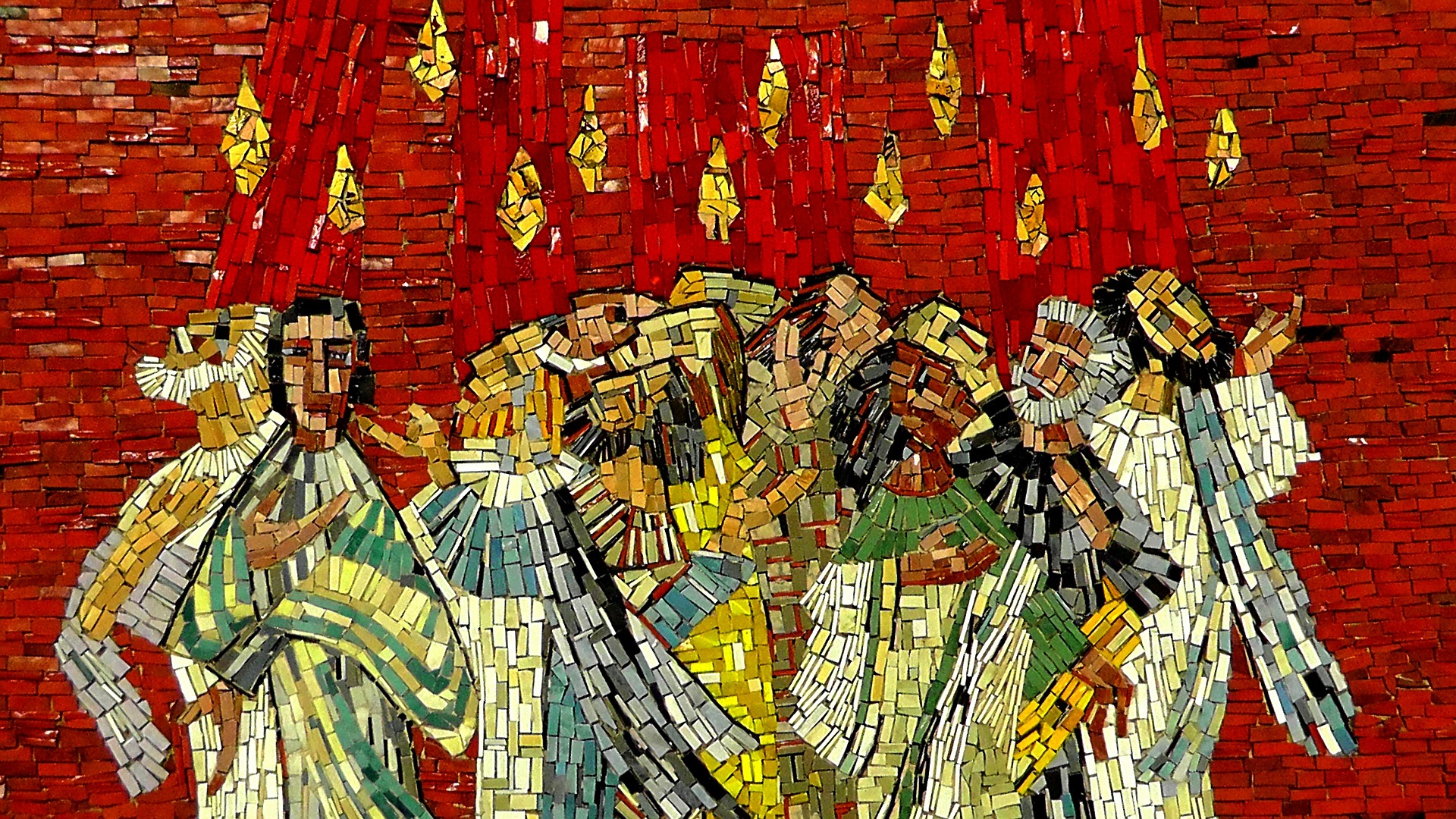
Rightly, we imagine this momentous event with powerful wind and earthquake. We are told the Spirit descended as if tongues of fire, hence all the red that we wear and that surrounds us. Yet, the Spirit can be like the still, small voice Elijah heard as well or a subtle urging. We can be led to new opportunities as doors open or as we are redirected through our losses. The Spirit is not limited by our expectations or previous experience but is filled with surprises.
And so, although Peter and some others expected the Spirit to learn toward the Jewish people and their religious practices, forcing Gentiles to submit to ritual laws, the Spirit had other ideas. Immediately after the Spirit came upon the disciples, Gentiles would join them as Church through the Spirit’s intervention – nothing they did. Yet, Peter’s bias and hesitation could only be corrected through a vision and a Centurion’s request to know the Lord, itself inspired by the Spirit. Through this circumstance in Acts 10, Peter says, “I now realize how true it is that God does not show favoritism but accepts from every nation the one who fears him and does what is right.” So should Christian Nationalism be a thing in any country? No, that’s not the Spirit’s work. It must be rejected. We are called to be a catholic (meaning universal) Church rooted in faith instead of politics.
And in our own time when the Southern Baptist Convention and others are trying to keep women away from the pulpit, or anywhere near the altar, or from teaching about Jesus, or in some cases voting or working outside the home (this teaching is back in style among some extremes), scripture indicates the Apostles were continually gathered in prayer alongside the women followers of Jesus (Acts 1:14). Joel foretold, despite common cultural practices and expectations, that the Spirit was to be poured on all flesh. Among the 120 believers (Acts 1:15) gathered in that upper room praying with one accord, women were present.
And today, we find a Spirit still reaching out to us from that first Christian Pentecost long ago…Rooted in the past, the Spirit further manifests itself in our lives. The fruits of the Spirit are at our disposal: love, joy, peace, forbearance, kindness, goodness, faithfulness, gentleness and self-control. We might struggle or fail at living them out at times, but they remain available to us. We have access to the Spirit’s guidance, diverse spiritual gifts, protection and power as much as those first disciples…earthquake, wind, fire or no. Each of us as individuals and all of us as Christ’s body, are being called by the Spirit to use our gifts as given us by God…to offer our spiritual first fruits…not just once a year but throughout our lives…each day.
Thus, we, too, might have visions, dreams and prophetic moments, but the majority of the Church understands that the time of the Apostles and Prophets as offices in the Church has ended. And as Paul argues, the greatest gift of all is love, not tongues or teaching. So, how might we modern folk listen to the Holy Spirit?
- Test what you think you hear. God doesn’t contradict scripture. Evaluate the fruits from what is being said and done.
- Seek peace – God’s voice is not one of anxiety, unsettledness and exhaustion: Trust God at all times, for God cares for you. Repent of errors, try to make peace with others and amends. Seek a quiet place when possible, to listen for God’s voice.
- Look and listen; watch and wait for God might be in the booming as well as the still small voices of your day. Even a little child might lead us. Yet know that God’s voice is not the voice of obscurity requiring decoder rings and mental and scriptural gymnastics. Yes, we might need prayer and scripture study or even to consult friends or spiritual leaders to better understand things, but God will – when the time is right – make himself known to us. Be suspicious of those who speak of secret messages or claim new revelations, as some are doing. Just because someone says they are Christian, they may not be.
- Live in hope – Even if we are in need of correction, God’s voice is not one of threat, condemnation or abandonment. One spiritual seeker explained it this way. “Condemnation is vague and abstract. It says: ‘You are not OK. Something is very wrong with you.’ Conviction is specific. It says: ‘What you said to your wife just now on the phone was insensitive.’ Condemnation discourages and breeds hopelessness. It gives you the feeling that nothing can ever fix your problem. But conviction encourages us. It gives us solutions to our problems. Condemnation pushes us away from God. Conviction draws us to God. The goal of condemnation is to make us give up. The goal of conviction is to help us reach our maximum potential, to be all we can be in Christ” (Charisma Magazine. Learn to discern the voice of God).
Now as the Spirit begins to work in our lives, some people might indeed suspect we are drunk. They might look at us as fools as they did of St. Francis of Assisi and his followers. My own parents, never knowingly having met Lutherans in Massachusetts, at first asked if I had joined a cult. For as a young adult, I had a synthesizing of my own faith and decided to try to live a more concretely scriptural life. And as the Spirit works within us, we might prove more brave, generous, or wiser than we ever thought possible. We might be called to live differently or risk everything.
Some people will notice these changes made by the Spirit…even when they (or we) may not understand them. Some will be inspired to follow Jesus because of this, and some will still deny him or oppose us because of it. Yet, never stop trying to cooperate with the grace offered. For through the power of the Holy Spirit, we are being grafted into God’s eternal story, not just some dusty history. With Augustine of Hippo, we might wish to pray each day:
Breathe in me, O Holy Spirit;
That my thoughts may all be holy.
Act in me, O Holy Spirit;
That my work, too, may be holy.
Draw my heart, O Holy Spirit;
That I love but what is holy.
Strengthen me, O Holy Spirit;
To defend all that is holy.
Guard me, then, O Holy Spirit;
That I always may be holy.
Amen.
Below, please find a video of our worship service. The sermon starts at about the 24:30 minute mark.(There was a medical emergency, so you will notice a break in the service. Also, someone accidentally picked up my manuscript during the emergency, hence the reference to my iPhone. It was quite the Sunday!
© 2026 The Rev. Louis Florio. All content not held under another’s copyright may not be used without permission of the author unless under terms of fair use and properly attributed. Scripture passages when used are from the NRSVue translation unless otherwise indicated.