Tag Archives: christian

The Ninety-Five Lent Madness Theses – Why vote for Luther?

Martin Luther v. MLK - One day only!

Martin Luther v. MLK – One day only!

As a proud (but not too proud) Lutheran, I am thankful to be part of the somewhat dysfunctional family fun known as Lent Madness. As we reach the cataclysmic matchup of Martin Luther v. Martin Luther King, Jr. on Monday, February 25th, I humbly submit these 95 theses (not the original 95 Theses by a long shot) to all those who love Lent Madness.

I have been told that some Anglicans don’t consider themselves Protestant. Others don’t honor Martin Luther with a day of commemoration. Yet if Episcopalian, you are in full communion with your Evangelical Lutheran Church in America (ELCA) brothers and sisters. So, how about throwing us a bone?

If Roman Catholic, how about a vote in the spirit of reconciliation? Was the Reformation really so bad? Don’t you know our faith traditions are in talks to heal the wounds and divisions of the past, even (maybe someday) share communion. Follow the example of Pope Benedict. Be a uniter, and not a divider. Vote for Luther!

If you, dear reader, are of another faith tradition, get to know Martin Luther. To know him is to love him. “This is most certainly true” (as Martin Luther used to say…a lot). Many of his writings are as informative and entertaining as when they were first penned.

I know some in Lent Mandess tend to prefer martyrs. Luther wasn’t one, but he received constant threats of imprisonment and death, struggled to make ends meet, and suffered long seperations from his beloved family. His health likely suffered as well due to his long hours in service to others. Perhaps most compelling, Martin Luther King’s family apparently had a thing for Martin Luther’s legacy. (You’ll want to read #55 below.)

Others would prefer modern people wear the Golden Halo. Well, reading these Ninety-Five Lent Madness Theses might convince you that Martin Luther is as relevant today as in the 16th Century.

For those that can’t seem to forgive the sometimes admittedly cranky, rude, and anti-semetic Luther, I hope you will try ot look at him in context before you vote. He held many biased and sometimes repulsive views of his time – appropriately called Dark Ages – to be sure, but he also showed evidence of increasing mental illness as he aged. This is most clearly noted by comparing his canon of work and his biography, not by taking things piecemeal out of context. This isn’t an excuse, but it might help you forgive and look at the bigger picture of his life.

Despite his clear failings, God used him to achieve great things. Roman Catholics, Protestants, and all kinds of Anabaptists benefited directly and indirectly from the Reformation long-term. It has fostered democracy and education. It even influenced the arts. Luther was a big part of the movement forward, a progressive for his time, and many of his contemporaries (including some adverseries) give him credit for his positive influence. His efforts didn’t just help change the United States (no small thing to be sure), but it helped transform the world and is still helping to do so. We have come a long way in the almost 500 years since the posting of his 95 Theses at Wittenberg.

Please give Martin Luther your most compassionate consideration. Vote for him while holding your nose if you must. (Just clean your hands before touching your keyboard again please. It is flu season.) He understood himself as a saved sinner, so maybe you can vote for a sinner after all as Rev. Janine Schenone suggested regarding Seabury.

As Luther died, he wrote, “We are beggars. This is true.” He was speaking about grace, but it might just work for Lent Madness too. I beg you (or at least ask politely); vote Martin Luther on February 25th. If you are like me, you can do no other. VOTE MARTIN LUTHER ON MONDAY FEBRUARY 25TH!

Look up #BigLutheran #hereIvote #vote4Luther #MartinLuther #Luther #LutheranConspiracy #embracethejerk #LentMadness on Twitter to see how things go.

Disputation of the Rev. Louis A. Florio, Jr.  (aka lou-d-luthrn  or @loudluthrn) on the Goodness and Efficacy of voting for  Dr. Martin Luther (2013)

Out of love for the truth and from desire to elucidate it, the Reverend Louis Florio, Master of Divinity, and ordinary pastor therein at Messiah Lutheran Church (Mechanicsville, VA), intends to defend the following statements and invoke your vote for the Rev. Dr. Martin Luther during Lent Madness.

  1. Luther loved God. He forcefully argued over and over again that the Ten Commandments and all of scripture wrapped into those first three commandments (as Lutherans count them) to honor and love God. Loving neighbor served to help fulfill that call, and served as sort of twin commandments. To me, it sounds a lot like Jesus.
  2. Luther was a spiritual trend setter. When the system came out against him, he continued to seek the truth through faith, scripture and reason despite the costs – and for him, there were many. He faced death threats and suffering throughout his career as a Reformer. Word Alone – Faith Alone – Grace Alone; that was enough for Luther. He steadfastly argued we are saved by grace though faith in Jesus Christ alone.
  3. Luther loved his wife, Katharina, despite her perhaps smelling a bit like herring when they first met. Luther in some ways (not all) ended up ahead of his time for women’s rights. They shared in their family’s economic and social life as relative equals. She, a former nun, was a close advisor and coworker in the Reformation and his letters speak lovingly of her. She was called the Morning Star of Wittenberg, and she became almost a model that a woman could do anything. When Luther died, he left his entire estate under her control against the practice of society at the time. He looked upon marriage as an equal calling to celibacy. Marriage helped fulfill God’s command in Genesis to go forth and multiply, but it also echoed and modeled the love which is God active in our lives (with or without children). Not a shrinking violet when it comes to talk of sex, he encouraged husbands to attend to all their wife’s needs. Read more in Luther on Women by Susan Karant-Nunn.

    Katharina-von-Bora

    Katharina von Bora Luther, the love of Martin Luther’s life. Click here to watch “The Morning Star of Wittenberg.”

  4. While always busy with the Reformation, Luther and Katie loved children and family life. They had six: Hans – June 1526; Elizabeth – 10 December 1527, who died within a few months; Magdalene – 1529, who died in Luther’s arms in 1542; Martin – 1531; Paul – January 1533; and Margaret – 1534. Although a man of his times in many respects regarding child rearing, Martin Luther spoke out against parents being overbearing and their responsibility to demonstrate Christian love at all times.Martin-And-Katherine-Luther
  5. Luther loved his neighbor and was compassionate towards them. For example, he argued that those who committed suicide should be shown love and mercy. They should be allowed to rest in hallowed grounds – not the practice of his day – for the darkness of this world had simply overcome them. Their salvation wasn’t resting on their own strength but the strength of Christ’s cross. (This is not unlike Hildegard of Bingen.) He was ahead of his time, perhaps since Luther himself seems to have suffered from depression himself. In his exposition of “Thou shall not murder,” Luther included ignoring your neighbor’s needs as a kind of murder. His faith was relational – toward God, toward neighbor, lived out together as church.
  6. Luther understood isolation and loneliness. Much like John of the Cross’ dark night of the soul, Luther wrote about Anfechtungen, the German word that Luther used to describe the overwhelming spiritual trial, terror, despair, and religious crisis that he experienced at times throughout his life. In such times, one must trust in the “hidden God” who is at work fulfilling all the promises of scripture (and more) with steadfast love. Luther often reminded himself of God’s promises in Baptism, simply reminding himself when afraid or filled with doubt, “I am baptized. I am Christ’s”
  7. Although in many ways a theological trendsetter, Luther was remarkably rooted in scriptures, those who came before him, and the mystical spirituality of the past. He loved the mystic who wrote Theologia Germanica, along with Augustine, Bernard, Bonaventure, Johannes Tauler, and Brigid of Sweeden; to name only a few. Don’t believe me? Read Theology of the Heart: The Role of Mysticism in the Theology of Martin Luther, by Bengt R. Hoffman.
  8. Luther loved animals and was bitterly opposed to hunting for sport. His beloved dog Tölpel (which means something like dunderhead) is mentioned affectionately again and again by Luther, and Luther expected animals to have a place in heaven thanks to our loving God. “Be thou comforted, little dog, Thou too in Resurrection shall have a little golden tail.” (Laurie B., if Old Marty starts to tank in the vote, get some of those cute pandas ready for him. He would love that, I am sure.)
  9. Luther was extremely social. He loved gathering with friends and visitors to talk over current events, theology, and more while sharing a meal and a beer or two. (Hey, he was German, don’t forget.) His family frequently rested on the verge of poverty hosting so many people. Some of his most candid comments are found in a collection called Table Talk.
  10. Luther liked music, and he wrote many hymns. He is said to have sometimes taken common, popular music and attached Christian lyrics. The rumor is that A Mighty Fortress is Our God was from a popular pub song. He also believed if you couldn’t sing, sing loud anyway. It would scare away the Devil and bring you good cheer.
  11. Luther liked beer and even made it. No wonder the pope assumed he was just some “drunk German monk.” His favorite was said to be Einbeck beer, said to be the most famous beer of the Middle Ages, available everywhere in Germany and shipped as far as Jerusalem. Learn more about the beers of Martin Luther at Cyberbrethren.com.
  12. Luther is your Homeboy. He was appreciated by contemporaries and later people for his down to earth language and theological approaches. Although, some (especially today) complain about these earthy characteristics and his bathroom language as well. Of course, who ever said saints are perfect?Luther is my homeboy.
  13. His theological descendants are your friends and neighbors. There are over 70.5 million Lutherans in the world. Visit the Lutheran World Federation (LWF) to learn more.
  14. How many Lent Madness participants have rap songs written for them?
  15. Do you like reading or hearing scriptures in your own language? Well then, vote for Luther! Like Wycliffe and Hus, Luther advocated for it, and he created the first Bible in the German tongue. Bibles in the vernacular were still opposed by the Roman Catholic Church at the time – including in England.German_Bible
  16. Do you like receiving both the body and the blood of Christ during the celebration of the Eucharist? Well then, vote for Luther! Again like Wycliffe and Huss, he advocated for it, and it became a reality. (In his day, only the body was commonly shared with the congregation during the Roman Catholic mass.)
  17. Do you enjoy and find benefit from the liturgy in your own language? Well then, vote for Luther! He helped make it happen.
  18. Luther believed in the real presence – not transubstantiation or consubstantiation which are Aristotelian, metaphysical constructs. He didn’t want to even try to explain the mystery and risk being unbiblical, never mind use philosophy to do so. Instead, he suggested trusting that it was the real body and blood of Christ in, under and through the bread. Jesus said it. It is most certainly true. (We could perhaps avoid a lot of arguments with this simple approach.)
  19. Luther did not desire to break up the church only reform it, and he explicitely didn’t want a religion named after him. (Of course, you don’t always get what you want.) About ninety percent of all Lutherans still believe that there is one universal (i.e. catholic with a small c) church despite theological divisions, and they live their lives quite ecumenically. Our confessions, the Book of Concord, are held to be true as far as they are proven consistent with scripture. Thus, denominations like the ELCA feel free to work and worship with other denominations. The other 10%, called confessional Lutherans, hold the confessions to be equal to scripture. If you don’t agree with the confessions as written, you are deemed deficient if not heretical. I think the 90% are correct. Why not show them your support and vote Luther! While you are at it, read about The Catholicity of the Reformation or other Lutheran related books.

    The pastor's cat is a Lutheran cat.

    The pastor’s cat is a Lutheran cat.

  20. In an attempt to be biblical, Luther reviewed what should be considered a sacrament. The seven sacraments were settled upon in about the 12th or 13th century. The 16th Century Luther preserved what had been the seven sacraments as ministries of the church, but only two remained as sacraments – Baptism and the Lord’s Supper. Why? Simply put, Jesus commanded these actions, and God’s Word is joined with physical things to become means of grace through faith. Confession almost made the cut, but it has no physical sign attached to it. Lutherans still practice corporate and private confession which Luther called a “healing medicine,” but it isn’t mandated. See, we Lutherans aren’t so different after all…
  21. Luther had a great sense of humor. Check out The Wit of Martin Luther by Eric W. Gritsch.
  22. How many Lent Madness participants have polkas made for them? (And seriously, who doesn’t like a good polka? #guiltypleasure)
  23. Luther was very human and certainly could be hot headed at times. The Lutheran Insulter is a fun tool to get your frustrations out.
  24. Imperfect as he knew he was, Luther held on to the grace of God even more. He viewed all Christians as simultaneously sinners and saints. When someone was struggling with sin, he advised, “sin boldly, but believe more boldly still.” This is all based upon his concept of justification by faith alone.Sinner Saint dog tags
  25. Luther believed Jesus never lied. Jesus died for us and spoke forgiveness to us. He died for our past sins, current sinfulness, and even future sins. We should trust him! To do otherwise is to laugh at or discount his cross. We would believe in our sin more than Christ. (…Not such a good thing, and something I had to learn.)
  26. Luther said, “Although the Christian is thus free from all works, he ought in his liberty to empty himself, take upon himself the form of a servant, be made in the likeness of men, be found in human form, and to serve, help, and in every way deal with his neighbor as he sees that God through Christ has dealt and still deals with him. This he should do freely, having regard for nothing but divine approval.” Loving neighbor was a gift in itself to us, even as it is pleasing to God. We should give ourselves to “Christ in our neighbor” just as Christ gave himself to us. When he had a sick friend write of an illness, Martin Luther heard Christ’s own call to be helped – the living Christ in his friend. Like Christ, we too must carry our crosses – service to others or our own sufferings – with faith. He developed a Theology of the Cross in opposition to a Theology of Glory. There would be no prosperity gospel for Luther. Life is hard, but God is good…always.
  27. Luther taught that we bear the name of Christ because Christ truly dwells in us, and we in his body the church. He argued we should trust in this reality and live like we believe it is true at all times.
  28. Luther wasn’t against Christian works; only that they didn’t save. Our works and sufferings are used by God to help faith grow in us and others, and it is used by God to establish the Kingdom of Heaven. We cannot sanctify ourselves. No cheap grace for him, as the Lutheran martyr Dietrich Bonhoeffer later expands upon in The Cost of Discipleship and elsewhere. If you appreciate Bonhoeffer’s writings or Jürgen Moltmann’s The Crucified God: The Cross of Christ as the Foundation
    and Criticism of Christian Theology, you really should vote for Luther.
  29. Although Luther was against the mass as a sacrifice or something that gets one extra credit for heaven, he valued and argued to maintain the liturgy when others wanted to punt it. In some Lutheran countries the Lutheran service is still called a mass. Click the picture below to learn about Lutheran worship, “a foundation of faith to everything we do.”Lutheran-Service-610x351
  30. Luther believed in the priesthood of all believers. “All Christians are truly of the spiritual estate.” You are not defined by any vocation. We are all equally and eternally children of God with important tasks to do on Christ’s behalf.
  31. Luther tried to empower families to be a little church within the greater church. His Small Catechism was for home use.
  32. Luther believed if God could speak through an ass against a prophet, God could use any person as a pastor. His Large Catechism was originally written for pastors, but today, it is widely read by people of all kinds of vocations. He argued for an educated pastorate for good order, but pastors are human like everyone else. Your pastoral call is temporary, but you call as a child of God is eternal.
  33. Vote for Luther! He has his own bobble head. If he wasn’t important, would he have a bobble head?Martin and Katy
  34. If you prefer, show your support with a cute Luther windup toy, then go vote. (Yes, there is a Katie version too.) ml_windup_150
  35. What man doesn’t like to read in the bathroom? That’s a great use of time, and Luther is said to have some of his best ideas come to him there. (This might not be true, but I like to think so…)
  36. Luther believed in Two Kingdoms. This helped lead to a separation of church and state, a modern polity in the church, as well as our modern democracy.
  37. Luther believed believers should be actively engaged in civil life, not separated or hidden away. Christians need to be involved in the community and its politics.
  38. In his Smalcald Articles, he described the saints as currently residing “in their graves and in heaven.” Luther maintained that it was not false doctrine to believe that a Christian’s soul sleeps after it is separated from the body in death, but he also didn’t condemn those who believed in immediate life after death. The bible isn’t clear. In addition, he hated to declare who would be saved and who would not in detail. To do so risked being unbiblical. He trusted those who believed in Jesus would be saved, but beyond that, it is up to God to discern. With our limited intellect and failings, we risk error to do otherwise and dangerously play at being God. He was for people discerning their beliefs based upon scripture, but he didn’t dictate his own beliefs as dogma. Pretty darn nice of him, I think.
  39. If you haven’t already noticed, Luther hated being unbiblical, sometimes to his detriment –consider the bigamy issue. (See #90.)
  40. Luther wrote often about the Jewish people, but his attitudes reflected a wrong-headed theological and cultural tradition which saw them as a rejected people guilty of the murder of Christ. At the same time as early as 1516, Luther wrote, “…[M]any people are proud with marvelous stupidity when they call the Jews dogs, evildoers, or whatever they like, while they too, and equally, do not realize who or what they are in the sight of God.” In writings, Luther sometimes advised kindness toward the Jews in that Jesus Christ was born a Jew, but his aim was often converting Jewish believers to Christianity. When Jewish people resisted conversion, he got more and more hard hearted about it. He couldn’t believe with the Reformation that they didn’t see the light of Christ. In short, he was often wrong (aka human) in his offenses. Sad but true, and I hope that this later errors doesn’t stop you from voting for him. He was a man of his time (the Dark Ages to be sure), likely suffering mental illness at the time of his most offensive writings, and no saint is perfect. He did a lot of good too. Can you forgive him this error? I hope so.
  41. Yes, he was a complicated, sinful person like the rest of us. On one hand, he wrote with promise toward his Jewish neighbors, hopeful they would see the light of the “true faith” lifted up in the Reformation. As he got older, suffered the death of his daughter, and most likely continued bouts of depression and perhaps even had mental issues due to urine poisoning (after a fierce case of urinary track blockage), he wasn’t so kind. He was a product of his time and circumstances to be sure, yet there’s no excuse good enough, and modern Lutherans have issued formal apologies. Too late perhaps for some people, but perhaps it can count for something when evaluating Luther’s legacy (and voting in Lent Madness).
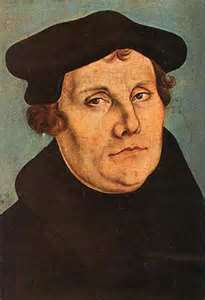
  42. Printed images of Luther that emphasized his monumental size were crucial to the spread of Protestantism – a large, portly size with double chin indicated he was a common guy, not some frail Catholic saint removed from the real world. Indeed, he was quite popular with the common folk.Martin Luther
  43. Although not seen as a traditional systematic theologian, his theological writings are quite numerous. He wrote and wrote in response to questions and debates as they came up. His works translated into English are in more than 55 volumes, and they don’t hold everything he wrote! (Try the cd-rom or buy the set.) The Weimar edition of his works began in 1883 and were completed in 2009 with 121 volumes in quarto format (around 80,000 pages). “For Luther theology was not a detached academic pursuit circumscribed by the walls, procedures, customs, and language of the university, but a matter of life and death. He took God seriously. Nothing is more important in man’s life than his relationship to God. The chief function of theology (and of the theologian), then, is not to speculate about God or even to systematize man’s knowledge of God. Rather its function is to lead men to and strengthen them in faith. For Luther faith meant specifically trust in God through Jesus Christ. Inevitably Luther’s classroom extended far beyond the university and the circle of educated students to whom he lectured there”  (Luther’s Works, Vol. 42, x).
  44. He was a reformer of the faith, but the reforms led to other modern changes in government, church, economics and more. Check out Law and Protestantism: The Legal Teachings of the Lutheran Reformation, by John Witte, Jr.
  45. The more he tried to do for God, it seemed, the more aware he became of his sinfulness. When he was young, God seemed not love but hatred. Johann von Staupitz, his spiritual director, advised him to study the mystics, following their path of surrender to the love of God. This helped lead him to Reformation understandings. Who doesn’t like a good conversion story?
  46. Luther’s “evangelical breakthrough” did not come all at once, but unfolded within the context of his teaching and pastoral responsibilities. However, a turning point came in 1515, when he was lecturing on Romans, in particular the passage on the “righteousness of God” (1:17). If Paul’s Letter to the Romans touches your heart, you’ll probably like Luther and should vote for him. By the way, it is likely fiction that it came to him in a bathroom, but who really knows. Psychologist Eric Erikson took a German phrase uttered by Luther and interpreted it literally to mean Luther was in the bathroom when he had his evangelical breakthrough. Other’s suggest it meant his enlightenment came during a time of melancholy.
  47. Luther sought to steer a middle way between papists to the right and political radicals and Anabaptists to the left. Thomas Müntzer (1488-1525) taunted Luther as “Dr. Easychair and Dr. Pussyfoot” but names never hurt old Luther. (He certainly hurled them back at times. See #23.) Despite Luther’s own occasional blustering against opponents, he hoped for ultimate reconciliation and unity. I argue that a vote for Luther is a vote for unity.
  48. Luther wasn’t always certain about what should be done. In the Peasant Rebellion, he saw the need for much change, but he also hated the excesses of violence and unrest. As the revolt broke the peace, Luther ultimately supported the authorities which led to many deaths. Again, do you really expect or want a perfect saint? It is hard being Christian in the real world. Show your forgiveness and vote for Luther.
  49. Luther’s 1534 Bible translation inspired William Tyndale, who spent time with Martin Luther in Wittenberg. Tyndale’s translation was foundational for the King James Bible. Thus, Luther’s work influenced the King James Version of the Bible, still the most popular English language translation. If you like it, say thank you by voting for Luther!
  50. Martin Luther had his own PBS documentary, The Reluctant Revolutionary. Could PBS be wrong about Luther being a cool guy? Check it out at PBS or watch an episode here, then vote for Luther.
  51. He has number of movies about him too, such as the 2003 version with Joseph Fiennes as Luther and Peter Ustinov as Frederick the Wise.
  52. He has his own comic book or graphic novel (if you prefer).Echoes of the Hammer
  53. The Moravians love Luther, and they commonly use his Large Catechism. They also make tasty cookies.
  54. John Calvin often spoke of his debt to Luther. If you are of the Reformed tradition, you owe Martin Luther to vote for him. (Just saying…)
  55. Martin Luther King liked Martin Luther too. In fact, he respected the #BigLutheran so much, he had his own name and the name of his son legally changed from Michael King. We now know his son as Martin Luther King, Jr. in honor of the #BigLutheran. Reformers themselves, I wouldn’t be surprised if they would vote for Martin Luther in Lent Madness (if they could).
  56. Although sharing some similarities in life and faith, Martin Luther and Martin Luther King shouldn’t be confused. Check out this test called “Who said what.” If you like Martin Luther King, Jr., you might just like Martin Luther enough to vote for him during Lent Madness.
  57. Martin Luther was quite practical. He preached a Sermon on How to Prepare to Die, including both spiritual and practical advice on caring for your loved ones left behind. In another writing dealing with the plague, he urged people to use their heads. Christian mercy required pastors to tend to their flock, but only those needed should risk their lives. If one would do, one should go. We don’t need to needlessly rush into martyrdom.
  58. Martin Luther understood we lived in a fallen world and there exists a tension between valid use of force and pacifism within Christian ethics. I suggest you read his short piece, Can a soldier too be saved. If you’re a veteran or a police officer, you’ll probably agree with the general thesis of this work. “What men write about war, saying that it is a great plague, is all true. But they should also consider how great the plague is that war prevents.”
  59. Martin Luther taught a great deal about Christian vocation in the widest of terms. If you are a ditch digger or king, be a Christian in how you live those calls out. Read about Luther on vocation. Your work is sacred when done in love – even if changing diapers – according to Martin Luther.
  60. His teachings helped lead to spiritual renewal, pietism (a heart centered, lived faith), and indirectly the German revivals and Great Awakenings.
  61. At the same time, his teachings helped lead to a love of liturgy and orthodoxy (which are not always known for the traits listed in #60.)
  62. His Luther Rose or Seal is both stylish and theological! Click the seal to learn how. Luther Rose
  63. Martin Luther was an avid supporter of public education. The Reformation helped lead to more public schools and libraries.
  64. He was actually humble, often insulting himself and not just others for foibles and failings.

    I humbly and subtly try to encourage a fair and unbiased vote from the congregation during Lent madness.

    I humbly and subtly try to encourage a fair and unbiased vote from the congregation during Lent madness.

  65. Luther worked for his keep. He worked as a carpenter, made and sold some beer, and grew food for sale. He was apparently known for his wonderful lettuce, beans, melons and cucumbers. Of course, he also was a professor and pastor. Of course, don’t forget Katie. She had the real business sense.
  66. Martin Luther has inspired a lot of “Lutheran fun” and merchandise at Old Lutheran.
  67. It’s fun to be Lutheran, you just have to know how…Dr. Seuss, a Lutheran, would probably vote for Martin Luther if he could. So, don’t be a Grinch.Grinch Vote for Luther too! Just for a taste of Lutheran fun, you might like to read One fish, two fish, Lutherans catch fish…and people too!
  68. Famous, perhaps infamous, and some not so well known people call Luther their friend. Listen to the Lutheran Song by Lost and Found for proof.
  69. Bach and many other composers loved music and Luther. Ahhhh, Bach!
  70. Let’s face it. You may not agree with everything he did or said, but he was pretty brave. Stand with him. Vote for him in Lent Madness. #hereIvote
  71. He’s on twitter, and those not old fashioned at all.
  72. He’s on Facebook, proof he is cutting edge.
  73. He inspires laughter. (For good or ill, Lutheran Satire is on Twitter and Facebook and Youtube – not always tastefully done, but it is there.)
  74. In 2017, it will be the 500th anniversary of the Reformation (or Protestant Revolt for you old timer Catholics). Let’s start the party early. After all, some are calling it the Luther Decade. Vote Luther!LutherLogo_500
  75. Many of the changes he advocated are today part of Vatican II reforms in the mid-twentieth century. As of 2006, Lutheran, Roman Catholics, and most recently Methodists have signed on to a Joint Declaration of the Doctrine of Justification by Faith. (Who would have thunk it possible back in 1517?)
  76. He didn’t like indulgences nor corruption in the church. Neither should we.indulgence
  77. His advocacy helped bring on what we know as modern, scholarly exegesis of biblical texts.
  78. He started from a peasant family that made good in mining, but he answered God’s call rather than the call of commerce or law school as his father wanted. Herr Luther was pretty mad…He might be happier if Martin makes a name for himself in Lent Madness.
  79. Caught in a horrific thunderstorm and terrified that he was going to die, Luther yelled a vow, “Save me, St. Anne, and I shall become a monk.” (St. Anne was the mother of the Virgin Mary and the patron saint of miners.) He was good to his word and joined the Augustinians at Erfurt. And yes, St. Anne is in Lent Madness this year. Perhaps it is a sign! Vote for Luther!
  80. Many of Luther’s teachings echo those of Augustine, a pretty smart dude.
  81. Luther was a beloved instructor at Wittenberg University and had a Doctor of Theology degree. He was no dummy either.
  82. He wasn’t a big fan of Greek philosophers, especially the excitement surrounding Aristotle. If you barely survived your college philosophy class(es), vote for Luther! He never cared for “mental gymnastics” in trying to prove a theological point.
  83. Luther prayed the Apostles’ Creed as do modern Lutherans. He formally believed in the communion of saints, but in searching scripture, he became less than keen on praying to saints or focusing upon saints interacting with us from heaven. In his mind, there was no clear evidence of this in the Bible, so why should one do it when we can cast all our cares on Jesus? He advised against it, instead focusing upon the church on earth, the Holy Congregation in German. See his Large Catechism, Apostles’ Creed, Article III. For similar reasons, he didn’t like all the superstitions and excess related to the veneration of saints and their relics. By the way, he remained a great fan of Mary the Mother of Jesus. Luther often called her the Queen of Heaven, suggested her statue could rightly be in ever church, and wrote Commentary on the Magnificat (1521) where he extolled the magnitude of grace given to Mary and her important Christian example.
  84. Still, commemorations of “saints” (all those who believe in Christ are considered saints, but some folks are exemplary) remain in the Lutheran faith traditions. We give thanks for their Christian life and witness. Many of those on the Episcopal calendar are commemorated, and even a number of Catholics, Reformed and Methodist Christians can be found on the ELCA’s list.
  85. Luther took no bull from the pope. When he received the papal bull, Exsurge Domine, threatening excommunication from the church and condemning his works, Luther burned it publically on December 10, 1520. On January 3, 1521, the Bull Decet Romanum officially declared Luther a heretic, as well as his followers, and anyone who from then on accepted or helped Luther and his followers.
  86. He wasn’t a big fan of the Book of James because it sounded so works oriented, but in reviewing what should be in the canon, he stuck with the opinion of the earlier church.
  87. Exceptions to this included the books of the Apocrypha. Instead, he went along with the Jewish scholars of his day to help discern what should be canonical.
  88. If nothing else he was consistent. When a question of divorce or a polygamous marriage came up, he couldn’t find any explicit orders against polygamy in scripture. Indeed, the patriarchs often had multiple spouses. This didn’t go over so big. Learn more about this scandal here.
  89. Lutherans tend to eat a lot of lutefisk. Feel sorry for us and vote for Luther.

    Lutefisk-Car-Emblem-(2382)

    Click here for a recipe! Mmmmm…

  90. If you voted for Lucy during the early first rounds of Lent Madness, remember that Lutherans (especially Swedish ones) love her…but the many(?) Italian-Irish Lutherans like me love her too. Visit my blog to learn more.
  91. Many expect MLK, Jr. to pommel Martin Luther in their Lent Madness first round match up. Wouldn’t you like to root for the underdog? We know Americans love conspiracy.  Shhhh….pass it along…vote for Luther!
  92. The Book of Concord, the Lutheran Confessions, is filled with good old fashioned theology. Many of the works included were written by Luther. Even if not Lutheran, you might find helpful theological tidbits.
  93. Luther said, “Pray and let God worry.” Sage advice during Lent Madness.
  94. The current Pope Benedict has spoken with some approval of Martin Luther, although he hasn’t become a big fan…yet. I am confident he would forgive…nay, even urge…Roman Catholics and others to vote for Luther in Lent Madness.
  95. Martin Luther had 95 theses, but the pope wasn’t one.

Although much of the above is most certainly true, I offer it with tongue in cheek. I hope you learn something, maybe laugh a bit…and, oh yeah….VOTE FOR LUTHER!

Remember, you aren’t voting against Martin Luther King, Jr., a remarkable man, but rather supporting someone even he respected and emulated. Neither man was perfect, but I hope you’ll vote for Luther. To me, it seems we simply can do no other. Besides, Lent Madness doesn’t really matter anyway. I doubt ML or MLK care one bit what happens…so why not stand with Luther? #hereIvote

Disclaimer: Please don’t blame my congregation nor denomination for this post. It is only an attempt at humor and polite discourse. Any fault found is my own. If (inspite of my post), you wish to learn more about the ELCA, visit their welcome page, or stop by Messiah Lutheran Church & School’s website.

© 2013 The Rev. Louis Florio. All contents not held under another’s copyright may not be used without permission of the author.

7 Comments

Filed under Church History, Law and Gospel, Lent Madness, saints, Uncategorized

Love & Resurrection

I lost fear in the black belt when I began to know in my bones and sinews that I had been truly baptized into the Lord’s death and Resurrection, that in the only sense that really matters I am already dead, and my life is hid with Christ in God. – Jonathan Daniels

Jonathan Daniels was a graduate of the Virginia Military Institute. He went on to become an Episcopal seminarian at the Harvard Divinity School, and from there, became a martyr in the deep south on August 20, 1965.

Jonathan Daniels was a graduate of the Virginia Military Institute. He went on to become an Episcopal seminarian at the Harvard Divinity School, and from there, became a martyr in the deep south on August 20, 1965. To learn more, click this image.

Jonathan Daniels was a white seminarian who felt called to help Dr. Martin Luther King, Jr. with civil rights work in the Deep South. Shortly before his martyrdom, he penned the words above. In his work, he had stared down violent threats and intimidation. His freedom in Christ helped him love with great abandon. Indeed, he loved unto death.

On Friday, August 20, 1965, he was heading to a general store in Hayneville, Alabama to get drinks with three friends. A local man, Tom Coleman, met them as they approached. He threatened them and leveled his gun at seventeen-year-old Ruby Sales who was African American. Daniels pushed Sales down to the ground and caught the full blast of the discharge. He died a martyr living out Jesus’ teaching, “No one has greater love than this, to lay down one’s life for one’s friends.” Martin Luther King, Jr. said Jonathan Daniel’s martyrdom was “one of the most heroic deeds of which I have heard in my entire ministry and career for civil rights.”

We might never be called to martyrdom, but we are called to love with abandon like Jonathan Daniels and so many of our Christian brothers and sisters before us. Ordinary people in so many ways, many of the greatest saints were quite fallible. Yet, they experienced the love of Christ in a way that changed them. They came to understand resurrection was not just an event only involving Christ in the distant past or one far in the future at the end of time. We can live a resurrected life starting now when we trust Jesus with our lives. It is that trust that frees us from sin, death, and the Devil. It frees us to love in miraculous ways, whether the world recognizes it or not.

I pray that as we approach another Easter, we don’t seek Christ in any old, dusty tomb. Let us seek him in our hearts and the relationships God leads us into. Find him in his holy word, studying it alone or with others. Encounter a foretaste of the feast to come in corporate worship at church or in the home. Serve the Risen Christ in the one’s he has entrusted to your care, perhaps even those whom you resent or whom are your enemies.

Yes, Jesus is risen. He is risen indeed! It is amidst our ordinary life and among our average neighbors that we will find him and begin to experience the new life he promises. He has gone ahead of us, waiting for us in our future. Do not be afraid. Rejoice, for “there you will see him,” much as the disciples were told in Matthew 28:7.

Christ’s peace to you, and happy Easter!

Pastor Lou

The above pastoral letter was originally published in Messiah Lutheran Church and School’s newsletter, The Messenger (March 2013 edition). To view the entire issue of The Messenger or to see the full calendar of events, visit: http://www.mlcas.org

Unless otherwise indicated, all scripture quotations for this article are from the New Revised Standard Version (NRSV) translation.

© 2013 The Rev. Louis Florio. All content not held under another’s copyright may not be used without permission of the author.

2 Comments

Filed under Church History, Community Life, saints, social justice, Uncategorized

Is Lent biblical?

Palm Sunrise at Viera Wetlands (Some rights reserved by photographer, Used by permission)

Palm Sunrise at Viera Wetlands,
by Matthew Paulson
(Some rights reserved by photographer, Used by permission)

The following sermon was preached during our Ash Wednesday service at Messiah Lutheran Church and School on February 13, 2013.

Texts:
Joel 2:1-17;
2 Corinthians 5:20b–6:10;
Matthew 6:1-21

Grace and peace to you from God our Father and from the Lord Jesus Christ. Amen.

Every year as we approach Lent, I am surprised at how many comments I hear or read about indicating that “Lent is not biblical.” When I come across such comments, I bristle a bit. I feel disappointment and frustration, and yes, sometimes even some anger when the person is particularly snarky about it. Of course, it isn’t biblical! No one is claiming that the season of Lent is biblical. It is no more biblical than Christians arbitrarily deciding upon December 25th as a good day to remember Jesus’ birth is biblical – not in the strictest sense anyway.

Yet, I fear these folks are missing the forest for the trees. They are sadly missing an opportunity to be blessed. There is no specific call for Lent in the Bible (no one is arguing that), and still, isn’t it remarkable that the earliest Christians found designating such a season spiritually helpful? During these forty days (not counting Sundays which are remembered as days of Resurrection), special disciplines are encouraged as they serve to nurture faith in the individual even as they might serve to witness to our faith and grow Christ’s Church. This season…a season designated by the community of faith for the good of all and to honor God…was found to be a meaningful, beautiful time of preparation for Easter. So, it became a yearly practice and was given a suitable name. The season became known as Lent, an old English word meaning spring.

Yes as with spring, we may witness new growth and new life during Lent. This is what we hope for during these forty days, but we may prevail upon its disciplines at any time of year. Such disciplines don’t lead to a reward for our goodness. They aren’t something we do to become holy, for we cannot become holy by our own power. Instead, such practices become our opportunity to “live in Christ” – to live out our faith concretely nurturing our love for God and others and thereby offering us a chance dwell in God’s grace and love for us. It is for that reason that we find such disciplines commended in the Law and the Prophets, and even by Jesus himself.

The Psalms[1] are filled with such spring-like imagery as are the prophetic texts[2], and some of Jesus’ own parables[3]. Our life with God is always filled with bounty and blessing, often symbolized by natural things: the streams that refresh us; or the trees that serve as protection or a home for God’s beloved creatures. For the many disciplines of Lent – reflection upon one’s life and repentance, fasting, prayer, and most certainly almsgiving and acts of mercy – they can become like the tall cedars of our faith providing us a safe dwelling place in this world of trouble…a place of comfort and shade, strength and renewal. Amidst their many branches, God embraces us. God can even transform us. This Lenten invitation to take actions rooted in our faith in Christ serves only as a reminder of what Paul said in his letter to the Romans, “God’s kindness is meant to lead us to repentance.”[4] It leads us toward a deepening unity with Jesus, both his life and in his church.

Indeed as someone said recently, “Ashes don’t say we’re holy. They say we’re sinners.” They are to reflect the ongoing prayers of our hearts, “I’ll try to be better. I’ll do what Lent asks: more prayer, more sacrifice, more almsgiving.”[5] Western Christians whether Roman Catholic or Protestant desire to remember their total reliance upon God’s grace. “Remember you are dust, and unto dust you shall return,” we are told. This life is fleeting, sometimes dangerous, and we at our best are only sinner-saints.[6] We need the grace of Jesus Christ to help us make it through. The church as a community, as the body of Christ, commends these practices to us. Through them, we may be built up by God and encouraged to build up one another.

Using varied words throughout Christ’s diverse and universal Church, we hear as much during community worship on Ash Wednesday. For example, the Episcopal Book of Common prayer (not too unlike our Lutheran commendation to a holy Lent heard earlier tonight) rightly proclaims, “The first Christians observed with great devotion the days of our Lord’s passion and resurrection, and it became the custom of the Church to prepare for them by a season of penitence and fasting. This season of Lent provided a time in which converts to the faith were prepared for Holy Baptism. It was also a time when those who, because of notorious sins, had been separated from the body of the faithful were reconciled by penitence and forgiveness, and restored to the fellowship of the Church. Thereby, the whole congregation was put in mind of the message of pardon and absolution set forth in the Gospel of our Savior, and of the need which all Christians continually have to renew their repentance and faith.”[7]

So, we begin this season of Lent with ashes – a broken, struggling people – but also gathered together as one holy people of God. Our sin is systemic, shared and individual, but we are also chosen and loved. God plans for our redemption. In a time of trial for the nation of Israel, Joel commended these same types of behaviors.[8] By their apathetic faith, unholy alliances with powers of this world, and acts of selfishness and sin, the people of God were at risk in those days. They were weakened as a nation by such behaviors, and a terrible plague of locusts put them further at risk – at risk of invasion, starvation, and suffering. Joel hoped that by immediate repentance the advancing threat would be turned aside by God.

Well, hear the Good News! Thanks be to Jesus Christ, we need not just hope. Salvation is ours. Forgiveness is possible, and it isn’t too late. No matter who we are, what we have done or failed to do, the grace of Jesus Christ invites us into his loving arms. These are days not of gloom and doom but of growing light. They are days to be celebrated. Through Christ’s cross, the sin of all who trust in him has been redeemed. His cross previously an instrument of torture and death became for us a forgiving place of shade where we can invite our friends and neighbors to also find rest. Through our baptism, we are clothed in Christ, the finest of garments, given new life and a new family of God. This is much as Zachariah and other prophets have promised throughout the ages.[9] It is a new day, a final age where Jesus is coming back to complete his work, and we are invited. In our hearing, all God’s promises have been fulfilled in Jesus Christ.[10]

As unworthy as we all might be, we are still loved by Jesus! And since we are so loved – loved unto his own death, Jesus invites us to gather, remember, and experience new life: remember our need for God; remember our failings and all the ways we turn away from God; and not least of all, remember all the grace-filled ways Jesus reaches out to us, drawing us back.[11] We have this shared forty-day journey to re-experience Jesus’ parable of the vine and the branches.[12] In this season, we will bear fruit by intentionally striving to remain in the vine which is Jesus. We admit openly that without Jesus we can produce no fruit, and so we turn to him all the more and hold on in faith. We will seek intentionally to better love God and our neighbor. We desire that this dedication and fruitfulness will not fade after forty days but instead last a lifetime. It will be Jesus who will use this time to prune us and bring new life. His light will overcome our darkness, and it will shine more and more brightly.

This is our Lent, our springtime given us as a gift in the present even as we await the eternal Easter of our future. Lent is more than a season of time. It is a call to a way of life, Christ’s way. It goes well beyond the Bible even as it is rooted in it, because together on this journey, we have the opportunity to personally encounter anew the living Word of God, Jesus Christ, our Lord and Savior. Amen.


[1] i.e. Psalm 104

[5] Sr. Mary Ann Walsh (February 12, 2012). Ashes for the unabashedly Catholic. WashingtonPost.com

[6] Martin Luther suggested believers are “simultaneously sinner and saint.” To learn more about this, read this short article: Saints and Sinners: Sin & Forgiveness from 2003.

[8] Joel 2: 1-17. This text speaks of a plague of locusts using quite powerful imagery as if it was an army of God.

[11] Lutheran Church of the Master , ELCA (Troy, MI) , Lenten reflection for Ash Wednesday. 2013.

[12] John 15

The above pastoral letter was originally published in Messiah Lutheran Church and School’s newsletter, The Messenger (June 2013 edition). To view the entire issue of The Messenger or to see the full calendar of events, visit: http://www.mlcas.org

Unless otherwise indicated, all scripture quotations for this article are from the New Revised Standard Version (NRSV) translation.

© 2013 The Rev. Louis Florio. All content not held under another’s copyright may not be used without permission of the author.

Leave a comment

Filed under Lectionary, Liturgical Year, Sermon

Surprise! It’s time to celebrate Lent.

“From silly devotions and from sour-faced saints, good Lord, deliver us.”
– St. Teresa of Ávila

Much too often, I come across people dreading Lent. Perhaps these folks might not like to remember that we are all sinners. Perhaps they feel threatened by the scriptural reminders of condemnation and death found in the texts so often used at our worship. They might be filled with dread as they overly focus on sacrifices and rituals. In doing so, we risk minimizing the power of Christ’s cross and resurrection; forgetting God’s grace reaching out to each of us. We tend to forget to live out and share our faith in daily life, and thus fail to fully experience the joy that it can bring to us and others today (not just in heaven). Lent in its Old English root means “spring,” and today, I have trouble viewing Lent as anything but a beautiful experience of growth and new life.

As I have shared with others, I become remarkably joyful during Lent. Even as I might confess my sins anew with ashes on my head, I can’t keep from smiling. You see, Lent was coincidentally the time of my rapproachement to the Church after many years away. Much like the prodigal son, I had spent my early adult years squandering the grace offered to me in my baptism. A difficult family life and things I saw as a police officer had hardened my heart against God and others. Eventually, I had come up empty. (No surprise there, I suppose.)

It was at this time of crisis – as Lent began in 1992 – faith-filled friends reminded me of the reality of God’s grace. With their loving witness, invitation and guidance, I discovered the compassion that God had for me all along. Much like Zaccheus in his tree, I became excited to hear Christ’s invitation to join with him in celebration within his Church. God was love indeed, and God could even love me! (This was indeed a great surprise to me at the time, for I had suspected wrongfully that my sins were too great even for Christ’s cross.)

Lent that year became a gift for me to be excitedly opened and treasured; a period of renewal and celebration. It was a joyful time of being embraced by Christ and by his Church. It proved to be my “re-conversion” experience, where I discovered the beauty of our baptismal promises and shared faith. It wasn’t a perfect time, and I still struggle with sin, but Jesus used this time of shared disciplines, fellowship, and service to restore me to wholeness. By Easter, I understood more about the Resurrection than I ever dreamed possible. I had begun to experience its reality in my own life. Thus affirmed, I trust I have much more to learn and experience in the years ahead.

Despite our sin and unworthiness, I don’t believe sour-faces or dread are necessarily very appropriate as we go about our Lent. Instead, I echo Paul proclaiming, “Rejoice in the Lord always; again I will say, Rejoice!” For with Jesus, all things are possible – even our new life in him. I pray this Lent prove a time of “re-conversion” for us all and a very real celebration. I am sure God’s grace will surprise us once again. [1]

For even more Joy this Lent…
Lent Madness 2012

As I reentered the Church, I found listening to other people’s stories helped me on my own walk with Jesus. Both historic persons – biblical personas such as the Prodigal Son, or real people such as Zaccheus and later saints – as well as people around me became a testimony about the grace God offers us through a beautifully diverse “great cloud of witnesses.”[2] These people of faith speak to me, not of perfection, but of God’s grace at work in our everyday lives. They remain concrete signs of God’s love active in the world as we ourselves strive to love God and neighbor.

Even as Lent is meant to be a time of self-examination and repentance, it is also certainly a time of joy. Fun need not be outlawed. Therefore, I am very grateful to the two Episcopal priests who created the interactive fun known as Lent Madness, and I happily recommend it to you as part of your own Lenten devotions.

Lent Madness is basically 32 saints (those primarily included in liturgical commemorations by the Church) matched up in a tournament-like single elimination bracket. By participating in Lent Madness, you will likely learn and laugh, because the bloggers responsible also seek to reveal the sometime laughable nature of Christ’s saints – a nature we all share.

So, I strongly urge you join other saints of our time at the website daily. We’ll read about some very special, faithful people and have the chance to vote for our favorites. Jesus offers salvation to us all, but your vote helps determine who “wins” the Golden Halo.

Watch this helpful video to learn more:

Voting 101 : A How-to Guide for the Lent Madness Voter from Forward Movement on Vimeo.

Unless otherwise indicated, all scripture quotations for this article are from the Today’s New International Version translation.

© 2011 The Rev. Louis Florio. All content not held under another’s copyright may not be used without permission of the author.



[1] The above portion of this post was written for use in the Lenten reflections to be shared by FaithInRichmond.org during Lent 2013. It was published under the title, Surprised by God’s Love.

Leave a comment

Filed under Church History, Community Life, Lectionary, Liturgical Year, saints, worship

God goes to the Super Bowl: Lutheran theology & commercials collide

I know it might seem strange to post about Super Bowl commercials on what is usually a blog dealing with spiritual issues, but I saw three advertisements which had a distinct spiritual and community dynamic. These stood out for their positive messages and in two cases, explicit reference to spiritual life. Others are here as they raise interesting theological points for discussion. We often say that “God is everywhere,” so why shouldn’t theology and advertisement meet?

Surely, as many scholarly books attest, I understand that consumerism can negatively impact and shape our spiritual views. Spirituality and community life can become just another marketing ploy. The “perfect life” can prove a hollow idol created by advertising executives and leading us away from God and our neighbor. These are true risks in our world.

In addition, some churches have adapted a sales approach to mission and ministry; striving to entertain an audience while seeking to outdo the competitor congregations through fresh, sometimes extreme marketing. This sometimes creates a church which one observant friend described as “theologically a mile wide but only an inch deep.” Such faith communities tend not to be rooted in the past nor truly engaging the inner lives of participants in the present. They can become not much different than the local car lot offering a special drawing or showplace just trying to fill seats and maximize the take.

Still, I found these entries in the Super Bowl race for attention unique and worthy of mention. Perhaps they might seem hokey to some. Maybe the companies have some alternative, darker reasons behind the pitch. Conceivable, I can be making too much out of nothing. Yet when so many companies go for tasteless shock and awe, it was refreshing to watch these.

My Top 3 Super Bowl Ads for 2013:

1st Place – Ram: The Farmer

I appreciated that the video presentation seamlessly echoed the great Paul Harvey’s wonderful reflections on the often forgotten or underappreciated farmer. Having lived for a time in the mid-west, I remember well the hardworking individuals staying out all night in sub-zero weather to care for a calf. I saw them tend to their families, their fields, their animals, and their business with passion, dedication and love. I admired the magnificent images; many of them like artwork and showing the many facets of the people we call farmers. Subtly placed within the images are diverse people praying, hoping, and loving while trying to make a living. At the same time, they have the ability to make the world a better place. Indeed, the farmer shares a vocation in the purest sense. Their work is a call from God. Let’s pray that they succeed in nobley living up to that call.

2nd Place – The Jeep: Whole Again

In our small church community, we have had a number of people who have served in the military to include wartime. Some have suffered from post-traumatic stress decades after their experience, while others are younger and dealing with fresher but what will likely be long-lasting wounds. Fortunately, not all suffer in this way. Yet no matter their status, we have a very affirming community for our military veterans. Several military installations are nearby, and a number of our people in our community work in support of the military which defends us.

We read news items of deaths. We hear of injuries and disability. Instead of statistics, we see our family members, friends, comrades, and neighbors. We know families split apart for far too long of a time (and any length of time is too long, even if necessary). Through these shared experiences, we sense the validity of Martin Luther’s reflections on the military being a vocation, a sacred calling:

…In the same way, when I think of a soldier fulfilling his office by punishing the wicked, killing the wicked, and creating so much misery, it seems an un-Christian work completely contrary to Christian love. But when I think of how it protects the good and keeps and preserves wife and child, house and farm, property, and honor and peace, then I see how precious and godly this work is; and I observe that it amputates a leg or a hand, so that the whole body may not perish… (excerpted from Martin Luther’s Whether Soldiers Too Can Be Saved)

With the historic love affair between jeeps and the military, along with this tasteful presentation (even explicitly yet subtley mentioning prayer no less), their advertisement doesn’t come across as jingoistic to me. It speaks of yearning, servant leadership, and love. We are not whole until there is peace and our military can be with us once again. The wounds of wars and a fallen world run deep, but there is hope. We can remain in a loving communion as we wait upon the Lord to restore peace and wholeness to our lives and our world.

3rd Place – Budweiser : The Clydesdales – Brotherhood

This ad could have perhaps made Francis of Assissi feel verklempt. Although fictional, the love that can be shared between man and animal reminds me of the “pets” in my own life who teach me about laughter and love every day. These relationships are spiritual in nature. Genesis may indicate God shares his dominion over the world and all that’s in it with us, but we are not to be abusive lords. We are to be loving stewards, caring for creation and the lives within it. This tender commercial has touched the hearts of many. If only more people would look deeper to see how all creation points us toward the majestic love of our God.

Lastly, some may questions the use of a beer commercial on this blog, but recall that Martin Luther and his wife, Katie, made their own beer and even sold it to support their Reformation work. For the theological merits of making or imbibing alcohol, that must wait for another time.

Runner-Up:

Samsung Mobile USA: The Next Big Thing

Although snarky, this runner-up is mentioned not only for its humor, but how it reflects our all too common tendency to be “bent inward upon ourselves” (as Martin Luther used to say). Seth Rogan and Paul Rudd play themselves, called in to promote the next big thing from Samsung. They both assume they are being recruited as “the next big thing,” rising stars in a media culture. This flash point to humor reminds us of our shared Achilles heel, our hubris. It was, is and remains the source of our common Fall.

Questionable Mention:

Tide: No stain is sacred

Certainly, I could have picked many of the hyper-sexual, juvenile, or abusive ads seeking to attract attention through shock. Instead, I will only mention this Tide commercial. I get the humor in it, but it also gave me reason to pause. Many people fall in the trap of a simple, superstitious faith where they see images and find meaning in questionable things – an image of Jesus on toast or a taco for example. Yet, there are other images such as Our Lady of Guadalupe that are much harder to explain away.

Lutherans (and Protestants in general) become cautious when discussing the mixing of spirit and matter, the gift of something spiritual – grace – by means of physical things. We do so because human nature often leads us toward excess. We have a tendency to create idols and pay for relics. We begin to worship things of humanity or earth rather than God. Lutherans do believe God can use the physical bound to the Word through faith as a means of grace (as in our two Sacraments, Baptism and the Lord’s Supper), but we would reject the superstitious sightings of grace so often merged with transitory things.

Martin Luther often used humor himself to attack this tendency in the church of his time (a church made of very fallible people just like today). Yet while on one hand I see the humor of this modern ad, I fear it might make people laugh at faith as a whole in some manner. I don’t personally like to mock my neighbors who might find spiritual meaning in such things, even if I don’t. I never hesitate to speak openly of my concerns about such behaviors, but hopefully, we can do so out of love for our neighbor and show them respect.

Unless otherwise indicated, all scripture quotations for this article are from the New Revised Standard Version (NRSV) translation.

© 2013 The Rev. Louis Florio. All content not held under another’s copyright may not be used without permission of the author.

Leave a comment

Filed under Community Life, Theology

Jesus, Families…and Ground Hogs?

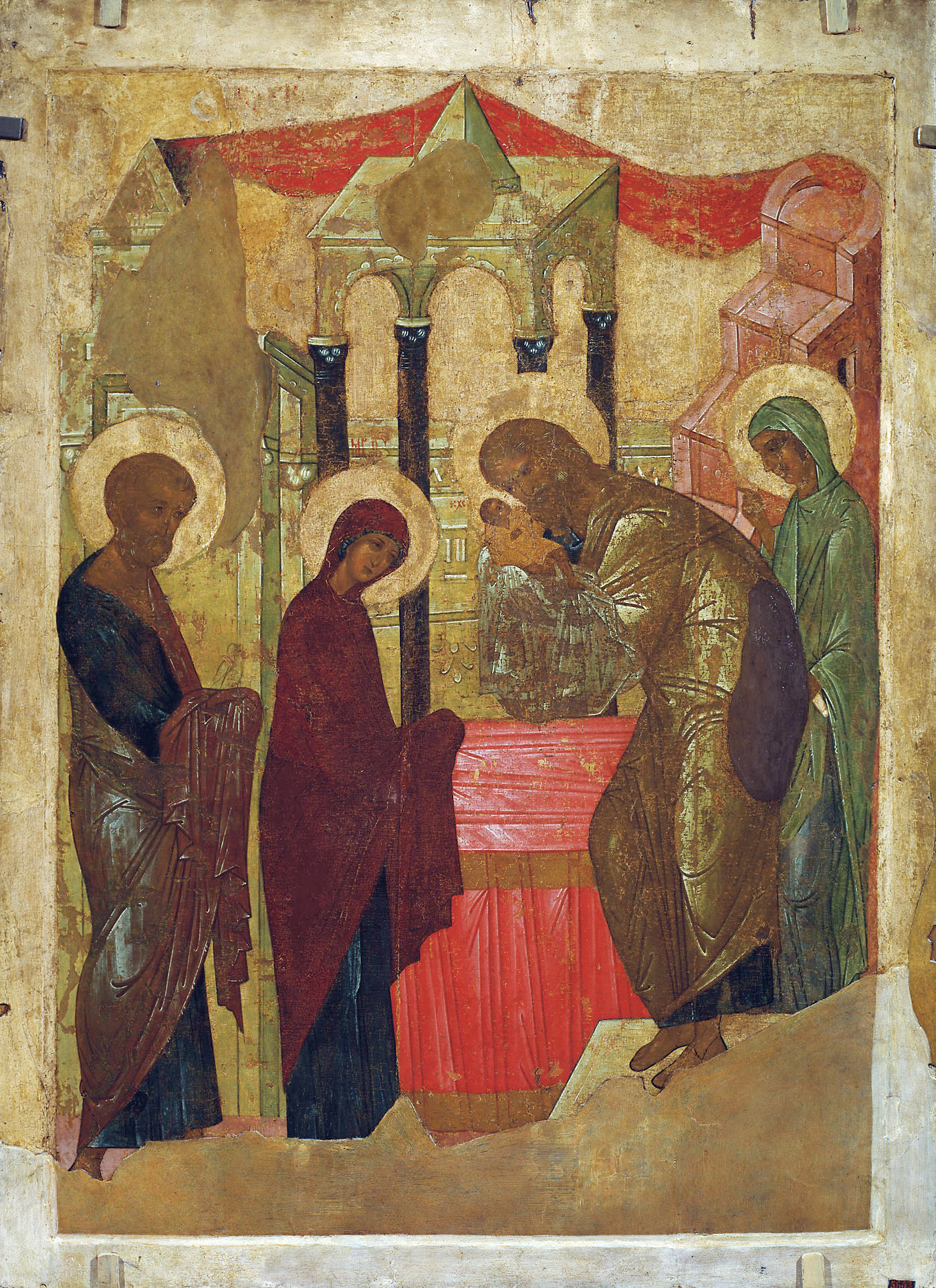
Presentation of Jesus at the Temple, Andrei RublevForty days after Christmas on February 2nd, Christians recall the Presentation of Jesus in the Temple. In a number of Christian denominations the season of Epiphany comes to an end.  According to scripture, Mary and Joseph took the baby Jesus to the Temple in Jerusalem forty days after his birth to complete Mary’s ritual purification after childbirth and to perform the redemption of the firstborn in obedience to the Law of Moses (Leviticus 12, Exodus 13:12-15).


As Mary and Joseph were poor, Mary was relieved of offering a lamb and a dove for her offering. Instead, she was to “take two turtle-doves or two pigeons, one for a burnt-offering and the other for a sin-offering; and the priest shall make atonement on her behalf, and she shall be clean” (Leviticus 12:8).

Around the globe, Christians will likely remember these early events as reported in Luke 2: 22-40. In fact, it is one of the most ancient feasts of the Christian church. With the traditional end of Epiphany, many remove any remaining Christmas greenery from their homes. If you are visiting the Taize’ Community in France, you will likely see a cage with two doves or pigeons in their Church of Reconcilliation. After the service, the birds are released. As the story reflects the light of Christ breaking into the world, it remains a common practice at many services throughout the world to bless candles for use during the year. To this day, some countries share special meals during family celebrations (i.e. crepes in France, or tamales in Mexico).

Pennsylvania Dutch folklore attached an ancient, pagan European practice of weather prognostication to this day. If the groundhog sees its shadow, superstition indicates winter weather will continue for six more weeks. (In ancient Europe, one might have heard of a badger or sacred bear serving this purpose.) Yet, such beliefs weren’t only held in Germanic nations. In England, one old English poem exclaims:

If Candlemas be fair and bright,
Winter has another flight.
If Candlemas brings clouds and rain,
Winter will not come again.

No matter the weather, I hope you and your family will develop your own ways of recalling the Presentation of Jesus. It reminds us of the Holy Family’s piety, and our family’s call as well. It displays a family united by love, as our own should be. The feast most importantly can remind us of how that young male child redeemed on that day came to redeem us through his cross and resurrection. We really should celebrate!

Unless otherwise indicated, all scripture quotations for this article are from the New Revised Standard Version (NRSV) translation.

© 2013 The Rev. Louis Florio. All content not held under another’s copyright may not be used without permission of the author.

Leave a comment

Filed under Church History, Liturgical Year

I hold you in my heart

Spring at Messiah.  "Therefore I tell you, do not worry about your life, what you will eat or what you will drink, or about your body, what you will wear. Is not life more than food, and the body more than clothing? Look at the birds of the air; they neither sow nor reap nor gather into barns, and yet your heavenly Father feeds them." (see Matt. 6: 25-34)

Spring at Messiah. “Look at the birds of the air; they neither sow nor reap nor gather into barns, and yet your heavenly Father feeds them.” (see Matt. 6: 25-34)

I thank my God every time I remember you, constantly praying with joy in every one of my prayers for all of you because of your sharing in the gospel from the first day until now. I am confident of this, that the one who began a good work among you will bring it to completion by the day of Jesus Christ. It is right for me to think this way about all of you, because you hold me in your heart, for all of you share in God’s grace with me, both in my imprisonment and in the defense and confirmation of the gospel. For God is my witness, how I long for all of you with the compassion of Christ Jesus. And this is my prayer, that your love may overflow more and more with knowledge and full insight to help you to determine what is best, so that on the day of Christ you may be pure and blameless, having produced the harvest of righteousness that comes through Jesus Christ for the glory and praise of God. (Philippians 1:3-11) 

On several levels, I have had a challenging year due to my health. First, I was adapting to life with newly diagnosed asthma. Second as the year came to a close, I faced an undiagnosed health issue causing me to be less available and to cut down on my hours working. The health issue is still under evaluation, but hopefully, it will prove a distant memory soon.

What I won’t ever forget is the patience, care, and kindness so many of you shared with me and Kristine as we began to deal with this new “imprisonment.” I am inspired at how your council leadership and ministry team leaders arose to the challenge too, as they adapted to my limitations and strove to provide you the highest level of spiritual care, Christian education and worship. Messiah is a great example of what it means to be part of the priesthood of all believers and cooperative ministry.

I am proud to serve Christ with you, and our many successes this year make me prone to boast in the great work Christ is doing in you and through you. As mentioned during worship, our congregation is held up these days by the Bishop’s staff and others as a model of ministry within our synod. Those that handled our consolidation loans marveled at how we do more than most congregations ten times our size. It brings me joy to have people identify us as “that congregation that does so much.”

Yes, it is not an over exaggeration or nicety when I say I love you all. It makes me excited to look forward to what God’s grace will do in our lives next!

Peace,
Pastor Lou


The above pastoral letter was originally published as part of Messiah Lutheran’s 2013 Annual Pastor’s Report. It has also been republished here and in Messiah’s newsletter, the Messenger. To view the entire issue of The Messenger or to see the full calendar of events, visit: http://www.mlcas.org

Unless otherwise indicated, all scripture quotations for this article are from the New Revised Standard Version (NRSV) translation.

© 2013 The Rev. Louis Florio. All content not held under another’s copyright may not be used without permission of the author.

Leave a comment

Filed under Pastoral Letter, Uncategorized

Sent into the World

The following are the three meditations I shared during our Family Christmas Eve Service at Messiah Lutheran Church and School in 2012. Our theme was “Sent into the World.” We remembered both how Jesus was sent into our world to save us as a newborn babe and how we are sent as his church out into the world. Thus, the service included many hymns and carols from all over the world. The three below were part of the meditation portion of the program, but it was a night filled with music and fun.

The Gift of Jesus

Reading: Isaiah 9:2-7

Prop: small Christmas tree ornament of the globe

“The people who walked in darkness have seen a great light; those who lived in a land of deep darkness—on them light has shined” (Isaiah 9:2).

Consider the world [holding up ornament]….Ok, it’s a bit larger than this ornament, but it’s a relatively small place in the vast, extensive darkness of space. Proportionally, this ornament in comparison to your own size is much, much larger – infinitesimally so – than what we would find with a God’s eye view of our planet. Our world is only a small rock in a vast galaxy that itself is only one of millions of galaxies. Our universe was created from a black void – both the Bible and science think so – and this poor little sphere spends much of its time suspended amidst that darkness; hidden by larger heavenly bodies, and threatened by them as well. Yes, our fallen world is filled with threats and horrors and many terrible unknowns, and it always has been. Yet, light breaks in to give warmth, nurture life, and bring joy. Amidst a cosmic battle, God doesn’t leave us unloved or alone in the dark. Instead, he chose to dwell among us…even became one of us on this tiny, out of the way planet we call home.

Long ago, the great prophet Isaiah lived in the 8th Century BC. It was a time of much darkness. Certainly, they didn’t have our modern conveniences or scientific knowledge, but they shared in our troubled humanity. Throughout Isaiah’s life, the nation of Israel faced wars and rumors of war. At least three times, the existence of Israel was at risk of obliteration and exile. It was a time of early death due to violence, famine and disease. There was seemingly too little joy and never enough peace. Yet, a son was born to a young maiden, wife of the king, and the prophet saw in this somewhat ordinary experience the promise that lay within. God would be faithful no matter how dark the days got. God’s plan to rescue his Holy people would never go unfulfilled. Later Christians would understand this same passage to testify to the coming of Jesus Christ.

Over the last few weeks, we have seen too much darkness. Many are still homeless in the northeast after Hurricane Sandy. Diplomats in Benghazi were horrifically killed. In Connecticut, we hear the cries of  modern “Rachels” weeping as foretold by the prophet Jeremiah. (See Jeremiah 31:15-17 and Matthew 2) They cry over too many innocents and our own innocence lost in the safety of their small town school. Closer to home and only in these past few weeks, members of our community have suffered new joblessness, accidents and serious illness, and our beloved Assistant to the Bishop, Pastor Chip Gunsten, died unexpectedly. More tears. More death. Darkness. We might be tempted to echo the writer of Lamentations wondering, “Why God would allow such things? Why would he punish us so?” as we groan anew:

5 [God] has besieged and enveloped me
with bitterness and tribulation;
6 he has made me sit in darkness
like the dead of long ago.  (See Lamentations 3)

Yet in these times of trouble, hear the promises that come to us through Isaiah. Much like that time long ago, there is a sign to remember and hope to be found amidst our darkness. When the time was right, a virgin did conceive, and a very different child was born…one like no one before or since…perhaps beyond Isaiah’s own understanding. He would be a miracle of light, giving hope, joy and love to all the nations. This king would not be a king in our political sense. Instead, he would suffer under the political forces of our world as we might. He would live amongst the ill and dying. His life would be continually threatened from the slaughter of the innocents in Bethlehem until his own death on a cross. God had come, not to punish us, but to share our lot and change it; to end suffering and bring everlasting peace. All authority rested on Jesus’ shoulders, and yet out of love, he took upon those same shoulders the weight of sin, death and the Devil to defeat them all and save us.

Like that original Christmas night long ago, Jesus comes to our tiny planet to touch our tiny lives and hearts today. He wishes to be God with Us, Emmanuel, and so none of the political chaos, evil or darkness is powerful enough to stop him. Although it might be hard for us to recognize him with our human senses at times, our faith hears his voice and trusts he is near. Together as church, we gather as one, holding on in the darkness and never alone. God does not will such suffering. God is only love. Jesus remains our proof, and the fullness of God’s Kingdom will banish our darkness forever when the time is right.

Until then, we testify to the light and hold on to one another – teaching, serving, worshipping, loving God and neighbor. For, “What has come into being in [that baby] was life, and the life was the light of all people. The light shines in the darkness, and the darkness did not overcome it (See John 1).”

Although we remain in this land of darkness, the light shines on us and through us still, and our Lord Jesus promises that it always will. No matter what worries us or threatens us…no matter the darkness we sense around us or in us, rejoice! Rejoice with the choirs of angels and all God’s saints for the promise of Christmas has come to us, and we will never again be separated from his love. Amen.

Carol, “Angels We have Heard on High,” Red, 289 


The Gift of Grace

Reading: Titus 2:11-14

Prop: Wrapped package or gift bag – empty inside

One of my favorite traditions each Christmas Eve is to gather with my extended family and friends, share a special meal and open gifts. It is such a great joy to see the look of expectation through the eyes of my young nieces and nephews gathered together. Unfortunately sometimes…and I’m afraid it was the same when I was young too…the package comes all wrapped and beautifully bowed…it gets opened frantically, quickly…only to have the child move on just as rapidly to the next gift. The gift delights for a moment, but then the child moves on perhaps as if that beautiful gift box or bag was filled with nothing. [Emptying and examining package]

We, the children of God, spend much of our lives in a similar fashion. We chase after the next bobble or possession, seek positions of power that don’t last, and spend too much time in activities that can’t love us – costly time away from our family and friends. I often hear when someone has a near death experience or approaches the end of their life, “I wish things were different. I have wasted my life.” Yes, as children, we can easily lose our way.

Yet through Christ, a different gift lies before us; one that is eternal and can fill all our life’s empty places. We sense that something is missing, and that perhaps, we could do better. We somehow in our hearts expect more from this life. And so, Jesus calls us buy name, offering us the ultimate gift of his love and friendship.

The theologian Dietrich Bonhoeffer compared us to miners trapped underground. We might feel that we are without hope – waiting for death – until suddenly a voice is heard, calling from seemingly nowhere, yet calling in our darkness. “Where are you? Help is coming!” The helpless miner stands up, mustering strength to cry out in return, “Here I am! Come through to me and rescue me!” Faced with the inability to save himself, the miner admits his neediness, “I cannot come through. I cannot help myself. But I wait. I wait and will hold on until you come. Only come quickly.” The miner sees nothing, nothing at all to give him hope. He only hears the promise of the savior, “I am coming for you!” Blow after blow, the sound comes nearer. There is a last crashing, seemingly thunderous blow of the hammer…light breaks in…at first just a hope or glimmer of light…but yes, more…certainly more! One strike and he will be free. New life will be his.[i]

This story is a metaphor for the giftedness of our present life. Jesus has come to save us, he is with us, and he will come again. That saving work began in a small stable. It continued on a cross. It proceeded from a tomb. Yet this is only the first breaking in of his light and love. His saving work continues to dawn in our daily lives today. He calls us to wait…listen for his voice, hold on for his help, and live in his hope. Look up, raise your heads, and expect salvation…a salvation that not even the power of death can keep from us.

In return, we are only asked in the present age to seek lives that are self-controlled, upright, and godly, 13while we wait for the blessed hope and the manifestation of the glory of our great God and Savior,* Jesus Christ (see Titus 2:11-14). He will do all the heavy work, so that through faith, we receive a gift beyond price – a saving grace, a living grace…a grace that must be shared with others, so that we may one day taste our freedom fully together. With such a life reborn of faith, we’ll sense the light of Christ is near us even amidst our darkness. Amen.

Carol, “I Am So Glad Each Christmas Eve,” Red, 271

The Gift of Church

Reading: Luke 2:1-20

“Props”: the people of God!


In these modern times, skeptics demand proof. “Prove that the reason for the season is Jesus! Prove to me that God is love!” What signs can we give them?

Long ago, some less modern skeptics gathered in a field. They were of lowly status, shepherds of sheep. They were known for dirty bodies and dirty lives filled with drinking, lies, and even theft. They were a hard people shaped by the hardness of life, and they expected little.

“Then an angel of the Lord stood before them, and the glory of the Lord shone around them, and they were terrified. But the angel said to them, “Do not be afraid; for see—I am bringing you good news of great joy for all the people: to you is born this day in the city of David a Savior, who is the Messiah, the Lord. This will be a sign for you: you will find a child wrapped in bands of cloth and lying in a manger.” (see Luke 2)

The long expected sign for the King of Kings, the Messiah, our Savior…the one who would change all the world…was a baby! It was a poor infant from a poor family in poor circumstances. A child swaddled in simple, torn strips of cloth. That was the great sign of God’s love. God had come to share in the hardness of life and free us from it.

That child would grow to be a boy wise beyond his years. Then, he would become a man who preached and taught not as the scribes and priests did but as one with the authority of God. This great rabbi would travel the land by foot. He would walk far and wide reaching out not only to the expected Chosen Ones of God, but all people: the lepers, the wounded, and the greatest of sinners. Even on his cross, that man would share comforting words of God from scripture, pray for his persecutors, offer forgiveness to someone crucified beside him, care for his mother, and give up his own life so that others might live. Jesus’ life and being was and remains that greatest of signs of God’s love for us.

And so here we are, gathered as millions and millions of Christians have done over the millennia and do so tonight. We would not be here if Jesus hadn’t been born as one of us and risen from the dead…if people like us hadn’t been touched by the light of his life and past that light on to us through the ages (as we will symbolically do with candlelight later this evening). The incarnate Christ is who we worship…the ever so real and yet divine Jesus…and he is present in our world through the incarnate church, the embodiment of his teachings, life and love.

We can be a hard people with a hard life, and yet the angels speak to us…call us to become Christ’s messengers. “Do not be afraid! To you is born a Savior”…for you a Savior. He is a gift come to you, so that you with others might share one communal, eternal, joyful life with him. Through faith, we are to be his body, a sign of good news and great joy for all people.

As his body, we are asked to share in his life, suffering, death, and resurrection out of love. It is his Spirit that washes over us in our baptism, and his flesh and blood that touches our own in our sacred meal. Just as Jesus’ life is the final answer to sin, death and the Devil, he has spoken us into being for this time and this place with all its unique challenges. Look to your right and left…see yourself in a mirror. We are the church! We are to be Christ in the world!

We are called to be Christ’s church together, a gift to the world as Jesus was God’s loving gift to us. As the Spirit was a gift to the first disciples that same Holy Spirit seeks to empower us now. Therefore go and make disciples of all nations (see Matthew 28:16-20)…be zealous in good deeds (Titus 2:14)…walk in his light (Isaiah 9:2)…For God so loved the world that he sent his only Son into our world to rescue us and dwell in our hearts (John 3:16-17). Out of that same love, God sends us back out into that hard, dark world – strengthened and never alone – to share his light not just on this holy night, but always.

May we like those shepherds, praise God and share with one and all what we have seen and heard. Amen.

Carol, “Infant Holy, Infant Lowly,” Red, 276


[i] Paraphrase of a portion of a sermon by Dietrich Bonhoeffer as translated in Robertson, E. (trans. And ed.) (2005) Dietrich Bonhoeffer’s Christmas Sermons. “How a prisoner awaits for his release.” December 3, 1933. pp. 88-90.


Unless otherwise indicated, all scripture quotations for this article are from the New Revised Standard Version (NRSV) translation.

© 2012 The Rev. Louis Florio. All content not held under another’s copyright may not be used without permission of the author.

Leave a comment

Filed under Liturgical Year, worship

Come, Lord Jesus, Come!

The following is a short sermon I preached to my congregation at Messiah Lutheran Church and School, on the Third Sunday of Advent, often called Gaudete (Rejoice) Sunday. Although our preschool students and elementary-agers were present to perform a joyous Christmas musical, the death and sadness of the last week, especially in Newtown, CT, could not be ignored.

As our last hymn [O come, O come, Emmanuel] reminds us[i], the Advent season is a time of waiting and expectation. The song is much like many others among our Advent hymns and even some of our more traditional Christmas carols. Many project a sense of sadness and longing. They can prove almost melancholy. Our hymn writers and liturgists – just like us – know the imperfections and pain of this world, and so we look toward Christ to deliver us. Our music, images, and prayers can reflect that sense of loss, waiting and hope. Being a Christian, I heard someone once say, is like being a person separated from their greatest love; something is missing, and not quite right. We hunger and thirst for that love to be one with us again, so that our lives can feel whole.

This week, we have been unhappily reminded of that truth. We lost our assistant to the bishop, Pastor “Chip” Gunsten, a dear friend of mine and many here at Messiah as well as throughout our synod, who died suddenly while undergoing treatment for cancer. We are not the only ones mourning, for our Catholic brothers and sisters lost their former beloved bishop, Walter Sullivan on the same day. He was someone I knew well, and he proved influential to my own discernment of service within the church. Our Presbyterian friends in Virginia lost one of their own leaders as well, Cynthia Bolboch, Moderator of the 219th General Assembly of the Presbyterian Church (U.S.A.) on December 12th.  Having many Presbyterian friends after attending a Presbyterian seminary, I shared in their own grief and sadness. As the week closed, I was tired and worn down from dealing with death and the many emotions that always accompany it. Then, we received the horrific, numbing news of Newtown, CT. People thousands of miles away shared in that community’s dread and grief and fearfully held their own loved ones closer.

How can we make sense of such things? I’m not sure that we can. Oh, as a Christian, I trust that God can use them – turn them on their head and make all things work for our good. I know blessings and signs of love can be found even amidst tragedy – perhaps especially at times of tragedy – through the heroes and servants shining in those times of darkness, or through the love that is shared with us to help us make it through. Yet, maybe we are never supposed to make sense of these things at all. It isn’t within our capabilities to make sense of the nonsensicle. The issues can be too involved for us to handle or beyond us. Maybe they just can’t ever make sense, because they are counter to what God wants for us. God’s will is to save us for a future full of hope, not to condemn us to an eternity of woe[ii]. God’s plan from the time of Adam and Eve was to redeem and save us out of love.[iii]

These sufferings are symptoms of that earlier wound. They are parts of our life as a fallen, imperfect people in a fallen, imperfect world. People sin. People suffer. People die. Uncontrollable evil and sadness do exist. Perhaps instead of looking back for answers as to why things happened, we should look forward. Our time is better spent in the face of such evil asking, “What would you have us do, Lord?”

Certainly, God never abandons us to this sorrow. God has a purpose and a plan which includes us. Jesus was sent into our world as a little child to share our life and lot; even our suffering unto death. God doesn’t rejoice at our destruction, but rather wants us to live abundantly through his only son.[iv] Jesus would become God’s final word on evil, sin and death. They have been defeated through his cross and resurrection, and we are saved here and now. Yet, sin and death are enjoying their final death throws at our expense. Jesus declares we are free from their power; saved even as we and creation might groan at times.[v]

In this present age, Jesus promises to come again to complete the work which he started and banish sin and death forever. There will be a new heaven and earth where suffering will be no more.[vi] In the meantime amidst our lingering troubles, he asks us to look up and be ready, not as a sullen or defeated people, but as his beloved people. Be ready, he says, so that our hearts are not weighed down with dissipation and drunkenness and the worries of this life, so that the day doesn’t catch us unexpectedly, like a trap.[vii]

No, we who are saved have a purposeful, divine work to do. We are left here – called to this time and this place – as his messengers speaking his words of love, healing and forgiveness; words so sorely needed in this wounded, combative world. Like the law and the prophets before him including John the Baptizer [viii], Jesus taught us what we need to do – love God with all we are and our neighbors as ourselves.[ix]

Today both despite our suffering and because of it, we are to speak these words and embody them. God uses us with all our weakness and imperfection to give them form and substance, flesh and bone, to make them real. We are echoes of Jesus crossing all the earth shouting, “Do not be afraid! Jesus has come! He is risen and will come again!” We are called to lovingly and boldly put these words into actions together as church…Christ’s church…his body…his hands reaching out and touching broken lives through our own.[x]

Today, we have also heard words that Paul spoke to Christians in Philippi when they were persecuted, broken and felt alone. These same words were shared with us yesterday at Pastor Gunsten’s funeral. Perhaps it is providential that the lectionary had them as one of our assigned texts considering recent events:

Rejoice in the Lord always. I will say it again: Rejoice! Let your gentleness be evident to all. The Lord is near. Do not be anxious about anything, but in every situation, by prayer and petition, with thanksgiving, present your requests to God.And the peace of God, which transcends all understanding, will guard your hearts and your minds in Christ Jesus.  (Philippians 4: 4-7)

Rightly, Jesus is called Emmanuel, God with Us. We need not get stuck in our fear, hurt or anger. Look up! Raise your head! Do not be afraid! These are the words Jesus speaks to us in the face of our most unimaginable threats or losses. When the world and its realities rage, when struck by great sorrow, or when we cannot find reconciliation with others we so deeply long for, Jesus speaks to us as he did similarly to that storm long ago, “Peace I leave with you; my peace I give you. I do not give to you as the world gives. Do not let your hearts be troubled and do not be afraid.”[xi]

This world can be a frightful, sad and lonely place, but we need not grieve as people without faith.[xii] We need not live as a people without love.[xiii] Despite any of our doubts, Christ’s peace and love are with us always[xiv], and we have a shared ministry to do in his holy name.[xv] His light is in our midst and shining through our hearts, and the darkness shall not overcome it.[xvi] Remember always that we are baptized – claimed and called, to be Christ and to serve Christ in the world.[xvii] We must never try to hide ourselves from the pain of this life and thus not truly live.[xviii]

We are Christ’s church, together with Jesus and thus never alone. He has come for us and will come again. Our longing will be vindicated. This truth is rightly celebrated at every moment and forever, but especially during Advent. We celebrate it this morning through our young people attending Messiah Lutheran School who have come to proclaim the story of Christ’s birth with us anew today.[xix] Amen.

Readings for the Third Sunday of Advent – December 16, 2012
Zephaniah 3:14-20
Isaiah 12:2-6
Philippians 4:4-7
Luke 3:7-18


[i] “O come, O come, Emmanuel, and ransom captive Israel, that mourns in lonely exile here until the Son of God appear. Rejoice! Rejoice! Emmanuel shall come to you, O Israel. (Evangelical Lutheran Worship, Hymn 257, verse 1)

[xiv] In Mother Teresa and Brother Roger’s book called Seeking the Heart of God (1993), Brother Roger writes: “Four hundred years after Christ, a believer names Augustine lived in North Africa. He had experienced misfortunes, the death of his loved one. One day he was able to say to Christ: ‘Light of my heart, do not let me darkness speak to me.’ In his trials, St. Augustine realized that the presence of the Risen Christ had never left him; it was the light in the midst of his darkness.”

[xvii] At times of fear or doubt, Martin Luther is said to have reminded himself, “I am baptized”; a reminder that he was Christ’s called, claimed and sent child. His writings also indicate that we act as Jesus in the world, but also encounter Jesus in the least of these, those suffering and alone. Through their lives Jesus cries out to us for compassion.

[xix] Isaiah 11:6

The Funeral of the Rev. Paul "Chip" Gunsten by The Rev. David Delaney, Ph.D

The Funeral of the Rev. Paul “Chip” Gunsten by The Rev. David Delaney, Ph.D

Unless otherwise indicated, all scripture quotations for this article are from the New Revised Standard Version (NRSV) translation.

© 2012 The Rev. Louis Florio. All content not held under another’s copyright may not be used without permission of the author.

Leave a comment

Filed under Community Life, Law and Gospel, Liturgical Year, Uncategorized, worship

St. Lucy – Innocent on all counts of burglary, witchcraft, & pagan roots

Lucy Before the Judge, by Lorenzo Lotto, 1523-32

Throughout Scandinavia and especially Sweden, the feast of St. Lucy on December 13th holds a special place on the liturgical calendar. Associated today with the lights and laughter of Christmas, the roots of this holy day are much darker.

Before science proved otherwise, December 13th was commonly considered the darkest point of the year. In nations where darkness reigns at wintertime due to their extreme northern location, a celebration developed to mark the transition from darkness to light. The pre-Christian season of Yule honored the winter solstice and the return of the sun through feasting, gift giving, and other gatherings. Such activities would hopefully keep one safe from the evil forces that lurked as an ever present danger.

One such danger was Lussi, a female demon who was thought to actively roam on December 13th. She would ride through the air with her followers, the Lussiferda. It would be dangerous to walk alone in the darkness. People feared falling asleep and becoming her victim. In some traditions, she might even come down the chimney to snatch away misbehaving children. Throwing all night parties seemed to remedy her threat.

Much later and far away in Italy, Lucy (sharing the Latin root for light, lux) was born in 283 CE. In Italian, she is known as Santa Lucia. Details of her life are sketchy and often tinged with myth, but she seems to have been a devoted Christian woman known for her generosity and faithfulness. The core of the story indicates she was pledged to a pagan for marriage. Lucy’s heart was elsewhere. She wanted to devote her life to Jesus Christ. Instead of using her dowry for marriage, she gave it to the poor. One story accounts that she wore a wreath with candles atop it to keep her hands free in order to deliver more assistance to her fellow Christians in the catacombs. Word came to her betrothed that she had found a more suitable bridegroom. In anger, he turned Lucy over to the local Roman authority, the magistrate Paschasius.

Here the stories vary, but what seems certain is that Lucy refused to marry her intended husband or reject Christ even under torture. She was perhaps blinded, thus hagiographic images of Lucy often show her eyes on a plate of some kind. Yet, this part of the story didn’t appear until the 15th Century in any known writings. However she met her end, it is uniformly reported she did so with faith in Christ even unto death in 304 CE. She is remembered as a martyr, thus her feast day’s liturgical color is red.

Lucy’s legacy is not that of Lussi, yet in the northern European lands, there stories somewhat merged. The light of Christ which shined so brightly through this young virgin’s life now became associated with the winter solstice. She doesn’t break into the home through the chimney. No one hides in fear. Instead a young girl is often selected to represent her and bear gifts (usually foods such as Lussekatt – a “St. Lucia Bun” – made with saffron) to her family, singing songs and wearing a wreath with lit candles around it. The song lyrics vary, but they have the Italian tune Santa Lucia. Today, many cities in Northern Europe have public processions to remember Lucy.

This is the English translation to one version called “Night Walks with a Heavy Step”[i]:

Night walks with a heavy step
Round yard and hearth,
As the sun departs from earth,
Shadows are brooding.

There in our dark house,
Walking with lit candles,
Santa Lucia, Santa Lucia!

Night walks grand, yet silent,
Now hear its gentle wings,
In every room so hushed,
Whispering like wings.

Look, at our threshold stands,
White-clad with light in her hair,
Santa Lucia, Santa Lucia!

Darkness shall take flight soon,
From earth’s valleys.
So she speaks a Wonderful Word to us:
A new day will rise again From the rosy sky…
Santa Lucia, Santa Lucia!

So whether in Italian (Santa Lucia), Swedish (Sankta Lucia), or English (Saint Lucy), this woman shouldn’t be confused with the burglarizing evil spirit or witch of old legends. Lucy is her own woman, not just a remake from paganism. She deserves to be remembered for her Christian witness through her ordinary life. She can serve as an inspiration for us to let the light of Christ shine through us. She is just one of a great cloud of witnesses God has used to break into the darkness of our world.

Like Lucy, we are children of that same light. We are innocent of all charges against us, real or imagined, through faith in the Son of God who came as a child in Bethlehem long ago. All powers of evil, sin and death raged against him then, but “The light shines in the darkness, and the darkness did not overcome it” (John 1:5). We are asked to serve as his living symbols, an assurance that he once came that Christmas long ago, but also proof that he is risen. We remain signs pointing to the truth that he will come again. We do this through boldly loving in his name, even unto death, for we know we shall share in his final victory. “Whoever loves a brother or sister lives in the light, and in such a person there is no cause for stumbling” (1 John 2:10). In Christ, we shall find forgiveness, new life, and a love we never dared hope for.

When Jesus finally does come at the end of the age, a new everlasting day shall rise. Darkness will forever take flight. “And there will be no more night; [those who trusted in him] need no light of lamp or sun, for the Lord God will be their light, and they will reign for ever and ever” (Revelation 22:5). With Lucy and all the communion of saints, we await and announce his coming.

Let us pray:
Lord God, Saint Lucy did not hide her light under a bushel, but let your light shine for the whole world, for all the centuries, to see. We may not suffer torture the way she did, but we are still called to let the light of our faith illumine our daily lives and the lives of others. Help us to have the courage to bring our faith into our work, our recreation, our relationships, our conversations, and every corner of this day. Amen[i]

Merry Christmas! Buon Natele! God Jul!

Pastor Lou


[i] Variation of a Roman Catholic prayer and one seen in a devotion by Bishop Kanouse of the Northern Texas-Northern Louisiana Synod, ELCA)

[i] Translation from http://www.mamalisa.com/blog/santa-lucia-day-song-and-saying-why-its-a-festival-of-light/


Unless otherwise indicated, all scripture quotations for this article are from the New Revised Standard Version (NRSV) translation.

© 2012 The Rev. Louis Florio. All content not held under another’s copyright may not be used without permission of the author.

Leave a comment

Filed under Church History, Community Life, Liturgical Year, Uncategorized