Tag Archives: christian

A sign of hope

Photo by author using Iphone11 Promax. All rights reserved.

Do not fear, for I have redeemed you; I have called you by name, you are mine.” Isaiah 43:1b

While taking Boomer for a walk yesterday, I caught sight of what appeared to be a red fireball in the sky. Only, it was not the sun or a meteor. It was the moon! I’ve seen reddish colored moons before, but I don’t recall ever seeing anything like this. The first thing that popped in my mind was a prophesy shared by Joel (2:31), “The sun shall be turned into darkness, and the moon into blood, before the great and terrible day of the Lord.” Yet in mere moments, I thought better of it. Fires in the west have caused a great plume of smoke to pass over our state, and refracted light likely caused the fiendish, end of times worthy glow. There was nothing to fear.

It is funny how quickly our minds can go to the most frightening or worst-case scenarios. Yet most often, our expectations prove wrong. Much like the Halloween costumes so popular this time of year, look under the mask or hood, and we find nothing threatening. We might even find a friend. I think Jesus would love us to approach all our troubles in a similar way. Even when we cannot figure out an answer on our own or trouble hangs around, Jesus has said in varied ways, “Let nothing trouble you. Trust in me.” Indeed, at just the name of Jesus, demons are said to flee. That might not prove so with all our earthly troubles – at least not right away. Sometimes, troubles of this life stick around with seeming finality. Still, Jesus says, whatever we hear or see, he will be with us, and we have nothing to ultimately fear even if we face death itself.

Martin Luther argued that our faith and baptism makes all the difference. It is like an eternal lifeline that nothing, not even our own sinfulness, can cut. “In this faith,” Luther says, “I stand and live. I eat and drink, sleep and wake, rule, serve, labor, act, and suffer, all in the faith that I am baptized.” And through our faith and baptism, the Spirit claims us and will never abandon us. Indeed, God will make good come from even the biggest bad because we are loved. How can a vine which is connected to the branch called Jesus not bear fruit? How can pure love ever let us go? That’s impossible! Luther ponders, “The life of such a person, whether great or small and no matter what it is called, is nothing but fruit and cannot be without fruit; for in Christ that person has been born into a new existence, in order to be constantly full of good fruit.”

With fall upon us, we are in a season of growing darkness. With the news, some might suggest our days are dark too. Yet, this is also the season where we harvest fruits of the earth. Jesus has saved us, and he will continue to save us. Our call is to trust that no matter how dark the days of our lives might grow the good fruit that we are shall never be cast aside. We belong to Jesus.  

Originally published in the October 2021 newsletter of Christ Lutheran Church, Fredericksburg, VA.

Unless otherwise indicated, all scripture quotations for this post are from the New Revised Standard Version (NRSV) translation.

© 2021 The Rev. Louis Florio. All content not held under another’s copyright may not be used without permission of the author.

Leave a comment

Filed under Pastoral Letter, Uncategorized

We have a purpose

“Therefore, let all fight the good fight in their own calling.”

Martin Luther had a formidable understanding of what it meant to be called by God. Whatever our vocation or station, we are called to love God and neighbor. We are to do the work allotted to us with our best effort but also a humility that understands all persons as equal before God. Everyone plays an important part in God’s plans. Yet understanding God’s plans for us can be difficult.

Whether you are a youth or an adult entering a new stage of life, we can ask similar questions. Who am I? Where do I fit in? What difference do I make? (These questions are affirmed by research found in the book, Growing Young: 6 essential strategies to help young people discover and love your church.) Certainly, the questions might vary in import as we age, but we often struggle with our significance. That’s why as Christians, we are encouraged to understand that our roles and work might change, but our true significance comes from God’s love for us. Whether a child or facing our final years of life, we have a purpose.

If it is true that we cannot fully understand that sacred purpose fully while living this life (as one saint opined), all is not lost. We are promised the help and guidance of the Holy Spirit. Through intentional prayer and Bible study, sharing our questions with faith-filled friends or pastors, or even by volunteering, taking classes, or trying new activities, the Spirit might help us identify our individual “what’s next” moment. Hardships and misfortunes might even become new opportunities for redirection, learning, or more compassionate relationships. Whatever we do, the Spirit goes with us and will seek to guide us. God can and will use all of it!

The Church also remains available to you. Yes, as noted above, you can speak to your friends, but there are specially trained persons called spiritual directors you might wish to explore. Once back in the Church as a young adult through today, I have sought a spiritual director or counselor to walk with me. You might find their support as part of a retreat experience, but others are willing to serve as your companion and guide over a longer, mutually agreed upon period. Just as Jesus mentored his disciples, the early Church found it helpful for elders and others with such gifts to serve as mentors. Spiritual direction might include directed Bible study and conversation, but also, they might be able to point us to practices and options leading us to spiritual growth, greater peace and joy, or new vocational understanding. The spiritual director can help us with discernment or even challenge our understanding as an accountability partner. Indeed, Martin Luther’s own growth as a Christian was thanks to his own spiritual director.

If this sort of intentional accompaniment sparks your interest, I would encourage you to speak with Pastor Anne or myself. There are many resources in Virginia, but not all of them are of the same quality or a good fit for your individual needs. Some are even free. If we are going to fight the good fight as Luther urged, it is good to know that we need not fight alone.

Peace be with you.+ Pastor Lou

Originally published in the September 2021 newsletter of Christ Lutheran Church, Fredericksburg, VA.

Unless otherwise indicated, all scripture quotations for this post are from the New Revised Standard Version (NRSV) translation.

© 2021 The Rev. Louis Florio. All content not held under another’s copyright may not be used without permission of the author.

Leave a comment

Filed under Pastoral Letter

Cultivating Self Care

Image by tinytribes on pixaby.com. Used by permission.

And this is my prayer, that your love may overflow more and more with knowledge and full insight to help you to determine what is best, so that in the day of Christ you may be pure and blameless, having produced the harvest of righteousness that comes through Jesus Christ for the glory and praise of God. (Philippians 1:9-11)

For many, the summer can prove busier than the school year. Even in our “play,” we can tend to be people who plan and program our time, thus stretching ourselves thin rather than building ourselves up. As August arrives and we return to our fall schedules, it is tempting to let go of self-care and personal growth in order to accomplish more before summer comes to an end. Yet what if less is truly more? What if in prioritizing a healthy love of self we could be empowered to love others better? We have to pick and choose what we need to really do most, but when we often put our needs last, that can just lead to burnout.

I remember when I was young, I pulled long hours at work and volunteered for more hours to help supplement my pay. That seemed reasonable at the time, but important relationships, exercise, meals and my spiritual life suffered. I found myself always busy and yet in many ways isolated. I approached my life with cynicism rather than joy. As one would expect, I hit a kind of bottom that convinced me I needed to repent.

In reorienting my life through daily spiritual practices, worship in community, and other self-care habits, I admit that it at first seemed like a bother. Yet soon, I noticed benefits. My attitude improved. I slept better and had less anxiety. I found deeper friendships and thus a more meaningful life. In making time for communal Bible study and continuing education for self-improvement, my zest for life increased. Even at work, my supervisor noted that I was working more efficiently in less time, and he experienced me as a more pleasant and peaceful person.

As the fall arrives, you will be invited to many events including church related activities. I’m not suggesting that you need to be at our congregation every time the doors are open, yet I would challenge you to discern what is best for you and your family. Self-care including that of your spiritual life needs to be an intentional priority, or you will be missing out on the abundant life Jesus promises. I encourage you to change things up and try something new as offered by Christ Lutheran, the Virginia Synod, or other faith groups in our area. Find a retreat, take a new class, or sign-up for a spiritual director from the ecumenical community at Richmond Hill or another community of your choice. Volunteer for a cause you feel passionate about. Better yet, invite a friend to join you. If you don’t know where to start, Pastor Anne or I will be happy to help you choose.

We are commanded by God to love our neighbor as ourselves, not better than ourselves. As human beings, our bodies are geared toward survival and achievement. Our God wishes us much, much more. Cultivating self-care can help us on our way.

Originally published in the August 2021 newsletter of Christ Lutheran Church, Fredericksburg, VA.

Unless otherwise indicated, all scripture quotations for this post are from the New Revised Standard Version (NRSV) translation.

© 2021 The Rev. Louis Florio. All content not held under another’s copyright may not be used without permission of the author.

Leave a comment

Filed under Pastoral Letter

Rethinking the Civil War, It’s Legacy, & Me

Click this image to read the article alluded to below in my blog, “Why Do Confederate Lies Live On” in The Atlantic.

“When I was a child, I spoke like a child, I thought like a child, I reasoned like a child; when I became an adult, I put an end to childish ways” (1 Corinthians 13:11).

Recently, I came across an excellent article in The Atlantic called “Why Do Confederate Lies Live On.” It was written by Clint Smith, an African American staff writer with the magazine. Focused on his experience with the chapel at Blandford Cemetery, it gave me reason to pause and reflect about my own life.

VMI Cadet Hartsfield of the Battle of New Market is buried somewhere in the Blanford Cemetery in a grave lost to history. In 2014, Petersburg’s VMI alumni group asked me to offer an invocation and benediction for their recognition of the 150th anniversary of the Battle of New Market on May 15th. I was serving as a pastor in Richmond at the time. I naively expected a small, outside event from what I was told. It ended up being a larger event in this cemetery chapel. (I had never heard of this chapel before my visit.)

I was told a World War 2 veteran who survived landing just a day or so after D-Day and fought through the war would speak about his experiences. He did, and that was positive. I did not expect a local SCV color guard with the Stars and Bars battle flag or the explicitly Confederate windows. It was sort of creepy and fascinating at the same time.

My previously prepared prayer alluded to the errors and evils of the Civil War. Yet now, I wish that I had explicitly and strongly refuted slavery and racism as part of it. I mentioned how the cadets’ actions under fire likely helped lead to the preservation and restoration of VMI after the war and perhaps indirectly helped shape or inspire folks like George C. Marshall and Civil Rights Martyr, Jonathan Daniels, and others to bravery or to do their duty. (At some level, I think that remains true for me.) I realize that God can make good come from anything, even our sin. I prayed VMI and our nation would become ever better, more just, and reconciled.

On one hand, I was honored to be asked by fellow alumni, especially for this momentous 150th anniversary year of the Civil War. My fellow alumni were hospitable, and like many alumni including myself, love VMI. On the other hand, I wish I went further and spoke more clearly about the sins of racism, slavery and treason. I value history, but we need to tell the whole story – even the ugliest parts.

Even though I’m from the north, even though some of my ancestors fought for the United States during the rebellion, even though my First Class dykes (senior mentors are called dykes after the cross-belts or dykes worn as part of the uniform) used to have me answer, “The United States of America, Sir,” to the question at VMI about who won the Civil War, the Lost Cause Myth can insidiously take hold of a person if we aren’t wary. It can obscure our vision and understanding, as well as stir division or wound others unintentionally. The myth dresses up and softens what’s ugly. After all, that myth and racism in all forms are just more signs of sin at work in our lives and world. And, sin often traps us subtly over time.

I’m not the person I was in 2014. My attitudes have hopefully continued to evolve, and I pray I continue to grow in understanding and empathy. Wherever needed, I desire the wisdom to repent of my sin including any sin related to racism. I want the courage to challenge racism wherever it is encountered. I’m not looking to erase history. I understand all of us, even the best of us, can only be simultaneously sinner and saint and never perfect. It can be helpful to remember the past. Yet as Christians, we understand we are always reforming. We need to separate ourselves from rigid, dualistic (that everything is all good or all bad), or simplistic thinking and bravely embrace the truth of our past and our present whatever we might see. We can love and respect our enemies, even those of the past, even as we seek to see them and their failures as they truly are.

Want to learn more? I would highly recommend this additional text: Robert E. Lee and Me: A Southerner’s Reckoning with the Myth of the Lost Cause.

Unless otherwise indicated, all scripture quotations for this post are from the New Revised Standard Version (NRSV) translation.

© 2021 The Rev. Louis Florio. All content not held under another’s copyright may not be used without permission of the author.

Leave a comment

Filed under Church History

Time to heal

“Peace, peace, to the far and the near, says the Lord, and I will heal them. (Isaiah 57:19)

As I write this, I am preparing to go to the hospital tomorrow morning bright and early for surgery. In the grand scheme of things, it should prove a minor surgery, but it has been on my mind, nonetheless. When I was younger, I perhaps did not give as much thought and care to my health and wellness as it deserved, but it seems a growing issue as I age. There’s an ache here or a pain there. Stress can be more present than in the days of my youth. Sleep can be a challenge – not enough time for sleep or at times (perhaps much worse or at least more frustrating) disrupted sleep. Then whether for annual visits, precaution, or due to illness, it seems like I am visiting with doctors more and more. It is a good thing that I like them!

I’ve learned from my chaplaincy work in hospitals, hospice, and among law enforcement, our health and wellness are never to be taken for granted. Instead, self-care is a complicated thing deserving our prayerful discernment, effort, and trust. Yes, you read that correctly. I wrote “prayerful discernment, effort, and trust,” for our physical, mental, emotional, and spiritual needs are all intertwined with one another and our need for God’s grace.

Did you ever notice that when Jesus forgave sins, it often resulted in other manifestations of healing? People were restored to relationship or could once again walk. Scripture commands (in James 5:14-15), “Is anyone among you sick? Let them call the elders of the church to pray over them and anoint them with oil in the name of the Lord.” God desires that we look heavenward for help, guidance, and hope. Martin Luther even alluded to our sacraments as a kind of healing medicine at times. Yet Jesus never taught, and scripture never claimed, that the healing to be gifted would only be physical or provided in the way we would want or expect it. Instead, we are asked to trust that the loving God who created us cares for us still. Indeed, God’s loving grace desires to enfold us in a kind of eternal hug from cradle to grave and beyond.  

No matter our situation or prospects in this world, Jesus offers us a peace that is not of this world and beyond our understanding. It is a gift that can help us enter with boldness into new challenges, the doctor’s office, surgery, or even hospice care. This does not mean there will never be tears or fear or other human emotions, but even when these human emotions rise (trying to help us process our situation) or amidst our limited wisdom seeking to find our way forward, we can try to remind ourselves of and trust in Jesus’ promise that we will never be alone. Indeed, it is Jesus who sends us family, friends, and trained professionals to help us on the way. How do I know? Well, all good things come from God, and near or far, God’s healing will always find us. Indeed, Jesus has declared that one day sickness and death will be no more, and we will be with him when that day comes.

Image: Picture by DarkoStjanovic on Pixaby. Used by permission.

Originally published in the July 2021 newsletter of Christ Lutheran Church, Fredericksburg, VA.

Unless otherwise indicated, all scripture quotations for this article are from the New Revised Standard Version (NRSV) translation.

© 2021 The Rev. Louis Florio. All content not held under another’s copyright may not be used without permission of the author.

Leave a comment

Filed under Pastoral Letter, Uncategorized

Our Lord’s Living Garden

In springtime, I often come to think of Thérèse de Lisieux as I take my walks. Thérèse was known for seeing God in the little things, even spring flowers or butterflies. She would regularly stop to reflect upon their intricate beauty. In her own way, it was a source of what we might call meditation or mindfulness. By focusing on her experiences of the moment, she discovered a deeper sense of peace and beauty around her and ultimately at work in her. She recognized even as she battled chronic, often debilitating illness, that she had reason to hope. Even in her illness, she could serve and be faithful to God. Simplicity was her watchword, often called by her “the little way.” And she herself eventually became commonly known as “the Little Flower.” For as much as many would overlook God’s work in creation, contemporaries often overlooked the spiritual beauty found in her lifestyle and vision. Yet today, she is remembered in Roman Catholic and Protestant seminaries and congregations across the world.

Martin Luther once quipped, “Our Lord has written the promise of resurrection, not in books alone, but in every leaf in springtime.” This is most certainly true! Yet, in this busy world, do we often stop to reflect on the gracious beauty at work in each of us and the world? Through our faith and baptism, God is still sharing the promises of the Gospel, and although not everyone will notice or believe it, all our lives make a difference. Indeed, Jesus died and rose from the dead for every one of us. As we are and for what we will become through grace, he sees value and beauty in each of us.

Much as Paul argued that each of us play a varied part in the body of Christ, Thérèse saw us as flowers in the garden. “I understood that every flower created by Him is beautiful, that the brilliance of the rose and the whiteness of the lily do not lessen the perfume of the violet or the sweet simplicity of the daisy. I understood that if all the lowly flowers wished to be roses, nature would no longer be enameled with lovely hues. And so, it is in the world of souls, Our Lord’s living garden.”

Scripture reveals to us that God is our Master Gardner. God has planted us in the region of Fredericksburg to do some particular good, to add unique beauty, and to be individual and communal signs of life and hope. We bloom through worship, fellowship, and service. We are rooted in his love. Yet as summer travels begin again, local gatherings increase, and some might have to continue to stay away due to medical issues or other concerns, know that you are not forgotten. Indeed, you are missed. Come back to us when ready with new stories and love to share. For you make a difference to us, and together, we are most beautiful. I wish you a happy and meaningful summer ahead.

Image: Picture by the author.

Originally published in the June 2021 newsletter of Christ Lutheran Church, Fredericksburg, VA.

© 2021 The Rev. Louis Florio. All content not held under another’s copyright may not be used without permission of the author.

Leave a comment

Filed under Pastoral Letter, Uncategorized

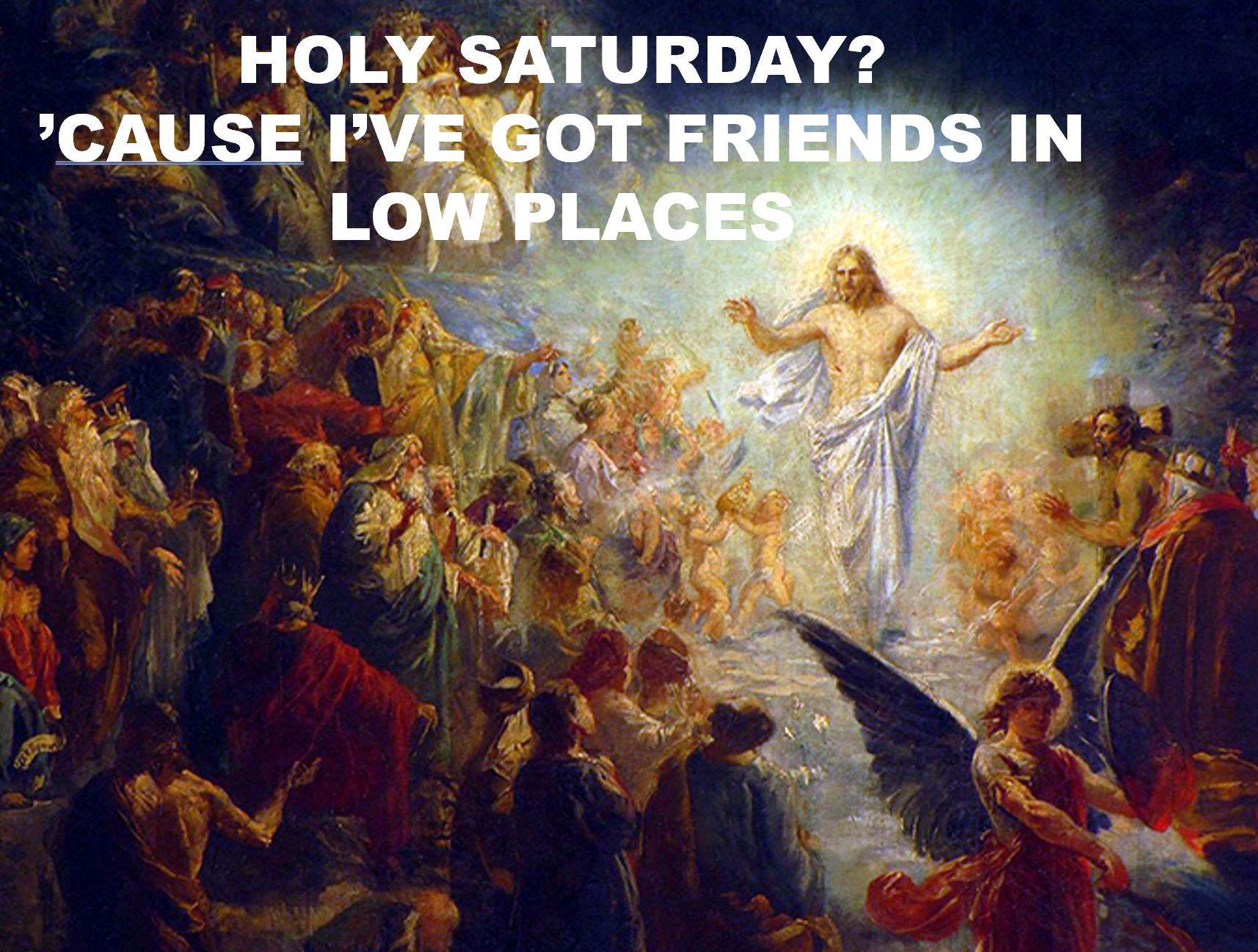
Holy Saturday?

Every year, I’m asked about where Jesus was or what he was doing on Holy Saturday. This meme pretty much sums it up even if in a humorous way. Jesus descended to sheol, the place of the dead out of love for others. The primary scriptural reference is from Peter 3:18-20:

“For Christ also suffered for sins once for all, the righteous for the unrighteous, in order to bring you to God. He was put to death in the flesh, but made alive in the spirit, in which also he went and made a proclamation to the spirits in prison, who in former times did not obey, when God waited patiently in the days of Noah, during the building of the ark, in which a few, that is, eight people, were saved through water” (NRSV Translation).

Christians debate what translated words to use. Did he descend into sheol, hell, or to the dead? That’s just a matter of translation. They also wonder about him coming victoriously or whether he still suffered? That is ultimately a holy mystery. What we do know is that Jesus experienced death fully, and even in death, he came to open heaven to those who trusted in God.

Leave a comment

Filed under Theology

Always a Blessed Easter

CHRIST’S DESCENT INTO HELL, Nun Kassiane at the Holy Monastery of the Annunciation, at Patmos island.

I want to thank the many people that reached out to me or prayed for me and my family at the time of my mother’s death. Her death was not expected, and as can often prove the case, it was a difficult experience on many different levels. As I write, the trees in my yard are about to burst forth with green. Flowers are poking through the ground. Holy Week and Easter lie before us. I cannot explain why God allows suffering and death, but I trust the signs of springtime around us are herald signs of what is yet to come. We know from scripture – and perhaps upon reflection about the grace active in our own lives – that God has the power to bring healing from sorrow and new life from death. God is only love, and Jesus promises that we who believe will share in his resurrection joy. With the losses in my life and in the lives of many around me, both large and small, we might be tempted to see only struggle. Yet, a resurrection day was to come for Jesus beyond his cross. He promises that a resurrection day will come for us all. It has already begun through faith. I sincerely wish you a hope-filled Easter. Jesus is risen. He is risen indeed. I pray we all see the joy and peace of Jesus – even if for a moment we must see through tears in our eyes.

Peace be with you, and thank you, for walking with me toward Resurrection Day.

Pastor Lou

Image: Artwork available on etsy.com, ReligiousIconsGR retains all rights to the above image and icon. I am not associated with the seller and do not receive any benefits from sharing this icon. Order at your own risk.

Originally published in the April newsletter of Christ Lutheran Church, Fredericksburg, VA.

© 2021 The Rev. Louis Florio. All content not held under another’s copyright may not be used without permission of the author.

Leave a comment

Filed under Pastoral Letter

Time marches on, but God walks with us

Time by geralt on Pxaby. Used with permission.

The human mind plans the way, but the Lord directs the steps. Proverbs 16:9

What a time we have had! As I write this, we are quickly approaching the one-year anniversary of our first pandemic shutdown in Virginia which occurred on March 13, 2020. As we entered 2020, I suspect none of us knew what really lay ahead. Even as everything closed, our common expectations that these troubles would last two weeks, or perhaps a month, seemed reasonable. When it comes to days like these, the old saying might have been proven true, “Humans plan, and God laughs.”

Cliches and proverbs are many, but the truth remains. We are short-sighted, emotional beings. We might make plans, but we are not aware of all the variables nor fully in control. For most of us, we struggle with that reality. Yet, both good things and bad things always happen in our world, and none of them, good or bad, last forever. On the other hand, God’s love does last, and God truly has been guiding us through some perilous, curious times. Through it all, yes, there has been much to grieve, but there has been much to celebrate as well. Within our congregation and families, we have celebrated marriages and births, and many other celebrations marking life passages within the lives of those we love. Upon reflection, we discover that “time marches on,” but also God walks with us. God’s Spirit constantly seeks to comfort us and direct us. We are surrounded by love in creation and in our homes. Even when seemingly alone, we remain in communion that neither time nor distance can stop.

As the Orthodox Divine Liturgy begins, the deacon proclaims to the priest, “It is time [kairos] for the Lord to act.” Chronos (meaning time) is used for speaking about sequential time like weeks and months. Kairos (also meaning time) is used to indicate an opportune, beneficial time for action. And here in worship, no matter the day or season, good or bad, there is an expectation that all will be well. All is well. God is acting to save and bless. That’s just who God is.

I wish I could write that all our daily troubles are behind us. I continue to hope that we will be together soon although we cannot really know when or how that will be as I write. Yet at the same time, I understand and trust that God is with us. Jesus, the Alpha and Omega, who exists outside of time also is at work within it. And the Spirit, our Advocate who acts to guide, console, and pray for us, seeks to bring us a conviction of faith, a trust, in a God who loves us always.

Originally published in the March newsletter of Christ Lutheran Church, Fredericksburg, VA.

Unless otherwise indicated, all scripture quotations for this article are from the New Revised Standard Version (NRSV) translation.

© 2021 The Rev. Louis Florio. All content not held under another’s copyright may not be used without permission of the author.

Leave a comment

Filed under Uncategorized

The Lost Valentine (Not the movie on Hallmark)

Read an article about what Valentine might have looked like here.

Much like Charlie Brown waiting to be noticed by the little red-haired girl, it seems we have come to overlook and ignore the very source of “Valentine’s Day.” Yes, the living, breathing follower of Christ who died as a martyr seems to have been forgotten. Even his title of “Saint” has most often disappeared from February 14th. Somehow, his historic contribution to our shared faith has been transfigured into candy sales, cards, and romantic movies. Good grief!

Valentine of Rome, known as Valentinus in Latin, was a well-known saint at one time with a popular devotion dating back to the late 3rd Century. There exist several Valentines on liturgical calendars, but much of the details of his life are lost to us. As questions exist about the veracity and scope of what we know, Roman Catholics took him off their liturgical calendar in 1969 as part of their process of liturgical renewal and modernization. Some other denominations – including the ELCA – followed suit. (He is still considered a saint, but he does not have a dedicated feast day celebrated at worship; excepting any local commemorations.)

Despite some doubts, a consensus about THE Valentine’s life exists. Some argue the famed Valentine was a Roman priest and physician or healer of some kind. He died during a general persecution of Christianity led by Emperor Claudius II Gothicus in about 269 AD. His day of martyrdom, February 14th, became his feast day. (The Church tends to recognize the day of death as a day of new birth in Christ, so the day of death most often becomes the feast day.) Other candidates include a bishop killed during a similar persecution under Emperor Aurelian in 273 and a person only known by this name martyred with other Christians in Africa during an unspecified date that same century. Both later Valentines allegedly also died on February 14th, and some argue the bishop may even be the priest (just two versions of the same life). Valentine was a common name back in those imperial days, and there are about one dozen other saints with that name, as well as a Pope (reigning for two months in 827 AD). So with limited documentation, one can understand the confusion.

Mythic stories have been shared about the primary Valentine’s marrying people in secret, sharing a card with his jailer’s daughter signed “your Valentine,” healing a judges blind daughter (inspiring the judge to convert to Christianity), and other such things, but they do not seem strongly supported by evidence. Valentine’s life and death probably had little to do with romance, but more likely a love for God and neighbor; a love that always heals and brings new life. Valentine appears to have been beheaded for his faith, and his flower crowned skull is now venerated in a Roman Catholic cathedral. That is not a very romantic ending, but it did inspire many others toward faith in Jesus.

So, how might we best put the saint back into the day? Perhaps, we could strive to serve our neighbors somehow? How could we help heal others – in mind, body, or spirit? Families might seek to take the focus from romantic love and refocus on the mutual love that builds others up. It has become the practice of some to draw names and seek to do something nice for the person chosen. We might take some time to tell one another how we see God at work in them. We could do something nice for those in the healing profession or serving as first responders. We could even pray for the Church, especially the persecuted Church. No, I am not suggesting we need to avoid fancy dinners and chocolates entirely, but maybe there could be more to the day than some would have us believe.

Originally published in The Hub, a weekly email of Christ Lutheran Church, Fredericksburg, VA.

© 2021 The Rev. Louis Florio. All content not held under another’s copyright may not be used without permission of the author.

Leave a comment

Filed under Church History