Traditional ritual objects of Sukkot, the Feast of Booths (Image from ReformJudaism.org which retains all rights. Click the image to go to their post on this holiday.
In ancient, tribal Europe, there were times of thanksgiving offered the tribal god or gods much as indigenous populations in other lands did. Particularly at multiple times of harvest or hunting throughout the year, peoples on all the inhabited continents would give thanks through prayer, praise (often both in song and dance), and feasting. As tribes morphed into nations if not empires, days of thanksgiving were often held in a similar fashion. Indeed, many of the foods we associate with our Thanksgiving feasts in the US could be found at medieval European feasts of yore, but most every culture has celebratory foods to share. Yet most certainly as others have suggested, any annual day of thanksgiving as we know it here in the United States would not have been part of Martin Luther’s life.
Among the earliest of biblical, Jewish traditions, stemming from Mosaic law and still practiced in Jesus’ time and through today, the Israelites celebrate Sukkot, also known as the Festival of Booths or Tabernacles. It is held each year with the fall harvest and traditionally lasts seven days. (This year, it was observed on October 9th through October 16th if using our modern calendar.) It is called Sukkot because households set up a simple, tent-like structure called a sukkah. In them, they recall the Exodus from Egypt. God provided for the Israelites and led them as they escaped just as God provides and leads them know. The structures remind Jewish people of the dwellings used by the tribes of Israel during their forty years of wandering in the wilderness. Throughout the week, meals are eaten in the structures and prayers offered. During some of the prayers, lulav (a closed frond of the date palm tree), hadass (a branch of the myrtle tree), and aravah (the leafy branch of the myrtle tree), the etrog (a yellow citrus fruit) might be held or waved. (Some suggest that Jesus’ being welcomed with palms as he entered Jerusalem for his sacrifice and death reflected this cultural practice, although the time of this was the festival of the Passover.)
Although that the Festival of Booths did not continue in the Christian faith, the spirit of such thanksgiving certainly has. Consider the advice of 1 Thessalonians 5:16-18, “Rejoice always, pray continually, give thanks in all circumstances; for this is God’s will for you in Christ Jesus.” In our Lutheran confessions, The Book of Concord, we read the words of Martin Luther echoing this sentiment: “Hence, since everything we possess, and everything in heaven and on earth besides, is daily given and sustained by God, it inevitably follows that we are in duty bound to love, praise, and thank Him without ceasing, and, in short, to devote all these things to his service.” We can only give God our praise, thanks, and honor.
Although our nation has one National Day of Thanksgiving each November, even in times of trial, we have cause to give thanks. God provides for us and loves us. With Martin Luther, we might pray, “God grant that we follow [Jesus’] Word to praise and thank our dear Lord for his precious blood, which he so freely offered for us. And may God keep us from the terrible vice of ingratitude and the forgetfulness of His blessings. Amen.” Everyday and every hour is the right time to seek to give God our thanksgiving.
Originally published in the November 2022 newsletter of Christ Lutheran Church, Fredericksburg, Virginia.
Unless otherwise indicated, all scripture quotations for this post are from the New Revised Standard Version (NRSV) translation.
When Jesus said, “I am the way,” he meant for us to follow his example, teachings and call. Yes, we have a shared mission through him but varied, distinctive calls. Much like our personalities or learning styles, spirituality differs between people. There’s no one way.
Today, October 4, the Church remembers the life and Christian witness of Francis of Assisi. And boy, was he different. Some compare him to a hippy. Others suggest he was a bit mad. For example, when his father tried to dissuade him from a life serving the poor, he demanded all the things he bought for Francis. Right in the middle of the public square, Francis undressed to return all his clothes to his father. Nothing would stop him from following Jesus.
The feast of Francis is celebrated on the day he died in 1226. Why? Well, as Christians, we believe that he entered into the Church Triumphant by the gracious virtue of his faith and baptism. As he led an exemplary life in many people’s minds, the Church assigned a feast day on our liturgical calendar a long time ago. With the Reformation, Lutherans continued to remember him. In fact, they celebrate him as a Reformer of the Church, just as we do Martin Luther. Francis was even said to have confronted the Pope for his lack of simplicty.
How did he start on his way? Legend has it that one day when he was praying before a crucifix, Francis heard a voice saying, “Francis, don’t you see that my house is being destroyed? Go, then, and rebuild it for me.” At first, he took the instructions literally. He began to reconstruct the nearby, dilapidated, little country church. Yet as he worked and prayed, he came to understand there was a greater need. Christ’s Church needed a renewal.
Francis abandoned his life as the son of a prosperous merchant. He came to ardently live for and serve the lonely, the poor, the sick (especially lepers), the forgotten, and the voiceless. By 1206, he was a street preacher and mendicant (one who lived off donations or the land, trusting in God’s grace to provide for him), and he traveled the region of Umbria extolling and teaching the people about God’s love. He gave up everything he knew and had, and he even dressed as the peasants in his region with a simple brown tunic tied by a rope. In time, others joined his work.
As he traveled and served, his spiritual understanding grew. Francis came to understand we are connected to one another but also the world. He loved all creatures, and according to many, he even preached to birds. Some of his writings praised all creatures as gifts, if not even our siblings. He allowed them in the church building, using them as part of the first ever Nativity scene to help teach about the birth of Jesus. Indeed, he saw God’s love at work in all things.
Reflecting this view, one of his greatest prayers is the Canticle of the Sun:
Most high, all powerful, all good Lord! All praise is yours, all glory, all honor, and all blessing. To you, alone, Most High, do they belong. No mortal lips are worthy to pronounce your name. Be praised, my Lord, through all your creatures, especially through my lord Brother Sun, who brings the day; and you give light through him. And he is beautiful and radiant in all his splendor! Of you, Most High, he bears the likeness. Be praised, my Lord, through Sister Moon and the stars; in the heavens you have made them, precious and beautiful. Be praised, my Lord, through Brothers Wind and Air, and clouds and storms, and all the weather, through which you give your creatures sustenance. Be praised, My Lord, through Sister Water; she is very useful, and humble, and precious, and pure. Be praised, my Lord, through Brother Fire, through whom you brighten the night. He is beautiful and cheerful, and powerful and strong. Be praised, my Lord, through our sister Mother Earth, who feeds us and rules us, and produces various fruits with colored flowers and herbs. Be praised, my Lord, through those who forgive for love of you; through those who endure sickness and trial. Happy those who endure in peace, for by you, Most High, they will be crowned. Be praised, my Lord, through our Sister Bodily Death, from whose embrace no living person can escape. Woe to those who die in mortal sin! Happy those she finds doing your most holy will. The second death can do no harm to them. Praise and bless my Lord, and give thanks, and serve him with great humility.
With such a love for the natural world, Francis became intimately associated with animals and nature. Thus, many congregations celebrate pet blessings much as we did at the House on Sunday with our friends from Trinity and St. George’s Episcopal. Within the last several years, the ecumenical effort, the annual Season of Creation, also came to be. It begins on September 1, the World Day of Prayer for the Care of Creation, and ends on October 4, the Feast of St. Francis of Assisi. Activities, prayer, and communal worship are offered encouraging us to embrace the world around us and care for creation each day of our lives.
Originally published in the Ocrtober 4, 2022 weekly news email of Christ Lutheran Church, Fredericksburg, Virginia, The Hub.
Unless otherwise indicated, all scripture quotations for this post are from the New Revised Standard Version (NRSV) translation.
This sermon was preached on Trinity Sunday (June 12, 2022) at Christ Lutheran Church in Fredericksburg, VA. You can listen to the sermon on my companion podcast:S1, Ep18, or watch it on our congregational YouTube channel.
Dance of the Trinity (water color on canvas) by Margie Thompson, SSJ, M.F.A. (The artist reserves all rights to the painting. Citation includes link to her work.)
Grace and peace to you from God our Father and from the Lord Jesus Christ. Amen.
On this Trinity Sunday, I was reminded of a brief but illuminating story shared elsewhere. An elder member of a congregation was feeling lonely in a nursing home when members of his congregation stopped in for a visit. While there, one read some scripture, another offered prayer, and together they all shared memories of their past along with the joys and sorrows of their present. As the visit concluded and the visitors prepared to depart, the older man said, “How did you know this is what I needed today? This was awesome!”
There had been no visions or prophesy shared. There were no miraculous healings visible. Yet, the man and his visitors both knew they had shared something sacred – something awesome and holy had been experienced. The man felt strengthened and encouraged for whatever lay ahead. He felt connected to these people, his congregation, and God once again. He was reminded that he was not alone…was never alone…and remained loved. That’s no small thing. And so, the man expressed his amazement and wonder the best way he knew how. He named what he had experienced with one, imperfect word, “Awesome!”[i]
When we sense that we have experienced the sacred, our human words often fall short. Poets and artists might try. Scientists of faith (such as Isaac Newton, Robert Boyle, George Washington Carver, or even Florence Nightingale in her work to create safer and more sanitary medical care)…so many scientists including many modern ones…have experienced awe inspiring, faith affirming events through their work. Yet whoever they were or are, they could never fully explain their experience. There was always something more to know. Yet this shouldn’t surprise us. How can a limitless, infinite, omnipresent and omniscient God be captured by any human means of communication, art, or even science? With our limited abilities and brain space, as created beings, we cannot fully understand God, or we would be God.
So, we try as best we can to make sense of it all and express the mysteries of God. We use allegories, allusions, similes, and more to capture bits and pieces of who God is and how God interacts with us. Theologians write and write and write trying to identify God and our relationship with God. In Martin Luther’s case over fifty-five very thick volumes of his writings have been collected and translated into English (just those in English!). Still, these millions of words fall short. God’s works are so wonderous and so many that the psalmist writes, “Were I to proclaim and tell of them, they would be more than can be counted” (Psalm 40:5).
This holy conundrum represents the issues we might experience with our theological understanding of God as a Trinity. We cannot fully explain the relationship between Father, Son, and Holy Spirit. We cannot fully describe our encounters with God. Indeed, from the earliest times of the Church, some people have rejected this Trinitarian construct. Early radicals and nonconformists of the Church tried, but their teachings were deemed heretical and rejected. Later, Christianized barbarians and still other believers rejected the Trinity, and the Church answered them all with creeds – imperfect yet concise statements of our belief (credo means “I believe” in Latin”). Indeed, even today’s Feast of the Holy Trinity was addred to the Church Year to help combat the rejections of and misunderstandings related to the Holy Trinity or Godhead – Father, Son, and Holy Spirit.
The Apostles’ Creed, the Nicene Creed, and the Athanasian Creed all speak of God in terms of Father who is the Creator, Son who is Savior, and the Holy Spirit which prays for us, guides, protects and nurtures us, and draws us into belief of and communion with our Triune God and Christ’s Church. The Athanasian Creed (the last creed created as agreed to by east and west) proclaims as it begins, “Now this is the catholic (universal) faith: We worship one God in trinity and the Trinity in unity, neither confusing the persons nor dividing the divine being. For the Father is one person, the Son is another, and the Spirit is still another. But the deity of the Father, Son, and Holy Spirit is one, equal in glory, coeternal in majesty. What the Father is, the Son is, and so is the Holy Spirit.” The creed goes on and on (it’s the longest of our three Ecumenical Creeds), but in short, it identifies that the Godhead or Trinity has varied attributes or characteristics, different functions that we might see or recognize, but somehow, some way, remains always one. Again, the creed reminds us, “What the Father is, the Son is, and so is the Holy Spirit.” At some level, the Church knows it (the Trinity) when we see it, but we see it only when and as God reveals itself to us. Thus, we cannot exactly put our finger on it, but with God’s help, we know it is there. (Whew! Does your head hurt yet? Now, you know a bit of what it feels like to be in seminary.)
In our first reading, we meet a personification of Holy Wisdom as a female. When God made the heavens and created all things, it was there. So, many see this passage as a reference to the Holy Spirit. Jesus, himself is called the Alpha and Omega in scripture (the first and last letters of the Greek alphabet) to help us understand that Jesus always was, is, and will be. God, who is called Father in one popular prayer gifted to us by Jesus, is also alluded to as being like a Mother Hen, or like a mom nursing a child, as well as described with other feminine imagery. We are told that God, our Creator, spoke everything that is into being out of nothing. Father, Son, and Holy Spirit are one…of spirit…existing in and outside of time simultaneously …working within and yet not subject too all the physical and metaphysical laws and constructs one might be able to identify. Father, Son, and Holy Spirit were one at creation. And with the many male and female attributes of God, it has been revealed that God is neither male or female but ultimately spirit, and we are told that male and female alike are created in God’s image.
Yet, humans meet God over linear time. We came to understand God better as we met God throughout history…much like a deepening relationship. And so, we are tempted to think that God the Creator came first, then Jesus was born, and then the Holy Spirit came on Pentecost. That make sense to us because we live in time, yet…ehhhh (making a buzzer sound)…that’s wrong…totally wrong. As some hymns try to convey (“Lord of the Dance” or “Come to the Dance of the Trinity” for example), it is as if the three persons of the Trinity eternally dance together throughout time, outside of time, and in our lives. God is Lord of the Dance, and we created creatures are invited to dance amidst the Trinity. It is in dancing that God reveals God’s self, and we come to know God, but God always was, is, and will remain more than what we experience or understand.
In today’s Gospel from John, we hear Jesus definitively make such connections without using any pure and pat Trinitarian formula. What belongs to God belongs to Jesus. What the Spirit shares comes from (belongs to) Jesus and thus also God the Creator. They are one, unified in purpose, essence, in all things. And yet, curiously, Jesus doesn’t go into any long explanation. Who God is gets revealed to us, and at best, it remains a matter of trust (of faith) because we cannot know all there is to know. Would Jesus lie about such things? I don’t think so. And yet, I must confess, I cannot fully understand the Trinity either. No human can.
As humans, it can be hard to accept that we can never fully obtain knowledge of God in this life. We like being in control, and knowledge gives us such power to contain and organize our lives that we might think that we are in control. Yet, life is never fully controllable. Good things happen to bad people at times, and bad things happen to the good among us at times. And yet, as we hear scripture where new meanings are discovered that seem to speak directly to us and our situation, when we fall in love with someone who just seems to get us, when someone calls at just the right moment, when the door that helps us escape an unpleasant situation opens toward a new future filled with hope, when we witness a new birth in creation or our family…ah, we know it (the Trinity) when we see it. A spark within us helps open us to the sacred at work right in front of us, and we perhaps come to believe just a little bit more. Maybe there is a meaning to life after all? Maybe there is a God who loves us?
And perhaps when all the words are spoken, when there are no more scientific theories to be conjectured, and when artist’s imaginations run dry…perhaps then, we will see God as God truly is….as John elsewhere writes, “God is love.” Maybe that’s enough for us to know. God created the world out of love. Jesus offered his own life for us out of love. The Spirit resides with us, guides us, and connects us out of love. We are told that God loved us in our mother’s womb, down to each hair on our head. God loves us even when we run away like Adam and Eve or any of the Prodigal Sons and Daughters among us, or even as we fail. God love us enough to share in our death, so that we can be free from the power of death. God loved us before we ever knew of God, and our Triune God promises to actively, presently, always and forever love us. I don’t know about you, but I would say that God is awesome. Maybe like the man in the nursing home, that’s all one can really say. Amen.
[i] Story adapted from “Daily Discipleship” (June 3, 2007) by the Evangelical Lutheran Church in America.
Unless otherwise indicated, all scripture quotations for this post are from the New Revised Standard Version (NRSV) translation.
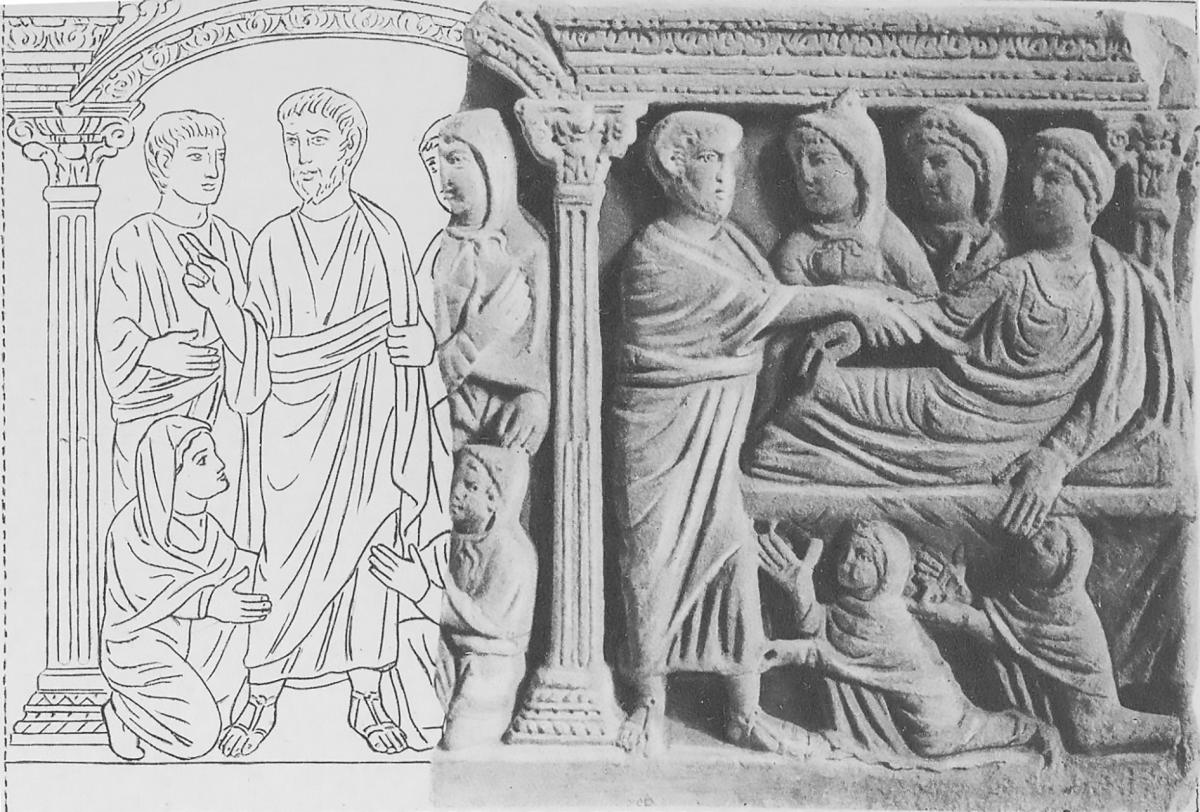
Raising of Tabitha, sarcophaus fragment, Musee de La’Arles Antique, 4th century AD. Giuseppe Wilpert. Rome: Pontificio Istituto di Archeologia Cristiana, 1929. Plate CXLV, no 6.
This sermon was preached on the Fourth Sunday in Easter (May 8, 2022) at Christ Lutheran Church in Fredericksburg, VA. Currently the worship video is not available due to a techincal issue.You can listen to the sermon on my companion podcast: S1,E15.
Grace and peace to you from God our Father and from the Lord Jesus Christ. Amen.
As the Book of Acts recounts the anecdotes of the early Church, we see Jesus’ teachings play out, become real, and even be expanded upon if not clarified within ordinary, everyday human lives. God works in history, yet these stories aren’t meant to be historical in the modern sense. In short, Acts is primarily a theological treatise hoping to spark and sustain faith.
Indeed, the author of Acts, St. Luke, writes that he set pen to paper to help provide the world with “an orderly account” of the promises that had been fulfilled among them as the early Church (see Luke 1:1). Starting in his gospel account of Jesus and extending into life amidst Christ’s earliest followers, Luke supplies us with a kind of “apologetic historiography” that helps establish and justify the origin and development of Christian peoples among the many faith traditions and cultures of his time.
Basically, as Professor Carl R. Holladay outlines in one of my favorite scholarly journals called Interpretation: A Journal of Bible and Theology[i], Luke seems to tell his story in such a way to help the hearers believe, but also he wishes to help us identify divine cause and effect. For example, Paul’s mission to eastern Asia Minor leads to the Jerusalem Conference (Acts 15) to discuss the future of Gentiles in what has primarily been a Jewish movement at that point. Then, the decisions made at that conference lead directly to Paul’s mission in the region of the Aegean Sea and eventually toward Rome. Indeed, in Luke’s understanding, just as the prophets’ life and testimony pointed to and connects with Jesus’ own glory, it is Jesus who animates and sends us out into the world. Our story is sewn into this larger, eternal story. Christ’s love at work in our lives leads to miracle upon miracle.
And in approaching history in this way, Luke understands that God’s ways are woven into all the tapestry of history, including individual lives and the smallest events. There’s both a personal intimacy and an overarching divine purpose being worked out among us…being fulfilled among us. We aren’t subjected to dumb luck or coldhearted fate; God has a loving plan for us…each and every one of us. And although bad things can happen to good people in a fallen world, or we can make bad choices hurting ourselves and others, it remains ok. God has the power and God wills to ultimately work things out for our welfare and to God’s glory. That’s partly why Luke doesn’t account for the Apostle Mark’s work establishing the Church in Egypt, or St. Thomas’ work in India, or other important Apostolic stories. It isn’t that these events weren’t significant or that miracles didn’t happen. No, Luke’s focus is on the grand design that wishes to spread faith from the center of the Jewish world, Jerusalem, into and throughout the gentile world as represented by Rome. Luke wants to clarify the Church’s role in the world in comparison to its two primary, contemporary accusers, Judaism and Roman religion and culture. So, his tale tends to follow Peter and Paul in their roller coaster ride toward Rome.
Certainly, Luke is not recounting some dull and dusty history. Luke is telling the story of Jesus Christ, Son of the Living God, who died and is risen from the dead…for you and for me. And Jesus’ power is still at work in, through, and around us. Luke sees a connection between what happened in “former times,” what is happening in his day, and right through our lives to “the last days” – the end of time. There’s a singular, loving purpose connecting all lives and moving us toward an ancient promise yet to be fulfilled – the resurrection of the dead and establishment of a new heaven and earth where we will live eternally with God in glory. As such, the Book of Acts incorporates the stories of many diverse individuals, and again, Luke assumes we play a part in this narrative too.
And so, we now come to the story of Tabitha – a life linked to the story of Jesus and our own. A fellow graduate student of mine, now a seminary professor, Dr. Raj Nadella, succinctly summarized the scene: “The story of Peter raising Tabitha from the dead parallels the story of Jairus’ daughter in Luke 8:40-56. While Jairus’ people advocated for his daughter in Luke 8, believers at Joppa advocate for Tabitha in this chapter. In both stories, the miracle occurs in a private setting. Just as Jesus sends everyone except Peter, James, and John out of the room prior to the miracle, Peter sends everyone out in this story. In both accounts, the deceased comes back to life after being ordered to get up. It is as if Peter, who was present when Jesus raised Jairus’ daughter from the dead, replicates a similar miracle at Joppa.”[ii] Do you hear the recurring, reverberating sound of God’s love at work as Luke tells it? God’s love echoes throughout time. As so many observe, Luke sees that history repeats itself. Yet, it is not exactly the same story, is it? Things have changed. Most importantly, Christ is risen! (Christ is risen indeed! Alleluia!) That Easter promise is still unfolding; the Kingdom of God birthing into our world through our lives. In this incident of resurrection, people with the help of the Spirit can understand that Christ’s authority has been truly shared with his followers. It is a hope-filled experience where Luke sees the victory of God and God’s people over the forces of death. Luke’s expectation and hope is that those who hear it for the first time or remember it in the future will come to an ever-deepening trust in Jesus as Lord.
Sadly, there are some who argue against the truth of such stories because they have never seen such things. Others in their enthusiasm or greed, sell videos on how you, too, can raise the dead. (It is true. As crazy as it might sound, I’ve seen them, and I know of someone who fell for this scam.) Yet even the Bible indicates raising from the dead is a rare thing. Surely, it wouldn’t be deemed such a big miracle if rising folks from death was a norm. It is important for us to recall that with the thousands of years covered, the Hebrew scriptures only preserves a handful of resurrection accounts enabled through the faith of prophets. Perhaps more surprisingly, Jesus himself is reported to have raised only three people from the dead during his earthly ministry (the widow’s son at Nain, Jairus’ daughter, and Lazarus). When someone is raised from the dead or miraculously healed…or not…one can always be sure that God has a very good and special reason for what God does or does not do. Somehow, God’s answer to our prayer – whether yes or no – will always be informed by God’s love for us and the world.
And so despite doubters, one can certainly find stories here and there of those risen from the dead or miraculously healed or helped if one looks. In my own life, there was a time when I served as a hospice chaplain to a person actively dying. (This means there were medical signs of impending death as judged by competent medical authorities). The family was Christian, but they had a hard time accepting his death and prayed for a miracle. As I prayed, they started to take over. They begged, pleaded and cajold hoping against hope that they could have even one more day with the one they loved. As I left that night, he was in a comatos-like state. When we were done praying, I said my goodbyes and went home. The next day, I received a call from a nurse. Somehow, someway, he was up and walking around, alert and talking, the next morning. The man’s doctor, nurse and hospice staff were rightly amazed. I was amazed. Science could not explain it. Yet the family that prayed so diligently, so passionately, with me that night saw this clearly as an affirmation of their own faith and hope. They gave thanks to God. All good things come from God, so who can say – however it happened – that they are wrong. I certainly will not! Strange things happen…miraculous and unusual things. Yet with all such miracle stories – whether Lazarus, Tabitha, or even the man I knew who was actively dying – the people involved eventually died. This incident wasn’t the End Times’ eternal, resurrected life with Jesus that we have in this passage. No, these miracles happen to call people into or affirm faith while we wait for that day. That’s what God uses miracles for. The love of God shows itself in a unique, concrete, if not intimate way for a particular and greater purpose. And so perhaps today’s account isn’t ultimately about Peter’s exemplary faith or Tabitha’s getting up from being dead after all? These details remain important, but I would like to suggest with others that Luke is pointing us toward something more. Again, this story is our story.
In Tabitha, we have a poor woman (a person at the margins of society likely due to her social and economic status and sex), and yet, our mighty God graciously, unexpectedly chooses to work miracles in her life. By that, I don’t mean God worked just through her resurrection (for that’s the low hanging fruit of the story). No, humble Tabitha, named Dorcas in Greek, was a seamstress who was known for her “good works and acts of mercy.” She echoed God’s love throughout her life. Her life and faith touched the lives of others and changed them for the better through relationships built on love. As Dr. Nadella also notes, “Her compassion and care allowed her to build a beloved community that became her family.”[iii] That’s the big and lasting miracle here – her legacy of love…ultimately Jesus’ legacy. Tabitha would experience death again, but in Christ, through her love shared and still being passed on through the Church, she lives on. And one day, Christ promises that we will all stand with him resurrected in his glory forever. Her story, our story, in no way ends with death.
For some, no matter what is said or how one tries to account for it, the story of Tabitha will remain an old wives’ tale. Yet, I believe with the early Church that the same divine love which raised her to life can be found at work in the lives of all those ordinary people who trust in Jesus – including yours and mine. That love was at work in Tabitha all along even before she or others perhaps recognized it, and it is still at work now. It is always at work even when we don’t see it or fully understand it. As a past seminary professor of mine attests, “God’s love creates, redeems and sustains without ceasing.”[iv] Through a faith, hope, and love lived out…echoing from and embodying Christ’s own life given for us…we become one with Christ’s story, power, and purpose…one with his love. We are transformed through that love into a resurrected people, walking in the world to change it, sharing in a legacy of love that will ripple throughout time without end. We can live generously like Tabitha, assured that death does not have the final word, because Jesus is the final word. And, it is he who has claimed us as his own forever. Amen.
[i] Holladay, C.R. (July 2012). “Interpreting Acts.” Interpretation: A Journal of Bible and Theology, 66(3), 245-258. Washington, DCs: Sage Publications
[ii] Nadella, R. (May 2022). Commentary on Acts 9:36-43 as downloaded from workingpreacher.org on May 5, 2022.
This sermon was preached on the Feast of the Resurrection of our Lord (April 17, 2022) at Christ Lutheran Church. Currently the recording and video is not available due to a techincal issue.
Grace and peace to you from God our Father and from the Lord Jesus Christ. Amen.
On a perfect Easter morning, as the sun rises and sanctuaries overflow with the scent of spring flowers…as we hear the giggles and screams of children searching for all those elusive Easter eggs…it is easy to be caught up in all the excitement. The music, the greetings, songs and prayers, even the food shared…all of this creates a tone of celebration if not victory. Rightly so, for Christ is risen! (Christ is risen indeed! Alleluia!).
And yet at the same time, how far away from that first Easter morning we can thus find ourselves. No, nothing was certain or celebratory on that first Easter morning. People only understood that Jesus had died. Those who loved him had hurriedly placed him in the tomb before the start of the sabbath, and now on the first day of the Jewish work week, women who loved him, disciples, came to finish their job preparing Jesus’ body for eternal rest. Amidst the pain and worry of the last week, Jesus’ promises of resurrection had been pushed aside…if not forgotten. The immediacy of the threats around them captured their attention. The grief related to his tortuous death consumed them. There was no celebration as they came to the tomb. They expected the worse. They expected death. Indeed, most of Christ’s disciples had abandoned him at his arrest and remained in hiding.
Yet when times get hard, why do we look for the living among the dead? We are much like those first disciples – those in hiding and those women trying to muddle through by doing just what they need to do to get through their day. We can forget about Christ’s resurrection promises. We can focus on our need, our grief, or our obligations and worry instead. We get lost in the present when Jesus and his Spirit all along keep trying to point us toward a future filled with hope. Yes, how humbling…those disciples are much like us. We can struggle to believe. We can wrestle with our faith. We can doubt.
And at such low points in our lives, the empty tomb lies before us. Its legacy reaching through the ages to confront our unbelief, our doubts and darkness. Again, why are we looking for the living among the dead? Why don’t we live as if Jesus lives? As we spoke about a few weeks ago, the stench of death is always floating around us, taunting us…telling us to be afraid. And yet so much more is going on. Jesus rose to defeat sin and death and guarantees us (guarantees us!) that even as we might struggle for our daily bread…or hope…an abundant, fruitful life can be ours starting now – from the very moment we believe. Amidst death, we can choose life…we can choose to trust in Jesus…because Jesus lives.
Much like those women, if we come to belief in Christ’s resurrection, we will likely struggle with our words. It might seem an idle, foolish tale to even our friends and family. It might be hard for us to believe never mind express. Christ is risen! (He is risen indeed!) Yet what does that mean for us…to us? How does his victory over sin and death resonate if not resound in and through our lives? Christ’s resurrection should matter with our every breath and transform each of our steps into sacred ones. Yes, “As it is written, ‘How beautiful are the feet of those who bring good news!’” (Romans 10:15).
With the resurrection of Jesus, everything has changed. All is new. Truly, St. Paul called it the start of a new and final age of history…a time for expectation to replace fear. We understand from scripture that the Kingdom of God is no longer just near, it has broken into our world and is still rushing in until it reaches its fullness. Imagine, heaven in the real world! It seems preposterous…impossible… and yet that is what the resurrection proclaims to us. In the risen body of Jesus transformed from death to life, we are asked to find an affirmation of all that Jesus taught and promised. Facing the empty tomb with these women disciples and Peter, we are asked to remember Jesus’ words and choose to believe.
Prior to Jesus’ death, he asked his disciples, “Who do you say that I am?” That question has only now grown in importance. We know what others might say, but who do you (Robert, Judy, John, Anne and Lou, whoever you may be)… Jesus is asking, “Who do you say that I am?” We cannot explain the mystery of the resurrection, so why do you…why do we…believe? That’s a sobering question because we can never know enough about Jesus. As imperfect humans, we can never understand enough or become worthy enough. At some point, we must surrender our need for knowledge and explanation; throwing our lives into the arms of our Risen Lord who is waiting to welcome us. In our weakness and want, we can only trust.
Having come to belief, the women did not know and understand all. As they went to tell others, they struggled with their words. The other disciples wrestled to trust in their story. Peter himself ran to the tomb to see for himself…only to find it empty…and with all that he had heard and seen, he walked away – not confirmed in his faith – but amazed…amazed! He was scratching his head…rubbing his eyes…trying to make sense of it all…wondering if his hope could really prove true. These great saints, the first of Christ’s chosen ones, struggled with faith. And so perhaps we can go easy on ourselves if we struggle at times too. Yet although gentleness might be called for, we are asked to share in not just their amazement and wonder but also their courage and hope. We are invited to believe without seeing and have our lives transformed.
As I’ve said elsewhere, the resurrected life that we are invited to share in is one of living relationship and experience. Faith must be lived. According to Jesus, ours is to be a resurrected life of service, fellowship, and corporate worship. It is one where we seek to follow Jesus each day as best as we can and introduce him to others even as we stumble in our telling. It is one where we might yet be called to share in the sting of Christ’s sacrifice and cross out of love for God and others. In hoping, believing, seeking…in daring to live for Jesus without all our questions being answered…Jesus will make himself known to us on our way. Jesus will prove true to his promise because Jesus does not lie.[i]
Yes, for our part, we are asked only to dare to hope…dare to hope…that this two thousand plus year story is true. It has come to us from person to person – against all odds – from people who had their lives changed for the better through belief while often under severe persecution. It has been affirmed through reported miracles. And indeed, some of these miracles were great, but most often miracles are ordinary things…small things…understood in an extraordinary, grace-filled way. I’ve also seen the resurrection testified to through the lives of others…great saints and ordinary ones…like my friends’ parents who loved me as a troubled youth and testified to Jesus in the way they did so…or as with the Ethiopian pastor who I met who rather than recant his faith suffered imprisonment and torture…or my friend from Bosnia who escaped genocide (crossing snow covered mountains on foot) under the threat of death because he knew he could not…would not…give up his resurrection hope in Jesus. For centuries before us, people have been willing to testify to the resurrection with their lives…risking their lives…stretching their lives to welcome others in Christ’s name…They did so because they dared believe in Christ’s resurrection. Such people and stories encourage me to risk believing and loving daily. As I recall such people and their stories, they help me walk on in faith.
Yes, the conundrum of the resurrection will never be solved by science. It cannot be proven beyond the shadow of a doubt with any human words. Yet, its truth can only be found through faith…in daring to live as if it is true…and the Risen Christ, because he loves us, will reveal himself to us…not just in times of victory but also amidst our times of doubt and darkness too. Christ is risen! (Christ is risen indeed! Alleluia!) Jesus is no longer amidst the dead. He is heaven in our very real world, inviting us to follow him…to walk with him…and to come see his glory for ourselves. As a friend wrote, “It is he, the Risen Lord, who brings us together. Although he remains invisible to our eyes, he can be mysteriously present for every human being, for each one of us.”[ii] We gather, and serve, and hope because Christ is Risen! (Christ is risen indeed! Alleluia!) Amen.
[i] “Jesus does not lie” was a favorite saying of Martin Luther.
“Can a woman forget her nursing child,or show no compassion for the child of her womb?Even these may forget,yet I will not forget you” (Is 49:15). Image: Mother and child, from Clipartkey. Used by permission.
The following sermon was offered at Christ Lutheran Church on February 13, 2022, the 6th Sunday after Epiphany. Due to the positive feedback and discussion, that followed, I am posting the text here. I have also embeded the worship service below.Primary text: Luke 6:17-26, the Beatitudes.
Grace and peace to you from God our Father and from the Lord Jesus Christ. Amen.
Well, settle in. This is a critically important discussion today, and it is one I know will be difficult for me, and likely for some of you – hopefully touching our hearts deeply. So, I will try to do my best. With St. Valentine’s Day upon us, it is a happy coincidence that our assigned lectionary readings lead us to reexamine the Beatitudes. The early Church consider them formative values that should shape our life together in the world. Yet I clearly recall as a youth forced to memorize them for confirmation, I really didn’t get them. I looked at them as maxims or even law like – a pronouncement from some distant God up high and far away. Perhaps that’s partly because the Beatitudes aren’t really meant to be memorized. They are meant to be integrated into one’s heart and soul, and that might take a mature faith born of suffering.
At their simplest, you can understand the Beatitudes as sayings of Jesus. Some of you might know or recall that our Jewish siblings often call what we know as the Ten Commandments the “Sayings of God.” Yes, they are at some level laws on how the community of faith should get along with one another and the world, but recall what Jesus and prophets said before him. The fullness of the law is love – in particular loving God and others as oneself.
And so, if you read Martin Luther’s Large Catechism or Rabbinical interpretations, they don’t always sound like stark law or mandates. They are a way of love…a means of walking through life with more joy and peace…literally walking humbly in the way of and with our God. The sayings – not numbered in the Bible but by people after the fact – are sometimes numbered differently, yet they are not legal codes. They are unique because through them God speaks love to those he has chosen, so that that they might…just might…become a blessing of love at work in the world. You can find moral and ethical dimensions to be sure, but they are all wrapped up in love.
With such a gift, it can be such a shame that we lack the understanding, the spiritual maturity, that they are meant to be so much more than Law. There’s Gospel infused into them too, because God spoke them and gave them to Moses for the people of God as a gift. God wanted the Israelites…and now through faith us…to become the Holy People of God…עם האלהים, a phrase in the Hebrew scriptures mentioned exhaustively and one I thus lift up to you often. We are a people set apart, made holy by God, called to live in holy ways, but not for our own sake. We are charged with a loving purpose in a fallen world.
Well, as scripture reveals to us, and our own more recent history makes plain, we cannot do this on our own. Scripture is a help. Thou “shalts and shalt nots” might inform, guide and challenge us to do better, but perhaps you have noticed that we live in a challenging world. Everything isn’t cherubs and boxes of chocolate. (My apologies to Forest Gump!) Love can be hard, and even when we try our best, we can fall, fail or suffer.
And so, out of love for us, Jesus offers us new sayings, blessings. (That’s really what beatitude means anyway – blessing.) These blessing will serve to draw us closer, more intimately toward God and one another. Yet unlike Moses’ experience, they are not sayings given directly to a prophet and by extension to the People of God. No, Jesus is God incarnate, and so these sayings are beyond special. They are not mediated but given directly to us. In a fallen world, these blessings recognize our suffering, but they tell us…promise us…God’s love is with us! Always with us! More than that, these sayings remind us that nothing can separate us from such a love.
In Luke’s telling, his witness, of the Gospel, there are some significant differences from the account in Matthew 5. (I’m not going to address those in detail today. I’ve tried to explain why such differences exist in detail on Facebook, my blog, Bible studies, and elsewhere recently.) Yet, consider who Luke was. He was a human just like you and me. He was of likely Greek descent, many think a Gentile, but some suggest perhaps that he was a Hellenized Jew. And in his life and time, he had the good fortune to become a doctor, meet Paul in his travels, and become a coworker with him. Luke inherited these stories, and so in the Gospel according to Luke, we hear his witness of Jesus. Much as if you or I were telling a story, the truth is transmitted through his lens (his context and experience), and he likely wanted it to relate to and be understood by his audience – those many Gentiles and Hellenized Jews we know surrounded him. (They are who he first wrote to.) In short, Jesus is a God of suffering. No, not causing suffering, but Jesus is willing to suffer for us and with us, and ultimately the answer to all suffering in the world.
Through Luke’s vocation (as doctor and servant of Christ with Paul), Luke knew the extreme suffering of his century. Luke would have been all too familiar with sickness, injustice, poverty, violence and death and the grief that always results. Thus, Luke recognizes the special nature of Jesus as God who has profoundly come to us as one of us. Jesus came to share in that suffering and reach out to the outsider (like gentiles and widows, immigrants, the lonely, the sick in body and spirit). Jesus was and remains God with us in our imperfection and suffering. At the same time, Jesus came as the answer to the Fall. Jesus came to heal and restore. This is exactly what Luke remembers and shares with us as Jesus prepares to share his most central of teachings. Luke points out to us in the opening verses, “Jesus heals! Jesus saves! Jesus loves those entrusted to his care amidst the evil and loss of our very real world!”
At this point in the story, people didn’t fully understand Jesus yet. (I’m not sure we really do today. I know I don’t!) Still, in hearing of his teaching and preaching, as well as the authentic love that he gifted to others, crowds came from all around the region often walking miles and miles and miles. Luke tells us that the people were desperate, so desperate for hope and healing, that they wrestled with one another reaching out to Jesus just in the hope of touching him, for “power came out from him and healed all of them.”
It is here that Jesus chose to share Good News with the crowd – and with those who might come afterward – to all those yearning to just touch the hem of his garment…to experience a little bit of hope if nothing else. Jesus knows not all of those in need could touch him in that sea of humanity any more than we might with him now ascended to heaven. Yet, Jesus wants us to listen and believe.
So, listen to what Jesus says. Reread it when you get home, and then over and over again. Treasure and ponder these words. In the beatitudes, Jesus is telling us that he already loves us amidst our suffering, and he invites us to love others as best as we are able. Whatever our sufferings are – big or small; transitory or seemingly permanent – he is God with us and already loves us. We can rejoice when our crops fail as the prophet Habakkuk announces. We can cast all our cares upon him for he cares for us, as Peter urges. We can recognize with Mary in her song, the Magnificat (also in Luke’s Gospel), that our soul magnifies the Lord, and we can rejoice in God our savior, as lowly as we might be. John says in Revelation, there will be a day when all our tears and suffering will be washed away, a future filled with hope Jeremiah called it, but John, too, acknowledges we aren’t quite there yet. All creation groans for redemption, as Paul tells us, so why are we surprised at suffering. Indeed, Jesus suffered for us. Yet suffering is not all that there is, for God is not only with us, God in Jesus is for us. We belong now to Jesus, and not one of his sheep will be lost.
What I am getting at is that all of scripture is filled with similar promises. The Beatitudes bring these promises into focus telling us that we should not trust our eyes or other senses. God is already blessing us with fortitude, hope, understanding and counsel and so much more. When we don’t have the words, we are promised the Holy Spirit lifts up our deepest needs and wounds to God. Life is hard…we might even at times rightly use more forceful, descriptive words than that…but don’t think for a moment that God’s love has abandoned us…abandoned you! Hope truly can be born of suffering.
At times, we might kid ourselves to think that we can just keep our chins up and make it through. We might internalize and deny our pain or the pain of the world. Yet we lie to ourselves when we share the old maxim, “God won’t give us anything more than we can handle,” for in the verse that inspires such hubris (1 Corinthians 10:13), we are instead told that our suffering is just part of our world…common at some level to one and all of us…but Paul actually writes, “God is faithful, and he will not let you be tested beyond your strength, [but if you are] with the testing he will also provide the way out so that you may be able to endure it.” Did you catch that? When we feel overwhelmed and cannot go on, when all hope seems lost, and we might feel like the biggest losers of victims in the world, dead inside, God will be there to bless us! Jesus plans our resurrection! It is God who will give us the way out and a way forward…always. It is God who will turn our suffering on its head and declare ultimate blessing. Even in suffering, more is going on than we can see or understand. God’s love for us overflows. Just hang on to the promise like a life preserver.
Now, I know I have gone on longer than normal, and I am the only thing standing between you and your Super Bowl fair, but please bear with me. After all, this is among the most important passages of promise offered us in scripture. As Christians we need to consider where we can testify to the Good News, and that can often come from our own stories and experience. So, I want to share one difficult but profound experience of grace from my life.
If you have experienced the death of a child, or experienced such deep loss in any way, you might relate to the seemingly inconsolable pain that such an experience can create. My wife and I have no children, which is a kind of loss for us emotionally, but I have experienced the death of beloved children at very young ages that I have had deep relationships with – a cousin at 16, and children and youth that I cared for in mission and other vocations. I have also seen children and infants brutalized and sometimes die. And as a police, hospital, and hospice chaplain, I have walked alongside officers, and nurses and families that have shared in such tragedies and walk wounded afterward as a result…often brought to tears just at the memory. How can we speak love at such times? Well, we can try to because God is there…perhaps hidden…hard to see…but our God who is love is there. So, we are asked to press on, reach out, and watch and wait for Jesus.
As a young chaplain, I was called to the hospital from home. A newborn infant had just died, and the family was gathered. The family had already been presented a memory box with a hand and footprint, a lock of hair and other small mementos of an all too short life. I came into the room not knowing exactly what to expect. I didn’t know what I could say, as I’m pretty sure no human words are ever good enough. As I turned the corner, almost startling me from my thoughts…there was the mom, held by the dad, right in front of me. The mom in her turn was lovingly, ever so gently, cradling her baby’s body in her arms. (It is an image I will never forget.) They had been praying…praying so very hard…and yet their beloved child had been taken from them. It was brutal. It was unfair. It remains beyond understanding. “That God would take a child from its mother as she prayed” was appalling.[i] I think a little bit of me died in that room in that moment.
Then awkwardly, hopefully, the mom reached out to me. She asked me to hold the baby in my own arms and bless the gift that it was and remained to them. And in that sacred moment, and still today, I know that as hard as it was to see through their tears and now my own, God was with us. God was in that shared love found in family and community. God was in the mom’s eyes looking at me with love and hope. God was in the caregivers and volunteers who supported them and those like them. I discovered that God was even trying to break into the world through me and my own heart which was now being torn apart. It wasn’t being torn for the sake of suffering. No, in that suffering, my heart was being opened so that that I could better welcome and embrace those in need before me.
This was a difficult, horrific event, perhaps one of the worst of my life and certainly their own. Why did this happen? I had and have no answer. Yet with that small body cradled in my arms, I recognized (perhaps it was God speaking) that God was cradling us in our suffering. It wasn’t about me and my abilities as a chaplain or human at all. God was at work, and Jesus opened my eyes to it. And so, I found I was empowered to bear this moment and perhaps somehow serve as a sign of grace to try to bear them up too…perhaps simply by my presence then…and perhaps now in my testifying of this sacred moment to you…As I walk on from it, even as it wounded me, healing was and is still entering the world.
As a Christian singer who experienced the loss of her own baby wrote in a song I deeply love and appreciate: “This is what it means to be held; How it feels when the sacred is torn from your life; And you survive. This is what it is to be loved; And to know that the promise was; [that] When everything fell, we’d be held.”[ii] I wish I could speak a word, and all your pain and the pain of the world would be gone. And, I don’t pretend to know why God has allowed things to be this way with so much suffering and pain. Yet I do know this…“Blessed are you who are poor, for yours is the kingdom of God. Blessed are you who are hungry now, for you will be filled. Blessed are you who weep now, for you will laugh.”
My beloved, God is with you and loves you. It is Jesus, after all, who said this, and proved it through his own suffering, death, and resurrection, so that we might experience life with him. These blessings are not about you, your strength of faith, or your perfection. They aren’t really about suffering either, even as they call us to be something (someone) more in the face of the suffering that is in the world. These blessings are about a new reality whether you believe it or not…God is active in our lives and our world – a God who is only love.
Go to Jesus as you can, not as you hope that you might. Reach out to him even when he seems too far away (if not hidden) from you, or when you think your suffering might be more or less than the crowd around you. For you and your struggles matter to Jesus, and he is already reaching out to you. Jesus is with you, always with you, and it is he who cradles you lovingly in his arms. Receive the blessing and believe. Amen.
Listen to this sermon on anchor.fm or Spotify LISTEN HERE
Image by tinytribes on pixaby.com. Used by permission.
And this is my prayer, that your love may overflow more and more with knowledge and full insight to help you to determine what is best, so that in the day of Christ you may be pure and blameless, having produced the harvest of righteousness that comes through Jesus Christ for the glory and praise of God. (Philippians 1:9-11)
For many, the summer can prove busier than the school year. Even in our “play,” we can tend to be people who plan and program our time, thus stretching ourselves thin rather than building ourselves up. As August arrives and we return to our fall schedules, it is tempting to let go of self-care and personal growth in order to accomplish more before summer comes to an end. Yet what if less is truly more? What if in prioritizing a healthy love of self we could be empowered to love others better? We have to pick and choose what we need to really do most, but when we often put our needs last, that can just lead to burnout.
I remember when I was young, I pulled long hours at work and volunteered for more hours to help supplement my pay. That seemed reasonable at the time, but important relationships, exercise, meals and my spiritual life suffered. I found myself always busy and yet in many ways isolated. I approached my life with cynicism rather than joy. As one would expect, I hit a kind of bottom that convinced me I needed to repent.
In reorienting my life through daily spiritual practices, worship in community, and other self-care habits, I admit that it at first seemed like a bother. Yet soon, I noticed benefits. My attitude improved. I slept better and had less anxiety. I found deeper friendships and thus a more meaningful life. In making time for communal Bible study and continuing education for self-improvement, my zest for life increased. Even at work, my supervisor noted that I was working more efficiently in less time, and he experienced me as a more pleasant and peaceful person.
As the fall arrives, you will be invited to many events including church related activities. I’m not suggesting that you need to be at our congregation every time the doors are open, yet I would challenge you to discern what is best for you and your family. Self-care including that of your spiritual life needs to be an intentional priority, or you will be missing out on the abundant life Jesus promises. I encourage you to change things up and try something new as offered by Christ Lutheran, the Virginia Synod, or other faith groups in our area. Find a retreat, take a new class, or sign-up for a spiritual director from the ecumenical community at Richmond Hill or another community of your choice. Volunteer for a cause you feel passionate about. Better yet, invite a friend to join you. If you don’t know where to start, Pastor Anne or I will be happy to help you choose.
We are commanded by God to love our neighbor as ourselves, not better than ourselves. As human beings, our bodies are geared toward survival and achievement. Our God wishes us much, much more. Cultivating self-care can help us on our way.
Originally published in the August 2021 newsletter of Christ Lutheran Church, Fredericksburg, VA.
Unless otherwise indicated, all scripture quotations for this post are from the New Revised Standard Version (NRSV) translation.
Click this image to read the article alluded to below in my blog, “Why Do Confederate Lies Live On” in The Atlantic.
“When I was a child, I spoke like a child, I thought like a child, I reasoned like a child; when I became an adult, I put an end to childish ways” (1 Corinthians 13:11).
Recently, I came across an excellent article in The Atlantic called “Why Do Confederate Lies Live On.” It was written by Clint Smith, an African American staff writer with the magazine. Focused on his experience with the chapel at Blandford Cemetery, it gave me reason to pause and reflect about my own life.
VMI Cadet Hartsfield of the Battle of New Market is buried somewhere in the Blanford Cemetery in a grave lost to history. In 2014, Petersburg’s VMI alumni group asked me to offer an invocation and benediction for their recognition of the 150th anniversary of the Battle of New Market on May 15th. I was serving as a pastor in Richmond at the time. I naively expected a small, outside event from what I was told. It ended up being a larger event in this cemetery chapel. (I had never heard of this chapel before my visit.)
I was told a World War 2 veteran who survived landing just a day or so after D-Day and fought through the war would speak about his experiences. He did, and that was positive. I did not expect a local SCV color guard with the Stars and Bars battle flag or the explicitly Confederate windows. It was sort of creepy and fascinating at the same time.
My previously prepared prayer alluded to the errors and evils of the Civil War. Yet now, I wish that I had explicitly and strongly refuted slavery and racism as part of it. I mentioned how the cadets’ actions under fire likely helped lead to the preservation and restoration of VMI after the war and perhaps indirectly helped shape or inspire folks like George C. Marshall and Civil Rights Martyr, Jonathan Daniels, and others to bravery or to do their duty. (At some level, I think that remains true for me.) I realize that God can make good come from anything, even our sin. I prayed VMI and our nation would become ever better, more just, and reconciled.
On one hand, I was honored to be asked by fellow alumni, especially for this momentous 150th anniversary year of the Civil War. My fellow alumni were hospitable, and like many alumni including myself, love VMI. On the other hand, I wish I went further and spoke more clearly about the sins of racism, slavery and treason. I value history, but we need to tell the whole story – even the ugliest parts.
Even though I’m from the north, even though some of my ancestors fought for the United States during the rebellion, even though my First Class dykes (senior mentors are called dykes after the cross-belts or dykes worn as part of the uniform) used to have me answer, “The United States of America, Sir,” to the question at VMI about who won the Civil War, the Lost Cause Myth can insidiously take hold of a person if we aren’t wary. It can obscure our vision and understanding, as well as stir division or wound others unintentionally. The myth dresses up and softens what’s ugly. After all, that myth and racism in all forms are just more signs of sin at work in our lives and world. And, sin often traps us subtly over time.
I’m not the person I was in 2014. My attitudes have hopefully continued to evolve, and I pray I continue to grow in understanding and empathy. Wherever needed, I desire the wisdom to repent of my sin including any sin related to racism. I want the courage to challenge racism wherever it is encountered. I’m not looking to erase history. I understand all of us, even the best of us, can only be simultaneously sinner and saint and never perfect. It can be helpful to remember the past. Yet as Christians, we understand we are always reforming. We need to separate ourselves from rigid, dualistic (that everything is all good or all bad), or simplistic thinking and bravely embrace the truth of our past and our present whatever we might see. We can love and respect our enemies, even those of the past, even as we seek to see them and their failures as they truly are.
In springtime, I often come to think of Thérèse de Lisieux as I take my walks. Thérèse was known for seeing God in the little things, even spring flowers or butterflies. She would regularly stop to reflect upon their intricate beauty. In her own way, it was a source of what we might call meditation or mindfulness. By focusing on her experiences of the moment, she discovered a deeper sense of peace and beauty around her and ultimately at work in her. She recognized even as she battled chronic, often debilitating illness, that she had reason to hope. Even in her illness, she could serve and be faithful to God. Simplicity was her watchword, often called by her “the little way.” And she herself eventually became commonly known as “the Little Flower.” For as much as many would overlook God’s work in creation, contemporaries often overlooked the spiritual beauty found in her lifestyle and vision. Yet today, she is remembered in Roman Catholic and Protestant seminaries and congregations across the world.
Martin Luther once quipped, “Our Lord has written the promise of resurrection, not in books alone, but in every leaf in springtime.” This is most certainly true! Yet, in this busy world, do we often stop to reflect on the gracious beauty at work in each of us and the world? Through our faith and baptism, God is still sharing the promises of the Gospel, and although not everyone will notice or believe it, all our lives make a difference. Indeed, Jesus died and rose from the dead for every one of us. As we are and for what we will become through grace, he sees value and beauty in each of us.
Much as Paul argued that each of us play a varied part in the body of Christ, Thérèse saw us as flowers in the garden. “I understood that every flower created by Him is beautiful, that the brilliance of the rose and the whiteness of the lily do not lessen the perfume of the violet or the sweet simplicity of the daisy. I understood that if all the lowly flowers wished to be roses, nature would no longer be enameled with lovely hues. And so, it is in the world of souls, Our Lord’s living garden.”
Scripture reveals to us that God is our Master Gardner. God has planted us in the region of Fredericksburg to do some particular good, to add unique beauty, and to be individual and communal signs of life and hope. We bloom through worship, fellowship, and service. We are rooted in his love. Yet as summer travels begin again, local gatherings increase, and some might have to continue to stay away due to medical issues or other concerns, know that you are not forgotten. Indeed, you are missed. Come back to us when ready with new stories and love to share. For you make a difference to us, and together, we are most beautiful. I wish you a happy and meaningful summer ahead.
Image: Picture by the author.
Originally published in the June 2021 newsletter of Christ Lutheran Church, Fredericksburg, VA.
Read an article about what Valentine might have looked like here.
Much like Charlie Brown waiting to be noticed by the little red-haired girl, it seems we have come to overlook and ignore the very source of “Valentine’s Day.” Yes, the living, breathing follower of Christ who died as a martyr seems to have been forgotten. Even his title of “Saint” has most often disappeared from February 14th. Somehow, his historic contribution to our shared faith has been transfigured into candy sales, cards, and romantic movies. Good grief!
Valentine of Rome, known as Valentinus in Latin, was a well-known saint at one time with a popular devotion dating back to the late 3rd Century. There exist several Valentines on liturgical calendars, but much of the details of his life are lost to us. As questions exist about the veracity and scope of what we know, Roman Catholics took him off their liturgical calendar in 1969 as part of their process of liturgical renewal and modernization. Some other denominations – including the ELCA – followed suit. (He is still considered a saint, but he does not have a dedicated feast day celebrated at worship; excepting any local commemorations.)
Despite some doubts, a consensus about THE Valentine’s life exists. Some argue the famed Valentine was a Roman priest and physician or healer of some kind. He died during a general persecution of Christianity led by Emperor Claudius II Gothicus in about 269 AD. His day of martyrdom, February 14th, became his feast day. (The Church tends to recognize the day of death as a day of new birth in Christ, so the day of death most often becomes the feast day.) Other candidates include a bishop killed during a similar persecution under Emperor Aurelian in 273 and a person only known by this name martyred with other Christians in Africa during an unspecified date that same century. Both later Valentines allegedly also died on February 14th, and some argue the bishop may even be the priest (just two versions of the same life). Valentine was a common name back in those imperial days, and there are about one dozen other saints with that name, as well as a Pope (reigning for two months in 827 AD). So with limited documentation, one can understand the confusion.
Mythic stories have been shared about the primary Valentine’s marrying people in secret, sharing a card with his jailer’s daughter signed “your Valentine,” healing a judges blind daughter (inspiring the judge to convert to Christianity), and other such things, but they do not seem strongly supported by evidence. Valentine’s life and death probably had little to do with romance, but more likely a love for God and neighbor; a love that always heals and brings new life. Valentine appears to have been beheaded for his faith, and his flower crowned skull is now venerated in a Roman Catholic cathedral. That is not a very romantic ending, but it did inspire many others toward faith in Jesus.
So, how might we best put the saint back into the day? Perhaps, we could strive to serve our neighbors somehow? How could we help heal others – in mind, body, or spirit? Families might seek to take the focus from romantic love and refocus on the mutual love that builds others up. It has become the practice of some to draw names and seek to do something nice for the person chosen. We might take some time to tell one another how we see God at work in them. We could do something nice for those in the healing profession or serving as first responders. We could even pray for the Church, especially the persecuted Church. No, I am not suggesting we need to avoid fancy dinners and chocolates entirely, but maybe there could be more to the day than some would have us believe.
Originally published in The Hub, a weekly email of Christ Lutheran Church, Fredericksburg, VA.
Husband, Pastor, Law Enforcement Chaplain, and member of the Clerical Errors (aka "The Three Priests"), I'm sharing my two cents with anyone who cares...
You can also find me on social media as Loudluthrn (Lou-d-Luthrn or Lou the Lutheran). It is a moniker given me while attending a Presbyterian Seminary, but I'm a loud and proud Lutheran too (just not too loud and proud, mind you).






 2pennyblog