Tag Archives: church history

Put the Chi back in Christmas

For all the hubbub about using “Xmas” instead of “Christmas” as shorthand (and in some cases where people intentionally desire to erase any reference of Christ from Christmas by using Xmas), the ironic, historic truth remains that ancient Christians utilized the Greek letter Chi and letter symbol Chi-Rho as a means to represent Jesus Christ. Such symbols are called christograms.

You see, the name Jesus Christ in Greek, the language of the New Testament texts, is Ἰησοῦς Χριστός. The first letter of the title Christ (signifying Jesus as the anointed one, the Messiah) looks like our English X and became a convenient, somewhat obscure way for early Christians in the catacombs and elsewhere to identify artistic representations of Jesus and Christian markings, signs, or art – similar to use of the Christian fish symbol.

Later, the Emperor Constantine I had a dream that he should put the “heavenly divine” symbol of Chi-Rho on his army’s shield before the Battle of the Milvian Bridge to guarantee victory. He did just that, won the battle, and turned the formerly pagan empire into a Christian one. The Chi-Rho symbol became and remains one of the most common christograms used in sacred and liturgical settings. In fact, it is often used as part of the modern Christmas tradition of the Chrismon Tree. Invented by a Lutheran in Danville,  Virginia in 1957, this practice is now popular in many congregations throughout the United States and across denominational lines.

As I find the debate over the use of Xmas somewhat distracting if not tedious and dislike the rush toward Christmas only to hide it away from the public eye as soon as December 25th passes, I try to experience Advent as a true time of expectant waiting and preparation. I also make an effort to enjoy the traditional Christmas period lasting twelve days through Epiphany on January 6th. So last year as Christmas approached, I posted an image I had found by Orthodox iconographer Raymond J. Mastroberte on Facebook saying, “Keep Chi in Christmas…Because early Christians used Greek abbreviations!” The illustrator’s image struck my sometimes questionable funny bone, and I playfully proclaimed that I would be putting the Chi in Christmas all twelve days.

Image and copyright by Orthodox iconographer Raymond J. Mastroberte. Image used here for teaching and not for profit under the terms of fair use.

Image and copyright by Orthodox iconographer Raymond J. Mastroberte. Image used here for teaching and not for profit under the terms of fair use.

In the context of our modern conundrum over Xmas, it wasn’t long until someone missed my attempt at humor. They argued that surely since Jesus Christ had done so much, suffered and died for our sake, we could most certainly take the time to spell out his name in full. It was as if the ancient Christian signs and symbols were suddenly disrespecting our Lord. And so, my attempt at lighthearted banter fell as another victim of this modern culture war.

As the past few years attest, an annual argument has indeed arisen about the secularization and explicit anti-Christian elements of our Christmas celebration. It should be expected, for in school gatherings and shopping malls, on public plazas and in our homes, religious symbols for Christ and his birth have come to be often replaced by winter scenes, Santa and his reindeer, snowmen, cute penguins or polar bears…the list goes on and on. In fact, some suggest that many Americans can’t specify what the Christmas holiday commemorates.

In opposition to Christmas, one atheist author argues that there is historically no proof that “Christ is the reason for the season.”[i] They suggest that winter celebrations have always existed, and such a modern mantra is only a Christian attempt to assert their cultural superiority over everyone else. Sadly in the name of multiculturalism, echoing choruses of Merry Christmas can be explicitly prohibited in some environs. Yes, just as there was no room at the inn on the original Christmas Eve, there seems to be no room in our public lives for Jesus today.

Yet, let’s not be too quick about things, as there are other signs to look for. Gallop found, “Ninety-five percent of Americans celebrate Christmas, and of these, 51% describe the holiday as ‘strongly religious’ for them, continuing an upward trend seen since 1989.” This 2010 poll also found a majority of Americans self-reported “incorporating specific religious activities or symbols into their holiday celebrations. This includes 62% who attend religious services on Christmas Eve or Christmas Day, 65% who display decorations with a religious meaning, and 78% who take time to reflect on the birth of Christ.”[ii] Self-reporting surveys can prove inflated, but we can see signs of hope for our beloved holiday.

Nevertheless, further confusing this debate, this same Gallop study found many more Americans were likely to practice secular traditions (in the ninetieth percentile range, depending upon the activity) than religious. Sadly, a recent poll by Think Finance claimed that 45% would rather skip Christmas due to the debt accumulated from gift giving.[iii] Others seasonally face bouts of depression or other mental illnesses magnified by their isolation or sense of loss during the holiday season, and thus they dread Christmas’ arrival.[iv]

Amidst debates and arguments, blinded by bobbles, decorations, and good deals, we can forget that our redemption is drawing near. Our time on earth is short, and we should live with hopeful and loving expectation as if Christ will indeed come soon. Signs of trouble and even outright persecution are nothing new. Jesus promised us such as these in his prophesies, comparing them to birth pangs.[v]

Should we then be so surprised that people are confused, lost, and hurting when it comes to Christmas and more importantly Jesus Christ? Should we let this distract us from our call as a holy people living together in Jesus’ holy name? Intentionally seeking the newborn Christ in our own hearts, we can repent of our own errors and grow in faith. Living as part of his body through our shared ministry of preaching, teaching and baptizing, or accepting and loving others (even our enemies) as they are, we can be used by God to bear Jesus into the world.

The devil’s in the details, and so it appears with our modern Christmas. Let’s not get anxious about the holiday – lost in empty debates or the holiday wrapping of materialism. As Christians, we are called to celebrate!

Look to the true heart of Christmas toward Jesus Christ himself, the final Word on this argument, come to save us. Whatever we choose to do and however we choose to say it, let’s seek to make Christ known every day. Look past the veneer of our time and see those suffering and alone around us. Enter relationship with them, help them, or guide them toward people who can. Celebrate the truth of Christ’s coming within every aspect of our lives – for the love of Χριστός, ourselves, and our neighbors.

There are more than enough signs of trouble and discord. Let’s not waste time dwelling upon them or pointing them out. Instead, let’s seek to be living, joyful signs that Jesus is near. That’s probably the best way for any of us to wish the world a meaningful Merry Christmas and eternity.

My wife, Kristine, and I wish you a holiday filled with blessings. May those same blessings flow through you to help transform the lives of others.

Pastor Lou

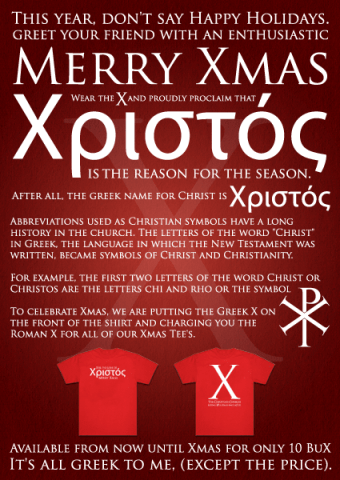
For those interested, visit OldLuteran.com for their comical take on this debate. Access their site through the image below:

[i] Cline, C. Putting Christ Back in Christmas: Is Jesus the Reason for the Season? as downloaded from http://atheism.about.com/od/christmasholidayseason/p/JesusReason.htm on November 30, 2012.

[ii] Jones, J.M. Christmas Strongly Religious for Half in U.S. Who Celebrate It: Secular traditions more common among Americans than religious traditions.  December 24, 2010 as downloaded from http://www.gallup.com/poll/145367/Christmas-Strongly-Religious-Half-Celebrate.aspx on November 30, 2012.

[iii] Berk, C.C. Why One Poll Says 45% Would Rather Skip Christmas. November 19, 2012 as downloaded from http://www.cnbc.com/id/49880517/Why_One_Poll_Says_45_Would_Rather_Skip_Christmas on November 30, 2012.

[iv] See for example Mayo Clinic’s Stress, depression and the holidays: Tips for coping at http://www.mayoclinic.com/health/stress/MH00030

[v] See for example Luke 21: 25-36 or Mark 13:8.

The above pastoral letter was originally published in Messiah Lutheran Church and School’s newsletter, The Messenger (December/January 2012 edition) in an abridged version. To view the entire issue of The Messenger or to see the full calendar of events, visit: http://www.mlcas.org

Unless otherwise indicated, all scripture quotations for this article are from the New Revised Standard Version (NRSV) translation.

© 2012 The Rev. Louis Florio. All content not held under another’s copyright may not be used without permission of the author.

Leave a comment

Filed under Church History, Community Life, Lectionary, Liturgical Year, Pastoral Letter, Uncategorized

Doom but not gloom

Christ the King

Today, too many fear the promised return of our Lord Jesus. In movies and other works of fiction, many can only imagine a terrible time of horror, suffering and judgment. Indeed, we are told in scripture that the end of time promises some form of Judgment Day will occur, but all is not a future full of darkness alone. With the symbolic language and prophetic texts used to speak of such a time, people tend to actively speculate about what such a time could be like. Many let their imaginations run wild for profit, the intimidation of others, or perhaps just out of ignorance. Yet in truth, to try to discern the mechanisms and mechanics of Judgment Day puts us at risk of being unbiblical. Such an exercise always proves futile for we lack God’s vision and understanding.

Instead of speculating about suffering or damnation, perhaps we should hold fast to Christ’s promise that he returns out of love for us. For rather than inspiring fear or proving a map to a terror-filled future, texts such as Revelation were written as much for (if not more for) Christians suffering in the present time to find hope and encouragement amidst persecution. In it, we are assured Jesus will most certainly come to complete what his life, death, and resurrection started. Jesus will come for us and our sake, to set the world right and bring new life. Thus rather than fearing the End of Time, the earliest Christians prayed that Jesus would come soon. The Second Coming is Christ’s answer to all that terrorizes our present lives, and we modern folk should rightfully celebrate along with those Christians who came before us.

Much after the first Christians, during a time when nationalism and secularism was taking a toll on the world through wars, greed, and political dysfunction, the feast of Christ the King was first introduced by Pope Pius XI in 1926. By 1969, the date was changed from the last Sunday in October to the last Sunday of the liturgical calendar year. Today, it is celebrated by the Roman Catholic Church along with many Anglicans, Lutherans, other Mainline Protestants, as well as parts of the of the Orthodox Church.

This ecumenical feast day is a celebration of hope while the universal church awaits Christ’s return. It serves to remind us that we should seek to live as one under our one Lord, Jesus Christ, loving God and our neighbor as ourself. Like the Christians before us, we remember and trust that Christ will come again – praying with hope that he comes soon. For only then will we experience the fullness of our promised life with him where “he will wipe every tear from their eyes. death will be no more; mourning and crying and pain will be no more, for the first things have passed away” (Revelation 21:4).

In the Evangelical Lutheran Church in Sweden, this feast day has been referred to as the Sunday of Doom. This name is somewhat ironic. There is doom in a sense, but we should never be overcome with doubts and sorrow as Christians. There is much more in store. The old world will pass away, and a new heaven and earth will be shared with us. Those who believe will be fully saved  and judged as if righteous; not based upon what they have done, but solely by grace through faith – trusting in what Jesus has already done for us through the power of his cross and resurrection. This Christ proclaimed, and it will be fulfilled.

Our true King will indeed return, but whatever trouble must come in the meantime, we should worship him, rejoice and be glad while we wait. We should set our hands and hearts to the work of making ourselves and our world ready for his return. For as much as we expect Christ, he asks and expects this of his faithful church.

Yes, the best is yet to come, and as Christians, we are promised that End of Time will mean a new beginning with our loving Savior and King. Our future (in the end) is nothing but bright.

Happy Christ the King Sunday!


Unless otherwise indicated, all scripture quotations for this article are from the New Revised Standard Version (NRSV) translation.

© 2012 The Rev. Louis Florio. All content not held under another’s copyright may not be used without permission of the author.

Leave a comment

Filed under Church History, Law and Gospel, Lectionary, Liturgical Year

The Reformation: It isn’t just for Lutherans anymore. (It never really was.)

Today at worship, we remember the posting of Martin Luther’s 95 Theses on October 31, 1517. More important than that, we celebrate with thanksgiving that the Holy Spirit worked through Luther and other reformers to bring a renewal to Christ’s church – one still playing out today. Even during that difficult time of misunderstanding, false (and some valid) accusations and critiques against Luther and Protestants, regrettable divisions, and outright war, the Roman Catholic Church did reform itself in many areas through what they call their own Catholic Reformation. This was partly a direct response to true abuses identified by Protestant Reformers. Never expected when Luther hammered his 95 Theses on that church door in 1517, the entire church grew in its faith understanding as it argued about and searched for God anew. Even some alternative faith expressions have been born (such as the Anabaptist traditions, pietistic faiths and more). Although plenty of missteps have been made by human believers, this movement of the Spirit has enriched Christ’s church, and it indicates God is still speaking to us – still transforming us by grace through faith in his Word, Jesus Christ.

True, all remained imperfect in our fallen world. Mutual condemnations continued primarily until the aftermath of WWI and later WWII. Yet through the horrors of war and genocide, many Christian began to ask why we should hate one another. It could not please God. Within this spirit of repentance, the Holy Spirit worked to help heal and address divisions. Using ecumenists such a Dietrich Bonhoeffer, Brother Roger of Taize’, along with many others (some remembered and some not), and partly through the leadership of Pope John XXIII and the Second Vatican Council, another renewal of the Church began – not unrelated to Luther’s own actions in 1517 and later. In fact, many of his historic arguments were revisited with a new openness of heart. Resulting changes have proven so profound that the Roman Catholic Pope John XXIII and other Roman Catholics, along with Christians of other faith traditions are included in the Evangelical Lutheran Worship’s calendar of commemorations. The World Council of Churches, the Lutheran World Federation, full communion agreements between denominations, and ecumenical dialogues remain signs that we hope and actively seek to move that process forward.

Ecumenical discussions continue despite any mistakes arguably made at times and the reality that some Christians still reject any such talks and cooperation. One result has been the recent agreement of what it means to be justified through faith. Although some historic differences might remain in practice, Catholic and Lutheran reforms over the last century have resulted in denominations remarkably similar even amidst their differences. The current Pope Benedict often speaks well of Luther even if he doesn’t fully agree with everything Luther said or did. He agrees with Luther’s “burning question”, as Benedict puts it: “what is God’s position towards me, where do I stand before God?” As a Roman Catholic publication recently noted, this remains the central question of life today, even though many people don’t realize it. He also applauds Luther’s Christ-centered spirituality. Last echoing Vatican II, Pope Benedict remarks, “It was the error of the Reformation period that for the most part we could only see what divided us and we failed to grasp existentially what we have in common in terms of the great deposit of sacred Scripture and the early Christian creeds. For me, the great ecumenical step forward of recent decades is that we have become aware of all this common ground, that we acknowledge it as we pray and sing together, as we make our joint commitment to the Christian ethos in our dealings with the world, as we bear common witness to the God of Jesus Christ in this world as our inalienable, shared foundation.” (See Brumley, M. The Pope, Martin Luther, and our time. The Catholic World Report. Posted September 25, 2011 at catholicworldreport.com)

It is truly remarkable that the Roman Catholic, Lutheran and recently Methodist denominations have agreed on a Joint Declaration on the Doctrine of Justification over the last 10 or so years. This remains yet another sign that the Spirit is still at work, that God will make all things work for the good as scripture promises, and that Jesus’ prayer that we be one need not remain a dream forever.

As we remember Martin Luther and the Reformation and perhaps seek to celebrate all things Lutheran, let us also look kindly upon all of our brothers and sisters in Christ. I believe we must seek to actively and intentionally listen for God’s guidance together, living in Christ’s love and the hope of what is yet to come through the Spirit’s work in our midst.

To read this historic document, Joint Declaration on the Doctrine of Justification, visit the link below:

http://archive.elca.org/ecumenical/ecumenicaldialogue/romancatholic/jddj/index.html


© 2012 The Rev. Louis Florio. All contents not held under another’s copyright may not be used without permission of the author.

Leave a comment

Filed under Church History, Law and Gospel, Liturgical Year

Sharing Faith

And every day in the temple and at home they did not cease to teach and proclaim Jesus as the Messiah. (Acts 5:42)

As September ended, Messiah Lutheran began a new adventure. We became a “teaching parish” for a Lutheran student currently attending Union Presbyterian Seminary in Richmond. Nathan Huffman is a member of Epiphany Lutheran Church (Richmond), but he comes to Messiah to be further nurtured in his faith and developed in his pastoral knowledge and skills. This is an unpaid internship where he will serve seven to ten hours per week during the fall and spring semesters of his first year at seminary. Primarily he will observe and try to learn about our life together, but he will also be asked to conduct a few classes, teach, and assist with some pastoral duties. Later in his seminary career, Vicar Nathan will be required to serve in a full-time internship with many more responsibilities prior to his being approved for ordination. His time with us is intended only to get his feet wet.

It is indeed an honor for Messiah Lutheran to be asked to serve in such a capacity. Certainly, the bishop’s staff and the seminary hope I will prove a worthy mentor appropriate for Vicar Nathan’s background and needs, but you also have been chosen. Our community is deemed a welcoming and healthy place with vital ministry, and you are being trusted to help shape Vicar Nathans theological and pastoral understandings, sense of call, and future ministry.

In many ways, we are simply being asked to share our lives and faith in a way that will help encourage Vicar Nathan and build him up. If problems or concerns are noted, we are asked to help him start to work through them. We all are to serve as his mentors, teachers, and guides – sharing our insights and understandings of God and church along with any of our own lingering questions – as best as we are able. We are to invite him to share in our tasks and help him discern his unique call from God.

In the early church, our scriptures make clear that people sensed an urgent but attainable call for them to actively share in the building up of Christ’s church, for faith in Christ is best shared through honest and loving relationships in the context of our ordinary lives. Each helped in the ministry as they were able in such a way that faith in Christ would be made known in temple, home and marketplace. All had something to offer.

Just as Vicar Nathan will share his faith, pastoral gifts and learning with us, we are asked only to share our lives and faith with him; such as they are. And when it comes time for Vicar Nathan to move on, we will remain in communion with one another – we part of his future ministry and he part of ours – teaching and proclaiming Jesus as the Messiah no matter what may come. Finding ourselves thoroughly wet and reminded once again of our shared baptismal mission, we will all walk on into the future better able to make Christ known.

Peace,

Pastor Lou

If you think you are perhaps being called to ordained ministry or another leadership roll within Christ’s church, I encourage you to speak to your pastor and explore the vocations links of the ELCA website: http://www.elca.org/Growing-In-Faith/Vocation.aspx

The above pastoral letter was originally published in Messiah Lutheran Church and School’s newsletter, The Messenger (October 2012 edition). To view the entire issue of The Messenger or to see the full calendar of events, visit: http://www.mlcas.org

Unless otherwise indicated, all scripture quotations for this article are from the New Revised Standard Version (NRSV) translation.

© 2012 The Rev. Louis Florio. All content not held under another’s copyright may not be used without permission of the author.

Leave a comment

Filed under Community Life, Ministry, Pastoral Letter, Uncategorized

Christ-bearers 24/7/365

Recently, we added clip art to our online calendar showing a small church on a tropical island. The caption reads, “Don’t take a vacation from church.” This does make some sense. Our spiritual needs and the needs of others don’t stop just because it is summer. We all need to be cared for, built up, strengthened and fed – sometimes in concrete ways. Coming together as the people of God – where we share our time, treasure, and talent, as well as our own needs – changes our lives along with the lives of others. These always remain important and sacred times where we will encounter the Risen Christ in some way, because as Jesus taught, “For where two or three are gathered in my name, I am there among them” (Matthew 18:20).

Yet note, Jesus said “where two or three are gathered.” Wherever we go, Christ awaits to meet us. Wherever we gather, Christ is. We are reminded that we are the church, not some building. Our brothers and sisters in Christ live well beyond Mechanicsville and Virginia and wish to welcome us in his name. No building or denomination can contain them. Some of our family members even wait to be discovered, as they will finally learn of Christ’s great love for them through us.

Wading in our faith and baptism, we are no longer our own. We are a new creation and part of a growing family. We always remain Christ’s, and we can never truly take a vacation from whom we are or who’s we are. As Christian’s, we are only asked to hold on to the hand of grace while we journey; trying to live up to our sacred family name.

Yes, we discover that we are “Christ-bearers” created, called, and sent into the world. This summer wherever we find ourselves – at home or away – I hope we all get the rest and relaxation we need, but also recapture, embrace, and come to better understand our true identity. As the communion of saints, let us remain the church that always recognizes Christ’s presence in our lives and makes his love known.

Peace,

Pastor Lou


The above pastoral letter was adapted from Messiah Lutheran Church and School’s newsletter, The Messenger (June 2012 edition). To view the entire issue of The Messenger or to see the full calendar of events, visit: http://www.mlcas.org

Unless otherwise indicated, all scripture quotations for this article are from the New Revised Standard Version (NRSV) translation.

© 2012 The Rev. Louis Florio. All content not held under another’s copyright may not be used without permission of the author.

Leave a comment

Filed under Pastoral Letter

Living Our Thanksgiving

Though the fig tree does not blossom, and no fruit is on the vines; though the produce of the olive fails and the fields yield no food; though the flock is cut off from the fold and there is no herd in the stalls, yet I will rejoice in the Lord; I will exult in the God of my salvation.” (Habakkuk 3:17-18)

Each year as Thanksgiving approaches, I tend to recall the period of my “conversion.” It isn’t that I didn’t understand Christ came as our Savior, nor that my baptism mattered. Intellectually, I had made that connection. Yet as a younger man, I just didn’t trust that Christ’s mission could possibly, truly include me – no matter what anyone said. Troubles within my family of origin, heartbreaks that too often come with life, and what I saw and experienced as a police officer had hardened my heart. Some inroads had been made into my life where seeds were planted for future spiritual growth, but in both word and deed, I fought the Spirit the entire way. As often happens in such a life, I became more isolated and felt empty. Many of the choices I made only served to hurt myself and others.

Fortunately, Christ reaches out to us even when we can’t see him; or even when we turn from him in our lives. When it seemed my life was crashing down around me, I discovered signs of his love and faithfulness, not only through the promises of my own baptism, but through those faithful and baptized Christians he had already sent into my life. Their example, guidance, prayers, and support showed me a new way to live. I became ready to trust in their testimony about Christ’s grace at work in their own lives, and as I delved into God’s word, I heard a message of love I hadn’t previously been ready to fully grasp. In forgiveness, I found joy, and my life began to reflect it.

One day when I had a flat, I was forced to change the tire in a heavy, nearly freezing rain. My fingers got stiff, and as I fumbled, began to bleed. Still, I caught myself singing a song of praise based upon Habakkuk’s own trust and joy. This surprised me for, only a few month’s earlier, other words would have certainly flowed from my mouth but no longer. My heart knew that my difficulties were a passing thing, and God’s love endures forever. Even in that moment, my heart found cause to trust Christ, remember the signs of his love active in my life, and give thanks for his protection and care.

Just as the great Psalm of praise, Psalm 113, is book-ended by the words “Praise the Lord”, I came to understand that so my life should be. For Christ is with us always, and in every moment (not just November or when times are good), he is worthy of our trust, praise and thanks.

Blessed Thanksgiving to you and yours,

Pastor Lou

The above pastoral letter was originally published in Messiah Lutheran Church and School’s newsletter, The Messenger (November 2011 edition). To view the entire issue of The Messenger or to see the full calendar of events, visit: http://www.mlcas.org

Unless otherwise indicated, all scripture quotations for this article are from the New Revised Standard Version (NRSV) translation.

© 2011 The Rev. Louis Florio. All content not held under another’s copyright may not be used without permission of the author.

Leave a comment

Filed under Pastoral Letter, Uncategorized

Always remember. Always love.

Ten years later, many continue to mourn the loss of loved ones on September 11, 2001. Lives were changed, war spread, the world’s economy suffered, and many remain afraid about what tomorrow might bring.

As Christians, we grieve with them, but we need not grieve without hope (1 Thes. 4:13). Our God may seem hidden at such times, but God promises us and our world a future full of hope, not woe (Jer. 29:11-13). All things, we are told, will work for the good of those who love God (Romans 8:28). You see, even in the darkest of times – even though life is never easy – God loves us, and the Son and Spirit will not leave us orphaned. Our Triune God is at work for us, in us, and through us to make all things new.

Trusting in this truth empowers us: to love and forgive others when all seems lost, to accept our own crosses as they come, even to become Christ’s presence in a very troubled world. In the aftermath of 9/11, many of us witnessed God’s power at work in both heroic ways and small acts of kindness. Today, it is that same power which draws us together for worship, only to send us out again to fearlessly love in Christ’s name. Despite any threats, no matter what happens – even death – we will remain Christ’s own.

Yes, we should remember September 11th. Yet as we grieve our losses, let us also never forget the love that was made manifest through such a terrible time. For the God who is love was not only present on that day but at work – through us and people like us, as well as in seen and unseen ways. God still remembers us. Christ remains with us. The Spirit always guides us. Despite any darkness we might face (or might find even within ourselves), the Kingdom of Heaven will most certainly come. We need never be afraid to love.

Peace,

Pastor Lou

The Chickahominy Volunteer Fire Department invites all members of our community to attend a 9/11 Memorial Dedication on September 11, 2011 at 2:00 pm in front of their fire station at 10414 Leadbetter Rd, Ashland, VA. The monument includes an artifact of the World Trade Center and is being dedicated to all those that died, as well as all those who sacrificed their lives in the conflicts which followed.

This letter was originally written for the worship bulletin of Messiah Lutheran Church (Mechanicsville, VA), September 11, 2o11.

© 2011 The Rev. Louis Florio. All content not held under another’s copyright may not be used without permission of the author.


Leave a comment

Filed under Uncategorized

Living God. Living Water. Living Faith.

…but I am speaking about genuine faith, which after it has justified, will not go to sleep but is active through love. – Martin Luther

This summer has proven to be another hot and dry one in our region, but one wouldn’t know it by looking at our busy shared life and ministry. The refreshing fruit of our faith was tasted throughout the summer as we gathered for fellowship and worship, continued to serve others in our community, and shared the good news and joy of God’s love with all those we met (both near and far from home). This reflects our life in Christ. We are often told that what makes us Christians is our trust in Jesus as the Son of the Living God. That was Peter’s confession, the confession of the early church, and it is now our inheritance and gift. We did not invent this heartfelt belief. God used ordinary people, places, and events to break our hearts open and invite us into this sacred life-giving relationship through the Spirit. It is a faith that calls us into new life together. Through our faith and baptism, we are made new. We discover who we truly are and whose we really are. Each and every day, new life is possible – the chance to forgive, the opportunity to reconcile, the blessing to be of service. We come to understand that our faith just isn’t meant as a gift for us. We have been given as a gift to a dry and weary world in desperate need of Christ’s love. Attempting to live our faith, we will be renewed and strengthened. Seeking to love our neighbor, new life will spring forth. Our ordinary and sometimes difficult lives will prove to be just as Jesus taught (John 7:38), As the scripture has said, ‘Out of the believer’s heart shall flow rivers of living water.’” We and our world will be made new.

Peace,

Pastor Lou

The above pastoral letter was originally published in Messiah Lutheran Church and School’s newsletter, The Messenger (September 2011 edition). To view the entire issue of The Messenger or to see the full calendar of events, visit: http://www.mlcas.org

Unless otherwise indicated, all scripture quotations for this article are from the New Revised Standard Version (NRSV) translation.

Photo used by permission © Marcuso/FreeDigitalPhotos.net: http://www.freedigitalphotos.net/images/view_photog.php?photogid=1913

© 2011 The Rev. Louis Florio. All content not held under another’s copyright may not be used without permission of the author.
Leave a comment

Filed under Pastoral Letter

Three Hours Changed My Life

Lord, as I contemplate your suffering on that cross so long ago, my heart grieves. I mourn your sacrifice for my sake. I regret the wounds that my sin has caused. In the days of my youth, I was quick to forget your saving act of love. I doubted that you died for me, and even if you had, I believed my sin too great to be forgiven. Through my lack of trust – embodied in so many of my words and deeds – I mocked you with my life. I scourged you with my poor choices. I made idols to lift up and worship rather than seek comfort in your holy cross. Although standing amidst the living, I had descended down into the Pit.

I confess that I remain a sinner, and yet, you have chosen me to live among your saints. In my distress, your arms reached out to me from that same cross I scorned. Your love crossed time to declare for me a new life of jubilee. Through people, places and events, you helped me recognize the truth and glory of your cross: you died for me, and my sin is never greater than your grace. I am not who I once was, and I have found hope in whom you will help me become. You will never forsake me, for you have paid too high a price. I have been made new through your love.

Lord, I know you will prove faithful to me and all of your promises. You have always been faithful even before I knew you. Your death remains a sign that you will always remember me. Purify my heart, O Christ, so that I never forget you. Still standing amidst the living, help me share this resurrected life with others. Amen.

The above text was composed after sharing Three Hours watching, waiting, and worshiping with some of my brothers and sisters in Christ from Messiah Lutheran Church. Each Good Friday, we gather from noon to three o’clock to hear the synoptic gospel accounts of the crucifixion, pray psalms, listen to meditative music, and hear reflections about the cross in our lives from Martin Luther, Dietrich Bonhoeffer, Brother Roger of Taizé, Jean Vanier and more.  At 7 pm, we reconvene for a special Good Friday worship service.

Leave a comment

Filed under Liturgical Year, Uncategorized

A new beginning

The angel said to the women, “Do not be afraid, for I know that you are looking for Jesus, who was crucified. He is not here; he has risen, just as he said. Come and see the place where he lay. Then go quickly and tell his disciples: ‘He has risen from the dead and is going ahead of you into Galilee. There you will see him.’ Now I have told you.” (Matthew 28: 5-7)

In the midst of Lent, we continue to watch, wait and pray for the very special celebration of Easter. Many of us have participated in diverse spiritual disciplines to help us grow in faith and service. These are wonderful and often quite helpful, but Lent really isn’t about those disciplines in and of themselves. We should never forget that these disciplines and special worship experiences are not meant as an end for us but a new beginning.

Approaching Christ’s tomb, his women followers found it empty. The angel invited them to investigate and ponder what they experienced, but finally it was enough. It was time to act. They weren’t to stay in the tomb. They were to go and tell others the good news with joy. They certainly didn’t understand everything that had happened. They had much more to learn and experience, but they were to go and share what they had seen and heard as best as they could.

As we leave Lent for the springtime which is Easter, we are asked to do the same. Share the good news through word and deed. Invite others to share in our fellowship, service and worship. In doing so, we will experience the Resurrection in our lives more intimately and be used by God to share this new beginning with others. The miracle of Easter will continue throughout our lives.

I wish you and your extended family members an Easter season filled with blessings and new life,

Pastor Lou

The above pastoral letter was originally published in Messiah Lutheran Church and School’s newsletter, The Messenger (April 2011 edition). You are invited to join us at any of our remaining Lenten gatherings and for our celebration of Easter on April 24th. To view the entire April issue of The Messenger or to see the full calendar of events, visit: http://www.mlcas.org

Unless otherwise indicated, all scripture quotations are from the New Revised Standard Version (NRSV) translation.

© 2011 The Rev. Louis Florio. All contents not held under another’s copyright may not be used without permission of the author.

Leave a comment

Filed under Pastoral Letter