‘To be in Christ’ is synonymous with ‘to be in the church-community.’
– Dietrich Bonhoeffer, theologian and martyr
As we approach our 50th anniversary, Messiah members have begun to actively reconsider what it means to be “church” together.
Fellow members of Messiah caught glimpses of our congregation’s own story in the book and movie, All Saints. Here, a radical, trust-centered hospitality and unlikely cooperation led to a struggling, small church’s vibrant renewal. This fostered great conversation and some new ideas for ministry. How have partnerships with others blessed us to be a blessing? Amidst difficulties, where have we seen God’s hand at work?
Your council will soon begin prayerful discernment as our budget and active ministry with All Souls Episcopal faces a challenging transition. What new opportunities and relationships await us? Are we willing to bend with the Holy Spirit’s guidance into uncharted territory?
Our theology on tap events have brought together people from several denominations as well as seekers for discussions on faith. Some who have been wounded by Church in the past overheard us and offered that our gatherings have given them “something to reconsider” when it comes to being “church.” We must continue to wrestle with faith questions openly; trusting Jesus will answer us and that others will hear the Good News though such public, vulnerable yet joyful witness.
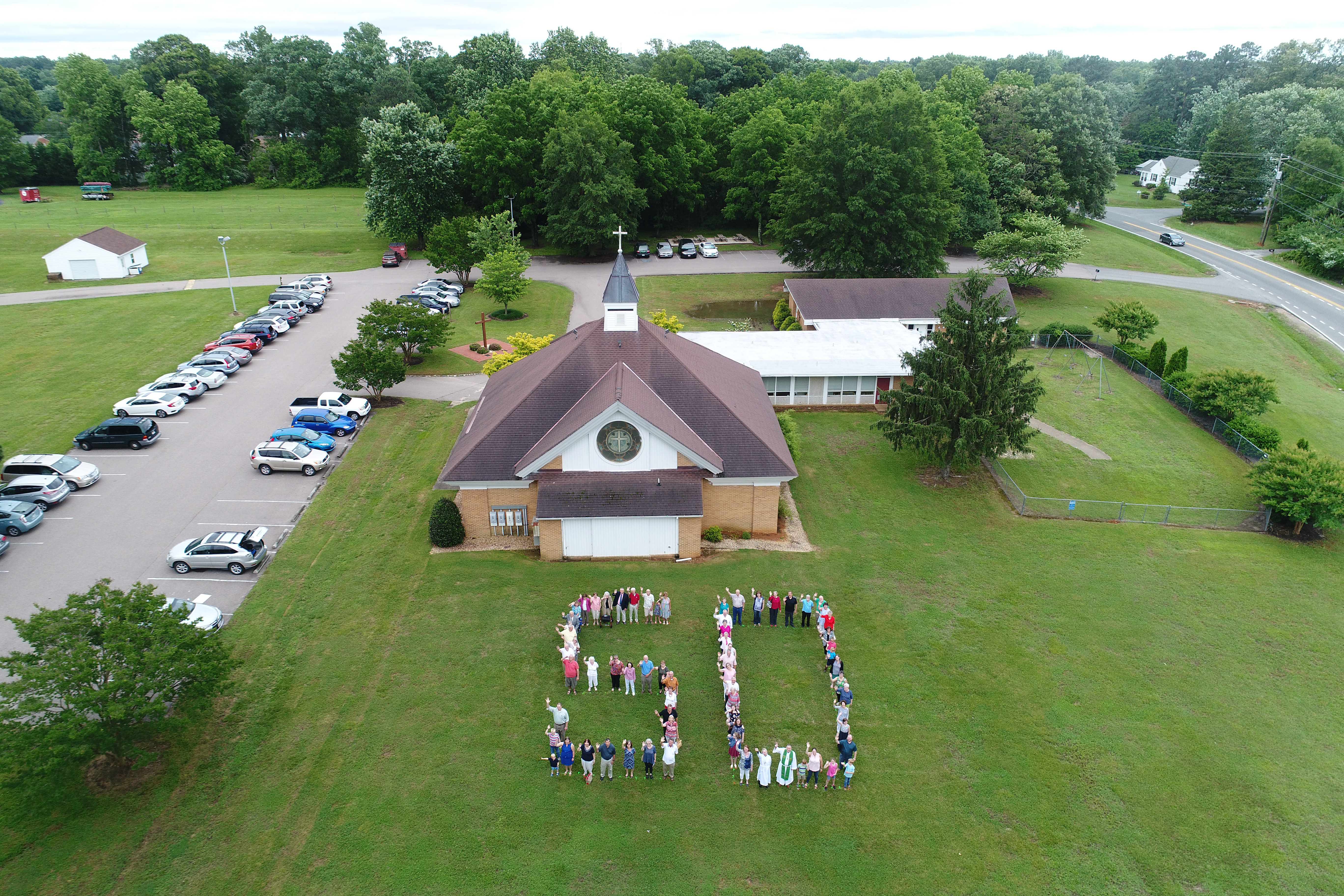
And as someone reflected upon our 50th anniversary drone photo, they thought our “50” formation also looked like the word “SO.” This raised the question, “So what’s next for us?” That’s a wonderful, hopeful question for any believer to ask each day. Where is God asking us to help sow his love and mercy? Where will we discover new life?
No human knows all the answers regarding our future, but as Vicar Ginny noted in her farewell during worship (as others have): “Surely the presence of the Lord is in this place. I can feel His mighty power and His grace. I can hear the brush of angels’ wings. I see glory on each face. Surely the presence of the Lord is in this place.”
As the song suggests, Christ reveals himself to us through holy community. We can touch the hem of his garment and almost see his face. Only together can we come into the fullness of this new, promised life with the Risen Christ.
Not everyone will always have the heart to notice, understand or appreciate such authentic community. It is difficult and takes our time, attention and lots of grace. We often fail. Yet, God is doing something miraculous and beautiful each day in and through our lives together. We are growing; together with God and in love of our neighbor.
It is approaching harvest time. In the name of Jesus Christ and your brothers and sisters of the Church, reconsider your place. Wherever you’ve been, whatever you’ve done or left undone, I invite you to walk with Jesus and us anew.
Be still and know. Be active to serve and grow. Be in Christ together.
Originally published in Messiah Lutheran’s newsletter, The Messenger (September 2018 edition).
Do not worry about anything, but in everything by prayer and supplication with thanksgiving let your requests be made known to God. And the peace of God, which surpasses all understanding, will guard your hearts and your minds in Christ Jesus. (Philippians 4:6-7)
The summer fun is about to end, and “school days, dear old golden rule days” are about to return. I’ve already seen people buying school supplies and clothing for their children, and from conversations, I know people are already trying to get their minds around their return to fall work schedules. It is a busy and often anxious time of year!
Whatever age the child of God might be, we are to look toward the same direction for our hope and encouragement. No matter how big or small the worry, whether your anxiety is about your lack of time, treasure, or talent, you are not meant to be alone. Jesus wants to walk with, guide and comfort you.
Above the hubbub of our days or amidst the darkness of any fear, turn to Jesus. Stop and listen for his still small voice. It can indeed be found in Bible study, daily prayer, and corporate worship. Martin Luther wrote, “I have so much to do that if I didn’t spend at least three hours a day in prayer I would never get it all done.”
Now, we don’t have to spend three hours in prayer, but we do need to be attentive and intentional to help us hear the voice of Christ in our lives. Martin Luther has some things to share with us about prayer:
His theology of prayer was centered on scripture. – To know the Word of God, we all need to spend time immersed in it. Hearing other viewpoints from sermons and group studies helps us avoid our own voices from unintentionally shouting down Christ’s own.
His theology of prayer recognized its importance. – Think about your own human relationships. Does conversations and quality time spent with the one’s you love help you to grow closer to one another? It is the same with our relationship with God and Christ’s church.
His theology of prayer understood the human and humble aspects of it. – We need God. We need others. Prayer helps remind us of these needs even as it helps us share them. Prayer is can be both talking and listening, spoken or sung, original or rote. There’s perhaps no such thing as a bad prayer, but simplicity and honesty can make them better. And if you can’t pray? Remember that the Spirit prays for us as can the church!
Luther’s theology of prayer is practical. – No issue is too small or unimportant, for we matter to Christ. We don’t need to prattle on, for our prayers can be as simple as calling for help or saying thank you. It is our heart that matters more than our words. Even dwelling upon a daily passage or verse of scripture can help shape our prayer life.[1]
Do not be anxious, but do not forget whose you are either. You belong to Jesus, and you are meant to be a gift to the church and the church a gift to you. So come on by and stay a spell. We have a place for you, and your brothers and sisters need to see you too!
“I have held many things in my hands, and I have lost them all; but whatever I have placed in God’s hands, that I still possess.” Martin Luther
In this world, nothing lasts forever: fortunes fade or disappear, relationships end or move on, opportunities pass, and people sadly die. Therefore, change is often feared and the unknown suspected. If not in our words, our actions often reveal our true thoughts about this “reality.” We tend to make choices that are meant to protect ourselves from the world. Often based on fears and the perception of or needs or wants, they end up being choices that can hurt ourselves and others rather than bless. They can unintentionally, slowly separate us from God, others, and the abiding joy Christ promised for our present.
In contrast, spring reminds us that our struggles won’t last forever. Against stacked odds, we become witnesses to new life brought forth and the dead resurrected all around us. Birds sing, and flowers bloom. Time and again, great prophets like Isaiah shared God’s promises through such images (as in chapter thirty-five): “The wilderness and the dry land will be glad” or “the mirage will become a pool of water.” Based on such promises, he goes on to give a charge to the People of God, “Encourage the exhausted, and make staggering knees firm. Say to those with an anxious and panic-stricken heart, ‘Be strong, fear not!’”
Sowers plant seed, wait and watch for spring while longing for the harvest. It takes time and patience, intentionality and effort. Storms or droughts might come, but we break the ground to refresh the soil, remove weeds and dead growth. There’s a kind of sweat equity needed, yet many hands make lighter work. And so, we are asked to join with others trusting winter, want and war will not last forever. We plant in hope and trust spring will come and a certain harvest will follow.
This Easter, I hope we all reflect upon what God has done for us in Christ, but we should also consider what God is asking of us in response. We have been sent to this time and this place, for we still live in much the same world of Isaiah. People need our hope, help and companionship, and we need there’s. There’s much work to be done. The time is right for you and me and all to recommit to the work of the church…of being church together.
True, we and our congregation face many challenges each day, but Christ holds us in his crucified, resurrected, loving hands if we let him. Don’t hold onto the past or present with anxiety. Hold on to the promises of the Resurrection. Be strong. Fear not. Share all that you are and have with his Kingdom. Turn over all your cares to Christ. For, it is time to open our hearts and hands toward all anew and discover all the good which God intends to grow and give for our sake and the sake of the world.
Originally published in Messiah Lutheran’s newsletter, The Messenger (April 2017).
Unless otherwise indicated, all scripture quotations for this article are from the New Revised Standard Version (NRSV) translation.
Even when I cry out, ‘Violence!’ I am not answered; I call aloud, but there is no justice. (Job 19:7)
During our recent sermon series on the Book of Job, our congregation members and world faced its own share of challenges and loss: economic threats, deaths in our extended family, a terrorist attack in Orlando, even our own roof-ripping kind of “whirlwind.” The world can seem a terrible place, and like Job, we are tempted to cry out to some divine police officer, “Violence! Help us!”
If you missed our sermon series, know this. God hears us, and God cares. We might not always see God at work, but he promises to labor for our welfare not for woe (Jeremiah 29:11). Indeed, our God often works behind the scenes hidden from our human view. As Jesus proclaimed, “Peace I leave with you; my peace I give to you. I do not give to you as the world gives. Do not let your hearts be troubled, and do not let them be afraid” (John 14:27). Our sovereign, loving Lord is in control.
Still, Job was right in one sense. There is no perfect justice in our world. Bad things can happen to good people. Yet in an unfair world, we are gifted with an unfair grace. God loves us and plans never to abandon us.
No more than Job can I pretend to know why month after month it seems I am mourning with congregational members or my own family members over one thing or another. Yet, I know this. God is love…only love. Like a child, I can choose to trust my heavenly parent who created me and you out of love. It is all I really have – God’s promise to love me. Fortunately, God doesn’t lie. Jesus, our brother, Son of the Living God, proved this love through his death and resurrection for our sake. Hear God’s promise:
“For the one who sanctifies and those who are sanctified all have one Father. For this reason, Jesus is not ashamed to call them brothers and sisters, saying, ‘I will proclaim your name to my brothers and sisters, in the midst of the congregation I will praise you.’ And again, ‘I will put my trust in him.’ And again, ‘Here am I and the children whom God has given me.’ Since, therefore, the children share flesh and blood, he himself likewise shared the same things, so that through death he might destroy the one who has the power of death, that is, the devil, and free those who all their lives were held in slavery by the fear of death.’” (Hebrews 2:11-15).
Job did not live in this world long enough to see justice reign in fullness, and we might not either. Still, even Job knew his Redeemer lives. We must as well and share that good news with others. God’s justice is breaking into our world. While we wait, we are only asked to trust in the love being offered us and share it. We must seek to give into love, not fear.
Yes, more trouble is in our future, but so is our Redeemer. He will return because he wishes to banish fear, tears, violence and evil forever. We might never understand the evil and struggle we face, but we can find courage. God loves us more than we could ever understand.
So in the face of much darkness, go ahead and pray. Go ahead and live in Jesus’ name.
I wish you Christ’s peace in all that you might face,
Pastor Lou
Originally published in Messiah Lutheran’s newsletter, The Messenger (July 2016).
Unless otherwise indicated, all scripture quotations for this article are from the New Revised Standard Version (NRSV) translation.
May the God of hope fill you with all joy and peace in believing, so that by the power of the Holy Spirit you may abound in hope. (Romans 15:13)
With each January, I’m usually contacted by several of our congregation’s youth and young adults as well as younger staff members at our school. They want me to write recommendations for college entrance or a new job. Almost always, the person making this request is humbled by the choices before them. They fear rejection or failure. At the same time, they feel dwarfed by the opportunities looming before them. Could their dreams be realized? They are almost afraid to find out!
Certainly, we aren’t always successful in our plans, but perhaps we should not get stuck in despair. Look instead toward God’s plans for us and be comforted. Through the prophet Jeremiah, God tells us, “For surely I know the plans I have for you, says the Lord, plans for your welfare and not for harm, to give you a future filled with hope” (Jeremiah 29:11). God seeks to be in communion with our hearts. Jesus came to rescue not condemn. The Spirit is our gift to console and guide us. With such company, need we become paralyzed in fear?
Jean Vanier, founder of L’Arche, reminds us, “Prayer is to say to Jesus, ‘Tell me what you want. May your will be done.’ Then, unexpectedly, Jesus says to us, ‘Tell me what you want.’ ‘Whatever you ask in my name, I will do…. If you ask anything of me in my name, I will do it’ (John 14:13, 14).” Peter begs us, “Cast all your cares on Jesus, for he cares for you” (1 Peter 5:7). Paul reminds us, “All things work for the good of those that love the Lord” (Romans 8:28).
Fear is very human, but Jesus wants to walk with us through our fear to the place God needs us to be. God’s plans may not prove our own. If we seek to listen to Jesus and follow, even if we mishear him a wee bit or a lot, it is he who will lead us to that place. That’s his promise to all God’s children, yes, even you.
The future is like a cloud to us, but then is it really just a coincidence that God so often is heard speaking from clouds in scripture? I don’t think so. We only have one way to go – forward. We can only navigate properly by following the Christ who loves us…into the gray…into sickness…into failure…into joblessness…even into the valley of death…
Yet through faith, we know any sadness need not last. Grace, forgiveness, healing and a peace beyond understanding awaits us. You see, God is already in our future awaiting us with open arms wherever and whatever that future may be. There’s nothing really to fear. God’s ready and willing to welcome us home. Like the paralytic healed in Capernaum, we really just need to pick up our mat and walk. We are forgiven. We are healed. We are free.
I pray that your Lenten walk be one centered on Jesus and the abundant hope he has in store for you.
Amy Delph of Messiah Lutheran goes Over the Edge for Special Olympics Virginia.
For he will command his angels concerning you
to guard you in all your ways.
On their hands they will bear you up,
so that you will not dash your foot against a stone. (Psalm 91)
As our Virginia Synod team, “Fools for Christ,” prepared to rappel down 25 stories as part of Over the Edge for Special Olympics Virginia, there was indeed noticeable anxiety. One heard some nervous gallows humor about last words and breaking ropes. People pointed to those they blamed for getting them into this mess. Some people ascended to the roof top only to think better of it when looking at the edge separating them from the cold, hard ground below.
It isn’t unusual or foolish to feel fear at such moments, as fear is ultimately a God-given survival mechanism. Yet, some overcame their fear trusting in a greater purpose. Even for those who turned back, there was no shame. They had made the attempt. We all recognized our fear and vulnerability, and it created a comradery on that roof top; a sense of community. People sought to support each other with their prayers and kind words of encouragement in success or defeat – much like any church should do.
Yet for those of us who believe, it struck me that there was even greater comfort to be found. The certainty of God’s promises. When Jesus faced temptation on the pinnacle of the Temple, he thought of such comfort too.[i] He quoted Psalm 91 in the face of the Devil. It was the words he clung to for encouragement and safety.
Jesus understood his Father in Heaven and the heavenly host remained on guard. He could trust God as his dwelling place, and nothing could truly harm him. No fear need stop him from his mission. It is the same with our lives as we face whatever highs or lows, blessings or curses that might come. God is with us. God intends to protect those who love him and know his name. These are God’s promises, “When they call to me, I will answer them; I will be with them in trouble, I will rescue them and honor them. With long life I will satisfy them, and show them my salvation” (emphases added). We can go over the edge into our future with confidence.
Yes, fortunately for us, God never lies. We need not let fear dictate our choices or behaviors. Failure need not define us. We are the beloved children of God together. Whether barely making it on a wing and a prayer, finding ourselves out on a limb, or hanging by a thread (or perhaps even a rope 400 feet above Cary Street), we are not alone for we have one another to turn to. Perhaps better still, God and the Heavenly Host is not only ready to catch us if we fall but has plans to lift us up to new life no matter what happens.
This month, we can rightly give thanks to God even if we feel at the end of our rope. God is with us, and God will never let us go.
“The harvest is plentiful, but the laborers are few; therefore ask the Lord of the harvest to send out laborers into his harvest.” (Matthew 9:37)
As we approach another Lenten season, I see barren farm fields around us. In the midst of winter, they don’t look like much. They are tired and seem spent. Yet with the right amount of gifts from God (water and nutrients) as well as care from the farmer (tilling, planting, weeding, etc.), these same fields will become abundant signs of life as we enter spring.
This is much as our Lent should be. We intentionally cooperate with the grace of God to promote and nurture life and love in the world. Following chosen disciplines and special worship or by making extra efforts of charity and service, we tend to the plot of land God has given us. We till and plant (reflecting on our lives, confessing our sin, and turning with expectation toward God’s promises). We weed (repent) and grow (renew). This sacred process is not just for us but also for our neighbor as we seek to share the love and grace we ourselves receive.
Yes, as we enter Lent, we return once again to the mission fields. We seek to reconnect to Christ and one another. What will you do to cooperate with God’s grace and nurture new life? Certainly, Jesus offers us his love freely, and so we could just watch and wait for spiritual growth. Yet as good farmers know, seeds of faith grow better with intentional love rather than lukewarm care.
Grace abounds, but Jesus invites all of us to roll up our sleeves and grow with God this Lent. Come join Jesus in the fields before us and witness the miracles God can do through your life and love.
Christ’s peace,
Pastor Lou
This post was originally published in Messiah Lutheran Church and School’s newsletter, The Messenger (February 2015).
Unless otherwise indicated, all scripture quotations for this article are from the New Revised Standard Version (NRSV) translation.
A cheerful heart is a good medicine, but a downcast spirit dries up the bones. (Proverbs 17:22)
I have been called many things in my life, but this past month I was called a clown. To be more precise, I was called to be a clown as part of our Vacation Bible School. Through skit and song, crafts and games, I was blessed to share a journey with forty youth and almost as many adults into deeper friendship with God and one another.
I find that relationships are most easily formed through joyful encounters and positive attitudes, and it isn’t much different for our relationship with Christ and his church. Our happy fellowship, laughter, and even a caring smile can serve as a witness to our faith and help sustain others, but I believe it also serves to encourage us in our work and shape our own futures.
What kind of joy is this? I am talking about much more than a positive attitude (although that helps). In fact, it ultimately isn’t about us at all. Trusting that no matter what happens we will always be cared for by Christ frees us to smile, to laugh, to risk relationship and love no matter the cost. We can be rejected, and yet our healthy self-esteem can continue unharmed because we are loved by God. We can seem to fail in our efforts and yet not worry; we share in Christ’s victory. Even as we struggle with sin or illness or tears, or anything else one can think of, we can trust with Julian of Norwich, “All shall be well, and all shall be well, and all manner of things shall be well.” God will use whatever happens for our good.
“Faith is a living, daring confidence in God’s grace, so sure and certain that a man could stake his life on it a thousand times,” declared Martin Luther. Yes, faith is God’s punch line to our world’s fallen reality. Faith surprises and empowers us. Even amidst difficulties or tears, it manifests itself through the fruit of the Spirit: love, joy, peace, forbearance, kindness, goodness, faithfulness, gentleness and self-control. It keeps us going in the face of great obstacles, and in answer to death, it births an abundant life.
Long ago, Francis of Assisi and his followers encountered Christ’s love in their midst through active fellowship, service and worship together. This radical communal lifestyle raised the eyebrows of many who called them “Fools for Christ,” yet that way of life brought Francis, his friends and those they served an abundance of joy – not sour, pious faces, rigorous religiosity, or burdensome obligations. Perhaps, they had the last laugh by adopting the name meant to deride them.
That is the kind of clown I hope I can be…that I believe Christ intends us to be together as church. Please help us together discover the gift of such joy this fall as we celebrate 45 years of ministry at Messiah. No kidding, it might just change the world.
May Christ’s peace and joy always reign in your life,
Pastor Lou
Unless otherwise indicated, all scripture quotations for this article are from the New Revised Standard Version (NRSV) translation.
The following is a short sermon I preached to my congregation at Messiah Lutheran Church and School, on the Third Sunday of Advent, often called Gaudete (Rejoice) Sunday. Although our preschool students and elementary-agers were present to perform a joyous Christmas musical, the death and sadness of the last week, especially in Newtown, CT, could not be ignored.
As our last hymn [O come, O come, Emmanuel] reminds us[i], the Advent season is a time of waiting and expectation. The song is much like many others among our Advent hymns and even some of our more traditional Christmas carols. Many project a sense of sadness and longing. They can prove almost melancholy. Our hymn writers and liturgists – just like us – know the imperfections and pain of this world, and so we look toward Christ to deliver us. Our music, images, and prayers can reflect that sense of loss, waiting and hope. Being a Christian, I heard someone once say, is like being a person separated from their greatest love; something is missing, and not quite right. We hunger and thirst for that love to be one with us again, so that our lives can feel whole.
This week, we have been unhappily reminded of that truth. We lost our assistant to the bishop, Pastor “Chip” Gunsten, a dear friend of mine and many here at Messiah as well as throughout our synod, who died suddenly while undergoing treatment for cancer. We are not the only ones mourning, for our Catholic brothers and sisters lost their former beloved bishop, Walter Sullivan on the same day. He was someone I knew well, and he proved influential to my own discernment of service within the church. Our Presbyterian friends in Virginia lost one of their own leaders as well, Cynthia Bolboch, Moderator of the 219th General Assembly of the Presbyterian Church (U.S.A.) on December 12th. Having many Presbyterian friends after attending a Presbyterian seminary, I shared in their own grief and sadness. As the week closed, I was tired and worn down from dealing with death and the many emotions that always accompany it. Then, we received the horrific, numbing news of Newtown, CT. People thousands of miles away shared in that community’s dread and grief and fearfully held their own loved ones closer.
How can we make sense of such things? I’m not sure that we can. Oh, as a Christian, I trust that God can use them – turn them on their head and make all things work for our good. I know blessings and signs of love can be found even amidst tragedy – perhaps especially at times of tragedy – through the heroes and servants shining in those times of darkness, or through the love that is shared with us to help us make it through. Yet, maybe we are never supposed to make sense of these things at all. It isn’t within our capabilities to make sense of the nonsensicle. The issues can be too involved for us to handle or beyond us. Maybe they just can’t ever make sense, because they are counter to what God wants for us. God’s will is to save us for a future full of hope, not to condemn us to an eternity of woe[ii]. God’s plan from the time of Adam and Eve was to redeem and save us out of love.[iii]
These sufferings are symptoms of that earlier wound. They are parts of our life as a fallen, imperfect people in a fallen, imperfect world. People sin. People suffer. People die. Uncontrollable evil and sadness do exist. Perhaps instead of looking back for answers as to why things happened, we should look forward. Our time is better spent in the face of such evil asking, “What would you have us do, Lord?”
Certainly, God never abandons us to this sorrow. God has a purpose and a plan which includes us. Jesus was sent into our world as a little child to share our life and lot; even our suffering unto death. God doesn’t rejoice at our destruction, but rather wants us to live abundantly through his only son.[iv] Jesus would become God’s final word on evil, sin and death. They have been defeated through his cross and resurrection, and we are saved here and now. Yet, sin and death are enjoying their final death throws at our expense. Jesus declares we are free from their power; saved even as we and creation might groan at times.[v]
In this present age, Jesus promises to come again to complete the work which he started and banish sin and death forever. There will be a new heaven and earth where suffering will be no more.[vi] In the meantime amidst our lingering troubles, he asks us to look up and be ready, not as a sullen or defeated people, but as his beloved people. Be ready, he says, so that our hearts are not weighed down with dissipation and drunkenness and the worries of this life, so that the day doesn’t catch us unexpectedly, like a trap.[vii]
No, we who are saved have a purposeful, divine work to do. We are left here – called to this time and this place – as his messengers speaking his words of love, healing and forgiveness; words so sorely needed in this wounded, combative world. Like the law and the prophets before him including John the Baptizer[viii], Jesus taught us what we need to do – love God with all we are and our neighbors as ourselves.[ix]
Today both despite our suffering and because of it, we are to speak these words and embody them. God uses us with all our weakness and imperfection to give them form and substance, flesh and bone, to make them real. We are echoes of Jesus crossing all the earth shouting, “Do not be afraid! Jesus has come! He is risen and will come again!” We are called to lovingly and boldly put these words into actions together as church…Christ’s church…his body…his hands reaching out and touching broken lives through our own.[x]
Today, we have also heard words that Paul spoke to Christians in Philippi when they were persecuted, broken and felt alone. These same words were shared with us yesterday at Pastor Gunsten’s funeral. Perhaps it is providential that the lectionary had them as one of our assigned texts considering recent events:
Rejoice in the Lord always. I will say it again: Rejoice! Let your gentleness be evident to all. The Lord is near. Do not be anxious about anything, but in every situation, by prayer and petition, with thanksgiving, present your requests to God.And the peace of God, which transcends all understanding, will guard your hearts and your minds in Christ Jesus. (Philippians 4: 4-7)
Rightly, Jesus is called Emmanuel, God with Us. We need not get stuck in our fear, hurt or anger. Look up! Raise your head! Do not be afraid! These are the words Jesus speaks to us in the face of our most unimaginable threats or losses. When the world and its realities rage, when struck by great sorrow, or when we cannot find reconciliation with others we so deeply long for, Jesus speaks to us as he did similarly to that storm long ago, “Peace I leave with you; my peace I give you. I do not give to you as the world gives. Do not let your hearts be troubled and do not be afraid.”[xi]
This world can be a frightful, sad and lonely place, but we need not grieve as people without faith.[xii] We need not live as a people without love.[xiii] Despite any of our doubts, Christ’s peace and love are with us always[xiv], and we have a shared ministry to do in his holy name.[xv] His light is in our midst and shining through our hearts, and the darkness shall not overcome it.[xvi] Remember always that we are baptized – claimed and called, to be Christ and to serve Christ in the world.[xvii] We must never try to hide ourselves from the pain of this life and thus not truly live.[xviii]
We are Christ’s church, together with Jesus and thus never alone. He has come for us and will come again. Our longing will be vindicated. This truth is rightly celebrated at every moment and forever, but especially during Advent. We celebrate it this morning through our young people attending Messiah Lutheran School who have come to proclaim the story of Christ’s birth with us anew today.[xix] Amen.
Readings for the Third Sunday of Advent – December 16, 2012
Zephaniah 3:14-20
Isaiah 12:2-6
Philippians 4:4-7
Luke 3:7-18
[i] “O come, O come, Emmanuel, and ransom captive Israel, that mourns in lonely exile here until the Son of God appear. Rejoice! Rejoice! Emmanuel shall come to you, O Israel. (Evangelical Lutheran Worship, Hymn 257, verse 1)
[xiv] In Mother Teresa and Brother Roger’s book called Seeking the Heart of God (1993), Brother Roger writes: “Four hundred years after Christ, a believer names Augustine lived in North Africa. He had experienced misfortunes, the death of his loved one. One day he was able to say to Christ: ‘Light of my heart, do not let me darkness speak to me.’ In his trials, St. Augustine realized that the presence of the Risen Christ had never left him; it was the light in the midst of his darkness.”
[xvii] At times of fear or doubt, Martin Luther is said to have reminded himself, “I am baptized”; a reminder that he was Christ’s called, claimed and sent child. His writings also indicate that we act as Jesus in the world, but also encounter Jesus in the least of these, those suffering and alone. Through their lives Jesus cries out to us for compassion.
I love history. It doesn’t matter if it is church or secular history, about peacemakers or warriors, I always seem to learn something helpful for my modern life when I look back in time. Beyond the many books I read and the movies and television shows I watch (often to my wife’s chagrin), I even enjoy those quick notes found in the “This Day in History” articles of my local newspaper. So sometimes (just for fun), I will look toward history when a significant day in my life occurs. For example, I was born on December 10. On that day in 1520, Martin Luther burned the papal bull (edict) demanding he recant from his critique of the Roman Catholic Church or be excommunicated. This would have been a death sentence back in his day. On June 1, the first written record of Scotch whiskey appears in the Exchequer Rolls of Scotland, certainly a day of celebration. Ironically, it also serves as the anniversary of another wonderful celebration for me – the day I married my wife. (Cheers to that!) On October 28, 2007, the congregation of Messiah Lutheran Church voted to call me as pastor. It was Reformation Sunday. (The Reformation actually began on October 31, 1517 when Luther posted his 95 Theses, but our denomination tends to recognize the anniversary on the Sunday before that date when October 31 isn’t itself a Sunday.) Now to be clear, I don’t plan events based upon historic dates. I enjoy looking backward after the fact; just to see if I learn any fun tidbit or maybe even something helpful. So by now, you get the idea. I am a bit of a nerd when it comes to history. I confess it to you freely.
Consequently, you probably won’t be too surprised to learn that I looked toward history after opening this blog on January 14, 2011. (Hopefully, my decision to write a blog will not become a day to live on in infamy.) In our denomination, we have days where we commemorate special witnesses to God’s love at work in our midst. We recall the Christian lives and witness of fellow saints. These saints aren’t perfect, for no human ever was, is, or can be perfect. As Luther pointed out, we are at best sinner-saints, truly saved but in constant need of our Savior’s grace. I often find people listed who I hadn’t previously known; at least not well. This was such an occasion, for by looking at our liturgical calendar, I made the acquaintance of Eivind Josef Berggrav (1884-1959), deceased Primate of the Church of Norway. Examining the life of Bishop Berggrav, we find the classic case of the right person being at the right place at the right time. Although special in many ways by most accounts, he perhaps wouldn’t have been more than a footnote to history if he hadn’t been the presiding bishop in Norway at the time of the Nazi occupation.
Personally, I found Bishop Berggrav interesting on several levels. First, he was a man of courage; a courage that appears to stem from his simple trust in God. Despite the threat of execution, his imprisonment in isolation, and the darkness of the times surrounding him, he remained prophetic in word and deed. He did his best to do what he felt called to do by God. He strived to act in love rather than react out of fear. This admirable quality was nurtured by his interaction with and his understanding of the catholic church (read “universal church,” note the small “c”). Despite differences in theologies, Berggrav believed there was only one church, and we should all strive together to answer Christ’s call to be the reflection of his light in a dark world. Like Nobel winner Nathan Söderblom after World War I, Berggrav believed that doctrinal agreement wasn’t crucial for Christians to live out this shared call. From his prior work to unify the church, his ecumenical contacts became an inspiration and support for him during World War II. The Confessing Church in Germany served as a model for his own leadership and action when the Nazi supported government attempted to take over the Church of Norway. Messages of support and news of public prayer on his behalf at Canterbury and other places helped sustain him during his imprisonment. Even in Norway, this attitude of openness and acceptance helped draw religious minorities (such as independent pietistic Lutheran churches and Roman Catholics) closer together in opposition of the fascist regime. Despite the oppression and challenges he faced, he learned to trust that he was never alone.
According to D.M. Yeager, he apparently was blessed with a charism of grace. Humble in his own self-assessment as sinner-saint, Berggrav tried to find the good in others. This was partly shaped by his past prison ministry. While not being blind to the realities of who he dealt with, he saw in them ordinary, fallible people where the goodness of God was still at work. In relating with others, people recognized his knack to be a compassionate, empathetic, bridge builder. After first taking on the role of bishop, he wrote in a letter, “My first objectives is to find something good,partly because I know there is always some good everywhere, and partly because I have to feel kindly toward a group before I can speak any words of admonition to them.”[i] Yet, such relationships were not to be maintained if they enabled or encouraged evil. When it was clear that the occupation government was committing atrocities and would not be true to its promises, he took actions against it.
Despite the personal costs, Bishop Berggrav found he had a Christian duty to disobey. He began to lead the institution of the church in its peaceful resistance. The church would seek to become a protective barrier between the illegitimate government and the citizenry. On Easter Sunday 1942, all but 64 of the 861 pastors of the Church of Norway read at worship The Foundation of the Church, a document primarily prepared by Berggrav explicitly stating that “the requirements of religious faith now made it impossible for Christians to cooperate with many of the laws and policies of the civil authorities.”[ii] The pastors then resigned simultaneously from the state church. Congregants responded as well, sheltering the pastors and refusing to participate in the state church. Reminiscent of the two kingdoms theology of Luther, he recognized that both church and state had parts in God’s ultimate plan. So while he argued that the church’s opposition should be and must remain peaceful, he remained a realist. He believed that when a government began to perform as a murderer, citizens must act in the government’s stead to protect themselves and fulfill God’s call for justice. Thus, some may indeed be called to take up arms for that purpose. This armed opposition isn’t purely political, nor is it to be self-serving. Violence is only entered into for the purpose of restoring a proper, just government, protecting the defenseless, and for calling others to repentance. Reconciliation must remain the goal.
There is much, much more to be said about Eivind Josef Berggrav, more than I could ever say here. For those interested in learning more, I would commend to you D.M. Yeager’s article, God, Church, and Country: Berggrav’s Leadership in the Norwegian Resistance in the Journal of Lutheran Ethics (available through elca.org). As for me, I recognize a bit better how his life has somehow touched my own through the communion of saints. I will be challenged to live up to his legacy as I think of him. For certainly all of us will face opposition in this fallen, imperfect world. Recalling of Baggrav’s own response in troubled times, we might be encouraged to look for the good in our enemies and to seek reconciliation where possible. We might find the courage to apply our faith as best we can to the troubles of our day. In all things, maintaining a simple trust in the eternal providence of God, we might see past our own immediate fears or suffering to realize that we just might be the right people at the right time and right place, sent by God, for these troubled days that surround us. We could even find ourselves inspired enough in our daily lives to risk acting in love no matter the cost. With such grace active in our lives, the course of history will certainly change for the better. Each day will prove historic and a blessing.
[i] Yeager, D.M. God, Church, and Country: Berggrav’s Leadership in the Norwegian Resistance. Journal of Lutheran Ethics, Vol. 6, Issue 5 [on-line edition via elca.org]. May 2006.
[ii] Yeager (on-line, ¶42) As noted by the author, the figures are according to a work by Odd Godal. In some documents, the number of pastors reported as resigning varies slightly.
Bibliography
Anonymous. (n.d.) Eivind Berggrav. Wikipedia.org as downloaded on January 15, 2011.
Evangelical Lutheran Church in America. Evangelical Lutheran Worship: Pew Edition. Minneapolis, MN: Augsburg Fortress.
Yeager, D.M. God, Church, and Country: Berggrav’s Leadership in the Norwegian Resistance. Journal of Lutheran Ethics, Vol. 6, Issue 5 [on-line edition via elca.org]. May 2006.
Husband, Pastor, Law Enforcement Chaplain, and member of the Clerical Errors (aka "The Three Priests"), I'm sharing my two cents with anyone who cares...
You can also find me on social media as Loudluthrn (Lou-d-Luthrn or Lou the Lutheran). It is a moniker given me while attending a Presbyterian Seminary, but I'm a loud and proud Lutheran too (just not too loud and proud, mind you).