Tag Archives: family

Love to Tell the Story

“That there were shepherds, means that no one is to hear the Gospel for himself alone, but everyone is to tell it to others who are not acquainted with it. For he who believes for himself has enough and should endeavor to bring others to such faith and knowledge, so that one may be a shepherd of the other, to wait upon and lead him into the pasture of the Gospel in this world, during the nighttime of this earthly life.” – Martin Luther

J. Bannister, Public domain, via Wikimedia Commons

During the season of Advent and Christmas, excitement builds as the story of Jesus is told. And, it needs to be told through sights and sounds! Martin Luther understood that no one can come to faith in Jesus until they hear about Jesus from the Church – you, me, and all who believe.

Among Luther’s own efforts, you will find the Christ Child or Christkindl. He promoted that Christ be adopted as the children’s gift-giver from December 6th through Christmas Eve. (This would incorporate practices related to St. Nicholas’ Day, St. Lucy’s Day, and other traditions.) The sprite-like child would not be seen by children, but Luther hoped practices related to the gifts’ arrival would help bring attention to the incarnation of Jesus.

The Christmas tree was encouraged by Luther, but once again, similar practices already existed. Saint Boniface (675-754), who Martin Luther admired, was a missionary in Germany. In an encounter with pagans, legends vary, but he was said to have struck down (perhaps miraculously) the Thunder Oak dedicated to Thor, often a place of sacrifice. (Some legends indicate it was a similar tree dedicated to Odin.) Boniface commended the people “gather about [a new tree], not in the wild wood, but in your own homes; there it will shelter no deeds of blood, but loving gifts and rites of kindness.” Luther might not have invented the Christmas tree, but he certainly promoted it’s use. In his own home, the candles lit were supposed to remind children of the stary night above Bethlehem. The angel on top reminds us of the first angels bringing us the Good News of Jesus.  

The Advent Wreath is sometimes attributed to Luther, although that is unlikely the case. It probably has deeper pagan roots. Scholars often give Johann Hinrich Wichern (1808–1881), a Protestant pastor in Germany and a pioneer in urban mission work among the poor, credit as the inventor of the modern wreath. Still, Advent wreaths were used in 16th century German, and Martin Luther encouraged families to observe Advent as a time for them to teach their children about the coming of Christ. The wreath is a handy tool at dinner or before bed for exactly that.

Among my favorite tales of Luther and Christmas is how he celebrated intergenerationally with his own children. His hymn, “From heaven to Earth I Come,” was designed to be sung with the adults playing angels coming down the stairs and the children playing shepherds singing in response.

Truly, there’s no limit to family practices rooted in your region, ethnicity, or family. Yet how do these practices witness to Jesus? How can you best share in the joy that is Jesus with others? Whatever your answers, Kristine and I pray that Jesus become more present in your life through the festive weeks ahead. We wish you all the merriest of Christmases!

Originally published in the December 2022 newsletter of Christ Lutheran Church, Fredericksburg, Virginia.

Unless otherwise indicated, all scripture quotations for this post are from the New Revised Standard Version (NRSV) translation.

© 2022 The Rev. Louis Florio. All content not held under another’s copyright may not be used without permission of the author.

1 Comment

Filed under Uncategorized

An A+ Kind of Love

The Hub, October 15, 2019

This Sunday, I presided at a bittersweet wedding. The bride’s beloved grandfather had died unexpectedly this past year, and he was sorely missed. The grandfather’s absence was palpable, but there was a lot of joy as people shared stories about him. As part of this celebration of ongoing life and love, the bride’s grandmother gifted the bride with a Bible given to her at her own wedding over 60 years ago as a remembrance to be used during the service. Among the texts chosen was the popular John 15:9-12 where Jesus invites us to abide in his love.

The bride’s grandfather, John, was a very intelligent, loving, Italian grandfather, the kind who could lovingly dote on children without spoiling them. Indeed, he often became a surrogate grandfather to many children at my former congregation. Not only would he give them little penny candies, he often asked questions about their week. He would offer them advice and encouragement in response to their answers. He was never too busy for a child.

It had become John’s habit long ago with his own children to jokingly offer a grade whenever a task was performed, or a challenge met. No matter how well they did, it was a C (an average grade) – maybe on a very good day a C+. Perhaps this was meant to challenge people to increasingly do better, or perhaps it was offered for the laughs and smiles it would solicit as they heard this grade and saw his smile again, and again, and again. Whatever the reason, I found in it a loving reminder. We are all human. We can always do better, love better, be better, and we need one another.

The liturgical wedding service reminds all of us through its words that although life is filled with love and excitement, it can become overcast and hard. Yet, the service, especially the Gospel, also reminds us of an A+ kind of love.  It’s a love that we can rest in and find strength from. It is a love that helps us bear all things patiently, to wait with hope, to accept one another as we are and not for what we would hope to be. It is a love that grows and lasts; always protects, always trusts, always hopes, always perseveres. It is a love that forgives and never fails. It reflects our God who is love and loves us.

As individuals, couples or community, we might only reach the grade of C+ on our own (even at our best), but God’s love is transformative. It is an A+ kind of love that we can abide in each and every day. It has the power to make our lives significant and declare us perfectly forgiven and free.

Originally published in The Hub, a weekly email of Christ Lutheran Church, Fredericksburg, VA.

© 2019 The Rev. Louis Florio. All content not held under another’s copyright may not be used without permission of the author.

Leave a comment

Filed under Uncategorized

Raising Little Evangelists

The Hub, September 2, 2019

Picture credit: zsuga on Pixabay. Used by Permission.

Over the next few months, our ministry teams will each have an opportunity to share about their ministry area through music. They will choose our hymns for worship. How appropriate our Evangelism Team started us out by choosing the hymns last Sunday. The hymns helped remind us that as we (re)gather this fall, we do so for the sake of being sent. Together, no matter our age or skills, we share the Great Commission to go into all the world for the purpose of making disciples for Jesus.

To many, evangelism can seem like a daunting task. Yet, it proves much easier than people think. Successful evangelism is based on relationships: with God; with one another as brothers and sisters in Christ; as well as with those who God sends to cross our path in daily life. In a recent article, Christian author, Jen Wilkin, offered a few simple ways “to raise little evangelists,” but it provides incites for all of us who are children of God.

First, she suggests we should practice being fluent in kind words. This skill is in short supply in our world. When we don’t exercise such prudence, we can become the stumbling blocks to faith Christ warned his followers about. When we do, our gentleness can become an invitation to deeper relationship.

We should also be fluent in reconciling words. Words of confession (such as “I’m sorry”) and grace-filled words (such as “I forgive you”) reflect the Gospel. In relationships, we can give and receive these signs of God’s own love for us.

Third, she suggests that we should become fluent in slow words echoing James 1:19 – quick to listen, slow to speak and slow to become angry. Measured words at the right moment help us share love and life rather than discord and death.

Here in this season of Sunday school, we are also reminded that as children of God the Word should dwell in us richly. We should be fluent in eternal words – words that help us help others discover our Triune God and the great love waiting to embrace them. Memorizing scripture, participating in small groups (classes and Bible studies) reflecting upon life applications, attending worship and meditating of scripture are times used by God to fill us with God’s Spirit. From this intimacy, love can flow more freely.

Last, we should practice hospitable words. Inviting people into our homes is often a normal consequence of new relationships. So, why not invite folks into our church home as well? “Why don’t you come to church with me some Sunday?” “I find hope from going to church. Maybe you can meet me there?” “Looking for a church family? I’m part of a great one. Maybe you would like to visit mine?”

These are all the kind of words Jesus used with great success. They are our legacy which can be easily shared – spoken, sung, written or even digitally – along with our faith, hope and love.

Originally published in The Hub, a weekly email of Christ Lutheran Church, Fredericksburg, VA.

© 2019 The Rev. Louis Florio. All content not held under another’s copyright may not be used without permission of the author.

Leave a comment

Filed under Uncategorized

Candlemas for the young family (And the young at heart)

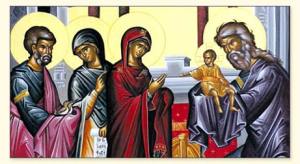
presentation

What a wonderful opportunity to rejoice in the light of Christ once again – Candlemas!

Candlemas is actually the Christian “Feast of the Presentation of Jesus at the Temple.” The Holy family had come to the Temple to fulfill the Law of Moses. Forty days after the birth of the male child, Mary’s ritual purification and the redemption of the firstborn son were due to be performed. Being a poor family, only a pair of turtledoves or two young pigeons needed to be offered to God.

Yet while they prepared to do so, two elderly, faithful people, Simeon and Anna, saw something else going on beyond the sacrifice. God was doing something much greater and offering something much dearer. God was doing something new. The Spirit revealed to them that God’s light had broken through the darkness. The infant, Jesus, was the long awaited Messiah and nothing would be the same ever again. Jesus, our joy and salvation, had come into the world!

This feast day comes forty days after Christmas and historically closed out the season. The remaining Christmas greens would be taken down. The days were still short and nights long. Spring was, well, yet to be sprung. And so this day came to serve as reminder that, “The light shines in the darkness, and the darkness did not overcome it” (John 1:5).

In time, it became a practice to bless the candles to be used in church during the coming year. Later, families would bring their own candles to church for a blessing. Hence, we now have the alternative name for the feast day, Candlemas.

candlemas at home

Using resources from Evangelical Lutheran Worship and the Revised Common Lectionary, your family can easily mark this day and your own baptismal call. The following is a short ritual I offered my congregation for home use:

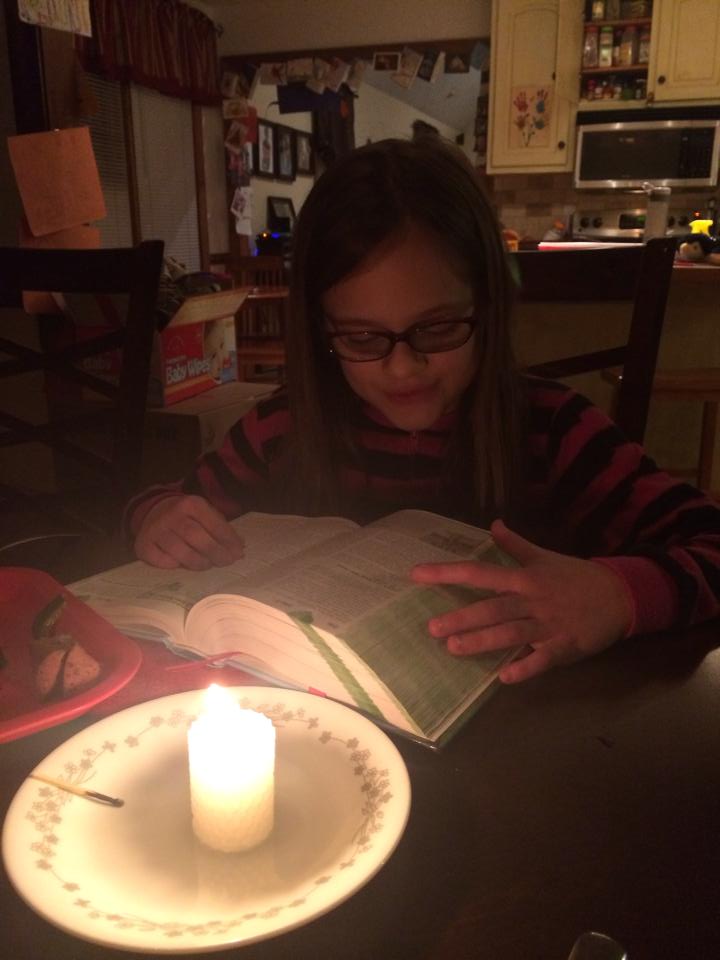
As the family gathers for a meal, before bed or at another convenient time, light your candle.

All: Alleluia. My eyes have seen your salvation, which you have prepared in the presence of all peoples. Alleluia.

Leader reads: Luke 2:22-40

A short reflection may be shared, or discussion time, or even a brief moment of silence to reflect in the light of the candle. When finished…

Leader: Let us pray together…
All: Almighty and ever-living God, your only-begotten Son was presented this day in the temple. May we be presented to you with clean and pure hearts by the same Jesus Christ, our great high priest, who lives and reigns with you and the Holy Spirit, one God, now and forever. Amen.

Leader: “Let your light shine before others, that they may see your good deeds and glorify your Father in heaven.” Go in peace to love and serve the Lord.
All: Thanks be to God.

Optional –

Close the gathering with a hymn or song dealing with light, perhaps “This little light of mine.”

This might also be a wonderful time to take out any saved baptismal candles and reflect upon the meaning of our individual baptism and talk about events of that day.

As better candles are made of beeswax, perhaps make a beehive cake to help your family celebrate.

A quote from John Chrysostom comes to my mind, “The bee is more honored than other animals, not because it labors, but because it labors for others.”

As we look upon our candles this Candlemas, let us urge our children (and all the children of God) to not waste time just being “busy bees” chasing things of this world. Let us instead love God and neighbor. Then, our lives will be used to build the Kingdom of God with Jesus. His light will come to shine through us.

Happy Candlemas, everyone!

early behive

Unless otherwise indicated, all scripture quotations for this article are from the New Revised Standard Version (NRSV) translation.

© 2015 The Rev. Louis Florio. All content not held under another’s copyright may not be used without permission of the author.

Leave a comment

Filed under Church History, Community Life, Lectionary, worship

Rediscovering the Spirit of Halloween

Luther Posting His 95 Theses

Luther Posting His 95 Theses

Each year, we hear debates among Christians regarding Halloween. With all its secular, commercial and bewitching components and hoopla, should Christians celebrate? I argue, “Yes!” If one considers the history of the day and its likely very intentional relationship to the start of the Protestant Reformation, it is impossible to deny the Christian faith’s connection to Halloween. We should celebrate with vigor, yet we should also understand its origins, purpose and potential.

Historically, the word Halloween is a contraction of All Hallows Eve. You might recall that hallow is an Old English word for “to be made holy” (as a verb) or saint (as a noun). Halloween is the evening before the Feast of All Hallows (or in modern English, Saints). Today, we know this religious celebration more commonly as All Saints Day, November 1st.

During All Saints Day, many in the Western church remember with thanksgiving the saints who are now with God. (Orthodox Christians celebrate this feast the Sunday after Pentecost.) Originally, the feast seems to have been celebrated intermittently and not uniformly on May 13th. That’s when Pope Boniface IV consecrated the Pantheon in Rome, a temple formerly dedicated to all gods, in about 609 CE. Thereafter, it became a church dedicated to Mary, the Mother of God and All Martyrs, those who died for their Christian faith. Since the Renaissance period, the building has served as a tomb rather than a church.

This ancient All Saints Day became a time to remember martyrs of the faith and later all canonized saints. During the reign of Pope Gregory III (731-741), the feast day was officially moved to November 1st. Some argue this was done to help combat and suppress the particular pagan Celtic practice of Samhain, a celebration on or about sunset 31 October to sunset 1 November.

Samhain and other similar pagan festivals marked the end of the harvest season and the beginning of winter. It was a time of growing darkness when the Celtic culture and many others – including many early superstitious Christians – believed the lines between our world and the place of the dead became blurred. Stories of hauntings and practicing divination were deeply associated with the pagan holiday.

As with Jewish custom, Christian worship practices recognize the next day begins at sundown. This allowed for a “vigil mass” or service to be held the evening before All Saints Day. This further helped coopt that evening of October 31st into a firmly Christian celebration.

Over the years, the Christian liturgical calendar continued to develop. A Commemoration of All Faithful Departed, not just martyrs or those declared to be saints through canonization, was officially added on November 2nd.[i] In Roman Catholic theology, the belief in purgatory (a place of purging sins to help make one worthy of heaven) had become accepted. This added religious feast day would serve to remember those faithful not yet in heaven and pray for their quick release from purgation. It was intimately associated with the practice of indulgences; pardons earned by works or paid for to free oneself or a loved one from purgatory more quickly.

With the many obvious medieval abuses of this teaching and his own spiritual awakening, Martin Luther began to wrestle with the contemporary practices of the Western church, especially indulgences. A biblical professor and Roman Catholic priest, he wrote 95 points (or theses) he wished to debate regarding how one is saved. Could one buy forgiveness paying for what was called an indulgence? Is it possible to earn your way into heaven or to prove yourself worthy of salvation? These were his ultimate questions.

From studying scripture, the answer had become obvious to Martin Luther. Faith comes down to trusting what Jesus did for us on the cross and through his resurrection. Jesus’ holy work was enough to cover all our sins – past, present and future – just as Jesus promised in scripture, “So if the Son makes you free, you will be free indeed.”[ii]

Although I personally have not yet found any writings explicitly connecting Luther’s posting of his 95 Theses on 31 October 1517  to Halloween, it seems exceedingly likely. Luther would expect large crowds to be present at church for the feast days ahead. Further, this educated man probably recognized the propriety of discerning about indulgences and purgatory as the Western church prepared to celebrate All Hallows Eve or Halloween, the Feast of All Saints, and the Commemoration of All the Faithfully Departed (now commonly known as All Souls Day). His 95 Theses specifically addressed beliefs, practices and excesses associated with these celebrations.

Understanding that we are saved by grace through faith in Jesus Christ, Lutherans no longer recognize purgatory or All Souls Day, but Halloween as well as All Saints Day remain on many of our personal and religious calendars. (For Roman Catholics and some others, many still look at the three days of October 31st through November 2nd as intimately connected and call it “the triduum of Hallowmas.”)

As a Protestant Christian, Halloween need not be a time where we find ourselves over focusing on evil, commercialism, violence or anything else. It can become a time of worship and spiritual formation. Despite its origins and relationship with pagan practices, it can now serve as the perfect time to remember what ignited the Protestant Reformation and particularly the saving work of Jesus Christ. We can celebrate both the love and memories of the faithfully departed as well as share in family fun – yes, trick-or-treating, trunk-or-treating or parties included. Like all things in life, our Halloween celebrations can be whatever we choose to make of them including something appropriate for all Christ’s sinner-saints[iii] still here on earth. How we celebrate can witness to our shared faith in Jesus and love for one another.

Some practices you might like to consider:

  • Visit grave sites of loved ones to place flowers, candles or luminaria (as allowed by regulation or law). Pray with thanksgiving for how God shared love with you through their lives.
  • In your faith community, share the names of those who have died over the last year perhaps ringing a bell for each one. You might allow for a special wreath where flowers can be added to symbolically represent those God used to shape your life and faith. Pray for all those who continue to mourn.
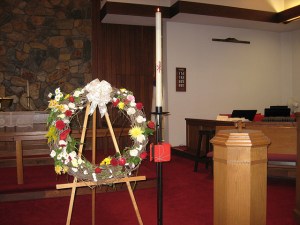
all saints sunday

  • Talk about your ancestors and family history together. Share stories of faith. How did your family communicate and pass down their faith in Jesus? Where do you see God’s steadfast love at work in the stories of the past or in your present lives?
  • Have a Reformation Day party or reenact Martin Luther’s posting of the 95 Theses.
  • Instead of dressing up as a ghost or goblin, consider positive role models such as faith-filled saints of the past or inspiring heroes of the present.
  • Share in a bonfire and hymn sing with friends and family or attend a fall festival.
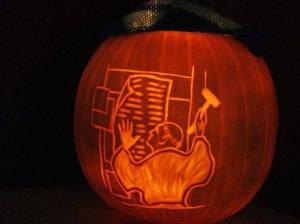
  • For something different, carve pumpkins with religious or Reformation themes.

We need not grieve like the rest of humanity over those who have died. Sin, death and the Devil no longer have a hold over us thanks be to Jesus Christ, so there is no cause to be afraid. As the children of God, we have a multitude of reasons to celebrate for all eternity. So, why not celebrate Halloween?


[i] Recognitions similar to All Souls Day seem to have been a practice from early Christianity, but they varied greatly in timing and scope. CatholicCulture.org reports this about the origin of All Souls Day: “Masses for the dead are found in the fifth century. But it was St. Odilo [c.962 – c.1048], fourth abbot of Cluny, who was responsible for the institution of the general commemoration of all the faithful departed; he instituted it and fixed its celebration on November 2, the day after All Saints. The practice spread to the rest of Christendom.” (Others claim the three day celebration stems from an order by Pope Gregory IV in the 8th century.) Indulgences are still attached to All Souls Day in the Roman Catholic Church. Learn more at: http://bit.ly/Hstmm5

[ii] John 8:36

[iii] Luther came to argue that Christians remain simultaneously sinners (still struggling with sin) yet saved (through faith in Jesus Christ). We should strive to follow Christ, but we must accept our constant need for grace. Jesus is the only source of our salvation, not our works.

Unless otherwise indicated, all scripture quotations for this article are from the New Revised Standard Version (NRSV) translation.

© 2013 The Rev. Louis Florio. All content not held under another’s copyright may not be used without permission of the author.

The image “pumpkin of Luther posting his 95 Theses” used above with this post is believed not to be copyrighted. If I am in error, please contact me, and I will remove it or provide proper attribution as desired. Efforts were made to identify its source but unsuccessfully.

Leave a comment

Filed under Church History, Liturgical Year, saints, Theology

There is no shame in humility

Italy Vatican PopeA response to “Pope’s foot-wash a final straw for traditionalists” as reported by the AP

Within an ancient culture that didn’t count women during the government census or necessarily notice or respect them in the home, it is not a real shocker the bible doesn’t often mention women.

Despite this, it remains most probable that women were an important part of Jesus immediate community and present at his final Passover Feast. Matthew reports that at the feeding of the 5,000, the count did not include women and children.[i] Or later, Matthew shares that women who “had followed Jesus from Galilee to care for his needs” watched as he died.[ii] (Was this perhaps after preparing and sharing in his last Passover Feast?). There are other attestations from other Gospel writers as well which some see as supporting that women were among his disciples and active in his ministry.

Whether you agree or not, or think women had their feet washed by Jesus or not, Jesus’ greatest intention on Maundy Thursday was to teach us to love and serve everyone (“one another”) as he had us. After all, Maundy comes from the Latin word mandatum (meaning “commandment”), and it was used in the early Latin Vulgate translation of John 13:34: “I give you a new commandment, that you love one another. Just as I have loved you, you also should love one another.” Using scripture to interpret scripture and seeing Christ’s own example, it is hard to argue that this command to love only covered Christians. Christ longs for his family to grow.

Yes, this final teaching echoed Jesus’ earlier ones. What’s the greatest commandment?[iii] Who is our neighbor?[iv] Jesus reached out to all those marginalized by society whether Jewish or not. We are not to become their stumbling block.[v] We are to let “the children” come to Jesus.[vi] Indeed, we are to love whoever might be thought as “the least of these” – perhaps children, inmates, the poor, women (in many cultures still), anyone we tend to label as “sinners”, and non-Christians. Matthew is said to have been the most Jewish of the Gospel writers; at least his writings reflected many Jewish teachings and responded to many Jewish biases about their being the chosen ones of God. Yet, he shows Jesus to be incredibly open and loving to all. Jesus longs for relationship!

Despite this, some traditionalist Roman Catholics have become more and more vexed by Pope Francis’ election and recent behaviors. He has cast aside signs of regalism. He has acted in ways lifting up the priesthood of all believers. He has expressed openness to Protestants, Orthodox Christians, and people of other faiths entirely. As in Argentina when a Cardinal, Pope Francis seeks simplicity, and he lives that way. Not the least of their issues with him, many traditionalist have expressed “the horror” (not my word, but often found in their tweets and posts) that the Pope would wash not only the feet of a juvenile women who happened also to be a prisoner, but in one case was Islamic. “He cultivates a militant humility, but can prove humiliating for the church,”[vii] Fr. Bouchacourt, head of the traditionalist, schismatic St. Pius X Society, said. I have seen similar less than charitable comments by other traditionalists, even from some of those who haven’t broken from the Roman Catholic hierarchy but instead claim to love and obey it. Some even suggest Pope Francis’ behaviors are just a show in violation of scripture.[viii]

If signs of humility are embarrassing to the Roman Catholic Church, then I bluntly but in love suggest these folks take a look at Jesus’ own behavior. Jesus often intentionally exemplified his teachings through public behaviors. That’s what teachers and leaders need to do. Jesus prayed in public at times not for his own sake and not for a show, but so that others could be comforted and learn of God’s love.[ix] He purposefully embodied earlier prophesies to help reveal his identity, such as by riding a young donkey into Jerusalem.[x] (Certainly, Palm Sunday was quite a spectacle.) Some of the same conservatives – those who were so protective in promoting the sanctity of the conclave and agressively argued that the election process was in the Spirit’s presence and following God’s will – turned on Pope Francis that first night.

Even as a Lutheran, I would agree that the Spirit is involved in leading the Roman Catholic Church, but I would also argue the Spirit seeks to guide all other denominations as well. Institutions made of fallible humans can err (a very Lutheran attitude to be sure), but we still remain Christ’s church. Despite the historic divisions of the universal church, Pope Francis holds one of (if not the most) prominent positions of Christianity. To be ashamed of such humble, public actions that so many “of the least” will take notice of seems the real shame to me.

This Lutheran says, “Good for Pope Francis!” Perhaps I shouldn’t care so much, but I (like countless other Christians) hope and pray for the coming reality of Christ’s own prayer that we live as one.[xi] We are the church together, not our denominations, through the grace of our shared faith and baptism. I humbly support my brother Francis in his efforts to make Christ’s love known in the entire world.

After all, Jesus asked us to love and support one another. He never said with our human minds, hearts and ways that we always would agree on everything.

Postscript: Vatican responds to complaints: http://bit.ly/Z02evs


[i] See for example Matthew 14:13-21.

[ii] See for example Matthew 27:55-57.

[iv] In response, Jesus taught about the Good Samaritan. See Luke 10:29-37.

[v] Read Matthew 18.

[vi] See for example, Matthew 19:14.

[viii] See for example Matthew 6.

[xi] See John 17.


Unless otherwise indicated, all scripture quotations for this article are from the New Revised Standard Version (NRSV) translation.

© 2013 The Rev. Louis Florio. All content not held under another’s copyright may not be used without permission of the author.

2 Comments

Filed under Community Life, Lectionary, Liturgical Year, Theology, Uncategorized

Jesus, Families…and Ground Hogs?

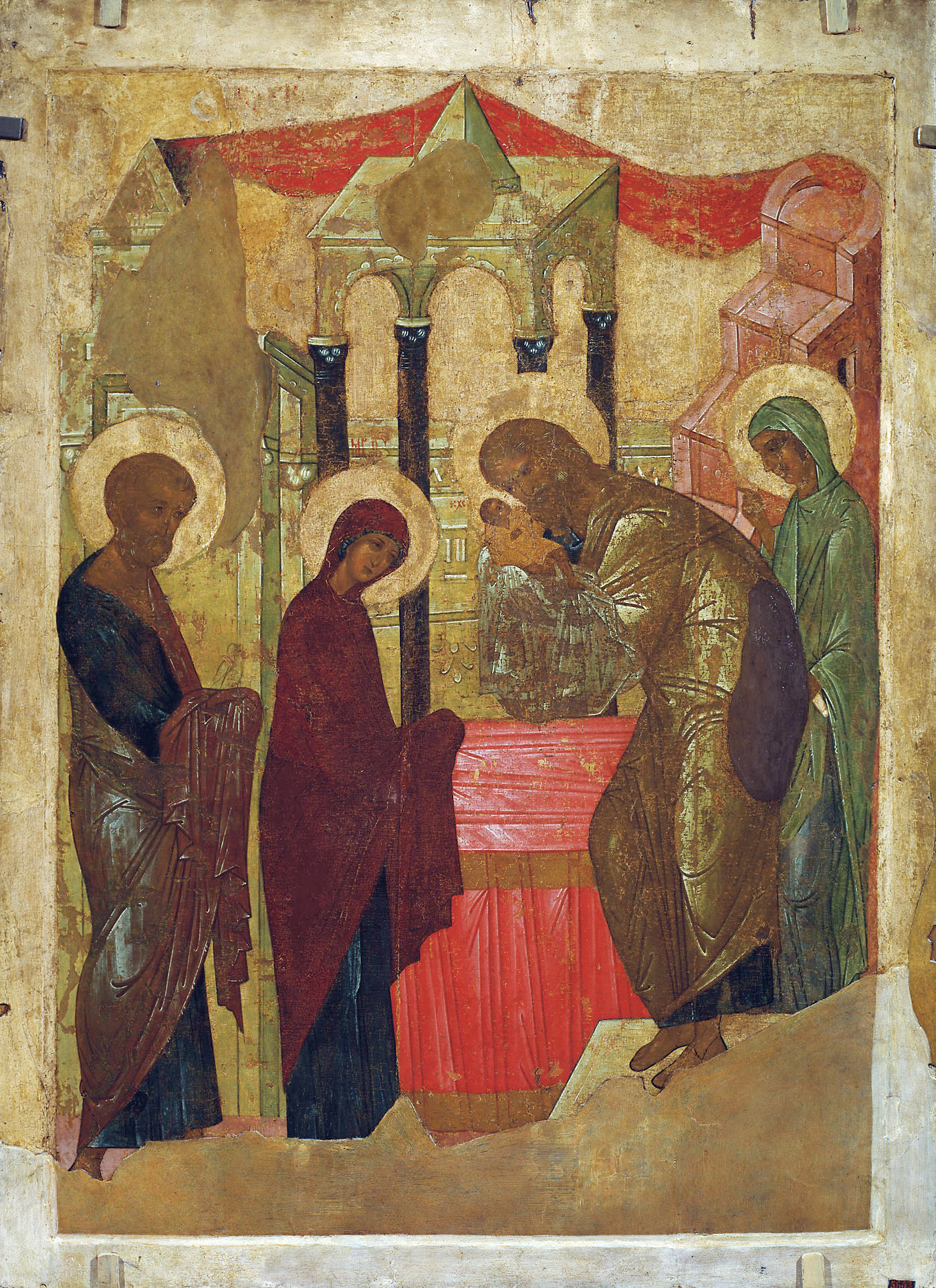
Presentation of Jesus at the Temple, Andrei RublevForty days after Christmas on February 2nd, Christians recall the Presentation of Jesus in the Temple. In a number of Christian denominations the season of Epiphany comes to an end.  According to scripture, Mary and Joseph took the baby Jesus to the Temple in Jerusalem forty days after his birth to complete Mary’s ritual purification after childbirth and to perform the redemption of the firstborn in obedience to the Law of Moses (Leviticus 12, Exodus 13:12-15).


As Mary and Joseph were poor, Mary was relieved of offering a lamb and a dove for her offering. Instead, she was to “take two turtle-doves or two pigeons, one for a burnt-offering and the other for a sin-offering; and the priest shall make atonement on her behalf, and she shall be clean” (Leviticus 12:8).

Around the globe, Christians will likely remember these early events as reported in Luke 2: 22-40. In fact, it is one of the most ancient feasts of the Christian church. With the traditional end of Epiphany, many remove any remaining Christmas greenery from their homes. If you are visiting the Taize’ Community in France, you will likely see a cage with two doves or pigeons in their Church of Reconcilliation. After the service, the birds are released. As the story reflects the light of Christ breaking into the world, it remains a common practice at many services throughout the world to bless candles for use during the year. To this day, some countries share special meals during family celebrations (i.e. crepes in France, or tamales in Mexico).

Pennsylvania Dutch folklore attached an ancient, pagan European practice of weather prognostication to this day. If the groundhog sees its shadow, superstition indicates winter weather will continue for six more weeks. (In ancient Europe, one might have heard of a badger or sacred bear serving this purpose.) Yet, such beliefs weren’t only held in Germanic nations. In England, one old English poem exclaims:

If Candlemas be fair and bright,
Winter has another flight.
If Candlemas brings clouds and rain,
Winter will not come again.

No matter the weather, I hope you and your family will develop your own ways of recalling the Presentation of Jesus. It reminds us of the Holy Family’s piety, and our family’s call as well. It displays a family united by love, as our own should be. The feast most importantly can remind us of how that young male child redeemed on that day came to redeem us through his cross and resurrection. We really should celebrate!

Unless otherwise indicated, all scripture quotations for this article are from the New Revised Standard Version (NRSV) translation.

© 2013 The Rev. Louis Florio. All content not held under another’s copyright may not be used without permission of the author.

Leave a comment

Filed under Church History, Liturgical Year

We are family!

I am the pastor at Messiah Lutheran Church in Mechanicsville, VA. We are continually blessed by a creative and active relationship with the local Lutheran Family Services of Virginia staff. We have cooperated on many projects like the Change Who Waits Rally in Richmond (see my entry below).

This past spring, we hosted our second annual LFS Family Celebration Picnic at Messiah. Our special guests included LFS staff and their families, along with children, family and volunteers of their adoption/foster care programs and autism programs. Fun is always had by all – both Messiah members and our guests – as evidenced by this wonderful video shared with us on our recent Rally Day. (Many of the pictures are from this year’s picnic.)

Our theme for Rally Day 2012 was “We are family!” And thanks be to God, we can always strive to live like one. We are already looking forward to our next LFS picnic! You should come…

To learn more about Lutheran Family Services of Virginia, visit: http://www.lfsva.org

Leave a comment

Filed under Community Life, Ministry, Uncategorized, worship