Thanks to all those who helped Messiah Lutheran Church and School celebrate our 45th anniversary. I created the above video to present during our worship service to help us reflect on our past, present and future together. It includes many (but not all) of our partners in ministry. For a small church, you’ll see once again that we have a long and loving reach! It is not by accident a Thrivent loan representative remarked that we do more than many congregations ten times our size.
At Messiah Lutheran, we live out many signs of discipleship: feeding the hungry, caring for the sick and those at risk, meeting the marginalized and loving them as they are. Our financial stewardship has increased each year (faster than our growing membership), and our volunteering and lay leadership at our congregation and in the community has increased even more so. We have many new partners and now friends in ministry that help us reach beyond Hanover County to the world. Firmly Lutheran, we open our hearts to work with other Christians as part of one universal church, the family of God.
Yet we aren’t just busy bodies. Our activities, programs, wealth, size or location don’t make us who we are. In fact, we sometimes “lack” in those areas by standards of the world. No, we seek to act in response to our greatest gifts from God – hope, faith and love – and that makes all the difference. It defines us, shapes us and is the source of our ultimate significance. It is what makes so many notice our small little church in Mechanicsville as something “different.”
Over six years ago, the love I saw you have for one another attracted me to say yes to the offer of a call as your pastor. It is your love, a reflection of Christ’s own, that inspires me still. It is what amazes so many I meet, and I see it changing the world a relationship at a time. God’s doing something here. Christ is being made known.
Sure we aren’t perfect, and we can always do better. A small church that seriously struggles at times, we have Jesus and we have each other. That’s more than enough, and so we keep on discipling…together…no matter what.
As my friend from the Congo wrote, “Glory be to God for his faithfulness, happy celebration to everyone at the Messiah Lutheran Church and School.” Indeed, it is God’s faithfulness that invited us to be church together and made our celebration possible. Thanks for letting me walk with you. It is my honor, privilege and joy.
Pastor Lou Christ the King Sunday November 24, 2013
(I hope you enjoy the video. Please feel free to share this video with your family and friends.)
As Thanksgiving approaches, I find a favorite movie has begun playing on television over and over again, Miracle on 34th Street. This year, I have been reminded that miracles can happen over and over again in real life as well – whenever people choose to love one another as Jesus asked.
This past All Saints Sunday, I was given permission to share a sacred story. It was a tale of a suffering saint, not from long ago, but of one in our midst. Our sister in Christ, Rachel[i], a long-time member of our congregation, a baptized and believing child of God, was in desperate need. She was alone, fighting mental illness, and at risk of becoming homeless.
Rachel is well known to many if not all in our congregation. She has been a congregational member since the 1990s, although she has attended on and off since that time. Of late, she has especially stood out. Visibly, she has grown weaker and distant. Flowing conversations have become more and more difficult. Recently, one might only be answered with a short phrase or a single word. Due to medical issues, she is often seen getting up and down during our worship – going outside the sanctuary to the rest room or for water – and then returning. To be frank, her demeanor, appearance and behaviors could easily put one off or prove annoying.
This situation is sadly not unusual. She shares a story with many who are without family and suffering from mental illness. It is a story that began perhaps before birth, as her mother is said to have suffered from both mental illness and addiction. (Such issues are believed by some to often be partly genetic.) Yet, Rachel also reportedly suffered severe abuse in her original home from others who should have loved her. It is quite a testimony to her tenacity and gifts that she escaped that environment to become a valued employee where she worked and love a family of her own.
Still like many with similar histories, married life proved a challenge. When her husband allegedly became abusive, she decided to divorce him and start again. Unfortunately, he was able to use her mental condition and lack of financial means against her. She lost her children to his custody, and the now adult children – seemingly not understanding mental illness nor family systems – continue to blame her for the dissolution of their family. There is no meaningful contact or support.
Although she had tried hard to provide for herself and for her children, life seemed to work against her as new problems and challenges arouse time and time again. With this, her mental illness seemingly began to take control of her life. She had lost family, and she now lost friends. She eventually lost her job. Initially, a neighboring family tried to help her, but they, too, ran into problems of their own in the difficult economy. They couldn’t help her any longer.
All along, members of our congregation were walking beside Rachel. Certainly, I offered pastoral care and counseling. On top of that (if not more importantly), she received help with food, shelter, and rides. People tried to be patient with her and relate to her; always welcoming her into our assembly. Several sought to be like family to her inviting her to share in holidays and celebrations in their home. Despite our congregation’s current financial challenges[ii] and being a relatively small congregation[iii] for our area, our council managed to quietly pay for her room for several months while she was staying with her neighbors. We also provided assistance with necessities. Our president captured the council’s collective feeling when he said, “She’s been our sister in Christ when it was easy and times were good. We can’t pretend she isn’t our sister now when it is hard. We need to help her.”
Indeed, Rachel is not her mental illness. She is the person who always volunteers to help others, especially children. She heard of a need for children’s sandals and shoes overseas from a veteran she knew, so she initiated a collection through our church. Hundreds of youth in Afghanistan benefited. She is always ready to help us with property needs, vacation bible school, or mission work despite her current limitations. She is one who walks miles to join us for worship or events if she cannot get a ride. She insists on donating money for our shared ministry even when she has little and is told to use it for her own needs. As another person who knew her well said, “Some people love this church, but Rachel LOVES this church. It is her family.” Rachel is our sister, Christ’s sheep, and remains a beloved part of our family of faith.
As with family, Rachel had given the local social services permission to cooperate with me in meeting her needs, but we were confounded as to what could be done when Rachel finally became homeless. The local county only had funds for short-term housing (2 weeks), and our congregation struggled to find the money to pay the discounted rent with her neighbors never mind at a hotel or apartment. It appeared Rachel would be moved into the sometimes rough Richmond homeless shelter system. This put her at further risk of being far removed from her church family, being set back and delayed in her disability claim, and starting anew with a different social worker in an overtaxed, urban environment.
As I pondered this situation, I recognized the great challenge before us to get the money we would initially need to care for Rachel – $2500 for the first few months of housing using the county’s vendor. It was the safest place, easiest transition, and best rate we could hope for, and yet we don’t have that kind of money lying around. As I prayed about it, it struck me that perhaps I was looking at this problem the wrong way. Yes, it is an enormous problem in many respects, but what if we just tried to address the need bit by bit, step by step, and day by day? We could have a special appeal in our church and ask friends in the greater community to help Rachel. If we just looked for fifty people to offer fifty dollars (about the cost of a family eating out in many cases or to attend a family outing), that could cover the initial need. For those who couldn’t give, they would be asked to pray, help Rachel in concrete ways when possible, and welcome her in our assembly.
Symbolically, fifty is a number of freedom and new life, and that is what we want for Rachel. Leviticus 25 describes a Year of Jubilee when debts were to be forgiven, forced servitude was ended, and people began fresh. We now had a chance to help free one of our own sisters in faith – just 50 people and $50 at a time. We would call it our 50 X 50 Campaign, multiplying the love we ourselves had received as individuals from Christ and assuring Rachel that she is not alone.
Announcing this at worship on All Saints Sunday, I was nervous as to how the congregation would respond. I was heavy in my heart because I knew well what was at stake. In past police, hospice care, and mission work with at risk youth in South Dakota, I carried too many memories of those who didn’t make it through such times. Yet our hope is in a God of steadfast love. It is a love of miraculous, healing power that often works through the lives of ordinary people in unexpected ways.
So, I took the risk and made the appeal trusting that “all things work for the good of those that love God,” and God answered through his Holy People. Despite our attendance being lower than average that morning[iv], over $4000 was raised to help Rachel. We have never collected that much money in any appeal that fast before, and I dare say, never for anything as important. Since then, money is still coming in. In a world where too many people wonder if anyone could love them as they are, Jesus spoke love to Rachel that morning. Through us, he is still speaking.
Over the past few weeks in worship, we heard once again about the Beatitudes and how we should love one another. We were urged that we should be patient with and support the weak. We were reminded – both Roman Catholic and Protestant Christians alike – that saints are needed for earth and not just for heaven. I can’t say how this particular sacred story about Rachel will end in the immediate future, but I know Jesus and his people are in it for the duration. We have to be, because that’s exactly the way Jesus asks it to be.
As church, we should never focus on how weak we are or the size of any challenge ahead of us. We just need to seek to love, and Jesus will do the rest. Thus, we are told that we can rejoice and do all things through Christ who strengthens us – even miracles – one relationship at a time…even from a small, old building on Atlee Road.
——————————————————————————————————————-
As Rachel’s needs are long-term and many others’ suffer as she does, donations are still being accepted for our benevolence and charitable work. If you would like to help, please send your tax deductible donation (noting “50 X 50” on the memo line) to:
Messiah Lutheran Church and School 8154 Atlee Rd. Mechanicsville, VA 23111
In hindsight, the above story is reminiscent of this song. Originally written at the time of the recent “Great Recession”, it reminds us all to love one another and boldly be ambassadors for Christ. We are never truly alone (Matt. 28:20)! Enjoy…
[i] For the sake of this public message, the woman’s name has been changed to provide for some privacy. It is a story shared with permission.
[ii] Although our financial situation has improved these past few years, it is still not unusual for us to struggle just to pay bills some months.
[iii] Messiah’s average attendance is about 95 with a bit over 200 members.
[iv] Attendance was in the mid-80s on November 3, 2013.
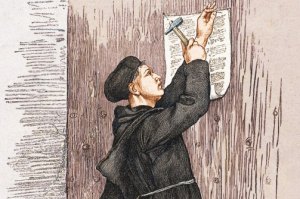
In case you come across this article by Thomas Cahill as I have being reposted and misused by some Roman Catholic brothers and sisters (along with some rather un-Christian remarks), be assured the author misses the mark somewhat when it comes to Luther’s psychology and theology. His take is too simplistic.
Luther’s efforts to reform the church (especially at the start) weren’t about ego alone, but about the Word of God being adhered to without mental gymnastics to make them fit corrupt and superstitious practices of the day. He was a pastor caring for his people, and a teacher seeking truth. His intent was not to be independent, revolutionary, or famous.
Unlike the short quote within the article, Luther’s words at Worms were more nuanced [please note the points I emphasize]:
“Unless I am refuted and convicted by testimonies of the Scriptures or by clear arguments (since I believe neither the Pope nor the Councils alone; it being evident that they have often erred and contradicted themselves), I am conquered by the Holy Scriptures quoted by me, and my conscience is bound in the word of God: I can not and will not recant any thing, since it is unsafe and dangerous to do any thing against the conscience.” (History of the Christian Church, vol. VII, ch. 3, sec. 55).
Martin Luther was posting an academic disputation – a common practice of his day – and wrote later writings to be discussed in community. He wasn’t looking for a fight nor a break with the church catholic, and his efforts were shaped by much more than just a matter of an individual’s ego.
True, self-interpretation of scripture has its weaknesses and excesses, but Luther wasn’t guilty there either. His focus remained on the assembly (the church) in relationship with one another and Christ. (This is made quit clear in his Large Catechism and other theological writings.) The church guided by the Spirit and tested by the divine revelation of scripture is the corrective for us all when it comes to interpretation, for Luther knew we all can err as much as popes and councils. We need to open scripture, listening for the Spirit and to one another.
As the debates rolled on and intensified, Luther failed to do that at times himself. Much like those posting anti-Lutheran insults and commentary, he let his anger and disappointment (and perhaps later his mental illness) govern some of his responses. After all, many people wanted to see him dead and weren’t exactly charitable either.
Martin Luther was human, and he realized it. In reviewing much of his writings, you will see him hesitate to state things definitively rather than to risk error. He critiques himself and his lack of ability. You will see calls for discernment rather than name calling over theological issues. He turns toward grace to light his way forward and not some internal power of his own.
I think such an attitude represents a very human, Christian humility and maturity rather than egocentricity. Adapted beyond theology discussions to a way of life, such an attitude will likely prove the best answer to what gridlocks us in our politics and divides our culture today.
As St. Paul reminded Luther and reminds us all, “And do not grieve the Holy Spirit of God, with which you were marked with a seal for the day of redemption. Put away from you all bitterness and wrath and anger and wrangling and slander, together with all malice, and be kind to one another, tenderhearted, forgiving one another, as God in Christ has forgiven you.” (Eph. 4:30-32). Even amidst important theological or other disputes, we are to remain one family of faith, the holy people of God.
Unless otherwise indicated, all scripture quotations for this article are from the New Revised Standard Version.
For those that have looked at my Heroes and Sheroes page, you might recognize that today is a special day for me. March 25th is the traditional commemoration date of Saint Dismas on a number of Christian liturgical calendars, and I bear his name.
Widely known as the “Good Thief” or the “Penitent Thief”, Dismas was crucified beside Jesus. The name Dismas was later adapted from a Greek word meaning “sunset” or “death.” His real name is unknown. Most likely, he was not a thief, but instead, some kind of rebel or raider deserving the death penalty under Roman law.
Dismas’ lesser feast day or commemoration derived from a tradition believing that March 25th was the actual calendar date of Christ’s crucifixion, although the Passover and Easter celebrations move due to their following a lunar calendar. The Feast of the Annunciation is the primary, modern celebration on our Lutheran calendars today (except when March 25th falls during Holy Week), but I still stop to remember St. Dismas annually on this day.
Although Dismas was never officially canonized by the Roman Catholic Church, he is declared so in scripture by Jesus himself. We hear in Luke that Dismas defended Jesus from the abuse of the other condemned man, commonly named Gestas (but also unknown). Hearing Jesus preach, teach and pray from the cross, Dismas began to look to Jesus with trust. He asked, “Jesus remember me when you come into your kingdom.” Jesus declared, “Truly I tell you, today you will be with me in Paradise.” (See Luke 23:39-43)
Years ago in a home with many challenges, I came to see the world in black and white terms. I secretly believed myself unlovable and defective even at a young age. As I write elsewhere, I am sure I heard the story of Dismas often in church growing up, but it first really impacted me while watching The Greatest Story Ever Told on television with my father in about eighth grade. At that time, I had been going through confirmation classes at St. Pius X Roman Catholic Church. Prior to confirmation (viewd as a sacrament in the Roman Catholic faith tradition), we were asked to think of a confirmation name, one to symbolize our coming to adulthood in faith and hopefully be a saint who inspired us.
In the Roman Catholic tradition, St. Dismas is the patron saint of condemned prisoners, reformed thieves, undertakers, funeral directors, penitent sinners, and prisoners. Indeed, some Lutheran and other prison ministries are named after him. When confirmed in the Catholic tradition, I decided to take his name. This seems ironic perhaps for one who would become a police officer, yet I always remembered how my heart was deeply touched by his story. In the depths of my being, I hoped I could be so loved.
Later as a young adult, I left active life in the church. I believed in God at some level, but I made bad choices at times, experienced losses that often come with life, and experienced much too much evil as a police officer. In short, I gave up on God. I became empty and cynical. I came to feel that not even Christ’s cross was enough to save me. I had much to repent over, for I was very wrong.
Yet when my life seemed darkest after another profound loss, two dear Christian friends from my past redirected my gaze toward the cross and its certain grace. On March 7, 1992, I had what I call my “re-conversion experience” – for I understand now that since my baptism and before, God has always been active in my life. My faith was small and deformed, but it made a difference in my life. God loved me before I ever realized it, even on Christ’s cross long ago. I truly experienced amazing grace, and my life changed.
Through this renewed experience with grace, I came to understand and more importantly finally trust that I was indeed loved and forgiven. I began to dig into scripture as never before. I hungered for the Word of life, and I found it alive in and through Christ’s church. With the church, I sought to share the grace I knew to be true with others in both word and deed. My police work became a sacred vocation. Later, God would invite me to take his love on the road through mission. Overtime, I discovered a home in the Lutheran family of faith. Still a sinner, I trust that I am also a saint. Christ declares this through his death and resurrection for our sake, and I do trust him for he never lies. His sacrifice atoned for our sin – past, present and future. His death remains enough to save us all.
Each year since my “re-conversion” and return to the church, I think of Dismas and rejoice. I celebrate the opportunities found in Lent and Christ’s forgiveness. I trust that with others who believe (and even those who don’t yet) I was, am and will be remembered. Dismas’ story is our own.
Yes, Jesus remembered us all as he died on that cross. He died, so that we could truly live…starting today.
Psalm 32 – The Joy of Forgiveness 1 Happy are those whose transgression is forgiven,
whose sin is covered. 2 Happy are those to whom the Lord imputes no iniquity,
and in whose spirit there is no deceit. 3 While I kept silence, my body wasted away
through my groaning all day long. 4 For day and night your hand was heavy upon me;
my strength was dried up as by the heat of summer. Selah
5 Then I acknowledged my sin to you,
and I did not hide my iniquity;
I said, ‘I will confess my transgressions to the Lord’,
and you forgave the guilt of my sin. Selah
6 Therefore let all who are faithful
offer prayer to you;
at a time of distress, the rush of mighty waters
shall not reach them. 7 You are a hiding-place for me;
you preserve me from trouble;
you surround me with glad cries of deliverance. Selah
8 I will instruct you and teach you the way you should go;
I will counsel you with my eye upon you. 9 Do not be like a horse or a mule, without understanding,
whose temper must be curbed with bit and bridle,
else it will not stay near you. 10 Many are the torments of the wicked,
but steadfast love surrounds those who trust in the Lord. 11 Be glad in the Lord and rejoice, O righteous,
and shout for joy, all you upright in heart.
Prayer:
Gracious Lord, even as you died on your cross, you looked upon Dismas and saw our human need, shared suffering, and sin. You looked upon him with love before his repentence. His simple trust in you opened a way of communion with your heart’s mercy and forgiveness even as the centurion’s spear sought to tear your heart asunder. Your death and resurrection saves me. His trust in you inspires me. Bless your entire church; that together we remember your cross with confidence, persevere in faith through times of trial, and experience the resurrection of our lives today. Empower us to remember and serve the outcast, sinner, and all who suffer; sharing your grace, mercy and love, as you have so abundantly shared it with us. Amen.[i]
[i] This prayer is inspired by a Roman Catholic prayer.
Unless otherwise indicated, all scripture quotations for this article are from the New Revised Standard Version (NRSV) translation.
“From silly devotions and fromsour-faced saints, good Lord, deliver us.” – St. Teresa of Ávila
Much too often, I come across people dreading Lent. Perhaps these folks might not like to remember that we are all sinners. Perhaps they feel threatened by the scriptural reminders of condemnation and death found in the texts so often used at our worship. They might be filled with dread as they overly focus on sacrifices and rituals. In doing so, we risk minimizing the power of Christ’s cross and resurrection; forgetting God’s grace reaching out to each of us. We tend to forget to live out and share our faith in daily life, and thus fail to fully experience the joy that it can bring to us and others today (not just in heaven). Lent in its Old English root means “spring,” and today, I have trouble viewing Lent as anything but a beautiful experience of growth and new life.
As I have shared with others, I become remarkably joyful during Lent. Even as I might confess my sins anew with ashes on my head, I can’t keep from smiling. You see, Lent was coincidentally the time of my rapproachement to the Church after many years away. Much like the prodigal son, I had spent my early adult years squandering the grace offered to me in my baptism. A difficult family life and things I saw as a police officer had hardened my heart against God and others. Eventually, I had come up empty. (No surprise there, I suppose.)
It was at this time of crisis – as Lent began in 1992 – faith-filled friends reminded me of the reality of God’s grace. With their loving witness, invitation and guidance, I discovered the compassion that God had for me all along. Much like Zaccheus in his tree, I became excited to hear Christ’s invitation to join with him in celebration within his Church. God was love indeed, and God could even love me! (This was indeed a great surprise to me at the time, for I had suspected wrongfully that my sins were too great even for Christ’s cross.)
Lent that year became a gift for me to be excitedly opened and treasured; a period of renewal and celebration. It was a joyful time of being embraced by Christ and by his Church. It proved to be my “re-conversion” experience, where I discovered the beauty of our baptismal promises and shared faith. It wasn’t a perfect time, and I still struggle with sin, but Jesus used this time of shared disciplines, fellowship, and service to restore me to wholeness. By Easter, I understood more about the Resurrection than I ever dreamed possible. I had begun to experience its reality in my own life. Thus affirmed, I trust I have much more to learn and experience in the years ahead.
Despite our sin and unworthiness, I don’t believe sour-faces or dread are necessarily very appropriate as we go about our Lent. Instead, I echo Paul proclaiming, “Rejoice in the Lord always; again I will say, Rejoice!” For with Jesus, all things are possible – even our new life in him. I pray this Lent prove a time of “re-conversion” for us all and a very real celebration. I am sure God’s grace will surprise us once again. [1]
For even more Joy this Lent…
As I reentered the Church, I found listening to other people’s stories helped me on my own walk with Jesus. Both historic persons – biblical personas such as the Prodigal Son, or real people such as Zaccheus and later saints – as well as people around me became a testimony about the grace God offers us through a beautifully diverse “great cloud of witnesses.”[2] These people of faith speak to me, not of perfection, but of God’s grace at work in our everyday lives. They remain concrete signs of God’s love active in the world as we ourselves strive to love God and neighbor.
Even as Lent is meant to be a time of self-examination and repentance, it is also certainly a time of joy. Fun need not be outlawed. Therefore, I am very grateful to the two Episcopal priests who created the interactive fun known as Lent Madness, and I happily recommend it to you as part of your own Lenten devotions.
Lent Madness is basically 32 saints (those primarily included in liturgical commemorations by the Church) matched up in a tournament-like single elimination bracket. By participating in Lent Madness, you will likely learn and laugh, because the bloggers responsible also seek to reveal the sometime laughable nature of Christ’s saints – a nature we all share.
So, I strongly urge you join other saints of our time at the website daily. We’ll read about some very special, faithful people and have the chance to vote for our favorites. Jesus offers salvation to us all, but your vote helps determine who “wins” the Golden Halo.
[1] The above portion of this post was written for use in the Lenten reflections to be shared by FaithInRichmond.org during Lent 2013. It was published under the title, Surprised by God’s Love.
Our church isn’t this building (Messiah Lutheran’s “new” sanctuary, October 1991)
I thank my God every time I remember you. (Philippians 1:3)
Over the last several years, we have spent much time working on and worrying about our aging building (much of which dates to 1968). It sometimes seemed that once one problem was addressed, another would turn up. It is remarkable to see how much has been done to improve our grounds and facility, especially during such difficult economic times. Messiah has physically become a more safe, beautiful and welcoming place, and so I am thankful for the council, property team, and all those that help with painting, fixing, mowing and more. People have been very generous with their time, treasure, and talent; blessing both us and the greater community we serve.
Yet as vitally important as such work remains, I don’t lose sleep over the challenges we face. Our strong foundation and cornerstone has and will remain Christ. It is a joy to be among so many Christians who are willing to take time to participate in Christian formation classes so that they and others can grow. Dr. Paul Hinlicky recently shared at a Virginia SynodACTS class, “The more educated the laity is, the more powerful the ministry is.” This has proven true as more and more members have discerned that they should participate in existing ministries at church and within our community, or have felt called to initiate new ones. It is also seen in the thoughtful and prayerful way our council approached the refinancing question or the welcome of All Souls Episcopal to share our building on Sundays and beyond. The conversations were thoughtful, biblical, challenging, and sometimes quite passionate, yet always, those involved went away secure in their love for one another and more committed to sharing in the mission placed before us by God. It is quite a testimony to the reality of the priesthood of all believers that James Anderson, Jake Addair, and Tripp Dillard conducted our congregational meetings about our financial challenges with such honesty, compassion, and vision. Few congregations exhibit such strong leadership across the board as I witness time and time again here at Messiah. It inspires me, and it builds up Christ’s church.
All this reminds me that it isn’t our building or the hierarchy of the ELCA that is ultimately the church. We are the church together in the way we love God, each other and our neighbors – not perfectly yet certainly well. “Your cooperation with the Richmond staff of Lutheran Family Services is a model for the entire state,” commented the CEO of Lutheran Family Services of Virginia on a visit a few weeks ago. As Thrivent Financial for Lutherans reviewed our church life, assets and vitality, the loan officer noted one of the greatest assets we have is one another. He said, “Amazing. I’ve looked at congregations ten times your size that don’t seem to have as much going on.” One recent visitor commented without any solicitation, “I felt the presence of God in your worship today.” A member of Messiah who travels many miles to worship with us told his surprised friends why he travels so far instead of finding an assembly closer by his home. He said, “I just can’t accept not seeing the people here at this church.”
We are a smaller congregation than many. We face many challenges – financial and otherwise. Yet Jesus is most certainly among us as our Lord and our friend. We are sincerely seeking to be faithful witnesses to him by living as loving friends to one another and our community, and your participation at any level has blessed many others whether you realize it or not. The ancient wisdom of Sirach proves true here:
“Faithful friends are a sturdy shelter: whoever finds one has found a treasure. Faithful friends are beyond price; no amount can balance their worth. Faithful friends are life-saving medicine; and those who fear the Lord will find them.”
In you, I have found friends, and even more so, brothers and sisters in Christ, a true treasure. In this season of thanksgiving, I offer mine to you and my God. Kristine and I will continue to celebrate your love and faithfulness in our lives. We pray that you and your families be blessed not just this Thanksgiving but always.
Peace,
Pastor Lou
Messiah began on November 3, 1968 (All Saints Sunday). To see pictures of our history together, visit the heritage page of our website’s gallery. (Complete photo gallery available through http://www.mlcas.org)
The above pastoral letter was originally published in Messiah Lutheran Church and School’s newsletter, The Messenger (November 2012 edition). To view the entire issue of The Messenger or to see the full calendar of events, visit: http://www.mlcas.org
Unless otherwise indicated, all scripture quotations for this article are from the New Revised Standard Version (NRSV) translation.
I woke up this morning to a brand new day, yet it was sadly much like yesterday: split executive and legislative branches, split senate and congress, split populace (almost a 50-50 vote), split country (the heartland states look like a bloody knife through the US, splitting the east and west coast blue states), split urban v. rural (in many cases, the majority of any state voted for Romney geographically but the few, heavily populated areas went for President Obama), split white male voters versus (seemingly) almost everyone else, and split young versus old. I hear cries of despair with some angry insults from “the losers.” I also have witnessed arrogant blustering over victory. Some wrongly make the President appear to be the answer to every ill known to humankind, yet he is human and not the Messiah. That isn’t fair to neither him nor the country, and to me, it seems to diminish God’s role in our public affairs. Despite a few boasts of a mandate, there is clearly a risk of a Divided States of America if we don’t watch ourselves, repent of our wrongs, and seek to love one another.
On both the Left and Right and among many inbetween, we need to change our ways. Policies shouldn’t be thrust down the throat of others, and any movement shouldn’t be log jammed mechanically. We should demand our leaders talk to one another rather than isolate themselves in their Congressional chamber or executive mansion. We all should practice some self-reflection and restraint. In addition, “We should fear and love God so that we do not tell lies about our neighbor, betray him, slander him, or hurt his reputation, but defend him, speak well of him, and explain everything in the kindest way” (Luther’s Large Catechism, section on the 8th Commandment).
Pastors and people should remain cognizant that faithful Christians can and do disagree on serious topics regarding loving God and neighbor. The pulpit shouldn’t be a place of personal, one-sided political agendas passed off as being “prophetic,” but rather the ministry of Word and Sacrament should prove a source of healing, reconciliation, and new life. We should think and pray hard before speaking and seek to engage and comfort those who have perhaps been thought of as our political enemies.
As with many times before in our fallen world, the difficult work of reconciliation lies before us. If we are ever to move forward to discover beginning signs of a true new day, we must intentionally seek to embrace this call from Christ. In times like these, I remember the words of Br. Roger of Taizé: “Human beings are sometimes severe. God, for His part, comes to clothe us in compassion. He weaves our lives, like a beautiful garment, with the threads of His forgiveness. He buries our past in the heart of Christ and He had already taken care of our future.”
We need no longer react in fear or self-interest. Jesus has freed us to act in love. Still being true to our faith and ideals; still calling out what we think to be sin, political wrongs, or violations of law (even if seemingly in our favor or fitting our world view); still demanding true transparency and not just promises of it – we can seek to be gentle with one another, as Christ is always and will forever be so gentle with us. We can recall that at our best, we are sinner-saints, imperfect, and thus, we can humbly acknowledge that we might just be the ones in error in the end. First and foremost, we must remember we are called to be one in Christ, and we need to try to view others as Jesus does.
No matter what happens politically or economically, I remain confident – not in the powers of this world, or even in myself, but in Jesus Christ alone. God’s will willbe done, and all will be well.
I invite you to reflect upon 2 Cor. 5, as I will be, over the days ahead. In addition, consider enacting a practice at your congregation started by our Mennonite brothers and sisters right here in Virginia – Election Day Communion. Learn more here:
“Greetings, favored one! The Lord is with you.” These words spoken by the angel Gabriel to Mary so long ago have echoed throughout the centuries. They now speak to us.
For her part, Mary was called to give birth to and raise a son, and her life and the life of others would change in unimaginable ways for eternity. One might rightly wonder what she did to deserve such an honor – to play such an important part in this divine plan. Although Christians often debate this question, scripture doesn’t explicitly say that she in any way earned anything. Perhaps it isn’t worth arguing about. Mary was ultimately “favored”, chosen by God despite any real or imagined weaknesses. Like us, she was created and called. In response, she answered despite any initial fear, doubt or darkness within herself, “Here am I, the servant of the Lord; let it be with me according to your word.” She trusted that, indeed, nothing is impossible where God is concerned. In faith, protected and empowered by God’s Spirit, and in humble thanksgiving, Mary would seek to live out her vocation as best she could.
Our Orthodox brothers and sisters call Mary, Theotokos. This title is commonly translated from the Greek as “the one who gives birth to God” or more simply “God-bearer.” As we selected music for our Advent and Christmas services, I meditated upon an old, favorite carol of mine, The Angel Gabriel from Heaven Came (ELW #265). It struck me once again how Gabriel’s greeting is in a way spoken to each of us who believe, for we are most favored as well. By grace through faith, the Lord is truly with us, and we have been chosen to bear Christ into the world as part of God’s plan.
Like Mary in scripture, we might at times prove afraid. We might sell ourselves and our God-given abilities short. We might even misunderstand Jesus’ roll and his plans. Yet despite any sin or failures on our part, or any challenges we face, Jesus promises the Spirit will dwell within us, protecting and empowering us to share in a miracle of new life. We are only asked to trust and respond – through loving God and others – as best we can. God will see to the miracles that will surely flow from there.
May the blessings of Christmas be with you now and always, Pastor Lou
The above pastoral letter was originally published in Messiah Lutheran Church and School’s newsletter, The Messenger (December 2011-January 2012 edition). To view the entire issue of The Messenger or to see the full calendar of events, visit: http://www.mlcas.org
Unless otherwise indicated, all scripture quotations for this article are from the New Revised Standard Version (NRSV) translation.
“Though the fig tree does not blossom, and no fruit is on the vines; though the produce of the olive fails and the fields yield no food; though the flock is cut off from the fold and there is no herd in the stalls, yet I will rejoice in the Lord; I will exult in the God of my salvation.” (Habakkuk 3:17-18)
Each year as Thanksgiving approaches, I tend to recall the period of my “conversion.” It isn’t that I didn’t understand Christ came as our Savior, nor that my baptism mattered. Intellectually, I had made that connection. Yet as a younger man, I just didn’t trust that Christ’s mission could possibly, truly include me – no matter what anyone said. Troubles within my family of origin, heartbreaks that too often come with life, and what I saw and experienced as a police officer had hardened my heart. Some inroads had been made into my life where seeds were planted for future spiritual growth, but in both word and deed, I fought the Spirit the entire way. As often happens in such a life, I became more isolated and felt empty. Many of the choices I made only served to hurt myself and others.
Fortunately, Christ reaches out to us even when we can’t see him; or even when we turn from him in our lives. When it seemed my life was crashing down around me, I discovered signs of his love and faithfulness, not only through the promises of my own baptism, but through those faithful and baptized Christians he had already sent into my life. Their example, guidance, prayers, and support showed me a new way to live. I became ready to trust in their testimony about Christ’s grace at work in their own lives, and as I delved into God’s word, I heard a message of love I hadn’t previously been ready to fully grasp. In forgiveness, I found joy, and my life began to reflect it.
One day when I had a flat, I was forced to change the tire in a heavy, nearly freezing rain. My fingers got stiff, and as I fumbled, began to bleed. Still, I caught myself singing a song of praise based upon Habakkuk’s own trust and joy. This surprised me for, only a few month’s earlier, other words would have certainly flowed from my mouth but no longer. My heart knew that my difficulties were a passing thing, and God’s love endures forever. Even in that moment, my heart found cause to trust Christ, remember the signs of his love active in my life, and give thanks for his protection and care.
Just as the great Psalm of praise, Psalm 113, is book-ended by the words “Praise the Lord”, I came to understand that so my life should be. For Christ is with us always, and in every moment (not just November or when times are good), he is worthy of our trust, praise and thanks.
Blessed Thanksgiving to you and yours,
Pastor Lou
The above pastoral letter was originally published in Messiah Lutheran Church and School’s newsletter, The Messenger (November 2011 edition). To view the entire issue of The Messenger or to see the full calendar of events, visit: http://www.mlcas.org
Unless otherwise indicated, all scripture quotations for this article are from the New Revised Standard Version (NRSV) translation.
So if the Son makes you free, you will be free indeed. (John 8:36)
True freedom isn’t found through political struggle, economic independence, or rugged individualism. Freedom comes ultimately through the heart alone. When we honestly look at ourselves, we find some level of both brokenness and beauty. Despite any of our gifts, we can’t be complete on our own. Realities of the world limit us. We need help. We need others. We need Christ. It might not seem to make sense, but rooted in relationship, we discover the meaning of true freedom.
In a healthy (not perfect) community founded on the love of Christ, we best discover a glimpse of who God created us to be. Whether or not we come from troubled homes or seem to have no one to call our own, we discover ourselves as part of a larger human family and purpose. Love, trust and mutuality help us mature and flourish. Forgiveness received and given makes us and others new. Shared service brings healing. We are never the center of the universe, but we discover our uniqueness can be used to bless others and our world. Best of all, through such a loving communion, we are drawn more deeply into the heart of all life and love, Jesus Christ himself.
Yes, we will all remain human, weak, and imperfect. The social structures that surround us will likely continue to reflect the brokenness inherent within each human heart. Yet despite these “realities”, Christ makes us free to love. Trusting him, we can therefore choose to bravely claim and embody the love given us first. Imperfect as we are, right now, no matter the risk or cost, we can seek to establish heart to heart relationships in his name. Within these relationships, we live out the gift of reconciliation, accept differences, and are empowered to help address any doubts and darkness within ourselves and our world. Miracles will happen. Hand in hand and guided by grace, we will experience the true freedom and transforming power found uniquely within the communion of saints. Rooted together in Christ, new life will most certainly grow.
Peace to you, and Happy Independence Day!
Pastor Lou
The above pastoral letter was originally published in Messiah Lutheran Church and School’s newsletter, The Messenger (July 2011 edition). To view the entire issue of The Messenger or to see the full calendar of events, visit: http://www.mlcas.org
Unless otherwise indicated, all scripture quotations are from the New Revised Standard Version (NRSV) translation.
Husband, Pastor, Law Enforcement Chaplain, and member of the Clerical Errors (aka "The Three Priests"), I'm sharing my two cents with anyone who cares...
You can also find me on social media as Loudluthrn (Lou-d-Luthrn or Lou the Lutheran). It is a moniker given me while attending a Presbyterian Seminary, but I'm a loud and proud Lutheran too (just not too loud and proud, mind you).









 2pennyblog