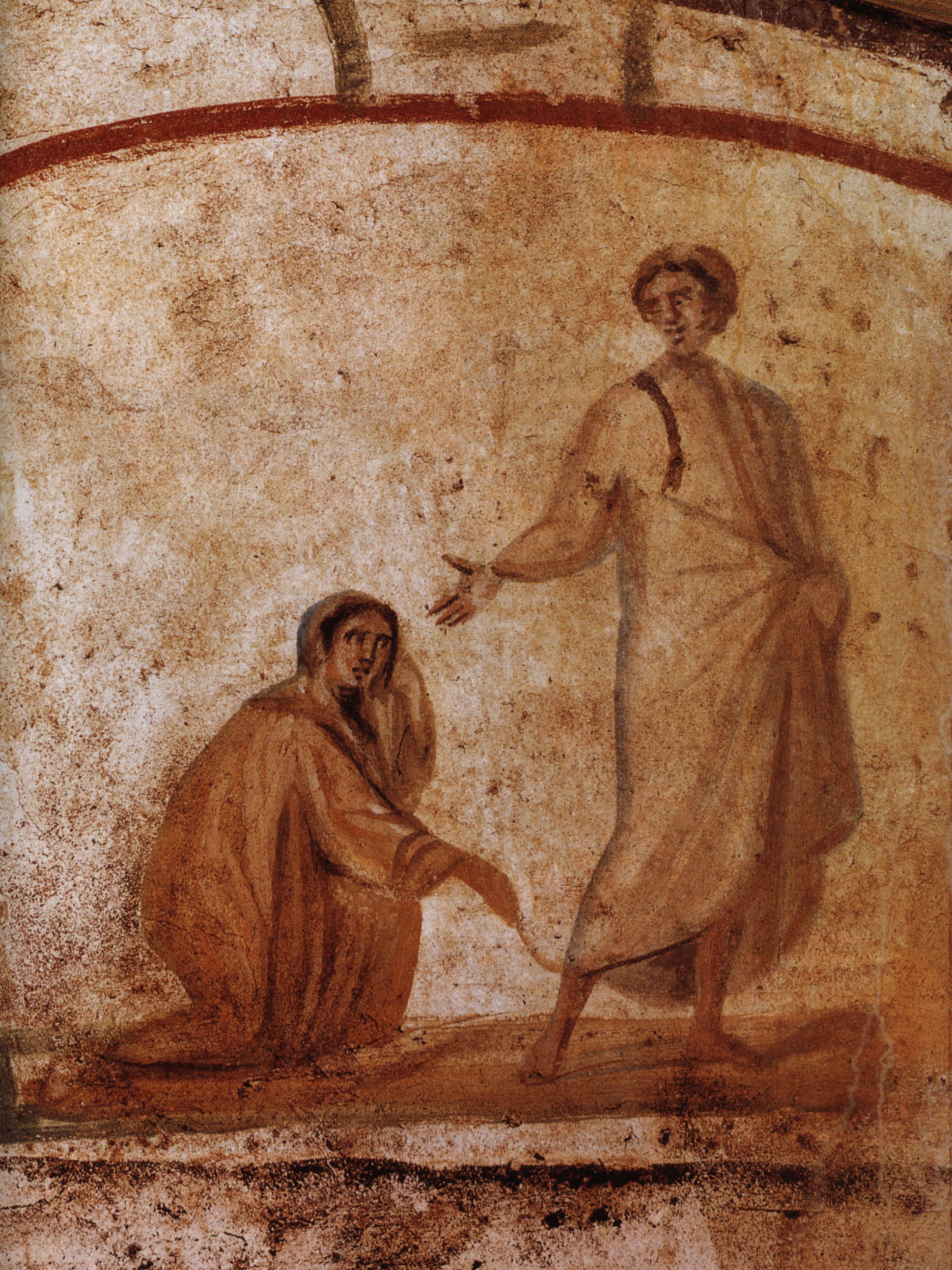
The readings for the 2nd Sunday After Pentecost, Yr. A were: Hosea 5:15-6:6; Psalm 50:7-15; Romans 4:13-25; Matthew 9:9-13, 18-26. This sermon was preached at Grace & Glory Lutheran Church in Palmyra, VA on June 7, 2026.
As a well-known law enforcement chaplain in Virginia, I am often asked to offer ceremonial prayers for events. This includes Law Enforcement Basic graduations from a regional academy. Amidst what is often shiny, happy faces of graduates and their families, a few days ago, you would have seen the shine of their badges obscured by a shroud. There have been some pretty traumatic stories in Virginia of late. Yes, a line of duty death, but other high-profile acts of violence even amidst families. And just south of where I currently live, six people died in a terrible vehicle accident with two more later in the week.
Exposure to trauma and loss comes at a cost. And so as I was at this most recent local academy graduation to offer the ceremonial prayers…with events reminding them of friends they had already lost in their service to the community…or other tragedies that they have been exposed to…I had several let down their usually robust guard of their emotions to risk speaking with me. These officers just needed to share with someone how wrong the world can seem at times. They hoped to find even just a bit of release from the weight of sorrow that they carried. In a sense, even if they did not fully recognize it, they yearned for healing…for someone to say that it will be ok.
I share this because I think we all might sense there is something wrong with our world…even when things seem to be going very well. In biblical terms, we usually sum it up by saying we live in a Fallen World. That’s perhaps too tidy a word for the messes that we see, but it reminds us that…whatever we believe about the story of Adam, Eve and the forbidden fruit they ate in the garden…something is just not right. As my Lakota friends say as they end their own sacred stories…Héčhetu yeló… “That’s the way it is.” Across cultures and religions, even secular philosophies, we humans tend to collectively recognize that the world needs help. We need help. For we are, even at our best, unwell.
This experience reminded me of why we need Jesus so desperately. We need the hope and healing he offers all. We along with all of creation groan for his return and his completed vanquishing of sin, death, and the Devil. We are told that at that time of restoration, at his return, a new heaven and earth will come where “the streets of the city shall be full of boys and girls playing” (Zechariah 8:5) happily and safely, and God will wipe every tear from our eyes. “Death will be no more; mourning and crying and pain will be no more,” for the first things will have passed away (Revelation 21:3-4).
As humble Lutherans, we are asked to recognize that we also are not well. Even at our best, we are saved, and yet, we still struggle with sin. That’s how Martin Luther summarized it. We are “Sinner-Saints.” As a former Dean of Trinity Lutheran Seminary wrote for the magazine Living Lutheran:
“Being a saint isn’t about what I do or don’t do but about who I am in relationship with God. That’s also true of being a sinner. The Lutheran confessions define sin as the self-centered failure to trust God (Apology of the Augsburg Confession, Article II). Adam and Eve’s problem wasn’t just that they ate a piece of fruit or broke one of God’s rules. Their real sin was their desire to be ‘like God,’ relying on their judgment rather than trusting God’s word. For us, too, our specific sinful behaviors are only symptoms of this self-centered condition that theologians call ‘original sin.’”[i]
Thus, recognizing our own need for grace, hopefully, we are more intentional about trying to offer that same grace to others. Or as John reminds us, “We love because [Jesus] first loved us” (1 John 4:19).
There was a popular author awhile back who used to quip that “Grace is unfair, which is one of the hardest things about it.”[ii] (We can struggle accepting the reality of who God chooses to offer grace too – sometimes ourselves but certainly those God loves but we deem somehow underserving.) Yet this is indeed the teaching embodied in and through Jesus. And today, it is one of the beautiful truths we can see with God’s help in our assigned Gospel reading. Within a few short verses, we see how grace works amidst the difficulties and selfishness of the world…how it reaches out to embrace individuals and respond to the world’s fallen harshness.
Look, for example, at the call of Matthew. Nothing is said of his deserving his call. Jesus just knows God’s purpose and possibility created within him and says, “Follow me.” As you have probably heard many times before, tax collectors of that day often lined their own pockets to supplement their pay. They were collaborators with a foreign empire suppressing the Jewish people. They were people who made terrible choices when it came to life and relationships. They sinned, and thus they were ostracized…which might have just made their behaviors in some cases worse. If you are going to be condemned, why not go all in on your sin? Why try? I would be a very rich man if I was compensated for every time I heard a modern person express such deformed thinking.
You see, Jesus came to save the world…to call all people to himself. God saw what was created and declared it good. Humans, however we might identify ourselves, all reflect God’s own goodness…God’s image. Despite the reality of sin, no matter how stuck we might feel…God thinks differently. With the help of God, we have the capability to do better and be better…to be made well. Jesus, our Redeemer and Savior, knew this as he approached the tax collectors. He lived this as he ate with tax collectors and other sinners. He sees them as the troubled children of God they are but also as they can be through his grace. So, grace comes to them…is offered them…through Jesus.
And what of the Pharisees? They knew God. They knew the law…but compassion and empathy were not always their strongest suit. If someone struggled with sin, they did not feel obligated to seek them out. They tended to give up on those they deemed sinners, and in doing so, they hesitated to be in relationship with them. Blindly, they thought they honored God and protected themselves from sin. Yet even in Jesus’ correction, he offers the Pharisees grace. They are asked to remember the words of Hosea, the prophet. God desires mercy, not sacrifice. We are invited to be God-like in the way we offer grace to others. They, like the tax collectors and sinners, are invited to repent and start anew.
In his warnings to the Jewish people in the Northern Kingdom, Hosea clearly speaks of the Law, the risk of judgement and consequences for their wondering hearts. Yet, the entire text, and Hosea’s own relationship with his unfaithful wife, Gomer, shouts of grace. Hosea seeks Gomer out with a willingness for forgiveness while offering new starts. God through the prophet’s teachings and actions demonstrates a repeated invitation despite repeated failures, “Return to me…Return to me.” This invitation brings back to my mind a hymn from my youth about Hosea, “ Come back to me with all your heart; Don’t let fear keep us apart; Trees do bend though straight and tall; So must we to others call.”[iii] Our hesitancy to repent of our own sins, to believe that we can change…or our lack of grace for others perhaps struggling with sin more than we or in a different way…is challenged by a grace which seeks each of us out as we are.
And then, most of us here know too well the sting of death…the fears or dismay that can come with any sickness. A leader of a synagogue had heard enough about Jesus to trust his ability to raise his dead daughter to new life. On his way, a woman who had a bleeding disorder of some kind had also heard of Jesus. She, too, had come to believe that healing was possible. She trusted in her heart that if she could just touch the hem of his garment, she would be healed.
You might now that in Numbers 15:37-41, God commanded Israelite men to wear twisted tassels of wool on the four corners of their outer garments. This cord was to serve as a daily visual reminder to keep God’s commandments. Yet in Hebrew, this hem area could also be called a corner, edge or wing. For the children’s sermon, I had a giant stuffed eagle to remind us of how in Psalms, Isaiah and elsewhere, eagles wings don’t just life us up, they gather us in. Or, we are told that God loves us as a mother hen protecting us with her wings. Some Jewish traditions believed this hem symbolically echoed Malachi 4:2 that the Messiah would bring healing in His “wings.”
So, a lot is going on here in our Gospel reading today. The unforgiveable are not only forgiven but called. We are also talking about resurrection as the greatest of prophets like Elijah were known for. The leader of the synagogue kneels before Jesus as one before God. The Spirit helps him identify Jesus. We then see a woman that has been isolated from active participation in her community by purity laws due to her bleeding. Suffering physically, emotionally, and socially, she is reaching out in faith to someone that she seems to see through a hopeful heart and the gift of faith as the Messiah. Against all odds, people have been forgiven, included, and healed…through the grace offered by Jesus.
Is it any wonder that news of this spread so quickly? Jesus defied human expectations and social convention to offer his healing grace. This remains true in our own lives. We are unwell. Life is unfair. Yet grace, being unfair, reaches out to us anyway. Grace moves based on the will of God, not human constructs of legalisms or expectation….God wills to save us. Can we accept that gift?
As a popular Christan speaker, Chad Bird, pointed out on Facebook,[iv] unrelated to our lectionary, we are asked to confess our sins and repent, because, I would add just as Luther wrote, it is healing medicine. We all need that healing. Yet, don’t ever stifle God’s lifegiving grace. Don’t sell its power short. Resist the temptation to doubt and believe. For it isn’t the complete and perfect confession of our sin that saves us, nor any of our efforts. Our faith, our trust in Jesus, imperfect and struggling as it might be, is used by Jesus to heal us…sometimes suddenly and sometimes over time…and it is he who invites us to risk following him. Bird writes:
Your repentance was not crucified for you.
Your confession did not die for you.
Your faith did not rise from the grave, Jesus and Jesus alone, lived, died, and rose again for you.
When God the Father forgives us, he forgives us as people who repent, confess, and believe.
But it is not our confession or our faith, that is our salvation.
Christ and Christ alone is our salvation.
And it is this same Jesus who has come to our own house this day, to eat with us at the table, to share his hope and healing with us. Amen.
[i] Kleinhans, K. (April 12, 2005). Saints and Sinners: Sin and Forgiveness. Living Lutheran. Downloaded at https://www.livinglutheran.org/saints-sinners/.
[ii] Philip Yancey wrote these words in his book, What’s so amazing about grace? (1997). Sadly, he confessed to an adulteress relationship last year, but this statement remains very true.
[iii] Hosea (Come back to me).
[iv] Chad Bird is a Scholar in Residence with 1517.org, a well-respected Christian non-profit organization rooted in the legacy of Martin Luther and the Protestant Reformation. He was a LCMS pastor and teacher who also had an affair and was divorced. After several years of active repentance and healing, he returned to writing and teaching particularly about the grace he and his family experienced. His Facebook post is dated June 6, 2026.
Below, please find a video of our worship service. The sermon starts at about the 23:57 minute mark.
© 2026 The Rev. Louis Florio. All content not held under another’s copyright may not be used without permission of the author unless under terms of fair use and properly attributed. Scripture passages when used are from the NRSVue translation unless otherwise indicated.