
Edited for additional content and minor corrections on November 12, 2026.
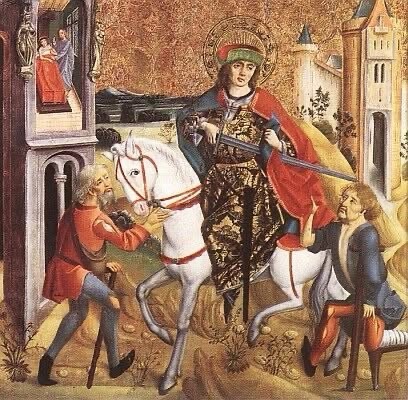
Today, November 11, the Church remembers Martin of Tours. Dying on November 8, he was buried on this date in 397.
Martin was a Roman soldier, born in what is now modern Hungary, who ended up serving in Gaul. One day, having compassion on a scantily clad, poor man, he cut his red military cloak to share it with him. That night, Martin experienced a dream or vision in which he saw Jesus Christ wearing the half-cloak he had given away; hearing Jesus tell the angels that Martin had clothed Him.
This spiritual encounter and his war experience changed the direction of his life. According to a biographer, Sulpicious, and other sources (as related in Wikipedia), “Martin came to conclusion that war was incompatible with the Christian life, so he resigned from the army and declined to receive the pension, telling, ‘I am the soldier of Christ: it is not lawful for me to fight.’ He was charged with cowardice and jailed, but in response to the charge, he volunteered to go unarmed to the front of the troops. His superiors planned to take him up on the offer, but before they could, the invaders sued for peace, the battle never occurred, and Martin was released from military service.” Martin became a priest and ended up Bishop of Tours in France.
During the Middle Ages, the supposed relic of St. Martin’s miraculous cloak (cappa Sancti Martini) was carried by the king even into battle, and used as a holy relic upon which oaths were sworn. The priest who cared for the cloak in its reliquary was called a cappellanu, and ultimately all priests who served the military were called cappellani. The French translation is chapelains, from which the English word chaplain is derived.
A popular devotion grew around Martin’s legacy. He was acknowledged a saint by popular acclaim before the more formal canonization process existed. On Martin of Tours feast day in 1483, Martin Luther was baptized the day after his birth to help assure his salvation. The Church at the time feared that if one was to die unbaptized, one would lose any chance of salvation. A tradition of the day was to name the infant being baptized after the saint of the day. Baby Luder became Martin Luder. And when it became popular in Wittenberg and elsewhere to Hellenize one’s family name, he began to use Martin Luther.
The Greek word έλεύθερος – Eleutherius – was the origin of his Latin name meaning free man. Many scholars of his time sought to latinize their name, and he settled on Luther by 1520. Yet all was not well. You see, the word Luder, his true family name, could mean a carcass, corpse, or dead animal flesh used as bait. It could also mean a disreputable person or even a prostitute in colloquial speech. Thus, some of those opposed to the Reformation eventually began calling their enemies Lutherans instead of Evangelicals, the preference of Reformers challenging Church practices. The term Evangelical was not a political use as it can be in the United States today. It just meant someone trying to interpret and live by the Word of God.
The term ‘Lutheran’ was first used soon after on July 4, 1519, by Dr. John Eck (Johann Maier von Eck), a Roman Catholic theologian, during the Leipzig Debate” (see Wikipedia). “You Lutheran…,” was perhaps meant to be pejorative by some, but at some point, Lutherans began to embrace it. The freeing theology inspired by Martin Luther and his friends now had a name that fit, too.
Centuries later, Martin Luther King Jr. was named after the 16th-century German Protestant reformer Martin Luther because his father changed both of their names following a trip to Germany in 1934. I find it lovely that he went on to be one of the greatest pacifists recognized in our history.
Then, it is likely no coincidence (if not intentionally, perhaps just mystically or providentially) that Martin of Tours feast day ended up becoming Armistice Day for WW1. I’ve not as of yet read anything about the two being related, but it’s a nice synergy.
Martin of Tours gave up his military vocation to serve others through the Church. When becoming bishop, a job he did not want, he famously prayed, “Lord, if your people need me, I will not refuse the work. Your will be done.” Today, he is considered by some Christian traditions as the Patron Saint of Soldiers as well as Chaplains.
Personally, I keep an icon of St. Martin in my office to encourage me in my volunteer work as a volunteer law enforcement chaplain. It helps remind me to keep my chaplaincy service centered on all the officers and deputies entrusted to my care, for Christ cares for them, too. I will seek to continue to help as long as called; working for greater justice and peace in the world as I do. Martin serves as a great role model.
Indeed, his feast day, called Martinmas, became the start of what we now know as Advent as early as perhaps the 5th Century in Gaul. Paralleling Lent’s relationship to Easter, one would practice the disciplines of Lent to prepare for Christmas. It became known as St. Martin’s Lent (Quadragesima Sancti Martini). Gradually, it was shortened and formally became Advent by the 12 Century.
Today, many modern denominations still focus on preparation but with joy and hope, less so a Lenten focus. In such churches, they often change the Advent candles’ colors from purple (a liturgical color of Lent) to blue (one reflecting purity and often associated with Mary). Still, Martin of Tours gets special attention for his Christian faith and witness on November 11, and we give God thanks for it. Hopefully, we learn from it, too
Let us pray: Lord God of hosts, your servant Martin the soldier embodied the spirit of sacrifice. He became a bishop in your Church to defend and spread the Christian faith. Give us grace to follow in his steps so that when our Lord returns we may be clothed with the baptismal garment of righteousness and peace; through Jesus Christ, our Lord, who lives and reigns with you and the Holy Spirit, one God, now and forever. Amen. (Evangelical Lutheran Worship)
© 2026 The Rev. Louis Florio. All content not held under another’s copyright may not be used without permission of the author unless under terms of fair use and properly attributed. Scripture passages when used are from the NRSVue translation unless otherwise indicated.



👍
Sent from my iPhone